Cyclicity of Second-hand-ness: The Language and Translaion
of Afrizal Malna’s “Toko Bekas Bahasa A dan B”
Zita Reyninta Sari
University of Auckland, New Zealand Email: [email protected]
ABSTRACT
Penned by the Indonesian poet, Afrizal Malna, “Toko Bekas Bahasa A dan B” is a poem with the prominent theme of second-hand-ness. This paper examines the use of language in Malna’s poem, along with its co-relation with its English translation by Gracia Asri, using translation theory from Marilyn Gaddis Rose and Lacan’s psychoanalytic theory on language and speech. Ultimately, this research found the presence of two cyclical relationships (cyclicities) in the following forms: (1) the cyclicity of language in the form of the co-dependent relationship between “problem” and “language”, made apparent by the non-normative translation of the poem, and (2) the cyclicity of language “birth” performed by characters A and B. These two cyclicities are constantly renewing themselves inside the scope of the poem.
Keywords: Afrizal Malna; cyclicity; Indonesian poetry; language; translation study
INTRODUCTION
In 1955, Maurice Blanchot proposed an argument that poetry is a kind of eternal renewal of itself. “The poem is a beginning [and] always speaks anew and is always starting over,” (Blanchot, 1989: 33). He saw that poetry speaks for itself, starts itself, and eventually completes itself in what sounds like a cyclical process of rejuvenation. A poet, meanwhile, is merely an agent involved inside the poetry’s cyclical existence.
This vision of the cycle of starting over is what the poet Afrizal Malna operates in, particularly in his poem “Toko Bekas Bahasa A dan B” (included in his 2013 collection, Museum Penghancur Dokumen). Malna’s poetic style, which consists of seemingly disjointed images and ideas wrapped inside deceivingly simple phrases, has earned itself a kind of stylistic “movement”, dubbed “afrizalian”. Malna noted in an interview that this
term was irst coined by Universitas Gadjah Mada’s
professor Faruk HT, and the term was quickly used to categorize other poetry with similar stylistic
aspects to Malna’s (Afan, 2016). “Afrizalian”
style is known for its seemingly simple writing, often putting everyday objects, especially those which in a glance are the most mundane—from
excrement-illed used diapers to leaky buckets to
empty Coca-Cola cans—in the spotlight. Under a closer inspection, however, these objects actually speak for their relationships with and between the body and the self.
Tia Setiadi ofered insight on how Malna’s objects “actively deine human beings” in his poetry.
She pointed out the overt symmetrical relationships between the objects through their constant association and disassociation with their meanings (Setiadi, 2010). Meanwhile, Andy Fuller, Malna’s English translator and personal friend, underlined Malna’s exploration of urban surroundings in his poetry, which includes
“[playing] one sentence of against another” and his
“engagement with language games” (Fuller, 2013: 9).
Fuller argued that this is Malna’s way of relecting
focus on Malna’s use of the objects depicted in his poetry as a way for the body to communicate itself, I choose to take an alternative route for this paper. The objects depicted in “Toko Bekas Bahasa A dan B” are themselves interesting to discuss, but I will choose to instead treat Malna’s poetic language as an object of itself; particularly, as a means to communicate various cyclicities.
The discussion of language in Malna’s poem does not merely involve its original Indonesian form, but also its English translation. The translation of “Toko Bekas Bahasa A dan B” that I use in this paper is by the poet Gracia Asri, as was published in an Indian poetry journal, Kritya (2013). I speciically
chose Asri’s translation because of its striking non-normativity, shown in its spelling, grammar, and sentence structure. This non-normativity will be relevant to my critical analysis in this paper.
Since “Toko Bekas Bahasa A dan B” is a relatively long poem, I will only include the parts that are relevant:
Toko Bekas Bahasa A dan B
Toko barang bekas A dan B menyimpan banyak bahasa bekas A dan B. Mimpi bekas, kesedihan bekas, musim panas bekas, semua agak heran tentang bahasa A dan B. Sedikit heran perlahan-lahan, mulai berjalan agak dan bertambah heran, dan mulai berlari menjadi sangat heran, seperti ledakan lain dalam sunyi sebelumnya: kenapa manusia menciptakan bahasa antar manusia. Setiap hari mereka bicara antar manusia dengan bahasa berbeda-beda. Apa saja yang mereka bicarakan antar manusia, dari apa saja yang mereka kisahkan antara A dan B. Apa saja yang mereka selesaikan dari persoalan apa saja A atau B. Apakah persoalan adalah bahasa mereka, dari apakah bahasa mereka adalah persoalan. A dan B saling menatap: adakah manusia yang tidak pernah menciptakan bahasa? Bisu dari persepsi dan pisau-pisau pemotong dokumen bekas.
Kipas angin bekas dalam toko barang bekas A dan B, tidak bisa menggerakkan udara menjadi angin dari pikiran-pikiran. Tidak berdaya memberikan kesejukan ke dalam ruang percakapan. Udara bekas, tubuh bekas, manusia bekas. Membuat bahasa saling bergesekan antara kata tetapi, maka, mungkin, dan apabila. Pertemuan makan malam antara
sebab dan akibat. Perpisahan antara ya dan tidak di sebuah lipatan selimut bekas. Kipas angin rusak dan kipas angin bekas. Keduanya tak tahu rusak karena bekas, dari bekas karena rusak. Atau rusak dan bekas karena gesekan debu-debu bahasa.
(strophe 1–2)
[…]
The English translation by Gracia Asri is as follows:
Second hand language store A and B
The second tongues language store A and B has many second tongue languages of A and B. Second hand dream, second hand sadness, second hand summer, everybody is wondering about language A and B. A little bit curious, slowly, start to walk and getting more curious, and starting to run, become really curious, like another explosion in the silence before: why human creates language between human. Everyday they talk between human, from anything that they told between A and B.
Anything that they inished from any problem
of A or B. Is a problem a language? A and B are staring at each other: is there any human that never create language? Mute from perception and knives to cut second-hand document. Second-hand fan in the second-hand store A and B, cannot move the air to be wind from minds. Powerless to cool the conversation room. Second hand air, second hand body, second hand human, make language, friction between language, between words, but, so, maybe and if. Dinner between cause and consequence goodbye between yes and no in the fold of second-hand blanket. Broken fan and second-hand fan. Both did not know broken for used or used for broken or broken and used because of the friction of language dust.
(strophe 1–2)
Before beginning the discussion, I would like to note that the poem is in a prosaic form. It lacks
traditional poetic qualities such as lines and ixed
with highly stylized sentences. For the purposes of this paper, I therefore choose to refer to the “sentences” in the poem as “verses” and “paragraphs” as “strophes”. Whenever I refer to a particular verse, I will put it as “verse [order of sentences] of strophe [order of
strophe]”. For example, “verse 7 of strophe 1” will refer to the seventh sentence on the irst paragraph.
Although the poem gives the impression that it
was set in a physical second-hand shop, the irst objects
that are introduced to the reader are abstract concepts, like “dreams”, “sadness”, and “summer”. It is not
until the last of the irst strophe that the poem starts
to introduce physical objects, like “document” and “fan”. The way that the poem opens with abstractness might actually foreshadow the predominant abstract characteristics of the entire poem.
The poem’s main theme is the adjective “bekas”, an abstract quality. This quality is attributed to objects and concepts featured in the entire poem, by default presenting them as “used”/”second-hand”/”bekas”. To say that something is “second-hand” is to say that something used to be something else. Based on this notion, we can argue that the poem itself is second-hand, because it used to be something else: a concept developed in Malna’s mind, perhaps, as an example. For English readers, the translated poem that you read can also be seen as a second-hand object, since it used to be a poem in Indonesian.
English readers might also notice the numerous discrepancies between the poem’s Indonesian version and Gracia Asri’s English translation. Asri used non-normative grammar and even did not translate some verses originally included in Malna’s version. As I have pointed out earlier, these incongruities in the translation will be an essential aspect discussed in the second section of this paper, in relation to the poem’s cyclicity.
Based on the cyclical characteristics found in the theme, language, and the translation of the poem, the research objectives of this paper can be categorized as follows:
• Discover and analyze examples of cyclicities in relation to second-hand-ness in the poem’s original version, translated version, and within the relationship between the two;
• Examine the cyclical economy occurring inside the poem through the language it uses; and • Analyze how the cyclicities perform in language
and as language.
My reading of this poem is mainly based on Blanchot’s argument of the cyclical characteristics of poetry that I mentioned in the beginning of this paper, but with relation to the quality of second-hand-ness. The analysis also utilizes approaches from applied linguistics theory, translation theory, and philosophy.
THE CYCLICITY OF TRANSLATION: WHEN
“PROBLEM” MEETS “LANGUAGE”
The interpretation of the term “second-hand” or “bekas” that is used repeatedly in “Toko Bekas Bahasa A dan B” is intriguing in both Indonesian and English.
“Toko bekas bahasa” can either refer to “the shop that sells second-hand language” or “the store that used to be language.” The second part of the title, “bekas bahasa A and B”, is also ambiguous. It can either be read as “A and B’s second-hand language” or “(the store that) used to be A’s and B’s language”.
Although the Indonesian word “bekas” has various English translations, including “used”, “former”, or “hand-me-down”, the word “second-hand” is the only translation of “bekas” that leads to the notion of cyclicity. Merriam-Webster’s Collegiate®
Dictionary deines the word “cyclicity” (also called
“cyclicality”) as “the quality or state of being cyclic”
(Merriam-Webster’s Online, 2016). In this paper, the
word is used to refer to the cyclical characteristics found inside the poem and between the poem and its translation and their connection to the characteristic of “second-hand-ness.”
Calling a translated text “second-hand” might
seem derogatory at irst. As Mona Baker (1993) stated,
the act of translating is often viewed as a “second-rate activity”. Consequentially, translated texts can be seen as a “distorted version” of its original, and sometimes a translation is seen as producing “second-hand texts” (Baker, 1993: 233). Baker critically contests the term “second-hand” for translation because she sees translation as an alternative means of recording “genuine communicative events” that is “neither superior nor inferior” to other kinds of communication (Baker, 1993: 234).
the act of describing something that accurately represents reality (Smith, 2002). For example, if speaker A describes an apple to speaker B, speaker A will be faithful to the shape, color, and every characteristic of the apple’s reality. Interpretive use, meanwhile, tries to be more faithful to the meaning
of the source itself; it interprets, not merely describes
(Smith, 2002). This deinition its with the act of
translating, because according to Smith (2002: 108), translations “must retain all the communicative clues of the original. […] Their value lies not in their intrinsic form, but in their communicative
function. Due to the structural diferences between
languages, it is not possible to reproduce the linguistic properties of one language in another.” Based on these characteristics, Smith seemed to agree with Gutt that translation should be placed under the term “secondary communication”, because it is an act of processing the original utterance/text to be faithful to the meaning of the source as opposed to an exact imitation of the
source in a diferent language.
Keeping Gutt and Smith’s theories in mind, I choose in this paper to call translation “second-hand”. To be clear, my choice is not to degrade or belittle translation, or to put it in a so-called “inferior” position, as Baker argued against. Instead, I equated translation with the characteristic of “second-hand”
that is closer to its deinition in Indonesian, “bekas”. As I have stated previously, “bekas” is a direct translation for “second-hand”, but it can also be translated into “used” or “former”. Thus, if I call a translated text “second-hand”, it is because it is “bekas”/”used” to
be in another language; namely, its “irst-hand” form.
As translator Marilyn Gaddis Rose posited, the process of translating for a translator is as follows: “[first], we comprehend the source material in language 1; second, we transfer our comprehension to language 2; and third, we express our comprehension in generally comparable target-language material” (Rose, 1991: 5). The process of comprehension of
the source material can be seen as the “irst-hand”
form, while the transfer of comprehension from language 1 to language 2 is the process of producing the comparable target-language material, or in this case, its “second-hand” form. This idea is reinforced by Rose’s description of what occurs after transferring the source material from one language to another:
After forming an expression of the material in the target language, translators do not report reliving the experience of transfer when
returning to it after some lapse of time. Once the transfer is made, the translator is severed from the original, and the process is irreversible (Rose 1991: 9).
The “irreversible process” that Rose refers to might also speaks to the “second-hand” quality of the result of the translation, which cannot and will not
be able to transform and return back into its
“irst-hand” form. What it turns into, one might argue, is a
new form of “irst-hand”. Indeed, the text has become
“second-hand” after translation. But from another perspective, this second-hand text can be an entirely
new “irst-hand” experience, not only for the audience
the translators plan to reach, but also for the translators themselves. This rejuvenation from second-hand to a
“new” form of irst-hand is how I view the economy
of translation.
My view on rejuvenation in translation relects
philosopher Benjamin McMyler’s view on
second-hand knowledge. McMyler (2011: 74) argues that
“knowledge acquired by testimony is second-hand in the sense that another person (the speaker) is partially epistemically responsible for the audience’s belief” (emphasis mine). Simply put, a piece of information/ knowledge will turn into a second-hand form of its original after it is passed down from another source. As a receiver of that knowledge, an individual (“the audience”) must be “rationally responsive” in response to the speaker’s trustworthiness; the receiver has to
“ingest” the information irst before “swallowing” it
(McMyler, 2011). This shows that second-hand-ness is not of inferior quality, because it is a result of a process of “ingestion”; namely, the intake part of thinking/ rationalizing. Then, if a language use (which includes translation) is second-hand, as a “testimony” as well as a result of “interpretation”, the loop of language
is ininite. Every language including its use is both “irst-hand” and “second-hand” inside the cyclical
economy of language “processing”.
Based on this theoretical stance, I conclude that Mona Baker’s insistence on avoiding the term “second-hand” for translation is not necessary. Especially in the context of the poem “Toko Bahasa Bekas A dan B”, translation being “second-hand” is not something
unacceptable. While the irst-hand experience of a text
might belong to the translator’s act of “processing”— what Rose previously called “comprehend[ing] the source material” and “transfer[ring] comprehension to [the target language]” (1991)—the resulting
aspects that can be viewed in a more positive light than negative in terms of poetic economy.
The irst signiicant aspect as a result of
translation is forward-movement. I have argued that to possess a second-hand quality means that something is a production of a cyclical process. In Malna’s poem, the “agents” involved in the cyclical process are A and B. A and B’s role in this poem shows the aspect of
forward-movement. When the poem irst introduces
the adjective “second-hand”, the term is immediately followed by the pairing of A and B. By doing so, the poem hints at a sense of moving forward at least in the following way: something “second-hand” used to be
“irst-hand” before it “moves forward” to be
second-hand. This is indirectly stated through the metaphorical
shift from A as the irst letter to B as the second letter.
In the order that is known to every human who has
learned the Latin alphabet, A represents the “irst”
while B represents the “second”. To include A and then B is to imply that there is a forward-movement from point “A” to point “B”. With this in mind, it can be said that the second-hand quality in the context of the poem does not indicate a setback; rather, it may speak of progress.
The second aspect is the concept of rebirth.
To illustrate this point, it may be itting to include
this English idiom: “one person’s trash is another person’s treasure.” The idiom indicates a situation of repurposing “trash”—which in this context is not meant to devalue but instead to describe the trash’s “status” as essentially composed of second-hand items—into something that other people can use and
beneit from. I view this as an example of
forward-movement combined with the concept of rebirth. In other words, from something that is undesirable to one party the second-hand item progresses further in the cycle of rejuvenation to eventually become something desirable to another party; thus, it is “reborn”. Because
of the forward-movement from A to B—or
irst-hand to second-irst-hand, in this case—the item acquires regeneration and becomes “new” to their new owners. Therefore, being second-hand is the objects’ new “status”. This process of rebirth may also explain the “irreversible process” that Rose proposes. Because of that, this argument of the concept of rebirth can also be used to characterize the transference from language A to language B in a process of translation.
Although the forward-movement denotes progress, it does not necessarily signify that language B is better than language A, or vice versa. Rather, I view language B as symbolizing a “new” form of
“treasure” out of something that is already “used”. In other words, if a language has undergone a process of translation, then it can be said that it has moved
forward to be reborn, and therefore can ofer a brand
new and fresh perspective or experience that may not be visible in the beginning. Hence, translation is not merely a means of interpretative transfer, but also serves to create something unprecedented from the
potential of its irst-hand form.
Malna himself, however, seems to be rather unsure about the notion of translation and the chance
of renewal it ofers. Many of Malna’s poems have
been translated into English, a language that he admits he neither speaks nor understands (Malna, 2013). For Malna, seeing his works translated into languages that are foreign to him is like seeing his plants move into an alien place. Malna’s view on translation denotes a sense of detachment and a feeling of estrangement, as if his works are “replanted” in a “foreign soil”, which is to say, a foreign language. After seeing Fuller’s translation of his works, Malna expresses his concern: My poems have migrated into another language—one I don’t understand. They
are in a diferent city and diferent language medium. Maybe they also have a diferent
breath. I imagine them like a plant that I have planted and that is now growing in another person’s garden. […] A migration, a language mutation that I can’t imagine (Malna, 2013b: 99, translated by Fuller).
Malna seems worried that his poetry becomes re-located or even dis-located because of translation. Perhaps, Malna would see Gracia Asri’s translation, with its deviation from the source material, as a perfect example of the “language mutation” he was concerned about.
Contrary to Malna’s view of translation being a kind of foreign relocation, philosopher Walter Benjamin noted that the process of translation may actually provide an opportunity for “the eternal life and the perpetual renewal of [the] language” (Benjamin,
1968: 74). While his statement corresponds with that
of Malna, that translation is a “removal from one language into another”, Benjamin also emphasized that this removal is not without advantages, because “[t] ranslation passes through continua of transformation, not abstract areas of identity and similarity” (Benjamin,
1978: 325). His statement might be another way of
saying that in order to maintain the continuous cycle
be avoided, since they are part of the “continua of transformation” necessary for the work to acquire rebirth.
On one hand, a translation is obviously never
without its laws. Philologist Alton J. Becker (2000:
19) wrote: “Translation has not been a neutral, painless act. It has been necessarily full of politics and
semi-intended errors of exuberance and deiciency”. Translation is never done to achieve a full idelity to
the source language, and thus the so-called “language mutation” that Malna worries about might always be present.
On the other hand, the cycle of translation, with its inescapable elements, might actually make translation the symbolic embodiment of a “perfect”
economy. Rasula and McCafery (2001: 248) summed
it up nicely by saying that “[t]here is never something ‘lost’ in translation without something else being found.” This is concurrent with my earlier argument that translation can give birth to “treasure” out of something that has been “used” through a cycle of moving-forward and rebirth.
The cycle of moving-forward and rebirth, or the perpetual renewal of translation, will always be maintained through the relationship between the source language and the target language. As Becker (2000: 18) asserted, “Translation is not the end point … Rather, it is a starting point, the beginning of moving back, looking back, towards the source […].”
Such cyclicity that Becker describes, as well as the discussion about the cyclical characteristics of translation’s “second-hand-ness”, can be seen in verse
4–7 of strophe 1 in the poem “Toko Bekas Bahasa
A and B”, which reads: “Setiap hari mereka bicara antar manusia dengan bahasa berbeda-beda. Apa saja yang mereka bicarakan antar manusia, dari apa saja yang mereka kisahkan antara A dan B. Apa saja yang mereka selesaikan dari persoalan apa saja A atau B. Apakah persoalan adalah bahasa mereka, dari apakah bahasa mereka adalah persoalan.”
Asri’s English translation of these verses did not correspond with the original. She omitted several words in her translation and shortened the poem’s original structure. If Malna’s verses were to be translated to include every word, faithful to the original contents that followed the rules of normative grammar, the verses would read: “Every day they talk
among humans in diferent languages. Anything that
they talk about among humans, from anything that
they tell between A and B. Anything that they inish
from any problems A or B. Is problem their language,
or their language is a problem” (my translation). Meanwhile, Asri’s translation reads: “Everyday they talk between human, from anything that they told
between A and B. Anything that they inished from
any problem of A or B. Is a problem a language?” As a
result of the missing parts, Malna’s verse 7 of strophe 1 becomes Asri’s verse 6.
As the translator of the poem, Asri must have
faced diiculty transferring Malna’s characteristic
“afrizalian” style into English. This might be the
reason why she chose not to translate verse 7 of
strophe 1 word-by-word. At a glance, her English translation for some of the verses seems to be slightly more “normative” than the way Malna originally arranged it. Still, Asri included numerous deviations
from the original, as seen from verse 6 above. Other
examples can be seen in verse 3 of strophe 1, where she used a compound sentence that did not conform to the normative parallel grammatical pattern (“start to walk and getting more curious, and starting to run, become really curious”), and did not use a plural form in the question/answer (“why human creates language between human”). Nevertheless, it can be argued that Asri’s non-normative translation is another way to reiterate Malna’s non-normative “afrizalian” style, albeit done through translation as opposed to poetry writing. More importantly, Asri’s deviation from the poem’s source language provides an example of the “language problem” that the poetic persona in Malna’s
poem raises in verse 6. Previously, I pointed out that
in translation, as in other acts of language, language
diferences cannot be transferred equally. Thus appears a question: does language ofer a solution to
human communication, or is it the cause of problems in communication? These are the subjects the poem sets forth to consider. Malna’s poem performs those subjects in itself through its complexities and the depiction of second-hand-ness as a form of cyclicity. But most of all, the subjects are especially outlined and propagated in Asri’s translations.
The issue of “language versus problem” is
apparent in Malna’s verse 7. The verse is delivered as a
statement: “Apakah persoalan adalah bahasa mereka, dari apakah bahasa mereka adalah persoalan”. The Indonesian word “apakah” translates to “is/does/ what” as an interrogative word. This translation is in the normative form and is the most commonly used.
If the translation of verse 7 used this normative rule,
meaning closer to the word “whether”, an indirect enquiry connoting uncertainty. If “whether” were used as the translation, the verse would read: “Whether problem is their language, from what is their language [a] problem.” Considering the fact that Malna’s poetic persona does not use a question mark in this particular
verse, verse 7 seems to be more of a statement than
a question. With this in mind, the most suitable translation for this verse would be the latter, using “whether”.
Asri’s English version, meanwhile, ofers
its own particularities. Asri excluded the mention
of “diferent languages between humans”. Instead, she speciied that the “anything” spoken “between
humans” is told between A and B. Most apparent
of all, Asri’s shortened verse 6 of “is a problem a
language?” features a question mark after the verse. In doing so, she established the verse as a question, not a statement.
The discrepancies between the Indonesian and English versions are another suitable example
of Rasula and McCafery’s argument about the
economy of losing-and-gaining in translation. In the case of Malna’s poem, the Indonesian version loses
the phrase “diferent languages” in verse 7, and gains
the embodiment of “talking in a diferent language”.
That embodiment is the poem’s English translation. Thus, due to this “embodiment”, the cyclical
economy of verse 7 transcends its text and moves
into the intertextual plane. The cyclicity no longer occurs merely among the words within the poem; it now occurs between the poem’s Indonesian version and its English translation. I have argued previously that Malna’s original poem is an indirect creator of its English translation. The English version obviously would not exist without the Indonesian. In turn, the English version “enriches” the interpretation of the Indonesian one, especially with Asri’s word choices and non-normativity. Eventually, both texts complement the particularities of each other.
This complementarity can be best perceived
by juxtaposing Malna’s original verse 7 and Asri’s verse 6. In Indonesian, verse 7 reads as a statement:
“Apakah persoalan adalah bahasa mereka, dari apakah bahasa mereka adalah persoalan”, while its
English counterpart, which is placed in verse 6, reads
as a question: “is a problem a language?” Evidently, the English version lacks the symmetrical quality that the Indonesian version displays through the back-and-forth relationship between the words “problem” and “language”. Even so, Asri’s English version is able
to paraphrase the statement, adding a more succinct interpretation but with the same meaning conveyed: is language the problem, or is problem a language
itself? These intertextual questions may even relect the statement/question in verse 6/7 and the point that it addresses. Do the diferences between English
and Indonesian evoke the so-called “problem” in understanding each other, or in other words, the “discrepancies” at the heart of multilingualism? Or, more importantly, do the “problems” in communication make it necessary to invent language, or is it because of “language” that such problems in communication
arose in the irst place?
Although those questions are clearly breaching a much broader subject and will be impossible to be covered in this paper alone, I propose that “yes” can be the answer, at the very least in the context of the
poem discussed here. As long as there are diferent
languages, problems in communication will continue to be created, and as long as there are problems in communication, there will be language. Similarly, as long as a language can be translated into another language, gaps of meaning as well as enrichment will always likely be present.
The argument about the mutual existence of “problem” and “language” actually touches the next discussion, particularly in how the two aspects form a cyclical relationship depicted in another part of the poem.
THE “BIRTH” AND REBIRTH OF LANGUAGE:
A PERPETUAL CYCLE
The cycle of language’s birth to which this section’s
subtitle refers speciically concerns the aspect of
language’s cyclical “creation” within the poem’s universe. This cyclicity is delivered through the mutual action of A and B, and mirrors the previously discussed back-and-forth relationship of problem and language.
A and B are introduced early on in the poem and featured prominently throughout it. Despite this,
the nature of “A” and “B” is never speciied. From the
whom the language belongs, or as the name/label of the language. It is also possible that A and B are both of those things simultaneously, or even neither. To
decipher this, we need to irst analyze the irst verse
of the poem.
Verse 1 of strophe 1 suggests that “the second-hand language of A and B” is synonymous with “A and B’s second-hand language.” Verse 1 thus can be interpreted as a statement that the second-hand language used to belong to A and B. In this case, A and B are seen as the owners of the language, at least in a metaphorical sense.
Ideas about the ownership of language have been raised by many applied linguistics researchers.
These researchers mostly agree that in the ield of
TESOL, the “ownership” of English lies in the hands of the speakers, both native and non-native. For instance, Lionel Wee (2000) argues that to be able to speak a language is equal to acquiring ownership of the language, because the speaker gains a “legitimate control” over the language once s/he has fully learned to speak it. This could explain why speaking
a language luently is sometimes called mastering a language. It is as if the language is a property that can be “mastered” once a speaker “conquers” it with their tongue.
On a similar note as the notion that “the speaker equals the master”, philosopher George Steiner proposes that language does not and cannot belong to an “outsider”. Steiner (2010: 185) writes that “[a] n outsider can master a language as a rider masters his mount; [but] rarely becomes as one with its
undeined, subterranean motion”. As such, a language
is too complex to be owned by a non-native speaker, because language encapsulates shared experience,
underlying feelings, memories, and relexes; it is as deeply ingrained as nature. Although it difers from
Wee’s argument, Steiner’s statement still implies that a speaker can own a language, as long as it is their native language.
Contrary to Steiner and Wee, philosopher
Jacques Derrida (2000) boldly stated in an interview
with Evelyne Grossman that language is not owned and can never owned. Derrida explains that language does not let itself be appropriated or be possessed. Because of this unattached characteristic, language is highly desired, as many have attempted to enforce ownership and appropriation of it. This leads to Derrida’s argument that “even when one has only a single mother tongue, when one is rooted in the place of one’s birth and in one’s language, even
then language is not owned” because “[l]language … does not let itself be possessed” (2000: 101). For Derrida, no one will be able to “mount” that “beast”, in Steiner’s sense, regardless of whether or not they are an outsider. Language is what is the most proper, and not anyone’s property.
With Derrida’s argument in mind, the language depicted in Malna’s poem may not belong to A and B after all. Rather, it can be argued that the ownership of language attributed to them (as is implied by the use of the preposition “of” in the “second-hand language of A and B”) actually refers to A and B’s action of
creating language through a cyclical process, as I will explain shortly.
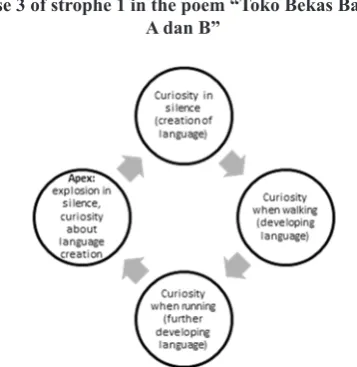
This particular creation of the “language of A and B” begins in verse 3 of strophe 1. This verse indicates that the existence of language, at least according to the poem’s poetic persona, starts with curiosity in relation to the (still unmentioned) nature of A and B: “A little bit curious, slowly, start to walk and getting more curious, and starting to run, become really curious, like another explosion in the silence before: why human creates language between human” (Asri’s translation).
The depiction of language in verse 3 is paralleled by Derrida’s argument, in which he stated that language is “desired” and would continue to be desired. In the poem’s case, said desire takes the form of the need to satisfy a “curiosity”. This is the desire that sparks a cycle of actions that follows, which gradually becomes more animated: “[…] slowly, start to walk and getting more curious, and starting to run, become really curious […]”. Additionally, the poem’s verse is lacking in agency. There is no clear mention of any particular character(s) who perform(s) the actions. This lack of agency indicates that the ones who are curious might be A and B themselves, considering the preceding verse ends with their mention. Because of this, A and B will be treated as pivotal elements in this cyclical action.
A and B’s movement becomes more “animated” as their curiosity rises. They start from a stationary position, then they start to “slowly walk”, and then they “run”. The apex of this development, both in curiosity and motion, is the “explosion in the silence before”. The explosion is followed by a colon (“:”), which implies that the explosion produces or leaves the following question/statement of why humans
create language in the irst place.
language, actually describes the creation of language itself. It is especially apparent in the mention of “like another explosion in the silence before”. This is where the cyclicity comes into play. The word “before”
signiies that there was another explosion happening
prior to the cycle that is currently occurring. This preceding “explosion” may actually be part of a never-ending creation loop: what comes after creates what came before it. This is a great example of the never-ending cycle of language creation, in which the created becomes the creator. Putting it in the form of a diagram, the cyclical process in verse 3 strophe of 1 can be depicted as in Figure 1.
Figure 1.
The cyclical process of language A and B creation in verse 3 of strophe 1 in the poem “Toko Bekas Bahasa
A dan B”
As the poem suggests and as the diagram shows, A and B are the creators of language A and B. If A and B are also the names of the languages depicted in the poem, then it means that they are the second-hand form of the “curiosity” that creates themselves. When they express their curiosity about the creation
of language, they inevitably return to the irst circle in
which their curiosity incites the creation of language
in the irst place. Therefore verse 3 is another example
of a “whole” cycle, where the starting point loops back to itself. A language produced by A and B returns to its creators to be reborn into another form of language.
The kind of cyclical process of language depicted in Figure 1 might be seen as a clear example of Lacan’s argument. From a psychoanalytic point of view, Lacan argues about the function of language
and speech. For Lacan (2006), the act of producing
language/speech always loops back to itself.
Speciically, for him, “true speech already contains its own response” (Lacan, 2006: 310). He points out that
the cyclical phenomenon of speech occurs beyond the general schematization of communication theories, i.e. “sender, receiver, and something that takes place in between”, if the one who speaks to communicate hears the sound of their own words. Thus, the sender will always also be the receiver, looping back to themself; while the response loops back to the speech (Lacan 1993). For Lacan, speech is a “gift” that “implies a whole cycle of exchange” (Lacan, 1994; Moore, 2011).
Lacan’s argument interprets the exchange value of the cyclicity of speech in terms of the transfer from
“irst-hand” (speech) to “second-hand” (the response
originated from the speech). In other words, the response of the speech is the second-hand form of the speech itself. This cycle is what occurs to A and B’s question about language creation: the response is wrapped inside the question. It is the economy of creation where one cannot exist without the other.
CONCLUSION
The poem “Toko Bekas Bahasa A dan B” and its non-normative English translation suggest that the quality second-hand-ness evokes a cyclical economy where
what is second-hand naturally used to be irst-hand and
will eventually return to being second-hand as long as the cycle of the item’s transference persists. Based on this notion, I arrive at the conclusion that such a perpetual cycle is recurring both in the poem’s use of language and in its relationship with its translation.
In analyzing the co-relation between the original poem and its translation, both in content
and in delivery, I ind two striking cyclicities: one,
cyclicity of “language and problem”; and two, cyclicity of “language creation”. Translation will inevitably incur a never-ending cycle of renewal that loops back to itself. This is due to how every time a work is translated into another language, there might be elements that are lost, and in turn other elements that are gained. This will be an enrichment of the original work, ensuring its longevity. However, with this perpetual rejuvenation comes the eternal dilemma of “the chicken and egg” in the topic of “language” and “problem”. This dilemma is especially apparent from the dissimilarities between the Indonesian version and its English translation.
Meanwhile, the content of the poem itself
ofers its rendition of the birth of language in a
language discussed in the poem. I propose that the language of A and B in Malna’s poem incites its own birth, thus exhibiting an example of a cycle of never-ending creation. This leads to a conclusion that the cyclicity of language birth depicted in Malna’s poem is a “perfect” cycle akin to Lacan’s speech theory that a “perfect” speech already contains its own response. In other words, its ending is wrapped up in its beginning—which, as Blanchot might say, thoroughly speaks of poetry itself.
ACKNOWLEDGEMENT
I would like to thank my academic supervisor, Professor Lisa Samuels of the University of Auckland, for her helpful commentaries about poetic cyclicities.
REFERENCES
Afan, H. (2016, 24 September). “Afrizal Malna,
Politik Sastra dan Puisi Gelap.” Retrieved f r o m h t t p : / / w w w. b b c . c o m / i n d o n e s i a /
majalah/2016/09/160825_majalah_bincang_
afrizalmalna.
Baker, M., Francis, G., & Tognini-Bonelli, E. (1993). Corpus Linguistics and Translation Studies Implications and Applications. Text and Technology: In Honour of John Sinclair (pp.
233). John Benjamins Publishing.
Becker, A. L. (2000). Beyond Translation: Essays Toward a Modern Philology. University of Michigan Press.
Benjamin, W. (1968). Illuminations: Essays and Relections, ed. Hannah Arendt, trans. Harry
Zohn. New York: Schocken Books, 2007, 217–
251.
Benjamin, W. (1978). Relections: Essays, Aphorisms, Autobiographical Writings (E. Jephcott Trans.).
New York: Schocken Books.
Blanchot, M. (1989). The Space of Literature (A. Smock Trans.). Lincoln, London: University of Nebraska Press.
Cyclicity. 2012. In Merriam-Webster.com. Retrieved
20 February 2017, from
https://www.merriam-webster.com/dictionary/cyclicity.
Derrida, J. (2005). Language is Never Owned: An
Interview. In T. Dutoit, & O. Pasanen (Eds.),
Sovereignty in Question: The Poetics of Paul Celan (pp. 101). New York: Fordham University Press.
Fuller, A. (2013, Autum). “Afrizal Malna: Techniques of Writing and Bodily Encounters with Urban Space”. The Newsletter, 9.
Gutt, E. (2014). Translation and relevance: Cognition and Context. London: Routledge.
Lacan, J. (1993). In Alain-Miller J. (Ed.), The Psychoses: The Seminar of Jacques Lacan, Book III 1955–
1956 (R. Grigg Trans.). London: Routledge.
Lacan, J. (1994). Le Séminaire, Livre IV, La Relation d’Objet. Paris: Seuil, p. 157.
Lacan, J. (2006). Écrits: The First Complete Edition in English, translated by Bruce Fink in Collaboration with Héloïse Fink and Russell Grigg.
Malna, A. (2013). Afrizal Malna Poems translated by Gracia Asri and Sartika Dian Nuraini. Retrieved
from http://www.kritya.in/0907/en/name_of_
poetry.html.
Malna, A. (2013). Museum Penghancur Dokumen. Yogyakarta: Garudhawaca.
Malna, A. (2013). Poetry and an Epidemic of History: A Letter from the Author to the Translator. Anxiety Myths (A. Fuller Trans.). (pp. 99–100, 102, 107).
Jakarta: The Lontar Foundation.
McMyler, B. (2011). Testimony, Trust, and Authority.
OUP USA.
Moore, G. (2011). Politics of the Gift: Exchanges in Poststructuralism. Edinburgh University Press.
Rasula, J., & McCafery, S. (2001). Imagining Language: An Anthology. MIT Press.
Rose, M. G. (1991). Seeking Synapses: Translators Describe Translating. In M. L. Larson (Ed.),
Translation: Theory and Practice, Tension and Interdependence (pp. 5–9). John Benjamins
Publishing.
Setiadi, T. (2010). Benda-Benda, Bahasa, dan Kala: Mencari Simetri Tersembunyi dalam Teman-temanku dari Atap Bahasa Karya Afrizal Malna.
Dari Zaman Citra ke Metaiksi: Bunga Rampai Telaah Sastra DKJ (pp. 134–146). Jakarta,
Indonesia: Kepustakaan Populer Gramedia. Smith, K. (2002). Translation as Secondary
Communication. The Relevance Theory Perspective of Ernst-August Gutt. Acta Theologica, 22(1), pp. 107–117.
Steiner, G. (2010). Language and Silence: Essays 1958–
1966. London: Faber & Faber.
Wee, L. (2002). When English is Not A Mother Tongue: Linguistic Ownership and the Eurasian Community in Singapore. Journal of Multilingual and Multicultural Development, 23 (4), pp. 282–