AUERBACH PUBLICATIONS
www.auerbach-publications.com
To Order Call: 1-800-272-7737 • Fax: 1-800-374-3401 E-mail: [email protected]
Asset Protection and Security Management Handbook
POA Publishing ISBN: 0-8493-1603-0
Building a Global Information Assurance Program
Raymond J. Curts and Douglas E. Campbell ISBN: 0-8493-1368-6
Building an Information Security Awareness Program
Cyber Crime Investigator's Field Guide Bruce Middleton
ISBN: 0-8493-1192-6
Cyber Forensics: A Field Manual for Collecting, Examining, and Preserving Evidence of Computer Crimes
Albert J. Marcella, Jr. and Robert S. Greenfield ISBN: 0-8493-0955-7
The Ethical Hack: A Framework for Business Value Penetration Testing
James S. Tiller ISBN: 0-8493-1609-X
The Hacker's Handbook: The Strategy Behind Breaking into and Defending Networks Susan Young and Dave Aitel
ISBN: 0-8493-0888-7
Information Security Architecture: An Integrated Approach to Security in the Organization
Harold F. Tipton and Micki Krause ISBN: 0-8493-1997-8
Information Security Policies, Procedures, and Standards: Guidelines for Effective Information Security Management
Information Technology Control and Audit Fredrick Gallegos, Daniel Manson,
Managing a Network Vulnerability Assessment Thomas Peltier, Justin Peltier, and John A. Blackley ISBN: 0-8493-1270-1
Network Perimeter Security: Building Defense In-Depth
Cliff Riggs
ISBN: 0-8493-1628-6
The Practical Guide to HIPAA Privacy and Security Compliance
Kevin Beaver and Rebecca Herold ISBN: 0-8493-1953-6
A Practical Guide to Security Engineering and Information Assurance
Debra S. Herrmann ISBN: 0-8493-1163-2
The Privacy Papers: Managing Technology, Consumer, Employee and Legislative Actions Rebecca Herold
ISBN: 0-8493-1248-5
Public Key Infrastructure: Building Trusted Applications and Web Services
John R. Vacca ISBN: 0-8493-0822-4
Securing and Controlling Cisco Routers Peter T. Davis
ISBN: 0-8493-1290-6
Strategic Information Security John Wylder
ISBN: 0-8493-2041-0
Surviving Security: How to Integrate People, Process, and Technology, Second Edition Amanda Andress
ISBN: 0-8493-2042-9
A Technical Guide to IPSec Virtual Private Networks
James S. Tiller ISBN: 0-8493-0876-3
Using the Common Criteria for IT Security Evaluation
Debra S. Herrmann ISBN: 0-8493-1404-6
AUERBACH PUBLICATIONS
A CRC Press Company
Boca Raton London New York Washington, D.C.
Information Security
FUNDAMENTALS
This book contains information obtained from authentic and highly regarded sources. Reprinted material is quoted with permission, and sources are indicated. A wide variety of references are listed. Reasonable efforts have been made to publish reliable data and information, but the author and the publisher cannot assume responsibility for the validity of all materials or for the consequences of their use.
Neither this book nor any part may be reproduced or transmitted in any form or by any means, electronic or mechanical, including photocopying, microfilming, and recording, or by any information storage or retrieval system, without prior permission in writing from the publisher.
The consent of CRC Press does not extend to copying for general distribution, for promotion, for creating new works, or for resale. Specific permission must be obtained in writing from CRC Press LLC for such copying.
Direct all inquiries to CRC Press, 2000 N.W. Corporate Blvd., Boca Raton, Florida 33431.
Trademark Notice: Product or corporate names may be trademarks or registered trademarks, and are used only for identification and explanation, without intent to infringe.
Visit the CRC Press Web site at www.crcpress.com
© 2005 by CRC Press LLC Auerbach is an imprint of CRC Press LLC
No claim to original U.S. Government works International Standard Book Number 0-8493-1957-9
Library of Congress Card Number 2004051024 Printed in the United States of America 1 2 3 4 5 6 7 8 9 0
Printed on acid-free paper
Library of Congress Cataloging-in-Publication Data
Peltier, Thomas R.
Information security fundamentals / Thomas R. Peltier, Justin Peltier, John Blackley. p. cm.
Includes bibliographical references and index. ISBN 0-8493-1957-9 (alk. paper)
1. Computer security. 2. Data protection. I. Peltier, Justin. II. Blackley, John A. III. Title.
QA76.9.A25P427 2004
Dedication
Contents
Acknowledgments Introduction
Chapter 1
Overview1.1 Elements of Information Protection 1.2 More Than Just Computer Security
1.2.1 Employee Mind-Set toward Controls 1.3 Roles and Responsibilities
1.3.1 Director, Design and Strategy 1.4 Common Threats
1.5 Policies and Procedures 1.6 Risk Management
1.7 Typical Information Protection Program 1.8 Summary
Chapter 2
Threats to Information Security 2.1 What Is Information Security?2.2 Common Threats
2.2.1 Errors and Omissions 2.2.2 Fraud and Theft 2.2.3 Malicious Hackers 2.2.4 Malicious Code
2.2.5 Denial-of-Service Attacks 2.2.6 Social Engineering
2.2.7 Common Types of Social Engineering 2.3 Summary
Chapter 3
The Structure of an Information Security Program3.1 Overview
3.2 Business Unit Responsibilities
3.2.1 Creation and Implementation of Policies and Standards 3.2.2 Compliance with Policies and Standards
3.3 Information Security Awareness Program 3.3.1 Frequency
3.3.2 Media
3.4 Information Security Program Infrastructure 3.4.1 Information Security Steering Committee
3.4.2 Assignment of Information Security Responsibilities 3.4.2.1 Senior Management
3.4.2.2 Information Security Management 3.4.2.3 Business Unit Managers
3.4.2.4 First Line Supervisors 3.4.2.5 Employees
3.4.2.6 Third Parties 3.5 Summary
Chapter 4
Information Security Policies 4.1 Policy Is the Cornerstone4.2 Why Implement an Information Security Policy 4.3 Corporate Policies
4.4 Organizationwide (Tier 1) Policies 4.4.1 Employment
4.4.2 Standards of Conduct 4.4.3 Conflict of Interest 4.4.4 Performance Management 4.4.5 Employee Discipline 4.4.6 Information Security 4.4.7 Corporate Communications 4.4.8 Workplace Security
4.4.9 Business Continuity Plans (BCPs) 4.4.10 Procurement and Contracts 4.4.11 Records Management 4.4.12 Asset Classification
4.5 Organizationwide Policy Document 4.6 Legal Requirements
4.6.1 Duty of Loyalty 4.6.2 Duty of Care
4.6.3 Federal Sentencing Guidelines for Criminal Convictions 4.6.4 The Economic Espionage Act of 1996
4.6.5 The Foreign Corrupt Practices Act (FCPA) 4.6.5 Sarbanes–Oxley (SOX) Act
4.6.6 Health Insurance Portability and Accountability Act (HIPAA)
4.8 Definitions 4.8.1 Policy 4.8.2 Standards 4.8.3 Procedures 4.8.4 Guidelines 4.9 Policy Key Elements 4.10 Policy Format
4.10.1 Global (Tier 1) Policy 4.10.1.1 Topic 4.10.1.2 Scope
4.10.1.3 Responsibilities
4.10.1.4 Compliance or Consequences
4.10.1.5 Sample Information Security Global Policies 4.10.2 Topic-Specific (Tier 2) Policy
4.10.2.1 Thesis Statement 4.10.2.2 Relevance 4.10.2.3 Responsibilities 4.10.2.4 Compliance
4.10.2.5 Supplementary Information 4.10.3 Application-Specific (Tier 3) Policy 4.11 Summary
Chapter 5
Asset Classification 5.1 Introduction5.2 Overview
5.3 Why Classify Information?
5.4 What Is Information Classification? 5.5 Where to Begin?
5.6 Information Classification Category Examples 5.6.1 Example 1
5.6.2 Example 2 5.6.3 Example 3 5.6.4 Example 4
5.7 Resist the Urge to Add Categories 5.8 What Constitutes Confidential Information
5.8.1 Copyright
5.9 Employee Responsibilities 5.9.1 Owner
5.9.1.1 Information Owner 5.9.2 Custodian
5.9.3 User
5.10 Classification Examples
5.11 Declassification or Reclassification of Information 5.12 Records Management Policy
5.12.1 Sample Records Management Policy 5.13 Information Handling Standards Matrix
5.13.1 Printed Material
5.13.2 Electronically Stored Information 5.13.3 Electronically Transmitted Information 5.13.4 Record Management Retention Schedule 5.14 Information Classification Methodology
5.15 Authorization for Access 5.15.1 Owner
5.15.2 Custodian 5.15.3 User 5.16 Summary
Chapter 6
Access Control6.1 Business Requirements for Access Control 6.1.1 Access Control Policy
6.2 User Access Management 6.2.1 Account Authorization 6.2.2 Access Privilege Management 6.2.3 Account Authentication Management 6.3 System and Network Access Control
6.3.1 Network Access and Security Components 6.3.2 System Standards
6.3.3 Remote Access
6.4 Operating System Access Controls 6.4.1 Operating Systems Standards 6.4.2 Change Control Management 6.5 Monitoring System Access
6.5.1 Event Logging 6.5.2 Monitoring Standards 6.5.3 Intrusion Detection Systems 6.6 Cryptography
6.6.1 Definitions
6.6.2 Public Key and Private Key
6.6.3 Block Mode, Cipher Block, and Stream Ciphers 6.6.4 Cryptanalysis
6.7 Sample Access Control Policy 6.8 Summary
7.2.1 Assets to be Protected 7.2.2 Potential Threats 7.2.3 Attitude toward Risk 7.2.4 Sample Controls 7.3 Fire Prevention and Detection
7.3.1 Fire Prevention 7.3.2 Fire Detection 7.3.3 Fire Fighting
7.4 Verified Disposal of Documents 7.4.1 Collection of Documents 7.4.2 Document Destruction Options 7.4.3 Choosing Services
7.5 Agreements
7.5.1 Duress Alarms 7.6 Intrusion Detection Systems
7.6.1 Purpose 7.6.2 Planning 7.6.3 Elements 7.6.4 Procedures
7.7 Sample Physical Security Policy 7.8 Summary
Chapter 8
Risk Analysis and Risk Management 8.1 Introduction8.2 Frequently Asked Questions on Risk Analysis 8.2.1 Why Conduct a Risk Analysis? 8.2.2 When to Conduct a Risk Analysis? 8.2.3 Who Should Conduct the Risk Analysis? 8.2.4 How Long Should a Risk Analysis Take? 8.2.5 What a Risk Analysis Analyzes
8.2.6 What Can the Results of a Risk Analysis Tell an Organization?
8.2.7 Who Should Review the Results of a Risk Analysis? 8.2.8 How Is the Success of the Risk Analysis Measured? 8.3 Information Security Life Cycle
8.4 Risk Analysis Process 8.4.1 Asset Definition 8.4.2 Threat Identification
8.4.3 Determine Probability of Occurrence 8.4.4 Determine the Impact of the Threat 8.4.5 Controls Recommended
8.7 Cost/Benefit Analysis 8.8 Summary
Chapter 9
Business Continuity Planning 9.1 Overview9.2 Business Continuity Planning Policy 9.2.1 Policy Statement
9.2.2 Scope
9.2.3 Responsibilities 9.2.4 Compliance
9.3 Conducting a Business Impact Analysis (BIA) 9.3.1 Identify Sponsor(s)
9.3.2 Scope
9.3.3 Information Meeting 9.3.4 Information Gathering 9.3.5 Questionnaire Design 9.3.6 Scheduling the Interviews 9.3.7 Conducting Interviews 9.3.8 Tabulating the Information 9.3.9 Presenting the Results 9.4 Preventive Controls
9.5 Recovery Strategies
9.5.1 Hot Site, Cold Site, Warm Site, Mobile Site 9.5.2 Key Considerations
9.5.2.1 People
9.5.2.2 Communications 9.5.2.3 Computing Equipment 9.5.2.4 Facilities
9.6. Plan Construction, Testing, and Maintenance 9.6.1 Plan Construction
9.6.1.1 Crisis Management Plan 9.6.1.2 Plan Distribution 9.6.2 Plan Testing
9.6.2.1 Line Testing
9.6.2.2 Walk-through Testing 9.6.2.3 Single Process Testing 9.6.2.4 Full Testing
9.6.2.5 Plan Testing Summary 9.6.3 Plan Maintenance
9.7 Sample Business Continuity Plan Policy 9.8 Summary
Glossary
Acknowledgments
An organization that has moved to the forefront of creating usable infor-mation for the inforinfor-mation security professional is the National Institute of Standards and Technology (NIST). The NIST 800 Series of Special Publications is a great source of information that many security profes-sionals have provided over the years. Joan Hash and the other dedicated people who work at NIST have added greatly to the profession.
The Computer Security Institute (CSI) has been the leader in the information security industry since 1974 and continues to provide leader-ship and direction for its members and the industry as a whole. John O’Leary has been the constant in all the changes seen in this industry. The new CSI management team of Julie Hogan, Chris Keating, and Jennifer Stevens continues to provide the tools and classes that the security professional needs to be successful. The new team has blended well with the CSI seasoned veterans of Pam Salaway, Kimber Heald, Frederic Martin, Nancy Baer, and Joanna Kaufman.
No one has all of the answers to any question, so the really “smart” person cultivates good friends. Having been in the information security business for nearly 30 years, I have had the great good fortune of having a number of such friends and fellow professionals. This group of long-time sources of great information include Mike Corby, Terri Curran, Peter Stephenson, Merrill Lynch, Bob Cartwright, Pat Howard, Cheryl and Carl Jackson, Becky Herold, Ray Kaplan, Genny Burns, Anne Terwilliger, Patrice Rapalus, David Lynas, John Sherwood, Herve Schmidt, Antonio and Pietro Ruvolo, Wayne Sumida, Caroline Hamilton, Dan Erwin, Lisa Bryson, and William H. Murray.
nearly 150,000 air miles together, and each day we learn something new from each other.
The other working buddy is John Blackley, a strange Scotsman who makes our life more fun and interesting. I have worked with John since 1985 and have marveled at how well he takes obtuse concepts and condenses them so that even management types understand.
Who can leave out their publisher? Certainly not me; Rich O’Hanley has taken the time to discuss security issues with numerous organizations to understand what their needs are and then presented these findings to us. A great deal of our work here is a direct result of what Rich discovered the industry wanted. Rich O’Hanley, not only the world’s best editor and task master, but a good friend and source of knowledge. Thanks Rich!
Introduction
The purpose of information security is to protect an organization’s valuable resources, such as information, computer hardware, and software. Through the selection and application of appropriate safeguards, security helps the organization’s mission by protecting its physical and financial resources, reputation, legal position, employees, and other tangible and intangible assets. To many, security is sometimes viewed as thwarting the business objectives of the organization by imposing poorly selected, bothersome rules and procedures on users, managers, and systems. Well-chosen secu-rity rules and procedures do not exist for their own sake — they are put in place to protect important assets and thereby support the overall business objectives.
Developing an information security program that adheres to the prin-ciple of security as a business enabler is the first step in an enterprise’s effort to build an effective security program. Organizations must continually (1) explore and assess information security risks to business operations; (2) determine what policies, standards, and controls are worth implement-ing to reduce these risks; (3) promote awareness and understandimplement-ing among the staff; and (4) assess compliance and control effectiveness. As with other types of internal controls, this is a cycle of activity, not an exercise with a defined beginning and end.
Chapter 1
Overview
The purpose of information protection is to protect an organization’s valuable resources, such as information, hardware, and software. Through the selection and application of appropriate safeguards, security helps the organization meet its business objectives or mission by protecting its physical and financial resources, reputation, legal position, employees, and other tangible and intangible assets. We will examine the elements of computer security, employee roles and responsibilities, and common threats. We will also examine the need for management controls, policies and procedures, and risk analysis. Finally, we will present a comprehensive list of tasks, responsibilities, and objectives that make up a typical infor-mation protection program.
1.1 Elements of Information Protection
Information protection should be based on eight major elements:
1. Information protection should support the business objectives or mission of the enterprise. This idea cannot be stressed enough. All too often, information security personnel lose track of their goals and responsibilities. The position of ISSO (Information Systems Security Officer) has been created to support the enterprise, not the other way around.
loyalty — this means that whatever decisions they make must be made in the best interest of the enterprise. They are also charged with a duty of care — this means that senior management is required to protect the assets of the enterprise and make informed business decisions. An effective information protection program will assist senior management in meeting these duties.
3. Information protection must be cost effective. Implementing con-trols based on edicts is counter to the business climate. Before any control can be proposed, it will be necessary to confirm that a significant risk exists. Implementing a timely risk analysis process can complete this. By identifying risks and then proposing appro-priate controls, the mission and business objectives of the enterprise will be better met.
4. Information protection responsibilities and accountabilities should be made explicit. For any program to be effective, it will be necessary to publish an information protection policy statement and a group mission statement. The policy should identify the roles and responsibilities of all employees. To be completely effective, the language of the policy must be incorporated into the purchase agreements for all contract personnel and consultants.
5. System owners have information protection responsibilities outside their own organization. Access to information will often extend beyond the business unit or even the enterprise. It is the respon-sibility of the information owner (normally the senior level manager in the business that created the information or is the primary user of the information). One of the main responsibilities is to monitor usage to ensure that it complies with the level of authorization granted to the user.
6. Information protection requires a comprehensive and integrated approach. To be as effective as possible, it will be necessary for information protection issues to be part of the system development life cycle. During the initial or analysis phase, information protec-tion should receive as its deliverables a risk analysis, a business impact analysis, and an information classification document. Addi-tionally, because information is resident in all departments through-out the enterprise, each business unit should establish an individual responsible for implementing an information protection program to meet the specific business needs of the department.
and changing process and therefore must be reassessed at least every 18 months.
8. Information protection is constrained by the culture of the organi-zation. The ISSO must understand that the basic information pro-tection program will be implemented throughout the enterprise. However, each business unit must be given the latitude to make modifications to meet its specific needs. If your organization is multinational, it will be necessary to make adjustments for each of the various countries. These adjustments will have to be exam-ined throughout the United States. What might work in Des Moines, Iowa, may not fly in Berkeley, California. Provide for the ability to find and implement alternatives.
Information protection is a means to an end and not the end in itself. In business, having an effective information protection program is usually secondary to the need to make a profit. In the public sector, information protection is secondary to the agency’s services provided to its constancy. We, as security professionals, must not lose sight of these goals and objectives. Computer systems and the information processed on them are often considered critical assets that support the mission of an organization. Protecting them can be as important as protecting other organizational resources such as financial resources, physical assets, and employees. The cost and benefits of information protection should be carefully examined in both monetary and nonmonetary terms to ensure that the cost of controls does not exceed the expected benefits. Information protection controls should be appropriate and proportionate.
The responsibilities and accountabilities of the information owners, providers, and users of computer services and other parties concerned with the protection of information and computer assets should be explicit. If a system has external users, its owners have a responsibility to share appropriate knowledge about the existence and general extent of control measures so that other users can be confident that the system is adequately secure. As we expand the user base to include suppliers, vendors, clients, customers, shareholders, and the like, it is incumbent upon the enterprise to have clear and identifiable controls. For many organizations, the initial sign-on screen is the first indication that there are controls in place. The message screen should include three basic elements:
1. The system is for authorized users only 2. That activities are monitored
1.2 More Than Just Computer Security
Providing effective information protection requires a comprehensive approach that considers a variety of areas both within and outside the information technology area. An information protection program is more than establishing controls for the computer-held data. In 1965 the idea of the “paperless office” was first introduced. The advent of third-generation computers brought about this concept. However, today the bulk of all of the information available to employees and others is still found in printed form. To be an effective program, information protection must move beyond the narrow scope of IT and address the issues of enterprisewide information protection. A comprehensive program must touch every stage of the information asset life cycle from creation to eventual destruction.
1.2.1
Employee Mind-Set toward Controls
Access to information and the environments that process them are dynamic. Technology and users, data and information in the systems, risks associated with the system, and security requirements are ever changing. The ability of information protection to support business objectives or the mission of the enterprise may be limited by various factors, such as the current mind-set toward controls.
A highly effective method of measuring the current attitude toward information protection is to conduct a “walk-about.” After hours or on a weekend, conduct a review of the workstations throughout a specific area (usually a department or a floor) and look for just five basic control activities:
1. Offices secured
2. Desk and cabinets secured 3. Workstations secured 4. Information secured 5. Diskettes secured
When conducting an initial “walk-about,” the typical office environment will have a 90 to 95 percent noncompliance rate with at least one of these basic control mechanisms. The result of this review should be used to form the basis for an initial risk analysis to determine the security require-ments for the workstation. When conducting such a review, employee privacy issues must be remembered.
1.3 Roles and Responsibilities
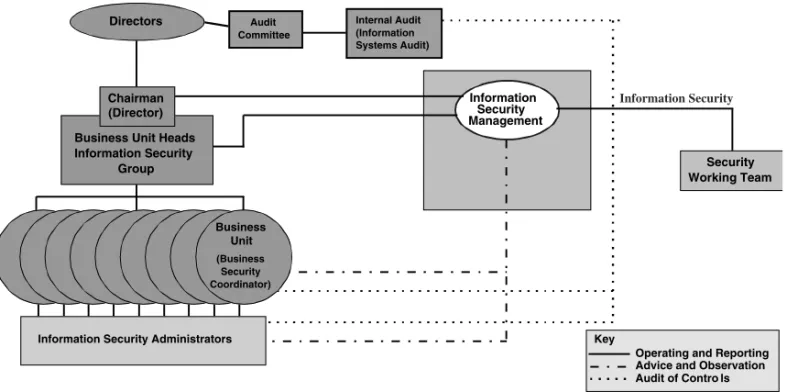
is the establishment of the function of Corporate Information Officer (CIO). The CIO directs the organization’s day-to-day management of information assets. The ISSO and Security Administrator should report directly to the CIO and are responsible for the day-to-day administration of the informa-tion protecinforma-tion program.
Supporting roles are performed by the service providers and include Systems Operations, whose personnel design and operate the computer systems. They are responsible for implementing technical security on the systems. Telecommunications is responsible for providing communication services, including voice, data, video, and fax.
The information protection professional must also establish strong work-ing relationships with the audit staff. If the only time you see the audit staff is when they are in for a formal audit, then you probably do not have a good working relationship. It is vitally important that this liaison be estab-lished and that you meet to discuss common problems at least each quarter. Other groups include the physical security staff and the contingency planning group. These groups are responsible for establishing and imple-menting controls and can form a peer group to review and discuss controls. The group responsible for application development methodology will assist in the implementation of information protection requirements in the application system development life cycle. Quality Assurance can assist in ensuring that information protection requirements are included in all development projects prior to movement to production.
The Procurement group can work to get the language of the informa-tion protecinforma-tion policies included in the purchase agreements for contract personnel. Education and Training can assist in developing and conducting information protection awareness programs and in training supervisors in the responsibility to monitor employee activities. Human Resources will be the organization responsible for taking appropriate action for any violations of the organization’s information protection policy.
An example of a typical job description for an information security professional is as follows:
1.3.1
Director, Design and Strategy
Location: Anywhere, World
Practice Area: Corporate Global Security Practice
Grade:
Purpose: To create an information security design and
needed to address the security needs of its clients. The information security design and strategy will comple-ment security and network services developed by the other Global Practice areas. The design and strategy practice will support the clients’ information technology and architecture and integrate with each enterprise’s business architecture. This security framework will pro-vide for the secure operation of computing platforms, operating systems, and networks, both voice and data, to ensure the integrity of the clients’ information assets. To work on corporate initiatives to develop and imple-ment the highest quality security services and ensure that industry best practices are followed in their imple-mentation.
Working Relationships: This position reports in the Global Security Practice to the Vice President, Global Security. Internal contacts are primarily Executive Management, Practice Directors, Regional Management, as well as mentoring and collaborating with consultants. This posi-tion will directly manage two professional posiposi-tions: Manager, Service Provider Security Integration; and Service Provider Security Specialist. Frequent external contacts include building relationships with clients, professional information security organizations, other information security consultants; vendors of hardware, software, and security services; and various regulatory and legal authorities.
Principle Duties and Responsibilities: The responsibilities of the Director, Design and Strategy include, but are not limited to, the following:
䡲 Develop global information security services that will provide the security functionality required to protect clients’ information assets against unauthorized disclo-sure, modification, and destruction. Particular focus ar-eas include:
䡲 Virtual private networks
– Data privacy – Virus prevention
䡲 Develop information security strategy services that can
adapt to clients’ diverse and changing technological needs.
䡲 Work with Network and Security practice leaders and
consultants; create sample architectures that communi-cate the security requirements that will meet the needs of all client network implementations.
䡲 Work with practice teams to aid them from the
concep-tion phase to the deployment of the project soluconcep-tion. This includes a quality assurance review to ensure that the details of the project are correctly implemented according to the service delivery methodology.
䡲 Work with the clients to collect their business
require-ments for electronic commerce, while educating them on the threats, vulnerabilities, and available risk miti-gation strategies.
䡲 Determine where and how you should use
cryptogra-phy to provide public key infrastructure and secure messaging services for clients.
䡲 Participate in security industry standards bodies to
en-sure that strategic information security needs will be addressed.
䡲 Conduct security focus groups with the clients to cultivate an effective exchange of business plans, product devel-opment, and marketing direction to aid in creating new and innovative service offerings to meet client needs.
䡲 Continually evaluate vendors’ product strategies and future product statements, and advise which will be most appropriate to pursue for alliances, especially in the areas of:
– Virtual private networks – Data privacy
– Virus prevention
– Secure application architecture – Service provider security solutions
䡲 Provide direction and oversight of hardware- and
soft-ware-based cryptography service development efforts.
efficiency, compliance with industry standards, and effectiveness of the client network designs and strate-gies that are implemented through the company’s pro-fessional service offerings. Exercise propro-fessional judgment in making recommendations that may impact business operations.
Knowledge and Skills:
䡲 10 Percent Managerial and Practice Management:
– Ability to supervise a multidisciplinary team and a small staff; must handle multiple tasks simultaneously; ability to team with other Practice Directors and Managers to develop strategic service offerings
– Willingness to manage or to personally execute necessary tasks, as resources are required
– Excellent oral, written, and presentation skills
䡲 40 Percent Technical:
– In-depth technical knowledge of information processing platforms, operating systems, and networks in a global dis-tributed environment
– Ability to identify and apply security techniques to develop services to reduce clients’ risk in such an environment – Technical experience in industrial security, computer
sys-tems architecture, design, and development, physical and data security, telecommunications networks, auditing tech-niques, and risk analysis principles
– Excellent visionary skills that focus on scalability, cost effec-tiveness, and implementation ease
䡲 20 Percent Business:
– Knowledge of business information flow in a multinational, multiplatform networked environment
– Solid understanding of corporate dynamics and general busi-ness processes; understanding of multiple industries – Good planning and goal-setting skills
䡲 20 Percent Interpersonal:
– Must possess strong consulting and communication skills – Must have the ability to work with all levels of management
to resolve issues
– Must understand and differentiate between tactical and stra-tegic concepts
– Must be able to weigh business needs with security require-ments
Attributes: Must be mature, self-confident, and perfor-mance oriented. Will clearly demonstrate an ability to lead technological decisions. Will establish credibility with personal dedication, attention to detail, and a hands-on approach. Will have a sense of urgency in establishing security designs and strategies to address new technologies to be deployed addressing clients’ business needs. Will also be capable of developing strong relationships with all levels of management. Other important characteristics include the ability to function independently, holding to the highest levels of personal and professional integrity. Will be an excel-lent communicator and team player.
Specific requirements include:
䡲 Bachelor’s degree (Master’s degree desirable)
䡲 Advanced degree preferred
䡲 Fifteen or more years of information technology
con-sulting or managerial experience, eight of those years spent in information security positions
䡲 CISM or CISSP certification preferred (other appropriate
industry or technology certifications desirable)
Potential Career Path Opportunities: Opportunities for
progression to a VP position within the company.
1.4 Common Threats
Information processing systems are vulnerable to many threats that can inflict various types of damage that can result in significant losses. This damage can range from errors harming database integrity to fires destroy-ing entire complexes. Losses can stem from the actions of supposedly trusted employees defrauding a system, from outside hackers, or from careless data entry. Precision in estimating information protection-related losses is not possible because many losses are never discovered, and others are hidden to avoid unfavorable publicity.
80 percent of the respondents identified employees as a threat or potential threat to information security. Also included in this survey were the competition, contract personnel, public interest groups, suppliers, and foreign governments.
The chief threat to information protection is still errors and omissions. This concern continues to make up 65 percent of all information protection problems. Users, data entry personnel, system operators, programmers, and the like frequently make errors that contribute directly or indirectly to this problem.
Dishonest employees make up another 13 percent of information protection problems. Fraud and theft can be committed by insiders and outsiders, but it more likely to be done by a company’s own employees. In a related area, disgruntled employees make up another 10 percent of the problem. Employees are most familiar with the organization’s infor-mation assets and processing systems, including knowing what actions might cause the most damage, mischief, or sabotage.
Common examples of information protection-related employee sabo-tage include destroying hardware or facilities, planting malicious code (viruses, worms, Trojan horses, etc.) to destroy data or programs, entering data incorrectly, deleting data, altering data, and holding data “hostage.” The loss of the physical facility or the supporting infrastructure (power failures, telecommunications disruptions, water outage and leaks, sewer problems, lack of transportation, fire, flood, civil unrest, strikes, etc.) can lead to serious problems and make up 8 percent of information protection-related problems.
The final area comprises malicious hackers or crackers. These terms refer to those who break into computers without authorization or exceed the level of authorization granted to them. While these problems get the largest amount of press coverage and movies, they only account for five to eight percent of the total picture. They are real and they can cause a great deal of damage. But when attempting to allocate limited information protection resources, it may be better to concentrate efforts in other areas. To be certain, conduct a risk analysis to see what the exposure might be.
1.5 Policies and Procedures
When creating an information protection policy, it is best to understand that information is an asset of the enterprise and is the property of the organization. As such, information reaches beyond the boundaries of IT and is present in all areas of the enterprise. To be effective, an information protection policy must be part of the organization’s asset management program and be enterprisewide.
There are as many forms, styles, and kinds of policy as there are organizations, businesses, agencies, and universities. In addition to the various forms, each organization has a specific culture or mental model on what and how a policy is to look and who should appr ove the document. The key point here is that every organization needs an infor-mation protection policy. According to the 2000 CSI report on Computer Crime, 65 percent of respondents to its survey admitted that they do not have a written policy. The beginning of an information protection program is the implementation of a policy. The program policy creates the organi-zation’s attitude toward information and announces internally and externally that information is an asset and the property of the organization and is to be protected from unauthorized access, modification disclosure, and destruction.
This book leads the policy writer through the key structure elements and then reviews some typical policy contents. Because policies are not enough, this book teaches the reader how to develop standards, proce-dures, and guidelines. Each section provides advice on the structural mechanics of the various documents, as well as actual examples.
1.6 Risk Management
Risk is the possibility of something adverse happening. The process of risk management is to identify those risks, assess the likelihood of their occurrence, and then taking steps to reduce the risk to an acceptable level. All risk analysis processes use the same methodology. Determine the asset to be reviewed. Identify the risk, issues, threats, or vulnerabilities. Assess the probability of the risk occurring and the impact to the asset or the organization should the risk be realized. Then identify controls that would bring the impact to an acceptable level.
The book entitled Information Security Risk Analysis (CRC Press, 2001) discusses effective risk analysis methodologies. It takes the reader through the theory of risk analysis:
3. Prioritize the risks.
4. Identify controls and safeguards.
The book will help the reader understand qualitative risk analysis; it then gives examples of this process. To make certain that the reader gets a well-rounded exposure to risk analysis, the book presents eight different methods, concluding with the Facilitated Risk Analysis Process (FRAP).
The primary function of information protection risk management is the identification of appropriate controls. In every assessment of risk, there will be many areas for which it will not be obvious what kinds of controls are appropriate. The goal of controls is not to have 100 percent security; total security would mean zero productivity. Controls must never lose sight of the business objectives or mission of the enterprise. Whenever there is a contest for supremacy, controls lose and productivity wins. This is not a contest, however. The goal of information protection is to provide a safe and secure environment for management to meet its duty of care. When selecting controls, one must consider many factors, including the organization’s information protection policy. These include the legis-lation and regulegis-lations that govern your enterprise along with safety, reliability, and quality requirements. Remember that every control will require some performance requirements. These performance requirements may be a reduction in user response time; additional requirements before applications are moved into production or additional costs.
When considering controls, the initial implementation cost is only the tip of the “cost iceberg.” The long-term cost for maintenance and moni-toring must be identified. Be sure to examine any and all technical requirements and cultural constraints. If your organization is multinational, control measures that work and are accepted in your home country might not be accepted in other countries.
Accept residual risk; at some point, management will need to decide if the operation of a specific process or system is acceptable, given the risk. There can be any number of reasons that a risk must be accepted; these include but are not limited to the following:
䡲 The type of risk may be different from previous risks.
䡲 The risk may be technical and difficult for a layperson to grasp. 䡲 The current environment may make it difficult to identify the risk.
1.7 Typical Information Protection Program
Over the years, the computer security group responsible for access control and disaster recovery planning has evolved into the enterprisewide infor-mation protection group. This group’s ever-expanding roles and respon-sibilities include:
䡲 Firewall control 䡲 Risk analysis
䡲 Business Impact Analysis (BIA) 䡲 Virus control and virus response team
䡲 Computer Emergency Response Team (CERT) 䡲 Computer crime investigation
䡲 Records management 䡲 Encryption
䡲 E-mail, voice-mail, Internet, video-mail policy 䡲 Enterprisewide information protection program 䡲 Industrial espionage controls
䡲 Contract personnel nondisclosure agreements 䡲 Legal issues
䡲 Internet monitoring 䡲 Disaster planning
䡲 Business continuity planning 䡲 Digital signature
䡲 Secure single sign-on 䡲 Information classification 䡲 Local area networks 䡲 Modem control 䡲 Remote access
䡲 Security awareness programs
In addition to these elements, the security professional now has to ensure that standards, both in the United States and worldwide, are examined and acted upon where appropriate. This book discusses these new stan-dards in detail.
1.8 Summary
Chapter 2
Threats to Information
Security
2.1 What Is Information Security?
Information security is such a wide-ranging topic that it can be rather difficult to define precisely what it is. So when it came time for me to try to define it for the introduction of this chapter, I was stuck for a long period of time. Following the recommendation of my wife, I went to the best place to find definitions for anything — the dictionary. I pulled up the Merriam-Webster dictionary online and came up with these entries:
Main Entry: in⋅for⋅ma⋅tion Pronunciation: “in′f r ma– ′sh n Function: noun
1: the communication or reception of knowledge or intel-ligence
2 a (1): knowledge obtained from investigation, study, or instruction
(2): INTELLIGENCE, NEWS
(3): FACTS, DATA b : the attribute inherent in and communicated by one of two or more alternative sequences or arrangements of something (as nucleotides in DNA or binary digits in a computer
program) that produce specific effects c (1) : a signal or character (as in a communication system or computer) representing data (2) : something (as a message, experimental data, or a picture) which justifies change in a construct (as a plan or theory) that represents physical or mental experience or another construct d : a quantitative measure of the content of information; specifi-cally : a numerical quantity that measures the uncertainty in the outcome of an experiment to be performed
3: the act of informing against a person
4: a formal accusation of a crime made by a prosecuting officer as distinguished from an indictment presented by a grand jury
—in′for⋅ma′tion⋅al, adjective
—in′for⋅ma′tion⋅al⋅ly, adverb
And for security, my result was this:
Main Entry: se⋅cu⋅ri⋅ty Pronunciation: sikyur′i t e– Function: noun
Inflected Form(s): plural-ties
1: the quality or state of being secure: as a : freedom from danger : SAFETY b: freedom from fear or anxiety c: freedom from the prospect of being laid off <job
security>
2a: something given, deposited, or pledged to make certain the fulfillment of an obligation b: SURETY 3: an evidence of debt or of ownership (as a stock certificate or bond)
So even after looking up information security in this dictionary, I still did not have a good way to describe and explain what information security was. Considering that I have worked in information security for almost nine years now, it was a little unsettling to not be able to define, at the most basic level, what I really did. The greatest difficulty in defining information security is, to me, because it is a little bit like trying to define infinity. It just seems far too vast for me to easily comprehend. Currently, information security can cover everything from developing the written policies that an organization will follow to secure its information, to the implementation of a user’s access to a new file on the organization’s server. With such a wide range of potential elements, it often leaves those in information security feeling as if they are a bit of the “Jack of all trades — and master of none.” To give you a better feeling of the true breadth of information security, we will cover some of the more common aspects of information security in brief. All of the facets that we cover in the next few paragraphs are discussed in more detail throughout the remainder of the book.
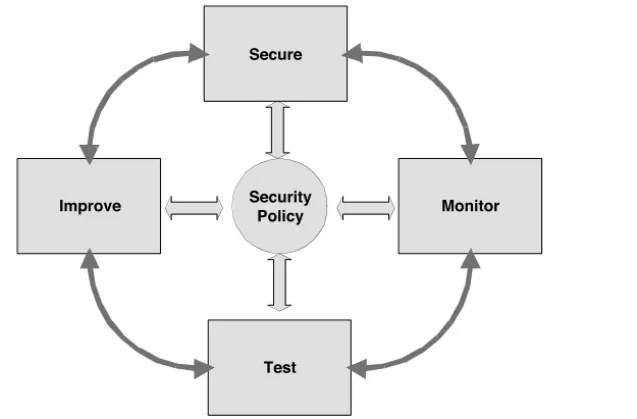
The first and probably most important aspect of information security is the security policy (see Figure 2.1). If information security were a person, the security policy would be the central nervous system. Policies become the core of information security that provides a structure and purpose for all other aspects of information security. To those of you who may be a bit more technical, this may come as a surprise. In the documentation for
FIGURE 2.1 Security Wheel
Security Policy Secure
Test
their Cisco PIX® product, the folks at Cisco® even refer to the security
policy as the center of security. RFC 2196 “Site Security Handbook” defines a security policy as “a formal statement of the rules by which people who are given access to an organization’s technology and information assets must abide.” Because of the central nature of security policies, you cannot discuss information security without mentioning security policies.
Another aspect of information security is organizational security. Orga-nizational security takes the written security policy and develops the framework for implementing the policy throughout the organization. This would include tasks such as getting support from senior management, creating an information security awareness program, reporting to an information steering committee, and advising the business units of their role in the overall security process. The role of information security is still so large that there are many other aspects beyond just the organizational security and security policy.
Yet another aspect of information security is asset classification. Asset classification takes all the resources of an organization and breaks them into groups. This allows for an organization to apply differing levels of security to each of the groups, as opposed to security settings for each individual resource. This process can make security administration easier after it has been implemented, but the implementation can be rather difficult. However, there is still more to information security.
Another phase of information security is personnel security. This can be both fun and taxing at the same time. Personnel security, like physical security, can often be a responsibility of another person and not the sole responsibility of the information security manager. In small organizations, if the word “security” is in your job description, you may be responsible for everything. Personnel security deals with the people who will work in your organization. Some of the tasks that are necessary for personnel security are creating job descriptions, performing background checks, helping in the recruitment process, and user training.
Supposedly, the CEO of a large company stands up in the general session of a hacker conference and announces, “This is a waste of time. My organization is so secure that if anyone here can break into our computers, I’ll eat my hat.”
Someone in the audience decides that the CEO needs to learn a lesson. The attacker decides to break into the organization, not by using the Internet or their telecommunication connection, but instead decides to take a physical approach to the attack. The attacker walks in the front door of the organization, walks to the second floor server room and proceeds to enter. Supposedly, the server room was having HVAC prob-lems, so the door had to be propped open to allow the excess heat out. The attacker walks through the rows of devices in the server room and walks up to each of the cabinets and reads the electronically generated label on each device. When he finds the rack with the device marked “Firewall,” he realizes he has found what he was seeking. The attacker then proceeded to turn off the firewall, disconnect the cables, and remove the firewall from the rack. The attacker followed this by hoisting the firewall up onto his shoulder and walking into the CEO’s office.
When the attacker entered the CEO’s office, he had only one thing to say. He asked, “What kind of sauce would you like with your hat?”
Physical security is much like information security in that it can be immense in its own right. Physical security can encompass everything from closed-circuit television to security lighting and fencing, to badge access and heating, ventilation, and air conditioning (HVAC). One area of physical security that is often the responsibility of the information security manager is backup power. The use of uninterruptible power supplies (UPS) are usually recommended even if your organization has other power backup facilities such as a diesel generator.
However, there is still more to information security. Another area of information security is communication and operations management. This area can often be overlooked in smaller organizations because it is often mistakenly considered “overhead.” Communication and operations man-agement encompass such tasks as ensuring that no one person in an organization has the ability to commit and cover up a crime, making sure that development systems are kept separate from production systems, and making sure that systems that are being disposed of are being disposed in a secure manner. While it is easy to overlook some of these tasks, doing so can create large security holes in an organization.
access to your organization’s systems and also for limiting what access an authorized user does have. Access control can be implemented in many different parts of information systems. Some common places for access control include:
䡲 Routers 䡲 Firewalls
䡲 Desktop operating system 䡲 File server
䡲 Applications
Some organizations create something often referred to as a “candyland.” A “candyland” is where the organization has moved the access to just one or two key points, usually on the perimeter. This is called a “candyland” because the organization has a tough crunchy exterior, followed by a soft gooey center. In any organization, you want access control to be in as many locations as your organization’s support staff can adequately manage. In addition to the previously mentioned components of information security, system development and maintenance is another component that must be considered. In many of the organizations that I have worked for, we never followed either of these principles. One area of system devel-opment and maintenance has been getting a lot of attention lately. Patch management would be a task from the maintenance part of system development and maintenance. This is a task that has many information security professionals referring to themselves as “patch managers.” With such a large number of software updates coming out so frequently for every device on the network, it can be difficult — if not impossible — for support staff to keep everything up-to-date. And all it takes is one missed patch on any Internet-facing system to provide attackers a potential entry point into your organization. In addition to keeping systems up-to-date with patches, system development is another area that should be security-minded. When a custom application is written for your organiza-tion, each component or module of the application must be checked for security holes and proper coding practices. This is often done quickly or not at all, and can often lead to large exposure points for the attacker.
If you are like me, you probably never plan for a hard drive failure until after the first one happens. For me, it actually took many failed hard drives before I became more diligent in performing home backups of my critical files. In a large organization, just having an idea what you would do in the event of a disaster is not enough. A formal plan must be written, tested, and revised regularly. This will ensure that when something much worse than a hard drive dying happens to your organization, everyone will know exactly what to do.
The last aspect of information security discussed here is compliance. Now you may be thinking that compliance is someone else’s job. And you might be telling the truth; but if we go back to our analogy that if information security were a person with security policy being the back-bone and access control being the skin, then compliance would be the immune system. I know that might be a rather odd comparison, but compliance is a component of information security and I like to think of the compliance folks like a partner to the security folks. Many information security professionals spend some time reviewing and testing an informa-tion system for completeness and adequacy, and that is compliance.
So maybe now you see why information security is so difficult to define — it is just huge! With all the phases from policy to telecommu-nications, there is a lot to it. All the phases are equally important, because when it comes to threats to an organization, a breakdown in any of the phases of information security can present a gaping hole to the attacker. This is why the information security professional must have an under-standing of all the aspects of information security.
2.2 Common Threats
Institute (CSI) in San Francisco estimates that between 60 and 80 percent of network misuse comes from inside the enterprise.
In addition to the multiple sources of information security attacks, there are also many types of information security attacks. In Figure 2.2, a well-known model helps illustrate this point. The information security triad shows the three primary goals of information security: integrity, confiden-tiality, and availability. When these three tenets are put together, our information will be well protected.
The first tenet of the information security triad is integrity. Integrity is defined by ISO-17799 as “the action of safeguarding the accuracy and completeness of information and processing methods.” This can be inter-preted to mean that when a user requests any type of information from the system, the information will be correct. A great example of a lack of information integrity is commonly seen in large home improvement ware-houses. One day, I ventured to the local home improvement mega-mart looking for a hose to fix my sprinkler system. I spent quite some time looking for the hose before I happened upon a salesperson. Once I had the salesperson’s attention, I asked about the location and availability of the hoses for which I was looking. The salesperson went to his trusty computer terminal and pulled up information about the hose I needed. The sales-person then let me know that I was in luck and they had 87 of the particular type of hose I needed in stock. So I inquired as to where these hoses could be found in the store and was told that just because the computer listed 87 in the store, this did not mean that there really were any of the hoses. While this example really just ruined my Sunday, the integrity of information can have much more serious implications. Take your credit rating; it is just information that is stored by the credit reporting agencies. If this information is inaccurate, or does not have integrity, it can stop you from getting a new home, a car, or a job. The integrity of this type of information is incredibly important, but is just as susceptible to integrity errors as any other type of electronic information.
FIGURE 2.2 CIA Triad
Availability
The second tenet of the information security triad is confidentiality. Confidentiality is defined by ISO-17799 as “ensuring that information is accessible only to those authorized to have access to it.” This can be one of the most difficult tasks to ever undertake. To attain confidentiality, you have to keep secret information secret. It seems easy enough, but remember the discussion on threat sources above. People from both inside and outside your organization will be threatening to reveal your secret information.
The last tenet of the information security triad is availability. Once again, ISO-17799 defines availability as ensuring that authorized users have access to information and associated assets when required. This means that when a user needs a file or system, the file or system is there to be accessed. This seems simple enough, but there are so many factors working against your system availability. You have hardware failures, natural disas-ters, malicious users, and outside attackers all fighting to remove the availability from your systems. Some common mechanisms to fight against this downtime include fault-tolerant systems, load balancing, and system failover.
Fault-tolerant systems incorporate technology that allows the system to stay available even when a hardware fault has occurred. One of the most common examples of this is RAID. According to the folks over at linux.org, the acronym RAID means redundant array of inexpensive disks. I have heard much debate as to what those letters actually stand for, but for our purposes, let us just use that definition. RAID allows the system to maintain the data on the system even in the event of a hard drive crash. Some of the simplest mechanisms to accomplish this include disk mirroring and disk duplexing. With disk mirroring, the system would have two hard drives attached to the same interface or controller. All data would be written to both drives simultaneously. With disk duplexing, the two hard drives are attached to two different controllers. Duplexing allows for one of the controllers to fail without the system losing any availability of the data. However, the RAID configuration can get significantly more complex than disk mirroring or disk duplexing. One of the more common advanced RAID solutions is RAID level 5. With level 5, RAID data is striped across a series of disks, usually three or more, so that when any one drive is lost, no information is destroyed. The disadvantage with using any of the systems mentioned above is that you lose some of the storage space from the devices. For example, a RAID 5 system with five 80-gigabyte hard drives would only have 320 gigabytes of actual storage. For more information on RAID, see Table 2.1.
a large number of servers or other devices. Usually a front-end component is necessary to direct requests to all of the back-end servers. This also provides tolerance, due to the fact that the front-end processor can just redirect the requests to the remaining servers or devices.
A technology that would lie between load balancing and RAID in terms of most availability would be system failover. With a failover environment, when the primary processing device has a hardware failure, a secondary device begins processing. This is a common technology to use with firewalls. In most organizations, to avoid having the firewall be a single point of failure on the network, the organization implements two firewalls
TABLE 2.1 RAID Chart
RAID Level Activity Name
0 Data striped over several drives. No
redundancy or parity is involved. If one volume fails, the entire volume is unusable. It is used for performance only.
Striping
1 Mirroring of drives. Data is written to two
drives at once. If one drive fails, the other drive has the exact same data available.
Mirroring
2 Data striping over all drives at the bit level. Parity data is created with a hamming code, which identifies any errors. This level specifies the use of up to 39 disks: 32 for storage and 7 for error recovery data. This is not used in production today.
Hamming code parity
3 Data striping over all drives and parity data held on one drive. If a drive fails, it can be reconstructed from parity drive.
Byte-level parity
4 Same as level 3, except data is striped at the block level instead of the byte level.
Block-level parity
5 Data is written in disk sector units to all drives. Parity is written to all drives also, which ensures that there is not a single point of failure.
Interleave parity
6 Similar to level 5 but with added fault
tolerance, which is a second set of parity data written to all drives.
Second parity data (or double parity)
10 Data is simultaneously mirrored and striped
across several drives and can support multiple drive failures.
that communicate with each other. In the event that the primary firewall cannot communicate with the secondary firewall, the secondary firewall takes over and begins processing the data.
As discussed, the job of the information security manager is difficult. There are many tasks that must be done to adequately protect the resources of an organization, and one slip along any of them can lead to a system breach. This is why the task of defending information systems is rather difficult. In the next section we look at other ways that your systems can be attacked.
2.2.1
Errors and Omissions
While error and omissions do not get the headlines of international hackers and the latest work propagating through the e-mail system, it is still the number-one threat to our systems. Because we cannot deny access to all of the user community, it becomes difficult to protect our systems from the people who need to use it day in and day out. Errors and omissions attack the integrity component of the CIA triad. To help fight these mistakes, we can use some of the following security concepts.
The first security concept that will help fight error and omissions is “least privilege.” If we give our users only the most minimal set of permissions they need to perform their job functions, then we reduce the amount of information that can be accidentally contaminated. Using least privilege can create additional overhead on the support staff members who are tasked with applying the access controls to the user community. However, it will be worth the additional changes to keep the integrity of our information systems.
Another principle that can help is performing adequate and frequent backups of the information on the systems. When the user causes loss of the integrity of the information resident on the system, it may be easiest to restore the information from a tape backup made the night before. Tape backups are one of the essential tools of the information security manager and can often be the only recourse against a successful attack.
2.2.2
Fraud and Theft
outsiders. It becomes very difficult to find the source of internal attacks without alerting the attacker that you suspect him of wrong-doing. The best line of defense against fraud and theft by your internal employees is to have well-defined policies. Policies can make it easier for the information security manager to collect data on the suspected wrong-doer to prove what bad acts the employee has performed.
If you have well-defined policies in your organization, the information security manager can use forensic techniques to gather evidence that will help provide proof of who performed the attack. While the entire breadth of forensics is beyond the scope of this book, we do spend a little time here discussing forensics from a high level.
Computer forensics allows a trained person to recover evidence from computer systems. The first rule of computer forensics is: “do no harm.” This means that if you are not sure what to do, do not do anything to the system. The first goal of computer forensics is to leave the system in as pristine condition as possible. This may run counter-intuitive to the technology professional whose instincts want to look at the system to determine exactly what is going on and how it happened. Every time the technical professional moves the mouse or touches the keyboard to enter a command, the system is changing. This makes the evidence gathered from the system more suspect. After all, how would one determine what was done by the suspected employee and what was done by the profes-sional investigating the activity?
There are many places that evidence of the activity may be left. Firewalls, server logs, and the client workstation are all places that should be investigated to determine if any evidence remains. When it comes to the client workstation, the first step in computer forensics is very non-technical. In this first step the security or support staff should be contacted to see what details they know about the system. One of the biggest potential problems would be if the client is using a hard drive encryption utility. The reason for this is that the second step is to “pull the plug.” If you pull the plug on a system that has an encrypted hard drive, you may never be able to determine what information is on that system. We talk more about encryption in a later chapter of this book.
Once the qualified professional has the suspect system, or at least the hard drive, he or she will then make a bit-stream backup of the hard drive. A bit-stream backup is different from a regular tape backup in that it makes an exact copy of the hard drive. A bit-stream backup does not just copy the files and the file system; it copies everything. The blank space, the slack space, file fragments, and everything else get copied to a second hard drive. The reason for this is that all the data recovery processes will be done on the second hard drive, leaving the original hard drive in its pristine state and it will not be modified. All data recovery processes performed on the system will also be performed on the backup copy of the hard drive.
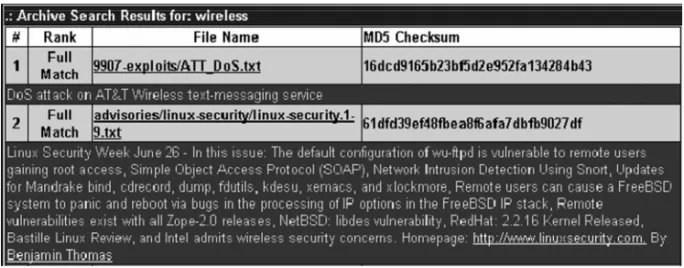
Once the copy is made, a comparison of the hard drives will be done using an integrity technology called an MD5 hash (see Figure 2.3). The definition of an MD5 hash, as taken from the MD5 Web page, is as follows:
[The MD5 algorithm] takes as input a message of arbitrary length and produces as output a 128-bit “fingerprint” or “message digest” of the input. It is conjectured that it is computationally infeasible to produce two messages having the same message digest, or to produce any message having a given prespecified target message digest.
In essence, MD5 is a way to verify data integrity, and is much more reliable than checksum and many other commonly used methods.
Once the MD5 hashes are made from each hard drive, the correspond-ing values can then be compared. If these values are the same, then the two drives are identical; if the MD5 values are different, then the bit-stream backup failed and the drives are different. MD5 hashes are quite commonly used to verify the integrity of a file. The values can be used to ensure that a file was not modified during download and can also be used as a component of a digital signature.
After the hard drives have been compared and found to be identical, the forensic professional would then begin looking at the hard drive for evidence that the attack was launched from that machine. The forensics professional will try to recover deleted files, will look for file fragments in slack space, and will also look through the data files on the suspect system to see if any evidence is present. If any evidence is found on the system, the forensic professional will document the evidence and turn it into a final written report.
2.2.3
Malicious Hackers
There are several groups of Internet users out there that will attack information systems. The three primary groups are hackers, crackers, and phreaks. While common nomenclature is to call all three of the groups “hackers,” there are some differences between the groups. A hacker is a user who penetrates a system just to look around and see what is possible. The etiquette of hackers is that after they have penetrated the system, they will notify the system administrator to let the administrator know that the system has a vulnerability. It is often said that a hacker just wants security to be improved on all Internet systems. The next group, the crackers, are the group to really fear. A cracker has no etiquette on breaking into a system. Crackers will damage or destroy data if they are able to penetrate a system. The goal of crackers is to cause as much damage as possible to all systems on the Internet. The last group, phreaks, tries to break into an organization’s phone system. The phreaks can then use the free phone access to disguise the phone number from which they are calling, and also stick your organization with the bill for long-distance phone charges.
The ways a hacker will attack a system can vary tremendously. Each attacker has his own bag of tricks that can be used to break into a system. There are several books on just the subject of hacking currently available, but we will cover the basic hacker methodology briefly here.
The basic hacker methodology has five main components: reconnais-sance, scanning, gaining access, maintaining access, and covering tracks. It might seem odd to think of a methodology for hackers; but as with anything else, time matters. So to maximize time, most hackers follow a similar methodology.
that could help in the attack. The attacker would then look for information in the DNS servers for the attack organization. This would provide a list of server and corresponding IP addresses. Once this is done, the hacker would move to active attacking.
To perform an active reconnaissance attack, a hacker would perform ping sweeps, SNMP network scans, banner grabbing, and other similar attacks. The attacks would help the attacker weed out the number of dead IP addresses and find the live hosts to move on to the next phase — scanning.
An attacker would begin scanning, looking for holes to compromise to gain access to the network. The attacker would scan all servers that are available on the Internet, looking for known vulnerabilities. These vulnerabilities could be in a poorly written Web-enabled application or from applications that have known security vulnerabilities in them. The attacker would also look at the organization’s firewall and routers to see if vulnerabilities exist there as well. Once an attacker has compiled a list of vulnerabilities, he would then move on to the next stage — gaining access.
There are many ways for an attacker to gain access to the target network. Some of the more common entry points into the network are through the target server’s OS (operating system), through an application that was developed in-house, as well as through an application with known vulnerabilities, through the network devices that can be seen from the Internet, and if all else fails the attacker will perform a denial-of-service attack. Once the attacker has access, all he wants to do is make sure that he can keep it.