www.ifc.org/thoughtleadership
NOTE 47 • OCT 2017
From Farm to Fork: Private Enterprise Can Reduce
Food Loss Through Climate-Smart Agriculture
More than a billion tons of food are lost annually across global food supply chains. Spillage, spoilage, insects, and rodents cause this post-harvest loss. Addressing it is a daunting challenge due to the complexity of the many factors involved. But it is a worthwhile challenge because of the potential beneits, including improved food security, nutrition, economic productivity, and response to climate change. Poor or nonexistent public infrastructure is often an underlying cause of food not being transported or processed effectively. And climate change damages existing infrastructure and increases losses. Despite the numerous environmental, economic, and socio-cultural barriers involved, there are many examples of private sector enterprises that have tackled post-harvest loss successfully. They focus on education, collaboration, and markets.
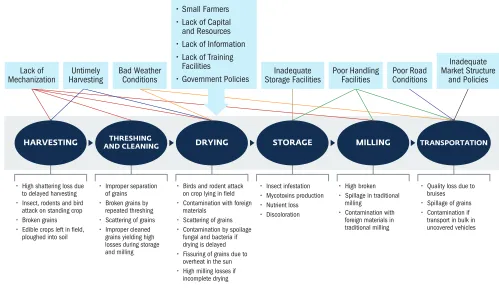
In developing countries, losses in food supply chains of fruits, vegetables, and grains take place predominantly during production, post-harvest handling, storage, and processing stages (Figures 1 and 2). Spillage and biological degradation of crops are the primary causes of losses, with biological degradation usually responsible for the vast majority of them. Spillage is mainly a problem during harvesting, transportation, and processing, while biological degradation occurs at all stages, particularly during storage operations.
Biological degradation includes bacterial and fungal decomposition, insect infestations and rodent damage. Managing any of these factors requires in-depth knowledge of what promotes them, what constrains them, and which technologies can be employed cost-effectively to maintain the quality of the produce.
Obtaining the required knowledge on biological degradation and using it to reduce post-harvest losses is challenging, particularly in developing countries. And careful scrutiny of potential benefits and pitfalls is required to answer critical questions: How much food could
practically be saved, and at what cost? And who would benefit from the savings?
Estimates of the amount of food lost are staggering. Some analyses estimate that one-third of global food production— or about 1.3 billion tons—is lost annually.1 Losses of that
magnitude compromise not only global food security, but also the world’s climate via greenhouse gas emissions.
Indeed, the production and biological degradation of 1.3 billion tons of food results in emissions of more than 4 billion tons of carbon dioxide equivalent. That is greater than the annual combined emisions of all countries other than China and the United States.2
Importantly, the variability of post-harvest loss across regions and supply chains makes it challenging to quantify accurately, particularly as losses in quality are difficult to estimate. Despite this uncertainty, it is clear that
smallholder farmers in developing countries stand to benefit the most from reducing food losses.
While large commercial farms tend to have the knowledge and finance need to reduce post-harvest losses, most smallholder farmers do not. By deploying various technologies and techniques, large farmers can reduce losses to below 2 percent of their harvest, while the majority of smallholder farmers in developing countries regularly lose more than half of their crops to spillage, spoilage, insects, and rodents.3
Technology and proits to the rescue?
The technologies available for reducing post-harvest food losses are varied and depend on the crop type and the main factor to be averted, among other things. In some cases, simple adjustments such as changing the containers used to transport crops can significantly reduce spoilage and spillage. In other cases, investments into new storage and processing solutions are required.
These include metal silos, sealed bags, threshing plants, and packaging facilities.4 The benefits of the technologies
available are clear, but effective implementation can be difficult and depends on a wide range of factors.
Indeed, despite the proven efficacy of the technologies introduced to Sub-Saharan Africa, there has been a ‘deplorable lack of success’ according to a recent review of loss-reduction projects. Technologies are frequently abandoned by small-holder farmers, particularly after being introduced by donor projects.5 It is important to
understand why this occurs and to apply lessons learned that can inform future approaches.
Viewing value chain steps in isolation. One reason for the lack of success in the past is that single solutions have been proposed and problems have been tackled in isolation. What is often needed instead are multiple interventions across the value chain. Although most losses occur during storage and milling, each step in the chain can and often does result in significant losses that warrant remedies (Figure 1).6
Furthermore, addressing only one step in the value chain is usually unlikely to achieve a major loss reduction. A cold storage chain is a good example of where the chain is only as strong as its weakest link, and a simple intervention in one link is likely to be of little value if other links remain weak. Assessing the value chain of each crop as a whole is consequently of critical importance prior to any intervention aiming at reducing post-harvest losses.
Ignoring the need for economies of scale. There are many technologies available to assist in reducing post-harvest
FIGURE 1 Estimated losses from the post-harvest chain for rice in South Asia
losses (Figure 2).7 These include metal silos, new transport
systems, packaging facilities and processing plants. Such technologies, however, require economies of scale, large volumes of produce, and capital investment, and, therefore, are not readily available to the smallholder farmer.
Even ostensibly low-cost options such as hermetically sealed bags have been perceived to be unaffordable by many small farmers due to cash flow constraints, particularly at the time of the year when the purchase of bags is required.8
Socio-cultural problems. Cultural norms and societal perceptions also impede the uptake of low-cost technologies that can reduce food losses. These factors are often simple, yet they can require years to uncover unless there is a detailed social survey conducted before introducing a technology. There may also be a need for ongoing technical support and education.
Three examples highlight these problems. First, metal silos for storing grain have not been used in some areas of Africa because due to a strong cultural imperative to store grain in the home. Second, in some countries it has been difficult for smallholder farmers to accept that hermetically sealed bags
for storing grain should have a higher price than traditional sack-cloth bags. Some farmers in Tanzania, for example, are unable to comprehend price differences between bags that seem outwardly similar.9
And third, although diatomaceous earth dust10 kills
insects by causing their cuticles to dry out, is non-toxic to humans, and has long been used in China to protect grain from insects, it’s likely that some farmers will need to be persuaded to mix their hard-won grain with what is, in essence, a blend of earth and ancient algae. Socio-cultural barriers to food loss remedies often seem obvious and easy to solve in retrospect, yet identifying them can be difficult.
It is increasingly recognized that, in addition to traditional economic models, the use of behavioural models—
generated from within the relatively new behavioural sciences —are essential for guiding the adoption of new technologies by communities.11
Climate change, pests and infrastructure. The expected impacts of climate change across Sub-Saharan Africa include increased frequency and severity of both droughts and floods. Crop growing seasons are also likely to shorten FIGURE 2 Factors potentially resulting in Post-Harvest Losses in grain supply chains in developing countries
and air temperatures will inevitably increase. All of these impacts are likely to increase post-harvest food losses in numerous ways, with potentially disastrous consequences for food security and human health. Three examples highlight the dangers of climate change.
First, bacterial and fungal spoilage of crops in storage will greatly increase in environments that become moister and warmer. Spoilage not only reduces income and food availability, but may also result in severe negative impacts on human health.
For example, when fungi spoil grains they release
dangerous mycotoxins which are subsequently ingested by consumers. The effects of mycotoxins on human health and productivity can be extreme and should be seen as a matter of grave concern by all participants in the value chain.12
Second, insect and rodent outbreaks are also expected to increase as rainfall becomes more erratic. This is a result of intense rainfall events causing wetter than normal soils. The combination of wet topsoils and warm temperatures promotes the reproduction of insect pests that attack crops both in the fields and in storage.
Growth and reproduction of rodents are also promoted by flushes of vegetation that arise on wet topsoils. Plagues of rodents can easily arise in such circumstances. If the vegetation then dies back following climate change-induced
dry spells and intense heat, rodents will tend to leave the fields and move into human habitations looking for food. Traditional storage systems in Africa are often not rodent-proof and, consequently, large losses of stored crops can be expected during such plagues.
And third, floods and landslides frequently damage infrastructure used along food supply chains. A simple example is a road network used to access markets and crop storage facilities. Poor infrastructure in developing countries already constrains transport and storage of food, and is often identified as the main factor underlying post-harvest food losses there.13 Climate change-induced
flooding is thus a danger that threatens to greatly undermine food security not only through damage to agricultural productivity but also by increasing post-harvest losses.
The examples described here are just a few of the
numerous effects of climate change on food supply chains. Such effects will warrant careful analysis by any entities wishing to resolve post-harvest losses in developing countries. Climate-smart interventions will need to be honed for each effect.
While climate change affects post-harvest losses, the converse is also true, as noted above. Food products carry an embedded carbon footprint, and food loss increases
FIGURE 1 Estimated cumulative post-harvest weight loss in 2007 in % from production of wheat, sorghum, and maize for countries in east and southern Africa
5–10% 10–15% 15–20% 20–25% 25–30% 30–35%
Sorghum Maize
this footprint unnecessarily. Additional land, water, and agricultural inputs are needed to produce food that is ultimately wasted.
Indeed, at a global scale, producing food that is subsequently lost requires an estimated 1.4 billion extra hectares of agricultural cropland, land that could be and should be supporting carbon-absorbing forests. Moreover, food waste that ends up in landfill sites produces methane, a greenhouse gas with approximately twenty times more impact on global warming than carbon dioxide. Reducing post-harvest food losses, therefore, has considerable potential for contributing meaningfully to reducing greenhouse gases in the atmosphere.
Lack of knowledge and skills. Technologies to reduce post-harvest losses, whether they are simple like hermetically sealed bags or complex like large processing and packaging facilities, require knowledge and skills to implement. As one study noted, even the simple technologies for reducing post-harvest losses are ‘precision-oriented’ requiring ‘careful attention to small details’.14 Providers of new
technologies in Sub-Saharan Africa have often found that the use of the technology is effective at the outset but that the efficacy and hence adoption of the technologies decline through time. This is often because ‘attention to small details’—such as ensuring hermetically sealed bags remain fully sealed—tends to decline in time unless technical support from the supplier is ongoing.
Inadequate knowledge and skills also often impede non-technical solutions to food loss. Warehousing, which includes warehouse receipt systems (WRS) and related inventory credit, is an example.15 It allows farmers to store crops in a
centralised, managed warehouse and receive a transferable receipt. This provides farmers with much-needed liquidity, and stores crops effectively. However, despite their apparent simplicity, such systems have only been functioning well in several countries in Sub-Saharan Africa.
Although it remains unclear why such systems have had only limited success, the most likely explanation is that stakeholders involved in warehousing and warehouse receipts financing lack sufficient knowledge and have not been trained well enough to navigate the complexities of fluctuating market prices of the stored stocks.16
Furthermore, the large throughputs of crops that are required to make warehouse operations economically viable often cannot be achieved by smallholder farmers.
For small-scale operations, inventory credit may be a
preferable system; here, crop harvests are offered as a guarantee for a cash loan. Microcredit can be issued against relatively small volumes of crops produced by smallholder farmers, while larger loans can be designed to be accessible to farmer associations.
Although a lack of access to sufficient—or indeed any— credit frequently prevents smallholder farmers from purchasing suitable technologies for reducing post-harvest food losses, in many cases simple skills in managing cash and taking investment decisions are the main barriers. For example, the purchase of hermetically sealed bags for storing grain was found to be a sensible as well as affordable investment for smallholder farmers in Tanzania, but very few farmers opted to buy them when the first became available.
This was primarily due to the fact that farmers’ cash reserves were lowest at the end of the growing season when the bags were needed, and also that a return on the investment two to three years after the purchase was a foreign and unwelcome concept. The farmers viewed the investment in a more favourable light once the distributers of the technology had invested time into explaining both the long-term benefits of the investment and the advantages of purchasing the bags at the beginning of the growing season when the expenditure was more affordable.
Successful navigation through the maze of PHL
Navigating the complex array of problems described above is a daunting prospect for any private sector entity wishing to contribute to solving the problem of post-harvest loss in a particular food supply chain. As noted earlier, interventions are often required along numerous links in the chain. Economies of scale need to be created.
All social and cultural barriers need to be assessed and appropriate interventions devised. Furthermore, skills and knowledge need to be imparted to ensure that all interventions can be sustainably managed and maintained through time. Innovative solutions to insufficient and ailing public infrastructure, including ways to connect remote smallholder farmers in a cost-effective manner to markets, also need to be devised.
many different food supply chains and countries. Examples are discussed below, from grain and fruit production in Ghana to vegetation production in the Philippines and coffee production in South America. The common themes emerging from these success stories include the following.
First, there is a strong focus on educating all actors in the value chain on the importance of reducing post-harvest loss and how to employ solutions that do so. Second, there is an emphasis on effective communication and collaboration among different sets of actors. Collaboration among producers as well as between producers and buyers in particular has been found to greatly reduce costs by shortening the value chain and improving the transfer of appropriate technologies across the shortened chain. And third, there is a strong commitment to a market-orientated approach, as opposed to using local cooperatives. While a market-orientated approach ensures that actors are accountable for all costs, the use of local cooperatives frequently leads to a lack of accountability and associated unnecessary expenditures.
Investments in the grain and fruit supply chains in Ghana. Two companies in Ghana, Premium Foods and Blue Sky Inc., demonstrate how education, communication, collaboration, and a market-orientated culture can combine effectively to reduce food loss in two different supply chains. Premium Foods has invested in an agribusiness centre that includes grain drying, shelling, and storage facilities that are integrally linked with farmer organizations, banks, business service providers, and input suppliers.17
Smallholder farmers using the agribusiness centre pay for extension services and receive training on a wide range of agronomic subjects. The centre receives grain from the farmers before it has been dried. The grain is then processed and sold by the centre. Loans from the input suppliers to farmers are paid off by the centre.
Post-harvest loss is greatly reduced as a result of the shorter time period required to dry the grain compared with traditional methods. The reduction in drying time is also a climate-smart agricultural approach because drying grain is increasingly difficult for farmers under climate change conditions, which include increasingly erratic and intense rainfall events.
Blue Sky, a fruit processor, was established by an investor with strong ties to supermarkets in Europe.18 The company
works closely with smallholder farmers and provides free training, free technical support, and interest-free loans. Fair Trade and Ethical Trade Organic certification are also
facilitated by Blue Sky. The farmers are paid promptly and receive prices for their fruit. The prices are agreed upon annually, they are higher than the costs of production, and they are adjusted for inflation.
The company also reduced post-harvest loss by constructing a local road network that links fields and processing plants, moving the production of fruits closer to the processing plants, establishing a juice processing plant, building packaging facilities, and managing the logistics of airfreight to ensure that their fresh-cut fruit arrives on the shelves of European supermarkets within 48 hours after harvesting. Since its establishment in 1998, Blue Sky has grown by scaling up its Ghanaian operations and replicating its model in Brazil, Egypt, and South Africa. In 2010 the company sold 3,800 tonnes of processed fruit and generated sales of $24 million from its Ghanaian operations alone.
Twinning commercial farmers with smallholder farmers in the Philippines. The Northern Mindanao Vegetable Producers Association, or NorMinVeggies, is a new type of market facilitator linking smallholder vegetable producers in the Philippines to supermarket chains, hotels, fast food chains and export markets.19
The association was established in 1999 by a group of farmers determined to capitalize on the emergence of supermarkets across this Pacific archipelago. The farmers comprised two distinct groups: smallholder and mid-size farmers. Prior to the formation of the association, only the mid-size farmers had access to capital, technical advice and technological solutions for PHL. Over time, the smallholder farmers learned new agronomic techniques and commercial approaches from the mid-sized farmers.
The benefit for all farmers was that production of all 12 different types of vegetables consistently reached critical volumes that enabled NorMinVeggies to negotiate from a position of strength with the supermarkets. To control quality, the association introduced quality assurance schemes, production schedules and traceability systems. These were rigorously adhered to, with lead farmers coaching other farmers and acting as quality managers. PHL on smallholder farms was up to 25% greater before the association introduced quality controls. By 2011 more than 5,000 farmers were operating under the umbrella of NorMinVeggies.
producers who grew coffee at more than 1,200 meters above sea level, a requirement for speciality coffee.20 The model
implemented by the project had three core components: access to markets, access to training and coordination, and building collaboration across the value chain.
The bank also provided the project cooperatives with matching funds for investments in infrastructure such as coffee washing stations, which reduced post-harvest losses. The success of the project was evident in the increase in the number of participating producers, from 3,000 at the outset to 6,000 at the close of the project in 2009; in the increased productivity of producers; in the increase in quality of coffee produced; and in the higher prices secured as a result of having larger volumes to trade.
Recommendations: running the private sector gauntlet within a food chain
It is an unfortunate reality that for every new private sector enterprise wanting to address post-harvest food loss and associated problems within a particular food supply chain in developing countries, only a small fraction will succeed and become large profitable entities over the long-term. Intense research on all the factors discussed in this note is consequently crucial before investing in such a venture.
A critical aspect of such research would be to undertake small-scale interventions—metal silos and hermetically sealed bags for storing grain, for example—that are specifically aimed at understanding the socio-cultural environment of a particular area. Once data is gathered on actual interventions (as opposed to theoretical hypotheses), investors in such technologies will be better prepared to make informed decisions.
Large banking institutions need to be aware that successful large-scale interventions to reduce post-harvest food loss in a value chain may require a combination of making sufficient finance available and ensuring that sufficient lateral thinking has been done.
A recent example from West Africa illustrates this point. The onion food supply chain in West Africa experiences considerable post-harvest loss because processing of the onions is usually undertaken hundreds of kilometres away from farms. Investors have considered the construction of processing factories closer to production areas to address the problem. Ultimately, however, such investments have tended to be constrained by unreliable power supplies.
A potential solution to overcome such a barrier to investment is a private sector investment in a large solar power plant that provides reliable electricity to both an onion processing plant and surrounding villages, irrigated farms, clinics, and schools. Addressing post-harvest food loss in this way could lead to virtuous cycles not only for food security and nutrition, but also the economy as a whole, health of
BOX 1 Warehouse Financing in Tanzania
Tanzania’s economy relies heavily on agriculture, and climate change is already affecting the pro-ductivity levels of key commodities. Tanzania is committed to increasing yields through Climate Smart Agriculture by offering better input supplies (seeds, chemicals, fertilizers, etc.), precision farm-ing techniques, and improved irrigation systems to smallholder farmers. It also seeks to protect smallholder farmers against climate related risks, increase productivity levels through crop insur-ance, and the use of warehouse receipts through
approved eficient storage facilities. These allow
the agricultural supply chain to improve post-har-vest practices—improved transport and storage facilities, better farm management, improved harvesting techniques, etc.—which will reduce crop losses and help maximize the portion of the harvested output delivered to markets.
IFC’s invested project entails a $40 million credit line under the Global Warehouse Finance Program (GWFP) to CRDB Bank Plc. in Tanzania. By using warehousing receipts as collateral, CRDB can ex-tend loans to medium-sized domestic traders and
cooperatives, which typically have less inancing
options than global agro-exporters. By increasing
access to inance in the agri-business sector, the
nearby communities, and education of school children. Even if interventions to address food loss are not twinned with electrical power, virtuous cycles for local economies and communities may occur when successful private sector enterprises that reduce food loss are successfully established.
The enterprises described above, from Ghana, the Philippines, and Central America, demonstrate this point. Incomes and skill sets of all the farmers involved with these enterprises increased markedly. The infrastructure and technologies supporting their food chains were modernised and maintained. Environmental management was improved, ensuring that ecosystems supporting their farming ventures were sustainably managed. And, importantly, the volume and quality of food produced for consumption within their value chains increased. Taking the above into account, what are the potential low-hanging fruit for private sector investment?
Providing appropriate technologies. Across Sub-Saharan Africa there are many successful enterprises producing food-loss reduction products such as storage containers and hermetically sealed bags. Prior to investing in such enterprises, plans for overcoming local social and economic barriers need to be studied. Capacity building of local farmers, with respect to using and financing the products, are crucial. Furthermore, technologies—and supply chains using them—need to be tailored to the infrastructure available in a particular geographic area.
Over large parts of Sub-Saharan Africa, large private sector investments in modern technologies to reduce food loss first require investments in infrastructure by the public sector. In Kenya, for example, entrepreneurs in the avocado supply chain only started investing in refrigerated containers after the government had provided appropriate port facilities to support a cold storage chain.21 Similarly, private sector
companies tend to construct large warehousing facilities for grain storage in Sub-Saharan African where road networks to smallholder grain farms are relatively developed.
Establishing agribusiness centers. Agribusiness centres— those established by Premium Foods in Ghana are an example—can help to reduce post-harvest food loss by providing farmers with appropriate technologies and extension services. Such centers can become important nexus points for individual farmers, connecting them to other farmers, agri-suppliers, and buyers.
Agricentres can also create economies of scale for smallholder farmers, they can enable transport from the field to a storage depot, and they can guide farmers on
adoption of climate-smart agricultural practices. Where appropriate, agribusiness centres could partner with microfinance institutions to offer farmers inventory credit. The resulting increased liquidity from cash loans would allow farmers to wait for favorable market conditions. This would further reduce food waste as seasonal market ‘gluts’ are avoided when cash-strapped farmers are no longer forced to sell their crops at unfavourable prices.
Funding the modification of value chains. The multi-stakeholder nature of value chains makes modifying them a complex undertaking. However, there are existing NGOs and other organisations that focus on reduction of post-harvest food loss by creating sustainable food value chains. Such entities could potentially be supported by the private sector through a specialist fund that provides financing and tailored technical support. Such a fund could provide the credit for projects addressing an entire value chain and also be a knowledge broker for best practices on reducing food losses.
Conclusion
For private sector investors, the examples from Ghana, the Philippines, and Central America have considerable potential for replication within food supply chains across the developing world. Intense analyses by multi-disciplinary teams will need to be conducted on socio-cultural factors, as well as consideration of appropriate technologies to address post-harvest food losses, the economic opportunities involved, and the likely climate change impacts.
Once this knowledge has been acquired, the structure and composition of potential private sector enterprises to reduce food loss can be designed. For such enterprises to be successful they will need to focus intensely on education, collaboration, and market-oriented approaches that address the many factors that reduce the supply of food traveling from farm to fork.
The economic and humanitarian rewards of doing so cannot be overstated. Billions of tons of food can potentially be saved, leading to improved food security, better nutrition, increased productivity, and greater political stability in developing countries.n
ABOUT THE AUTHOR
ACKNOWLEDGMENTS
The author would like to thank the following colleagues for their review and suggestions: Nina Zegger, Global Head, Global Climate Business, Manufacturing, Agribusiness and Social Services, IFC; Anup Jagwani, Principal Investment Oicer, Agribusiness and Forestry, Manufacturing, Agribusi-ness and Social Services, IFC; Ahmad Slaibi, Operations Oicer, Clean Energy & Resource Eiciency, Cross Cutting Advisory, IFC; Thomas Kerr, Principal Industry Specialist, Climate Policy Team, Climate Business, IFC; Makiko Toyoda, Senior Trade Finance Oicer, Trade & Supply Chain, Products – Financial Institutions Group, IFC; Tibor Kludovacz, Industry Specialist, Climate Business – Financial Institutions Group, IFC; Marcene Broadwater, Global Head, Climate Strategy &
Business Development, Climate Business, IFC; Thomas Rehermann, Senior Economist, Thought Leadership, VP Economics and Private Sector Development, IFC, and René Schieritz, Kevin Emslie and Pierre Bégat, Environmental and Climate Change Consultants, C4 EcoSolutions.
ADDITIONAL NOTE ABOUT CLIMATE SMART AGRIBUSINESS
This note is one of two EM Compass Notes about private sector opportunities within Climate Smart Agribusiness. The second note focuses on how precision farming can enable climate-smart agribusinesss and was concurrently published as EM Compass Note 46.
For media queries, please contact Nadine Ghannam: [email protected].
ABOUT IFC AND WAREHOUSE FINANCING
IFC, a member of the World Bank Group, is the largest global development institution focused on the private sector in
emerging markets. Working with more than 2,000 businesses worldwide, we use our capital, expertise, and inluence to
create markets and opportunities in the toughest areas of the world. In FY17, IFC delivered a record $19.3 billion in
long-term inancing for developing countries, leveraging the power of the private sector to help end poverty and boost shared
prosperity. For more information, visit www.ifc.org. IFC aims to create markets for farmers and traders in emerging markets and has successfully launched the $500 million Global Warehouse Finance Program (GWFP) to allow farmers
access to inance, reduce post-harvest losses, improve the stability of market prices, and encourage formalization of agri-businesses. Approved in 2010, GWFP promotes investment in warehouse receipts inancing by working with partner banks, and offers advisory services. Warehouse inancing is a secured lending technique that is especially beneicial for farmers
and small- and medium-sized businesses, which are often otherwise unable to secure borrowing requirements due to a
lack of suficient conventional loan collateral. In order to reduce post-harvest food losses, GWFP also provides advisory
services, funded by Global Agriculture Food Security Program and the Government of Japan, to help improve post-harvest
practices at storage facilities. GWFP has inanced more than $6 billion of commodity inance transactions involving a range of agricultural commodities in developing economies mainly in Sub-Saharan Africa. In addition, warehouse inancing has
reached more than 750,000 farmers and contributed to food availability for almost seven million people.
1 Gustavsson, Jenny, Christel Cederberg, and Ulf Sonesson. 2011. “Global food losses and food waste - Extent, causes and prevention.” FAO Food and Agricultural Organization of the United Nations.
2 These figures include emissions from associated agricultural inputs, deforestation and soil carbon declines in agricultural fields.
3 Hodges, Rick J., Jean C. Buzby, and Ben Bennett. 2011. “Postharvest losses and waste in developed and less developed countries –
Opportunities to improve resource use.” Journal of Agricultural Science
(149) 37-45; Kumar, Deepak, and Prasanta Kalita. 2017. “Reducing postharvest losses during storage of grain crops to strengthen food security in developing countries,” Foods 6 (1), 8.
4 Kumar and Kalita. 2017.
5 Affognon, Hippolyte, Christopher Mutungi, Pascal Sanginga, and Christian Borgemeister. 2015. “Unpacking postharvest losses in Sub-Saharan Africa – A meta-analysis.” World Development (66) 49–68. 6 Hodges, Buzby, and Bennett. 2011. 37-45.
7 Kumar and Kalita. 2017.
8 Daminger, Allison, Saugato Datta, and Dana Guichon. 2016. “Reducing post-harvest loss – A behavioral approach.” Ideas42.org.
9 Daminger, Datta, and Guichon. 2016. Manufacturers of the
hermetically sealed bags have partially solved this problem by changing the appearance of the bags and providing detailed infor-mation on the benefits of hermetic sealing on the exterior of the bags.
10 Mined from ancient deposits of diatoms – a form of phytoplankton. 11 Daminger, Datta, and Guichon. 2016.
12 Kumar and Kalita. 2017.
13 Rosegrant, Mark W., Eduardo Magalhaes, Rowena A. Valmonte-Santos, and Daniel Mason-D’Croz. 2016. “Returns to investment in reducing postharvest food losses and increasing agricultural productivity growth.” Paper prepared for the 2016 Agricultural & Applied Economics Association Annual Meeting, Boston, Massachu-setts, 31 July – 2 August.
14 Daminger, Datta, and Guichon. 2016.
15 World Bank. 2011. “Missing Food – The case of postharvest grain losses in Sub-Saharan Africa.” 2011. World Bank – FAO – Natural Resources Institute. World Bank Report 60371-AFR, 2011.
16 World Bank. 2011. 17 World Bank. 2011.
18 Neven, David. 2014. “Developing sustainable food value chains – Guiding principles.” FAO Food and Agricultural Organization of the United Nations, 2014.
19 Neven, David. 2014. 20 Neven, David. 2014.