st February 1 , 2016 Johor Bahru, Johor Malaysia
Held by Universitas Ahmad Dahlan Universiti Teknologi Malaysia
Published by Graduate Program
The Contribution of Education Institution
to ASEAN Economic Community
Proceeding of International Joint Seminar
The Contribution of Education Institution to
ASEAN Economic Community
February 1, 2016 Johor Bahru, Johor Malaysia
ISBN : 978-602-95864-9-7
Held by
Universitas Ahmad Dahlan Universiti Teknologi Malaysia
Steering Committees:
Prof. Dr. Achmad Mursyidi, M.Sc., Apt. (Universitas Ahmad Dahlan, Indonesia) Prof. Dr. Hamdan Said (Universiti Teknologi Malaysia, Malaysia)
Reviewer:
1. Prof. Dr. Suyata
Universitas Ahmad Dahlan, Indonesia 2. Prof. Dr. Suharsimi Arikunto
Universitas Ahmad Dahlan, Indonesia 3. Prof. Dr. Hamdan Said
Universiti Teknologi Malaysia, Malaysia 4. Dr. Nora Elizabeth F. Maniquiz
University of Nueva Caceres, Philippines 5. Assoc. Prof. Dr. Charas Atiwithayaporn
Thaksin University, Thailand
Editor: Dwi Sulisworo
Published by Graduate Program of Universitas Ahmad Dahlan Copyright © Universitas Ahmad Dahlan
Jl. Kapas No. 9, Semaki, Yogyakarta, Indonesia Phone +62 274 564 515
Proceeding of International Joint Seminar iii The Contribution of Education Institution to ASEAN Economic Community
PREFACE
Recently, ASEAN has a new momentum for enhancing the nation competitiveness through mutual collaboration in any sectors. One of the important aspects is on education as a system to improve human resources quality. We have to enhance our collaboration time by time.
Consequence of this committement, research is to be a core and an important activity to support better collaboration environment among ASEAN countries.
This international joint seminar on The Contribution of Education Institution to ASEAN Economic Community as a part of mutual cooperation between Universitas Ahmad Dahlan, Yogyakarta, Indonesia and Universiti Teknologi Malaysia, Johor Bahru, Malaysia, is intended to study any issues concerning with education, sciences, and humanities especially on facing ASEAN Economic Cummunity era. Through this seminar, all participants and both universities can seek the possibilities of joint research or collaborative research among others in multi and interdisciplinary area.
Thank you very much to all participants from Indonesia, Malaysia, Thailand, and Philippines for your beneficial discussion and new perspective on education reform.
Johor Bahru, February 2016
TABLE OF CONTENTS
Cover i
Preface ii
Table of Contents iii
Developmental guidance and counseling comprehensive in Indonesia
Agus Ria Kumara, Caraka Putra Bhakti, Fatwa Tentama 1
Anti-corruption values internalization to children through story-telling using punakawan puppet characters
Amiruddin 7
Enhancing college human resource quality for competition in the globalization era
Aris Indriyanti 15
The State of Teacher Education in Region V: Policy Implication
Arlene O. Monsalve 23
Developing condusive instructional environment to improve early childhood autonomy
Fenny Dwi Andayani 33
The effect of organizational commitment and work environment on job performance of educational employees in Yogyakarta
Fatwa Tentama 37
Community- approach based on local wisdom: at bantul earthquake recovery cases
Hadi Suyono 43
Thematic clipping of children’s language for effective learning
Hartini 49
Student- teacher motivation creativity for growing local wisdom empowerment
Haryanti 55
Implementation of innovative curriculum at senior high in rural areas schools of Indonesia
Herlina Bayu Purbosari 59
The Development of Science Module Based on Pedagogical Content Knowledge for Prospective Teacher of Elementary School
Ika Maryani 67
The influence of game syllabuses and word cards to stimulate early reading of childhood education
Isminah 77
Developing Social Emotional of Early Childhood through game of Jamuran
Juminah 83
Challenges of principal leadership in indonesia: (case of village and city areas supported by school operational cost)
Proceeding of International Joint Seminar v The Contribution of Education Institution to ASEAN Economic Community
Using role play to internalize character building for young children
Karyati 95
Character education based on local wisdom
Musri Nasution 99
The role of Indonesia vocational education in facing asean economic community
Novi Resmi Ningrum 103
Developing enterpreneurship motivation model for university students
Ocnatias Eka Saputri 109
The Level of English Proficiency among the High School Students of University of Saint Anthony: An Assessment
Rafael V. Oñate 113
Education based cultural in globalization era: case the Indonesian context
Rahmad Nasir, Harun Al-Rasyid, Suma Sri Jumiati 121
K to 12 Program: It’s Implication to Faculty and Institutional
Management
Ray B. Ortega 129
Strong personality of Indonesian students in facing asean economic community challenges
Rellin Ayudya 141
School culture as a foundation for education quality enhancement
Rungchatchadaporn Vehachart, Charas Atiwithayaporn 147
The significance of enrichment program to the students’ achievement on English language study
Silvia Rosmaida. A 159
Improving teacher performance through transactional leadership style
Sri Supatmi 163
Strategic analysis of educational quality improvement at underdeveloped regions in Indonesia
Developmental guidance and counseling comprehensive in Indonesia
Agus Ria Kumara
1), Caraka Putra Bhakti
2), Fatwa Tentama
3)1, 2
Guidance and Counseling Department
3
Psychology Department
Ahmad Dahlan University, Indonesia
1
Abstract
Guidance and Counselling are an integral part of the education, which is an attempt at realizing the educational functions include function development, help individuals develop themselves in accordance with fitrah (potential) and diversity. Guidance and counseling are the comprehensive program developed in Indonesia, They are the paradigm of guidance and counselling services which adopted from the ASCA model. Competency standards proposed are divided into 5 areas of development, namely the development of spiritual area , academic development, the development of the field of personal/social development of the areas of career development, the field the attitude of citizens of a democratic and accountable.
Keywords: guidance and counseling, comprehensive, Indonesia
Introduction
Guidance and Counselling are integral part of the education, which is an attempt at realizing the educational functions include function development, help individuals develop themselves in accordance with considering potential difference. According to the Depdiknas (2008) when this has occurred a change of paradigm approach to guidance and counseling, from traditional-oriented approach, remedial, clinical, and centered on a counselor, to development-oriented approaches and preventive. Approach to guidance and counseling developmental or comprehensive based on the achievement of the tasks of development efforts, development potential, and solving client problems.
Developmental guidance and counseling in Indonesia comprehensive
Guidance and counseling comprehensive in Indonesia, is the paradigm of guidance and counseling services which is adopted from the ASCA model. A comprehensive approach (comprehensive in scope) is the concept of service that reflects the approach on grounding system, program services, management and accountability. Guidance and counseling comprehensive model is strengthened by the 2013 curriculum of Permendikbud No. 111/ 2014 about guidance and counseling in primary and secondary education. In the regulation strengthens the role of the counselor as a teacher of guidance and counseling have to collaborate with the school's stakeholders in the development of the potential and competence of the students is based on the needs of students.
The term "Developmental Guidance and Counseling" which juxtaposed with the term "comprehensive approach" was taken from Myrick (2011): "Developmental Guidance and Counseling: A Comprehensive Approach" meant that developmental guidance and counseling as a comprehensive approach. This means that the development paradigm is much guidance and counseling, in the guidance and counseling the development focus is helping "the development of individual potential" fit the characteristics and "needs" of each. Because of the potential that individuals of diverse and quite a lot of coverage, all need to be developed as a whole (comprehensive) then in helping develop it isn't enough only when done by a school counselor, but needs collaboration with the various parties that allegedly could contribute to the development of individual potential. Like money, one side of the image to the contrary is indeed not the same, but the value is still one. One side talking focus, the other side speaking parts of focus that need attention.
Developmental guidance and counseling ... 3 Agus Ria Kumara, Caraka Putra Bhakti, Fatwa Tentama
Flowchart Guidance and Counseling Comprehensive in Indonesia
The purpose of the guidance and counseling comprehensive program that is systemic to overcome the gap between the standards of competence of students that will be achieved and actual ability of students in school or in a specific area. To develop standards of competence the students began by reviewing the educational purpose of the school and the State concerned. The purpose of education includes the contents of guidance and counseling focusing on topics such as academic achievement, career development, and personal-social development. Check the relevant literature, the statement of the Association as well as a review of culture and gender, and local issues that may become standard competences students (Gysbers, 2012).
The standard of competency students need to be identified early because this is the purpose of the guidance and counseling comprehensive program. To develop standards of competence of these students need in the analysis the purpose of national education in Indonesia as well as the institutional goals of the school. Law No. 20 of 2003 article 3 mentions, "national education serves to develop the ability to form character and the civilization of the peoples dignity in the framework of the intellectual life of the nation, aimed at the development of potential learners in order to become a man of faith and piety to God Almighty, precious, healthy, have learned, accomplished, creative, independent, and become citizens of a democratic and accountable.
As a comparison in American standards of competence of students divided into three areas (domains), namely academic, personal/social, and career (ASCA, 2005), while Florida (2010) suggested four areas of development (domain) that is academic, career, social, and personal involvement in the community and the development of Global Citizenship. While Utah (Gysbers, 2012) standard development competencies into four areas, namely the development of academic/learning, career development, multicultural/global citizens development, social and personal development.
The development of Standards of competence of students in Indonesia is different from other countries. Competency standards for student in Indonesia is adapted based on the purpose of national education, and the culture of Indonesia. Diverse culture in Indonesia makes a lot of input in the development of standards of competence for students. The results of the study of literature and the adaptation of standard competencies are developed by ASCA, Florida and Utah as well as FGD. We propose
PHYSICAL:
Network system body, the five senses, gender
SPIRITUAL
(Spirit of god)
NAFS (Soul):
Heartminds, lust
FAITH: God, angels, Al-kitab, prophet, the last day,
destiny Human
Potential
Career
Akademic
Personal/Social
Citizens
Democratic Attitude
the development field (domain) which is divided into 5 areas: (1) The development of Spiritual
Students understand about the nature of faith in God. Students understand about the nature of love to God. (2) The development of the academic field
The student will acquire the attitudes, knowledge and skills that contribute to effective learning in school and the development of his lifetime.
Students can finish school with supported following the various self development to help further study options.
(3) The development of the field of personal-social
Understand And accept the potential as well as empowering and developing potential.
Understand the talent and interest owned, have a positive vision of the future. Have the self motivation and fighting power and developing independence behavior.
Has a sensitivity to the environment and develop skills utilizing nature.
Has excellent communication skills to build positive interpersonal relationships. (4) The development of career fields
Understand the development world careers, mengekplorasi ability, and is able to prepare (strategy) for the process of a career in the future.
Capable of overcoming the problems that exist in preparation for careers and able to take career decisions.
(5) The development of the field the attitude of Citizens of a democratic and responsible
Knowledge and skills as responsible citizens, understand the cultural differences and caring nation.
Students can demonstrate as citizens of a democratic.
Standard of competence development in Indonesia is adapted to the culture of the country concerned, one of the fields into the idiosyncrasies in Indonesia is spiritual. It can be seen from the base of the Pancasila, the first point namely "divinity of the one true God". Bernard Lewis (Juntika, 2011) describes one of the principal elements of a civilization is a religion. Religion is an important factor that determines the characteristics of a civilization. In order to become a nation of civilized nations of Indonesia, then the values of the religion that exists in Indonesia should still be built and practised in everyday.
Conclusion
Developmental guidance and counseling ... 5 Agus Ria Kumara, Caraka Putra Bhakti, Fatwa Tentama
academic development, the development of the field of personal-social development of the areas of career development, the field the attitude of citizens of a democratic and accountable.
Reference
Anwar Sutoyo. (2006). Model konseling qurani untuk mengembangkan fitrah manusia menuju pribadi kaaffah. Desertasi. Bandung: UPI.
American School Counselor Association. (2005). The ASCA National Model: A frame work for school counseling program. Second Edition. Alexandria, VA: Author. Depdiknas. (2008). Penataan pendidikan profesional konselor dan layanan bimbingan
dan konseling dalam jalur pendidikan formal. Jakarta: Depdiknas.
Florida Departement of Education. (2010). Florida’s school counseling framework. Florida: State of Florida Departement of State.
Gysbers, N.C. & Henderson P. (2012). Developing and managing your school guidance and counseling program, fifth edition. Alexandria: American Counseling Assosiation
Juntika Nurihsan. (2011). Membangun peradaban bangsa indonesia melalui pendidikan dan bimbingan komprehensif yang bermutu. Pidato Pengukuhan Jabatan Guru Besar. Bandung : UPI.
Myrick, Robert D. (2011). Developmental guidance and counseling: A practical approach, fifth edition. Minneapolis: Educational Media Corporation.
Anti-corruption values internalization to children through story-telling
using
punakawan
puppet characters
Amiruddin
Psychology Science Department, Graduate Program Ahmad Dahlan University, Indonesia
Abstract
Corruption is an extraordinary crime because the crime could damage the level of a country, one form of corruption behavior. Namely the abuse of public power for private gain that harms the public by way unlawful, corruption in Indonesia is not only done coworkers, but corruption has involved family, i.e. family which was originally expected to be the first and main castle in the prevention and eradication of corruption, now it its role to be fading. Supposed role of the family needs to be reinforced in the prevention, and eradication of corruption.
The writer is interested in discussing the phenomenon of corruption in Indonesia today as the theme of internalization of values on anti-corruption for children through methods of using story for Punakawan characters in the puppet. The reason for the selection method of the story is very precise method given to children for the development of moral behavior.
This method is expected by the children feel happy and keen to listen to stories, so listen to the story is an interesting activity in children. Internalization of anti-corruption values in children by presenting the figure of Punakawan figures, which appear in a child's behavior, is a process of imitation and behavior (modeling). Level observations on the behavior of children in the anti-corruption are the result of observation of the model and the level of quality imitation also depends on the child's perception of the figure that is used as a model. Therefore, the skilled person models, the higher the quality imitation reading behavior committed by children.
Keyword: anti-corruption, children, story telling method, education
INTRODUCTION
transparency International Indonesia, 2014).
The world community began to view corruption as an important issue since last two decades. Various initiatives to combat corruption conducted from the regional, national and international level. Efforts or strategies developed by the united nation called The Global programmed Against Corruption and made in the form of United Nations Anti-Corruption toolkit (UN Doc) include the establishment of an independent institution that specifically handles corruption. Institutions in Indonesia Corruption Eradication Commission (KPK), are a special institution established to combat corruption and consists of two main working the repression and prevention.
Every effort has been done by the Corruption Eradication Commission (KPK) ranging from enforcement to prevention. Then the good performance of KPK as catching officials of corruption, these results are based on 30 November 2015, Profession or Occupation KPK arrested the perpetrators of corruption that consists of: Private as many as 13 people, members of the DPR or DPRD as many as 12 people, the governor 4, the Mayor or the Regent and Vice as many as 4 Head of the Institute or the Ministry of as many as three people, and Echelon I, II, III of 7 people (http://acch.kpk.go.id/berdasarkan-profesi/jabatan). Work then results in the field of prevention have not been so visible, because changing the corrupt behavior are in need of a long time.
Cases of corruption in Indonesia is not only done just coworkers, but corruption has involved family, this happened on a case handled by KPK as a suspect M. Nazaruddin, Hambalang Pensions Athletes convicted of corruption involving his wife namely Neneng Sriwahyuni(Vivanews, 2013). Another case, a former Member of Parliament and his Zulkarnaen Djabar Dendy Prasetya cases involved corruption in the procurement of the Qur'an in the Ministry of religion (Kompas, 2014). According to Samad, one of the KPK leaders expressed concern because lately a lot of corruption cases involving family (Kompasiana, 2014).
The family as a major deterrent against corruption, but now faded role. The role of the family should be reinforced in the prevention and eradication of corruption. This is reinforced by the statement Samad, namely the need for the prevention of family level by providing socialization anti-corruption cause, where parents play an important role in shaping the mindset of a child, especially a father (Kompasiana, 2014). Anti-corruption education based on the family has been doing an important role in the prevention of corruption. How family introduces a simple life, without having to embed the luxuries of life and behave honestly in everyday life. The role of a very large family in a household, the child's success depends on the education of the family. Thus, Family not only gave birth to a new generation, but also gave birth to discretion(Commission, 2011). The purpose of the wisdom evolve, the families prepare children to function in society can undergo. In turn, this knowledge will be invested again in the new generation (Commission, 2011).Author deliberately discuss the internalization of the values of anti-corruption in children with methods Punakawan story using the characters in the puppet inspired by the reflection of the many phenomena corruption in Indonesia today. The reason for the method of selecting the story because the story is very useful in the moral development of children.
Anti-corruption values internalization... 9 Amiruddin
conducted Setianti (2008) proved that there are differences in interest in reading among children who listened to the reading of a story with not listening to storytelling, where children listened to a method story has a high interest of the child who does not listen to the reading of the story, selection method Punakawan story using the characters in the puppet more effective in the values of anti-corruption. The use of the characters in the story to help the process of imitation method works well the behavior of the characters. This is in line according to according to Bandura (under the Shah, 2003) most of the things learned by humans are the result of a process of learning through imitation (imitation) and presenting examples of behavior (modeling). Expected use of methods stories through puppet characters (Punakawan), children can easily imitate, and this was confirmed also by the results Ningrum (2013), which can provide Punakawan character role in the puppet as a medium for cultivation of character in society.
The use of characters Punakawan, such as: People Semar, Gareng, Petruk and Bagong fact, if examined in-depth capable of representing the human character, it is in line with Krishna (2013), that Punakawan characteristically represent a general profile of man, they are figures multirole that can be advisors rulers or warriors, and even gods. Even Punakawan also serves as an entertainer, critic, as well as a transmitter of truth, virtue, and virtue advocate.
It can be concluded internalization of the values of anti-corruption in children using the story of a character more effective in Punakawan. The approach is a strong culture to shape the culture of corruption in Indonesian society. According to Sofia (2011) despite the cultural approach tends to take a long time to see his success, but the results will have an impact on the long-term. That is because the goal of this approach is the formation of human quality as a key element in rejecting all forms of corruptive behavior, human quality formation starting from the family, because the family is capable of producing the generation of anti-corruption. Given the important role parents cultivate anti-corruption stance on all members of the family, so the family remains a bulwark and safety of this country. Values of honesty instilled and reinforced continuously through good parenting, as well as character building done to make all family members personal integrity.
DISCUSSION
Methods Story using Figures of Punakawan
Ben (2015) the story is a series of events presented, both derived from real events (non-fiction) or intangible (fiction). According to Smyth (1996) story is one of communication between individuals that can be done all ages and everywhere. The method has the benefit of one story to convey moral messages to children. This is similar According to Ben (2015) story benefits of delivering a message of moral values and religious affective and besides it also helps the process of imitation of good works figure in the story. The method is more effective story using figures and children easily understand, because the children have an interest in animated figures, animals and symbols that represent their world, due to this stage of cognitive development of children who are not yet ready to perform the operation. According Papilia and friends (2009) childhood more role play, fantasy play, dramatic play, or play the imagination, might create an object such as a doll, symbolizing or presenting other things.
the whole punakawan itself. Semar respected by friend and foe alike Semar a reference to knights for advice and became a respected figure. However, the characters remain humble, not arrogant, honest, and still love each other can be an example of good character. Full excess, but do not forget yourself because of the advantages (Yokimirantiyo, 2013). 2) NalanalaGareng derived from Khairan (obtaining goodness). Gareng is child Semar meaning or obtained by worshiping the idol. NalaGareng is a person who is not articulate, what it says is sometimes awry. However it is very funny and ridiculous. NalaGareng is a character who has a lack punakawan accessories are part of the body. NalaGareng deformed feet, hands, and eyes. Symbolized character is deformed legs depicting humans must be careful in life (Yokimirantiyo, 2013). 3) Petruk is derived from the fatruk (leave it). Petruk is Semar second child. Petruk figure depicted with long forms that symbolize thought to be long. In living human being should think long (no undue haste) and patient,when not think will lead to regret. Petruk is a figure that is naughty and intelligent, as well as the sweet-faced smile engaging, articulate, and also very funny. He likes to quip untruth with jokes-jokes (Yokimirantiyo, 2013).4) Bagong derived from the word alghoyaba (worse case). Bagong is punakawan Java. Bagong is the youngest child of Semar or the fourth Punakawan. In the puppet story, Bagong is a character created from the shadow of Semar, Bagong fat-fat as well as Semar, but like children Semar others. Symbolized character of the human form is cumbersome to be simple, patient, and not too amazed at worldly life (Yokimirantiyo, 2013).
Therefore, the opportunity to include moral values in children, especially anti-corruption in the form of an interesting story, imaginative and in accordance with their world is very important in the internalization of anti-corruption.
Definition of Anti-corruption Values
Based on a formula determined by the Corruption Eradication Commission (KPK), there are nine basic values that need to be inculcated and reinforced through the implementation of anti-corruption education in schools, which is the value of honesty, fair, bold, simple life, responsibility, discipline, hard work, thrift and self-reliant. According Bura and Puspito (2011), referring to the anti-corruption values include honesty, caring, self-reliance, self-discipline, responsibility, hard work, modesty, courage, and justice. The anti-corruption values, namely: 1) Honesty; According to Wijaya (2008), defines honestly recognize, say or to give information according to the information in accordance with reality and truth. 2) Concern;The word care is to heed, watch and ignore (Sugono, 2008), the value of care is very important for a child to life in the school and society. As future leaders, a child needs to have a sense of concern for their peers, both in the school environment or the environment outside the school. 3) Independence; The independence of the character shown in everyday life such as tidying up his own bed.
Anti-corruption values internalization... 11 Amiruddin
exemplary, perseverance, endurance, clear objectives, working power, establishment, self-control, fortitude, determination, power, strength, manliness, and undeterred. 7) Simple; Simple lifestyle should be taught to children as simple are shown in the daily lives of children such as school shoes are still good to keep using, do not have to buy new ones. 8) The courage shown in daily life such as in schools for example, dares to appear in front of the class to do the questions provided by the teacher. 9) Justice is the same weight, not partial, not impartial. Equity are shown in everyday life, such as at home when fed by the parents how the child is taking the appropriate quota specified parent.
The Relationship of Internalization Anti-corruption Values in Children with People Story Methods Punakawan in Puppet
The nuclear family is the smallest unit of society consisting of father, mother and their children (Commission, 2011). The family is the first environment known since the child is born into the world. The role of the family is very important in the formation of moral values. It is in line with by Balson (Setyowati, 2005) stated throughout a person's behavior such as language, emotional game and the skills learned, then developed in the family, school and community. The child's personality is formed through the family, so that they have a picture of life that forms the principles which will be played in his life. The family has an important role in the moral formation of children, especially the planting of anti-corruption values. According to Piaget (Santrock, 2003) mentions the task of development of children aged 4-10 years is the cultivation of moral values.
Instill moral values can be done by using the story method Punakawan characters in the puppet. Punakawan figures such as: Semar, Gareng, Petruk and Bagong are human behavior in everyday life. Semar has the character of humble, not arrogant, honest, and still love each other can be an example of good character. Gareng with his imperfect conditions of make life simple and always powerful obstacles, Petruk known character has a big dream and the future, but it is also known to be very brave Petruk. Petruk is a smart character, as well as a sweet-faced with a captivating smile, panda speak, and also very funny. He likes to quip untruth with jokes-jokes. Bagong symbolized the character of the human form is cumbersome to be simple, patient, and not too amazed at the life of the world.
Based on the above it can be concluded that the character possessed Punakawan
figures portray the behavior of anti-corruption values. Methods of using the story through characters Punakawan hope children feel happy and keen to listen to stories. So listen to the stories is an activity that is considered to be attractive to children. Internalization of anti-corruption values in children by presenting the figure of
CONCLUSION
Internalization of anti-corruption values in children with methods Punakawan story using characters in the puppet is one solution in preventing the commission of corruption, both in small and large scale in Indonesia. Is given in this paper solution targeted at the establishment of quality individuals who play a significant role in the form of corruptive behavior in the future will come. Childhood is the main base in instilling values and foster corruption. The family, school environment, and especially teacher as an element closest to the child who plays a significant role in efforts to internalize the values of anti-corruption.
REFERENCES
Bura, R. O., Puspita, N.T 2011.Model Pembelajaran Mata Kuliah Anti korupsi dalam Pendidikan Antikorupsi untuk Perguruan Tinggi. Puspita dkk (editor). Jakarta: Kementrian Pendidikan dan Kebudayaan RI Direktorat Jenderal Pendidikan Tinggi.
Kresna, 2012. DuniaSemar. Jogjakarta: Diva Press
Komisi Pemberantasan Koropsi (KPK). 2013. Membangun Gen Aksi dari Keluarga Jujur, Keluarga Bahagia. Jakarta: KPK.
Kurniadi, Y. 2011. Dampak Masif Korupsi. Dalam buku Pendidikan Anti-Korupsiuntuk Perguruan Tinggi. Jakarta: Kementrian Pendidikandan Kebudayaan RI Direktoral Jendral Pendidikan Tinggi.
Ningrum. D. S. 2011. Peran Tokoh Punakawan Dalam Wayang Kulit Sebagai Media Penanaman Karakter Di Desa Bendosewu Kecamatan Talun Kabupaten Blitar.
(Retrieved January, 7, 2016) From http://jurnal.online.um.ac.id/ data/artikel/ artikel
Papalia, D. E., Olds, S.W & Feldman, R. D. 2009. Human Devloment: Perkembangan Manusia Edisi : 10. Jakarta: Salemba Humanika.
Prasetyo, N. 20011. Membangun Karakter Anak Usia Dini. Jakarta: Direktorat Pembinaan Pendidikan Anak Usia Dini Kementerian Pendidikan Nasional. Santrock, J. W 2007. Child Devloment: Elevent Edition. New york: McGraw-Hill.
Setyowati Y. 2005. Pola Komunikasi Keluarga dan Perkembangan Emosi Anak. Retrived fromhttp://jurnal.uajy.ac.id/jik/fils/2012/05/JIK-Vo2-No1-2005_5.pdf
(Retrieved January, 18, 2016)
Setianti, F. (2008). Efektivitas Mendengarkan Pembacaan Cerita untuk Meningkatkan Minat Membaca Anak Sekolah Dasar. Jurnal Humanitas. Vol.5 (1) 15-27.
Sofia, A. I. 2011. Model Pembelajaran mata kuliah anti korupsi dalam pendidikan anti korupsi untuk perguruan tinggi. Puspita, dkk(editor). Jakarta: Kementerian Pendidikan dan Kebudayaan RI Direktorat Jenderal Pendidikan Tinggi.
Smyth, J. (1996). Lett’s Tell Stories Sharing with Young Children. Canberra: Goanna Print.
Transpransi International Indonesia. 2014.Corruption Perception Index 2014.(Retrieved January, 2, 2016) from http://www.ti.or.id/ index.php/publication/ 2014/12/06/
corruptionperciption Index-.
Wijiyanto, Zachrie, R. 2009. Korupsi Mengorupsi Indonesia; Sebab, akibat dan prospek pemberantasan.Jakarta: Gramedia Pustaka Utama.
Anti-corruption values internalization... 13 Amiruddin
Yokimirantiyo. 2013. Mengenal Karakter Tokoh Punakawan. Retrieved January, 18, 2016 from http://yokimirantiyo.blogspot.co.id/2013/01/mengenal-karakter-tokoh -punakawan.html.
http://www.ti.or.id/index.php/pressrelease/2014/12/03/ corruption perceptions- index-2014 –perhatian -indonesiaharus- lebih-serius- memberantas- korupsi.(Retrieved January, 2, 2016)
http://sosbud.kompasiana.com/2014/12/03/ keluarga- dan- korupsi- 708186. html (Retrieved January, 18, 2016)
https://kakbimo.wordpress.com/makalah-ringkas (Retrieved January, 18, 2016)
Kemendag. 2013. Global Competitiveness Report. Jakarta. (Retrieved January, 2, 2016) from http://www.kemendag.go.id/files/pdf/2013/09/05/global-competitiveness-report-2013-2014-naik-12-peringkat-indonesia-semakin-kompetitif
Enhancing college human resource quality for competition in the
globalization era
Aris Indriyanti
Education Management Department, Graduate Program Ahmad Dahlan University, Indonesia
Abstract
Towards the 21st century college will face quite serious numerous challenges and problems in its development. The crucial issues concerning human resource development amounted to 219.20 million in Indonesia so that the need for solving various problems, especially in the field of education. Nowadays universities in Indonesia were treading global challenges. The challenge is how to turn this potential into one more effective to drive the country's development as an effort to improve the welfare of Indonesian people. The college is a producer of excellence and professional workforce so that the need for housekeeping in the education sector is more advanced based global education, because the problems that arise can be influential in various other sectors. Barriers to increasing the competitiveness of higher education can be seen from various aspects of the problems that arose. There are several alternative solutions to problems that exist in improving the competitiveness of higher education in Indonesia, including through the improvement of human resources, in college in Indonesia.
Keywords: competitiveness, education, college.
INTRODUCTION
In order to face the competition in the globalization era and the ASEAN Economic Community or AEC, it is necessary to be competitive advantages of a country against other countries is competitive and comparative in a State as a factor that determines global competition among countries. Globalization is a reality that can not be avoided. The policies undertaken by the government to face globalization and the world community (MEA). The competitiveness of universities in Indonesia compared with other countries is relatively low in the known, 2009 (Jalal 2009,APTISI 2007) Publication of The Global Competitiveness Report issued by the World Economic Forum in 2008 illustrates the competitiveness of Indonesia in towards global competition. In 2008, states that the ranking by World Economic Forum based Growth Competitiveness Indexis based on competitiveness categorized in the order of 55 of the 134 countries that follow. Indonesia's performance in 2008 was not so progress compared to 2007 is in the order of 54 of the 131 Countries (Source: -The Global Competitiveness Report 2008-2009).
education. The main part of the nation's competitiveness is human resources, human capital, the second is technological innovation. It means aright to high competitiveness or lack of competitiveness in the world education in Indonesia. HR issues are still low may affect the development process with the lack of support from the level of lab or productivity and good quality. HR productivity rate is one measure of the quality of human resources, in fact since the last 4 years decline. Prolonged economic crisis has resulted in a decrease in labor productivity/ HR. Facts about the quality of human resources are still lacking competition supported by survey on the reading of the indexes still lacking a comparison with other countries, such as the United States is at index 55,in Japan is at index 38,the State Singapore is a 41,the State Malaysia at index 15, and Indonesia is only 0.009. (Source: -The Global Competitiveness Report2014).
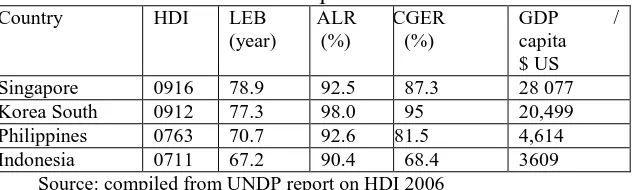
Report of the United Development Program (UNDP) may be a reference that can be used to determine the quality of human resources with other countries. According to data from the Human Development Index (HDI) or the Human Development Index (HDI). Based on 177 countries, the position of the State of Indonesia is ranked 111. According Aminudin Bakri (2011) parameter in order to assess the quality of man can be divided into four factors, namely, Life Expectancy at birth or LEB; value of life expectancy in the world, the rate Adult literacy rate or ALR; that is based on the percentage of children which have been aged 15 years has been able t o read, based on survey Combined primary, secondary and tertiary gross enrollment ratio
[image:23.595.138.454.441.536.2](CGER) or the Gross Enrolment Ratio (GER), the ratio students registered, and according to the Gross Domestic Product, or GDP, is opportunity gross domestic(GDP). According to the UNDP report of 2006 showed that the human development index in 2004 as follows.
Table 1 Data Development Index Human
Country HDI LEB (year)
ALR (%)
CGER (%)
GDP / capita $ US Singapore 0916 78.9 92.5 87.3 28 077 Korea South 0912 77.3 98.0 95 20,499 Philippines 0763 70.7 92.6 81.5 4,614 Indonesia 0711 67.2 90.4 68.4 3609
Source: compiled from UNDP report on HDI 2006
Table 2 Global competitive Index
No. Country Score World Ranking Ranking ASEAN 1 Singapore 565 2 1 2 Malaysia 516 20 2 3 Thailand 466 31 3 4 Indonesia 475 34 4 Source Global Competitive Index 2014
[image:23.595.150.448.563.649.2]Enhancing college human resources quality... 17 Aris Indriyanti
Similarly, in the study of higher education, the problem of human resources becomes very crucial in improving the competitiveness of graduates. Quality faculty and all employees ineffectiveness of education becomes the main thing to improve the competitiveness of college graduates. So the high quality of human resources in a college it will be the higher competitiveness in the university, so the quality of human resources will create a competitive graduates compared to graduates at other universities. Based on this background, this paper will present a number of analysis and thinking about the importance of improving the quality of human resources to improve the competitiveness of higher education in many developing countries.
WRITING METHOD
The method used in analyzing this problem is the study of literature on the role of human resources to improve the competitiveness of universities in facing the challenges of globalization towards society MEA.
LITERATURE REVIEW
Analysis of the problem regarding the quality of human resources need to be supported with references will describe some support materials.
Education in Higher Education
Factor of education is a very fundamental in improving the quality of life, besides there are social and economic factors in the direction of better conditions(Prima Riza 2007).Seven principles that can help to improve undergraduate education are identified. According to W .;Gamson, Zelda F based research on college teaching and learning, good practice in undergraduate education: (1) Improve the relationship between students and faculty ; (2) scaling up of mutual relations and cooperation between students ; (3) developing active learning techniques (4) provide instant feedback; (5) emphasizes time on task;(6) communicate high expectations; and (7) respect diverse talents and ways of learning. Examples of approaches that have been used in various types of universities in recent years are described. In addition, the implications of these principles for the funds the way the state and regulate higher education and to organizations how to run briefly discussed. An example of a good approach such as: seminar students on important topics taught by senior faculty; study groups of 5-7 students who meet regularly during the class to solve the problems set by the instructor; active learning using structured exercises, discussions, team projects, and criticism of colleagues, as well as internships and study independent; and mastery learning, learning contracts, and computer-assisted instruction approach, which takes a considerable time to learning.
Competitiveness of Human Resources in Education
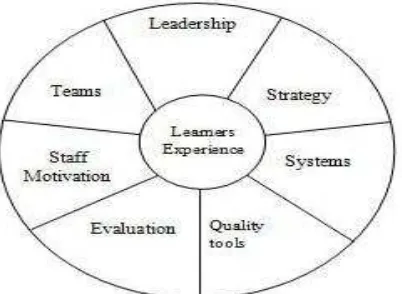
in order realizing quality education more effective and more efficient. Based on the arrangement drawings of human resources to enhance competitiveness
Figure 1. Resource Planning in Education Administration Engkoswara
Based on the above picture there is source power and the main cultivated fields, namely:
(1) Resources human resources (HR), which consists of several components consisting of students, teachers, staff, and communities that use and take advantage of educational services;
(2) Factor further is Learning resources (SB) is a plan learning activities can be used as a medium and a tool for learning, including curriculum
(3) Source facility and availability of funds for education(SFD)is factor that can support and enable educational walk in accordance with the expected.
Growth and development have requirements that can be used to implement more efficient use of technology with the resources Human power is generated through the education process will be used in the existing educational technology (Linda Setiawati, 2012).
Quality of Human Resources
Quality according to the definition of Phil Crosby is universal agreement on a standard or standards that have been defined (conforming to specification) by Josep Juran defined as fitness for use or fitness for a benefit or usefulness (Soin, 1993). Quality of which must be owned by professor (lecturer), which became the main thing to improve the quality of college graduates. In this case the lecturer is required to be committed in teaching, because the main thing for the achievement of these goals, because many professors in at universities that do not commit fully to the college. Problems of education in Indonesia is still about the poor quality, and there relevance, efficiency and productivity are not maximized. The cause is the availability of teachers and inadequate quality and welfare of teacher shave not been up to standard(MONE Strategic Plan, 2005). Is expected to appear are form effort that can improve the quality of human resources quality Edward Sallis(1993)states "Quality management is a continuous circle of improvement continues and more priority improvement and
Enhancing college human resources quality... 19 Aris Indriyanti
Figure 2 Quality Circles Human Resources
According Deden "Higher education remains one of the key competitiveness of nations. Therefore it must have quality and continue to explore and create human resources and product quality ".Under the National Education Act of 2003 in Article 19 paragraph (1) states "college is the level of education after a secondary education which includes educational programs include diploma, undergraduate education, graduate studies, specialization education and doctoral education are held by universities high.
DISCUSSION
HDI relationship with the reality of Indonesian human resources in higher education is very influential in the field of education. Education field has become a expectation of hope for quality improvement and quality of human resources in Indonesia. According to Robert M. Hutchinson, (1998), Educations is an understanding. Education is the only way to, and more useful life. This article is trying to overview the role of education in producing quality Nevertheless there are still many problems of our education for the world of work and the integrity of a nation; our students when out and or. Not easy to change opinions and thoughts the wider community in brief. Similarly, the problems of competitiveness are in college. There as some solutions to solve the problem of competitiveness of graduates divided into three aspects related to the above.
work well if the desired goal can be achieved with good (Donnelly, Gibson and Invanccevich: 1994) .Stated that performance is one of the principal roles in an interaction between the ability or ability (A), the chance or opportunity (O) and motivation or motivation (M) so that it can be formulated that performance = f (AXOXM).That is: the performance is a function of one's ability and provides the opportunity and motivation (Robbins: 1996).
HR performance is closely linked with the competencies required of HR and commitment to an organization for the globalization era. Competent be possessed SDM must meet some basic competence between the covers education and commitment to build emotional intimacy with a unified vision and mission of individuals with a vision that is organized, the desire to commit to implementing performance management and a willingness to stay in the organization with a sense of security in organizations Between some components already mentioned, a more dominant factor in improving the competitiveness of Higher Education is good leadership and competent in assuming responsibility on faculty level and at the level of universities.
HR-quality and reliable, has a superb character strong, highly competitive and has a high intellectual is a basic principle which is indispensable in order to create superior products, authoritative, intelligent, exemplary, and moral quality. Additionally HR should be able to have the academic competence, pedagogical competence in managing learning in college, has a superior professional competence and personality competence, authority and a good role in communicating relationship social with the community and students. Source human power can be ready to face the challenge to the ASEAN Economic Community (AEC) in the globalization era(Baedhowi, 2009: 2).
CONCLUSION
As part of the nation heading to the ASEAN Economic Community (AEC) in the globalization era various problem must be faced. Facing a wide range of issues is more crucial and must be repaired. The problem is more complex HR lack of human resources and the quality of education, with the problems caused competitiveness a nation to be low based on the above study it can be concluded that the competitiveness of the organization or college is strongly associated with the performance of HR, especially related to improving product quality academic, educational services and user loyalty.
Enhancing college human resources quality... 21 Aris Indriyanti
REFERENCES
Aminuddin, B. (2011). Reorientasi kebijakan dan pengelolaan pendidikan teknologi dan kejuruan (Ptk) di era desentralisasi. Jurnal MEDTEK, 3(2).
Baedhowi. (2009). Tantangan pendidikan masa depan dan kiat menjadi guru
profesional. Seminar Nasional dan Launching Klub Guru Indonesia Wilayah Yogyakarta.
Deden, S. (2010). Daya saing perguruan tinggi. https:// dedensoleh. wordpress.com/ 2010/02/04/daya-saing-lulusan-perguruan-tinggi/ Deden Sholehudin. Diiakses tanggal 29 November 2015.
Departemen Pendidikan Nasional Republik Indonesia. (2005). peraturan pemerintah Republik Indonesia nomor 19 tahun 2005 tentang standar nasional pendidikan.
Donnelly., Gibson and Invanccevich. (1994). Organisasi: perilaku, struktur proses jilid 1-2. Jakarta: Erlangga.
Euis, K. (2009). Membangun daya saing bangsa melalui pendidikan refleksi profesionalisme guru di era globalisasi.
Engkoswara. (1999). Dasar-dasar administrasi pendidikan. Bandung: Alfabeta.
Hatten, K. J., & Rosenthal, S. R. (2001). Reaching for the knowledge edge. New York: Amrican Management Association.
Robert, H. M. (1998). The learning society: a mentor book, the britannica perspectives. Laporan world economic forum (2008-2009). The global competitiveness report. Setiawati, L. (2012). Studi pada perguruan tinggi negeri di Jawa Barat Menuju World
Class University. Jurnal Penelitian Pendidikan,13(2).
Porter, M. E. (2009). The global competitivenestreport. world economic forum
Nasri Bachtiar. Daya saing perguruan tinggi http://fekon.unand.ac.id/in/home/1032-daya-saing-perguruan-tinggi-oleh-prof-dr-nasri-bachtiar. Diakses tanggal 1 desember 2015.
Jalal, P. R. (2007). Competency manajement: teknik mengimplementasikan manajemen SDM berbasis kompetensi untuk meningkatkan daya saing organisasi Jakarta: PPM.
Prima, R. ( 2007). Pendidikan dan mutu manusia. Jurnal sosio teknologi Edisi 12.
Robbins, S. P. (1996). Perilaku organisasi, Jilid 2. Jakarta: Prehallindo.
Salis, E. (1993). Total quality management in education. London: Kogan Page. Soin, S. S. (1993). Total quality esentials. McGraw Hill.
Undang-undang Republik Indonesia Nomor 20 Tahun 2003 tentang Sistem Pendidikan Nasional.
The State of Teacher Education in Region V: Policy Implication
Arlene O. Monsalve
College of Teacher Education
University of Saint Anthony, Iriga City, Philippines
Abstract
This study determined the status of Teacher Education Institutions (TEI’s) in
Region V and provided implications of the profile to the thrusts of Higher Education in the Philippines. Through descriptive-survey method, data were
taken from the records of TEI’s with the Dean as key informants. Major findings were: the increase of enrolment in TEI’s can be attributed to the K to 12
implementation; the Bachelor of Elementary Education, Bachelor of Secondary Education and Bachelor of Science in Industrial Education are the programs
offered in the TEI’s; as to the accreditation levels, out of 74 TEI’s (private, SUC’s and LUC’s), six (6) are accredited Level I, nine (9) Level II, four (4)
Level III; three (3) on candidate status and the rest are not accredited; as to the over-all performance in the Licensure Examination for Teachers, there are more
passers in the Elementary than in the Secondary level; SUC’s have the highest
number of faculty researches; faculty members are dominated by females and
none of the TEI’s has Special Centers or Institute on Community Extension. On
quality and excellence, the findings imply that there is a need to submit for
accreditation, CHED’s Institutional Sustainability Assessment and benchmark in
high performing TEI’s on efficiency and effectiveness. TEI’s need to enhance faculty qualification through scholarships, impose stricter admission requirements, improve content and pedagogy; On relevance and responsiveness,
TEI’s need to establish linkages and put emphasis on educational technology; On
access and equity, TEI’s should promote CHED scholarships to high school
graduating students.
Keywords: State of Teacher Education Institutions, Policy Implications
INTRODUCTION
The character of an institution can be seen in the extent to which its regular functioning reflects concern for quality. Every academic institution evolves its own functional modalities in its efforts towards actualizing its goals. These modalities represent institutional characteristics making it a distinct environment. An academic institution always is functionally autonomous but has working linkages with a broader framework of a macro context. An institution providing professional education programmes has these features more pronounced as it draws its resource inputs and clientele from the macro set up as well as giving the product benefit to the same. This puts the quality aspect of a professional education institution under spotlight. A teacher education institution (TEI) is no exception. Further it has to be recognized that the quality of a TEI is not merely determined by the product performance in the field but also has to be seen in respect of its functional elements in the overall context of the institutional vision.
complex, rapidly changing world. Quality Teacher Education has a great role in answering the demands of global competitiveness. It is stated in Article I, Section 1 of CHED Memorandum Order No. 30, Series 2004, ―Revised Policies and Standards for Undergraduate Teacher Education Curriculum‖, to wit:
Quality pre-service teacher education is a key factor in quality Philippine education. In the Philippines, the pre-service preparation of teachers for the primary and secondary education sectors is a very important function and responsibility that has been assigned to higher education institutions.1
Likewise, Republic Act No. 77842 aims to provide and ensure quality education by strengthening the education and training of teachers nationwide through a national system of excellence for teacher education. Its vision is a teacher education system whose mission is to educate and train teachers of unquestionable integrity and competence, and who is committed to their continuing professional growth and obligation to help their students grow as responsible individuals and citizens of the Philippines and of the world.
Indeed, all efforts to improve the quality of education in the Philippines are dependent on the service of teachers who are properly prepared to undertake the various important roles and functions of teachers. As such, it is of utmost importance that the highest standards are set in defining the objectives, components, and processes of the pre-service teacher education curriculum.
Considering that the TEIs are tasked to produce quality teachers who will be handling elementary and secondary levels of basic education, it is of utmost importance that Teacher Education Institutions should know their strengths and sustain them; and to improve on their weaknesses. Particularly now that the 12-year basic education cycle has been implemented, the task of training teachers who will handle the basic education is the responsibility of the TEIs. TEIs must give its utmost concern in producing quality graduates to answer the purpose of this basic education which is to be at par with international standards.
Forecasting and planning to achieve the goals of providing quality education requires research. The primary purpose of this research is to project the scenarios of
TEIs in the region. The Region’s database on Teacher Education therefore will contain
sufficient information for scientific planning to be undertaken. Thus, this study.
THEORETICAL FRAMEWORK
The present study is anchored on Theory of Performance (ToP) by Don Elger which have bearing on the problem studied. The Theory of Performance (ToP) by Don Elger3 develops and relates six foundational concepts to form a framework that can be used to explain performance as well as performance improvements. To perform is to produce valued results. A performer can be an individual or a group of people engaging in a collaborative effort. Developing performance is a journey, and level of performance
describes location in the journey. Current level of performance depends holistically on 6 components: context, level of knowledge, levels of skills, level of identity, personal factors, and fixed factors. Three axioms are proposed for effective performance improvements. These involve a performer’s mindset, immersion in an enriching environment, and engagement in reflective practice.
The state of teacher education in Region V... 25 Arlene O. Monsalve
advancing is used to characterize effectiveness of performance. That is, a person or organization performing at a higher level produces results that can be classified into categories:
(1) Quality increases—results or products are more effective in meeting or exceeding the expectations of stakeholders;
(2) Cost decreases—amount of effort or financial resources to produce a result goes down; amount of waste goes down;
(3) Capability increases—ability to tackle more challenging performances or projects increases;
(4) Capacity increases—ability to generate more throughput increases; (5) Knowledge increases—depth and breadth of knowledge increases;
(6) Skills increase—abilities to set goals, persist, maintain a positive outlook, etc. increase in breadth of application and in effectiveness; and,
(7) Identity and motivation increases—individuals develop more sense of who they are as professionals; organizations develop their essence.
With the insights gained from the aforementioned theory, the researcher was able to theorize that having a clear view on the status of the Teacher Education Institutions (TEIs) could lead to policy recommendations and actions towards the improvement of the quality of teacher education institutions in the region.
CONCEPTUAL FRAMEWORK
The conceptual paradigm of the present study was based on the system’s approach which shows the interplay of the three important elements: input, process and output.
Input. It includes the characteristics of the Institutional Profile of Teacher
Education Institutions (TEIs) in the Bicol Region in terms of curricular program offerings, accreditation status, number of school by province and by type, enrolment profile, performance in licensure examination, faculty qualification, students assistance and scholarship programs, faculty researches, and extension and community involvement; the implications of the profile alignment with the thrusts of Philippine Higher Education (CHED) along quality and excellence, efficiency and effectiveness, relevance and responsiveness, access and equity; and, formulation of policy implications for the improvement of the teacher education institutions in the region.
Process. It consists of the analysis and interpretation of the data on the Profile
of Teacher Education Institutions (TEIs) in the Bicol Region; along the thrusts of Philippine Higher Education. (CHED)
Output. Based from the findings of the present study, would formulate policy
implications for the improvement of teacher education institutions in the region.
The feedback loop provides mechanism for the continuing development of the study to further achieve the identified goals.
Statement of the Problem
The main goal of the study is to determine the status of the Teacher
Education Institutions in Region V. Specifically, it seeks to answer the following queries:
(1) What are the Profile of Teacher Education Institutions (TEIs) in the Bicol Region in terms of:
(a) Curricular Program Offerings (b) Accreditation Status
(d) Enrolment Profile
(e) Performance in Licensure Examination (f) Faculty Qualification
(g) Students Assistance and Scholarship Programs (h) Faculty Researches
(i) Extension and Community Involvement
(2) What are the implications of the profile alignment with the following thrusts of Philippine Higher Education (CHED):
(a) Quality and Excellence (b) Efficiency and Effectiveness (c) Relevance and Responsiveness (d) Access and Equity?
(3) What policy implications can be recommended for the improvement of the teacher education institutions in the region?
Assumptions
The study guided by the following assumptions:
(1) The Profile of Teacher Education Institutions (TEIs) in the Bicol Region in terms of Curricular Program offerings, accreditation status, number of school by province and by type, enrolment profile, performance in licensure examination, faculty qualification, students assistance and scholarship programs, faculty researches, extension and community involvement varies.
(2) There are implications aligned with the thrusts of Philippine Higher Education (CHED) along quality and excellence, efficiency and Effectiveness, relevance and responsiveness, access and Equity.
Policy implications can be recommended for the improvement of the teacher education institutions in the region.
Scope and Delimitation
The main goal of the study is to determine the status of the Teacher Education Institutions in Region V. It particularly focuses on the Profile of Teacher Education Institutions (TEIs) in the Bicol Region; and, the implications of the profile alignment with the thrusts of Philippine Higher Education (CHED).
The participants of the study were the State Universities and Colleges, Community Colleges, Private Colleges and Universities offering Teacher Education Program.
REVIEW OF RELATED LITERATURE
What do student teachers need to learn in order to become effective? Teachers in the contexts in which they will be employed? That is the most fundamental of all the questions that can be asked about teacher education.
The crucial factor is the foundation on which the professional training is based. Especially controversial were the relationships between the university or college offering the programs and the schools for which the student teachers were being prepared. Traditionally, schools provided professional experiences during the practicum
The state of teacher education in Region V... 27 Arlene O. Monsalve
the role of experienced teachers employed in the schools. Whereas it had been more usual for them to act as advisers and supervisors of initial school experience, they now sometimes undertook much responsibilities, such as designing and coordinating the whole program, with universities providing a supporting role and awarding the final qualification.
The types of institutions offering initial teacher education programs also vary from system to system. In some places, teacher education, especially at the elementary level, is offered in single purpose, state-run or private colleges known often as teachers colleges or colleges of education. In other countries, teacher education is offered by multipurpose institutions, sometimes called polytechnics, which are tertiary education institutions emphasizing training for a variety of occupations, for example paramedical services, occupational therapy, and journalism.7
Providing actual teaching experience in real school situations (the practicum) is one of the most challenging tasks for planners of teacher education. Traditionally, in the elementary school context, the student teacher was placed with a volunteer school teacher and would be assigned lessons to design, prepare, and present under that teacher's guidance. Usually these lessons would number about three per day, after an initial period of orientation and observation, for about three weeks each year of the program. The teacher would provide feedback on a selection of those lessons but, in order to develop confidence and independence, would not be present for all of the lessons, especially toward the end of the period of practice teaching. The college or university in which the student teacher was enrolled would usually appoint one of its own faculty to supervise this process and that person would visit and observe the student teacher on several occasions and would have the responsibility of reporting on progress and awarding a grade, after discussing the experience with both the student and the cooperating teacher. Student teachers would often have other assignments to complete as well as those involving face-to-face teaching. For example, they might be required to establish a file on school organization and curriculum resources in the school. In the context of the secondary school, in which the student teacher might be obtaining experience in a number of specialist subject areas involving more than one school department, a corresponding number of cooperating teachers and college or university supervisors might be appointed.
This traditional approach to the practicum has been criticized on the grounds that it militates against bridging the gap between theory and practice, when the two might be learned more effectively if integrated. In some cases the problem was approached by trying to make the university or college the site of more practically orientated school experiences. Thus, such innovations as laboratory schools were established at the university. Over the last three decades of the twentieth century, the bridge was sought in the form of simulations, such as microteaching. Microteaching usually occurred on the campus of the college or university. It consisted of scaled-down teaching situations in which shorter than normal lessons would be taught to smaller groups of students with limited numbers of teaching skills to be practiced in pursuit of a small number of learning objectives. Usually, teaching spaces were developed and built specifically for the environment of microteaching. The lessons would be videotaped, so that the student teacher could view the lesson, often in consultation with peers and a supervisor or mentor, and obtain feedback which could be used in re-planning the lessons.
"competency-based" teacher education gave too much emphasis to the "performance" or "behavioral" aspects of teaching at the expense of insight and reflection. Accordingly, calls for more reflective approaches were made and were accepted. Marvin Wideen and colleagues,8 after an extensive review of research on the effectiveness of innovations in teacher education, including reflective practice, found little encouragement for their adoption, and concluded that such innovations have little ability to affect beginning teachers within teacher education structures.
Major challenges for initial teacher education in the twenty-first century include: (1) The raising of the status of the teaching profession to a level at which it attracts
the best qualified applicants;
(2) Harnessing rapidly developing technology to provide maximum learning opportunities for student teachers, especially those in remote areas and those in developing countries, where conventional resources such as libraries are impossible to resource adequately;
(3) Discovering the optimum balance between theory and practice in the curriculum of teacher education in the many and varying contexts in which it is provided. (4) Developing teacher education structures and curricula that provide
(5) optimal balances among the academic, humanitarian, aesthetic, and moral domains of human experience.
A redesign of our education systems (including teacher education) is essential if they are to be more effective in policy development for the long term and yet still retain their capacities to cope with the present. Since it is unlikely that there will be major increases in resources for education, the redesign of education systems will clearly need to make better use of current resources, both human and material. To accomplish this, we must a