Side Grafting of Unproductive Cocoa: Socio-Economic and Ecological Impact
Taryono1 and Dyah Weny Respatie1
ABSTRACT
Cocoa is a tree of the humid lowland tropics produced largely by small
farmers, therefore in developing countries it can be used to generate farmer’s
income, provide labor employment and conserve environment. At the last decade, the cocoa productivity, the size and quality of beans in Indonesia significantly tend to decline due to the ageing of the tree, poor farming maintenance practice, planting of low yielding variety and ravages caused by pest and diseases. Such declining affects the price and the farmer’s income, and farmers respond by leaving the plantation, replacing with food crops or oil palm, and increasing forest clearing which will threaten the environment. Such problem can be addressed by increasing the long term cocoa productivity of existing farms through side grafting of unproductive cocoa trees with genetically improved varieties. In 2008, it was reported that there are around 235.000 ha of unproductive cocoa that can be improved though side grafting. There was almost 90.000 ha that has been side grafted in 2009 and 2010 by the government support, and in 2011 evaluation through focus group discussion has been carried out. Side grafting with recommended varieties normalizes the cocoa growth, and cures the diseases. With a recommended cultivation technique, the productivity increases twice which followed by improve seed size. These result probably will gives an impact not only on the
income but also farmer’s future. Several farmers informed that they will not
demolish their cocoa farm or even clear new land for crop food. Normal growth of cocoa and stopping opening new land will have a positive effect to the environment especially in mitigating climate change.
Keywords: side grafting, cocoa
INTRODUCTION
Cocoa is one of the important tree crops in the world which grown for the beans used for the manufacture of drinking cocoa and chocolate (Bindu & Malika, 2008). Cocoa is grown in developing countries across tropical Africa, Latin America and Asia. Cocoa plantation is one of the most important forms of land use and of enormous economic importance (de Graaff, 1986). Most of cocoa beans produced globally are originally from cocoa trees which are cultivated by smallholder farmers who manage only a few ha and generally rely on family labor (Neilson, 2010). Cocoa provides a source of income for a lot of farmers due to its capability for generating high economics value of beans and employment.
1
Cocoa trees can start bearing pods within two or three years and reach peak production after ten years (Neilson, 2010). In some cases, they can continue bearing pods for decades and the production usually declines rapidly after 25 years old and ageing trees are normally susceptible to various pest and diseases.
Indonesia is currently belong to the largest cocoa producing countries in the world, mainly bulk cocoa based on forester hybrid (Johnson et al., 2004; Meulemans et al., 2002). Cocoa plantation has been developed since 1980s and smallholders cocoa farmers who own plots ranging from 0.5 to 1.5 ha dominate almost 93% of cocoa area (Abbate, 2007). In 2010, the total cocoa area reaches 1.587 million ha. The boom factors include low cost of labor, abundant suitable land, government aid policy for development (Ruf et al., 1995). At the last decade, the cocoa productivity, the size and quality of beans significantly tend to decline due to the ageing of the tree, poor farming maintenance practice, planting of low yielding variety and ravages caused by pest and diseases. Similar condition and causal factors were reported in Cameroon by Bisseluea (2007). Such declining affects the price and the
farmer’s income, and farmers respond by leaving the plantation, demolishing
the cocoa trees and substituting with food crops or oil palm, and increasing forest clearing which will threaten the environment. Such problem by the government will be addressed by Cocoa National Program which focused on replanting of old and heavy damaging trees, rehabilitation means increasing the long term cocoa productivity of existing farms through side grafting of unproductive cocoa trees with genetically improved varieties, and intensification of low productivity of cocoa trees. In 2008, it was reported that there are around 235.000 ha of unproductive cocoa that can be improved through side grafting and there was almost 59.500 ha spread in 6 provinces has been side grafted in 2009 and 28.400 ha in 10 provinces by 2010. In 2011, almost all side grafted trees in 2009 started bearing pod; evaluation through focus group discussion therefore has been able to be carried out.
MATERIAL AND METHODS
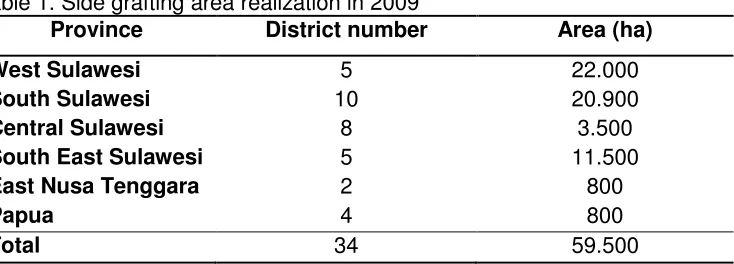
In 2009, there was 59.500 ha low cocoa productivity which spreads in 6 provinces have been rehabilited through side grafting by the Indonesia Government. Four provinces are located in Sulawesi Island, 1 in East Nusa Tenggara, and another in Papua (Table 1).
Field visit is used to see the field condition and tree performance included pest attack, pods number and size, and even seed size. In the focus group discussion, the types and cost of input, beans price and the socio impact of rehabilitation will be questioned. To estimate the ability of side grafting cocoa trees in sequestrating carbon,carbon in the leaves form measured by Moesser et al., (2010) will be exploited. Information will be analyzed descriptively to come with comprehensive conclusion.
Table 1. Side grafting area realization in 2009
Province District number Area (ha) caused by the ageing of the tree, poor maintenance practice, planting of low yielding variety and ravages due to pest and diseases attack. Nielson (2010) stated that cocoa production usually decreased rapidly after 25 years old. Cocoa boom happened in Indonesia in 1980s and due to the cultivation of low yielding variety, the national productivity only reaches 1.100 kg dry beans/year/ha. Since 2003, the productivity tends to decrease. Indonesian cocoa is affected by three main diseases and pest problems such as pod borer caused by Conopomorpha cranuella, vascular streak disease (VSD) by
Oncobasidium theobromae and fungal disease by Phytophtora palmifora
To do side grafting, rootstock must be in the active growth phase, which is characterized by flushing. Land tillage, fertilizer application, pruning and sometime irrigation may stimulate the plant growth. The best time of side grafting should be done on dry season, at 40 – 60 cm height of the rootstock. Shoot-stock (scion) must be protected using transparent plastic and tightly bound so that rain water has not damaged the grafting. After 3-4 weeks, the plastic cover was removed and tree must be pruned to provide enough sunshine to the shoot. The main stem must be cut out when the shoot reaches 6 months old. Later on, fertilizer must be applied in the dosage of 200 g NPK per plant a year to support the trees growth.
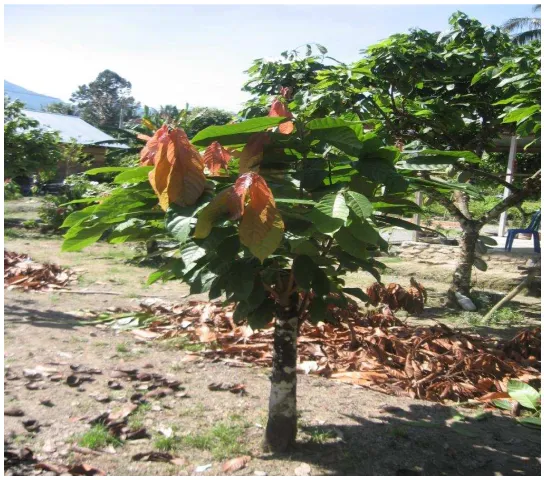
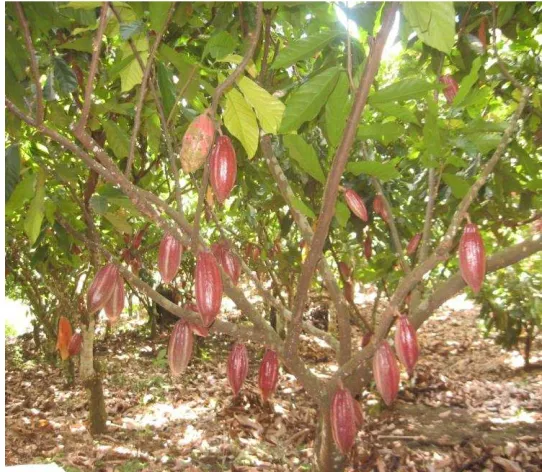
Evaluation ofthe impact of side grafting on cocoa growth and productivity Based on survey, the original tree means rootstock was 13 years old. Some of them showed VSD symptom and the productivity was reported only 519 kg dry beans/ha/year (Table 2). The condition of original tree in Central Sulawesi seems better than South Sulawesi shown by the still better productivity in the Central. Side grafting in Sulawesi Island can be executed in July. In January in the coming year, the plastic cover could be opened. The cocoa side grafting grew normally. Two-three months after main stem cutting, the new shoot showed vigorous growth (Figure 1.) and after 14 months some trees started bearing pods (Figure 2). Side grafted cocoa is characterized by free from VSD disease, shorter trunk with pods coming from the new shoot and sometime also from the main stem (Figure 3). Shorter cocoa trees are preferred due to easily pod harvesting and pruning.
Figure 2. Bearing pods of side grafted cocoa,2011
Almost100 % farmersbelievedthatside grafting can increased cocoa beans productivity crop. According to farmers when the side grafted tree entered thethird year, the productivitywouldreach1.574kgdrybeans/ha/year, an increase of 1.089kgdrybeans/ha/yearor203% (Table 2). In 1995, higher result was achieved till 2000 kg dry beans/year/ha in similar island (Ruf et al., 1995). The production sustainability has been questioned however by a lot of researcher. Since 2003, the national cocoa productivity then has been dropped and the condition in Sulawesi was even worst. In 2008, it was reported that the cocoa productivity in Sulawesi was only 500 kg dry beans/year/ha (Manggabarani, 2008).
As a result of such productivity improvement, farmersinsomedistrictsof SulawesiIsland are moreconfident to rehabilitate their own farms. The productivity will be sustained, especiallyif theplantwas managed with a recommended cultivation technique such asfertilizer application, weeding, pruning, and sanitation through close composting of organic matter such as leaves, pods husk and twig. Direct close composting in the field will improve soil fertility and avoid pest sources.
Table 2. The impact of side grafting on cocoa productivity in 2011 No. Districts Realization
system, non shaded strategies with more chemicals. Unfortunately such high productivity could sustain for longer times, they only produced for 6 – 8 years. Evaluation ofthe impact of side grafting on farmer’s income
When the productivity increases, theoretically the farmer’s income will
improve. However the farmer’s income depends upon the beans price and hoe, hand-sprayer, plant-scissor and basket, and also some taxes (Table 3). The most expensive input cost is fertilizer. If an-organic fertilizer is used, each tree needs 400 g/year. The introducing of organic fertilizer especially bio-fertilizer may reduce the cost.
Table 3. Estimated input cost of cocoa field of Banggai district
No. Expenditure cost
When the price of unfermented dry beans is valued 20.000 IDR, the revenue of cultivating side grafted cocoa reached between 24 – 40 millions IDR (Table 4). The lowest revenue was estimated in Soppeng district due to low productivity. Farmers in Central Sulawesi seem more optimistic than in South Sulawesi. They believed that rehabilitation their cocoa tree with recommended varieties can increase their income up to 31,5 millions IDR/ha/year and cocoa field rehabilitation through side grafting will improved the farmer’s welfare.
Table 4. Total input cost, revenue and income of some rehabilitation districts
District
Sidrap 2.250.000 7.250.000 7.500.000 32.000.000 5.250.000 24.750.000
Soppeng 2.700.000 6.820.000 5.000.000 24.000.000 2.300.000 17.180.000 North
Luwu 2.700.900 8.634.000 12.000.000 32.000.000 9.299.100 23.366.000
Banggai 6.815.000 8.610.000 12.000.000 40.000.000 5.185.000 31.390.000
Parimo 4.050.000 8.500.000 12.000.000 40.000.000 7.950.000 31.500.000
Side grafting with recommended varieties normalizes the cocoa growth, and cures the VSD diseases. With a recommended cultivation technique, the productivity increases twice which followed by improve seed size. Several farmers informed that they will not demolish their cocoa farm or even clear new land for crop food.
Evaluation ofthe impact of side grafting on environment
It is very difficult to measure the impact of side grafting of cocoa on the environment especially when cocoa tree is intensively cultivated (Ntiamoah & Afrane, 2008). There is some negative impact of intensive cocoa production such as the use of pesticide and an-organic fertilizer which can lead to the destruction of part of the soil flora and fauna through physical and chemical deterioration (Cowell & Clift, 1997).
Cocoa production is also suspected to make the largest contribution to eutrophication which is mainly caused by leakage of nutrient during cultivation and cocoa plant disease because cocoa tree generates large amount of solid waste such pod husks. Such waste become significant source of disease when use as mulch inside the plantation (Ntiamoah &Afrane, 2008).
yielding and pest resistant varieties as scion material are recommended to further enhance the environment.
Cocoa side grafting means “increasing the long term productivity of
existing cocoa farm, restoring abandoned lands and mitigating climate
change” (Rice & Greenberg, 2000). Carbon dioxide is the most important greenhouse gases due to its abundant concentration and superior ability to trap heat (Innocent & Gee, 2008). Cocoa tree can contribute to the carbon storage (Sonwa et al., 2009), therefore side grafting of cocoa can contribute to improve environment through carbon sequestration. Carbon sequestration is the process of transferring CO2 from the atmosphere into the soil through crop residues and other organic solids, and in a form that is stable and not easily releases (Sundermeier et al., 2009). Carbon is primarily stored in the soil as soil organic matter. Such carbon sequestration will offsets carbon emissions from the use of fossil fuel, improve soil quality and in the long run agronomic productivity.
There were different reports on the ability of cocoa tree to fixe carbon. Gockowski et al. (1998) reported that mature cocoa tree (40 years old) fixed carbon at around 154 ton/ha; cocoa system of 15 – 25 years olds showed on average carbon amount of 111 and 132 ton/ha respectively, whereas Sonwa et al. (2009) published that plant associated with cocoa, cocoa trees, litter and roots store respectively 170, 13, 4 and 18 ton carbon/ha. Mosser et al. (2010) reported that cocoa can produce 2,76 ton/ha leaves; 22,32 ton/ha stem and braches and 5,74 ton/ha roots. It seems that the ability of cocoa tree to capture CO2 is very high. With proper handling of organic waste at the plantation, side grafting can prolong the ability of capture carbon. A primary strategy in mitigating climate change is to adopt land use and agricultural management that will reduce greenhouse gas emission and increase carbon sequestration. Side grafting of unproductive cocoa due to poor farm maintenance practice, planting low yielding variety and ravages caused by pest and diseases seems to be an appropriate approach to mitigate climate support. We wish also to thank to Mr. M. Sarjono, Dr. Wayan A. Susila, Dr. H. Hanafi and all the working groups for the fruitful collaboration.
Abbate, M. 2007. The “Sweet Desire” cocoa plantation and its knowledge
transfer in Central Sulawesi, Indonesia. University of Gottingen. Germany
Bisseluea, D. H. B. 2007. Ecological, social and economics determinants in cocoa productivity system in Southern Cameroon. Dissertation. University of Gottingen. Germany
Bier, J. R. Muschler, D. Kass., E. Somariba. 1998. Shade management in coffee and cocoa plantation. Agroforetsry systems 38: 139 – 164 Bindu, M. R., V. K. Malikka. 2008. Micrografting in cocoa (Thobroma cacao
L.). International Journal of Agricultural Science 4: 601 – 603
Cowell, S. J., R. Clift. 1997. Impact assessment for LCA involving agricultural production. International Journal of LCA 2: 99 – 103
De Graaff, J. 1986. The Economics of Coffee. Pudoc. Wageningen. The Netherlands
Gowkowski, J., B. Nkamleu, J. Wendt. 1998. Implications of resource use intensification for the environment and sustainable technology systems in the central Africa rainforest. International Institute of Tropical Agriculture. Cameroon
Johnson, G. I., A. Iswanto, J. Ravusiro, P. J. Keane, N. Hollywood, S.V. Lambert, D. I. Guest. 2004. Linking farmers with markets: the case of cocoa. In: Agriculture Product Supply Chain Management in Developing Countries (Johson & Hoffman, eds.). ACIAR Proceedings 119c.
Hartemik, A. E. 2005. Plantation agriculture in the tropics. Environmental Issues. Outlokk on Agriculture 34: 11-21
Innocent, N. M., J. Ge. 2008. Toward a sustainable land use option in Bamande Highlands Cameroon: implication for climate change mitigation, income generation and sustainable food supply. Research Journal of Applied Science 3: 51 – 65
Meulemans, C. C. E., U. Surapati, A. Tjatjo. 2002. Colorimetric measurement of cocoa beans (Theobroma cacao L.). Indonesian Journal of Agricultural Science 3: 52 – 57
Moesser, G., C. Leuselner, D. Hertel, D. Hoelscher, M. Koehler, D. Leitner, B. Mitchalchik, E. Prihastanti, S. Tjitrosemito, L. Schwendenmann. 2010. Response of cocoa trees (Theobroma cacao) to a 13 – month dessication periods in Sulawesi, Indonesia.
Neilson, J. 2010. Chocolate: a global value chain of tropical commodities. Geodate 23: 7 - 10
Ntiamoah, A., G. Afrane. 2008. Environmental impact of cocoa production and processing in Ghana: life cycle assessment approach. Journal of Cleaner Production 16: 1735 - 1743
Rice, R. A., R. Greeberg. 2000. Cocoa cultivation and the conservation of biological diversity. Ambio 29: 167 - 173
Economics of Cocoa Supply (Ruf & Siswoputranto, eds.). Woodhead Pub. Ltd. England
Sonwa, D. J., S. F. Weise, B. A. Nkongmeneck, M. Thatat, M. J. J. Janssens. 2009. Carbon stock in smallholders chocolate forest in Southern Cameroon and the potential role in climate change mitigation. Earth Environmental Science 6: 1 -10. Doi: 10.1088/1755-1307/6/5/252008 Sundermeier, A., R. Reeder, R. Lal. 2008. Soil Carbon