145
The Impact of Celebrity Fan Club towards the Willingness to Stay at Hotel XYZ
Armando
International Business Management Program, Petra Christian University Jl. Siwalankerto 121-131, Surabaya
E-mail: [email protected]
ABSTRACT
Tourism industry is one of the most important industry in Indonesia. In Jakarta, five-star hotel has been one of the most promising business. This research is done to know the impact of Celebrity Fan Club campaign towards the willingness to stay at Hotel XYZ. The four source models, which are source credibility model, source attractiveness model, product match-up model and meaning transferability model, are elements that are used to measure the campaign which will impact the willingness to stay. The sample that the author use is anyone who has experienced staying in five-star hotels. There are 76 samples that was gathered in this research using simple random sampling method.
The analysis technique that is used in this research is multiple linear regression to know the relationship between the Celebrity Fan Club which is a celebrity endorsement towards the willingness to stay. The research result shows that Celebrity Fan Club significantly impact the willingness to stay.
Keywords: Source, Celebrity Endorsement, Willingness to Stay, Celebrity Fan Club and Branding.
ABSTRAK
Pariwisata adalah salah satu industry yang penting di Indonesia. Di Jakarta, hotel berbintang lima telah menjadi salah satu bisnis yang menjanjikan. Penelitian ini dilakukan untuk mengetahui pengaruh dari program Celebrity Fan Club terhadap kemauan untuk menginap di Hotel XYZ. Terdapat empat macam model untuk menilai program tersebut yang terdiri dari kredibilitas model, daya tarik model, kesesuaian model dengan produk, serta proses transfer arti model. Sampel yang diambil oleh penulis adalah orang yang sudah pernah merasakan menginap di hotel bintang lima. Dalam penelitian ini telah terkumpul sebanyak 76 sampel dengan menggunakan metode sampel acak.
Teknik analisa yang digunakan adalah regresi linear berganda yang bertujuan untuk menggambarkan hubungan antara Celebrity Fan Club yang merupakan dukungan selebriti terhadap kemauan untuk menginap. Hasil dari penelitian ini menunjukan bahwa secara keseluruhan, Celebrity Fan Club secara signifikan mempengaruhi kemauan untuk menginap.
Kata Kunci: Sumber, Perwakilan Selebrity, Kemauan untuk Menginap, Celebrity Fan Club and Branding.
INTRODUCTION
Tourism industry is one of the most important industry in Indonesia because it is an ever increasing sector. Tourism is one of the biggest contributor in the foreign exchange reserves. In fact, it is always a top five contributor from 2007 to 2012 against ten largest export commodity. (Kementrian Pariwisata Indonesia, n.d., Table 1). The reason of the spectacular growth is because there are a lot of tourist destination in Indonesia. There are Bali, Jakarta, Raja Ampat and many other tourist destination that is worth to visit.
As a national capital city, Jakarta has been one of the most attractive tourism destination in Indonesia because of its promising growth and its tourist attraction. As a melting pot of all Indonesian culture, Jakarta has its own charm that attract both domestic and international tourist to come to Jakarta.
To the fact that Jakarta has a big potency in the Indonesian tourism industry, the provincial government has taken effort to increase its tourism attractiveness. One of the program is a double decker bus that had been operated since the beginning of March (Tahun 2014 sektor pariwisata makin cerah, 2013). The bus are launched to promote
Jakarta’s landmark as a tourism destination like the Old City
of Batavia, Monumen Nasional, Ancol, and many other place of interest.
146 accommodate a lot of national and international scale event like Jakarta Fair, Jakarta Fashion festival, Java Jazz and many more which has a large potency to attract more tourist to visit Jakarta. The campaign also promote Jakarta cuisine, golf courses, hotel, relaxation and its landmarks. Those effort by the government are effective enough to attract more tourist.
As the city with the perfect blend of culture, relaxation and city dynamics, business hotel demand is increasing over the time. Many business people need a place to stay temporarily, conduct meeting or just simply to dine to do negotiation. Many other tourist need a place to relax and enjoy the beauty of the city. With that potency in the market, hotel business is a very attractive business in Jakarta.
Positive effort from government and Jakarta growth potency has made both starred and non-starred hotel becomes a potential business. Over the years, the average occupancy rate has seen to be increasing consistently. Occupancy rate is the percentage of rooms that is occupied by guests. Moreover, compare to the national average, Jakarta has relatively higher occupancy rate over the year. Therefore, more hotels that will open up in the future seeing this trend.
In Jakarta, there are various hotel from one-starred to five starred hotel. Each class has its own market dynamics and competitive environment. One of the most intense competition is five-starred hotel market. More five-stars hotels are going to open in the future like W hotel in Ciputra World Jakarta, MGM Hotel in SCBD Jakarta and many other world hotel brands. Moreover, there are currently several high profile hotel brands that compete each other like Ritz-Carlton, Hotel XYZ, JW Marriott, Grand Hyatt, Pullman and many other hotel. These hotel must be able to provide first class room, food and services. These hotels are pushed to innovate and communicate their brand to differentiate themselves from other hotels.
One of the most distinct campaign that the author sees as an interesting topic is Celebrity Fan Club by Hotel XYZ Group. Celebrity Fan Club campaign is a program that hire celebrities to endorse the hotel to tell their experience their stay in Hotel XYZ. There are 27 celebrities that has joined this club. In this research, the author would like to know the effectiveness of this program to communicate the difference of Hotel XYZ Jakarta among the other luxury hotel.
LITERATURE REVIEW
This research analyzes the impact of Celebrity Fan Club towards the willingness to stay at Hotel XYZ. To
enhance reader’s understanding, this chapter explains about the definition of each concept that supports this research. This section is structured to explain the program concept of Celebrity Fan Club which uses celebrity as their source to communicate the brand. Then, the concept of willingness to stay.
Hotel is an establishment providing accommodation, meals, and other services for travelers and tourists, by the night (Oxford Dictionary, n.d.). Hotel XYZ is advertised as a five-starred hotel. There are several standard that must be fulfilled so that a hotel may claim to be a five-star hotel.
Every country has different rating system for hotel. In Indonesia, the hotel rating system is regulated in Ministerial Decree (Surat Keputusan Menteri): SK 22/U/VI/78 which is later updated to SK Menbudpar 2002 (Pribadi, 2008) .
Celebrity Fan Club Program
Celebrity Fan Club is an advertising campaign which involves several celebrity guests to appear in Hotel XYZ Group advertising posters. Hotel XYZ’s brand communication manager, Jill Kluge claims that all celebrities who appears on the ad are all real guests of Hotel XYZ and voluntarily joins the club. In exchange of their appearance, Hotel XYZ donate to the charity of the celebrity chosen charity cause.
Celebrity Endorsement
Celebrity Fan Club use celebrity as the endorser to the brand. According to McCracken (1989), celebrity endorsement is an act of any individual who enjoys publicity and uses it by appearing with the product or services in an advertisement. Celebrities has been widely used in advertising because endorsement is intended to create opinion leadership and influence attitude of the consumer (Hawkins & Mothersbaugh, 2010). Celebrity endorsement are also capable to communicate brand personality by personifying a brand that communicate the characteristics and meaning of the brand (Hawkins & Mothersbaugh, 2010).
A lot of researchers has made a lot of model that may measure the effectiveness of communication through celebrity endorsement. Sertoglu, Catli and Korkmaz (2014) mentioned some of the models from several of researchers. They are source credibility model (Hawkins & Mothersbaugh, 2010), source attractiveness model (McGuire, 1985), Product Match-Up Model (Kamins, 1989) and Meaning Transfer Model (McCracken, 1989). These models explains the relationship between celebrity supports
to the buyer’s behavior.
Source Credibility Model
147 Source Attractiveness Model
McGuire (1985) mentioned four dimensions of source attractiveness model which are familiarity, likeability, similarity, and attractiveness (in Roozen, n.d. p 5). McGuire (1985) defines familiarity as the knowledge of source through exposure. In the simpler word, familiarity can be defined as popularity or publicity of the endorser. McGuire
(1985) defines likeability as the audience’s affection towards
the source based on attributes such as physical appearance, personality attributes or behavioral attributes. Similarity as the resemblance between source and audience (McGuire, 1985). This means that audience feels that the endorsers reflect their self-concept and lifestyle (Hawkins & Mothersbaugh, 2008). According to Hawkins and Mothersbaugh (2008), concept consists of private self-concept which is how the individual see and wish to see himself or herself and social self-concept which is how the individual feel other people see and would like other people to see him or her. In this research, however, the author only uses how the respondent see and perceive other see themselves instead of how they wish to see and wish others to see themselves. The reason is similarity measures how respondents see the resemblance between them and the celebrity (McGuire, 1985). Hawkins and Mothersbaugh
(2008) defines attractiveness as the source’s ability to attract
attention.
Ohanian (1990) argues that the more familiar, likeable, similar and attractive a source is, the more persuasive the message will be. Chaiken (1979) argues through his research that the better the source attractiveness, the more effective the communication compare to the unattractive source (in Roozen, n.d. p 5).
Product Match-up Model
DeSarbo and Harshman (1985) argues that the nature of the source effects is to some extent determined by the relationship between an endorser and a brand (in Lee, 2003 p10). Hawkins and Mothersbaugh (2008) argues that the product and the endorsers should match with each other so that it can influence the attitude effectively. Therefore, match-up congruence between brand, product and the endorsers should be considered in choosing a celebrity (Cooper, 1985; in Zahaf & Anderson, 2008 p 59).
Marketers should make sure the relationship between the image of the endorsers, brand and the audience are complementing each other to be able deliver intended messages effectively (Hawkins & Mothersbaugh, 2008).
Meaning Transfer Model
Celebrity endorsers develop a persona in the society by the help of their statuses and images promoted by the media. Society later will assign certain meaning against the personified brand which will later transfers into the company brands (McCracken, 1986; in Sertoglu, Catli & Korkmaz, 2014 p 68). Consumer will expect that the brand will actually transfer some meaning to their life (Amos et al, 2008; in Sertoglu, Catli & Korkmaz, 2014 p 68). Hawkins and Mothersbaugh (2010) explains that the celebrity can be a
powerful icon when consumer may be associated with certain attributes with their own desires or needs.
Willingness to Stay
Hotel offers accommodation, food, services and so on to its potential guests. In this research, the author focus more
on the hotel’s offer on accommodation. Hotel rent its room
for guest to stay overnight in its building. Therefore, accommodation is an important aspect in the hotel. The
willingness of the potential guests to buy hotel’s
accommodation service is willingness to stay in the particular hotel.
Since, there is no specific concept that directly explains about willingness to stay, the author use the concept of purchase intention to explain the willingness to stay. Purchase intention is the predisposition or intention to buy a certain brand or product (Belch et al, 2004, in Sallam & Wahid, 2012 p 57). Purchase intention can be measured by knowing potential customer's likelihood to shop and recommend the store to others (Baker et al., 1992, in Jahangir, Parvez & Bhattacharjee, 2009 p 32). In this research, those dimensions will be used as dependent variable.
The hypotheses that is used in this research are: H1: Celebrity Fan Club source models simultaneously impact the willingness to stay at Hotel XYZ
H2: Celebrity Fan Club source models individually impact the willingness to stay at Hotel XYZ
RESEARCH METHOD
This research aims to study the impact of Celebrity Fan Club to the willingness to stay at Hotel XYZ. Based on the explanation above, this research is an explanatory study. The analysis method in this current study is designed to explain the relationship of both the independent and dependent by testing the hypotheses. Through this research, readers may be
able to understand how celebrity fan club’s credibility model,
attractiveness model, product match-up model, and meaning transferability model will influence guests’ willingness to stay at Hotel XYZ.
Hotel XYZ target market are basically can be grouped into two. The first one is MICE segment and the other one is Travel segment. MICE are those people who have meetings(M), incentives (I), conference (C), and event (E). Traveler are those who stays in hotel for leisure. Therefore, the population of this research are all target market of Hotel XYZ. The author attempt to mimic the population by taking samples from the defined population. In this research, the author choose simple random sampling. Simple random sampling may give a more variable results since every population has the same chance to be taken as sample. Through this, the result will be less biased and more accurate. To mimic the population, the author use qualification to ensure that the sample is the right population. The author require the sample to have at least one experience in five-star hotel.
148 measurement scale should be valid. Validity means that the scale that is used are actually measuring the right thing (Ghozali, 2011). To test the validity of the measurement scale, it can be used to correlate the construct variable to the indicators that it has by using bivariate correlation. If the
correlation between the variables and indicator’s significance
value is less than 0.05, then the indicator is considered to be valid.
A good measurement tools also need to be reliable. Reliability is necessary contributor to validity since a reliable tools provide consistent results (Cooper & Schindler, 2011). One of the approach to measure the reliability is internal consistency approach. The author uses Cronbach Alpha value to measure the reliability of the model. Cronbach Alpha is a coefficient of internal consistency (Revelle, 1979). The rule of thumb in Cronbach Alpha is that if the value is larger than 0.6, the reliability of the scale is acceptable to be used further (George & Mallery, 2003). The procedure is to gain the highest reliable result as possible. Therefore, if there is any indicators that is required to be deleted to gain reliable results, the indicator will not be included in the further analysis (SPSS Inc., 2010)
Multiple linear regression is an analysis tool that is used in three condition. First, it is often used to develop a self-weighting estimating equation to predict values of dependent variable (DV) from the values of several predictor variables (IV). Second, to control and cofound variables to better evaluate the contribution of other variables. The third use is, to test and explain causal theory (Cooper & Schindler, 2011). Therefore, to explain the impact of Celebrity Fan Club to the willingness to stay at Hotel XYZ, the author choose multiple linear regression method as it serves the purpose to study each variable effect and simultaneous effect to the dependent variable.
The common model of multiple linear regression is presented as follows.
Y=β0+β1 X1+β2 X2+β3 X3+⋯+βn Xn+ε Where
0 = constant, the value of Y when all X values are zero n = coefficient of all X values that serves as the slope of the regression surface on the particular X
= error term, for calculation purpose,
is assumed to be 0The coefficient of the independent variable shows the influence power over the dependent variable. Therefore, the larger the coefficient of one independent, the larger the influence of that variable against the dependent variable will be. The independent variable is taken from the unstandardized coefficient because it serves for accuracy because it keeps the unit of measurement and the original variance (Schroeder, Sjoquist & Stephan, 1986).
RESULTS AND DISCUSSION
The author has performed reliability tests of each variables. The result of the reliability tests is that all of the variables are reliable and are allowed to be used for the further measurements.
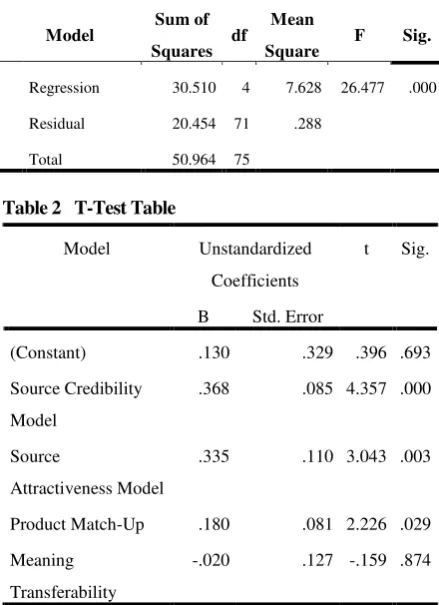
The author performed F-test to test the overall significance of the model. Since the significance value is 0.000, it is below 0.05. Therefore, the hypothesis alternative is accepted which means the Celebrity Fan Club source models simultaneously impact the Willingness to Stay at Hotel XYZ. Table 1 present the ANOVA test of the model. In this research, the results argues that the celebrity endorsement impacts the intention to purchase.
Table 1. ANOVA Test of Model
Model Sum of
Squares df
Mean
Square F Sig.
Regression 30.510 4 7.628 26.477 .000
Residual 20.454 71 .288
Total 50.964 75
Table 2 T-Test Table
Table 2 presents the t-test that is done on each variable. The author performed t-test to test individual significance of the model. Each variables are tested to gain the relationship. Source credibility model significance value is 0.000 which is below 0.05. Therefore, the Source Credibility Model is significantly impact the Willingness to Stay at Hotel XYZ. Source attractiveness model significance value is 0.003 which is below 0.05. Therefore, the Source Attractiveness Model is significantly impact the Willingness to Stay at Hotel XYZ. Product Match-up Model significance value is 0.029 which is below 0.05. Meaning Transferability Model significance value is 0.874 which is above 0.05. Therefore, the Meaning Transferability Model is not significantly impact the Willingness to Stay at Hotel XYZ.
In this research, there are four variables that explain the
relationship between endorser and buyer’s behavior. They
are Source Credibility Model, Source Attractiveness Model, Product Match-up Model and Meaning Transferability Model. One important finding in this research is that not all variables are significantly affect the buyer’s intention to purchase, which is the willingness to stay in this research. The result that is presented in this chapter shows that
Model Unstandardized
Coefficients
t Sig.
B Std. Error
(Constant) .130 .329 .396 .693
Source Credibility
Model
.368 .085 4.357 .000
Source
Attractiveness Model
.335 .110 3.043 .003
Product Match-Up .180 .081 2.226 .029
Meaning
Transferability
149 meaning transferability is not a significant predictor to the willingness to stay.
CONCLUSION
This research is interested in studying the impact of Celebrity Fan Club towards the willingness to stay at Hotel XYZ. The research aim to answer how overall and individual four source models (source credibility model, source attractiveness model, product match-up model, and meaning transferability) of the ad campaign will affect the willingness to stay at Hotel XYZ.
The first findings is that there is an overall significant impact of Celebrity Fan Club campaign towards the willingness to stay at Hotel XYZ. Celebrity Fan Club has proven to be an effective advertisement campaign to alter the willingness to stay of the potential guest.
The second finding is that source credibility has a significant impact to the willingness to stay at Hotel XYZ. Source credibility is an important contributor to the success of the celebrity endorsement program like Hotel XYZ. This result is regarded to be consistent with the statement that source credibility is a crucial component in communicating a brand (Zahaf & Anderson, 2008).
The third finding is that source attractiveness model has a significant impact to the willingness to stay at Hotel XYZ. The research result stated that this variable is a significant predictor to the willingness to stay. This is consistent with theories that states a more attractive source able to influence behavior than the not attractive ones (Ohanian, 1990; Chaiken, 1979, in Roozen, n.d.). Therefore, it is important to
take into account the celebrity’s attractiveness to be included
into the Celebrity Fan Club.
The next finding is that product match-up model has a significant impact to the willingness to stay at Hotel XYZ. This variable can be judged as a significant contributor to the willingness to stay. This means that the celebrity choice is an important factor to determine the success of the campaign. Therefore, it is imperative to consider about the match up congruence between celebrity and the brand to ensure effective communication.
One of the most interesting finding is that meaning transferability model in this research is failed to be accepted as a significant predictor to willingness to stay. As the result of the research suggests, Celebrity Fan Club campaign is an effective advertisement campaign. Hotel XYZ should continue Celebrity Fan Club campaign. However, there should be an evaluation to make its program more successful. There are some recommendation that the author would like to contribute to make Celebrity Fan Club campaign become a more powerful branding measure.
The first suggestion is to continue adding more credible and attractive celebrity to its list. As the result of the research has presented, source credibility and source attractiveness are both important contributor towards altering
potential guests’ attitude and both of them influence the
willingness to stay positively. Therefore, it is important for Hotel XYZ to select celebrities more carefully in order to achieve better credibility and attractiveness. One of the way to choose a more credible and attractive may be looking for the list of celebrity guests that has stayed at Hotel XYZ
previously and interview the celebrity while negotiating the compensation.
The next recommendation for Hotel XYZ is to choose celebrities that really represent the brand. What Hotel XYZ has done up until the present is a good gestures from the hotel to raise awareness and position its brand. When adding more celebrities, Hotel XYZ should be able to choose celebrities that match with its positioning in the market.
The final recommendation for Hotel XYZ is to prevent misinterpretation of its advertisement. The result of the research shows that meaning transferability is failed to be accepted as a significant contributor to altering attitude of the potential guests which is not consistent with the theories. The cause might be noise of the communication that causes messages to be not effectively delivered (Rothwell, 2004). Therefore, Hotel XYZ should be able to reduce the noise when communicating its brand. However, not all noise are controllable. As Rothwell (2004) has mentioned that there are three source of noises which are from the sender, receiver and environment. The only noise that can be controlled by Hotel XYZ is the noise from the sender. This means that the advertisement campaign should be fixed using a different approach to be able to communicate its brand image such as photo-shoot at one of the best suites in one of the Hotel XYZ property. In order to be able to communicate properly through the poster, it is suggested to add several words like reason why a celebrity is a fan to Hotel XYZ in a short sentence.
The author realizes that this research is not perfect. One of the limitation that the author faces is that the author face limitation of time and resources to obtain more various data available in the population. As the result, the respondent profile that is obtained in this research are somewhat homogenous. In other words, the respondent that is obtained mostly are on the same age range and domicile. As can be seen in the descriptive statistics, the respondents who participates in the research are mostly at their 20 to 30 years old. Moreover, this research has relatively small sample size if compared to the population because limited time and resources. Looking for a larger sample size is costly and the author has a limited budget on this research that causes the sample size to be relatively small. Moreover, the author could not obtain the data from the direct potential guest since the
hotel’s policy that prohibits the author to collect data from the
prospect that come to the hotel.
The other limitation is that the aim of focus in this research limit the insight of the other hotel products. Hotel’s product is not only accommodation but also events, restaurant and relaxation business. With only focusing on willingness to stay, it limits the insight to view how Celebrity
Fan Club impact on the potential guest’s intention to
purchase the other service of the hotel facility.
150 Regardless of limitations faced by the author, there are a lot of ways to make this research to be better in the future researches. The research may get a more meaningful result if the respondent profile are more various. In other words, the research should get more data from different age range and domicile. The future research should also involve a bigger sample size. By obtaining a bigger sample size, the result may be more accurately describe the population.
If there will be another research about the Celebrity Fan Club, the research should also include other products and services of the hotel like event, restaurant and relaxation business. This may give a better insight how effective Celebrity Fan Club is. Furthermore, more celebrities should be included in the future research. The research design should be able to include more celebrities so that it may be able to capture the whole aspect of Celebrity Fan Club.
REFERENCES
Amos, C. et al. (2008). Exploring the Relationship between Celebrity Endorser Effects and Advertising Effectiveness: A Quantitative Synthesis of Effect Size. International Journal of Advertising, 27(2), 209-234.
Badan Pusat Statistik (2013). Statistik Daerah Provinsi DKI Jakarta 2013. Retrieved on February 22, 2014, from
http://jakarta.bps.go.id/flip/statda2013/index.html #/29/zoomed.
Baker, J., Levy, M., & Grewal, D. (1992). An experimental approach to making retail store environmental decisions. Journal of Retailing, 68, 445-60.
Belch, G., Belch, M., (1994). Introduction to advertising and promotion: An integrated marketing communications perspective, ed. 3, Irwin: Homewood
Brant, R. (2007). Multiple Linear Regression.
Retrieved on March 31 from
http://www.stat.ubc.ca/~rollin/teach/BiostatW07/r eading/MLR.pdf
Chaiken, S (1979). Communicator Physical Attractiveness and Persuasion. Journal of Personality and Social Psychology, 137, l387-1397.
Cooper, D.R. & Schindler, P.S. (2011). Business Research Method. New York: McGraw-Hill. Cooper, M. (1985). Can celebrities really sell
products?. Marketing and Media Decisions, 64-65. Desarbo, W.S. & Harshman, R.A. (1985).
Celebrity-Brand Congruence Analysis. Current Issues and Research in Advertising.
Dinas Pariwisata Provinsi DKI Jakarta (2014). About Enjoy Jakarta. Retrieved on February 23, 2014,
from
http://www.jakarta-tourism.go.id/taxonomy/term/11.
Drexel University. (n.d.) Testing Independence of Error Terms: The Durbin-Watson Statistics. Retrieved on March 31, 2014 from Literature Review. Journal of Marketing Management, 41(3), 291-314.
Forkan, J. (1980), Product Match-up Key to Effective Star Presentations. Journal of Advertising Age, 51, 42-48
George, D., & Mallery, P. (2003). SPSS for Windows step by step: A simple guide and reference. 11.0 update (4th ed.). Boston: Allyn & Bacon.
Ghozali, I. (2011). Aplikasi Analisis Multivariate dengan Prgram SPSS 21. Semarang: BP Universitas Diponegoro
Hawkins, D.I. & Mothersbaugh, D.L. (2010). Consumer Behavior: Building Marketing Strategy. New York: McGraw-Hill Irwin.
Hoekman, M.L.L. & Bosmans, A.M.M. (n.d.). Celebrity Endorsement: How does celebrity endorsement influence the attitude towards the brand and how does negative publicity affect this relationship?. Tilburg: Tilburg University. Hovland, C. & Weiss, W. (1951). The Influence of
Source Credibility on Communication Effectiveness. Public Opinion Quarterly, 15, 635-650.
Hovland, C.I. Janis, L.I. & Kelley, H.H. (1953). Communication and Persuasion. New Haven: Yale University Press.
Jahangir, N, Parvez, N & Bhattacharjee, S.S. (2009).
Determinants of Customers’ Willingness to Buy: An Empirical Investigation. Journal of Behavioural Sciences, 18(2), 41-52
Kamins, M.A. (1989). Celebrity and Noncelebrity Advertising in a Two-Sided Context. Journal of Advertising Research. 29(3). 34–42.
Kementrian Pariwisata. (n.d.). Ranking Devisa Pariwisata Terhadap 10 Ekspor Barang Terbesar, Retrieved on February 21, 2014, from http://www.parekraf.go.id/asp/ringkasan.asp?c=11 7.
Lind, D., Marchal, W., & Wathen, S. (2012). Statistical Technique in Business and Economics. (15th ed). New York: McGraw-Hill
Mann, P.S. (1995). Introductory Statistics (2nd ed.). New York: Wiley
McCracken, G. (1989). Who is the Celebrity Endorser? Cultural Foundations of the Endorsement Process. Journal of Consumer Research, 16(3), 310-322. McGuire, W.J. (1985). Attitudes and Attitude Change.
New York: Random House.
Ohanian, R. (1990). Construction and Validation of A
Scale to Measure Celebrity Endorser’s Perceived
Expertise, Trustworthiness, and Attractiveness. Journal of AdvertisingResearch, 19(3), 39- 52. Oxford Dictionaries (n.d.). Oxford: Oxford University
151 Pallant, J. (2011). SPSS Survival Manual. Berkshire:
McGraw-Hill
Pang, C. (1973). Product Match-Up Congruence: Will It Affect Buyer Behavior?. New Jersey: Barricade Books
Pribadi, Gerry H. (2008). Hotel Konvensidi Indonesia. Yogyakarta: Universitas Atma Jaya
Render, B., Stair, R., & Hanna, M. (2012). Quantitative Analysis for Management (11th ed). New Jersey: Pearson
Revelle, W (1979). Coefficients Alpha, Beta, Omega, and the glb: Comments on Sijtsma. Psychometrika,74, 145-154
Roozen, I. (n.d.). The Relative Effectiveness of Celebrity Endorsement for Beauty, High- and Low Involvement Product Print Advertisements. Brussels: Hogeschool Universiteit Brussel. Rothwell, D.J (2004). In the Company of Others: An
Introduction to Communication. New York: McGraw Hill
Sallam, M.A.A & Wahid, N.A. (2012). Endorser
Credibility Effects on Yemeni Male Consumer’s
Attitudes towards Advertising, Brand Attitude and Purchase Intention: The Mediating Role of Attitude toward Brand. International Business Research, 5(4). 55-66.
Schroeder, L.D., Sjoquist, D.L, Stephan, P.E (1986). Understanding regression analysis, New York: Sage Publications.
Sertoglu, A.E. Catli, O & Korkmaz, S. (2014). Examining the Effect of Endorser Credibility on the Consumers' Buying Intentions: An Empirical Study in Turkey. International Review of Management and Marketing, 4(1), 66-77.
SPSS, Inc. (2010). Introduction to Statistical Analysis with PASW Statistics, Chichago: SPSS Inc. Steel, R. G. D., & Torrie J. H.. Principles and
Procedures of Statistics. New York: McGraw-Hill Book Company
Van der Waldt, D. et al. (2009), Celebrity Endorsements versus Created Spokespersons in Advertising: A Survey among Students. SAJEMS, 12(1), 110-114.