Communication
in Our Lives
Fifth Edition
Julia T. Wood
Lineberger Distinguished Professor of Humanities
University of North Carolina at Chapel Hill
© 2009, 2006 Wadsworth/Cengage Learning
ALL RIGHTS RESERVED. No part of this work covered by the copyright herein may be reproduced, transmitted, stored, or used in any form or by any means graphic, electronic, or mechanical, including but not limited to photocopying, recording, scanning, digitizing, taping, Web distribution, information networks, or information storage and retrieval systems, except as permitted under Section 107 or 108 of the 1976 United States Copyright Act, without the prior written permission of the publisher.
Library of Congress Control Number: 2007939609
Student Edition:
ISBN-13: 978-0-495-50201-2 ISBN-10: 0-495-50201-4
Instructor’s Edition: ISBN-13: 978-0-495-56559-8 ISBN-10: 0-495-56559-8
Wadsworth Cengage Learning
25 Thomson Place Boston, MA 02210 USA
Cengage Learning products are represented in Canada by Nelson Education, Ltd.
For your course and learning solutions, visit academic.cengage .com.
Purchase any of our products at your local college store or at our preferred online store www.ichapters.com.
Communication in Our Lives Julia T. Wood
Executive Editor: Monica Eckman
Senior Development Editor: Greer Lleuad
Assistant Editor: Kimberly Gengler
Editorial Assistant: Kimberly Apfelbaum
Associate Technology Project Manager: Jessica Badiner
Marketing Manager: Erin Mitchell
Marketing Assistant: Mary Anne Payumo
Senior Marketing Communications Manager: Shemika Britt
Art Director: Linda Helcher
Print Buyer: Sue Carroll
Permissions Editor: Margaret Chamberlain-Gaston
Production Service: Lachina Publishing Services
Art Editor: John Hill
For product information and technology assistance, contact us at Cengage Learning Academic Resource Center, 1-800-423-0563 For permission to use material from this text or product, submit all requests online at www.cengage.com/permissions. Further permissions questions can be e-mailed to permissionrequest
@cengage.com.
Preface ix
About the Author xvii
Introduction xviii
Part I:
Foundations of Communication
1 The World of Communication 1
2 Perception and Communication 30
3 Communication and Personal Identity 53
4 Listening Effectively 77
5 The Verbal Dimension of Communication 102
6 The Nonverbal Dimension of Communication 129
7 Communication and Culture 154
Part II:
Interpersonal and Group Communication and Media Literacy
8 Foundations of Interpersonal Communication 182
9 Communication in Personal Relationships 209
10 Foundations of Group and Team Communication 234
11 Effective Communication in Task Groups and Teams 258
12 Communication in Organizations 284
13 Media and Media Literacy 305
Part III:
Public Communication
14 Planning Public Speaking 333
15 Researching and Developing Support for Public Speeches 358
16 Organizing and Presenting Public Speeches 385
17 Informative Speaking 423
18 Persuasive Speaking 444
Closing: Pulling Ideas Together 471
Appendix A Annotated Sample Speeches 476
Appendix B Interviewing 486
Glossary 503
References 510
Index 529
Preface ix
About the Author xvii Introduction xviii
Part I: Foundations of Communication
1 The World of Communication 1
Why Study Communication? 2 Defining Communication 3 Values of Communication 4
Personal Values 5 Relationship Values 5 Professional Values 6 Cultural Values 7
Models of Communication 9 Linear Models 9
Interactive Models 10 Transactional Models 11
The Breadth of the Communication Field 12 Intrapersonal Communication 13
Interpersonal Communication 13 Group Communication 14
Organizational Communication 15 Mass and Social Media 16
Public Communication 18 Intercultural Communication 19 Unifying Themes in the Field 20
Symbolic Activities 20 Meaning 21
Critical Thinking 22
Ethics and Communication 23 Careers in Communication 24
Research 24 Education 24
Media Production, Analysis, and Criticism 25
Training and Consulting 25
Human Relations and Management 26 Chapter Summary 27
Case Study: A Model Speech of Self-introduction 28
2 Perception and Communication 30
Human Perception 31 Selection 32 Organization 33 Interpretation 37
Influences on Perception 39 Physiology 40
Culture 40 Social Roles 43 Cognitive Abilities 44
Enhancing Communication Competence 46 Perceptions, Communication, and
Abstraction 46
Guidelines for Enhancing Competence 47 Chapter Summary 50
Case Study: College Success 52
3 Communication and Personal Identity 53
What Is the Self? 54
The Self Arises in Communication with Others 54
The Self Is Multidimensional 61 The Self Is a Process 61
We Internalize and Act from Social Perspectives 62
Social Perspectives on the Self Are Constructed and Changeable 67 Enhancing the Self 69
Make a Strong Commitment to Improve Your Self 69
Gain Knowledge as a Basis for Personal Change 70
Set Realistic Goals 70
Accept Yourself as Being in Process 72 Create a Supportive Context for
Change 72 Chapter Summary 74
Case Study: Parental Teachings 75
4 Listening Effectively 77
The Listening Process 79 Being Mindful 79
Physically Receiving Messages 81 Selecting and Organizing Material 81
Interpreting Communication 82 Responding 83
Remembering 83
Obstacles to Effective Listening 83 External Obstacles 83
Internal Obstacles 85 Forms of Nonlistening 88
Pseudolistening 88 Monopolizing 88 Selective Listening 89 Defensive Listening 90 Ambushing 90
Literal Listening 90
Adapting Listening to Communication Goals 91
Informational and Critical Listening 91 Relational Listening 93
Other Purposes of Listening 97 Chapter Summary 98
Case Study: Family Hour 100
5 The Verbal Dimension of Communication 102
Symbols and Meaning 103 Symbols Are Arbitrary 104 Symbols Are Ambiguous 105 Symbols Are Abstract 107
Principles of Verbal Communication 108 Interpretation Creates Meaning 108 Communication Is Rule Guided 110 Punctuation Affects Meaning 112 Symbolic Abilities 113
Symbols Define 113 Symbols Evaluate 115
Symbols Organize Perceptions 116 Symbols Allow Hypothetical Thought 117 Symbols Allow Self-reflection 117
Enhancing Effectiveness in Verbal Communication 119
Engage in Dual Perspective 119 Own Your Feelings and Thoughts 120 Respect What Others Say about Their
Feelings and Ideas 122
Strive for Accuracy and Clarity 123 Chapter Summary 125
Case Study: The Roommates 127
6 The Nonverbal Dimension of Communication 129
Principles of Nonverbal Communication 131 Verbal and Nonverbal: Similar Yet
Different 131
Supplements or Replaces Verbal Communication 132
Regulates Interaction 132 Establishes Relationship-level
Meanings 133
Reflects Cultural Values 136
Types of Nonverbal Communication 138 Kinesics 138
Haptics 139
Physical Appearance 139 Artifacts 140
Proxemics 142
Environmental Factors 143 Chronemics 144
Paralanguage 146 Silence 147
Improving Nonverbal Communication 148 Monitor Your Nonverbal
Communication 148 Interpret Others’ Nonverbal
Communication Tentatively 148 Chapter Summary 150
Case Study: Nonverbal Cues 151
7 Communication and Culture 154
Understanding Culture 155
Multiple Social Communities in a Single Society 156
Cultures Are Systems 161
Communication’s Relationship to Culture and Social Communities 162
Communication Expresses and Sustains Cultures 162
Cultures Consist of Material and Nonmaterial Components 164 Cultures Are Shaped by Historical and
Geographic Forces 167
We Learn Culture in the Process of Communicating 169
Cultures Are Dynamic 170
Improving Communication between Cultures and Social Communities 172
Resist the Ethnocentric Bias 172
Recognize That Responding to Diversity Is a Process 173
Chapter Summary 177
Case Study: The Job Interview 179
Part II: Interpersonal and Group
Communication and Media Literacy
8 Foundations of Interpersonal Communication 182
Self-disclosure 184
vi
•
Contents
Self-disclosure and Closeness 185 Communication to Build Supportive
Climates 187
Levels of Confirmation and Disconfirmation 187
Defensive and Supportive Climates 190 Evaluation versus Description 190 Certainty versus Provisionalism 191 Strategy versus Spontaneity 192
Control versus Problem Orientation 193 Neutrality versus Empathy 194
Superiority versus Equality 194 Conflict in Relationships 195
Conflict May Be Overt or Covert 196 Conflict May Be Managed Well or
Poorly 196
Conflict Reflects and Expresses Cultures and Social Communities 198
Conflict May Be Good for Individuals and Relationships 199
Guidelines for Creating and Sustaining Healthy Climates 200
Actively Use Communication to Shape Climates 200
Accept and Confirm Others 200 Accept and Confirm Yourself 202 Self-disclose When Appropriate 203 Respect Diversity in Relationships 204 Chapter Summary 205
Case Study: Cloudy Climate 207
9 Communication in Personal Relationships 209
Defining Personal Relationships 210 Uniqueness 210
Commitment 210 Relationship Rules 211 Affected by Contexts 212 Relational Dialectics 213
The Evolutionary Course of Personal Relationships 215
Friendships 215
Romantic Relationships 217
Challenges in Personal Relationships 224 Adapting to Diverse Communication
Styles 224
Dealing with Distance 225 Creating Equitable Romantic
Relationships 226
Resisting Violence and Abuse between Intimates 228
Negotiating Safer Sex 229
Chapter Summary 230
Case Study: Wedding Bells? 232
10 Foundations of Group and Team Communication 234
What Are Groups and Teams? 235 Potential Limitations and Strengths of
Groups 237
Potential Limitations of Groups 237 Potential Strengths of Groups 239 Features of Small Groups 240
Cohesion 240 Group Size 241 Power Structure 242 Interaction Patterns 244 Group Norms 245
Cultural Influences on Group Decision Making 245
Individualism 246 Assertiveness 246 Equality 246
Progress, Change, and Speed 247 Risk and Uncertainty 247
Informality 248
Communication in Small Groups 249 Forms of Group Communication 249 Chapter Summary 253
Case Study: The Class Gift 255
11 Effective Communication in Task Groups and Teams 258
Task Groups 259 Project Teams 259 Focus Groups 260
Brainstorming Groups 261 Advisory Groups 262
Quality Improvement Team 263 Decision-making Groups 263 Leadership Communication 264
Leadership, Not Leader 264 Styles of Leadership 266 Decision-making Methods 270
Consensus 270 Voting 270 Compromise 271 Authority Rule 271
Organizing Group Discussion 272 Stage One: Define the Problem 273 Stage Two: Analyze the Issues 275 Stage Three: Establish Criteria 275 Stage Four: Generate Solutions 276 Stage Five: Evaluate Solutions 276 Stage Six: Choose and Implement the Best
Stage Seven: Develop an Action Plan to Monitor the Solution 277
Understanding and Managing Conflict in Groups 278
Types of Conflict 278 Chapter Summary 280
Case Study: Teamwork 281
12 Communication in Organizations 284
Key Features of Organizational Communication 286
Structure 286
Communication Networks 286 Links to External Environments 287 Organizational Culture 288
Vocabulary 289 Stories 290
Rites and Rituals 292 Structures 295
Guidelines for Communicating in Organizations 298
Adapt to Diverse Needs, Situations, and People 298
Expect to Move In and Out of Teams 300 Manage Personal Relationships on the
Job 301
Chapter Summary 302
Case Study: Ed Misses the Banquet 304
13 Media and Media Literacy 305
The Nature and Scope of Media 306 Defining Mass Media and Social
Media 306
The Prevalence of Media in Our Lives 308 Understanding How Media Work 310
Understanding Mass Media 310 Understanding Social Media 316 Developing Media Literacy 321
Understand the Influence of Media 322 Access to Media 322
Analyze Media 324
Critically Evaluate Media Messages 324 Respond Actively 326
Chapter Summary 328
Case Study: Power Zapper 330
Part III: Public Communication
14 Planning Public Speaking 333
Public Speaking as Enlarged Conversation 335
Choosing and Refining a Topic 337 Choosing Your Topic 337
Defining Your General and Specific Purpose in Speaking 341
Developing a Thesis Statement 344 Analyzing Your Audience 346
Demographic Audience Analysis 347 Situational Audience Analysis 350 Chapter Summary 354
Case Study: A Model Speech of Introduction 356
15 Researching and Developing Support for Public Speeches 358
Conducting Research 359
Library and Online Research 360 Personal Knowledge 363
Interviews 363 Surveys 365
Using Evidence to Support Ideas 367 Statistics 367
Examples 368 Comparisons 372 Quotations 372 Visual Aids 375 Chapter Summary 380
Case Study: Using Evidence: Environmental Racism 383
16 Organizing and Presenting Public Speeches 385
Organizing Speeches 386 Outlining Speeches 387
Organizing the Body of a Speech 388 Designing the Introduction 401 Crafting the Conclusion 404 Building in Transitions 405
Communication Apprehension: Natural and Often Helpful 406
Causes of Communication Apprehension 407 Reducing Communication
Apprehension 410
Presenting Public Speeches 412 Oral Style 412
Styles of Delivery 413 Practice 417
Chapter Summary 418
Case Study: Analyzing Delivery: Speech of Self-introduction 421
17 Informative Speaking 423
The Nature of Informative Speaking 424 Informative Speaking in Everyday Life 424 Comparing Informative and Persuasive
viii
•
Contents
Guidelines for Effective Informative Speaking 427
Provide Listeners with a Clear Thesis Statement 427
Connect with Listeners’ Values and Experiences 428
Motivate Listeners to Want Information 429
Build Credibility with Listeners 429 Adapt to Diverse Listeners 430 Organize So Listeners Can Follow
Easily 431
Design Your Speech to Enhance Learning and Retention 432
Involve Listeners 435
Use Effective and Ethical Supporting Materials 437
Chapter Summary 439
Case Study: Informative Speech: The Black Box 442
18 Persuasive Speaking 444
Understanding Persuasive Speaking 445 The Three Pillars of Persuasion 447
Ethos 447 Pathos 448 Logos 450
Building Credibility 452
Understanding Credibility 452 Types of Credibility 453 Enhancing Credibility 454
Organizing Speeches for Persuasive Impact 454
The Motivated Sequence Pattern 455 One-sided and Two-sided
Presentations 459
Guidelines for Effective Persuasive Speeches 461
Create Common Ground with Listeners 461
Adapt to Listeners 463
Avoid Fallacious Reasoning 464 Chapter Summary 466
Case Study: Persuasive Speech: The Case for Graduated Licensing 469
Closing: Pulling Ideas Together 471
Appendix A Annotated Sample Speeches 476
“Civility without Censorship: The Ethics of the Internet-Cyberhate” by Bell Atlantic Corporation Chairman Raymond W. Smith 476
“Mending the Body by Lending an Ear: The Healing Power of Listening” by Carol Koehler, Assistant Professor of Communication and Medicine 481
“Witchcraft” by Dana Wheeler 484
Appendix B Interviewing 487
Understanding Communication in Interviews 488
Types and Purposes of Interviews 488 The Structure of Interviews 490 Styles of Interviewing 492
Forms of Questions in Interviews 494 Challenges When Communicating in
Interviews 496
Preparing to Interview Effectively 496 Managing Illegal Questions in
Interviews 498 Summary 500
Case Study: Tough Questions 502
Preface
W
hen I was an undergraduate student, I fell in love with the field ofcommunication. My first communication course convinced me that communication was more central to my life than anything else I had studied or could study. That feeling grew stronger with each communica-tion course I took during my undergraduate and graduate studies.
I wrote Communication in Our Lives to share with students my love of com-munication and my belief that it is critically important in our everyday lives. Because I want this book to engage students, I’ve tried to make it as interesting and substantive as communication itself. I use a conversational style of writing and weave into all chapters examples, reflections from students, and applica-tions that invite students to engage material personally. Because I want this book to help students develop their competence as communicators, I empha-size concrete skills and hands-on applications.
Distinguishing Features of Communication
in Our Lives
Communication in Our Lives has three distinct conceptual emphases. In addi-tion, it includes a number of pedagogical features designed to highlight the relevance of communication to students’ everyday lives and experiences. Some of these features have been retained from the fourth edition, and some, as well as additional content, are new to the book’s fifth edition.
Conceptual Emphases
Three conceptual goals guided my writing of this book: (1) to emphasize theo-ries and research developed by scholars of communication, (2) to integrate coverage of social diversity as it relates to communication, and (3) to respond to student and faculty feedback about previous editions.
Emphasis on Communication Theory, Research, and Skills
Onex
•
Preface
and conducted research that has shed light on the dynamics of human inter-action.
Communication in Our Lives therefore highlights theories, research, and skills developed by scholars of communication. For example, Chapter 9 pro-vides coverage of relational dialectics, a theory primarily developed by Leslie Baxter, a professor of communication at the University of Iowa. Chapter 13 relies on very recent research by scholars of social media to sharpen under-standing of how various digital technologies are making our lives ever more connected. Chapters 14 through 18 draw on research by communication scholars that enlarges our understanding of principles of effective public com-munication. For instance, Clella Jaffe (2007) has identified the wave pattern as a way of organizing speeches that is more common in ethnic groups with strong oral traditions, and James McCroskey and Jason Teven (1999) have shown that speakers who demonstrate good will toward listeners tend to have higher credibility than those who don’t. I emphasize the work of communi-cation scholars both because their research is valuable and because I want students to appreciate the intellectual richness of the communication field. Although I emphasize the work of communication scholars, I don’t ignore relevant research conducted by scholars in fields such as sociology, psychology, and anthropology. Thus, this book draws on research and theories in these and other related disciplines.
Integrated Attention to Social Diversity
I have woven discussionof social diversity into the basic framework of this book. I do not do this to be “politically correct” or to advance a liberal social agenda. Instead, I aim to provide integrated attention to social diversity because it is one of the most significant features of contemporary life in the United States. Our culture includes people of different ethnicities, ages, genders, physical and mental abilities, sexual orientations, economic classes, and religious or spiritual com-mitments.
The metaphor of America as a melting pot in which all differences are homogenized has given way to other metaphors such as the family quilt. Just as a family quilt consists of squares with distinct integrity, our culture consists of people with unique histories and identities; just as the individual squares in a family quilt create an exquisite whole, the different people in America make up a rich, complex overall culture.
Communication in Our Lives encourages students to appreciate social diver-sity as a fact of cultural life that has profound implications for our communi-cation with others. Because social diversity affects our communicommuni-cation in all contexts, I weave discussion of diverse cultures and communication practices into all chapters of this book. For example, in Chapter 10 I note how cultural values affect communication in groups and teams. In discussing personal iden-tity in Chapter 3, I point out how social views of race, economic class, gender, and sexual orientation affect self-concept.
In addition to weaving social diversity into all chapters, Chapter 7 is devoted exclusively to communication and culture as the foundation of effective inter-action in today’s world. This chapter provides a sustained and focused explo-ration of the reciprocal relationship between culture and communication.
Evolution in Response to Student and Faculty Feedback
Likeeditions while also incorporating feedback from students and faculty. Before beginning work on this edition, I read feedback from hundreds of faculty members and students who used the previous edition. Their suggestions and comments led me to make a number of changes in this new edition.
Perhaps the most obvious change in this edition is the inclusion of a new chapter on organizational communication (Chapter 12). As I’ve talked with faculty and students around the country and read written feedback from them, I’ve learned that understanding communication in the workplace is a priority for many students today. Chapter 12 focuses on understanding how commu-nication shapes organizations and how people can communicate effectively within them.
In preparing this edition of Communication in Our Lives, I kept in mind the frequent complaint from instructors that each new edition of a text-book gets longer because authors add new material without taking out other material. I resisted this tendency. I have streamlined all chapters by deleting dated material and references and tightening prose. I also reduced the num-ber of features in chapters so that pages are less “busy” than in the previous edition.
Because many faculty assign speeches in the first weeks of a term, and to lay a foundation for the public communication chapters that constitute Part 3, I weave speech activities into early chapters of the book. For instance, Chapter 1 includes a Sharpen Your Skill activity that invites students to prepare and present a short speech of introduction. By completing public speaking activi-ties in early chapters, students gain valuable speaking experience and they appreciate connections between public speaking and other forms of com-munication. I have also further integrated Speech Builder Express™ into Chapters 14–18, which focus on public speaking. Wherever appropriate within these chapters, I mention the program’s speech outlining and development resources. Additionally, at the end of these chapters, I suggest specific activi-ties designed to help students make use of this online tool. Speech Builder Express is described further in a subsequent section.
In recent years, ethical—and unethical—actions have gained renewed prom-inence in cultural life, and this edition of the book reflects that. Communication instructors know that they need to teach students to recognize ethical issues
in communication, whether it be interaction in personal relationships, mass communication, or public speaking. To underline the importance of ethics, this edition calls attention to ethical issues and choices in communication. In addition to identifying ethical aspects of communication in each chapter, I include one question at the end of each chapter, flagged with an icon, that focuses on ethics.
This edition of Communication in Our Lives also reflects changes in schol-arship and modes of interaction. Those familiar with the fourth edition of this book will notice that the current edition includes more than 150 new research sources. Finally, this edition includes amplified attention to social media—cells, iPods, the Web, MP3s, and so forth—that are increasingly part of our everyday lives.
Proven Pedagogical Features
First, I adopt a conversational style of writing rather than the more distant and formal style often used by textbook authors. I share with students some of my experiences in communicating with others, and I invite them to think with me about important issues and difficult challenges surrounding communica-tion in our everyday lives. The accessible, informal writing style encourages students to personally engage the ideas I present.
A second feature of this book is the student commentaries. Every chap-ter is enriched by reflections on experience that were written by students in my classes and other classes around the country that adopted previous edi-tions of this book. The quesedi-tions, insights, and concerns expressed by diverse students enlarge the viewpoints represented in this book. Furthermore, they invite readers to reflect on their own experiences as communicators. I wel-come comments from students around the country, so students in your class may wish to send their comments and reflections to me for inclusion in future editions of this book.
Communication in Our Lives also includes pedagogical features that promote learning and skill development. Punctuating each chapter are Sharpen Your Skill exercises that encourage students to apply concepts and develop skills discussed in the text. Many of these exercises end with a prompt to the book’s online resources, which offer additional opportunities for skill application. Each chapter also includes Communication Highlights, which call attention to interesting communication research and examples of communication issues in everyday life.
New to this edition of the book are Quiz Yourself questions. I include three of these questions in each chapter so that students can test their grasp of material as they read. Answers to the Quiz Yourself questions are provided at the end of each chapter.
Case studies, mentioned previously, are another central feature. These brief scenarios and speeches appear at the end of each chapter to bring to life the ideas and principles presented. Rather than using generic case studies, I wrote the ones used in this book so that they would directly reflect chapter content and provide students with representative examples of communication theories and skills—this edition features a new case study on groups and teams for Chapter 10. In addition to their presentation in the book, the case studies are featured both in the Communication in Our Lives Interactive Video Activities and CengageNOW as short videos accompanied by interactive questions for discussion and analysis. With the multimedia enactments of the scenarios, instructors and students can analyze not only verbal messages but also nonver-bal communication. Appendix A provides a collection of annotated speeches
for student analysis.
Focus questions open each chapter so that students have a preview of the main ideas to be covered. Each chapter concludes with the Communication in Our Lives Online section, which provides both an introduction to the text’s many online resources and the print version of the text’s learning aids—a list of key concepts with corresponding page numbers, answers to the chap-ter’s Quiz Yourself questions, and then a series of For Further Reflection and Discussion questions that encourage students to reflect on and discuss the chapter’s material. Each set of these questions includes at least one question that uses InfoTrac® College Edition, which is explained in detail below, and, as mentioned above, a question focused on ethics. Finally, as I discussed
lier, at the very end of each chapter in Part 3, Public Communication, I suggest a related Speech Builder Express activity.
Resources for Instructors
Laurel Traynowicz, Boise State University, and I have written an Instructor’s Resource Manual that describes approaches to teaching the basic course, pro-vides a wealth of class-tested exercises including new teaching resources for the public speaking segment of your course, and provides suggested journal topics and sample test items.
The PowerLecture CD-ROM contains an electronic version of the Instructor’s Resource Manual, ExamView® Computerized Testing, predesigned Microsoft® PowerPoint® presentations, and JoinIn® classroom quizzing. The PowerPoint presentations contain text, images, and cued videos of the case studies and can be used as is or customized to suit your course needs.
The Resource Center for Speech Communication offers a variety of rich learning resources designed to enhance the student experience. These resources include self-assessments, blogs (online journals), images, video, Web resources, and animations. All resources are mapped to key discipline learning-concepts, and users can browse or search for content in a variety of ways. More than just a collection of ancillary learning materials, the Resource Center for Speech Communication also features important content and com-munity tools that extend the education experience beyond a particular class or course semester.
The Teaching Assistant’s Guide to the Basic Course by Katherine G. Hendrix is also available to adopters of this text. Designed specifically for the new munication teacher and based on leading teacher-training programs in com-munication, this guide includes general teaching and course management topics and specific strategies, such as giving performance feedback, managing sensitive class discussions, and conducting mock interviews.
Wadsworth Cengage Learning’s extensive video library includes the Student Speeches for Critique and AnalysisandCommunication Scenarios for Critique and Analysis, which include sample student speeches and the interpersonal and group communication scenarios featured as case studies in this text. These videos provide realistic examples of communication that allow students and teachers to identify specific communication principles, skills, and practices, and to analyze how they work in actual interaction.
With the TLC (Technology Learning Connects) Technology Training
and Support, you can get trained, get connected, and get the support you need for seamless integration of technology resources into your course. This unparalleled technology service and training program provides robust online resources, peer-to-peer instruction, personalized training, and a customizable
program you can count on. Visit http://www.academic.cengage.com/tlc/
to sign up for online seminars, first days of class services, technical support, or personalized, face-to-face training. Our online or onsite trainings are fre-quently led by one of our Lead Teachers, faculty members who are experts in using Wadsworth Cengage Learning technology and can provide best prac-tices and teaching tips.
flex-text program you can add your personal touch to Communication in Our Lives with a course-specific cover and up to 32 pages of your own content, at no additional cost.
I encourage you to contact your local Wadsworth Cengage Learning rep-resentative or http://www.academic.cengage.com for more information, user names and passwords, examination copies, or a demonstration of these ancil-lary products. Available to qualified adopters.
Resources for Students
The student companion workbook, co-authored by Donetta Cooper, Indiana University—Purdue University Fort Wayne, and me, provides practical exer-cises and inventories that guide students in applying concepts and developing skills discussed in the book. It includes chapter outlines, class-tested activities, and self-tests.
The CengageNOW™ for Communication in Our Lives is available to students when instructors order this online textbook resource packaged with the text. Using chapter-by-chapter diagnostic pre-tests that identify concepts students don’t fully understand, this online system creates a personalized study plan for each chapter. Each plan directs students to specific resources designed to improve their understanding. Chapter post-tests give them an opportunity to measure how much they’ve learned and let them know if they are ready for graded quizzes and exams. In addition, CengageNOW provides students with a multitude of text-specific learning aids, including interactive electronic ver-sions of all the Sharpen Your Skill and Communication Highlight activities. For instructors, CengageNOW is available on WebCT and Blackboard, allow-ing them to provide virtual office hours, post syllabi, set up threaded discus-sions, and track student progress.
The Communication in Our Lives book companion website is available to students at no additional charge when instructors order this online textbook resource packaged with the book. The website features study aids such as chapter outlines, flash cards and other resources for mastering glossary terms, and chapter quizzes that help students check their understanding of key con-cepts. Also included are student resources such as an interactive version of the Personal Report of Communication Apprehension (PRCA) and speech preparation worksheets.
The Communication in Our Lives interactive video activities, available to students at no additional charge when instructors order this online textbook resource packaged with the book, feature videos of the sample speeches and interpersonal and group communication scenarios featured in the book’s case studies. This multimedia tool allows students to evaluate the speeches and scenarios, compare their evaluation with mine, and, if requested, submit their response electronically to their instructor.
The end-of-chapter activities in Part 3, Public Communication, can be completed with Speech Builder Express 3.0 organization and outlining pro-gram, available to students at no additional charge when instructors order this online textbook resource packaged with the book. This interactive web-based tool coaches students through the speech organization and outlining process. By completing interactive sessions, students can prepare and save their out-lines—including a plan for visual aids and a works cited section—formatted according to the principles presented in the text. Text models reinforce stu-dents’ interactive practice.
If you order the online resources packaged with the text, your students will have access to InfoTrac College Edition with InfoMarks. This virtual library’s more than 18 million reliable, full-length articles from 5,000 academic and popular periodicals and retrieve results almost instantly. They also have access to InfoMarks—stable URLs that can be linked to articles, journals, and searches to save valuable time when doing research—and to the InfoWrite online resource center, where students can access grammar help, critical-thinking guidelines, guides to writing research papers, and much more.
The eAudio Study Tool for Communication in Our Livesprovides a fun and easy way for students to review chapter content whenever and wherever. For each chapter of the text, students will have access to the audio of the case study for that chapter, learning objectives, and a chapter summary. Students can purchase the eAudio for Communication in Our Lives through iChapters (see below) and download files to their computers, iPods, or other MP3 players.
The iChapters.com online store provides students with exactly whatthey’ve been asking for: choice, convenience, and savings. A 2005 research study by the National Association of College Storesindicates that as many as 60 percent of students do not purchase all required course material; however, those who do aremore likely to succeed. This research also tells us that students want the ability to purchase “a la carte” course material in the format that suits them best. Accordingly, iChapters.comis the only online store that offers eBooks at up to 50 percent off, eChapters for as low as $1.99each, and new textbooks at up to 25 percent off, plus up to 25 percent off print and digital supplements that can help improve student performance.
A Guide to the Basic Course for ESL Students by Esther Yook of Mary Washington College is an aid for non-native speakers. This guide includes strategies for accent management and overcoming speech apprehension, in addition to helpful web addresses and answers to frequently asked questions.
Finally, The Art and Strategy of Service Learning Presentations by Rick Isaacson and Jeff Saperstein is an invaluable resource for students in the basic course that integrates or will soon integrate a service learning component. This hand-book provides guidelines for connecting service learning work with classroom concepts and advice for working effectively with agencies and organizations. It also provides model forms and reports and a directory of online resources.
Contact your Wadsworth Cengage Learning representative or http://www .academic.cengage.com for more information.
Acknowledgments
All books reflect the efforts of many people, and Communication in Our Lives is no exception. A number of people have helped this book evolve from an early vision to the final form you hold in your hands. My greatest debt is to my edi-tor, Monica Eckman, and my development ediedi-tor, Greer Lleuad. From start to finish, they have been active partners in the project. This book reflects their many insights and their generous collaboration.
Lachina Publishing Services; Lisa Devenish, text designer; Lili Weiner, photo researcher; Linda Helcher, art director; Margaret Chamberlain-Gaston, per-missions acquisition manager; Sue Carroll, print buyer; Jessica Badiner, associ-ate technology project manager; Kimberly Gengler, assistant editor; Kimberly Apfelbaum, editorial assistant; and Erin Mitchell, marketing manager.
I am also grateful to the people who reviewed previous editions of this book, who have been most generous in offering suggestions for improving the book.
Reviewers who worked with me in developing this edition, and to whom I am especially grateful, are Theresa Albury, Miami Dade College, Wolfson Campus; Andrew C. Billings, Clemson University; Angela F. Cooke-Jackson, Eastern Kentucky University; Edward R. Coursey, Palm Beach Community College; Lee A. McGaan, Monmouth College; and Avinash Thombre, University of Arkansas, Little Rock.
I could not have written this book without the support of the Department of Communication Studies at the University of North Carolina at Chapel Hill. There, I am blessed by generous colleagues who are always willing to discuss ideas and share insights. In addition, the undergraduate and graduate stu-dents in my classes have allowed me to experiment with new approaches to teaching communication and have helped me refine ideas and activities that appear in this book. Invariably, my students teach me at least as much as I teach them, and for that I am deeply grateful.
I also thank my closest friends who are sources of personal support, insight, challenges, and experience—all of which find their way into what I write. Those people are Carolyn, Nancy, Todd, and LindaBecker. I also thank my four-footed friends for their unconditional love: our dog, Cassidy; and our two cats, Sadie Ladie and Ms. Wicca.
Finally, and always, I acknowledge the support and love of my partner Robbie (Robert) Cox. Like everything else I do, this book has benefited from his presence in my life. Being married to him for 33 years has enriched my appreciation of the possibilities for love, growth, kindness, understanding, and magic between people. In addition to being the great love of my life, Robbie is my most demanding critic and my greatest fan. Both his criticism and support have shaped the final form of this book.
About the Author
J
ulia T. Wood is the Lineberger Distinguished Professor of Humanitiesand a professor of Communication Studies at the University of North Carolina at Chapel Hill. Since completing her Ph.D. (Pennsylvania State University) at age 24, she has taught classes, conducted research, and written extensively about communication in personal relationships and about gender, communication, and culture. In addition to publishing more than seventy arti-cles and chapters, she has authored or co-authored seventeen books and edited or co-edited eight others. The recipient of twelve awards for outstanding teach-ing and thirteen awards for distteach-inguished scholarship, Professor Wood divides her professional energies among research, writing, and teaching.
Professor Wood lives with her partner, Robert (Robbie) Cox, who is also a professor of Communication Studies at the University of North Carolina and who is currently the President of the national Sierra Club. Completing her family are a dog, Cassidy, and two cats, Sadie Ladie and Ms. Wicca. When not writing and teaching, Professor Wood enjoys traveling, legal consulting, and
spending time talking with students, friends, and family. Courtesy of Dan Sears
For Carolyn
© ???????????????????
Introduction
Focus Questions
1. Which aspects of your life are affected by communication? 2. How does the author’s identity shape this book?
port him.
You’ve been invited to interview for your dream job, and getting it depends on communicating effectively in the interview.
A group you belong to is working on recycling programs for the campus, and you’re frustrated by the group’s inefficiency. You want to make meet-ings more productive.
At the end of the term, your romantic partner will graduate and take a job in a city 1,000 miles away, and you wonder how to stay connected across the distance.
You met an interesting person on Facebook. At first, you enjoyed interact-ing with him, but lately he’s been sendinteract-ing you IMs incessantly, and you feel he’s intrusive.
The major project in one of your courses is an oral research report, so your grade depends on your public speaking ability.
S
ituations like these illustrate the importance of communication in oureveryday lives. Unlike some of the subjects you study, communication is relevant to every aspect of your life. We communicate with ourselves when we work through ideas, psych ourselves up to meet challenges, rehearse ways to approach someone about a difficult issue, and talk ourselves into or out of various courses of action. We communicate with others to build and sus-tain personal relationships, to perform our jobs and advance our careers, to connect with friends and meet new people online, and to participate in social and civic activities. Every facet of life involves communication.
Although we communicate all the time, we don’t always communicate effec-tively. People who have inadequate communication knowledge and skills are hampered in their efforts to achieve personal, professional, and social goals. On the other hand, people who communicate well have a keen advantage in accomplishing their objectives. This suggests that learning about communica-tion and learning how to communicate are keys to effective living.
Communication in Our Lives is designed to help you understand how com-munication works in your personal, professional, and social life. To open the book, I’ll introduce myself and describe the basic approach and special fea-tures of Communication in Our Lives.
Introduction to the Author
As an undergraduate, I enrolled in a course much like the one you’re taking now. It was an introductory class in which we studied a variety of communica-tion forms and contexts. In that course, I began a love affair with the field of communication that has endured for more than 35 years. Today I am still in love with the field—more than ever, in fact. I see communication as the basis of cultural life and as a primary tool for personal, social, and professional satis-faction and growth. This makes communication one of the most dynamic and important areas of study in higher education. It is a field that is both theoreti-cally rich and pragmatitheoreti-cally useful. I know of no discipline that offers more valuable insights, skills, and knowledge than communication.
•
•
•
•
Because communication is central to our lives, I feel fortunate to teach communication courses and conduct research on human interaction. Working with students allows me to help them improve their communication skills and thus their effectiveness in many arenas. Research and writing continually enlarge my understanding of communication and let me share what I learn with others like you.
Because you will be reading this book, you should know something about the person who wrote it. I am a 56-year-old, middle-class, Caucasian hetero-sexual with strong spiritual commitments. For 33 years, I have been married to Robert (Robbie) Cox, who is also a professor of communication studies at my university. As is true for all of us, who I am affects what I know and how I think, act, interact, and write. For instance, many of the examples I share in the chapters that follow reflect my teaching and research in interpersonal communication and gender and communication.
Other facets of my identity also influence what I know and how I write. My race, gender, social-economic class, and sexual orientation have given me certain kinds of insight and obscured others. As a woman, I understand dis-crimination based on sex because I’ve experienced it personally. I do not have personal knowledge of racial discrimination, because Western culture confers privilege on European Americans. Being middle class has shielded me from personal experience with hunger, poverty, and class bias; and my heterosexu-ality has spared me from being an object of homophobic prejudice. Who you are also influences your experiences and knowledge and your ways of com-municating.
Although identity limits our personal knowledge and experiences, it doesn’t completely prevent insight into people and situations different from our own. From conversations with others and from reading, I have gained some understanding of people and circumstances different from my own. In our increasingly diverse world, we all need to learn about a variety of people, life circumstances, and cultures. We need to understand and communicate effectively with people whose communication styles differ from ours. What we learn by studying and interacting with people of diverse cultural heritages expands our appreciation of the richness and complexity of humanity. In addi-tion, learning about and forming relationships with people different from ourselves enlarges our personal repertoire of communication skills and our appreciation of the range of ways to communicate.
Much of my time is spent teaching and writing, both of which I enjoy greatly. I find teaching particularly gratifying because it allows me to open students’ eyes to the wonder and value of communication and to share in their pleasure as they refine their skills as communicators. Writing is another way I share my passion for communication and the knowledge I’ve acquired over the past three decades. To provide a context for your reading, let me share my vision of this book.
Introduction to the Book
Communication in Our Lives introduces you to many forms and functions of communication in modern life. The title reflects my belief that communica-tion is an important part of our everyday lives. Each chapter focuses on a spe-cific kind of communication or context of interaction.
xx
•
Introduction
Every facet of life involves communication.
Coverage
Because communication is a continuous part of life, we need to understand how it works—or doesn’t—in a range of situations. Therefore, this book covers a broad spectrum of communication encounters, including communication with yourself, interaction with friends and romantic partners, work in groups and teams, interaction in organizations, mass and social media, interaction between people with diverse cultural backgrounds, and public speaking. The breadth of communication issues and skills presented in this book can be adapted to the interests and preferences of individual classes and instructors.
Students
Communication in Our Lives is written for anyone interested in human com-munication. If you are a communication major, this book and the course it accompanies will provide you with a firm foundation for more advanced study. If you are majoring in another discipline, this book and the course you are tak-ing will give you a sound basic understandtak-ing of communication and opportu-nities to strengthen your skills as a communicator.
Learning should be a joy, not a chore. I’ve written this book in an informal, personal style; for instance, I refer to myself as I rather than the author, and I use contractions (can’t and you’re instead of the more formal cannot and you are), as we do in normal conversation. To heighten interest, I punctuate chap-ters with concrete examples and insights from students at my university and other campuses around the country.
Theory and Practice
Years ago, renowned scholar Kurt Lewin said, “There is nothing so practical as a good theory.” His words remain true today. In this book, I’ve blended theory and practice so that each draws on and enriches the other. Effective prac-tice is theoretically informed: It is based on knowledge of how and why the communication process works and
what is likely to result from differ-ent kinds of communication. At the same time, effective theories have pragmatic value: They help us understand experiences and events in our everyday lives. Each chapter in this book is informed by the theories and research gen-erated by scholars of communica-tion. Thus, the perspectives and skills recommended reflect cur-rent knowledge of effective com-munication practices.
Features
Focus Questions
Each chapter opens with several focus questions that highlight important top-ics to be covered. Reading the questions helps you focus your attention as you study the chapter. Rereading the questions after completing the chapter allows you to check your understanding of the ideas discussed.
Experiencing Communication in Our Lives
Each chapter concludes with a case study, “Experiencing Communication in Our Lives.” With each one, I invite you to think about how principles and skills we discuss in that chapter show up in everyday life. I ask a few questions about the case study that allow you to apply what you have learned in a chapter to analyzing real-life communication and developing strategies for improving interaction. You can access videos that depict each case study via the Online Resources for Communication in Our Lives. (To learn how to get started with your Online Resources, see the inside front and back covers of this book).
Integrated Attention to Cultural Diversity
Diversity is woven into the fabric of this book. The world and the United States have always been culturally diverse. Awareness of diversity is integral to how we communicate and think about communication; it is not an afterthought. I integrate cultural diversity into the text in several ways.
First, each chapter includes research on diverse people and highlights our commonalities and differences. For example, Chapter 9, on personal relation-ships, identifies general differences in women’s and men’s communication and provides clues about how the sexes can translate each other’s language. Early chapters trace the impact of ethnicity, sexual orientation, gender, and other facets of identity on self-concept and communication practices.
You’ll also notice that the photos I chose for this book include people of different races, ages, religions, and so forth. Likewise, each chapter includes examples drawn from a range of people, walks of life, and orientations, and the case studies feature diverse people.
In addition to incorporating diversity into the book as a whole, in Chapter 7 I focus exclusively on communication and culture. There you will learn about cultures and social communities (distinct groups within a single soci-ety) and the ways cultural values and norms shape how we view and practice communication. Just as important, Chapter 7 will heighten your awareness of the power of communication to shape and change cultures. This chapter will extend your insight into the intricate relationships between culture, identity, and communication. In addition, it will enhance your ability to participate effectively in a culturally diverse world.
To talk about social groups is to risk stereotyping. For instance, a substantial amount of research shows that women, in general, are more emotionally expres-sive than men, in general. A good deal of research also reports that Blacks, in general, speak with greater animation and force than Whites, in general. Yet, not all women are emotionally expressive, not all men are emotionally inexpres-sive, not all Blacks communicate forcefully, and not all Whites communicate blandly. Throughout this book, I try to provide you with reliable information on social groups while avoiding stereotyping. I rely on qualifying terms, such as most
and in general, to remind us that there are exceptions to generalizations.
Student Commentaries
Communication in Our Lives also features commentaries from students. In my classes, students teach me and each other by sharing their insights, experi-ences, and questions. Because I learn so much from students, I’ve included reflections written by students at my university and other campuses. As you read the student commentaries, you’ll probably identify with some, disagree with others, and be puzzled by still others. Whether you agree, disagree, or are perplexed, I think you’ll find that the student commentaries valuably expand the text by adding to the voices and views it represents. In the students’ words, you will find much insight and much to spark thought and discussion in your classes and elsewhere. You may have insights about material covered in this book. If so, I invite you to send me your commentaries so that I might include them in the next edition of this book.
Communication Highlights
“Communication Highlights” call your attention to especially interesting find-ings from communication research and news reports involving communica-tion in everyday life. The “Communicacommunica-tion Highlights” offer springboards for class discussions.
Sharpen Your Skill
“Sharpen Your Skill” exercises bring to life the concepts we discuss by show-ing you how material in the text pertains to your daily life. They invite you to apply communication principles and skills as you interact with others. Some of the “Sharpen Your Skill” features suggest ways to practice particular commu-nication skills. Others encourage you to notice how a specific commucommu-nication principle or theory shows up in your interactions. If you do the “Sharpen Your Skill” exercises, you will increase your insight into communication in general and your own communication in particular.
Quiz Yourself
Integrated into each chapter are several “Quiz Yourself” self-assessments that allow you to test your grasp of important material. The “Quiz Yourself” self-assessments invite you to test your understanding of material in an ongoing way as you move through each chapter. Answers to the “Quiz Yourself” ques-tions appear after the “Key Concepts” list at the end of each chapter.
Critical Thinking
Communication in Our Lives strongly emphasizes critical thinking. Competent communication demands critical thinking: distinguishing logical arguments from illogical ones, drawing sound conclusions from evidence, and applying concepts from one context to a different context. Each chapter calls attention to critical thinking by pointing out specific topics and issues that require criti-cal thought.
Ethics
that I point out particular ethical questions and considerations. Also, I’ve included one question focused on ethics at the end of each chapter.
I hope you enjoy reading this book as much as I’ve enjoyed writing it. I also hope that this book and the class it accompanies will help you develop the skills needed for communication in your life. If so, then both of us will have spent our time well.
Julia T. Wood The University of North Carolina at Chapel Hill
new technologies enhance romantic relationships, group interaction, and public speaking?
5. This is a good time to familiarize yourself with InfoTrac College Edition®. Go to the site identified on the card that accompanied your book, and type in your password (also on the card). Type in the keyword “communication,” and see how many articles relate to that topic. Select one to read. (To learn how to get started with InfoTrac College Edition, see the inside front and back covers of this book).
6. Think critically about how your identity influences what you have experienced. Using as a model my introduction of myself in this chapter, consider how who you are (your race-ethnicity, sex, age, spiritual commitments, economic status, and sexual orientation) both directs and limits your experience and your perspective on social issues.
7. To learn about myths and realities
related to social diversity, access WebLink 0.1 via your CengageNOW for Communication in Our Lives. Before reading information on this site, did you believe any of the myths it identifies? (To learn how to access the WebLinks via your CengageNOW, see the inside front and back covers of this book).
1. Think about the various forms and contexts of communi-cation: intrapersonal communication (communication with yourself), personal relationships, groups, and public speak-ing. In which contexts is your communication most effec-tive? In which contexts do you want to become more skill-ful? At the outset of the course, you might make a contract with yourself to focus on improving in one or two areas. 2. Do you agree that theory and practice are natural
allies? As a class, discuss the importance of theories in everyday life. How do they affect your behavior and your interpretations of people, situations, and events? 3. Media today often comment on the emergence of
multiculturalism in the present era. Yet in this introduction, I claim that the United States and the world have always been multicultural but that this has not been widely recognized. Do you agree that multiculturalism is not new but only recently acknowledged? Do you think the current emphasis on multiculturalism is appropriate and valuable?
4. How do new technologies affect oral communication? Does face-to-face interaction become more important, less important, or different in importance? Has the information revolution changed the nature or significance of oral communication in professional settings? How do
F O R F U R T H E R R E F L E C T I O N A N D D I S C U S S I O N
© Jon Feingersh/Blend Images/Getty Images
Focus Questions
1. Why study communication? 2. What is communication?
3. What’s included in the fi eld of communication? 4. What themes unify the fi eld of communication? 5. What are the levels of meaning in communication? 6. What careers are open to people who have strong
backgrounds in communication?
The World of
M
ike hangs up the phone and shakes his head. Talking with Chris is awkward now that they live 800 miles apart. They were buddies in high school but drifted apart after they enrolled in different uni-versities. They talk by phone every few weeks and send e-mail and IMs fre-quently, but it’s not the same as hanging out together. Shrugging, he turns on the TV while he finishes dressing for his date with Coreen. The top news story is about the tragic shooting spree at Virginia Tech. He grimaces, think-ing that the world has become a pretty mean place. Turnthink-ing his thoughts back to Coreen, Mike hopes she won’t want to talk about their relationship again tonight. He can’t see the point of analyzing and discussing their relationship unless something is wrong, but she likes to talk about it.As he dresses, Mike thinks about his oral presentation for Thursday’s sociol-ogy class. He has some good ideas, but he doesn’t know how to turn them into an effective speech. He vaguely remembers that the professor talked about how to organize a speech, but he wasn’t listening. Mike also wishes he knew how to deal with a group that can’t get on track. He and six other students have worked for three months to organize a student book co-op, but the group can’t get its act together. By now everyone is really frustrated, and nobody listens to anyone else. He checks his cell and finds angry messages from three of the group members. He shrugs again, turns off the TV, and leaves to meet Coreen.
Like Mike, most of us communicate continually in our daily lives. Effective communication is vital to long-distance friendships, romantic relationships, public speaking, interviewing, classroom learning, and productive group dis-cussion. Communication opportunities and demands fill our everyday lives.
Mike—and the rest of us—rely on communication long after our college years. Even if you don’t pursue a career that relies centrally on public speaking skills, such as teaching or law, communication will be essential in your work. You may need to talk with clients or patients, make progress reports, engage in public dialogues, and present proposals. You may want to persuade your boss you deserve a raise, represent your company at a press conference, or work with colleagues to develop company policies. You will have conflicts with co-workers, supervisors, and subordinates. You may need to deal with superiors who e-mail racist jokes or harass you sexually or with whom you simply dis-agree. Beyond your career, you’ll communicate with family members, friends, and social acquaintances in a range of settings, each of which will call for com-munication skills.
Why Study Communication?
Because you’ve been communicating all of your life, you might wonder why you need to study communication. One answer is that formal study can improve skill. Some people have a natural aptitude for playing basketball. They become even more effective, however, if they study theories of offensive and defensive play and if they practice skills. Likewise, even if you communi-cate well now, learning about communication and practicing communication skills can make you more effective (Hargie, 2006).
per-sonal impact. For instance, if Mike learned about different gender communi-ties, he might understand why Coreen, like many women, enjoys talking about relationships even when there is no problem. If Mike had better insight into the communication that sustains long-distance relationships, he might be able to enrich his friendship with Chris despite the miles between them. If he knew how to develop an agenda, Mike might also be able to get his group on track. Studying public speaking could help Mike design a good presentation for his class report. Learning to listen better would help Mike retain information like his professor’s tips on organizing oral reports. Communication theory and skills would help Mike maximize his effectiveness in all spheres of his life.
To study communication is to learn about much more than communica-tion. John Peters (2000) writes that understanding communication offers “[an] answer to the painful divisions between self and other, private and pub-lic, and inner thought and outer word.” Communication in Our Lives will help you understand the profound interweaving of communication into personal, professional, social, and civic life. This book will help you become a more confident and competent communicator. Part I clarifies how communication works (or doesn’t work) and explains how perception, personal identity, lan-guage, nonverbal communication, listening, and cultural factors affect the overall communication process. In Part II, we’ll look at communication in five contexts: personal relationships, small groups, organizations, interviews, and mass communication. Part III focuses on public speaking.
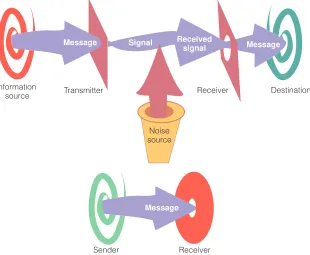
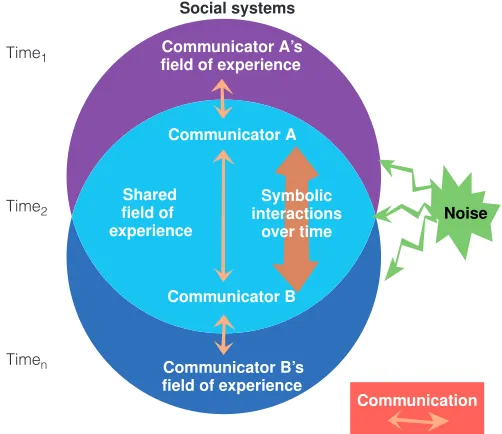
This chapter lays a foundation for your study of communication. We’ll first define communication. Next we’ll discuss the values of communication in many spheres of your life. Then we’ll examine some models of communica-tion to clarify how the process works. In the third seccommunica-tion of the chapter, we’ll describe the breadth of the communication field and careers for communica-tion specialists.
Defining Communication
Communication* is a systemic process in which people interact with and through symbols to create and interpret meanings. Let’s elaborate the key parts of this definition.
The first important feature of this definition is process. Communication is a process, which means it is ongoing and always in motion, moving ever forward and changing continually. It’s hard to tell when communication starts and stops, because what happened long before we talk with someone may influence interaction, and what occurs in a particular encounter may have repercussions in the future. We cannot freeze communication at any one moment.
Communication is also systemic, which means that it occurs within a sys-tem of interrelated parts that affect one another. In family communication, for instance, each member of the family is part of the system (Galvin, Dickson,
4
•
P A R T O N E
Foundations of Communication
& Marrow, 2006). In addition, the physical environment and the time of day are elements of the system that affect interaction. People interact differently in a formal living room and on a beach, and we may be more alert at certain times of day than at others.
Different modes of communication also affect what happens between peo-ple. Recall Mike’s dissatisfaction with e-mail and phone contact with his friend Chris. He found face-to-face interaction more satisfying. Communication is also affected by the history of a system. If a family has a history of listening sensitively and working out problems constructively, then saying, “There’s something we need to talk about” is unlikely to cause defensiveness. On the other hand, if the family has a record of nasty conflicts and bickering, then the same comment might arouse strong defensiveness. A lingering kiss might be an appropriate way to show affection in a private setting, but the same action would raise eyebrows in an office. To interpret communication, we have to consider the system in which it takes place.
Our definition of communication also emphasizes symbols, which
are abstract, arbitrary, and ambiguous representations of other things. Symbols include all language and many nonverbal behaviors, as well as art and music. Anything that abstractly signifies something else can be a symbol. We might symbolize love by giving a ring, by saying “I love you,” or by embracing. Later in this chapter, we’ll have more to say about symbols. For now, just remember that human communication involves interaction with and through symbols.
Finally, our definition focuses on meanings, which are the heart of commu-nication. Meanings are the significance we bestow on phenomena—what they signify to us. Meanings are not in experience itself. Instead, we use symbols to create meanings. We ask others to be sounding boards so that we can clarify our own thinking, we talk to them to figure out what things mean, we listen to them to enlarge our own perspectives, and we label feelings to give them real-ity. We actively construct meaning by working with symbols.
There are two levels of meaning in communication. The content level
of meaning is the literal message. For example, if someone says to you, “Get lost!” the content level of meaning is that you should get lost. The relationship level of meaning expresses the relationship between communicators. In our example, if the person who says, “Get lost!” is a friend and is smiling, then you would probably interpret the relationship level of meaning as indicating that the person likes you and is kidding around. On the other hand, if the person who says, “Get lost!” is your supervisor, and she is responding to your request for a raise, then you might interpret the relationship level of meaning as indi-cating that your supervisor regards you as inferior and dislikes your work.
Values of Communication
Now that we have a working definition of communication, let’s consider its value in our lives. We spend a great deal of time communicating. We talk, listen, have dialogues with ourselves, participate in group discussions, pre sent oral reports, watch and listen to mass communication, and so forth. From birth to death, communication shapes our personal, professional, and social lives as well as the culture in which we live.
QUIZ YOURSELF
Personal Values
George Herbert Mead (1934)* said that humans are “talked into” humanity. He meant that we gain personal identity as we communicate with others. In the earliest years of our lives, our parents tell us who we are: “You’re smart.” “You’re so strong.” “You’re such a clown.” We first see ourselves through the eyes of others, so their messages form important foundations of our self-concepts. Later, we interact with teachers, friends, romantic partners, and co-workers who communicate their views of us. Thus, how we see ourselves reflects the views of us that others communicate.
The profound connection between identity and communication is dra-matically evident in children who have been deprived of human contact. Case studies of children who were isolated from others for long periods of time reveal that they lack a firm self-concept, and their mental and psychological development is severely hindered by lack of language (Shattuck, 1980).
Communication with others not only affects our sense of identity but also directly influences our physical and emotional well-being. Consistently, research shows that communicating with others promotes health, whereas social isolation is linked to stress, disease, and early death (Baumeister & Leary, 1995; Bolger & Eckenrode, 1991; Bolger & Kelleher, 1993; Crowley, 1995). People who lack close friends have greater levels of anxiety and depres-sion than people who are close to others (Kupfer, First, & Regier, 2002; Lane, 2000; Ornish, 1999; Segrin, 1998). One group of researchers reviewed scores of studies that traced the relationship between health and interaction with others. They reached the conclusion that social isolation is as dangerous statis-tically as high blood pressure, smoking, obesity, or high cholesterol (Crowley, 1995). Many doctors and researchers believe that loneliness impairs the immune system, making us more vulnerable to a range of minor and major illness (Sheehan, 1996).
Life-threatening medical problems are also affected by healthy interaction with others. Heart disease is more common among people who lack strong interpersonal relationships (Ornish, 1998; Ruberman, 1992). Heart patients who feel the least loved have 50% more arte