Pacific Regional Rep
Access
eport of the Cooperative Perform
Audit:
ess to Safe Drinking Water
2
Foreword
Performance audits of government operations, actively promoted by PASAI, have become increasingly accepted, if not demanded, as a vital tool in ensuring government operations are both transparent and accountable for the public resources they use on the public’s behalf across the Pacific region.
If one jurisdiction undertaking a performance audit is valuable then it follows that there must be economy of scale if more participate.
To this end, PASAI has developed a program of Cooperative Performance Audits within the region. The focus to date has been on environmental auditing as environmental issues, such as the sustainable management of water resources, cross country borders and boundaries. Cooperative audits, involving a number of individual Pacific country/state audit offices, are a powerful tool to assess regional environmental impacts. The Cooperative Performance Audit program also has the clear goal of building performance auditing capacity across PASAI member audit offices.
The cooperative performance audit of access to safe drinking water is the second in this series and a topic of obvious and fundamental importance. Sadly not all people in the region share the same standards of access to safe drinking water. This report seeks to identify these deficiencies and the success stories.
This report is the culmination of a team effort but special mention must be made of the financial assistance and support provided by our development partners: the Asian Development Bank and the INTOSAI Development Initiative. The Regional Working Group on Environmental Auditing and the Applied Geoscience and Technology Division (SOPAC) of the Secretariat of the Pacific Community provided invaluable technical support and advice over the course of the audit.
I commend this report to Pacific island governments, donor agencies, and environmental organisations involved in water issues.
Lyn Provost Secretary General
3
Table of Contents
Abbreviations and Glossary of Terms ... 5
Abbreviations ... 5
Glossary of Terms... 5
1. Summary ... 6
Introduction ... 6
PRAI Objectives and Outcomes ... 6
Cooperative Audit Objective and Scope ... 7
Overall Audit Conclusion ... 8
Key Findings ... 8
Structure of the Regional Report ... 13
2. Introduction to the Audit ... 14
Reasons for the Audit ... 14
Planning for the Audit Program ... 14
Second Regional Cooperative Performance Audit ... 15
3. Access to Safe Drinking Water in the Pacific Region ... 18
Millennium Development Goals ... 18
Pacific Island Water Challenges ... 18
Regional Frameworks for Action ... 19
Monitoring Arrangements ... 20
4. Main Findings against Each Line of Enquiry ... 22
Line of Enquiry 1: Is there a legal and policy framework to ensure access to safe drinking water? .... 22
Line of Enquiry 2: Has the framework been implemented? ... 26
Line of Enquiry 3: Is the effectiveness of implementation monitored and can improvements be demonstrated?... 35
5. Executive Summaries ... 41
Cook Islands ... 41
Fiji ... 44
Kiribati ... 47
The State of Kosrae of the Federated States of Micronesia (FSM) ... 50
The Republic of Palau ... 52
4
Tuvalu ... 59
Yap State – Federated States of Micronesia ... 63
APPENDIX A: Capacity Building through the Cooperative Performance Audit Approach 64 The First Cooperative Performance Audit ... 64
The Second Cooperative Performance Audit... 65
Performance Audit Skills ... 67
5
International Organisation of Supreme Audit Institutions INTOSAI Working Group on Environmental Auditing Millennium Development Goals
Pacific Association of Supreme Audit Institutions Pacific Island Countries and Territories
Pacific Regional Audit Initiative Regional Action Plan
Regional Working Group on Environmental Auditing Applied Geoscience and Technical Division of the SPC Secretariat of the Pacific Community
Performance Audit – An audit of the economy, efficiency and effectiveness with which an audited entity uses its resources in carrying out its responsibilities.
6
1.
Summary
This report provides a regional overview of the process and outcomes of the Cooperative Performance Audit in the Pacific region on access to safe drinking water. The report records the achievements against Pacific Regional Audit Initiative (PRAI) objectives, including building performance auditing capacity within PASAI (see Appendix A), and the lessons learned from the second cooperative audit. In addition the high level findings, about access to safe drinking water in the Pacific island countries/states that were the focus of the audit, are presented.
Introduction
This report assesses the contribution of the second cooperative performance audit to the achievement of the Pacific Regional Audit Initiative (PRAI) objectives. It contains some high level observations about access to safe drinking water in Pacific countries, based on comparative results across the ten individual country/state audit reports. It also contains several examples of good practice that the audits found and includes key messages identifying where improvements are required.
The report should be of interest to Pacific island governments, donor agencies, and environmental organisations involved in water issues.
The report also assesses how performance audit capability in Pacific island audit offices is increasing as a result of the cooperative audit process (see Appendix A).
PRAI Objectives and Outcomes
The overarching PRAI objective is ‘to raise Pacific public auditing to uniformly high standards’. To achieve this objective, one of the PRAI outputs is to build and sustain public auditing capacity through the conduct of cooperative audits with participating Supreme Audit Institutions (SAIs) in the Pacific region.
The PRAI work program notes that SAI capacities differ across the region but they all face similar human resource capacity challenges. In seeking to address this issue, one of the strategies used is to develop performance auditing capacity through a cooperative audit approach. This component of the PRAI supports cooperative performance audits that result in individual national reports and an overview regional report.
Why Audit Drinking Water?
Pacific island countries and territories have unique water management issues due to factors such as their small size, lack of natural storage, competing land uses, and vulnerability to hazards including drought and cyclones. Not all Pacific island people have drinking water supplied to their homes. As a region, the Pacific may not meet the Millennium Development Goal target 7C: ‘to halve, by 2015, the proportion of people without access to safe drinking water and basic sanitation’.
7 Which SAIs Participated?
Ten PASAI member audit offices took part in the audit: Cook Islands, the states of Kosrae and Yap of the Federated States of Micronesia (FSM), Fiji, Kiribati, Palau, PICT 1, Samoa, PICT 2 and Tuvalu. Of the SAIs participating in the second cooperative audit, seven had participated in the first cooperative audit and three were new to the cooperative performance audit approach, the states of Kosrae and Yap of FSM and Kiribati.
The audit reports of the following SAIs are now in the public domain: Cook Islands, Fiji, the states of Kosrae and Yap of FSM, Kiribati, Palau, Samoa, and Tuvalu. Two additional SAIs participated in the cooperative audit. However, their reports have not yet been released and because of confidentiality issues the individual country reports cannot be identified in this regional report. As a result, when cross-country comparisons are made in this report, these Pacific island countries will be referred to as PICT 1 and PICT 2.
The Governments of the nine1 Pacific island countries are signatory to the Pacific Regional Action Plan (RAP) on Sustainable Water Management, 2002, which guides actions on water supply and drinking water safety issues within each of their jurisdictions.
Support for the Audit
The audit was supported by the Asian Development Bank (ADB), the INTOSAI Development Initiative (IDI), the Pacific Association of Supreme Audit Institutions (PASAI) and the Regional Working Group on Environmental Auditing (RWGEA). The Applied Geoscience and Technical Division (SOPAC) of the Secretariat of the Pacific Community (SPC) provided technical advice on water management issues.
The audit teams worked together on the planning phase and the reporting phase of the audit, using a peer review approach and with support from expert advisors including in-country support during fieldwork, audit analysis and report drafting.
Cooperative Audit Objective and Scope
The aim of the audit was for each participating SAI to assess the effectiveness of actions (taken by key agency/agencies) to improve access to safe drinking water, by examining:
• Line of Enquiry (LOE) 1 - Is there a legal and policy framework to ensure access to safe drinking water?
• Line of Enquiry (LOE) 2 - Has the framework been implemented? and
• Line of Enquiry (LOE) 3 - Is the effectiveness of implementation monitored and can improvements be demonstrated?
The audits focused on either the management of drinking water in key locations, such as public water utilities or the operations of key agencies in each country/state. This included considering whether the Pacific Island Countries and Territories (PICTs) were taking the
1
8 steps required by the Pacific Regional Action Plan and other regional water agreements. It was intended that each participating SAI would report its findings in its own jurisdiction and that a high-level regional perspective would be contained in this regional overview report.
Overall Audit Conclusion
The overall objective for the cooperative audit was to assess the effectiveness of management of the supply of safe drinking water in selected locations within nine PICTs. The overall audit conclusion is that most of the audited PICTs need to strengthen arrangements to improve access to safe drinking water. A key concern is that where there is no single overarching legal and policy framework for improving access to safe drinking water, there are resulting weaknesses in implementation, coordination, and making improvements based on monitoring and sound data. The few PICTs with specific legislation for safe drinking water tended to have a more robust and coherent approach to management and were more able to demonstrate improvements. There are also funding and capability constraints in most PICTs, which limit their effectiveness and ability to improve their performance.
The individual audit reports recommended areas where improvements could be made. The implementation of those recommendations should lead to improved access to safe drinking water for citizens in Pacific island countries and associated health benefits.
Key Findings
The main findings from each of the three lines of enquiry are noted below.
The overall finding on the first line of enquiry is that most of the ten PICTs have legal and policy frameworks in place but not a single, overarching framework.
An effective legal framework, supported by policies and strategies, is essential for effective management and supply of safe drinking water. The Regional Action Plan on sustainable water management encourages PICTs to develop a legal framework appropriate to the needs of their citizens.
The results for this line of enquiry are summarised in part 4 of this report (table 4.1). The key findings for this line of enquiry were broadly positive:
• nine of the ten audits had laws relevant to water management in place; principally overarching public health acts covering matters such as risks to the water supply;
9 • five of the ten audits found that national strategies, plans or policies were in place that identified risks to the supply and safety of drinking water and referred to the United Nations Millennium Development Goal related to safe drinking water;
• five of the ten audits reported that the policy framework recognised the role of traditional owners with a further two audits reporting that this role did not apply within their jurisdictions.
However, the audits also found that:
• there is no uniform approach to developing systems and processes required to underpin access to safe drinking water, with only three audits reporting that regulations were in place to:
o protect water sources;
o allocate water to consumers; and
o specify water quality standards to ensure water is suitable for consumption. Comment on First Line of Enquiry
Where government objectives are set out in legislation, there is often a need for further guidance to ensure those objectives are enshrined in national policies or planning approaches.
The audits broadly found that the necessary legislative requirements for access to safe drinking water are in place, but in most cases these are fragmented rather than in a single piece of legislation regulating safe drinking water. The effect of the requirements being spread among different statutory instruments is that other tools such as regulations and policies become more important to guide the implementation of government objectives ensuring access to safe drinking water.
It is also more challenging to effectively implement the framework and monitor whether objectives are being achieved where the framework is fragmented.
The overall finding on the second line of enquiry is that legal and policy frameworks have not been effectively implemented in most of the ten audited countries/states.
The cooperative audit assessed whether the legal and policy frameworks for supply of safe drinking water had been implemented, and were operating effectively, focusing on:
10 Administrative Support for Access to Safe Drinking Water
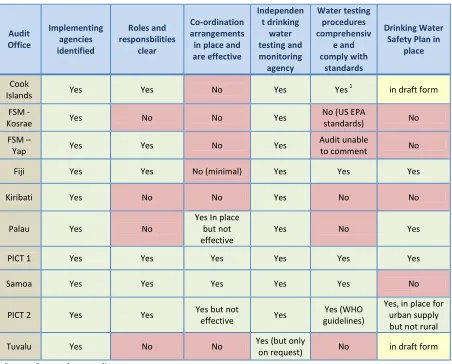
This involved examining the roles and responsibilities of key agencies, coordination arrangements between them, and arrangements to ensure safe drinking water. The results are summarised in part 4 of the report (table 4.2).
All audits found that agencies responsible for implementing the water management framework were identified. Six audits found that roles and responsibilities between agencies were clear. However, most audits (six) found a lack of coordination between responsible agencies. In particular:
• only two audits assessed coordination arrangements between these agencies as effective;
• six audits found that coordination arrangements were not in place; and
• two audits found coordination arrangements were in place but were not effective. These results are concerning, as coordination of administrative effort and clarity about roles and responsibilities are basic conditions for efficient use and management of resources to achieve the best possible result.
Eight of the ten countries/states covered by the audit need to take concerted action to facilitate greater coordination between existing water agencies and other responsible parties to effectively manage arrangements for sustainable access to safe drinking water for their citizens.
Drinking Water Safety Planning, and Independent Monitoring and Water Testing
Ensuring drinking water safety requires a risk management approach, an independent testing agency, and compliance with water quality standards:
• four countries/states audited have drinking water safety plans in place, and are making improvements based on risks identified in the planning process;
• all of the ten countries/states audited had an independent agency responsible for drinking water testing and monitoring, however
o several audits found that the number of water supply inspections and testing procedures were erratic or did not comply with approved standards; and
• lack of investment in appropriate facilities for water quality testing and also staff training was the prime cause for a lack of assurance that water testing procedures were comprehensive.
Water Pricing Policies
11 cost-recovery policies, tariffs, billing and collections systems, and financial operating systems.
Although water pricing policies exist in the majority of the countries audited, in most cases the policies were either not regularly reviewed and updated or funding was not set at a level to pay for and maintain the water supply system. The exception was PICT 1.
Where water charges apply, they need to be set considering capacity to pay, be applied equitably, and be reviewed from time to time.
Water System Infrastructure
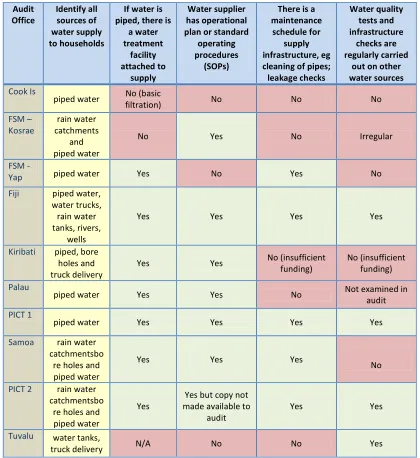
Part 4 of the report (table 4.3) summarises, on a comparative basis, the water system infrastructure in place in the audited countries/states.
Piped water was the most common option for providing access to improved sources of drinking water in the selected locations covered by the audit. However, in two cases there was no water treatment facility attached to the source.
The audits found a high degree of variance in the results concerning compliance by water utility operators with standard operating procedures, including basic maintenance matters such as cleaning pipes and checking for leaks.
Comment on Second Line of Enquiry
Administrative support for access to safe drinking water and water system infrastructure requires significant improvement across the Pacific countries audited. Coordination arrangements between responsible agencies and clarity around roles and responsibilities are generally poor. More PICTs should become involved in the drinking water safety planning process as it is leading to positive outcomes for the four countries/states audited that are using the process.
Water quality testing arrangements need improvement with the lack of investment and trained staff identified as key inhibitors.
12
The overall finding on the third line of enquiry is that there are weaknesses in monitoring systems and performance management frameworks.
The third line of enquiry considered whether monitoring arrangements were in place to assess the effectiveness of implementation of the legal and policy framework, and whether improvements in access to safe drinking water could be demonstrated.
This involved looking at:
• water quality monitoring and testing arrangements, public health data, and information provided to the public; and
• performance management arrangements.
The results are summarised in part 4 of the report (tables 4.5 and 4.6) and below.
Water Quality Monitoring and Testing, Public Health Data Collection, and Information Given to the Public
• Most of the audits (seven) found monitoring arrangements for water quality/safety in place;
• Five of the audits found regular and comprehensive water quality testing;
• Nine of the ten audits found public health data was collected on the incidence of diseases arising from the consumption of poor quality water;
• Only three audits found that the public was regularly informed if water was unsafe for drinking; and
• Three of the countries/states audited need to do more in the area of public awareness about drinking water management and quality.
Performance Management Arrangements
• Only five audits found a performance management framework in place;
• Only three audits found that the overall effectiveness of the water management system was monitored and reported to stakeholders; and
• Only four audits found that data were available on matters such as climate change effects and population growth and used to forecast effects on the supply of safe drinking water.
13
Comment on Third Line of Enquiry
Despite the somewhat negative findings in the areas of performance management arrangements and the lack of good information and forecasting, six audits found that improvements in access to safe drinking water could be demonstrated. This is encouraging. Overall, there is scope for all PICTs covered by this cooperative performance audit to make improvements to parts of their water management arrangements to improve access to safe drinking water for their citizens. There is good support and guidance available from regional organisations involved in water resource management issues, such as the SPC, to facilitate these desired improvements.
Structure of the Regional Report
This report consists of five parts:
• part 1 provides the executive summary;
• part 2 contains general information on the audit, reasons for the conduct of cooperative performance audits on environmental topics; planning for the audit program including external agency support; and the second regional cooperative performance audit and participating SAIs;
• part 3 provides background to the audit topic, including: Millennium Development Goals, Pacific island water challenges, regional frameworks for action, and monitoring arrangements;
• part 4 contains the main findings against the three lines of enquiry; the existence of a legal/policy framework, the implementation of the framework, and whether the effectiveness of implementation is monitored and if improvements can be demonstrated; and
14
2.
Introduction to the Audit
This part sets out the reasons for the conduct of cooperative performance audits on environmental topics; planning for the audit program including external agency support; and the second regional cooperative performance audit and participating SAIs. The audited entities are also identified.
Reasons for the Audit
2.1 The cooperative performance audit on access to safe drinking water is the second cooperative performance audit to be undertaken in the Pacific Association of Supreme Audit Institutions (PASAI) region. It is part of a program of Cooperative Performance Audits (CPA) in the region with the objective of building performance audit capacity within individual Supreme Audit Institutions (SAIs) to ultimately identify and promote improvements in the effectiveness, efficiency and economy of public administration. Results of performance audit capacity building through the CPA program are reported in Appendix A.
2.2 The CPA program is conducted under the Pacific Regional Audit Initiative (PRAI). A key aspect of the PRAI is to build capacity in individual SAIs through participation in cooperative performance audits and cooperative financial audits. This aligns with the strategic objective of INTOSAI for greater cooperation among SAIs.
2.3 At the 2008 PASAI Congress, auditors-general decided that the first CPA program should be environmentally focussed. This was a very good fit with the INTOSAI’s Working Group on Environmental Auditing (WGEA) work plan that aims to facilitate concurrent, joint, or co-ordinated audits in each of the INTOSAI regions, including PASAI.
Planning for the Audit Program
2.4 Initial planning work for the CPA program was undertaken between the 2008 and 2009 PASAI congresses, including discussion at two meetings of PASAI’s interim governing body, the Transitional Working Group. The SAI of New Zealand, in its role as coordinator of the ACAG/PASAI Regional Working Group on Environmental Auditing (RWGEA), conducted a survey of PASAI members to identify suitable topics for the CPA program and to find out which SAIs would be interested in taking part.
2.5 The survey favoured solid waste management as the topic for the first cooperative performance audit, with freshwater management a close second and fisheries the third choice. Many SAIs expressed interest in taking part in the program.
2.6 Planning for the CPA program relied heavily on the guidance produced by the Working Group on Environmental Auditing (WGEA) on conducting cooperative audits to determine the appropriate form of cooperation, and the level of support required.
15 External Agency Support
2.8 The Asian Development Bank (ADB) agreed to fund an advisor to lead the program and the INTOSAI Development Initiative (IDI) agreed to support planning and reporting meetings for each of the audits. Additional support was provided by IDI with the establishment of a capacity building expert position in the PASAI Secretariat. One of the functions of the capacity building expert is to assist with the delivery of the CPA program. 2.9 The first cooperative performance audit was completed in 2010 on the environmental topic of solid waste management. Ten Pacific SAIs participated: Cook Islands, the Federated States of Micronesia (FSM), PICT 1, Guam, Papua New Guinea, the Republic of Marshall Islands, the Republic of Palau, PICT 2, Tonga and Tuvalu. The consolidated regional report of these audits is now available on the PASAI website: www.pasai.org. Individual SAI audit reports, where available, are on their specific websites.
Second Regional Cooperative Performance Audit
2.10 At the 13th PASAI Congress held in Kiribati in July 2010, auditors-general agreed to continue with the CPA program, with the second cooperative performance audit being on the topic of access to safe drinking water. Again, ten Pacific SAIs decided to participate. The audit objective and high-level lines of enquiry agreed at the congress were:
Why Focus on Access to Safe Drinking Water as the Audit Topic?
2.11 The availability, quantity and quality of freshwater is basic to the activities, interests and responsibilities of many different sectors. It impacts on every aspect of modern day life from industrial production, for example hydro power; to food production, for example agriculture and fisheries; to service industries such as tourism. It is also a basic necessity of human life. The topic of equitable and sustainable management of available freshwater resources is large and includes the management of catchment and river basins to downstream extraction for agricultural purposes and also the needs of local communities. Because of this, there was a need to identify and narrow the scope of the audit to make it manageable. The decision of auditors-general to focus on access to safe drinking water as the preferred audit topic was influenced by information that indicated that the citizens of a number of Pacific island countries were not able to access safe drinking water in the quantity necessary to protect and sustain human life.
2.12 ‘Access’ and ‘safe’ are the two key terms in the audit topic that were examined in detail by the ten audit teams. ‘Access’ refers to the availability of freshwater in sufficient
To assess the effectiveness of actions (taken by key agency/agencies) to improve access to safe drinking water, by examining:
• Line of Enquiry (LOE) 1 - Is there a legal and policy framework to ensure access to safe drinking water?
• Line of Enquiry 2 - Has the framework been implemented? and
16 quantities for drinking and hygienic purposes (UN Water and Sanitation taskforce for the Millennium Project, 2005). The Joint Monitoring Program for Water Supply and Sanitation (JMPWSS) established by the WHO and UNICEF defines safe drinking water as water with microbial, chemical and physical characteristics that meet WHO guidelines or national standards on drinking water quality.2
2.13 For developing countries in the Pacific, safe drinking water is an important factor in safeguarding human health. Unsatisfactory management of freshwater resources has resulted in the reporting of around 6.7 million cases of acute diarrhoea across the region on an annual basis. Children less than five years of age are over-represented in this WHO statistic.
Participating Audit Offices
2.14 Ten PASAI member SAIs concurrently performed audits of access to safe drinking water laws, policies and practices within their jurisdictions: Cook Islands, the states of Kosrae and Yap of the Federated States of Micronesia (FSM), Fiji, Kiribati, Palau, PICT 1, Samoa, PICT 2 and Tuvalu.
2.15 This high level of participation in the second cooperative performance audit, replicates that of the first regional cooperative performance audit and again provides a representative cross-section of PICTs, supporting the development of a regional overview report.
2.16 It was agreed that the scope of the audit would be limited to either the management of key locations, such as public water utilities or the operations of key agencies in each country.
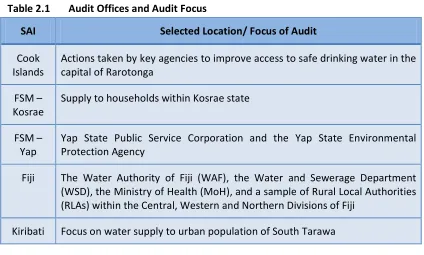
2.17 Table 2.1 sets out the selected location and/or focus of the audit. Table 2.1 Audit Offices and Audit Focus
SAI Selected Location/ Focus of Audit
Cook Islands
Actions taken by key agencies to improve access to safe drinking water in the capital of Rarotonga
FSM – Kosrae
Supply to households within Kosrae state
FSM – Yap
Yap State Public Service Corporation and the Yap State Environmental Protection Agency
Fiji The Water Authority of Fiji (WAF), the Water and Sewerage Department (WSD), the Ministry of Health (MoH), and a sample of Rural Local Authorities (RLAs) within the Central, Western and Northern Divisions of Fiji
Kiribati Focus on water supply to urban population of South Tarawa
2
17 Palau Koror-Airai public water supply system
PICT 1 National capital district water supplier
Samoa Actions taken by key agencies to ensure access to safe drinking water– Ministry of Natural Resources and Environment (MNRE), Samoa Water Authority (SWA) and the Ministry of Health (MOH)
PICT 2 The Water Board (TWB), Ministry of Health (MOH) and Ministry of Land, Survey and Natural Resources (MLSNR) and Village Water Committee (VWC) on the main island
Tuvalu Water Division in the Ministry of Works and the Environmental Health Unit on the main island of Funafuti
Source: Country/state audit reports. Audited Entities
3.
Access to Safe Drink
safe drinking water supports administrations responsible for tThis was sourced from information pro
4
INTOSAI Working Group on Environme March 2004, p. 6.
rinking Water in the Pacific Region
und to the audit topic, including: Millennium Develallenges, regional frameworks for action, and mon
oals
ed Nations Millennium Summit, world leaders en nnium Development Goals (MDGs). The eight
range from halving extreme poverty to halting th of 2015. These universal goals provide a blueprin and each leading development institution. Ever monitoring and reporting against goal achievemen
ironmental Sustainability includes target 7C: ‘Halvin ithout sustainable access to safe drinking wate ific Island Countries and Territories are not on trac
et in 2015.3
uidance, Auditing Water Issues, experiences of Sup tes that:
ing water is a crucial prerequisite for life of all pe contribution of SAIs to this public responsibility
e of government in this field.’4
egional commitment to achieve the MDG target rts Pacific SAIs auditing the performance of for this essential service to their communities.
ges
ter Forum held in 2003 noted the following ch
provided by Applied Sciences and Technology Division (SOPAC) of onmental Auditing, Auditing Water Issues – experiences of Supreme A
19 • uniquely fragile water resources due to small size, lack of natural storage, competing land use, vulnerability to natural hazards and those brought about by human activity, including drought, cyclones and urban pollution;
• water and wastewater service providers constrained by lack of human and financial resource bases, restricting the availability of experienced staff and investment, and effectiveness of cost-recovery;
• highly complex water governance due to the disconnect between traditional community and national administration practices and instruments; and
• lack of information and baseline data and poor monitoring capacity.
3.6 Pacific island countries present an incidence rate of diarrhoeal diseases 20 per cent greater than the world average and over four times higher than Australia and New Zealand. These data are presented in Figure 3.1.
Figure 3.1 Incidence Rate of Diarrhoeal Diseases per 1000 population in Australia and New Zealand, Pacific Island Countries, and the World, 2002
Source: WHO statistics, 2002.
3.7 For every eight people in Pacific island countries, only one had access to piped water to their dwelling, plot or yard in 2006 and only 46 per cent had access to any type of improved drinking water source. The definition of improved drinking water source is presented in the next section of this part with more detail provided in part 4 of this report. 3.8 Dealing effectively with Pacific islands water challenges requires concentrated effort by Pacific island governments in coordination with development/donor organisations and local communities.
Regional Frameworks for Action
3.9 There are a number of regional frameworks in place, including:
3.10 The Pacific Regional Ac Management (2002), the RAP, areas: water resources man awareness, technology, institutio 3.11 Under each of these the required actions and identifying responsible for their implem national and local governments regional effort and donor agenci 3.12 In 2006, Pacific leaders water and sanitation issues th Pacific Plan. Signatories to the P part in this cooperative audit.
Monitoring Arrangements
3.13 The MDG target 7C spec proportion of people without associated indicator for monitor drinking water source. This is drinking water sources (includin protected dug well, protected sp 3.14 The WHO and UNICEF Sanitation (JMPWSS) is respons towards the MDG targets. These targets. At the aggregate level, which data are available are e lementation. These parties include ents, regional agencies to coordinate encies amongst others.
ders agreed to address the region’s s through the Pacific RAP under the
he Pacific RAP include the countries whose audit
pecifically concerning drinking water is: ‘halving, out sustainable access to safe drinking water. nitoring progress: proportion of population using a
defined as: ‘percentage of the population usin ding household water connection, public standpip d spring, rainwater collection, and bottled).’ ICEF Joint Monitoring Programme for Water
onsible for obtaining coverage statistics to monit hese coverage statistics may differ from the official to different criteria in defining ‘access’ to drinkin
stimating coverage.5
3.5, data issues and comparability remain a chal ine to support accurate monitoring and reporting
consists of data extracted from the ADB Annua ndicators for Asia and the Pacific on progress to vel, the Yearbook reported that about half the eco re expected to reach the MDG target for improv
ta for the Pacific island countries being audited.
ommitment into Action, 2008, p. 6.
21 Table 3.1 Percentage of Population using Improved Water Sources between 1900 and 2008. Source: ADB Annual Statistical Yearbook 2010, Key Indicators for Asia and the Pacific.
22
4.
Main Findings against Each Line of Enquiry
The part presents overview findings against each Line of Enquiry (LOE). They are supplemented by good practice examples identified during the individual country/state audits and also some of the key messages from these individual audits.
Line of Enquiry 1: Is there a legal and policy framework to ensure access to safe drinking water?
4.1 The Regional Action Plan (RAP) on Sustainable Water Management is the agreed regional blueprint to guide the actions of country administrations to address water supply and drinking water safety issues within their jurisdiction.
4.2 The RAP includes this key message for responsible authorities in the Pacific:
• ‘develop national instruments including national visions, policies, plans, and legislation appropriate to each island taking into account the particular social, economic, environmental and cultural needs of the citizens of each country.’ 4.3 Because of this direction outlined in the RAP, individual audit teams examined the degree to which national visions, policies, plans, and legislation were in place in the countries/states audited.
National Legislative Instruments
23 Table 4.1 Legislation, Policies and Plans Related to Access to Safe Drinking Water in Audited Countries
Audit
1 Both Kosrae and Yap are states within the Federated States of Micronesia (FSM). FSM nationally includes in its Infrastructure Development Plan reference to MDG target 7C and the states of Kosrae and Yap are
included in this estimate.
2 Yap uses the US Environmental Protection Act (USEPA) as guidelines for water quality testing. 3. Regulations will be issued once the Water Authority of Fiji 2007 promulgation is endorsed.
24 5. PICT 2’s Water Board Act 2000 provides for the general administration and operation of the Water Board which has responsibility for the supply of water to towns in PICT 2, but not villages. There is also a draft Water Resource Management Bill before cabinet.
25 4.5 It is important that where there are numerous pieces of legislation concerned with the administration of ensuring access to safe drinking water, there is a coherent legal framework to guide administrators who are responsible for implementation. While only three of the audited countries/states had drinking water legislation or a similar law in place, another three audits reported that legislation for a Safe Drinking Water Act or similar was in draft form. Also, it is positive to note that nine of the ten audits reported that other laws have been enacted relevant to the audit topic. These are principally overarching public health acts, which are especially important for population health impacts from consuming unsafe water. Generic environment acts also play a key role in protecting fresh water sources such as catchments or dams.
4.6 The majority of countries/states audited did not have a coherent, formalised legal framework that provides management with regulatory tools to ensure access to safe drinking water for the communities that they service.
Risks
4.7 The Cook Islands audit reports on the treatment of risks to public water supply and public health issues through complementary legislation, in this case, the Cook Islands Public Health Act 2004.
Regulations
4.8 Regulations to guide systems and processes required for access to safe drinking water were not uniform in the audited countries/states. Only three audits reported that regulations were in place to protect water sources, allocate water to consumers, and specify water quality standards that must be met to ensure drinking water is of a quality suitable for consumption. This is not a good result. The absence of regulatory guidance impacts on the effectiveness of implementation and the capacity to monitor the results of implementation.
National Strategies/Plans
4.9 The existence of strategic planning arrangements to support legislative objectives is fundamental to effectively managing access to safe drinking water. In the absence of well-defined strategies/plans, the risk of non-compliance with legislative objectives, where they exist, increases. National planning becomes a priority where, as discussed in 4.5, there are multiple pieces of legislation that govern a topic. A cohesive national plan provides the framework necessary to ensure that gaps in implementation are reduced, that duplication of administrative effort is minimised and that national aspirations can be achieved.
26 4.10 Five of the ten country/state audits reported that national strategies, plans or policies were in place that identified risks to the supply and safety of drinking water with a further three in draft form. This is a positive result.
4.11 The Samoa audit reported on a good practice namely, a comprehensive sector-wide approach that has recently been introduced in Samoa.
4.12 It is also positive to note that six of the ten country/state audits reported that the national policy/planning approach makes reference to the MDG target 7C. As indicated in the above table, both the states of Kosrae and Yap are included in the National Infrastructure Development Plan for FSM nationally and the Republic of Palau reports separately against progress towards MDG targets.
Role of Traditional Owners in Water Policy Framework
4.13 The cooperative audit also sought to identify to what degree the legal role of traditional owners was recognised in the water policy framework. This is an important cultural and economic consideration as traditional owners may have rights vested in the ownership of water catchment areas or extraction points along the water supply chain. It is important where these rights exist that they are acknowledged and appropriate consultative and compensation mechanisms are put in place. Five of the ten country/state audits reported that the legal role of traditional owners was recognised in the policy framework with a further two audits reporting that this legal role did not apply within their jurisdiction.
4.14 Overall, the cross-audit results indicate that more attention needs to be paid, at the national level, to the development of legislative instruments to guide the implementation of access and drinking water safety measures. It is important that government objectives are set out in legislation and that, in turn, these are expressed through national policy and planning arrangements to guide implementation.
Line of Enquiry 2: Has the framework been implemented?
4.15 To assess whether or not the legal and policy framework had been implemented, and how effective implementation was, the ten country/state audits focussed on examining:
• administrative support for access to safe drinking water; and
27 • water system infrastructure.
4.16 Comparative audit results are presented in the following tables. Table 4.2 examines the administrative framework to support access to safe drinking water in the countries/states audited. Results on financial arrangements including a water pricing policy are discussed separately. Table 4.3 examines, on a comparative basis, the water system infrastructure. Issues concerning whether water supply systems and testing arrangements apply equally to urban and rural populations was examined in some audits. This examination is reported separately to other comparative results.
Administrative Support for Access to Safe Drinking Water
4.17 Table 4.2 examines, on a comparative basis, the administrative support for access to safe drinking water in the countries/states audited. Administrative support includes the features of: identification of the implementing agencies, clarity around roles and responsibilities, co-ordination arrangements between these agencies, and a water quality monitoring agency that is independent of agencies that provide water services.
Table 4.2 Administrative Support for the Implementation of the Framework
Audit
28 4.18 While all country/state audits reported that agencies responsible for implementing the framework were identified, coordination arrangements between these agencies were either not in place (six audits) or in place but not effective (two audits). This is not a good result as coordination of administrative effort is a basic prerequisite to maximise the use of scarce resources to achieve the best possible outcome. This poor result is further compounded by a lack of clarity around the roles and responsibilities of the agencies involved in implementing the framework. Only six of ten audits reported that agency roles and responsibilities were clear. Concerted action is necessary at the individual country/state level to facilitate coordination between existing water agencies and other responsible parties (including international donor agencies) to effectively manage arrangements for sustainable access to safe drinking water and, while doing this, ensure that public resources are used wisely.
4.19 The appointment of an overarching committee to coordinate and drive administrative effort is a good practice mechanism. The following example was identified in the Samoa audit report.
4.20 In countries/states that lack a comparable co-ordination mechanism there would be value in exploring opportunities to develop a dedicated high-level, administrative steering committee with responsibility for the water sector, including access to safe drinking water, and which would be accountable to stakeholders.
Independent Monitoring Agencies and Water Testing Arrangements
4.21 Separating the function of monitoring from the actual delivery of services is an important administrative control as it provides assurance that monitoring and water testing arrangements remain independent of service functions.
4.22 All of the ten country/state audits reported that there was an independent agency responsible for drinking water testing and monitoring. While this is a good result, a number of audits reported that the number of water supply inspections and associated testing procedures were erratic, too costly to perform on a routine basis, or the procedures were not compliant with approved standards.
4.23 Even where water quality standards were specified in regulations, audit reports noted generally, that lack of investment in appropriate facilities for water quality testing and also staff training was the prime cause for a lack of assurance that water testing
29 procedures were comprehensive and complied with applicable regulatory or other international standards. These issues will be examined further in LOE 3.
Drinking Water Safety Planning
4.24 The Pacific Drinking Water Safety Planning (DWSP) program is an initiative of the Applied Sciences and Technology Division (SOPAC) of the SPC and WHO. The program commenced in 2005 to assist participating countries to build capacity in developing system-specific water safety plans and implement subsequent improvement schedules. Drinking water safety planning is a comprehensive risk assessment approach that encompasses all aspects of drinking water supply, from catchment to consumer.6
4.25 It is a positive result that four country/state audits reported that DWSPs are in place with a further two in draft form.
4.26 The following is a good practice reported in the Fiji audit of the national water authority, the Water Authority of Fiji (WAF).
4.27 It is also good to see that the Cook Islands, Fiji, Palau and PICT 1 all have improvement schedules in place to treat the risks identified through the drinking water safety planning process.
Financing Access to Safe Drinking Water Including a Water Pricing Policy
4.28 Another key message for responsible authorities, endorsed by Pacific leaders in the Pacific Regional Action Plan (RAP) on Sustainable Water Management, is:
• ‘establish financially-viable enterprises for water that result in improved performance by developing appropriate financial and cost-recovery policies, tariffs, billing and collections systems, and financial operating systems.’
4.29 Because of this RAP message, the audit teams examined the degree to which appropriate financial and cost-recovery policies were in place in the countries/states audited.
4.30 In developing countries with low GDPs, water pricing policies (cost-recovery policies) are very sensitive policy instruments. However, in the absence of appropriately set tariffs, which take into account the capacity of consumers to pay for access to safe
6
SOPAC, Pacific Drinking Water Safety Planning Guide, 2008.
The WAF has drawn up Drinking Water Safety Plans (DWSPs) for four out of 15 of its water treatment plants. Four of the 15 treatment plants in Fiji were selected to pilot this approach before it is rolled out more broadly.
30 drinking water, the ability of water utilities to rehabilitate ageing water supply systems and to provide on-going system maintenance on a cost recovery basis is limited.
4.31 Seven of the ten country/state audits reported that financial arrangements were in place including a water pricing policy. A number of other audits reported that they were still dependent on a national budget allocation and did not have a ‘user pays’ policy. 4.32 The PICT 1 audit reported on the cost recovery successes of the national capital district water supplier, which has been operating on a profit margin for the past four years. This has resulted in the company being financially viable and able to sustain its operations.
4.33 While the operation of the national capital district water supplier demonstrates sound financial management, it needs to be noted that its operating environment, the national capital district, has a population base of around 1 million within a confined geographic area. It also has located within its geographic area a significant number of industries as well as government offices. Other Pacific island countries may not be in a similar position and continue to struggle with getting the balance right between government and donor subsidies and cost recovery as financial tools to support sustainable access to safe drinking water for their communities.
The Role of Donor Agencies
4.34 A number of country/state audits reported on their dependence on international donors to fund safe drinking water priorities and the need for better co-ordination between donor funds and local water initiatives.
4.35 A key message from the Tuvalu audit report was that:
• in Tuvalu, the planned activities in the water framework and plan are largely dependent on donor funding. If there is no funding available to finance parts of the framework, then implementation of that part of the framework is not undertaken. Multiple donors, with overlapping priority areas, can lead to the potentially The national capital district water supplier began operation on 1st November 1996 with loan funding of Kina 6.0 million, borrowed from the National Provident Fund. From 1996 to 2004, the company was operating without making profits and in 2005 the first ever profit was posted. In the following year, the loan of 6.0 million was repaid and the first dividends were declared and paid to its shareholder, an independent public business corporation.
31 inefficient allocation of resources to less crucial activities within the framework. For example, in the past, donor funded projects have targeted the same activity over the same time period. This related to fixing and supplying water to households on Funafuti.
4.36 This situation again points to the need for an administrative mechanism such as an overarching steering committee with responsibility for coordinating safe drinking water implementation activities that is responsive to the national priorities determined by government and the community.
Rate Setting and Billing Procedures
4.37 Also in response to the RAP message, a number of audit reports examined the timeliness and accuracy of administrative procedures to identify water users, set rates and bill accordingly. For example, the Palau audit found that:
• water utility rates and fees are not regularly reviewed and updated. Water users were charged different rates. Fees and charges were only recently updated, 19 years after the implementation of initial water fees in 1992. The fees collected are much less than the amount needed to provide water supply.
4.38 The Kiribati audit found that:
• the Public Utility Board (PUB) had billed X customers or households for the three years 2008-2010. However, the audit identified that the number of customers used by the account section for billing purposes was not the same as the number of water users identified through a water unit survey. The survey result showed that the number of households connected to PUB water system was Y, which implies that Y-X customers in 2010 received the water free. This consequently affects PUB billing and hence overall water sales and revenue.
4.39 If water utilities are to be financially viable and able to provide basic system maintenance, there is a need to review the basis for setting water pricing policies including the development of financial and cost-recovery policies, tariffs, billing and collection systems, and financial operating systems that are aligned with the capacity to pay of water system users. This review would best be conducted at national levels with a regional overlay. The outcome of these reviews would assist in identifying where there is a need for government subsidies and the role that donor agencies can play. The impact of poor financial oversight of public water utilities is discussed in the next section.
Water System Infrastructure
4.40 Table 4.3 examines, on a comparative basis, the water system infrastructure that was in place in the audited countries and states. Results relating to whether or not testing arrangements apply equally to urban and rural populations are reported separately, as this aspect of the audit was not examined uniformly across country/state audits.
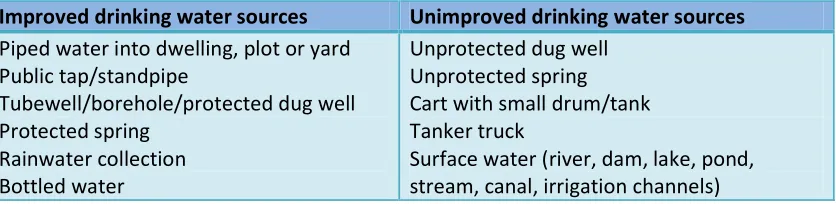
33 Table 4.4 Improved and Unimproved Types of Drinking Water Sources
Improved drinking water sources Unimproved drinking water sources Piped water into dwelling, plot or yard
Public tap/standpipe
Surface water (river, dam, lake, pond, stream, canal, irrigation channels) Source: WHO, UNICEF.
4.43 As can be seen from Table 4.3, piped water was the most common option for providing access to improved sources of drinking water in most of the countries/states audited. Water sources identified in Table 4.4 meet accepted international definitions of ‘improved’ water sources. Piped water is at the top of the list. This is because the absence of piped water hampers the ability of the users to utilise drinking water in sufficient quantities to meet the basic demand not only for drinking, cooking and hand washing, but also for bathing and laundry.7 However, WHO and SOPAC qualify this definition in Converting Commitment into Action:
• ‘piped drinking water to the household is likely to be of better quality than that from point source systems (for example a well), as there is the possibility of carrying out effective centralised treatment by the service provider.’
4.44 The audits reported varying results concerning this assumption with two of the ten country/state audits reporting that no treatment facility was attached to the source.
4.45 Other areas of water infrastructure examined in the cooperative performance audit that impact on access to and quality of water supplied to the community through public water utilities includes whether standard operating procedures are in place, especially a system maintenance schedule. Again the country/state audits reported a high degree of variance in the results concerning these key features of well-maintained and operational water infrastructure.
4.46 While seven of the ten country/state audits reported that the water supplier had an operational plan or standard operating procedures (SOPs) in place, only five reported that there was an associated maintenance schedule for supply infrastructure, eg cleaning of pipes and leakage checks.
7
WHO and SOPAC, Converting Commitment into Action, 2008, p. 16.
4.47 The importance of wate maintenance was identified as c
4.48 The PICT 1 audit report fo • the national capital dist assessed, the PICT 2 audit was th that indicated that there was regularised system for test quality in rural areas but with were deliberately cutting pip losses translated into signifi resulted in the inequitable ac
ater losses through leakage as a result of poor in as critically urgent in the audit conducted in Kiribat
rt found that:
istrict water supplier had purchased and pu tically detect leakage in the water distribution netw emphasises the benefits that can be garnered by
e checks on other improved water sources, such a lity of water of these sources, was also exam
dit, where applicable. Again, there was significant eight country/state audits that audited this, five re
ertaken to some degree or another.
in PICT 2 reports on the practice of rainwater har ecks and water quality testing and the challenge Whether or not testing arrangements apply equa lso commented on here, as this aspect of the au
hat in 2008 it was estimated that 22 per cent of w pipeline supplying the population of South Tara imate has risen to 50 per cent of total production ution system. Audit site visits and observations re
r losses were as a result of broken pipes and beca pipes to redirect water from the main pipe. T nificant lost revenue for the Public Utility Boar e access of community members to water.
35 4.53 In summary, administrative support for access to safe drinking water and water system infrastructure requires significant improvement across the Pacific countries/states audited. Coordination arrangements between responsible agencies and clarity around roles and responsibilities were generally found to be poor. Involvement in the WHO/SOPAC drinking water safety planning process was patchy, but where it was in place there were positive outcomes with the development of improvement schedules based on identified risks to access to safe drinking water. Water quality testing arrangements need improvement with the lack of investment and trained staff identified as key inhibitors. 4.54 Financing impacts on the ability of individual countries to provide sound water system supply infrastructure, including water treatment facilities at source and maintenance schedules such as regular leakage checks on pipes. While there were water pricing policies in the majority of the countries audited, with the exception of PICT 1, the policies were either not regularly reviewed and updated or not set at a level to adequately pay for and maintain the water supply system.
4.55 The role played by donor agencies is also important in this context and more needs to be done to ensure that appropriate co-ordination and oversight mechanisms are in place to ensure that donor funding is responsive to national and community priorities.
Line of Enquiry 3: Is the effectiveness of implementation monitored and can improvements be demonstrated?
4.56 Sound monitoring arrangements provide assurance to the public and stakeholders that systems are working effectively and that risks to public health are managed. Accurate, current data is fundamental to effective monitoring. Data gathered through monitoring can also be used to inform future planning and decision-making by identifying where there are gaps in implementation and the potential impact of these gaps.
4.57 As discussed in part 3 of this report, drinking unsafe water can have serious impacts on public health, particularly that of small children. As a result, water quality monitoring
36 and testing arrangements from source through distribution to consumption are critical in safeguarding public health. Because of this, the individual country/state audits examined whether or not arrangements were in place to provide this level of assurance and whether results were reported to the public on a regular basis.
4.58 Comparative audit results are presented in the following tables. Table 4.5 examines the water quality monitoring and testing arrangements and information provided to the public in the countries/states audited. Table 4.6 examines the performance management arrangements of responsible agencies that are in place in the audited countries/states. Water Quality Monitoring and Testing Arrangements
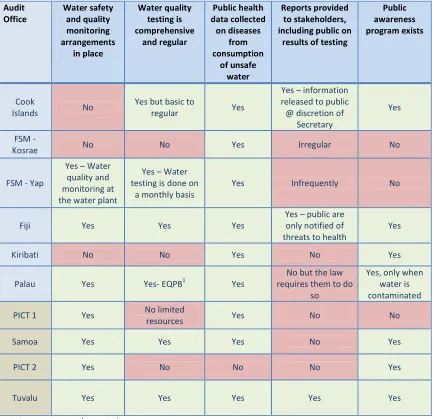
4.59 Table 4.5 identifies water quality monitoring and testing arrangements and where related information is provided to the public.
Table 4.5 Water Quality and Testing Arrangements and Public Notifications
Audit
37 4.60 While the majority of Pacific island country/state audits found that there were monitoring arrangements in place, the comprehensiveness and regularity of testing was less systematic. A number of reports commented that this was due to limited manpower and insufficient resources to perform the required tasks.
4.61 A positive outcome was that nine of the ten country/state audits found that public health data were collected on the incidence of diseases arising from the consumption of poor quality water. This provides the opportunity to monitor, over the long-term, whether implementation of government measures to address access to safe drinking water are having the desired effect on public health.
4.62 Less positive were the audit results (three of ten) concerning whether or not the public is regularly informed if water is not safe for public consumption. Where responsible agencies have concerns over the quality of water made available to the public, the public should be made aware of these concerns. Tuvalu provides a good practice example of involving the community in testing arrangements and also communicating these results by radio.
4.63 A key message from the audit report of the state of Yap was that:
• ‘announcements are made infrequently over public radio on water quality testing results’. The audit then went on to recommend that ‘the responsible agencies should develop targeted public awareness programs concerning safe drinking water for the communities it services, including timely notification on water quality’.
4.64 One of the key themes of the Pacific RAP is awareness with a corresponding message:
• ‘access to, and availability of information on water should be provided to all levels of society’.
38 4.65 The involvement of civil society in good water resources management needs to be facilitated by government. One avenue is through public awareness programs. A number examined the performance management arrangements of the responsible agencies. 4.67 Table 4.6 outlines the performance management arrangements of responsible agencies that are in place in the audited countries/states.
Table 4.6 Performance Management Arrangements
39
Samoa No Yes Yes Yes
PICT 2 No No No No
Tuvalu No No Yes Yes
Source: Country/state audit reports.
Notes: 1. YSPSC is the Yap State Public Service Corporation.
2. EPA is the Environmental Protection Agency.
4.68 The use of performance indicators to measure agency performance is a well-accepted public and private sector practice. There is a degree of variability by public sector organisations responsible for access to safe drinking water in the audited Pacific island countries/states. Where performance indicators are not in use, as reported in five of the above audits, it is difficult to demonstrate that improvements in access to and the safety of drinking water are occurring. This in turn could potentially jeopardise future investments by donor agencies if current investments are unable to be identified and outcomes reported.
4.69 A further important use of water supply and water quality data is the ability to forecast demand taking into account climate change and population growth scenarios. The Government of Tuvalu provides a good practice example of an integrated water management approach to regular and more intense droughts in Tuvalu.
4.70 A key message from the Palau audit was the need for the Water Utility in Palau to forecast water demands arising from population and commercial growth in the republic:
• the audit found that there had been a growth in water connections over the last two years including from some major hotel developments. However there was no process in place to forecast future water demands arising from these developments to assist the Water Utility to appropriately plan for increased demand on its water supply system.
40 4.71 One of the main challenges to managing water resources in the Pacific islands was identified in part 3 of this report:
• the lack of information and baseline data and poor monitoring capacity.
41
5.
Executive Summaries
This part contains the executive summaries of those national reports that are in the public domain, and which include responses from the audited entities.
Cook Islands
Performance Review on Access to Safe Drinking Water on Rarotonga
Executive Summary
There are many challenges in providing access to safe drinking water to the community. However as a basic human right, it is an essential part of daily life, and critical to our health and well-being. The quality of drinking-water may be controlled through a combination of protection of water sources, control of appropriate treatment processes and management of the distribution and handling of the water. Guidelines must be appropriate for national and local circumstances, including environmental, social, economic and cultural circumstances and priority setting.
The Cook Islands Audit Office has a responsibility under Section 27(g) of the Public Expenditure Review Committee and Audit (PERCA) Act 1995-1996 ‘to pursue any concern that arises in respect of the management of public resources which in its opinion justifies further investigation’ and to report findings in accordance with Section 32 of the PERCA Act. The objective of our performance audit was ‘to assess the effectiveness of the actions taken by key agencies, to improve access to safe drinking water’. The scope of our audit focused on the capital of Rarotonga, because of the reticulated public water network and due to major public concern regarding water supply during dry periods.
To achieve our objective we assessed:
• the existence of a legal and policy framework;
• implementation of the legal and policy framework by key agencies; and • compliance with the framework including monitoring arrangements.
42 Key Findings
Existence of a Legal and Policy Framework
• Lack of an overarching policy and framework that ensures access to safe drinking water;
• MOIP’s legislation is outdated and does not provide the Water Works Division with sufficient guidance or authority, including a lack of strategic planning;
• The Ministry of Health’s legislation and policy does not sufficiently cover the Ministry’s role in monitoring water quality, and quality standards do not apply to all consumers and all water sources;
• The proposed Water Resources Management Bill and draft National Water Policy address the deficiencies in the current legislation, including the establishment of a water authority and the introduction of water rates.
Implementation of the legal and policy framework
• MOIP Water Works Division did not have operational policies or procedures in place; • The MOH water quality policy is not aligned with the Public Health Act and provided
very limited operational standards for water sampling and analysis. Compliance with the Legal and Policy Framework
• All of the key agencies did not have proper monitoring arrangements or performance indicators in place in order to assess the effectiveness of their actions. Overall Conclusion
Currently, there is no one overarching policy or legal framework that ensures access to safe drinking water or provides a coordinated approach to water delivery, quality or management. The current legislation deals with various aspects of water supply and water quality. With the exception of the Environment Act, the current legislation requires urgent review as it is outdated and fails to provide the Ministries of Infrastructure and Planning and Health with adequate guidance or authority for their specific roles.
The lack of an overarching framework contributes to poor coordination of resources and communication between agencies. Water strategies from the National Sustainable Development Plan have not been met within the required timeframe, although most of the initiatives are now underway.