43
3-EPIOCOTILLOL FROM THE BARK OF
AGLAIA SMITHII (MELIACEAE) AND TOXIC ACTIVITY
AGAINST ARTEMIA SALINA AND CYTOTOXIC ACTIVITY
AGAINST MURINE LEUKEMIA CELLS P-388
Harneti D.1, Tjokronegoro R.1, Subarnas A.2, and Supratman U.1
1Deparment of Chemistry, Faculty Mathematics and Natural Sciences, UNPAD 2Faculty of Pharmacy, UNPAD
Abstract. Aglaia s mithii is a higher plant belonging to Meliaceae family and widely distributed in South East Asia. Plants of Meliaceae family were known as a source of cytotoxic (anticancer) substances. In the course of our continuing research for biologically active compounds from Indonesian tropical plants, the methanol extract from bark of Agl aia s mithii showed significant activity against brine shrimp (Artemia s alina) and murine leukemia cells P-388. The methanolic extract from the dried bark of A. smithii was concentrated and extracted successively with n-hexane, methylene chloride and ethyl acetate. By using Brine Shrimp Lethality Test (BSLT) to follow the separation (bioassay guided isolation), the compounds of n-hexane extract was separated by combination of column and thin layer chromatography to yield a toxic compounds. The chemical structure of active compounds were determined by spectroscopic data and compared with those spectra data reported previously were identified as 3-epiocotillol (1.) The toxic activity of compounds (1) against brine shrimp (A. salina) were evaluated by Meyer method and showed activity with LC50 13,4 µg/mL, respectively. The cytotoxic activity of compounds (1) against murine leukemia cells P-388 were evaluated by Alley Method and showed weak activity with IC50 11 µg/mL.
Keywords: Aglaia s mithii; Meliac eae; brine shrimp lethality test; murine leukemia cell P-388; 3-epiocotillol
INTRODUCTION
Plants belonging to the genus Aglaia are a rich source of tetracyclic triterpenoids of the cycloartane, dammarane and tirucallane series [1] In continuation of our work on plants belonging to this genus collected in Indonesia, we ha ve isolated from the bark of Aglaia s mithii the known dammaran triterpenoids 3-epiocotillol (1).
44 O
OH
HO
H
H
H
(1)
Aglaia s mithii is a higher plant belonging to Meliaceae family and widely distributed in South East Asia. Plants of Meliaceae family were known as a source of cytotoxic (anticancer) substances [2-4] . The methanol extract from bark of A. smithii showed significant activity against brine shrimp (Artemia s alina) and murine leukemia cells P-388. This plant has not yet been subje cted to any phytochemical or biological investigation. The methanolic extract from the dried bark of A. smithii was concentrated and extracted successively with n-hexane, methylene chloride and ethyl acetate. By using Brine Shrimp Lethality Test (BSLT) to follow the separation (bioassay guided isolation), the compounds of n-hexane extract was separated by combination of column and thin layer chromatography to yield two toxic compounds. The toxic activity of compounds (1) against brine shrimp (A. s alina)
were evaluated by Meyer method and showed activity with LC50 13,4 µg/mL, The cytotoxic activity of compounds (1) against murine leukemia cells P-388 were evaluated by Alley Method and showed weak activity with IC50 11 µg/mL.
EXPERIMENTAL SECTION
MaterialsBark material of Aglaia s mithii Corr. was collected in Bogor Botanical Garden West Java Indonesia, during October 2006. The specimen was identified and deposited at the Herbarium Bogoriense West Java Indonesia.
Instrumentation
Rotavapor R-200 Buchi with vacum Vac V-500 Buchi. Fischer-Johns Melting Point Apparatus. Spektrofotometer FTIR Shimadzu 8400 and FTIR Spectrum One Perkin Elmer. Spektrofotometer NMR (Nuclear Magnetic Resonance) JEOL JNM ECA-500. Mariner Biospectrometry, Hitachi L 6200, sistem ESI (Electrospray Ionisation),
positive ion mode and Shimadzu LCMS solution, negative ion mode. Bruker SMART APEX Diffractometer.
Procedure
Extrac tion and isol ation
45 silica gel yielding compound (1) (51 mg) (1) n-hexane/ethyl acetate, 7 : 3, (2) n -heksana/aseton, step wise.
Bioassay
The toxic activity of compounds (1) against brine shrimp (A. salina) were evaluated by Meyer method and showed activity with LC50 13,4 µg/mL. The cytotoxic activity of compounds (1) against murine leukemia cells P-388 were evaluated by Alley Method and showed weak activity with IC50 11 µg/mL.
RESULTS AND DISCUSSION
The dammarane, 3-epiocotillol (1) were isolated from the n-hexane extract of A. smithtii bark by chromatography on silica gel. They have been found previously in
A. lawii leaves [5]. However, they have been described in other genera of the family Meliaceae and were identified on the basis of comparison of their spectral data with literature values [1,5]. They all possess the same 20S,24-epoxy-25-hydroxy chain at C-17.
3-Epiocotillol
3-epiocotillol showed an [M-H]+ peak at m/z 461 in the LC-MS, coresponding to molecular formula C30H52O3.
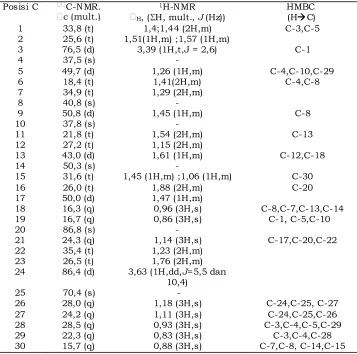
Recent detailed NMR studies have unambiguously demonstrated that the 24R and 24S isomer can be easily distinguished by the resonances of C-24 (δC 83.2 for the R-isomer and δC 86.5 for the S-isomer) [5]. The chemical shifts and coupling patterns of the H-24 differ also from each other (δH3.7, J =7 and 7 Hz and δH 3.6, J = 10 and 5.5 Hz, respectively) (Table 1). Position hydroxyl group at C -3 and gemdimethyl at C-4 with HMBC correlation H-28/C-3, C-5, C-29; H-29/C-28,C-5,C-3. The IR showed the absorption of a hydroxyl group at 3300 cm-1.
47 ACKNOWLEDGEMENTS
We thank for The Ministry of National Education, Directorate of Higher education, Republik Indonesia, for financial support (STRANAS Project 2010) and LIPI Serpong for NMR measurement.
REFERENCES
1. Roux, D., T. Martin., T. Adeline., T. Sevenet., H. Hadi., and Pais , M. 1998. Foveolins A dan B, dammarane triterpenes from Aglaia foveolata. Phytoc hemistry 49(6): 1745- 1748.
2. Omar S., Zhang, J., Kinnon, M.S., Leaman, D., Arnason, J.T., and Philogen, B.J.R. 2003. Traditionally-used antimalarials from Meliaceae.
Current Top Medicinal Chemistry 3(2): 133-139.
3. Nugroho, B. W., Edrada, R.A., Wray, V., Witte L., Bringmann, G., Gehling, M., and Proksch, P. 1999. An insectisidal rocaglamida derivates and related compounds from Aglaia od or ata (Meliaceae). Phytochemistry 51: 367- 376.
4. Nakatani, M., Abdelgalell, S.A.M., Sand, M.M.G., Huang, R.C., Doe, N., and Iwagawa, T. 2004. Phragmalin Limonoids from Chukrasia tabularus.
Phytoc hemistry 65: 2833-2841.