3-Mercaptopropionic Acid as Corrosion Inhibitor for Carbon Steel in CO2 Aerated 1% NaCl Solution with Buffer Control-pH
Yayan Sunarya
Chemistry Study Program, Universitas Pendidikan Indonesia, Bandung, Indonesia
email: [email protected]
Received April 6, 2017; Accepted September 23, 2018; Available online December 8, 2018
ABSTRACT
In this research, 3-Mercaptopropionic acid (MPA) as corrosion inhibitor of carbon steel in CO2 aerated 1%
NaCl solution with buffer pH adjustment has been studied by means of electrochemical impedance (EIS) and polarization (Tafel plot). MPA was found to be an effective carbon steel inhibitor. Percentage inhibition efficiency (IE %) calculated by both Tafel plot and EIS, ranged from 85% to 90%. MPA was found to affect the cathodic processes and act as cathodic-type inhibitors. Mechanism of inhibit corrosion by adsorption mechanism leads to the formation of a protective chemisorbed film on the metal surface film which suppresses the dissolution reaction and the hydrogen evolution reaction is activation controlled.
Keywords: 3-mercaptopropionic acid, corrosion inhibitor, carbon steel, Tafel, EIS.
INTRODUCTION
Corrosion is the destructive result of chemical reaction between a metal or metal alloy and its environment. Corrosion on the exterior of pipes can be controlled by coating or cathodic protection, but not in the interior. It can only inhibited by the adding of inhibitor. The inhibitors are chemical compounds that deposit on exposed metal surfaces from the corrosive environment.
Inorganic materials likes chromic, nitrous, or silica compounds has been applied as corrosion inhibitor, however, they are non-friendly in environmental. Therefore, in the recent time, developing of corrosion inhibitor toward organic materials that containing nitrogen or sulfur atoms with cyclic structure. In research on organic corrosion inhibitors, attention is paid to the mechanism of adsorption and also to the relationship between inhibitor structures and their adsorption properties. It has been observed that the adsorption depends mainly on the electronic and structural properties of the inhibitor molecule such as functional groups, electron density on donor atoms and p orbital character of donating electrons (Raicheva, Aleksiev, & Sokolova 1993).
Corrosion inhibitors used for the protection of steel in oil wells are mostly organic bases containing nitrogen, sulfur and
oxygen atoms in their structure. The inhibition of steel corrosion in acidic media was studied previously by using these nitrogen bases. One of the major features of conditions in production-well structures is that the liquid mixture contains a high percentage of NaCl (typically 1-3 per cent) and it is saturate with CO2 (Sahin & Bilgic, 2003)
A thorough study of the so-called sweet corrosion would require a gradual change of corrosive medium, starting with NaCl solutions and finally ending up with the actual conditions prevailing in the oil wells. Thus, CO2-saturated salt solution, which is the case with most underground waters, may be regarded as a step towards the imitation of the natural, oil-mixed brine waters (Manahan, 2000).
In CO2 solutions, the dominant species in the medium is governed by the pH of the solution, and the pH of underground waters may be controlled by agents other then CO2. In the absence of other pH-active chemicals, CO2-saturation lowers the pH of the solution, but in this study, no attempt was made to compensate for the pH-change. pH adjustments with citric-phosphate buffer, mixing with other minerals to approach the brine water concerned.
been addressed toward the goal of using cheap, effective molecules at low or ‘‘zero’’ environmental impact. These compounds include certain amino acids and derivatives, which have been tested for various metals, such as carbon steel or copper corrosion in H2SO4 or HCl (Moretti, Guidi, and Grion 2004). MPA is derivative of cysteine, which is relatively cheap and easy to produce in high purity. In this paper MPA was tested as carbon steel corrosion inhibitor in CO2-saturated aqueous NaCl solutions and pH of solution was adjusted by buffer, due to the corrosion inhibition efficiency showed by the mercapto functional group.
EXPERIMENTAL SECTION remainder Fe) were used as working electrode, with an exposed area of 1.76 cm2 were embedded in epoxy resin. The electrode surface was gradually polished with silicon carbide papers (from grade 300 to 1200), cleaned with distilled water, degreased in acetone before use and dried at room The solutions were prepared from analytical grade (Merck) reagents. The solutions were aerated with CO2 gas, which was bubbled over the solution during the measurements.
Electrochemical studies
Electrochemical experiments were carried out by means of potentiostat equipment (Tacussel-Radiometer PGZ 3O1) and controlled with Tacussel corrosion analysis software (Voltamaster 4). Measurements were obtained using a conventional three-electrode
glass cell with a platinum counter electrode and a saturated calomel electrode (SCE) as reference. Values of the parameters in the electrochemical experiments were as follows: exposure time, 30 min; solution volume, 250
The anodic and cathodic polarization curves were recorded by a constant sweep rate of 0.5 mVs-1, potential range, ± 100mV with respect to open circuit potential. The corrosions rates were determined by the Tafel extrapolation method and fitting the linear part of the curve to the polarization equation, using:
D electrons in the reduction of the metal ions, D = density of the metal in g/cm3, i = corrosion current density in mA/cm2.
Impedance spectra were obtained in the frequency range 50 kHz to 10 mHz with ten points per decade at the corrosion potential after 30 minutes of immersion. A sine wave with 10 mV amplitude was used to perturb the system and applied DC potential is free with respect to open circuit potential. The impedance diagrams are given in the Nyquist representation.
Percentage inhibition efficiencies (IE) were determined by both the methods: (1) Tafel extrapolation and (2) Electrochemical impedance spectra (EIS). The first method is method is determined by :
100
Rti and Rt0 are the polarization resistance with and without the inhibitor, respectively.
RESULTS AND DISCUSSION
protective effect reached (the minimum concentration of experimental interest).
Potentiodynamic polarization measurements
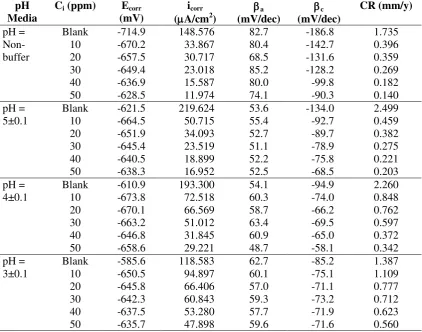
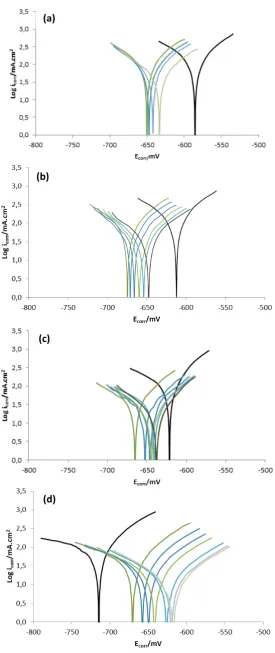
Current potential characteristics resulting from potentiodynamic curves for the carbon steel electrode in 1% NaCl solution were evaluated by Tafel plot method. Figure 1 depicts typical potentiodynamic polarization curves of MPA at different concentrations in 1% NaCl solutions. Table 1 represent the various electrochemical parameters for carbon steel corrosion in 1% NaCl containing different concentrations of MPA under investigation respectively, and show the corrosion potential, Ecorr, corrosion current density, icorr, Tafel slopes (c and a), and corrosion rate, CR.
It can be found from the experimental results that MPA decreased icorr significantly at all the studied concentrations. The cathodic current densities were decreased indicating that MPA suppressed cathodic reactions. The effect of concentration increase is more pronounced
in case of c. This shows a greater increase in the energy barrier for cathodic hydrogen proton discharge when compared to that of anodic carbon steel dissolution (Wang, Liu, and Xin 2004; Al-Mobarak, et al., 2010). This suggested a cathodic type control and MPA mainly acts as a cathodic type inhibitor in 1% NaCl solution.
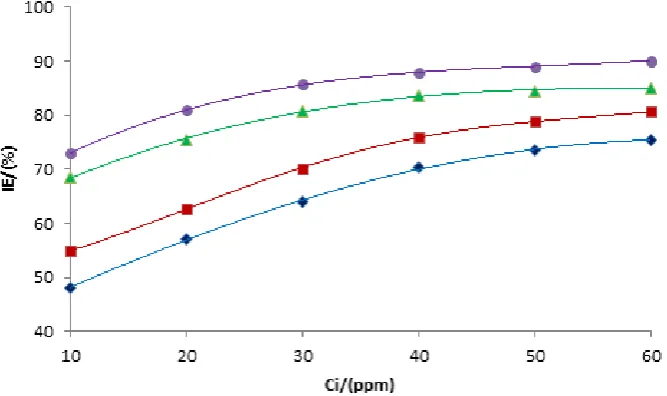
The values of icorr in Table 1 provide the evaluation of IE%. The dependence of the IE on the concentration is shown in Figure 2. According to the maximum value of IE reached in the concentration range studied media of MPA considered in this investigation can be lined as follows: pH non-bufer > pH 5 > pH 4 > pH 3. The data show that IE% increase with the addition of MPA in all media, due to the increase in the blocked fraction of the electrode surface by adsorption and the hydrogen evolution reaction is activation controlled. The optimum percent inhibition efficiency was obtained by MPA in CO2 aerated 1% NaCl media at pH non-bufer is 90% for concentration of 40 ppm MPA. Table 1. Electrochemical parameters obtained from the polarization curves of MPA in 1%NaCl solution with buffer pH adjustment.
Figure 1. Potentiodynamic polarization curves for carbon steel in CO2 aerated 1% NaCl solution containing different concentrations of MPA. (a) pH 3±0.1, (b) pH 4±0.1, (c) pH 5±0.1, and (d) pH non-buffer.
(a)
(c) (b)
Electrochemical impedance results
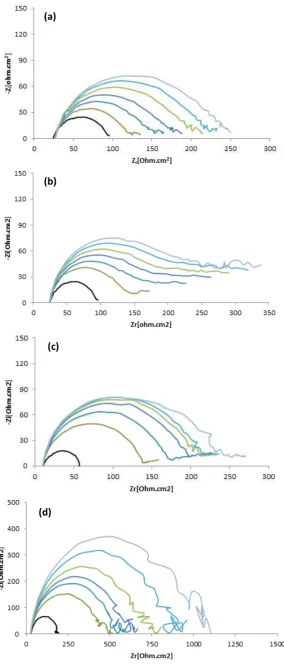
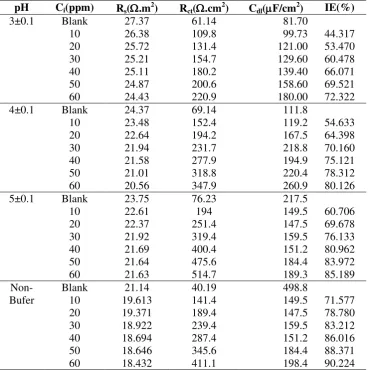
Figure 3 show the corresponding Nyquist plots for carbon steel in 1% NaCl solution at various pH and the various concentrations of MPA. The best semicircle can be fitted through the data points in the Nyquist plot using a non-linear least square fit so as to give the intersections with the x-axis, which are Rs and Rct. The impedance diagrams obtained in all media have almost a semicircular appearance. This shows that a charge transfer process mainly controls the corrosion of carbon steel. It is seen from this Figure that the impedance diagrams were almost semicircular in appearance but were not perfect semicircles. This difference has been attributed to the frequency dispersion (Wang, et al., 2004; Bentiss, Traisnel, Vezin, and Lagrenèe, 2004; Mihit et al., 2010).
The corrosion kinetic parameters derived from the Nyquist plots and inhibition efficiency (IE%) calculated by charge transfer resistance are given in Table 2. The greatest effect was observed at pH non-bufer which gives IE values over 90%. Similar behavior is observed in all media. Inhibition efficiency is found to increase with inhibitor concentration in all media. The AC impedance study also maximal (-Z”max) by the following equation:
t significantly changed after the addition of MPA in the corrosive solutions and that the impedance of inhibited substrate increases with increasing concentration of inhibitor in media. As it can be seen from this table, when the inhibitor is added, Cdl values tend to increase, unless in nonbufer media. The increasing of Cdl in all concentration MPA may be due to the adsorption of MPA on the metal surface leading to the formation of an insoluble barrier film from the acidic solution and/or a decrease in local dielectric constant. However, when the MPA concentration is increased, Cdl values tend to increase that suggests decreasing in the thickness of the electrical double layer (Bentiss, et al., 2004; Mihit, et al., 2010).
The thickness of this barrier film can be evaluated by using the following equation:
d
exposed area of the carbon steel test electrode and d is the thickness of the organic coating.Figure 3. Nyquist diagrams for carbon steel in 1% NaCl solution at various pH and concentrations of MPA. (a) pH 3±0.1; (b) pH 4±0.1; (c) pH 5±0.1; (d) pH Non-buffer
(a)
(b)
(c)
Table 2. Impedance measurements and inhibition efficiencies for carbon steel in 1% NaCl solution containing different concentrations of MPA.
pH Ci(ppm) Rs(.m 3.08 obtained from capacitance-bridge measurement, the resulting thickness was 27.2 x 10⁻⁸ cm, which clearly proves that the inhibition is due to the formation of a stable adsorbed film on the metal surface (Wang et al., 2004). The value of inhibition efficiency obtained from EIS measurements for latter concentration of MPA follows the order: Non-buffer > > pH 5 > pH 4 > pH 3. The results obtained from the EIS measurements correspond to those from polarization tests. Inhibited Mechanism
As far as the inhibition process is concerned, it is generally assumed that the adsorption of the inhibitors at the metal solution interface is the first step in the action mechanism of inhibitors in aggressive media. Inhibition of corrosion of carbon steel in 1% NaCl solution by MPA can be explained on the basis of adsorption. Three types of adsorption
cathodic reactions. In acid media, this electron donating groups. The adsorption of MPA on anodic sites may decrease anodic dissolution of carbon steel.
From the experimental results, we replacement of hydrogen atom on the mercapto substituent by alkyl/aryl groups or replacement of hydrogen atom on the carboxylic group by amino group may result in more corrosion inhibition.
CONCLUSIONS
The MPA shows good inhibiting properties for carbon steel in CO2 aerated 1% NaCl solution with pH buffer adjustment, mainly pH non-bufer. It was found to affect the cathodic processes and act as cathodic-type inhibitors. Mechanism of inhibit corrosion by adsorption mechanism and the adsorption leads to the formation of a protective chemisorbed film on the metal surface film which suppresses the dissolution reaction and the hydrogen evolution reaction is activation controlled. REFERENCES
Al-Mobarak, N.A. K.F. Khaled, M. N.H. Hamed, K.M. Abdel-Azim, N.S. Abdelshafi. (2010): Corrosion inhibition of copper in chloride media by 2- mercapto-4-(p-methoxyphenyl)-6-oxo-1,6-dihydropyrimidine-5-carbonitrile: Electrochemical and theoretical study, Arab. Journal of Chemistry 3, 233–242.
Bentiss, F., Traisnel, M., Vezin, H., Hildebrand, H.F., Lagrenee, M. (2004): 2,5-Bis(4-dimethylamino-phenyl)-1,3,4- oxadiazole and 2,5-bis(4-dimethylaminophenyl)- 1,3,4-thiadiazole Derivatives: Structure - Activity Correlations, Corr. Sci., 45, 371-380. Manahan, S.E. (2000): Environmental
Chemistry, Lewis Pub., New York.
Mihit, M., Laarej, K., Abou El Makarim, Bazzi L., Salghi R., Hammouti B. (2010): Study of the inhibition of the corrosion of copper and zinc in HNO3 solution by electrochemical technique and quantum chemical calculations, Arab. Journal of Chemistry, 3, 55–60.
Moretti, G., Guidi, F., Grion, G. (2004): Tryptamine as a green iron corrosion inhibitor in 0.5 M deaerated sulphuric acid, Corrosion science, 46 387-403. Raicheva, S.N., Aleksiev, B.V., & Sokolova,
E.I. (1993): The efect of he chemical structure of some nitrogen- and sulphur-containing organic compounds on their corrosion inhibiting action. Corrosion science., 34, 343-350.
Sahin, M. & Bilgic, S. (2003): The inhibition effects of some heterocyclic nitrogenous compounds on the corrosion of the steel in CO2-saturated NaCl solutions, J. Anti-Corrosion: Method and Mater., 50, 34-39.