STUDENTS’ VOICE ON THEIR TEACHING
IN REAL CLASSES AT SCHOOL:
WHAT DOES IT REVEAL?
by
Siti Mina Tamah
English Education Study Program
Faculty of Teacher Training & Pedagogy
Widya Mandala Catholic University Surabaya
ACKNOWLEDGMENTS
The writer is grateful to Prof. Veronica L. Diptoadi, the head of LPPM, the
Research Institute of Widya Mandala Catholic University Surabaya. She has encouraged
the writer to submit the proposal to be reviewed. The opportunity will not be available if
it is not supported by the Head of the English Department as well as the Dean of
Teacher Training Faculty of Widya Mandala Catholic University. The writers are then
thankful to Hady Sutris Winarlim, M. Sc., and Dra Agnes Santi W., M. Pd respectively.
The writer acknowledges indebtedness also to the anonymous reviewers who have given
their valuable input for the improvement of her research proposal. Davy Budiono, M.
Pd., the head of Teaching Practice Laboratory also deserves her gratitude as the initial
description of the subjects were obtained from him hence making it possible for her to
have a better proposal.
More importantly, as this research involves students who finished their Teaching
Practice (PPL) in the academic year of 2011/2012 (odd semester August-December
2011), the writer will not miss the opportunity to sincerely thank them.
The writer is completely aware that without the assistance of those people
mentioned previously and others who are involved indirectly in this study and whom she
cannot mention one by one, this research will not appear in its present shape. She is
therefore indebted to them.
Surabaya, June 2012
DAFTAR ISI
CHAPTER II REVIEW OF RELATED LITERATURE
2.1 Teaching Practice …………..……….……….. 2.2 Micro Teaching ..………..………….……….…... 2.3 Evaluation …………...……….……….. 2.4 Knowledge and Skills Expected to Be Transfered
in Real Classroom Implementation ………..……..…….
CHAPTER IV DATA ANALYSIS AND FINDINGS
4.3.1 Setting ………. 4.3.2 Class Size and Duration ………. 4.3.3 Perceived Advantages ………
4.4 Student Teachers’ Teaching Practice and Micro Teaching:
The Interrelationship ……… 4.6 Findings: Answers to the Research Questions ……… 4.6.1 The Extent to Which Pre-Activities of Teaching Practice Are Useful for Student Teachers in Their Teaching in
LIST OF APPENDICES
Appendix 1 The questionnaire for the try-out ………. 57
Appendix 2 The questionnaire for the actual study …...……… 62
Appendix 3 The questionnaire posed in the interview ………..… 67
Appendix 4 Initial General Description of the subjects ……...……… 68
LIST OF TABLES
Table 4.1 General Information About the Research Subjects ….. 14 Table 4.2 Teaching Practice Evaluation Setting …...…….……… 16
Table 4.3 Usefulness of Pre-Activities for Teaching Practice
Evaluation ……….………..… 17
Table 4.4 Usefulness of Post-Activities for Teaching Practice
Evaluation ………...……… 17
Table 4.5 Internal-oriented Perceived Advantage of Micro
Teaching ……….. 21
Table 4.6 External-oriented Perceived Advantage of Micro
ABSTRACT
This descriptive study has its main concern on revealing how Teaching Parctice in real classes at school is perceived by student teachers. More particularly this particular study is intended to document the extent the student teachers think they have been assisted in their teaching in real classes at school. The minor objectives are:
1. to reveal the extent to which pre-activities of Teaching Practice are useful for student teachers in their teaching in real classes,
2. to reveal the extent to which post-activities of Teaching Practice are useful for student teachers in their teaching in real classes,
3. to reveal the extent to which teaching demonstration in Micro Teaching is advantageous,
4. to reveal the extent to which Micro Teaching assists student teachers in their Teaching Practice with regard to Lesson Plan making,
5. to reveal the extent to which Micro Teaching assists student teachers in their Teaching Practice with regard to Lesson Plan implementation,
6. to reveal the extent to which Micro Teaching is perceived different from Teaching Practice by student teachers,
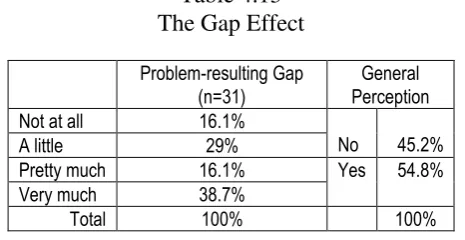
7. to reveal the extent to which the difference between Micro Teaching and TP causes problem to student teachers, and
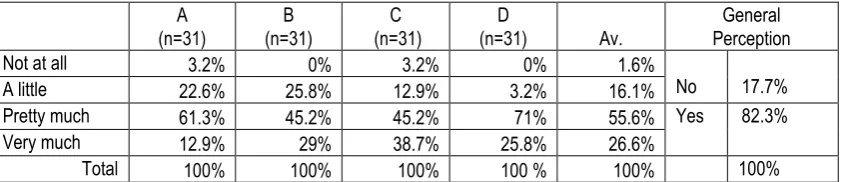
8. to reveal the extent to which Micro Teaching assists student teachers in their Teaching Practice with regard to the knowledge and teaching skills in real classroom instruction.
This study engaged 38 student teachers studying at the English Department of a university in Surabaya. They were the students who programmed Teaching Practice in the odd semester of 2011/2012 academic year. They just finished their Teaching Practice at school a semester ago for it was the even semester of 2011/2012 academic year when this study was conducted.
A set of questionnaire was devised to obtain the data. Two types of questions – open and closed ones – were formulated in such a way to gather information concerning the student teachers’ awareness indicating the extent the knowledge and skills they got in Micro Teaching were transferred in real classroom implementation at school. The closed questions in the questionnaire asked respondents to indicate on a Likert scale of 1 to 4 how much they agreed to the statement provided. Items to reveal suggestions and comments with regard to the contribution of Micro Teaching for their Teaching Practice were also included. Another instrument employed was semi structured interview and stimulated recall taken from the collection of their Lesson Plans developed both in Micro Teaching and Teaching Practice. The data from the interview and stimulated recall were, however, not analysed as the main data.
The study finds that the majority of the student teachers thought the pre-evaluation activities – observing the school’s tutor teaching, consulting the lesson plan to the school tutor and the lecturer – are useful for them. It is also found that the majority of the student teachers thought that the post-evaluation activities – getting the feedback from the school tutor and the lecturer – are beneficial to them. Teaching demonstration is perceived to be advantageous owing to some factors covering (1) the
student, (6) the student teacher’s being a private teacher and (6) the student teacher’s joining other subjects like TEFl and TEYL. Lesson Plan making experience is considered useful. The implementation of the Lesson Plan is perceived positively by the majority of the student teachers. Student teachers’ steady answers indicated positively that they experienced a very big gap teaching in two different settings – the number of the students, classroom management, experience to teach in real class, different characteristics of students, and Lesson Plan issue. A situation resulting from such a disparity in experience between Micro Teaching and Teaching Practice is deemed problematic by almost 55% student teachers. The student teachers in this study showed high perception on the extent to which Micro Teaching assists them in real classroom instruction with regard to the knowledge and teaching skills.
CHAPTER I
INTRODUCTION
1.1 Background
Yusuf (2006) in Dweikat (n.d) puts forward that teacher education is not only
theory-based but it is also practice-oriented. Through theory and practice student
teachers are provided with the knowledge and skills necessary for them to acquire the
basic components of teacher education. The practice-oriented experience include among
others teaching practice, workshop, and microteaching.
Teaching Practice is a course in which students are given chances to teach real
students in schools. At the English Department of the Faculty of Teacher Training and
Pedagogy of Widya Mandala Catholic University Surabaya, this 4-credit program
which lasts for 36 effective days requires various activities to be performed by the
students. One of the most essential activities is teaching English in real classes to apply
their English teaching skills.
As a prerequisite of enrolling Teaching Practice, the students must pass Micro
Teaching. Micro Teaching is a course in which students are given opportunities to teach
English to their friends in the form of simulations. The Micro Teaching classroom is the
imitation of the real ones in schools. It is expected to be the place for students to prepare
themselves on campus to get knowledge and skills before they go to real teaching field.
In Micro Teaching the students are provided with the theory and application of
Micro Teaching Skills. Besides developing an appropriate lesson plan, the students get
the opportunity to practice in front of their peers. They are trained to demonstrate the
ability to create classroom discourse by organizing teaching activities like asking
questions of various kinds, responding to students’ questions appropriately, assessing students’ learning achievement appropriately, and applying appropriate teaching techniques, media, and other learning resources in conducting the class activities. The
materials used in Micro Teaching are taken from the textbooks used in schools which
implement Competency-based Curriculum. In brief, the overall purpose is to prepare the
students before they are enrolled in Teaching Practice.
The brief description about the relation between Teaching Practice and Micro
mean that what is learned in one place can be used in another. Freeman (1994) in
Mullock (1999: 173) points out that transfer is an assumption which lies at the heart of
education. What is often assumed is that the content of teacher education courses is
automatically transferred to the classroom.
The transfer assumption might indirectly mean that what the students have got in
Micro Teaching is spontaneously passed on to their Teaching Practice. Indeed no
discussion of a program evaluation, in this case the one of Teaching Practice would be
complete without the input from the students themselves as they are the ones who
implement the knowledge and skills they obtain from Micro Teaching in the real
classrooms at school. This particular assumption of transfer from Micro Teaching to
Teaching Practice is worth investigating. Since so far there has not been any research
performed to obtain somewhat scientific data about what students say related to their
teaching in real classes at school, the writer raises this issue to commence a preliminary
study to reveal the perceived advantages of Micro Teaching and Teaching Practice as
well as the extent the knowledge and skills obtained in campus are transferred onto real
classroom teaching practice at school – hence, revealing ‘the voice of students’ as it is
stated in the title of this research.
1.2 Statements of the Problem
Based on the rationale mentioned above in (1.1), the writer poses the following
research question: “How is Teaching Practice in real classes at school perceived by
student teachers?” from which the minor questions are formulated as follows:
1. “To what extent are pre-activities of Teaching Practice useful for student teachers in
their teaching in real classes?”
2. “To what extent are post-activities of Teaching Practice useful for student teachers in
their teaching in real classes?”
3. “To what extent is teaching demonstration in MT advantageous?”
4. “To what extent does Micro Teaching assist student teachers in their Teaching
Practice with regard to Lesson Plan making?”
5. “To what extent does Micro Teaching assist student teachers in their Teaching Practice with regard to Lesson Plan implementation?”
6. “To what extent is Micro Teaching perceived different from Teaching Practice by
7. “To what extent does the difference between Micro Teaching and Teaching Practice
cause problem to student teachers?”
8. “To what extent does Micro Teaching assist student teachers in their Teaching
Practice with regard to the knowledge and teaching skills in real classroom instruction?”
1.3 Objectives
Referring to the research question previously posed, the writer is conducting this
study to achieve the objective of revealing how Teaching Practice in real classes at
school is perceived by student teachers. More particularly, this study is intended to
document the extent the student teachers think they have been assisted in their teaching
in real classes at school. The minor formulated objectives derived from the minor
research questions are as follows:
1. to reveal the extent to which pre-activities of Teaching Practice are useful for student
teachers in their teaching in real classes,
2. to reveal the extent to which post-activities of Teaching Practice are useful for student
teachers in their teaching in real classes,
3. to reveal the extent to which teaching demonstration in Micro Teaching is
advantageous,
4. to reveal the extent to which Micro Teaching assists student teachers in their
Teaching Practice with regard to Lesson Plan making,
5. to reveal the extent to which Micro Teaching assists student teachers in their
Teaching Practice with regard to Lesson Plan implementation,
6. to reveal the extent to which Micro Teaching is perceived different from Teaching
Practice by student teachers,
7. to reveal the extent to which the difference between Micro Teaching and TP causes
problem to student teachers, and
8. to reveal the extent to which Micro Teaching assists student teachers in their
Teaching Practice with regard to the knowledge and teaching skills in real classroom
instruction.
1.4 Significance of the Study
The research to be performed in this study is based upon such a premise that
critical factors in determining the degree of success of the Department’s attempt in
assisting them in real classroom instructions. As a consequence, the long-term objective
of this study is to draw syllabus designer’s attention to what needs maintaining and/or
improving with regard to the overall syllabus especially the Micro Teaching one. It is
somewhat an urgent study as the curriculum of Department is now under revision and
soon the syllabus will also be. Furthermore, when the student teachers are prepared well
and when they are there in schools, they can in some way be the representatives for
promoting the Department in the society.
1.5 Scope and Limitation
The center of investigation in this study excludes the administrative activities
carried out by the student teachers at school. The study is restricted to merely the
student teachers’ teaching in real classes in applying their English teaching skills. The
teaching in real classes is the one that is scored or evaluated by the English school
teacher and/or the lecturer assigned to evaluate their teaching. Therefore it also
excludes the non-scored teaching by the student teachers who are sometimes asked to
be a substitute teacher as the respective classroom teacher is absent.
1.6 Theoretical Framework
The conceptual framework for investigating this study derives from the assumption that
what student teachers have undergone in Micro Teaching on campus is applied in the
real classrooms at school. Therefore the literature review will touch upon the issue on
Teaching Practice, Micro Teaching, evaluation, andknowledge and skills expected to be
transferred in real classroom implementation.
1.7 Definition of Key Terms
The student teachers in this study refer to the ones registering a course named
Teaching Practice. The students’ voice refers to the perception or awareness of their
own teaching performance in real classes. It also refers to the suggestions and comments
of the student teachers with regard to the contribution of Micro Teaching for their
1.8 Organization of the Research Report
This study is presented in five chapters. In Chapter I the researcher introduces
the background, presents the problem statement along with the objective, points out the
significance of the study, and the limitation of the study, provides theoretical
framework, and defines the key-terms. Chapter II reviews the related literature
underlying the research. Chapter III presents the research method used in this study. It
includes a description of the research design, the research instrument, the research
subjects, and the procedures to collect and analyse the data. Chapter IV will deal with
the results of the data analyses and the findings. Chapter V concludes the study.
CHAPTER II
REVIEW OF RELATED LITERATURE
2.1 Teaching Practice
Prevalently, Teaching Practice is provided at teacher training institutions. At the
English Department of the Faculty of Teacher Training & Pedagogy of Widya Mandala
Catholic University, Teaching Practice is a course offered in semester 7. It is popularly
named PPL which stands for Program Pengalaman Lapangan. It is a program to provide students to have teaching experience in school field, outside campus.
This course is such a big program that the Department has a technical execution
unit to take care of the administration of this 4-credit course. Students programming
Teaching Practice are registered as Teaching Practice participants. The students are
placed in schools – elementary, junior high and senior high schools. At school the
students are well-known as Mahasiswa PPL or PPL students but they are treated as teachers (in this study, they are named ‘student teachers’). They are required to be
practicing teachers for 36 effective days and to perform various activities related to both
administrative and non-administrative responsibilities. One of their non-administrative
responsibilities is being in real classes to apply their English teaching skills (Universitas
Katolik Widya Mandala Surabaya. 2002).
2.2 Micro Teaching
Referring to Manis (`1973), Dweikat (n.d) asserts that microteaching implies a
condensed and simplified teaching situation and provides teacher candidates with
opportunities to systematically study and practice specific teaching behaviors in a
simulated environment. The simulation consists of the following four basic phases: (1)
studying a specific teaching skill, (2) applying the skill in a five to ten-minute lesson
taught to three to seven pupils, (3) receiving information feedback from a supervisor and
peers, and (4) using information from the feedback phase to re-plan and reteach the
lesson, trying to improve the quality of his performance to a new group of students. Mergler and Tangen’s study (2010) reviewed in Dweikat (n.d) examined pre-service teachers' efficacy in relation to the utilisation of micro teaching. Their qualitative
children. Their study indicated the positive impact microteaching had on developing
teacher identity.
Having the standard of competence “The ability to create classroom discourse by organizing activities and depicting micro skills” (Universitas Katolik Widya Mandala
Surabaya. 2011), Micro Teaching is a course in which students are given chances to
teach English to their friends in the form of simulations. The classroom is the imitation
of the real one in high schools. The materials used in the practice teaching are from the
textbooks used in high school that apply Competency-based Curriculum.
At the English Department of the Faculty of Teacher Training & Pedagogy of
Widya Mandala Catholic University Surabaya, Micro Teaching has been a course of its
own since the Department implemented the syllabus of 2003/2004. The syllabuses
implemented prior to 2003/2004 academic year have ‘Simulation’ as the equivalent of
Micro Teaching.
Both ‘Simulasi’ and Micro Teaching are similar in their objective and prerequisites. The objective of ‘Simulasi’, stated in Buku Pedoman Fakultas Keguruan dan Ilmu Pendidikan Tahun Kuliah 2002/2003 is: “Simulasi bertujuan membimbing mahasiswa calon guru agar memahami, menguasai dan menghayati seluk beluk
mengajar sebelum mahasiswa calon guru mengajar di kelas nyata (sekolah latihan)
untuk mengikuti Program Pengalaman Lapangan (PPL)” [translation: Simulation is
aimed at guiding teachers-to-be so that they understand, and master teaching issues
before the teachers-to-be teach in real classes or go to the school to join Teaching
Practice]. Meanwhile, the aim of Micro Teaching, stated in Buku Pedoman Fakultas Keguruan dan Ilmu Pendidikan Tahun Kuliah 2011/2012 is to provide students with chances to teach English to their friends in the form of simulations. With regard to the
prerequisites, both require students to pass skill subjects and content subjects like
Curriculum and Materials Development, Teaching English as a Foreign Language, and
Language Testing. In ‘Simulasi’ and Micro Teaching, students are asked to make a Lesson Plan. After ‘Simulasi’ and Micro Teaching, students are given feedback to their teaching performance. They are simply a program where students are given chances to
teach English to their friends on campus.
There are however some differences between them. ‘Simulasi’ is not a regular
a student who becomes a practicing teacher has about 20-25 peers as the students called audience; in Micro Teaching – as the class size is made smaller – a practicing teacher has about 8-12 audience. In ‘Simulasi’, the audience can be the students programming ‘Simulasi’ or not programming ‘Simulasi’ (the students from lower semesters); in Micro Teaching the audience are the students programming Micro Teaching.
2.3 Evaluation
Referring to Rea-Dicks and Germaine (1992), Man (2004:151) asserts that
evaluation is a part of everyday existence which occurs naturally in a wide variety of
domestic and professional situations. A company makes a judgment as to the usefulness
of having advertised its products using the media of radio vs. tv. A radio announcer
comes to a view as to the interests of listeners to a particular broadcast.
Aspects of curriculum are, without exception, subject to evaluation. It can be
used to make decisions. As Nunan (1999) puts forward, evaluation refers to “the
collection and interpretation of information about aspects of the curriculum (including
learners, teachers, materials, learning arrangement, etc.) for decision making purposes”
(Nunan, 1999:85). Cannon & Newble (2000:209) similarly argues, “Evaluation is a
process of obtaining information to form judgements and make decisions about
programmes, courses and teachers.”
Concerning decision making after evaluation, Richards (2001:297) states that it
is easier to arrive at decisions about a program or a course if more documentation about
it is available. Exemplifying relevant documentation, Richards further states that
information on, for instance, the reason why a course was chosen and the number of
students can provide an overview of the nature of the course and its mode of operation
and reveal certain problems.
They are two ways to validate an instructional program: quantitative evaluation
and qualitative evaluation (Bell, 1987:184). Qualitative evaluation is characterized by the learners’ being asked to pass judgements on the course and on the trainers. Meanwhile, Quantitative evaluation is characterized by the teacher’s testing the learners.
Referring to Weir and Roberts (1994), Richards puts forward the characteristics
of program evaluation. They include: (Richards, 2001:294)
a central interest in improvement, as well as the demonstration of the “product value” of a
program or project or their components
an associated commitment to a deeper professional understanding of the processes of educational change, as well as the results of that change
systematic documentation for evaluation purposes both during implementation and at the
beginning and end of a program or project’s life
a willingness to embrace both qualitative and quantitative methodology appropriate to the purpose of the evaluation and the context under review
2.4 Knowledge and Skills Expected to Be Transferred in Real Classroom Implementation
In the Micro Teaching Syllabus employed at the English Department of the
Faculty of Teacher Training & Pedagogy of Widya Mandala Catholic University
Surabaya, the basic competences indicating the objective of the course are as follows:
7. apply appropriate teaching techniques, media, and other learning resources in conducting the class activities
8. give appropriate feedback to the students
9. develop and carry out micro teaching skills of English 10. establish rapports
Derived from objectives formulated, various learning experiences are provided
to the students. They cover: (1) preparing a lesson for the upcoming micro-teaching, (2)
experiencing in making questions and responding to the questions, (3) conducting
teaching practices, particularly teaching techniques, with peers as students, (4)
observing the teaching techniques and engage in group review of the micro-teaching
lessons to enhance the effectiveness of their teaching and learning skills, (5) conducting
self-assessment reflection and exposure to best-practice methods, techniques, and
materials prior to actual engagement in pre-professional practicum and student teaching
experiences, (6) experiencing a class discussion on teaching techniques, (7) observing
the overall experience of their peers of the teaching and support for learning, (8)
Implicitly, the knowledge and skills that are expected to be transferred by the
student teachers in real classroom implementation can be summarized as follows:
1. knowledge of Lesson Plan development
2. skills in opening and closing a class
3. skills in making questions and responding to the questions
4. skills in explaining instructional materials clearly
5. skills in giving appropriate feedback to the students
6. skills in assessing students’ learning achievement appropriately
7. skills in applying appropriate teaching techniques, media, and other learning resources in
conducting the class activities
CHAPTER III RESEARCH METHOD
3.1 Research Design
This research is descriptive in nature. It is intended to be an account of a
small-scale evaluation study depicting primarily the students’ voices on the extent Micro
Teaching assists them in their Teaching Practice or on the extent the knowledge and
skills they get in Micro Teaching are transferred in real classroom implementation at
school.
3.2 Research Instruments
To obtain the data, the writer designed a set of questionnaires. Two types of
questions – open and closed ones – were formulated in such a way to gather information
concerning the student teachers’ awareness indicating the extent the knowledge and
skills they got in Micro Teaching were transferred in real classroom implementation at
school. This implies that the questionnaire items were formulated to probe what was and
was not transferred and why it happened. The questionnaires were also designed to shed
light on the transfer in Lesson Plan development. The closed questions in the
questionnaire asked respondents to indicate on a Likert scale of 1 to 4 how much they
agreed to the statement provided. Items to reveal suggestions and comments of the
students with regard to the contribution of Micro Teaching for their Teaching Practice
were also designed.
Another instrument employed was semi-structured interview and stimulated
recall taken from the collection of their Lesson Plans developed both in Micro Teaching
and Teaching Practice. The data from the interview and stimulated recall were, however,
not analysed as the main data. They were merely used as a reference for a more accurate
interpretation of the data obtained from the questionnaires analysed. The instruments
were by and large expected to get the student teachers’ reflection upon their experience
in teaching. The complete questionnaire is attached in Appendix 1 (for the try-out) and
Appendix 2 (for the actual study). Some examples of the items showing revisions are
Before the try-out After the try-out (used for the actual research instrument)
1 My joining friends’ Micro Teaching My friends’ teaching (I was the student or
audience of my friends’ teaching
demonstration) 2 Others (please specify)
____________________________
Other subject(s) I joined (specify) ____________________________
3 The difference or gap is a problem. 1 2 3 4
The difference or gap causes a problem. 1 2 3 4
3.3 Research Subjects
There were 38 students – thus 38 student teachers – available as the subjects.
They were the students who programmed Teaching Practice in the odd semester of
2011/2012 academic year. They just finished their teaching practice at school a semester
ago for it was the even semester of 2011/2012 academic year when the study was
conducted.
3.4 Data Collection Procedure
After the proposal was accepted, the writer prepared the main research instrument of
this study. The items in the questionnaire were formulated to yield the data to analyse. The
try-out was then conducted. Having been improved (if necessary), the set of questionnaires
was then multiplied and distributed to the respective subjects.
The subjects consent was obtained orally when they got together in a classroom –
responding to the invitation to come to campus. They were sincerely asked to be involved
as the subjects of the study. To reduce their potential worries, the participants were told
that their responses would be kept completely confidential and would be used for research
only. Some students came and directly filled out the questionnaire; some took it home and
returned it before the due date. Some completed the questionnaire sent by email as they
could not come when invited.
The questionnaire was ideally to have been administered right after they finished
their PPL. However, it was administered about 4 months after they completed their PPL
due to the research time line of the research center from which this study was funded.
All respondents were then asked to submit the collection of their Lesson Plans
(both the Micro Teaching and the Teaching Practice ones). However, only about half of
they submitted only the available the Lesson Plans they had. The semi structured
interview was then administered to some respondents who were purposively selected to
include those teaching at elementary, junior and senior high schools.
3.5 Data Analysis Procedure
The obtained data were analysed by (1) tallying the answers of the closed
questions and counting the percentage, and (2) summarizing the answers of the open
questions and counting the percentage. The data were then classified and interpreted.
CHAPTER IV DATA ANALYSIS
4.1 Pre-analysis: General Information
The questionnaire was distributed to 38 students who had passed Teaching
Practice in the academic year of 2011/2012 (odd semester August-December 2011).
However only 32 completed questionnaires were returned. Among the returned
questionnaires, 1 questionnaire was dropped. It was from a student teacher who (1) had
a severe problem with eye sight, (2) was then not required to make Lesson Plans, (3)
did not do the Teaching Practice at ‘SD’ (Elementary School), ‘SMP’ (Junior High
School), nor ‘SMA’ (Senior High School), but at Wima Kids, a children English course
run by the Department, (3) took Micro Teaching course in the even semester of
2010/2011 academic year – 3 semesters before taking Teaching Practice. The initial
general description of the subjects can be seen in Appendix 4. The following is the
renewed subject description after one returned questionnaire is excluded.
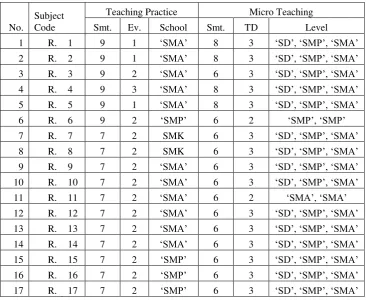
Table 4.1
General Information About the Research Subjects
No.
Subject Code
Teaching Practice Micro Teaching Smt. Ev. School Smt. TD Level 1 R. 1 9 1 ‘SMA’ 8 3 ‘SD’, ‘SMP’, ‘SMA’ 2 R. 2 9 1 ‘SMA’ 8 3 ‘SD’, ‘SMP’, ‘SMA’ 3 R. 3 9 2 ‘SMA’ 6 3 ‘SD’, ‘SMP’, ‘SMA’ 4 R. 4 9 3 ‘SMA’ 8 3 ‘SD’, ‘SMP’, ‘SMA’ 5 R. 5 9 1 ‘SMA’ 8 3 ‘SD’, ‘SMP’, ‘SMA’
6 R. 6 9 2 ‘SMP’ 6 2 ‘SMP’, ‘SMP’
7 R. 7 7 2 SMK 6 3 ‘SD’, ‘SMP’, ‘SMA’ 8 R. 8 7 2 SMK 6 3 ‘SD’, ‘SMP’, ‘SMA’ 9 R. 9 7 2 ‘SMA’ 6 3 ‘SD’, ‘SMP’, ‘SMA’ 10 R. 10 7 2 ‘SMA’ 6 3 ‘SD’, ‘SMP’, ‘SMA’
11 R. 11 7 2 ‘SMA’ 6 2 ‘SMA’, ‘SMA’
18 R. 18 7 1 ‘SD’ 6 3 ‘SD’, ‘SMP’, ‘SMA’ 19 R. 19 7 1 ‘SD’ 6 3 ‘SD’, ‘SMP’, ‘SMA’
20 R. 20 7 1 ‘SD’ 6 2 ‘SMP’, ‘SMA’
21 R. 21 7 2 ‘SD’ 6 3 ‘SD’, ‘SMP’, ‘SMA’ 22 R. 22 7 1 ‘SMA’ 6 3 ‘SD’, ‘SMP’, ‘SMA’ 23 R. 23 7 2 ‘SMA’ 6 3 ‘SD’, ‘SMP’, ‘SMA’ 24 R. 24 7 2 ‘SMP’ 6 3 ‘SD’, ‘SMP’, ‘SMA’ 25 R. 25 7 1 ‘SD’ 6 3 ‘SD’, ‘SMP’, ‘SMA’
26 R. 26 7 2 ‘SMP’ 6 2 ‘SD’, ‘SMP’
27 R. 27 7 2 ‘SMP’ 6 3 ‘SD’, ‘SMP’, ‘SMA’ 28 R. 28 7 2 ‘SMP’ 6 3 ‘SD’, ‘SMP’, ‘SMA’ 29 R. 29 7 2 ‘SMP’ 6 3 ‘SD’, ‘SMP’, ‘SMA’ 30 R. 30 7 2 ‘SMP’ 6 3 ‘SD’, ‘SMP’, ‘SMA’ 31 R. 31 7 2 ‘SMP’ 6 3 ‘SD’, ‘SMP’, ‘SMA’ Note: Smt.: Semester; Ev.: Evaluation frequency; TD: Teaching Demonstration frequency; ‘SD’: Elementary School; ‘SMP’: Junior High School; ‘SMA’: Senior High School; SMK: Vocational School.
4.2 Student Teachers’ Teaching Prcatice
In Table 4.1 which summarizes the student teachers’ responses to items 2-3 of
Part A, item 1 of Part B and also item 1 of Part C in the questionnaire to reveal general
information about the research subjects, it is seen that 6 student teachers (R.1-R.6) were
students of semester 9 when they did their Teaching Practice. Twenty five student
teachers were students of semester 7 when they did their Teaching Practice.
Twenty-nine student teachers had their Micro Teaching 1 semester before they took Teaching
Practice (after having Micro Teaching they directly had Teaching Practice). Two student
teachers (R.3 and R.6) had Micro Teaching 2 semesters before they took Teaching
Practice; this means that after having Micro Teaching they did not directly have
Teaching Practice. More detailed information about the student teachers’ Teaching
Practice follows.
4.2.1 Setting
Five student teachers carried out their Teaching Practice in ‘SD’ (Elementary School); eleven and fifteen student teachers in ‘SMP’ (Junior High School) and ‘SMA’
(Senior High School) respectively. Eight student teachers got Teaching Practice
evaluation once; 23 student teachers got Teaching Practice evaluation twice.
Those having their Teaching Practice at ‘SD’ got the chance to teach the first,
sixth graders were not engaged as the students of the student teachers. The reason of not
having the fourth graders as the students might be that the school tutor did not teach at
those levels so that the class was not available for the student teachers to have their
evaluation. Meanwhile the reason of not having the sixth graders as the students might
have been related to the school policy which forbade student teachers to have their
Teaching Practice evaluation in the last grade class.
Five student teachers having their Teaching Practice at ‘SMP’ got the chance to teach at grade 7 for their evaluation; five student teachers at grade 8; one student teacher at grade 9. Among 14 student teachers who had their Teaching Practice at ‘SMA’, 7 student teachers got the chance to have students of grade 10 as their students; 6 student
teachers grade 11; 5 student teachers grade 12. Among 11 student teachers who got the Teaching Practice evaluation twice at ‘SMA’, 3 student teachers taught at different grades for their evaluation. Eight out of these 11 student teachers taught at the same
grade twice. This main description of the evaluation setting is summarized in Table 4.2.
Table 4.2
Teaching Practice Evaluation Setting
Elementary School (‘SD’) Junior High School
(‘SMP’) Senior High School (‘SMA’)
The answers to items 2 and 3 of Part B in the questionnaire indicate that those
having Teaching Practice at ‘SD’ had quite small classes. One student teacher got a
class of 10-15 students; two 16-20 students; two 21-30 students. The time allocation for
each of their Teaching Practice evaluation ranged from 26-30 minutes (experienced by 1
student teacher) and 31-35 minutes (experienced by 4 student teachers). Those having
Teaching Practice at ‘SMP’ had small and big classes. Four student teachers got a class
of 16-20 students; three 21-25 students; four 35-42 students. The time allocation for
each of their Teaching Practice evaluation ranged from 36-40 minutes. The majority of
those having Teaching Practice at ‘SMA’ had small and big classes. Two student
The time allocation for each of their Teaching Practice evaluation ranged from
31-45 minutes. It is mostly based on the allocated time for the class meeting of each
subject in high schools.
4.2.3 Perceived Usefulness
The answers to item 4 of Part B in the questionnaire reveal that before having
Teaching Practice evaluation, 9 of 31 student teachers did not get the chance to observe
the school tutor (Guru Pamong) while the tutor was teaching, 6 student teachers did not
get the chance to consult their Lesson Plan to the school tutor, and 3 student teachers did
not get the chance to consult their Lesson Plan to the lecturer. Meanwhile after having
Teaching Practice evaluation, 8 of 31 student teachers did not get the feedback to their
teaching from the school tutor, and 6 student teachers did not get the feedback from
their lecturer. The rest of the student teachers who got the chance for the pre-activities
before their Teaching Practice evaluation and the chance for the post-activities
expressed the usefulness of the activities – by means of a Likert scale of 1 to 4 (‘1’
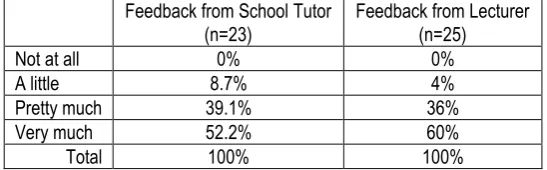
means not at all; ‘2’ a little; ‘3’ pretty much; ‘4’ very much). Their voice is summed up in Tables 4.3 and 4.4.
Table 4.3
Usefulness of Pre-Activities for Teaching Practice Evaluation
Observation on
Usefulness of Post-Activities for Teaching Practice Evaluation
Feedback from School Tutor
observation on the school tutor’s teaching, the lesson plan consultation with the school
tutor, and the lesson plan consultation with the lecturer were greatly useful for them.
They more particularly considered the opportunity pretty much useful – ranging from slightly below 23% to slightly below 43%, and very much useful – ranging from slightly below 43% to slightly above 68%. Similarly, the opportunity with regard to
post-evaluation activities covering the feedback from the school tutor, and the feedback from
the lecturer were to a great extent useful for them. About 39% student teachers consider
the feedback from the school tutor pretty much useful; about 52% student teachers considered it very much useful. Thirty-six percent student teachers considered the feedback from the lecturer pretty much useful; about 52% considered it very much useful.
Six student teachers mentioned that feedback from the teacher and lecturer was
the most useful experience among all the perceived usefulness of Teaching Practice.
Nevertheless, in general most student teachers in fact argued that the most useful
experience they got from Teaching Practice in real classes was handling real students,
handling big classes (as compared to small ones in their on-campus teaching
demonstration), and interacting with real students. Some comments worth-revealing
with regard to the most useful experience in Teaching Practice are:
Handle some lazy students. It’s hard to motivate them espeically the students of grade XII [R. 10].
By doing PPL I could learn many things to become a teacher later. Especially the new things that I got from PPL helped me to prepare becoming a [real] teacher [R.31]. How to manage the time, how to handle the big class ... [R.22].
I can interact directly with students [R.21].
4.3 Student Teachers’ Micro Teaching
This sub-chapter is intended to present the Micro Teaching setting – the
education level that the student teachers were expected to practice for their teaching
demonstration, the class size and duration of the student teachers’ teaching
demonstration. It is also intended to highlight the advantages perceived by student
4.3.1 Setting
Of 31, 27 student teachers got their teaching demonstration for three times in
Micro Teaching. The other 4 student teachers (R.6, R.11, R.20, and R.26) got it for two times only: one student teacher at the levels of ‘SD’, ‘SMP’ respectively, one student teacher at the levels of ‘SMP’, ‘SMA’ respectively, one student teacher at the levels of ‘SMP’ twice, and one student teacher at the level of ‘SMA’ twice (see Table 4.1).
4.3.2 Class Size and Duration
Twenty-one (67.7%) student teachers got a class of 5-10 students during their
Teaching Demonstration; ten (32.3%) 11-15 students. The time allocation for each of
their Teaching Demonstration ranged from 10-15 minutes – experienced by 7 (22.6%)
student teachers and 16-20 minutes – experienced by 24 (77.4%) student teachers.
4.3.3 Perceived Advantages
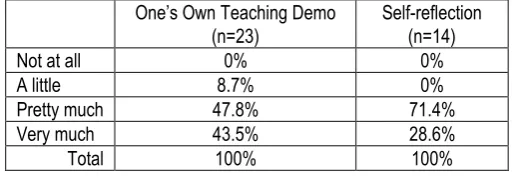
The extent to which the student teachers’ own teaching is advantageous
Item 4 of Part C in the questionnaire having been responded by the student
teachers indicate that 23 (74.2%) student teachers thought they got advantageous
teaching experience in Micro Teaching course because of their own teaching when
carrying out their on-campus teaching demonstration.
Those assuming that their own teaching demonstration was pretty much (‘3’) advantageous stated:
Because in Micro Teaching I had to choose my own themes, methods and materials independently and it allowed me to feel like a real teachers.
Actually it helped me a lot to broaden my teaching skills during Micro Teaching course. Because I could practice how to make a good Lesson Plan so that I can deliver a good teaching.
Those assuming the experience was very much (‘4’) advantageous with regard to their own teaching demonstration stated:
I learned that I needed to be well-prepared, to focus, tidak menyepelekan [translation: I should not underestimate things].
Directly after I did my teaching demonstration, I realized what was good and what was bad from it immediately.
I got new knowledge and practice more.
It’s like the more practice you have, the more expert you be. That’s it, teaching demos I
did in Micro Teaching helped me a lot. I could develop my ideas in teaching.
On the other hand, the only student teacher who assumed that his/her own
teaching demonstration was a little (‘2’) advantageous wrote:
I could experience myself as a real teacher so I could experience myself in making Lesson Plan.
The extent to which the student teachers’ self-reflection is advantageous
Fourteen student teachers thought they got advantageous teaching experience in
Micro Teaching course because of their self-reflection after the teaching demonstration
they did. No student teacher rated the self-reflection as not at all nor a little advantageous.
Those rating the advantageous experience of self-reflection as pretty much (‘3’)
stated:
After I had done my Micro Teaching, from my self-reflection I could know what was my weaknesses.
I feel like doing the real teaching after demonstration.
It sure helped me looking at my self-reflection. Then I could do better the following meeting.
Melalui self-reflection saya bisa dengan jujur menilai diri sendiri dan dapat menentukan mana yang perlu dan tidak perlu.
Those rating the advantageous experience of self-reflection as very much (‘4’) asserted:
The self-reflection is very useful because I can know my mistakes so I can improve my ability.
I got to know myself better: how was my appearance, did I laugh too much, such things that helped me discovering my behaviour.
Table 4.5
One’s Own Teaching Demo
The extent to which the peer comment is advantageous
Twenty-two student teachers got their friends’ comment or evaluation after the
teaching demonstration they carried out. The majority thought their friends’ comments
were pretty much and very much advantageous for them. Slightly below 14% thought the comments were a little advantageous – mentioning Their comments sometimes did
change my teaching style; I don’t really pay attention to what my peers say, honestly (1 of the 3 student teachers did not any give comments)
Those rating the comment from peers as pretty much (‘3’) useful stated: Some comments were absolutely helpful, but some others were just mistakes-finding. Sangat membantu karena penilaian mereka obyektif [translation: It’s very helpful as they provide objective evaluation].
Because my friends can see my weakness.
It helped a lot somehow because they are the ones who watched me during my teaching demo.
Comments from my friends can build my teaching way to be better.
Those rating the usefulness of the comments from peers as very much (‘4’) noted down:
Friends really helps me to comment on my mistakes, it was really helpful.
Hearing and getting comments from other persons could really help me to improve my teaching, I could see my strength and weakness in teaching from different point of views.
Their comments can improve my ability in teaching.
My friends gave ideas and critics from the students’ perspective.
My frients’ comment is somehow helpful to improve my teaching, especially their critics.
The extent to which the lecturer’s comment is advantageous
Of 31, 27 student teachers got lecturers’ comments or evaluation after the
teaching demonstration they performed. The majority argued their lecturers’ comments
were pretty much and very much advantageous.
Those assuming the lecturers’ comments were pretty much (‘3’) advantageous remarked:
My lecturer give me good input to teach.
From the lecturer’s evaluation I can improve the way I’m teaching, the lesson plan, the materials, the manner of a teacher, etc.
My lecturer’s comment was very helpful for me to see how good I was in teaching whether my teaching was getting better for every demonstration I did. Also, his comment taught me how I could find an appropriate topic and handle the class.
Their comments sometimes did change my teaching style.
Those assuming that the lecturers’ comments were very much (‘4’) advantageous asserted:
My lecturer’s comment gave me a very good chance to improve my teaching.
Comments that I received very useful for me as a teacher because I am currently working as a teacher.
It helps me very much so I know my weakness.
From my lecturer’s evaluation, I could reflect my fault and my weaknesses.
Hearing and getting comments from other persons could really help me to improve my teaching, I could see my strength and weakness in teaching from different point of views.
Experts always give a better suggestion than my peers do.
I could have a thorough feedback from my lecturer so I thing it’s very helpful.
It was really helpful in improving my performances for the next evaluation.
Karena komentar seorang dosen merupakan komentar paling penting dan berguna untuk saya. Dan dosen tidak akan memberikan sembarangan komentar [translation: Comments from a lecturer is the most important and useful for me. And a lecturer will not provide pointless comments].
Komen dari ahli sangat penting [translation: Comments from an expert is very important].
On the other hand,
My lecturer didn’t give many comments at that time, but a few of his comment somehow
useful.
It a little helpful but the lecturer only gave a little input and feedback. Terkadang dosen menghadap ke laptop dan seolah tidak memperhatikan mahasiswa yang sedang melakukan teaching demo [translation: Facing a laptop, the lecturer sometimes seems to ignore the students having the teaching demo].
are the remarks of the very few (a bit below 10%) student teachers assuming that the lecturers’ comments were a little (‘2’) advantageous.
Six student teachers (R.3, R.8, R.11, R.15, R.23 and R.25) added that the most
useful experience they got from Micro Teaching was the comments from friends and
lecturers. R.23 more specifically wrote “The most useful experience [from Micro Teaching] was I got feedback from my friends and lecturer wheather I was good or not really good in teaching”
The extent to which the student teacher’s being a student is advantageous
Eighteen student teachers realized the advantages by being a student or audience of their friends’ teaching demonstration. Slightly below 85% of the student teachers perceived the chance of observing peer’s teaching to be pretty much and very much useful. The minority – a bit below 16% of the student teacher – perceived the chance a
Those realizing a few advantages obtained from being a student or audience of their friends’ teaching demonstration commented: (1 of 3 student teachers did not give comments)
Sedikit melihat dan mengambil sisi positifnya [translation: Observing a little but taking the positive things]
Because I could see my friend’s strength and weakness.
Those realizing pretty many advantages obtained from being a student or audience of their friends’ teaching demonstration noted down:
From their teaching I also learnt something (which one is good & which one is bad). I could take the beneficial things for both myself and my friends.
From my friends’ teaching I can also improve my skill in teaching. I could learn how they taught and developed it into my own teaching.
I could learn from friends’ teaching to improve my skill in teaching (their teaching as my reference).
Those realizing a lot of advantages obtained from being a student or audience of their friends’ teaching demonstration jot down:
From my friend’s teaching, I could know and share with my friend’s teaching
experience.
When I noticed their weak points or their mistake then I could learn something from it. Because of that I was able to prepare myself better. We never know if the materials will sometimes be useful for our own Teaching Practices in the real classroom, right? So I may say it is SUCH an OPPORTUNITY.
I learnt from my friends experience so that I could make a better lesson plans for myself. By becoming a student I can learn another way of teaching from my friends.
The extent to which the student teacher’s being a private teacher and joining other
subjects is advantageous
To date, it has been indicated that advantageous teaching experience as claimed
by the student teachers are due a variety of reasons such as carrying out the teaching
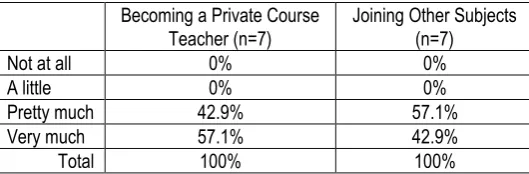
Table 4.7
Other Perceived Advantages of Micro Teaching
Becoming a Private Course Teacher (n=7)
Joining Other Subjects (n=7)
Not at all 0% 0%
A little 0% 0%
Pretty much 42.9% 57.1%
Very much 57.1% 42.9%
Total 100% 100%
As seen in Table 4.7, only 7 student teachers – they are R.12, R.13, R.14, R.20, R.26, R.27, R.29 – indicated that they were private teachers when they did their teaching demo and noticed that their becoming one was advantageous for their teaching
experience in Micro Teaching course. All the 7 student teachers chose either pretty much or very much as the degree of advantages of being a private teacher.
Having chosen pretty much, the respective student teachers commented:
At that time I taught two elementary school students and it really helped me undertand
kids’ characteristis better.
Yes, it gave me expereince how to teach/dealt with students.
Having chosen very much, the respective student teachers commented:
From my experience as a private course teacher, I could overcome how to teach as a teacher.
This is an additional/another useful media to enhance my teaching skills and handling the students.
Similarly, 7 student teachers – R.8, R.9, R.13, R.14, R.20, R.22, R.26 – pointed
out that other subjects like TEFL, TEYL, Teaching Science, Language Testing,
Speaking 4 that they joined in the previous semesters contributed pretty much and very
much to their teaching experience in Micro Teaching course.
Having chosen pretty much, the respective student teachers remarked: I got a good understanding of the methods and techniques available.
In here [Language Testing class] I could learn how to make appropriate assessment. Then I could use it in my Teaching demonstration.
Having chosen very much, the respective student teachers remarked:
TEFL & TEYL gave me more practices.
I could develop more fun and more various methods and adapted it for my Micro Teaching course.
As previuously reported, only 7 of 31 student teachers claimed in the
questionnaire that they got the benefit form other subjcets they got. It is however found
from the interview that more students might actually claim similalry that they got
benefits from joing other subjcets like TEFL and TEYL. All the 4 interviewed
respondents who did not see the benefit hence who did not respond the the item in the
questionnaire in fact admitted the benefit when they were interviewed. They did not
recognize it when doing the written reponding but they remembered it in the interview. One of them (R.23) orally informed “Ya, yes other subjcets like TEFL and TEYL also useful. I got the theory and I got the practice teaching in front of my firends”
4.4 Student Teachers’ Teaching Practice and Micro Teaching: The Interrelationship
Each student enrolling Micro Teaching and Teaching Practice has to prepare a
Lesson Plan prior to the teaching demonstration and real class teaching respectively.
Items 1-5 of Part D in the questionnaire having been completed by the student teachers
indicated that with regard to Lesson Plan development, the majority of the student
teachers admitted obtaining high degree of learning experience. They considered they
had learnt to formulate teaching objectives, to develop teaching materials, to develop
language teaching methods and techniques, to develop media, and other learning resources
for the class activities, and to develop the way to assess students in Lesson Plan making
both in Micro Teaching and Teaching Practice.
4.4.1 Learning Experience in Lesson Plan Making
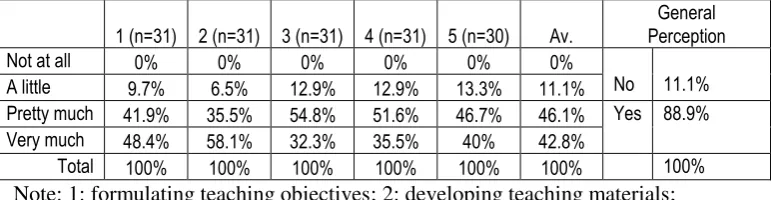
Quite a lot of student teachers (slightly below 84%) admitted that they had
pretty much and very much learning experience when they prepared their Lesson Plan before their teaching demonstration. Similarly, quite a lot of student teachers (slightly
below 89%) disclosed that they had pretty much and very much experience when they
prepared their Lesson Plan before their Teaching Practice in real classes (see Tables 4.8
Table 4.8
Learning Experience in Micro Teaching Lesson Plan Making
1 (n=31) 2 (n=31) 3 (n=31) 4 (n=31) 5 (n=30) Av. General Perception
Learning Experience in Teaching Practice Lesson Plan Making
1 (n=31) 2 (n=31) 3 (n=31) 4 (n=31) 5 (n=30) Av.
Six student teachers (R.4, R.7, R.17, R.26, R.27 and R.29) in fact admitted that
the most useful experience they got from Micro Teaching was LP making or developing.
As an additional illustration, R.17 specifically added, “The most useful experience I got from Micro Teaching: when I was assigned to create the Lesson Plans for three different levels, such as SD, SMP, SMA”
4.4.2 Experience in Lesson Plan Implementation
Having prepared a Lesson Plan, the student teachers were then engaged in
teaching. In Micro Teaching they were involved in teaching their peers who were
supposed to act as ‘SD’/’SMP’/’SMA’ students based on the Lesson Plan prepared. In
Teaching Practice they were involved in teaching ‘SD’/’SMP’/’SMA’ students in real
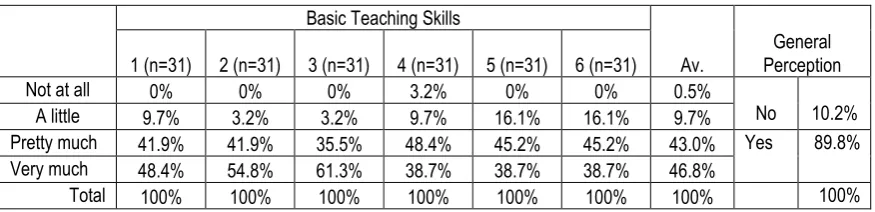
classrooms. The student teachers’ answers to items 6-11 of Part D having been analysed
indicated that with regard to their teaching itself – the implementation of the Lesson Plan – the majority of the student teachers admitted obtaining high degree of teaching experience. They considered they had learnt five basic teaching skills of opening and
explaining instructional materials clearly, of giving appropriate feedback to the students
or skill of providing informal assessment, of applying appropriate teaching techniques (e.g.
games, group work), and using media & other learning resources. They also got the experience
in classroom management.
Quite a lot of student teachers (slightly above 87%) maintained the idea that they
had pretty much and very much teaching experience when they implemented their Lesson Plan in front of their peers. Correspondingly, the majority (reaching almost 90%)
claimed that they got pretty much and very much teaching experience when they implemented their Lesson Plan in real classrooms at schools (see Tables 4.10 and 4.11).
Table 4.10 Note: 1: opening and closing a class; 2: questioning; 3: explaining instructional materials; 4: giving feedback; 5: applying appropriate teaching techniques and using learning resources; 6: conducting classroom management; Av.: Average.
Table 4.11 Note: 1: opening and closing a class; 2: questioning; 3: explaining instructional materials; 4: giving feedback; 5: applying appropriate teaching techniques and using learning resources;
Six student teachers (R.9, R.10, R.16, R.22, R.24 and R.31) in fact admitted that
the most useful experience they got from Micro Teaching was the teaching
demonstration itself. Some comments worth-quoting are:
I learnt how to incorporate various media in teaching [R.9].
We tried to handle our students. They pretended as the real students [R.10].
The most useful experience that I got from Micro Teaching was I got to know how to teach
students, how to make materials for teaching and how to manage the students in the classroom
[R.16].
How to solve things that don’t fill my expectations (i.e. I prepared a group work for 4 groups consisting of 3 members, but only 9 people came. I had to change the groupings instantly and
still used the materials I prepared) [R.22].
The most useful experience that I got from Micro Teaching is when I was teaching in front of
friends and my lecturer [R.24].
By doing Micro Teaching we can learn the skills, knowledge, and even techniques to teach in
the class [R.31].
One student teacher (R.30) differently admitted that the most useful experience
he/she got from Micro Teaching was the whole set of teaching demonstration as it was
considered to be a good preparation before the real teaching practice.
4.4.3 The Difference between Micro Teaching and Teaching Practice
Inquired to reveal if they found a gap between on-campus Micro Teaching and Teaching Practice in schools, student teachers’ consistent answers to items 12 and 13 of Part D in the questionnaire indicated that they experienced a very big gap teaching in
two different settings (one student teacher’s answer was disregarded as it was not
consistent). The majority (slightly below 97%) chose either pretty much or very much as
the response agreeing to “I discovered something new about teaching in Teaching
Practice.” and “I have a different teaching experience in my Teaching Practice compared
to the one in on-campus Micro Teaching.” This in fact amounts to about three quarters –
to be exact 76.7% and 83.3% respectively – of the student teachers who claimed that
they experienced very much difference between teaching in Micro Teaching class and the one in a real class.
Table 4.12
Micro Teaching and Teaching Practice: The Gap
(n=30) (n=30) Perception
Not at all 0% 3.3% 1.7%
No 3.3%
A little 3.3% 0% 1.7%
Pretty much 20% 13.3% 16.7% Yes 96.7%
Very much 76.7% 83.3% 80%
Total 100% 100% 100% 100%
Some of the remarks pointed out by those belonging to the group of ’96.7% Yes’
experiencing much difference between Micro Teaching and Teaching Practice are
associated with the number of the students, classroom management, experience to teach
in real class, different characteristics of students, and Lesson Plan issue.
Some of the remarks associated with number of the students are:
Moreover, the number of the students are really big compared with the students in Micro Teaching.
I had to handle sometimes almost 40 students in a classroom … different from Micro Teaching class.
Some of the remarks associated with classroom management include:
There was a big difference in handling the class. When I was teaching my own friend, there was no problem at all, but when it comes to Teaching Practice the difference was big. Some classes were hard to control.
Especially for the class management. The students were very naughty and noisy.
If in on-campus Micro Teaching, the students were our friends, it was so easy to handle the class, but in Teaching Practice we faced real children and it was so many students, it is quiet hard to handle the class.
In the real class I felt very nervous and confused when I had to teach the students. Besides, i found that it was difficult to manage the whole class.
The real students are really hard to handle. We have to be sooo attractive / carried out interesting activities to grab their attention.
The remark associated with experience to teach in real class is:
I was given the chance to teach regularly and I needed to follow the materials in the textbook.
Some of the remarks associated with different characteristics of students
I thought the difference was the students. When I had my Teaching Practice in school,
the students weren’t quite polite and they tended to be naughty. The situation was
different when I had my teaching demonstration in Micro Teaching.
If I may say Micro Teaching is just the appetizer. I could do my Micro Teaching pretty good, but not for my Teaching Practice. It was totally different between teaching your friend who pretends as a student and teaching in a real class. Yes, the students’ response & behaviour].
If Micro Teaching the students are my own friends but Teaching Practice, I face real students. When I deliver the lesson in Micro Teaching all the students understood but in Teaching Practice only 60% understand.
Teaching new people is a lot harder than teaching my own friends because I haven’t known them before.
In Teaching Practice I had to use mainly Bahasa Indonesia (or bilingual). Teaching in Teaching Practice is more challenging.
It’s very challenging to teach real students, know their ability, their activities, interest,
etc.
Lebih menyenangkan dan menantang pada waktu Teaching Practice karena saya merasakan menghadapi anak-anak secara nyata [translation: Teaching Practice is more fun and challenging because of the real students].
Teaching Practice much more fun than Micro Teaching. Some of the remarks associated with Lesson Plan are:
The lesson plan that we made in micro teaching class and Teaching Practice is quiet
different. We use English in our Micro Teaching’s lesson plan but when we were
Teaching Practice we used bahasa to make RPP (Lesson Plan);
I got many new things when I did my Teaching Practice and the one that made me surprised at Teaching Practice as making RPP. RPP was a planning of a material for one semester.
The only student teacher who belongs to the group of ’3.3% No’ claiming that
he/she experienced no difference between Micro Teaching and Teaching Practice writes
in the comments slot as follows: “The students at school are more naughty than our