1 23
Journal of Applied Phycology
ISSN 0921-8971
J Appl Phycol
DOI 10.1007/s10811-014-0346-y
Gracilaria
waste biomass (
sampah
rumput laut
) as a bioresource for selenium
biosorption
1 23
Gracilaria
waste biomass (
sampah rumput laut
) as a bioresource
for selenium biosorption
David A. Roberts&Nicholas A. Paul&
Symon A. Dworjanyn&Yi Hu&Michael I. Bird&
Rocky de Nys
Received: 6 January 2014 / Revised and accepted: 14 May 2014 #Springer Science+Business Media Dordrecht 2014
Abstract Iron-based sorbents (IBS) are a promising tool for
the removal of toxic metalloids, in particular, selenium (Se), from mining waste water. However, a barrier to the application of IBS is the absence of a sustainable and cost-effective substrate for their production. We demonstrate that IBS can be produced from the waste biomass that remains after the commercial extraction of agar from farmed seaweed (Gracilaria; Rhodophyta). The biosorbent is most effective when the waste Gracilaria biomass is treated with a ferric solution, then converted to biochar through slow pyrolysis. The resulting IBS is capable of binding both selenite (SeIV) and selenate (SeVI) from waste water. The rate of selenate (SeVI) biosorption, the predominant and most intractable form of Se in industrial waste water, is minimally affected by temperature. Similarly, the capacity of the biosorbent for Se (qmax) is unaffected by pH. Theqmaxvalues for the optimised
biosorbent range from 2.60 to 2.72 mg SeVI g−1 biochar
between pH 2.5 and 8.0. Gracilaria waste is a sustainable substrate for IBS production and can be used to treat a costly waste problem. The use ofGracilariawaste as a substrate for waste water treatment could simultaneously improve the sus-tainability and profitability of seaweed farming by valorizing a low-value waste stream.
Keywords Selenium . Biosorption .Gracilaria. Biochar
Introduction
While seaweed is an effective substrate for the biosorption of metals from waste water, there has been little or no uptake of algal-based biosorption within industrial settings (Gadd
2009). One barrier to implementing seaweed-based biosorption at the scales required by industry is the lack of biomass that is available in sufficient quantity, while also being sustainable and cost effective (Bulgariu and Bulgariu
2012). The wild harvest of seaweed is unlikely to be environ-mentally sustainable as a means of providing biomass for biosorption (Volesky2007). An alternative source of biomass is from the aquaculture of seaweed which has seen annual average increases in biomass production of 7.5 % since 2000, with production exceeding 15 million t in 2010 (FAO2012). Cultivation of the red seaweedGracilariahas had one of the most rapid increases in production, growing from approx-imately 150,000 t (wet) in 2000 to nearly 2 million t in 2010 (FAO2012). Much of this increased production has occurred in Indonesia; where over 500,000 t of Gracilaria
(Rhodophyta) biomass is now produced annually. The inten-sive cultivation ofGracilariaspp. became widespread in the nineteenth century as the demand for agar outstripped the supply of Gelidium biomass, the traditional source of high quality agar (Armisen1995). WhileGracilariaspp. naturally produce a poor-quality agar rich in sulphate, pre-treatment of
Electronic supplementary materialThe online version of this article (doi:10.1007/s10811-014-0346-y) contains supplementary material, which is available to authorized users.
D. A. Roberts (*)
:
N. A. Paul:
R. de NysMACRO–the Centre for Macroalgal Resources and Biotechnology, and School of Marine and Tropical Biology, James Cook University, Townsville 4811, Australia
e-mail: [email protected]
S. A. Dworjanyn
National Marine Science Centre, Southern Cross University, Coffs Harbour 2450, Australia
Y. Hu
Advanced Analytical Centre, James Cook University, Townsville 4811, Australia
M. I. Bird
School of Earth and Environmental Science and Centre for Tropical Environmental and Sustainability Science, James Cook University, Cairns 4870, Australia
J Appl Phycol
the biomass with sodium hydroxide can reduce the sulphur content and increase the quality of the agar product (Armisen
1995). However, the by-product of the agar extraction process is a granulated waste material comprised of remnant biologi-cal tissues which has no value attributed to it and is therefore stockpiled as waste (Seo et al. 2010). The waste product (hereafter referred to as ‘Gracilaria waste’) represents an underutilised resource. The attribution of value toGracilaria
waste would benefit the farming communities that are respon-sible for the bulk ofGracilariaproduction and improve the sustainability of commercial agar production (Kang et al.
2011).
One potential use ofGracilariawaste (known in Indonesia assampah rumput laut) is as a biosorbent for the removal of metalloids from waste water effluents. Selenium (Se) is an important metalloid that, despite being an essential element for all vertebrates and some plants, is highly toxic at doses slightly in excess of essential requirements (Sappington2002; Chapman et al.2009). Se is particularly common in effluents from coal mining and processing facilities where it is primar-ily found in the form of the selenate oxyanion (SeO42−)
(Sappington2002; Chapman et al.2009; Torres et al.2011). While there are several existing treatment technologies for Se, they are generally unable to achieve Se concentrations that satisfy regulatory requirements, are costly to implement at the necessary scales or are ineffective at treating dilute waste effluents (Amweg et al.2003; Gonzalez et al.2012). The US EPA currently lists adsorption of Se to ferrihydrite surfaces as the best available technology (BAT) for Se removal but also note that this technology is ineffective at removing selenate (SeVI), the predominant form of Se in mining effluents (Mondal et al.2004). Furthermore, traditional algal-based biosorbents and activated carbon (AC) are ineffective as a means of removing metalloids such as Se from waste water regardless of oxidation state (Mahan et al. 1989; Niu and Volesky2003; Latva et al. 2003; Mane and Bhosle 2012). Very little research has considered the biosorption of oxyanionic compounds by algal biosorbents, with the excep-tion of arsenic (Pennesi et al.2012b). The cell wall of red macroalgael species contains high concentrations of sulfated polysaccharides such as agar, which are characterised by negatively charged functional groups such as carboxyl. This gives red macroalgae a high affinity for dissolved metals (Davis et al.2003) and the vast majority of biosorption re-search has focused on cationic metals such as copper, nickel, lead and zinc (Pennesi et al.2012a,b).
The most promising method for metalloid remediation is biosorption with iron-based sorbents (IBS) (USEPA 2001; Sharma and Sohn2009). Biosorption is a process where target contaminants are passively removed from waste water by functional groups that are naturally present on the surface of biomass, and that remain active even when the biomass is dead or denatured (Volesky2001; Davis et al.2003). We have
previously demonstrated that seaweed, freshwater macroalgae and their derived biochars, can serve as particularly effective substrates for the production of IBS, due to their high affinity for iron (Fe) in solution (Roberts et al.2013). Dried biomass and biochar can be treated with an iron-based solution and thereafter will have a high affinity for dissolved Se as both selenate (SeVI) and selenite (SeIV) (Roberts et al. 2013; Kidgell et al.in press). One limitation of the approach, how-ever, is that significant amounts of Fe can leach from the surface of the IBS, posing further environmental issues. As the rate of Fe leaching is negatively correlated with Se uptake, further optimization of the biosorbent preparation to reduce Fe leaching should also increase the biosorbent capacity of the IBS. Additionally, the effects of exposure conditions on the rate and extent of biosorption are not currently known (in particular temperature and solution pH).
Given the requirement for a viable and accessible feed stock supply for IBS production, we examine the efficacy of
Gracilariawaste as a feed stock for the sustainable production of an IBS that is effective at treating seleniferous waste waters. We address three main questions. First, is Fe-treated
Gracilariawaste (as both biomass and biochar) an effective Se biosorbent and what is the preferred method for the con-version to Gracilaria waste to Fe-treated biochar? Second, what is the influence of temperature on the rate and extent of Se uptake from solution for the optimisedGracilariawaste sorbent? Third, how does solution pH influence the Se-binding capacity of the biosorbent (qmax)? In addition, we
describe the physical characteristics of the untreated
Gracilaria waste biochar. This research represents the first step towards adding value to a waste product from the globally expanding seaweed aquaculture industry, as well as the devel-opment of a sustainable IBS for remediation of an otherwise intractable and highly toxic metalloid from mining waste water.
Methods
Preparation of biomass and biochar
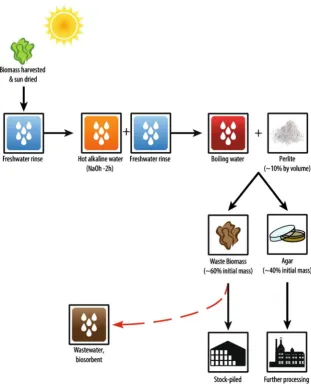
tissues and perlite which constitutes approximately 10 % of the final waste volumetrically (Fig.1).
Three types of IBS were prepared from GW; Fe-treated GW, pre-pyrolysis treated biochar and post-pyrolysis Fe-treated biochar. The pre- and post-pyrolysis biochar IBS were created by Fe treating the GW before (pre) and after (post) it was converted to biochar, respectively, as described below. In all cases, the Fe treatment of the biosorbent was done with a 5 %w/vFeCl3solution (Sigma). GW biomass or biochar (in
the case of post-pyrolysis Fe-treated biochar) were added to the 5 % Fe solution at a rate of 25 g L−1for 24 h on a shaker
(150 rpm) at 20 °C. The biomass or biochar was then filtered from the solution and rinsed with deionised (DI) water until the rinse water ran clear, then dried to constant mass at 60 °C. The GW was converted to biochar under optimised conditions (Bird et al.2011). Briefly, approximately 200 g of GW or Fe-treated GW was weighed, loaded into a wire mesh basket and suspended in a sealed 2-L stainless steel container in a muffle furnace. The container was continuously purged with N2gas
at 4.0 L min−1and heated to a hold temperature of 450 °C for
1 h. The resulting biochar was then cooled to room
temperature, under continued N2flow, before use in
experi-ments. GW biochar was characterised following procedures previously described (Castine et al. 2013). Briefly, biochar yield was calculated by measuring the weight of the biomass before and after pyrolysis. The P content was determined by inductively coupled plasma mass spectrometer (ICP-MS), while elemental profiles (C, H, O, N and S) were quantified using an elemental analyser (OEA Laboratory Ltd., UK). Initial screening experiments
An initial biosorption experiment was conducted to examine the extent of SeIVand SeVIadsorption from freshwater on Fe-treated GW biomass and biochar loaded with Fe before or after pyrolysis, and the extent of Fe leaching from each biosorbent when deployed in solution. The initial SeIVand SeVIconcentration was 500μg L−1. The mock Se solution
was made from diluted stocks of sodium selenite (Na2SeO3)
and sodium selenate (Na2SeO4), respectively, in DI water. The
Se stocks were adjusted to pH 4.0 with 0.01-M HCl before use in the experiments.
Fig. 1 Processing ofGracilaria to extract agar and produce Gracilariawaste biomass. The waste biomass has no current use, but can be used as a substrate for functional charcoals to treat waste water
All glass- and plastic-ware was acid-washed in a 5 % nitric acid (HNO3) bath then rinsed in DI water prior to use
in the experiments. Each replicate comprised 15 mL of the Se solution and 0.15 g of dried Fe biomass or the Fe biochar derivatives (a stocking density of 10 g L−1of biosorbent) in
a plastic beaker. The beakers were shaken at 100 rpm for 4 h at 20 °C and then filtered through a 0.45-μm glass fibre
syringe filter and analysed for Se and Fe. Se stock concen-trations were determined from three water samples that were filtered through a 0.45-μm syringe filter and all data shown
relate to measured rather than nominal concentrations. In addition, samples containing no algae were processed in the same manner to serve as a control to quantify losses of Se to experimental glassware and filters.
Effect of temperature and Se concentration on the rate of Se biosorption
A second experiment was performed to determine the rate and extent of SeVIbiosorption from mock effluents at two initial Se concentrations and three exposure temperatures. On the basis of the preceding experiments, pre-pyrolysis Fe-treated biochar was used as this biosorbent proved to be the most effective treatment with respect to minimal Fe leaching during deployment (see“Results”sub-section“Biosorption of Se by Fe-treated GW sorbents”). The preferred biosorbent is there-fore produced by pre-treating GW with Fe bethere-fore pyrolysis, and is hereafter referred to as Gracilaria-modified biochar (GMB). All subsequent experiments utilise GMB as the biosorbent. Selenate (SeVI) was used as it is the predominant and most intractable form of Se in industrial effluents (Mondal et al.2004). The nominal SeVIconcentrations were 500 and 5,000 μg L−1 SeVI with initial pH of 4.0. The
experiments were run in Innova 44R shaking incubators at 5, 15 and 25 °C, with independent samples being collected as described earlier after 0.25, 0.50, 1, 4, 24 and 168 h of exposure.
Determination ofqmaxfor GW Fe biochar under different
initial pH
Experiments were conducted with pre-pyrolysis Fe biochar (GMB) to determine the biosorbent capacity for Se (qmax)
under a range of initial pH conditions. The results of the rate of uptake experiment indicated that equilibrium was achieved within 4 h regardless of initial SeVIconcentration. Theqmax
experiments were therefore run for this period. A pilot study was first performed to determine the effect of pre-rinsing the biosorbent on Fe leaching from GMB once deployed in solu-tion. The concentration of Fe in treated water was measured after exposure to un-rinsed biochar, and biochar rinsed either once or twice with deionised water for 60 min each time. On the basis of these results, theqmax study compared the Se
capacity of un-rinsed and rinsed (two 60-min rinses) biosorbents.
We used previously described methods to predict qmax
under batch conditions (Volesky2007). Briefly, a serial dilu-tion range of SeVIsolutions (1, 5, 10, 20, 50 and 100 mg L−1)
were tested in batch sorption studies for a period of 4 h. The pH of the stock solutions was adjusted to pH 2.5, 4.0 and 8.0 using 0.1-M HCl (2.5 and 4.0) and NaOH (8.0). After the 4-h contact period, the solutions were filtered (0.45μm) and the
water samples analysed as described below. The qmax was
determined from the line of best fit of equilibrium Se concen-trations in treated water (mg L−1) and the Se concentration of
the biosorbent at equilibrium (mg g−1). The initial and
final Se content of the rinsed and un-rinsed biochar at equilibrium were measured from the highest Se treatment to validate the predictedqmax. A control was also included
to determine if leached Fe could also remove Se from solution. This may occur if leached Fe in solution acts as a flocculent to bind and precipitate Se that is then removed by filtration (0.45 μm) prior to analysis. A serial dilution
of Fe was created (0, 0.5, 10, 50 and 100 mg L−1Fe) from
diluted iron (III) chloride hexahydrate (FeCl3· 6H2O) stock
solutions. Se was then added at 100 mg L−1 and the
solution shaken at 100 rpm for 4 h (the same duration as the biosorbent qmax experiment). The solution was then
filtered (0.45 μm) and analysed as described below. The
initial Fe concentrations were determined from un-filtered water samples.
Elemental analysis
All water samples were analysed for final total Se and Fe content after the experimental contact times to quantify Se removal and Fe leaching from biosorbents, respectively. Se and Fe were measured by a Bruker 820-MS inductively coupled plasma mass spectrometer (ICP-MS, Australia). The Se and Fe content of the biochar samples were analysed by first digesting 100 mg of the biochar in a Teflon digestion vessel with 3.0-mL double distilled HNO3and 1.0-mL
ana-lytical grade H2O2at room temperature for 2 h, followed by
microwave digestion (180 °C for 10 min), then diluted with Milli-Q water and analysed as described in the following sections.
The use of FeCl3 to load the biomass and biochar
samples potentially introduces Cl− ions into the water
samples. Of the available Se isotopes, the polyatomic ion
37
Cl40Ar+can interfere with detection of77Se. The isotope
82
isotope56Fe is interfered by polyatomic ion16O40Ar+. To accommodate for measurement of potentially high Fe con-centrations, an automatic attenuation factor was applied to ICP-MS detector on mass 57 to extend the linear range of the instrument. Samples were diluted tenfold before ICP-MS analysis. A series of commercially available multi-element standards (Choice Analytical, Australia) were used to calibrate the ICP-MS. Indium was added online to work as the internal standard to correct for instrument drift and matrix effects. The detection limits (3 × SD) mea-sured for this method were 1 ppb for Se and 100 ppb for Fe. For quality control purposes, 1- and 5-ppb Se and 250-ppb Fe were spiked into a 1 % HCl solution separately and measured along with every batch of samples. The average recovery of these spike solutions was 110 % (n= 10) for 1 ppb Se, 99.4 % (n= 10) for 5 ppb Se and 98 % for 250 ppb Fe (n= 10).
Data analyses
Se biosorption and Fe leaching in the initial screening ex-periments were analysed by two-way ANOVA using theR -base package. The factors were‘treatment’(Fe-treated waste biomass and pre- and post-pyrolysis Fe biochar), and ‘spe-ciation’ (SeIV and SeVI). The Se data are expressed as percent removal based on initial and final Se concentrations in each replicate. Se uptake in the timed rate of uptake experiment was analysed separately for the initial Se con-centrations by two-way ANOVA including the factors‘time’ (0:15 to 168:00 h, random) and ‘temperature’(5 to 25 °C, fixed). The error terms were adjusted as appropriate for the mixed model (Zar 2010). The qmax results were plotted
against a logarithmic line of best fit using a model-fitting process and the maximumqvalues derived from the data as described above.
Results
Biosorption of Se by Fe-treated GW sorbents
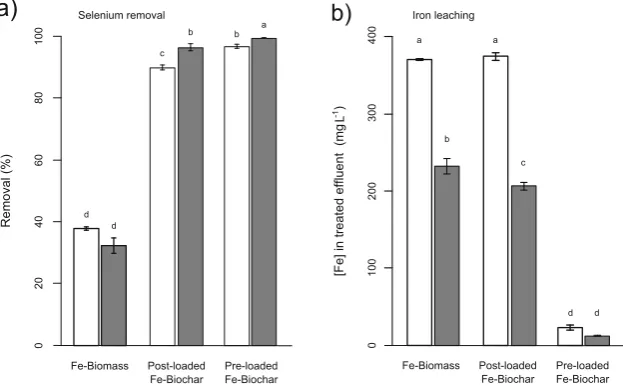
The mean mass loss of GW on pyrolysis was 12.5 % and the resulting GW biochar had a mean total C content of 6.7 % (organic C 5.2 %) and O content of 7.2 %. The total N, S and P contents were 0.09, 0.4 and 0.5 %, respectively (TableS1). Fe-loaded GW biomass was effective as a biosorbent for Se as both SeIVand SeVI, achieving 32 and 38 % removal, respec-tively, from the 500 μg L−1 solutions (Fig. 2a). However,
when Fe-loaded biomass was converted to biochar (pre-pyrolysis Fe biochar) or un-treated biochar was treated with Fe (post-pyrolysis Fe biochar), the sorbents displayed much higher Se removal ranging from 90 to 95 % removal of SeIV and SeVI, respectively, within the 4-h contact period (Fig.2a). The removal of Se from solution was more effective when the Fe was loaded onto the GW before pyrolysis, rather than after pyrolysis, achieving 95–99 % Se removal (Fig.2a). Both the pre- and post-pyrolysis Fe biochar treatments removed slight-ly more SeVIthan SeIV, while removal of Se by Fe biomass did not differ significantly between the two Se oxidation states (‘speciation×treatment’:F2, 12=11.8,P=0.001, Fig.2a).
Both Fe biomass and post-pyrolysis Fe biochar leached significant amounts of Fe into the effluent, with mean con-centrations of Fe in treated water ranging from 205 to 375 mg L−1Fe (Fig.2b). In contrast, pre-pyrolysis Fe biochar
leached up to 20 times less Fe than the post-pyrolysis Fe biochar, with the mean concentration of Fe in treated waters ranging from 12 to 23 mg L−1Fe (Fig.2b). There was also a
significant interaction between Se oxidation state and biosorbent treatment for the amount of Fe leaching (‘specia-tion×treatment’: F2, 12=124.6, P<0.001), with significantly
more Fe leaching from Fe biomass and post-pyrolysis Fe biochar when exposed to SeIVin solution than SeVIin solution
Fig. 2 aRemoval (%) of Se as SeIV(white bars) and SeVI(grey bars) andbFe leaching into treated samples with Fe-treated GW biomass and biochar. Bars that share acommon letterare not significantly different according to post-hoc Tukey’s comparison (P>0.05)
(Fig. 2b). As the pre-pyrolysis Fe biochar was the best performing biosorbent, both with respect to Se removal and Fe leaching, it is the preferred biosorbent and is referred to as
Gracilaria-modified biochar (GMB).
Effect of temperature and Se concentration on the rate of Se biosorption by GMB
Se biosorption by GMB was rapid, with more than 95 % of the total Se removal occurring within the first 15 min (Fig.3a, b). At an initial Se concentration of 438 μg L−1, the treated
effluent contained approximately 30μg L−1after 15 min at
all temperatures tested (Fig. 3a, c, e). Similar patterns of uptake also occurred at the high initial Se concentration (4,180 μg L−1) with the treated effluent containing
1,300μg L−1after 15 min at all temperatures (Fig.3b, d, f).
There was a significant time by temperature interaction for Se uptake (430 μg L−1 ‘time × temperature’: F10,36= 3.15,
P< 0.01, 4,200 μg L−1 ‘time × temperature’: F10,36= 3.74,
P<0.01). This was attributable to some desorption of bound Se from the GMB at the highest temperatures between 24 h and 7 days of exposure. There was no detectable Se in the 430 μg L−1 treatments exposed to the GMB at 5 °C after
7 days, while at 15 and 25 °C, the final concentrations of Se in
treated water were 6.2 and 13.7 μg L−1, respectively. Final
concentrations in the 25 °C treatment increased from 9.9– 13.4 μg L−1 between 24 and 168 h of exposure (Fig. 3e).
For the 4,200μg L−1treatment, the effluents exposed to GMB
at 5 and 15 °C had final Se concentrations of approximately 250μg L−1after 7 days, while at 25 °C, the final concentration
was approximately 500μg L−1(Fig.3b, d, f). There was again
some desorption of bound Se at 25 °C between 24 h and 7 days of exposure, increasing from 280 to 507μg L−1across
this period (4,200μg L−1, Fig.3c).
Determination ofqmaxfor GW Fe biochar under different
initial pH
The concentration of Fe that leached from GMB into the treated water sample could be reduced to <5 mg L−1by
pre-rinsing the biosorbent twice in DI water for 60 min per rinse (Fig.4). The concentration of Fe was also approximately 10 % lower on the rinsed GMB (0.047±0.001 and 0.052±0.003 % on rinsed and un-rinsed GMB, respectively). Se concentra-tions were less than limits of detection (0.1 mg kg−1) on the
biosorbents prior to deployment. While pre-rinsing of the GMB reduced the amount of Fe in the treated water samples, it also reduced the capacity of the biosorbent for Se. The
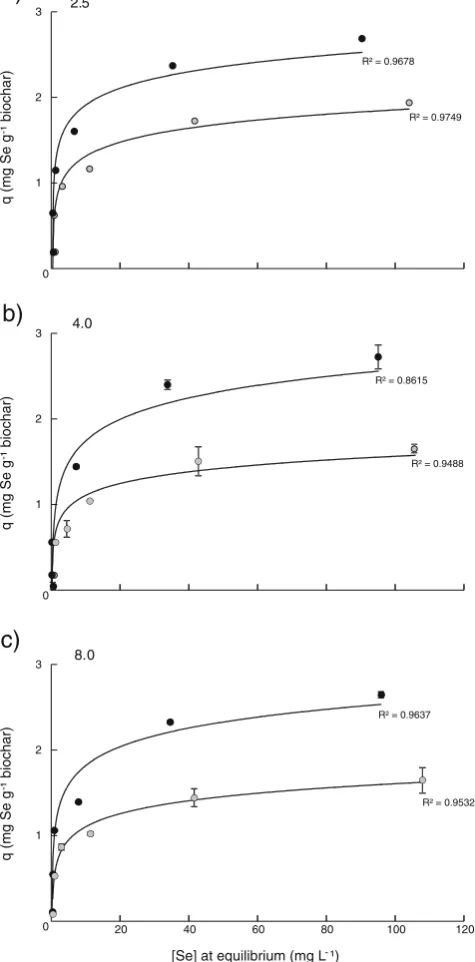
predictedqmaxvalues ranged from 2.60–2.72 mg g−1for
un-rinsed GMB and 1.65–1.85 mg g−1 for the rinsed GMB
(Fig.5a–c). Se uptake was well described by a logarithmic line of best fit, attainingR2 values of between 0.8615 and 0.9749 for the different pH and biosorbent treatments (Fig.5a–c). The pH in theqmaxstudies were stable, with final
pH in the 2.5, 4.0 and 8.0 treatments being 2.65±0.1, 4.25± 0.1 and 8.20±0.1, respectively, after 4 h.
In all cases, the concentration of Se measured on the used biosorbents was slightly lower than the predicted values. However, these differences were not significantly different (one-tailed t test; P>0.05) and measured qmax values were
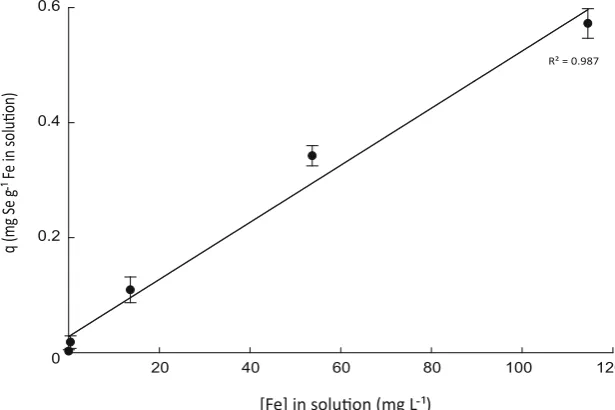
within 5–15 % of predicted values (Table1). Flocculation of Se with free Fe in solution, followed by filtration, was able to partially remove Se from solution, with a strong linear rela-tionship between initial Fe concentrations in (un-filtered) wa-ter and Se removal on filtration (Fig.6). The water treated by rinsed and un-rinsed GMB in theqmaxexperiment had mean
final Fe concentrations of 4.9 and 23 mg L−1, respectively.
The linear relationship between initial Fe concentration in solution and Se precipitation predicts that these Fe concentra-tions equate to an equivalentqvalue of 0.05 and 0.14 mg Se g−1Fe, respectively, which approximates the differences
be-tween predicted and observedqmax (Table1).
Discussion
Removal of metals from industrial waste streams requires environmentally sustainable and cost-effective solutions. Biosorption of contaminants with seaweeds holds great prom-ise, but the application of seaweed biosorption in industrial
settings has been limited by various factors. These include an inability to treat metalloids with existing biosorbents, a lack of specificity for target contaminants in complex waste waters, and the lack of a sustainable and cost-effective source of biomass (Volesky2007; Gadd2009). This study demonstrates Fe-treated GW biochar (GMB) is an effective biosorbent that can specifically target a contaminant (Se) that is unable to be removed from effluents by un-treated seaweed biomass. The GMB is effective against both main oxidation states of Se (SeIVand SeVI) and is most effective when the GW is
pre-[Se] at equilibrium (mg L ¹)
20 40 60 80 100 120
Fig. 5 The effect of pH and pre-rinsing of the biosorbent on theqmax (mg Se g−1 biochar) of GW Fe biochar.
treated with Fe, then converted to biochar through slow py-rolysis. This is a rare example of re-engineering a truly sus-tainable waste material to solve a second industrial waste problem.
In addition to being effective against both Se oxidation states, the extraction efficiency of Se is unaffected by pH and minimally affected by temperature, indicating the biosorbent could be effectively deployed under a range of environmental conditions with little or no control of influent water quality characteristics. However, given the interaction between temperature and desorption of Se after long-term deployments, more frequent replacement of GMB could be considered for higher temperature operations to avoid Se leaching. The qmax of 2.60–2.72 mg Se g−1 is similar to
previously published values for biosorption of selenite by iron-coated granular activated carbon (Zhang et al.2008). To our knowledge this is, however, the first demonstration of selenate (SeVI) biosorption by an IBS produced from a com-mercially available waste stream.
While the GMB could be pre-rinsed to reduce Fe leaching when deployed in solution, this also resulted in a reduction in binding capacity of approximately 40 %. The reduction in
qmaxcan be attributed to two processes, both of which are
related to Fe leaching. If GMB is pre-rinsed before deploy-ment, the surface content of Fe is reduced by approximately 10 %, reducing the Se-binding capacity of the biosorbent surface by a similar proportion. Furthermore, our data show that the leached Fe also contributes to the overall removal of Se from solution by flocculating and precipitating Se that is then removed when the samples were filtered. The contribu-tion of free Fe to the Se removal observed in the experiment is relatively small but detectable nonetheless. Somewhat surpris-ingly, pH had no bearing on theqmaxof the biosorbent under
initial pH conditions ranging from 2.5 to 8.0.
Relatively little is known about the mechanisms involved in anionic biosorption on substrates of any kind (Gadd2009). When pH is above the pKa of a given functional group, that functional group has a negative charge and therefore an affin-ity for metal cations (Mehta and Gaur2005). When pH falls below the pKa of a functional group, it becomes saturated by protons giving it an overall positive charge and some efficacy to adsorb oxyanionic contaminants (Pennesi et al. 2012b). Therefore, as both the availability of functional groups for metal uptake and metal speciation are highly pH dependent, cationic biosorption is also strongly influenced by pH (Mehta and Gaur2005). The fact that pH had minimal effects on the extent of Se biosorption indicates that the mechanism of uptake differs from cation biosorption to un-manipulated biosorbents. In the case of an IBS, the deposited Fe particles provide a secondary substrate for Se biosorption, effectively coating the negatively charged functional groups with posi-tively charged Fe. It is thought that the surface-bound Fe forms covalent bonds with aqueous Se (Manceau and
Table 1 Predicted and observedqmax(mg Se g−1biochar) for rinsed and un-rinsed GMB and three initial pH. Predictedqmaxwere derived on the basis of initial and final Se concentrations while observed values are based on measured Se contents of spent GMB from each treatment
Biosorbent Initial pH qmax(mg Se g−1GMB) ttest
Predicted Observed Difference P
Rinsed 2.5 1.85±0.15 1.79±0.17 0.06 0.399
4.0 1.65±0.05 1.56±0.06 0.09 0.147 8.0 1.65±0.15 1.53±0.15 0.12 0.301 Un-rinsed 2.5 2.60±0.02 2.50±0.02 0.10 0.102 4.0 2.72±0.14 2.61±0.09 0.11 0.278 8.0 2.66±0.04 2.57±0.06 0.09 0.173
0
20 40 60 80 100 120 0.2
0.4 0.6
R² = 0.987 Fig. 6 The effect of Fe in
Charlet1994). The Fe therefore acts as a precursor to support secondary Se biosorption and the involvement of functional groups in biosorption of Se is indirectly mediated through the affinity of the biomass for Fe. The fact that the functional groups have no direct involvement in Se biosorption would explain why theqmaxis pH independent. Our data also
dem-onstrate that a secondary, albeit minor, pathway of Se removal by IBS through the flocculation and precipitation of Se by Fe that has leached from the biosorbent. Given the rate and extent of Se uptake by the biosorbents were unaffected by tempera-ture and pH, respectively, our data demonstrate the GMB will be effective across a wide range of environmental conditions without the need for tight control on physico–chemical char-acteristics of feed waters.
A key implication of the mode of action of an IBS is that the only means with which to increase biosorption capacity is to increase the bonding of Fe to the IBS surface or the physical characteristics of the IBS to boost contact between the effluent and biosorbent. This is in direct contrast to cationic biosorbents, where tight control of physical environmental parameters is critical to success in situ. The physical charac-teristics of biochar, in particular, the surface area to volume ratio and pore size distribution, can be manipulated through controlled pyrolysis. The temperature at which biochar is produced, as well as the rate and duration of heating, influ-ences the biochar yield and surface properties (Joseph et al.
2009). Pore size distribution may be a critical factor in in-creasing the efficacy of IBS as a sufficient pore size to allow complete contact between the biosorbent surface and effluent may greatly increase the rate and extent of Se biosorption. Optimization of the Fe loading techniques may also lead to further gains in biosorption efficiency. Untreated seaweeds yield unique biochars when subject to pyrolysis (Bird et al.
2011). Seaweed typically yields biochar with a relatively low C content (~30 %), but very high N and P concentrations (Bird et al.2011). For these reasons, seaweed biochar is an effective fertiliser and soil ameliorant to improve soil fertility (Bird et al.2012). In contrast, the biochar produced from GW had characteristics more typical of a pyrolysis ash than a biochar, with a very high yield on pyrolysis (~90 %) and very low C content (<10 %).
WasteGracilariabiomass can be used for production of GMB to treat industrial waste water. This is a truly sustainable source of biomass for biosorption. The GMB is effective in the sorption of both main oxidation states of Se and this distin-guishes the approach from existing Se treatment technologies, including the current best available technology (BAT) ferri-hydrite adsorption which is ineffective at removing selenate (Mondal et al.2004). The production of GMB for treatment of Se in waste waters would improve the sustainability of
Gracilaria cultivation by redirecting unused waste towards solving environmental problems—sustainably treating waste with waste.
Acknowledgments We thank Charlotte Johansson for assistance with the laboratory experiments and Tony Forsyth for assistance in preparing the biochar. This research is part of the MBD Energy Research and Development programme for Biological Carbon Capture and Storage. This project is supported by the Advanced Manufacturing Coopera-tive Research Centre (AMCRC), funded through the Australian Government’s Cooperative Research Centre Scheme, and the Australian Renewable Energy Agency (ARENA). SAD was sup-ported by a grant from the Australian Centre for International Agricultural Research (ACIAR).
References
Amweg EL, Stuart DL, Weston DP (2003) Comparative bioavailability of selenium to aquatic organisms after biological treatment of agricul-tural drainage water. Aquat Toxicol 63:13–25
Armisen R (1995) World-wide use and importance ofGracilaria. J Appl Phycol 7:231–243
Bird MI, Wurster CM, de Paula Silva PH, Bass AM, de Nys R (2011) Algal biochar—production and properties. Bioresour Technol 102: 1886–1891
Bird MI, Wurster CM, De Paula Silva PH, Paul NA, de Nys R (2012) Algal biochar: effects and applications. GCB Bioenergy 4:61–69 Bulgariu D, Bulgariu L (2012) Equilibrium and kinetics studies of heavy
metal ions biosorption on green algae waste biomass. Bioresour Technol 103:489–493
Castine SA, Paul NA, Magnusson M, Bird MI, de Nys R (2013) Algal bioproducts derived from suspended solids in intensive land-based aquaculture. Bioresour Technol 131:113–120
Chapman PM, Adams WJ, Brooks ML, Delos CG, Luoma SN, Maher WA, Ohlendorf HM, Presser TS, Shaw PD (2009) Ecological as-sessment of selenium in the aquatic environment: summary of a SETAC Pellston Workshop. Society of Environmental Toxicology and Chemistry, Pensacola
Davis TA, Volesky B, Mucci A (2003) A review of the biochemistry of heavy metal biosorption by brown algae. Water Res 37:4311–4330 FAO (2012) The state of world fisheries and aquaculture 2012. Rome,
Italy
Gadd GM (2009) Biosorption: critical review of scientific rationale, environmental importance and significance for pollution treatment. J Chem Technol Biotechnol 84:13–28
Gonzalez CM, Hernandez J, Peralta-Videa JR, Botez CE, Parsons JG, Gardea-Torresdey JL (2012) Sorption kinetic study of selenite and selenate onto a high and low pressure aged iron oxide nanomaterial. J Hazard Mater 211–212:138–145
Joseph S, Peacocke C, Lehmann J, Munroe P (2009) Developing biochar classification and test methods. Earthscan, Sterling, pp 249–258 Kang OL, Ramli N, Said M, Ahmed M, Yasir SM, Ariff A (2011)
Kappaphycus alvareziiwaste biomass: a potential biosorbent for chromium ions removal. J Environ Sci 23:918–922
Kidgell JT, de Nys R, Hu Y, Paul NA, Roberts DA (in press). Bioremediation of a complex industrial effluent by biosorbents derived from freshwater macroalgae. PLOS One. Accepted 26.03.2014.
Latva S, Peräniemi S, Ahlgrén M (2003) Study of metal-loaded activated charcoals for the separation and determination of selenium species by energy dispersive x-ray fluorescence analysis. Anal Chim Acta 478:229–235
Mahan CA, Majidi V, Holcombe JA (1989) Evaluation of the metal uptake of several algae strains in a multicomponent matrix utilizing inductively coupled plasma emission spectrometry. Anal Chem 61: 624–627
Manceau A, Charlet L (1994) The mechanism of selenate adsorption on goethite and hydrous ferric oxide. J Colloid Interface Sci 168:87–93 Mane PC, Bhosle AB (2012) Bioremoval of some metals by living algae Spirogyra sp. andSpirullina sp. from aqueous solution. Int J Environ Res 6:571–576
Mehta SK, Gaur JP (2005) Use of algae for removing heavy metal ions from wastewater: progress and prospects. Crit Rev Biotechnol 25: 113–152
Mondal K, Jegadeesan G, Lalvani SB (2004) Removal of selenate by Fe and NiFe nanosized particles. Ind Eng Chem Res 43:4922–4934 Niu H, Volesky B (2003) Characteristics of anionic metal species
biosorption with waste crab shells. Hydrometallurgy 71:209–215 Pennesi C, Totti C, Romagnoli T, Romagnoli T, Bianco B, de Michelis I,
Beolchini F (2012a) Marine macrophytes as effective lead biosorbents. Water Environ Res 84:9–16
Pennesi C, Veglio F, Totti C, Romagnoli T, Beolchini F (2012b) Nonliving biomass of marine macrophytes as arsenic(V) biosorbents. J Appl Phycol 24:1495–1502
Roberts DA, Paul NA, De Nys R (2013) Biosorbent and methods of use. Provisional Australian patent AU2013902101
Sappington KG (2002) Development of aquatic life criteria for selenium: a regulatory perspective on critical issues and research needs. Aquat Toxicol 57:101–113
Seo Y-B, Lee Y-W, Lee C-H, You H-C (2010) Red algae and their use in papermaking. Bioresour Technol 101:2549–2553
Sharma VK, Sohn M (2009) Aquatic arsenic: toxicity, speciation, trans-formations, and remediation. Environ Int 35:743–759
Torres J, Pintos V, Gonzatto L, Domínguez S, Kremer C, Kremer E (2011) Selenium chemical speciation in natural waters: protonation and complexation behavior of selenite and selenate in the presence of environmentally relevant cations. Chem Geol 288:32–38 USEPA (2001) Selenium treatment/removal alternatives demonstration
project. EPA/600/R-01/077. United States Environmental Protection Agency, Cincinnati
Volesky B (2001) Detoxification of metal-bearing effluents: biosorption for the next century. Hydrometall 59:203–216
Volesky B (2007) Biosorption and me. Water Res 41:4017–4029 Zar JH (2010) Biostatistical analysis. Prentice Hall, New Jersey Zhang N, Lin L-S, Gang D (2008) Adsorptive selenite removal from