Indonesia Defense Diplomacy to Include Tanjung Datu Segment as Outstanding …| Istiqamah | 65
INDONESIA DEFENCE DIPLOMACY TO MAKE TANJUNG DATU SEGMENT AS
OUTSTANDING BOUNDARY PROBLEM OF INDONESIA-MALAYSIA
Istiqamah1
Program Study of Defence Diplomacy, Indonesia Defence University ([email protected])
Abstract – This study discusses about implementation of Indonesia’s defense diplomacy and its analysis in effort to obtain Tanjung Datu segment as Outstanding Boundary Problem of Indonesia-Malaysia. This is based on the status of Tanjung Datu as Outstanding Boundary Problem was ambiguous due the different interpretations of Memorandum of Understanding (MOU) 1976 and 1978 by Government of Indonesia. The negotiation to obtain Tanjung Datu segment as Outstanding Boundary Problem Indonesia-Malaysia in 2001. Indonesia attempt to lobby Malaysian to attach Tanjung Datu as OBP and its intensively conducted by Indonesia’s delegates until finally, Indonesia accepted the Malaysian decision that Tanjung Datu is not part of the OBP. This research method was qualitative approach where data collection technique was through interviews with six informants including practitioners and experts in related fields. This study showed that the subjects of Indonesia’s defense diplomacy in efforts to obtain Tanjung Datu segment as OBP Indonesia-Malaysia are Pankorwilnas, Directorate of Army Topography, Ministry of Defense, Ministry of Home Affairs and JUPEM (Malaysian Position Measurement and
Mapping). While the object of Indonesia’s defense diplomacy in the efforts to obtain
Tanjung Datu segment as OBP Indonesia-Malaysia are the implementation of Indonesia’s
national interest to achieve territorial sovereignty and it was also part of defense.
Keywords : Defense Diplomacy, Bounday Making Theory, Territorial Sovereignty, Tanjung Datu Segment, Outstanding Boundary Problems.
Introduction
iscussion regarding the Tanjung
Datu segment started from the
determination of land border by
the Indonesia-Malaysia referring to the uti
possidetis juris principle, where Indonesia
inherits the Netherland lands and Malaysia
inherits the British lands. The
determination of said land border refers to
1 Istiqamah is a student of the Indonesia Defense University, Program of Defense Diplomacy Cohort 2. He
is a graduate of International Relations of State Islamic University Syarif Hidayatullah Jakarta in 2014.
the agreement between the Netherland
and British Government, which is:
“Treaty Between the Netherland Government and the British Government Defining the Boundaries Between the Two Countries in the Island of the Borneo, 20 Juni 1891, Agreement of the Joint Report Concerning the Implementation at Field of the Treaty of 1891 between Netherland Possesion and British Protection in the Island of Borneo, 28 September 1915 dan Treaty Between
66 | Journal of Defense & State Defense | December 2017 | Volume 7 Number 3 the Netherland Government and the
British Government Defining the Boundaries Between the Two Countries in the Island of Borneo, 26
Maret 19282.”
According to the Army Topography
Directorate, democratic process between
smoothly because leaving a few points of
conflict also called as Outstanding
Boundary Problems (OBP). Indonesia have
proposed ten outstanding boundary
problems which is located each at five
location in two sectors, east sector (East
Borneo-Sabah) which is the Sebatik Island,
Sinapad River, Semantipal River,
B2700-B3100 and C500-C600, meanwhile the
west sector (West Borneo-Serawak)
which is Batu Aum, Sungai Buan, Mt.Raya,
point D.400 at Bengkayang Region and
Tanjung Datu. However, Malaysia have a
different opinion in the number of OBP. To
Malaysia, Tanjung Datu cannot be a part of
the OBP because the issue has been
resolved. This different opinion between
Malaysia and Indonesia is based on the
2 Erika. “Tanjung Datu Status as Outstanding
Boundary Problem in the Border of Indonesia
interpreting method of border
determination in 1976 and 1978.
This issue emerged the first time in a
Work Group Discussion Report regarding
the Affirmation Issues of The National
Border of Indonesia-Malaysia in May 14th
1983. This is concerning the discrepancy in
the affirmation of the border. However,
discrepancy issues in affirming the border
at Tanjung Datu is never conveyed
officially to Malaysia. The 27 Joint
Demarcation Malaysia-Indonesia Boundary
Committee on Demarcation and Survey
meeting on October 29-31, 2001, at
Kinabalu City becomes a momentum for
Indonesia to propose so Tanjung Datu is
re-assessed and becomes one of the OBP.
In the 10-11 of April 2002, a Special Meeting
is held between both Head of National
Committee. In that meeting, Indonesia
again proposes Tanjung Datu to become
one of the OBP, But Malaysia refuses
because the conflict at Tanjung Datu has
been resolved with the signing of the
Memorandum of Understanding (MOU)
19783.
The involvement of TNI (Indonesia
National Army) in resolving the border
conflict, especially Tanjung Datu segment
and Malaysia”. (thesis, Faculty of Defense Management IDU, Jakarta, 2014), p. 3
Indonesia Defense Diplomacy to Include Tanjung Datu Segment as Outstanding …| Istiqamah | 67 becomes an interesting issue in this paper.
Said involvement is observed in several
aspects of technical measurements,
guarding the border even participating in
the formulation of the decision. Other
than that, border conflict becomes one of
the object of national defense strategic
issues. National defense means every effort to uphold the nation’s sovereignty,
defending the entirety of the national land
and security of the whole nation from
military as well as armed threats 4 .
Upholding the nation’s sovereignty
becomes the basis of an inch of NKRI land
must be fought and this becomes the
fundamental of the existing diplomatic
defense process when discussing Tanjung
Datu segment agenda as an
Indonesia-Malaysia OBP in 2001-2002.
According to the background as
explained above, the main issue
formulation in this research is how is the
implementation of Indonesia's defense
diplomacy in an effort to include the
Tanjung Datu segment as Outstanding
Boundary Problems Indonesia-Malaysia.
The period was after the MOU 1978 was
signed to its peak, during the negotiations
4 Makmur Supriyatno, Pendirian Batas Darat
Internasional antara Indonesia-Malaysia di Pulau Kalimantan, (Jakarta: CV Makmur Cahaya Ilmu, 2016), p. 99
of The Joint Malaysia-Indonesia Boundary
Committee and Special Meeting in
2001-2002. This time span was chosen because
at that time there was effort to enter the
agenda of Tanjung Datu as OBP
Indonesia-Malaysia.
Research Methodology
To answer the formulated issue above, the
method used is the qualitative method
with historical descriptive approach. The
technique used to collect the data is in
depth interview and literature review.
Data analyisis technique used in this
research is the Miles and Huberman model
which consist of 3 stages, which are data
reduction, data display, and conclusion
drawing/verification. Data reduction
means summarizing, selecting imporant
points to give a clear image as well as
simplify the next data collecting for the
researcher. After the reduction, data will
be presented in a short essay, chart, and
relation between categories, flowchart
and etc. The last stage is concluding all or
the result to show new findings in this
research5.
5 P.D. Sugiyono, Metode Penelitian Kualitatif –
68 | Journal of Defense & State Defense | December 2017 | Volume 7 Number 3 Research Result and Discussion
Indonesia Diplomacy to Include Tanjung Datu Segment as Indonesia-Malaysia OBP
Indonesia has never officially informed the
Tanjung Datu segment issues after the
signing of MOU 1978. The talks on the
Tanjung Datu segment were only
discussed internally through the Working
Group Discussion Report on the Issue of
Border Affirmation of Indonesia and
Malaysia on May 14th 1983. According to
Brigadier General Makmur Supriyatno, the
annual Joint Border Committee or the
General Border Committee also never
discussed the Tanjung Datu segment and
that is proven with no record in every
Minute of Joint Border Committee
Meeting6.
Brigadier General Makmur
Supriyatno as the person who first
Malaysia-Indonesia Boundary Committee
meeting on October 29-31 2001 in Kinabalu,
Sabah, Malaysia. The Indonesian
delegation was led by DR. Ir. Siti Nurbaya,
6 Erika, Op.Cit, p. 52
MSc. as the Secretary General of the
Ministry of Home Affairs of Indonesia and
Chairman of the Indonesian National
Committee of Indonesian-Malaysian
Border. Meanwhile, the Malaysian
delegation is led by Datuk Dr. Nik Mohd.
Zain bin Hj. Nik Yusuf as Secretary of the
General Ministry of Land and Co-operative
Development and Malaysia Chairman of
the National Malaysia-Indonesia Boundary
Committee.
Indonesia seeks to include the
Tanjung Datu segment as OBP, proposing
the Malaysian side to conduct a re-survey
in Tanjung Datu area. Thus, the final result
of the Indonesian side is to propose 10
OBPs with 5 OBPs in the west sector
namely Batu Aum, Point D400, Mt. Jagoi,
Mt. Raya (along with Tanjung Datu
segment) and 5 OBP in the east sector ie
Sinapad River, Simantipal River, Sebatik
Island , Point C500-C600 and Point B.
2700-B. 3.100.
Malaysia responded to Indonesia's
proposal by assuming that Malaysia only
agrees on 9 OBP and felt that the
problems at Tanjung Datu segment had
been resolved with the signing of the
Demarkation MOU at the Joint
Indonesia Defense Diplomacy to Include Tanjung Datu Segment as Outstanding …| Istiqamah | 69
and Demarcation of International
Boundaries Between Indonesia-Malaysia
meeting in 1978. However, Indonesia
insisted that the Tanjung Datu segment
issue be discussed in the upcoming
meeting due to technical problems.
Malaysia accepted on condition that
Indonesia make technical note and convey
the argument about Tanjung Datu
segment7.
After the meeting, the research was
conducted on recommendations of the
Directorate Army of Topography and the
Minister of Home Affairs and Secretary
General of the Ministry of Home Affairs
unilaterally by the Indonesian team
against the Tanjung Datu segment. The
research aims to be taken into
consideration during the Joint
Indonesia-Malaysia Boundary Committee (JIM)
meeting held in 2002. The research used
aerial photography method, manual and
digital air photograph interpretation, field
observation, detail measurement, use of
Geodetics Global Positioning System
(GPS), calculation of cross-section on Field
Plan and Traverse & Height and field
7 Makmur Supriyatno, “Masalah Perbatasan
Darat Internasional antara Republik Indonesia-Malaysia di Daerah Tanjung Datu Kabupaten
Sambas Provinsi Kalimantan Barat”, Discussion Forum of the Ministry of Coordination for Political, Legal and Security Affairs, 2009.
measurement. The overall data and
information were then analyzed by
Indonesia to obtain new evidence (ie
novum) ie the surface of the land in
Tanjung Datu segment is
geomorphologically flat, the absence of
watershed so that the measurement
technique must use straight line boundary
and not the waterpass technique. Based
on the results of the study where the
measurements were made not in
accordance with the requirements as
stated in Treaty 18918.
On April 10-11 2002 a meeting was
held between the Joint Border Committee
of Indonesia-Malaysia in Jakarta, namely
The Special Meeting to Finalize the Terms
of Reference for the Joint Democratic
Party and Working Committee on the
International Boundary between
Indonesia-Malaysia. The agenda of the
meeting discussed the Term of Reference
(TOR) for the Joint Work Group on the
Outstanding Boundary Problems. The
Indonesian delegation was again led by
the Secretary General of Department of
Home Affairs at the time, DR. Ir. Siti
8 Makmur Supriyatno, “Informasi tentang
Permasalahan Teknis OBP Garis Batas Internasional antara RI-Malaysia di Tanjung
70 | Journal of Defense & State Defense | December 2017 | Volume 7 Number 3 Nurbaya, M.Sc. and the Malaysian
Delegation is led by Datuk Dr. Nik Mohd.
Zain bin Hj. Nik Yusuf.
In the meeting, the Indonesians
presented the results of previous research
on the area of Tanjung Datu
leveling. The Malaysian side responded to
Indonesia's point of view by saying that
Malaysia accepted the argument that the
Tanjung Datu segment is not watershed or
flat, Malaysia is unwilling to include
'acceptance of the argument' in writing
which will later be incorporated into the
'Record of Meeting', Malaysia questioned
why Indonesia signed the MOUs in 1976
and 1978, after two years of measurement
results were carried out, Malaysia found it
difficult to withdraw the signed MOUs in
the Malaysian government systems and
Malaysia does not agree to include
Tanjung Datu into TOR OBP9.
Based on the Record of the Meeting,
it is recorded that the results of the
border issues (OBP), Indonesia stated that
Tanjung Datu is one OBP because there
are technical problems that can be
categorized as the same as other OBPs,
Indonesia states that Tanjung Datu is one
of the OBPs to be discussed in JWG OBP,
Malaysia stated that Tanjung Datu is not
an OBP, Malaysia stated that the problem
at Tanjung Datu is resolved with MOU
signing on August 23rd 1976 and November
18th 1978, the parties stated that there
were differences of perception about
Tanjung Datu case and did not find an
agreement in TOR and Malaysia agreed to
meet again in July 200210.
Analysis of The Implementation of Indonesian Defense Diplomacy in an Efforts to Incorporate Tanjung Datu Segment as Outstanding Boundary Problems of Indonesia-Malaysia
I conclude that defense diplomacy is the
use of armed forces and defense-related
infrastructure to achieve the objectives of
a foreign policy or defense interests within
the national scope of a country. Utilization
of military instruments can be through
dialogue forums, research on Tanjung
Datu status determination, formulating
forms of cooperation, conducting a joint
Indonesia Defense Diplomacy to Include Tanjung Datu Segment as Outstanding …| Istiqamah | 71 exercise or participating in peace by
engaging in conflict prevention. Defense
diplomacy not only moves in the
perspective of defense or security but can
take action in the field of humanitarian,
social, economic, political and even
environmental because of the current
trend of a threat to a country is very
dynamic.
In addition, defense diplomacy can
not be limited only from the perspective of
the subject where defense diplomacy is
the same as that of armed forces. If we
also look at defense diplomacy from the
perspective of the object ie the purpose of
diplomacy, then the application of
defense diplomacy will be very broad and
useful for the national interest on behalf
of the state defense.
This researcher's perspective is
inseparable from the researcher's
understanding of Du Plessis's assumption11
of defense diplomacy namely the use of
trained armed forces to achieve foreign
policy and national interest and
Muthanna 12 which states that all
components related to defense (not just
armed forces) such as Ministries, research
11 Antonio Du Plessis, “Defence Diplomacy:
Conceptual and Practical Dimensions with
Specific Reference to South Africa”, 2008. 12 KA Muthanna, “Military Diplomacy”, Journal of
Defence Studies, Vol. 5 No. 1, Januari 2011.
and development institutions and
Universities may carry out defense
diplomacy activities.
In addition, researchers also
interpret the views of Rodon Pedrason 13
on defense diplomacy using all
instruments, and in this case, the
researcher sees the implementation of
Indonesia's defense diplomacy, using
political instruments in carrying out
defense diplomacy to include the Tanjung
Datu segment as Outstanding Boundary
Problem Indonesia-Malaysia.
More specifically, the researcher
divides the researcher's analysis on the
implementation of defense diplomacy in
an effort to lift the Tanjung Datu segment
as OBP Indonesia-Malaysia into two
perspectives, namely subject and object.
Defense Diplomacy Views The Agenda of An Effort to Bring Up Tanjung Datu Segment As OBP Indonesia-Malaysia From Subject Perspective
Subjects or actors who have a major role
in defense diplomacy are the Ministry of
Defense and the Armed Forces, as well as
civilian officers working in the defense
sector. But due to the close relationship
72 | Journal of Defense & State Defense | December 2017 | Volume 7 Number 3 between defense and foreign policy, the
role of diplomats is also taken into account
in defense diplomacy14.
The development of the
international system has resulted in the
widespread of actors involved in defense
diplomacy. Currently defense diplomacy
can be via Track-1 channel and Track-2
channel. Track-1 channel is a network of
ministerial officials, members of
parliament, military and police officers.
While Track-2 channel is a network of
decision makers and civil community.15
On the agenda of of an effort to
bring up Tanjung Datu segment as OBP
Indonesia-Malaysia, the role of institution
is very big, namely National Area
Coordination Committee (Pankorwilnas)
and organization like The Joint Boundary
Committee. In addition, Indonesian
government institutions such as the Army
Directorate of Topography, Ministry of
Defense and the Ministry of Home Affairs
have their respective duties which
essentially lead to the Tanjung Datu
segment as OBP Indonesia-Malaysia in
2001-2002 and JUPEM as the official state
of Malaysia also has a role which was
14 A.R. Silva, “Defense Diplomacy: What are we talking about?” Encontro Nacional da ABRI,
(2015), pp. 1-9.
enormous when it became a delegation of
Malaysian representatives during the
talks.
a. National Area Coordination Committee
(Pankorwilnas)
The National Territory Coordinating
Committee (Pankorwilnas) is a
committee that handles border issues
during the New Order period and was
established on June 4th 1971 based on
Indonesian Presidential Decree No. RI.
36 year 1971. The establishment of
Pankorwilnas is based on the
consideration that coordination,
integration and synchronization needs
to be taken in solving national and
seabed problems and aiming for
everything concerning the settlement
of national and marine area problems
can be based on the overall
government policy. Pankorwilnas also
has duties such as formulating policy
points concerning the settlement of
national and seabed area issues and
preparing the materials needed to
solve national and seabed nationalities
15 Iis Gindarsah, “Indonesia’s Defence Diplomacy
Harnessing The Hedging Strategy Against
Indonesia Defense Diplomacy to Include Tanjung Datu Segment as Outstanding …| Istiqamah | 73
problems with neighboring
countries.16.
The Pankorwilnas report has
always been a basic reference in the
settlement of border issues. One of the
reports from the Sub-Committee for
the Settlement of Problems of National
and Marine Boundaries of the Republic
of Indonesia in 1983 on the Results of
the Working Group Discussion on the
Indonesia-Malaysia Border Affairs
concerning land border issues which at
that time was not named OBP 17 ,
including the measurement of Tanjung
Datu segment which is considered to be
detrimental to the Indonesian side.
The existence of Pankorwilnas
became the central subject in defense
diplomacy where the institution that
was established during the New Order
period was indeed under the auspices
of the Ministry of Defense and Security
and has qualified military members in
border issues.
Pankorwilnas also plays a major
role in establishing bilateral
Indonesia-Malaysia which serves to resolve and
affirmation of borders and border
surveys of the two countries. This
institution is still running until now and
16 Makmur Supriyatno (2016), Op.Cit. 17 Ibid
preceded by MOU Year 1973 which
mandates the establishment of a
commission should be formed by
Indonesia-Malaysia. This institution is
named National Committee and
Technical Committee.
Home Affairs. The National Committee
is in charge of resolving border
affirmations and surveys along with
territorial borders. While the Technical
Committee in the period 1973-1983 is
led by the Head of Bakosurtanal, the
period 1983-2009 is led by Kapussurta
ABRI. Currently, the Technical
Committee is led by the Defense
Ministry's Regional Directorate of
Defense. The Technical Committee
prepares the program and conducts
joint survey and affirmation also
prepares progress reports or the
results achieved in the implementation
74 | Journal of Defense & State Defense | December 2017 | Volume 7 Number 3 establishment of the National Oceanic
Council to deal with maritime affairs,
based on the enactment of the United
Nations Convention on the Law of the
Sea of 1982, Pankorwilnas was declared
no longer valid. The dissolution of
Pankorwilnas had an impact on the
transformation of the organization
structure in handling border issues. At
present, the highest leader of the
border issues handling organization is
held by the National Committee,
chaired by the Secretary General of the
Ministry of Home Affairs.
The dissolution of Pankorwilnas in
1982 became a disadvantage for
Indonesia because Indonesia is no
longer has an institutions that focus on
addressing border issues, especially
land border issues. However, over time,
the dissolution of Pankorwilnas did not
dampen the desire of the Army to solve
the land border issues. This is evident
by diplomatic proceeding on the issues
of the Tanjung Datu segment which has
so far been ambiguous.
b. Army Directorate of Topography
The Army Directorate of Topography is
in charge of organizing the provision
and presentation of geographic or
terrain information in the form of
topographic maps, terrain data and
analysis as well as other topographical
products in the framework of
implementation of Army duties.
The Army Directorate of
Topographic is under the position of
the Ministry of Defense and is part of
the negotiation agenda of Tanjung
Datu segment effort as OBP
Indonesia-Malaysia by directly measuring the
border of Borneo-Sarawak and Sabah,
including the Tanjung Datu segment. It
is previously described the
organizational structure, Army
Directorate of Topography has served
as Co-Project Director of West Sector
and Co-Project Director of East Sector.
The expertise in measurement,
mapping, and surveys owned by the
Arny Directorate of Topography makes
them believed to be involved as
delegates of border negotiations, and
to give consideration to the boundaries
of the technical aspects.
During the 1976-1978 border
negotiations, the Army Directorate of
Topography worked as a survey and
boundary executive under the
responsibility of Bakosurtanal.
Meanwhile, in the negotiation on the
agenda of submitting the Tanjung Datu
Indonesia Defense Diplomacy to Include Tanjung Datu Segment as Outstanding …| Istiqamah | 75 2001-2002, the Army Directorate of
Topography was involved in their
research under the authority of the
Ministry of Home Affairs.
c. Ministry of Defense
The Ministry of Defense is the
executing element of the government,
led by the Minister of Defense and
domiciled under and answers to the
President. The Ministry of Defense has
the task of administering defense
affairs in the government, which aims
to assist the President in organizing
state administrations.
The Ministry of Defense is the
main actor in defense diplomacy. On
the agenda of appointment of Tanjung
Datu segment as OBP
Indonesia-Malaysia, Ministry of Defense
participated as delegation during
negotiation where Ministry of Defense
served as Technical Committee.
d. Ministry of Homeland Affairs
The Ministry of Homeland Affairs has
the task of organizing domestic
government affairs to assist the
President in organizing the state
administration.
In the border negotiations, the
Chairman of the Delegation is led by the
Secretary General of the Ministry of
Homeland Affairs, who also serves as
the National Committee. The Secretary
General of the Ministry of Homeland
Affairs has the duty to organize the
coordination of task implementation,
guidance and administration support to
all organizational units within the
Ministry of Homeland Affairs.
In Siti Nurbaya's era as Secretary
General of the Ministry of Homeland
Affairs, the agenda for the
appointment of the Tanjung Datu
segment was attempted to negotiate
with Malaysia through the JIM-27
negotiations in 2001. When Malaysia
asked the Indonesian side to make a
technical note about the
argumentation of the Tanjung Datu
segment issue, Siti Nurbaya ordered a
re-examination of the Tanjung Datu
segment, which then produced
evidence that the Tanjung Datu
segment is flat. Nevertheless, the
Malaysians are not willing to consider
this assumption as the basis of the
proposed segment of Tanjung Datu as
OBP Indonesia-Malaysia because the
Indonesian-Malaysian side signed the
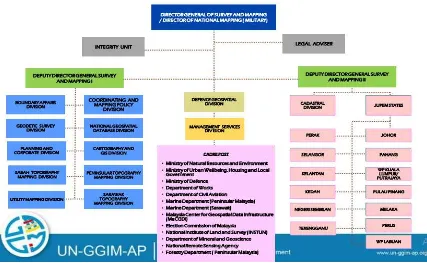
76 | Journal of Defense & State Defense | December 2017 | Volume 7 Number 3 Figure 1. JUPEM Organizational Structure
e. JUPEM
Malaysian Position Measurement and
Mapping or (JUPEM) for short is a
Malaysian state institution in charge of
measuring and mapping and obtaining
a mandate to control measurement,
mapping, topography and geodesy.
JUPEM becomes the representative of
Malaysian state delegation when
conducting border negotiations.
JUPEM has a military division
named Defense Geospatial Division
which is also involved in the negotiation
agenda of including Tanjung Datu
segment as OBP Indonesia-Malaysia.
According to Brigadier General Makmur
Supriyatno, there was a delegation of
Defense Geospatial Division
representatives present at the
negotiations. In other words, the
subject of defense diplomacy has
occurred with the involvement of
military representatives between the
countries of Indonesia and Malaysia
during the negotiation agenda of
including Tanjung Datu Segment as
OBP Indonesia-Malaysia in 2001 and
2002. The organizational structure of
Indonesia Defense Diplomacy to Include Tanjung Datu Segment as Outstanding …| Istiqamah | 77 Defense Diplomacy Views the Agenda of
an Effort to Bring Up Tanjung Datu
Segment as an OBP Indonesia-Malaysia
from Object Perspective
In a narrow sense, defense diplomacy can
be defined as "the use of military
personnel, including attache officers, who
assist in the prevention and resolution of
conflicts, the development of a
democratic armed forces". This definition
has a relationship with the understanding
contained in the Strategic Defense Review
1998 - "the provision of armed forces to
conduct activities undertaken by the
Ministry of Defense such as removing
hostilities, establishing and maintaining
trust and fostering a democratic armed
forces, thus In the broader context,
defense diplomacy can be described as
"the use of armed forces operating in
non-war Territory sovereignty is one aspect of
the security dimension, because a country
will be able to guarantee the security of its
inhabitants in a jurisdictional territory of
authority. According to the Army
Commander of the Republic of Indonesia
for the period of 2010-2013, Admiral Agus
Suhartono, legal certainty about the
sovereignty of the state which in turn will
provide assertiveness and certainty of the
territorial boundaries of NKRI. Boundary
territorial clarity will also facilitate the
management of border areas as it ensures
supervision, security, law enforcement
and protection of NKRI territory by the
state defense apparatus or national law
enforcement apparatus. The State of
Indonesia still has a variety of unfinished
issues concerning the clarity of the status
of territories adjacent to other countries
affecting the population occupying the
territory has limitations in enjoying the
rights granted by the country so that
sometimes they have to live under the
welfare line.
The agenda of appointment of
segment of Tanjung Datu as OBP
Indonesia-Malaysia at JIM meeting 2001
and Special Meeting year 2002 aim to fight
for national interest of Indonesia state
that is sovereignty of NKRI region. The
filing of the Tanjung Datu segment as OBP
Indonesia-Malaysia by the Indonesian side
at the time was based on the foundation
that Indonesia had a great opportunity to
reach the region of 1499 HA because of
the results of research showing that
Tanjung Datu segment was flat and error
measurement occurred in 1975-1978 .
However, Indonesia must accept the fact
that Malaysia does not have the desire to
negotiate the Tanjung Datu segment again
78 | Journal of Defense & State Defense | December 2017 | Volume 7 Number 3 agreed on the measurement results and
signed the MOU Year 1978.
Reflecting on the defense
dimension, territorial sovereignty is
always part of the defense object. It is
stated in the Minister of Defense of the
Republic of Indonesia Regulation No. 13 of
2014, one of which states that the border
region has a strategic value in realizing the
territorial integrity of the Unitary Republic
of Indonesia and potentially threatened.
In addition, Law no. 3 of 2002 on State
Defense has elaborated it in article 1 ie:
a. State defense is all efforts to defend
the sovereignty of the state, the
territorial integrity of the Unitary
State of the Republic of Indonesia,
and the safety of the whole nation
from threats and disturbances to the
integrity of the nation and state.
b. The state defense system is a
universal defense system that
involves all citizens, regions and other
national resources, and is prepared in
advance by the government and is
held in total, integrated, directed and
in a continuous manner to uphold the
sovereignty of the state, territorial
integrity and safety of the whole
nation from all threats.
19 Plessis, Op.Cit.
An absoluteness that border
negotiations have always been a defense
sphere. This is included in the agenda of
the affirmation of Tanjung Datu segment
as OBP Indonesia-Malaysia in 2001 and
Special Meeting 2002. Although the
Chairman of the Bargaining Delegation is
the Secretary General of the Ministry of
Home Affairs, the object negotiated,
attempted, diplomacy is the material, the
scope of national defense. This is because
the Indonesian Defense System embraces
the defense system of the universe
(Sishanta) where the defense is guarded
by the military and non-military (civil
society). In addition, a synergistic
civil-military relationship reflects that defense
diplomacy has worked well in a country.
This is similar to that is done by the United
States who saw one of the parameters of
defense diplomacy is the existence of
military civil relations19.
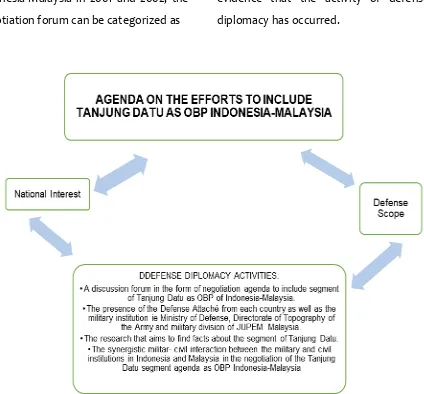
Plessis20 also describes the defense
diplomacy instruments performed by
South Africa namely the presence of
Defense Attachés, bilateral-multilateral
interactions such as agreements and
meetings to improve foreign policy
objectives. In addition, the researcher has
explained the activities of defense
Indonesia Defense Diplomacy to Include Tanjung Datu Segment as Outstanding …| Istiqamah | 79 Figure 2. The Defense Diplomacy Overview in an Agenda of The Efforts to Include of Tanjung Datu Segment as OBP Indonesia-Malaysia in Object Perspective
diplomacy in the previous chapter that the
use of military apparatus is possible
through forums and the research on the
determination of Tanjung Datu status. In
the negotiation agenda for the affirmation
of Tanjung Datu Segment as OBP
Indonesia-Malaysia in 2001 and 2002, the
negotiation forum can be categorized as
bilateral interaction between
Indonesia-Malaysia. The presence of Indonesian and
Malaysian Defense Attachés in the
negotiations and the research conducted
by the Indonesian side to prove that
Tanjung Datu segment is flat becomes
evidence that the activity of defense
80 | Journal of Defense & State Defense | December 2017 | Volume 7 Number 3
In accordance to Hans Morgenthau’s
statement21, “Diplomacy is the promotion
of the national interest by peaceful means”,
negotiation regarding the agenda of the
effort of affirming Tanjung Datu Segment
as OBP Indonesia-Malaysia is not detached
from the national interest of the Indonesia
to make Tanjung Datu Segment as part of
its territory. Therefore, the researchers
reviewed that negotiations on the agenda
of efforts to include the Tanjung Datu
segment as OBP Indonesia-Malaysia in
2001 and 2002 were part of the defense
diplomacy. In summary, defense
diplomacy views the negotiation from an
segment as OBP Indonesia-Malaysia is one
of the border negotiations between
Indonesia and other countries. State
borders have always been an important
issue for a country because it is closely
related to the state's sovereignty over a
territory. The clarity of border status will
21 Your Article Library, “Diplomacy: Meaning,
Nature, Functions and Role in Crisis
Management”,
http://www.yourarticlelibrary.com/internation
benefit the government in exercising its
sovereignty and prospering its people.
The problem of unresolved
Outstanding Boundary Problems resulted
in a conflict of interest for both Indonesia
and Malaysia. The problem of Tanjung
Datu segment is only one small example
where a country will always try to pursue
various ways in order to achieve its wishes,
and one of the most peaceful and
effective ways is diplomacy.
Diplomacy is an art to impose desires
or interests can be fulfilled by a country.
Defense diplomacy was born as a
contemporary form of diplomacy that can
synergize civilian and military sides in
order to realize their interests. In the case
of Indonesia, defense diplomacy has been
underway at the negotiation of the
Agenda on Efforts to include Tanjung Datu
segment as OBP Indonesia-Malaysia in
2001 and 2002.
Reviewing the point of view of
defense diplomacy when viewing the
negotiation of the agenda on efforts to
include Tanjung Datu segment as OBP
Indonesia-Malaysia in 2001 and 2002 is
observed from two perspectives, namely
subject and object. The subject's
al-politics/diplomacy-meaning-nature-
functions-and-role-in-crisis-management/48491 , accessed on November 16,
Indonesia Defense Diplomacy to Include Tanjung Datu Segment as Outstanding …| Istiqamah | 81 viewpoint is seen from which actors are
involved in the negotiation of the agenda
of efforts on including the Tanjung Datu
segment as OBP Indonesia-Malaysia in
2001 and 2002 and what role it was then.
From the Indonesian side, the actors
involved are the National Territory
Coordinating Committee (Pankorwilnas),
the Army Directorate of Topography, the
Ministry of Defense and the Ministry of
Homeland Affairs. On the Malaysian side,
Malaysia's Jurisdiction and Mapping
(JUPEM) is the main institution of the
Malaysian state that is fully involved in the
determination of the border to become a
delegate in border negotiations. JUPEM
itself has a military division named
Defense Geospatial Division who
participated in the negotiation process.
Meanwhile, the point of view of
object observing the negotiation of the
agenda of efforts to include the segment
of Tanjung Datu as OBP
Indonesia-Malaysia in 2001 and 2002 is seen from
what the objectives of Indonesia to
attempt to include Tanjung Datu Segmetn
as OBP Indonesia-Malaysia as well as the
form of instruments or activities of
defense diplomacy underway while
working on it. Indonesia saw the
negotiation of the agenda on efforts to
include the Tanjung Datu segment as OBP
Indonesia-Malaysia in 2001 and 2002 as an
implementation of national interest in
achieving its territorial sovereignty. In
addition, the negotiation of the agenda on
efforts to include the Tanjung Datu
segment as OBP Indonesia-Malaysia in
2001 and 2002 constitute a form of
defense that is reasonably to be fought on
behalf of the national interest.
The form of defense diplomacy
Defense Attachés in negotiations and
other military institutions as
representative of main actors of defense
diplomacy, to get the facts taken into
consideration in the negotiation of the
agenda of efforts to include Tanjung Datu
segment as OBP Indonesia-Malaysia in
2001 and 2002 as well as the synergistic
military-civilian interaction with the main
objective of achieving the national interest
of Indonesia.
Referrences
Badan Nasional Pengelola Perbatasan
(National Border Management
Institution). (2011). Semangat Baru
82 | Journal of Defense & State Defense | December 2017 | Volume 7 Number 3 Spirit Changes the Face of State
Borders: Reflection and Projection).
Jakarta: National Border
Management Institution.
Erika. (2014). Status Tanjung Datu Sebagai
`Outstanding Boundary Problem Pada Perbatasan Negara Indonesia dan Malaysia (Tanjung Datu Status As an Outstanding Boundary Problem At Indonesia's Country Border and Malaysia). Jakarta: University of Defence.
Gindarsah, I. (2015). Indonesia's Defence Diplomacy Harnessing The Hedging
Strategy Against Regional
Uncertainties. RSIS Working Paper, 1-19.
Jabatan Ukur dan Pemetaan Malaysia (Malaysian Position Measurement
and Mapping). (2017). Fungtion.
Taken back from Offical Portal of Malaysian Position Measurement
and Mapping:
https://www.jupem.gov.my/v1/my/in fo-jupem/fungsi/
Jamil, H. (2014). Capacity Building for
Geospatial Information Management in Malaysia (Case Studies in JUPEM). Bali: Regional Commitee of United
Nations Global Goespatial
Information Management for Asia and the Pacific.
Kementerian Hukum dan HAM (Ministry of Law and Human Rights. (2014). Indonesian Republic National News. Taken Back From DITJENPP Ministry
of Law And Human Rights:
http://ditjenpp.kemenkumham.go.id /arsip/bn/2014/bn403-2014.pdf
Pedrason, R. (2016). Introduction to
Module Defence Diplomacy.
Diplomasi Pertahanan Universitas Pertahanan Indonesia. Sentul.
Plessis, A. d. (2008). Defence Diplomacy : Conceptual and Practical Dimensions with Specific Reference to South Africa. 87-119.
Silva, A. R. (2015). Defense Diplomacy:
What are we talking about? 5o
Encontro Nacional da ABRI, 1-9.
Sugiyono, P. D. (2012). Metode Penelitian
Kuantitatif, Kualitatif dan R&D. Jakarta: Alfabeta.
Supriyatno, M. (2009). Masalah Perbatasan Darat Internasional antara Republik Indonesia-Malaysia di Daerah Tanjung Datu Kabupaten Sambas, Provinsi Kalimantan Barat (Conflict of the International Land Border between the Republic of Indonesia and Malaysia at Tanjung Datu Region of Sambas Regency, West Borneo Province). Jakarta.
Supriyatno, M. (2011). Informasi tentang
Permasalahan Teknis (Outstanding Boundary Problems) Garis Batas Internasional antara RI-Malaysia di Tanjung Datu (Camar Bulan) (Information on the Outstanding Boundary Problems between the RI-Malaysia in Tanjung Datu (Camar Bulan). Jakarta.
Supriyatno, M. (2016). Pendirian Batas
Darat Internasional antara Indonesia-Malaysia di Pulau Kalimantan (Establishment of International Land Boundary between Indonesia-Malaysia on Borneo Island). Jakarta: CV Makmur Cahaya Ilmu.
Supriyatno, M. (2016). Pertahanan dan