967
Access to Justice for Victims of the
International Carbon Offset Industry
Kylie Wilson*
International carbon offset schemes allow industrialized countries and private entities to offset domestic greenhouse gas emissions by financing climate change mitigation projects in the developing world. Large multinational corporations profit from the sale of surplus credits and carbon derivatives on the international carbon market. The Clean Development Mechanism is a compliance-offset scheme established by the Kyoto Protocol and administered by the Clean Development Mechanism Executive Board. Despite the mechanism’s stated objective that projects contribute to sustainable development, corporate investors pursue low-cost emission reductions while imposing a range of environmental and socioeconomic costs on developing countries. Poorly implemented projects damage local biodiversity and displace vulnerable communities. In spite of these concerns, the parties to the Kyoto Protocol are currently considering the proposal for a Clean Development Mechanism appeals procedure. The proposal, if implemented in its current form, would favor project developers by allowing them to appeal adverse decisions of the Executive Board. This Article presents an empirical critique of the Clean Development Mechanism’s regulatory framework, focusing on access to information, public participation, environmental impact assessment, and access to justice. It argues for strengthened procedural requirements that would boost the mechanism’s contribution to sustainable development and would enable non-governmental organizations to adequately scrutinize projects. The parties to the Kyoto Protocol should also grant local stakeholders and non-governmental organizations standing to appeal the registration of projects and the issuance of carbon credits to the impending Clean Development Mechanism Appellate Body. Without such reforms, the United Nations will continue to subsidize the destruction of biological diversity and the
Copyright © 2011 Regents of the University of California.
* B.Sc. L.L.B. (Hons.), 2010, Macquarie University, Sydney; Researcher to the Hon. Justice
marginalization of the poorest communities in the developing world in the name of climate change mitigation.
Introduction... 968
I. An Overview of Carbon Offsetting and the Clean Development Mechanism ... 974
A. The Theory and Origins of Offsetting... 974
B. The CDM’s Legal Framework... 977
1. Institutions ... 977
2. The Project Cycle... 980
C. The Impending CDM Appeals Process... 983
II. The CDM’s Struggle to Contribute to Sustainable Development ... 989
A. Standards for Public Participation and Environmental Impact Assessment in International Environmental Law ... 994
B. Evaluating the CDM’s Procedural Requirements ... 997
1. Access to Information... 997
2. Public Participation in Decision Making ... 1000
3. Environmental Impact Assessment... 1003
4. Access to Justice ... 1005
C. Case Studies of Implemented CDM Projects... 1006
1. Hydroelectric Projects... 1006
2. Forestry Projects ... 1012
3. Biomass and Waste Projects ... 1014
D. Lessons from Case Studies ... 1015
III. An Equitable CDM Appeals Process... 1017
A. Reforming the Operation of the CDM ... 1021
B. Access to Justice for Local Stakeholders and NGOs Within the Impending CDM Appeals Process ... 1024
C. Conceptual, Practical, and Political Limitations to Reform... 1026
D. Broader Implications... 1027
Conclusion ... 1029
INTRODUCTION
The origins of anthropogenic climate change are entrenched in the evolution of the global capitalist economy, and the need to reduce human dependence on fossil fuels represents a significant threat to continued economic growth.1 Rather than directly regulating fossil fuel consumption, economists,
governments, and corporate interest groups have focused on establishing carbon markets to reduce greenhouse gas emissions while maintaining
1. PETER NEWELL &MATTHEW PATERSON, CLIMATE CAPITALISM:GLOBAL WARMING AND THE
economic growth. International emissions trading and carbon offset schemes are attractive responses to climate change because they are seen as a “win-win” opportunity, enabling companies to abate their greenhouse gas emissions while profiting from the generation and sale of carbon credits.2
The Clean Development Mechanism (CDM) is one of three market-based mechanisms established by the Kyoto Protocol to the United Nations Framework Convention on Climate Change (Kyoto Protocol) that aim to reduce the cost of climate change mitigation to the global economy. It allows industrialized countries and private entities to finance projects in developing countries and then use Certified Emission Reductions (CER) accruing from projects to fulfill their emission reduction commitments or to trade on the international carbon market.3 The CDM is based on neoliberal logic,4 but its
current legal framework is the result of a tenuous compromise struck during the Kyoto negotiations. Its three stated objectives are: (1) to assist non-Annex I parties in achieving sustainable development, (2) to contribute to the ultimate objective of the United Nations Framework Convention on Climate Change (UNFCCC), and (3) to assist Annex I parties in achieving compliance with their emission reduction commitments.5
Ostensibly, the CDM stands out as one of the Kyoto Protocol’s greatest success stories. It is the first and only market-based, flexible mechanism to have channeled private capital to finance greenhouse gas emission reductions in developing countries.6 It has established a primary market in a regulatory
commodity worth $7.4 billion in 2007,7 which far exceeds the level of
investment voluntarily contributed by governments.8 The CDM has led to the
generation of more than 800 million CERs, and is expected to generate a total
2. Id. at 111.
3. Kyoto Protocol to the United Nations Framework Convention on Climate Change art. 12(3)(b), Dec. 11, 1997, 2303 U.N.T.S. 148 [hereinafter Kyoto Protocol].
4. Emissions trading and carbon offsetting are forms of “neoliberal” or “market-based” environmental governance because the management of climate change is partly delegated to the market in an attempt to reduce greenhouse gas emissions more efficiently than under traditional forms of “command-and-control” regulation. See Adam Bumpus & Diana Liverman, Accumulation by Decarbonization and the Governance of Carbon Offsets, 84 ECON.GEOGRAPHY127, 145 (2008); David Driesen, Economic Instruments for Sustainable Development, in ENVIRONMENTAL LAW FOR
SUSTAINABILITY277 (Benjamin Richardson & Stepan Wood eds., 2006); NEWELL &PATERSON, supra note 1, at 23–25.
5. Kyoto Protocol, supra note 3, art. 12(2).
6. Christina Voigt, Responsibility for the Environmental Integrity of the CDM: Judicial Review of Executive Board Decisions, in LEGAL ASPECTS OF CARBON TRADING:KYOTO,COPENHAGEN AND
BEYOND 272, 273 (David Freestone & Charlotte Streck eds., 2009).
7. KARAN CAPOOR &PHILIPPE AMBROSI, WORLD BANK, STATE AND TRENDS OF THE CARBON
MARKET 2008, at 2 (2008), available at http://siteresources.worldbank.org/NEWS/Resources/State& Trendsformatted06May10pm.pdf.
of 2.7 billion CERs by the end of the Kyoto Protocol’s first commitment period in 2012.9 It has also spurred a vibrant derivatives market, which in 2010 was
worth $18.3 billion.10
However, criticism of the environmental and economic performance of the CDM is mounting. From an environmental perspective, the CDM has been described as ineffective and unjust. Scientists have argued that the methods of calculating emission reductions are inherently flawed and easy to manipulate, resulting in the issuance of CERs that do not reflect actual emission reductions.11 The CDM has been criticized for enabling companies to prolong
the use of fossil fuels rather than investing in the deployment of renewable energy technologies.12 Indeed, the idea of offsetting does not come from
environmentalists and climate scientists, “but from politicians and business executives trying to meet the demands for action while preserving the commercial status quo.”13
Critical scholars argue that the CDM is a product of the entrenched inequalities of global society and is “geared in the interests of international capital.”14 They say that the CDM shifts power from the state to corporations,
thereby opening the door for a new form of “carbon colonialism” that will exacerbate existing environmental and social injustice.15 These criticisms
challenge the fundamental economic assumptions behind the use of market-based mechanisms at the global level, and suggest that even a reformed CDM might not be able to achieve its objectives.16 Despite such opposition, the
economic success of the CDM has ensured that the mechanism will continue to be an integral part of the post-2012 international climate change regime.17 The
9. CDM in Numbers, U.N.FRAMEWORK CONVENTION ON CLIMATE CHANGE,http://cdm.unfccc. int/Statistics/index.html (last visited Jan. 3, 2012).
10. NICHOLAS LINACRE,ALEXANDRE KOSSOY &PHILIPPE AMBROSI,WORLD BANK,STATE AND
TRENDS OF THE CARBON MARKET 2011, at 9 (2011), available at http://siteresources.worldbank.org/ INTCARBONFINANCE/Resources/State_and_Trends_Updated_June_2011.pdf.
11. Madhusree Mukerjee, A Mechanism of Hot Air, SCI. AM. June 2009, at 18; Quirin Schiermeier, Clean-Energy Credits Tarnished, 477 NATURE 517, 517–18 (2011), available at http://www.nature.com/news/2011/110927/full/477517a.html.
12. John Vidal, Rich Countries to Pay Energy Giants to Build New Coal-Fired Power Plants, GUARDIAN (London), July 14, 2010, at 22, available at http://www.guardian.co.uk/environment/ 2010/jul/14/un-carbon-offset-coal-plants.
13. Nick Davies, The Inconvenient Truth About the Carbon Offset Industry, GUARDIAN(London), June 16, 2007, at 14, available at http://www.guardian.co.uk/environment/2007/jun/16/climatechange. climatechange.
14. Andriana Vlachou & Charalampos Konstantinidis, Climate Change: The Political Economy of Kyoto Flexible Mechanisms, 42 REV.RADICAL POL.ECON.32, 41–45 (2010).
15. Heidi Bachram, Climate Fraud and Carbon Colonialism: The New Trade in Greenhouse Gases, 15 CAPITALISM NATURE SOCIALISM 5, 6 (2004).
16. Harro van Asselt & Joyeeta Gupta, Stretching Too Far? Developing Countries and the Role of Flexibility Mechanisms Beyond Kyoto, 28 STAN.ENVTL.L.J. 311, 315–16 (2009).
CDM will also serve as a model for emerging and future offset schemes, including the Reducing Emissions from Deforestation and Forest Degradation mechanism.18
From an economic perspective, project developers have complained of high transaction costs, increasing regulatory delays, and a lack of transparency and accountability in Executive Board decision making. According to the World Bank, these deficiencies have contributed to a sharp downturn in the value of the CDM market, from $7.4 billion in 2007 to $1.5 billion in 2010.19
The establishment of an independent CDM appeals process has been suggested as a means to strengthen the procedural “rights” of project developers and create a more robust, transparent, and accountable system.20 Project developers
and carbon industry bodies such as the International Emissions Trading Association—which represents over 170 companies, including Goldman Sachs, Rio Tinto, BP, and Shell—have endorsed this recommendation and engaged in successful lobbying for the establishment of a CDM appeals process.21
The CDM draws competing criticisms regarding its economic and environmental performance because of the inherent tension between the stringent regulations necessary to ensure that projects deliver environmental benefits and the low-cost emission reductions demanded by project developers and investors.22 Efforts to improve environmental integrity through enhanced
United Nations Framework Convention on Climate Change, Conference of the Parties Serving as the Meeting of the Parties to the Kyoto Protocol on Its Seventh Session, Durban, S. Afr., Nov. 28–Dec. 9, 2011 , Outcome of the Work of the Ad Hoc Working Group on Further Commitments for Annex I Parties Under the Kyoto Protocol at Its Sixteenth Session, Draft decision -/CMP.7, ¶ 1 (advance unedited version), http://unfccc.int/files/meetings/durban_nov_2011/decisions/application/pdf/awgkp_outcome. pdf (last visited Jan. 4, 2012).
18. United Nations Framework Convention on Climate Change, Report of the Conference of the Parties on Its Fifteenth Session, Copenhagen, Den., Dec. 7–19, 2009, Copenhagen Accord, dec. 2/CP.15, ¶ 6, U.N. Doc. FCCC/CP/2009/11/Add.1 (Mar. 30, 2010), available at http://unfccc.int/resource/ docs/2009/cop15/eng/11a01.pdf.
19. ALEXANDRE KOSSOY & PHILIPPE AMBROSI, WORLD BANK, STATE AND TRENDS OF THE
CARBON MARKET 2010, at 37–39 (2010), available at http://siteresources.worldbank.org/ INTCARBONFINANCE/Resources/State_and_Trends_of_the_Carbon_Market_2010_low_res.pdf; LINACRE,KOSSOY &AMBROSI,supra note 10, at 9.
20. See, e.g., Moritz von Unger & Charlotte Streck, An Appellate Body for the Clean Development Mechanism: A Due Process Requirement, 3 CARBON &CLIMATE L.REV. 31 (2009); Jolene Lin & Charlotte Streck, Mobilising Finance for Climate Change Mitigation: Private Sector Involvement in International Carbon Finance Mechanisms, 10 MELB.J.INT’L L.70 (2009); Ilona Millar & Martijn Wilder, Enhanced Governance and Dispute Resolution for the CDM, 3 CARBON &CLIMATE L.REV.43 (2009); Ludger Giesberts & Alexander Sarac, An Appeals Process for the Kyoto Protocol’s Clean Development Mechanism, 4 CARBON &CLIMATE L.REV.260 (2010).
21. See Our Members, INT’L EMISSIONS TRADING ASS’N,http://www.ieta.org/our-members (last visited Jan. 17, 2011); State of the CDM Market 2008: Facilitating a Smooth Transition into a Mature Environmental Financing Mechanism, INT’L EMISSIONS TRADING ASS’N, 11 (2008), http://www.
ieta.org/index.php?option=com_content&view=article&id=96%3Astate-of-the-cdm-2008&catid=27%3Aarchived-reports&Itemid=93.
regulatory supervision increase transaction costs, while simplifying procedures and deregulating the market compromise environmental goals. The current CDM regulatory framework purports to achieve the optimum balance between these competing goals by imposing five main requirements that a project developer must satisfy before the CDM Executive Board will register a project. First, project developers must demonstrate that their project will result in real, measurable, and long-term reductions in emissions that are in fact “additional” to any that would occur in the absence of the mechanism.23 Second, the project
developer must obtain a letter of approval from the host country confirming that the project contributes to sustainable development.24 Third, the project
developer must invite comments from local stakeholders.25 Fourth, the project
developer must conduct an environmental impact assessment (EIA), if required by the host country.26 Finally, the project design document must be made
publicly available on the UNFCCC website to receive comments from non-governmental organizations (NGO) and state parties to the Convention.27
Despite these requirements, the Executive Board consistently approves projects that cause significant socioeconomic and environmental damage. Large hydropower projects inundate fertile agricultural land and displace forest and farming communities.28 Forestry projects pose a threat to native
biodiversity and can disrupt local hydrological cycles, reducing the availability of water for indigenous people and local communities.29 Some projects have
even been associated with human rights abuses resulting from the forced removal of people from their land.30 The international community has largely
ignored these issues, instead focusing its attention on including new technologies within the CDM, removing barriers to investment and streamlining the approval process in order to attract more investment.
At the fifth session of the Conference of the Parties Serving as the Meeting of the Parties to the Kyoto Protocol (COP/MOP) in Copenhagen, the COP/MOP requested that the Executive Board draft procedures for appeals
23. Kyoto Protocol, supra note 3, art. 12(5)(b)–(c).
24. United Nations Framework Convention on Climate Change, Report of the Conference of the Parties Serving as the Meeting of the Parties to the Kyoto Protocol, Montreal, Can., Nov. 28–Dec. 10, 2005, Modalities and Procedures for a Clean Development Mechanism As Defined in Article 12 of the Kyoto Protocol, dec. 3/CMP.1, ¶ 40(a), U.N. Doc. FCCC/KP/CMP/2005/8/Add.1 (Mar. 30, 2006), available at http://unfccc.int/resource/docs/2005/cmp1/eng/08a01.pdf [hereinafter Modalities and Procedures].
25. Id. ¶ 37(b).
26. Id. ¶ 37(c).
27. Id. ¶ 40(c).
28. John Vidal, Giant Dams Threaten Livelihoods of 300,000 Tribal People, GUARDIAN
(London), Aug. 9, 2010, at 18.
29. Joyotee Smith, Afforestation and Reforestation in the Clean Development Mechanism of the Kyoto Protocol: Implications for Forests and Forest People, 2 INT’L J.GLOBAL ENVTL.ISSUES322, 327–28 (2002).
30. See, e.g., U.N. Special Rapporteur Issues Report on Panama Dam,CULTURAL SURVIVAL
against its decisions.31 This proposal has been discussed extensively from the
project developers’ perspective.32 However, there has been only minimal
exploration of whether or how such an appeals procedure could be used to strengthen the procedural rights of local stakeholders and hold CDM investors liable for the adverse environmental and social impacts of projects.33 This
Article aims to challenge the one-sided dialogue surrounding the proposed CDM appeals process, and to substantiate the need to significantly strengthen the CDM’s procedural requirements and grant local stakeholders and NGOs standing to appeal decisions of the Executive Board. Such reforms will lead to greater consideration of the externalized costs associated with CDM projects, enhanced scrutiny by the general public and NGOs, increased pressure on investors to design and implement sustainable projects, and, ultimately, more equitable outcomes for local stakeholders.
Part I of this Article will outline the underlying neoliberal economic rationale of the CDM, its origins in the Kyoto Protocol negotiations, and its current regulatory framework. It will also briefly canvas the literature on the impending CDM appeals process. Part II examines the vexed issue of whether the CDM is fulfilling its goal of sustainable development. It focuses on whether the CDM’s legal framework satisfies the procedural aspects of sustainable development, namely access to information, public participation in decision making, EIA, and access to justice. Part II also critiques the existing CDM legal framework based on primary observations from project design documents and case studies of hydroelectric, forestry, and waste projects. The contrast between the rationale outlined in Part I and the analysis of projects in Part II serves to highlight the substantial gap between the initial ambitions and rhetoric surrounding the CDM and the reality of how CDM projects are implemented. Part III will explore the legal and normative bases for strengthening local stakeholders’ procedural rights and granting access to justice. It will then outline a set of recommendations to address the identified deficiencies in the CDM regulatory framework. Part III will also explore the political and practical limitations to reform and the broader implications of the ideas and arguments presented in this Article.
31. United Nations Framework Convention on Climate Change, Report of the Conference of the Parties Serving as the Meeting of the Parties to the Kyoto Protocol on Its Fifth Session, Copenhagen, Den., Dec. 7–19, 2009, Further Guidance Relating to the Clean Development Mechanism, dec. 2/CMP.5, ¶ 42, U.N. Doc. FCCC/KP/CMP/2009/21/Add.1 (Mar. 30, 2010), available at http://unfccc.int/resource/docs/2009/cmp5/eng/21a01.pdf.
32. See, e.g., Lin & Streck, supra note 20; Millar & Wilder, supra note 20; Giesberts & Sarac, supra note 20.
I. AN OVERVIEW OF CARBON OFFSETTING AND THE CLEAN
DEVELOPMENT MECHANISM
A. The Theory and Origins of Offsetting
Climate change has been described as “a market failure on the greatest scale the world has seen.”34 It is the result of the fact that commodities markets
externalize the consequences of consumption and investment choices on the climate system.35 The Pew Center on Global Climate Change recently pointed
out that, “[i]n the absence of prices (costs) associated with environmental damages, producers and consumers need not account for such damages in their activities and choices.”36 This is a reiteration of Ronald Coase’s argument that
the problem of the harmful effects of pollution would be solved if the “damaging business has to pay for all damage caused.”37 Emissions trading is a
neo-liberal economic policy that applies the Coase Theorem to the problem of climate change. Coase argued that the market could internalize the external social and environmental costs if policy makers and businesses conceptualize “factors of production” as rights to perform certain physical actions, such as the creation of smoke, noise, or greenhouse gas emissions, and not just physical assets that businesses can acquire.38 In the absence of transaction costs, it does
not matter to whom rights to pollute are assigned because the market will modify the initial legal allocation of those rights through transactions to achieve the most efficient outcome.39 Businesses will weigh the cost of
eliminating the harmful effects of pollution against the cost of purchasing the right to pollute. This will lead to the utilization of factors of production— including rights to pollute—where the value of the product yielded is greatest, thereby minimizing external social and environmental costs more efficiently than under alternative systems of regulation.40
Policymakers apply the Coase Theorem to the problem of climate change by placing a legal limit on greenhouse gas emissions and by assigning emission permits, allowances, or credits to participants in the scheme. Those who are able to reduce their emissions easily and cheaply will have surplus credits, which they can sell to those who have higher marginal abatement costs. By limiting the right to emit greenhouse gases and allowing individuals to trade those rights, the market places a price on carbon, which forces businesses to
34. NICHOLAS STERN, THE ECONOMICS OF CLIMATE CHANGE:THE STERN REVIEW 27(2007).
35. Id.
36. Janet Peace & Robert Stavins, Meaningful and Cost Effective Climate Policy: The Case for Cap and Trade,PEW CENTER ON GLOBAL CLIMATE CHANGE, 1 (2010), http://www.pewclimate.org/ docUploads/case-for-cap-and-trade-paper.pdf.
37. R. H. Coase, The Problem of Social Cost, 3 J.L.&ECON.1, 2 (1960).
38. Id. at 43–44.
39. Id. at 15.
internalize the cost of their greenhouse gas emissions on the global environment.41 This encourages emitters to invest in low-carbon technologies
and consumers of greenhouse-gas intensive goods and services to change their spending patterns in response to increasing costs.42
The main advantage of emissions trading is that it leads to the employment of climate change mitigation efforts where the value of those efforts is greatest, and does so at a lower cost than under traditional command-and-control regulation.43 Because greenhouse gases are not contained by national borders,
the supply of emission reductions can be generated anywhere to benefit the environment by reducing the overall global concentration of greenhouse gases. Thus, regardless of the initial allocation of responsibility, the fungibility of emission reductions44 enables the invisible hand of the market to direct
investment to wherever the cheapest reductions can be made.45
Carbon reductions are like many other commodities in that they are often easier and cheaper to produce in the developing world, where industrial processes are generally less efficient, regulatory requirements are less onerous, and raw materials, labor, and land are usually less expensive.46 For example, in
1998, it was estimated that the cost of emission reductions in the United States was $125 per metric ton of carbon dioxide equivalent (CO2eq), compared to
$14–23 per metric ton in the developing world.47 This is because the relatively
advanced stage of technological development in industrialized countries makes replacing or retrofitting existing energy infrastructure with cleaner technologies increasingly difficult. In other words, energy producers experience diminishing returns in terms of the quantity of greenhouse gas reductions for each dollar invested in cleaner technologies. In developing countries, where new energy capacity is needed but existing energy infrastructure is less efficient, new, lower-emitting energy facilities can be built to meet the burgeoning demand for energy while substantially reducing emissions. This means that the same level of investment can result in greater emission reductions in the developing world
41. PATRICIA BIRNIE,ALAN BOYLE &CATHERINE REDGWELL, INTERNATIONAL LAW AND THE
ENVIRONMENT 364 (3d ed. 2009).
42. STERN, supra note 34, at 353.
43. See Driesen, supra note 4, at 280.
44. Each of the six greenhouse gasses listed in Annex A of the Kyoto Protocol are fully fungible. The global warming potentials of each gas, as determined by the Intergovernmental Panel on Climate Change, are used to calculate the carbon dioxide equivalence of each gas so that each and every CER is equal to one metric ton of carbon dioxide equivalent (CO2eq). INTERGOVERNMENTAL PANEL ON
CLIMATE CHANGE,CLIMATE CHANGE 1995:THE SCIENCE OF CLIMATE CHANGE 22(1995), available at http://www.ipcc.ch/ipccreports/sar/wg_I/ipcc_sar_wg_I_full_report.pdf.
45. Tom Tietenberg, The Tradable-Permits Approach to Protecting the Commons: Lessons for Climate Change, in CLIMATE-CHANGE POLICY 167, 168 (Dieter Helm, ed. 2005).
46. Bumpus & Liverman, supra note 4, at 133.
47. LAVANYA RAJAMANI,DIFFERENTIAL TREATMENT IN INTERNATIONAL ENVIRONMENTAL LAW
yoto Protocol.56
than in the industrialized world.48 Hence, the total cost of tackling climate
change can be lowered by reallocating investment to climate change mitigation efforts in the developing world.49
Despite these advantages, not all parties at the Kyoto negotiations supported market-based mechanisms to reduce the cost of climate change mitigation. The CDM resulted from negotiations that attempted to merge the United States-backed goal of market-based flexibility with Brazil’s original proposal for a “clean development fund.”50 Brazil argued that Annex I Parties
who did not comply with the Kyoto Protocol should pay a financial penalty of $10 for every metric ton of CO2eq emitted in excess of their assigned
amount.51 These fines were to fund climate change mitigation and adaptation
projects in developing countries.52 The Group of 77 (G77) and China53
endorsed this proposal as a means of enforcing compliance with Annex I Parties’ emission reduction commitments, while generating additional revenue for development assistance.54 However, the United States, which was only
willing to accept modest emission reduction commitments in exchange for a liberal international emissions trading scheme, characterized the fund as a “flexible financing instrument.”55 The result was Article 12 of the Kyoto
Protocol with its multiple objectives: (1) to assist non-Annex I parties in achieving sustainable development, (2) to contribute to the ultimate objective of the UNFCCC, and (3) to assist Annex I parties in achieving compliance with their emission reduction commitments. The European Union, along with the G77 and China, reluctantly accepted emissions trading and the CDM in the hope of obtaining the United States’ ratification of the K
48. Michael Wara, Measuring the Clean Development Mechanism’s Performance and Potential, 55 UCLAL.REV.1759, 1774 (2008).
49. BIRNIE,BOYLE &REDGWELL, supra note 41, at 364.
50. Jacob Werksman, The Clean Development Mechanism: Unwrapping the ”Kyoto Surprise,” 7 REV.EUR.COMMUNITY &INT’L ENVTL.L.147, 152 (1998); U.N. Framework Convention on Climate Change, Tracing the Origins of the Kyoto Protocol: An Article-by-Article Textual History, ¶¶ 349–56, U.N. Doc. FCCC/TP/2000/2 (Nov. 25, 2000) (by Joanna Depledge), available at http://unfccc.int/resource/docs/tp/tp0200.pdf.
51. Werksman, supra note 50, at 151.
52. Id.
53. The G77 “is the largest negotiating coalition in the United Nations system.” The group was originally established by seventy-seven signatories in 1964, but now has over 130 member states. It is the primary advocate of developing countries within the international climate change regime. China remains an associate to the G77, rather than a full member. FARHANA YAMIN &JOANNA DEPLEDGE, THE INTERNATIONAL CLIMATE CHANGE REGIME:AGUIDE TO RULES,INSTITUTIONS AND PROCEDURES
34–35(2004).
54. Werksman, supra note 50, at 151.
55. Id. at 151–52.
B. The CDM’s Legal Framework
Since its inception, the CDM has come to be governed by a complex and dynamic body of legal text, which has evolved through incremental efforts of the COP/MOP and the Executive Board.57 The following outline of the CDM’s
legal framework provides the necessary background for evaluating its effectiveness in Part II of this Article.
All three of the Kyoto Protocol’s flexible mechanisms enable Annex I Parties to purchase or trade carbon credits. Each credit traded allows the purchaser to increase its emissions by one metric ton of CO2eq above its legal
limit. However, unlike the Joint Implementation mechanism and emissions trading between Annex I Parties,58 the two parties to a CDM transaction are
not in competition.59 Host countries do not have a cap on their emissions.
Therefore, the creation of CERs does not entail an economic cost, but rather an economic gain. Indeed, because host countries tax CERs, the more CERs a project generates, the more revenue the host country will receive.60 The CDM
market thus engages both host countries and investors who seek to maximize the number of CERs generated.61 In this context, a robust regulatory
framework for the registration of projects and issuance of CERs is imperative to the success of the CDM and the overall performance of the global carbon market in achieving its environmental goals.62
1. Institutions
The CDM is subject to the authority and guidance of the COP/MOP and is supervised by the Executive Board.63 The COP/MOP formally adopted the
57. Matthias Krey & Heike Santen, Trying to Catch Up with the Executive Board: Regulatory Decision-Making and Its Impact on CDM Performance, in LEGAL ASPECTS OF CARBON TRADING: KYOTO,COPENHAGEN AND BEYOND 232,232–34 (David Freestone & Charlotte Streck eds., 2009).
58. Under Joint Implementation, both investor country and host country are Annex I Parties. Therefore, new credits cannot be created and issued. Instead, the host country must convert some of its Assigned Amount Units into Emission Reduction Units and transfer them to the investor country. In order to avoid transferring surplus units, host countries have a strong incentive to ensure that emission reductions achieved by a project are real and verifiable. Kyoto Protocol, supra note 3, art. 6(1); see Jelmer Hoogzaad & Charlotte Streck, A Mechanism with a Bright Future: Joint Implementation, in LEGAL ASPECTS OF IMPLEMENTING THE KYOTO PROTOCOL MECHANISMS:MAKING KYOTO WORK 176 (David Freestone & Charlotte Streck eds., 2005).
59. Ernestine Meijer & Jacob Werksman, Keeping It Clean – Safeguarding the Environmental Integrity of the Clean Development Mechanism, in LEGAL ASPECTS OF IMPLEMENTING THE KYOTO
PROTOCOL MECHANISMS:MAKING KYOTO WORK 191, 193 (David Freestone & Charlotte Streck eds., 2005).
60. See, e.g., Measures for Operation and Management of Clean Development Mechanism Projects in China, DEPARTMENT OF CLIMATE CHANGE, NATIONAL DEVELOPMENT AND REFORM
COMMISSION,art. 24(Nov. 21, 2005), http://cdm.ccchina.gov.cn/english/NewsInfo.asp?NewsId=905.
61. Axel Michaelowa, Interpreting Additionality of CDM Projects: Changes in Additionality Definitions and Regulatory Practices over Time, in LEGAL ASPECTS OF CARBON TRADING:KYOTO, COPENHAGEN AND BEYOND 248,248–49(David Freestone & Charlotte Streck eds., 2009).
62. Voigt, supra note 6, at 274.
CDM Modalities and Procedures, which govern the CDM project cycle, at its first meeting in 2005. The COP/MOP and the Executive Board continually amend and supplement these procedures. The Executive Board is also responsible for reviewing and registering projects, issuing CERs, accrediting and suspending designated operational entities, and developing a publicly available repository of rules, procedures, methodologies, guidelines and standards that it applies in reviewing projects and issuing CERs.64 The
Executive Board has established six specialized panels to assist in the performance of its functions, including the Accreditation Panel and the Registration and Issuance Team.65 The Executive Board consists of ten
members nominated by the relevant constituencies and elected by the COP/MOP.66 Members are required to “[p]ossess appropriate technical and/or
policy expertise” and to act in their personal capacity.67 They must not have a
pecuniary interest in any CDM project or designated operational entity.68
While the Executive Board often conducts reviews of projects, the responsibility of determining the eligibility of proposed projects lies primarily with private auditors, known as designated operational entities.69 Project
developers contract designated operational entities to validate a proposed project or verify and certify emission reductions.70 The Executive Board
accredits entities on the basis of accreditation standards in the CDM Modalities and Procedures, and the COP/MOP is responsible for an entity’s final designation as a designated operational entity.71 If a designated operational
entity ceases to meet accreditation standards, the COP/MOP may suspend or withdraw the entity’s accreditation.72 The COP/MOP may also require a
designated operational entity to purchase and cancel CERs if significant deficiencies are identified in any of the entity’s reports.73 The majority of the
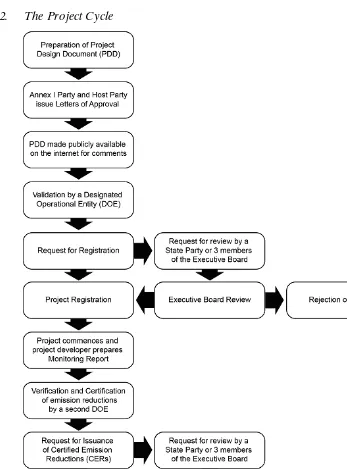
steps in the project cycle, as shown in Figure 1, are conducted by designated operational entities who decide, based on information provided by the project developer, whether or not to validate a project or certify CERs. The entity’s decision is final unless the Executive Board opts to conduct a review of the
64. Modalities and Procedures, supra note 24, ¶ 5; see also Rules and Reference, U.N. FRAMEWORK CONVENTION ON CLIMATE CHANGE, http://cdm.unfccc.int/Reference/index.html (last visited Jan. 17, 2011).
65. Modalities and Procedures, supra note 24, ¶ 18; Governance, U.N.FRAMEWORK CONVENTION ON CLIMATE CHANGE, http://cdm.unfccc.int/EB/governance.html (last visited Oct. 22, 2011).
66. Modalities and Procedures, supra note 24, ¶¶ 7–8(a).
67. Id. ¶ 8 (c).
68. Id. ¶ 8 (e)–(f).
69. Tyson Dyck, Enforcing Environmental Integrity: Emissions Auditing and the Extended Arm of the Clean Development Mechanism, 36 COLUM.J.ENVTL.L. 259, 261 (2011).
70. List of DOEs, U.N.FRAMEWORK CONVENTION ON CLIMATE CHANGE, http://cdm.unfccc.int/ DOE/list/index.html (last visited Jan. 17, 2011).
71. Modalities and Procedures, supra note 24, ¶ 20.
72. Id. ¶ 21.
project.74 However, designated operational entities face unavoidable conflicts
of interest because they contract directly with the project developer and therefore have an incentive to act in the project developer’s interest.75 It has
been suggested that the costs of conducting the verification should be included in the CDM project application fees paid to the UNFCCC Secretariat. This way, the Executive Board could contract directly with designated operational entities, who would then have the incentive to disclose as much information as possible to the Executive Board and not to act in the developer’s interest.76
74. Rolf Weber, Regulation and Financial Intermediation in the Kyoto Protocol’s Clean Development Mechanism, 22 GEO.INT’L ENVTL.L.REV.271, 277 (2010).
75. Wara, supra note 48, at 1799.
2. The Project Cycle
Figure 1: The CDM Project Cycle
methodologies to be used for data collection and monitoring.77 The project
design document must also demonstrate that the project will reduce emissions below those that would have occurred in the absence of the CDM project.78
This project eligibility requirement, called the “additionality” criterion, is designed to ensure that CDM projects create emission reductions that are “additional to” any emission reductions that would have occurred if the CDM did not exist.79 This means that the CDM operates as a subsidy by providing
additional revenue, in the form of CERs, needed to make certain emission reduction projects financially viable.80 If projects do not demonstrate
additionality to a high degree of certainty, the integrity of the CDM will be undermined because it will be issuing credits for reductions that would have been made anyway, resulting in a net global increase in emissions.81
In preparing the project design document, the project developer must invite comments from local stakeholders. The project design document must contain a summary of the comments received, and state how those comments were taken into account.82 The term “stakeholders” is defined broadly to mean
“the public, including individuals, groups or communities affected, or likely to be affected” by the proposed project.83
The project design document must also describe the environmental impacts of the project. If the project participants or the host country considers those impacts to be significant, the project developer must undertake an EIA in accordance with the host country’s procedures.84 Project developers must
obtain written approval from the Designated National Authorities of the host country and the relevant Annex I country. The host country’s letter of approval must attest to the project’s contribution to their country’s sustainable development.85
The project developer must then contract with a designated operational entity to validate the project. The entity reviews the project design document to confirm that the project is in full compliance with the CDM Modalities and Procedures and any other applicable standards or guidelines.86 The designated
operational entity must publish the project design document on the internet for thirty days in order to receive comments from state parties, stakeholders, and
77. Modalities and Procedures, supra note 24, app. B, ¶ 2(a)–(b), (h).
78. Id. ¶ 2(d).
79. Kyoto Protocol, supra note 3, art. 12(5)(c); see Michaelowa, supra note 61, at 248–49.
80. Wara, supra note 48, at 1764; Michaelowa, supra note 61, at 249; YDA SCHREUDER,THE
CORPORATE GREENHOUSE:CLIMATE CHANGE POLICY IN A GLOBALIZING WORLD 171(2009).
81. Meijer & Werksman, supra note 59, at 193.
82. Modalities and Procedures, supra note 24, ¶ 37(b).
83. Id. ¶ 1(e).
84. Id. ¶ 37(c).
85. Id. ¶ 40(a).
UNFCCC accredited NGOs.87 The designated operational entity then
determines whether, on the basis of the information provided by the project developer and taking into account the comments received, the project should be validated.88
Once the validation report is complete, the designated operational entity submits a request for registration to the Secretariat, who conducts a completeness check and publishes the request for registration on the internet.89
The Executive Board registers the project unless a state party involved in the project or at least three members of the Executive Board request a review of the project within twenty-eight days of the publication of the request for registration.90
During a review, the Review and Issuance Team and the Secretariat undertake independent technical assessments of the project and recommend either the registration or rejection of the project.91 If both assessments result in
the same recommendation, it automatically becomes the Executive Board’s final decision after twenty days.92 If the assessments result in two different
recommendations or if a member of the Executive Board disagrees with the recommendation, the Executive Board considers the project at its next meeting.93 If a project is rejected, the reasons for the decision must be
communicated to the project developer and the public.94
Once the project is underway, the project developer must prepare a monitoring report and a second designated operational entity must verify and certify the estimated emission reductions.95 This designated operational entity
determines whether the monitoring report is in accordance with the requirements of the registered project design document, and whether the methodologies for the estimation of emission reductions have been applied correctly.96 The designated operational entity then certifies in writing that the
87. Id. ¶¶ 27(h), 40(b)–(c); United Nations Framework Convention on Climate Change, Clean Development Mechanism Executive Board, Procedures for Processing and Reporting on Validation of CDM Project Activities, ¶¶ 3, 5(g), 10, 13, EB 50 Rep., Annex 48 (Oct. 16, 2009), available at http://cdm.unfccc.int/Reference/Procedures/valid_proc02.pdf.
88. Modalities and Procedures, supra note 24 ¶ 40(d).
89. United Nations Framework Convention on Climate Change, Clean Development Mechanism Executive Board, Procedure for Requests for Registration of Proposed CDM Project Activities, ¶¶ 4, 12, 16, EB 59 Rep., Annex 12 (Feb. 18, 2011), available at http://cdm.unfccc.int/UserManagement/ FileStorage/1DZKI7NAS8BV34P6F5Q0U9MJTHGYCX.
90. Id. ¶¶ 17, 19, 23–24.
91. United Nations Framework Convention on Climate Change, Clean Development Mechanism Executive Board, Procedures for Review of Requests for Registration, ¶¶ 12–15, EB 55 Rep., Annex 40 (July 30, 2010), available at http://cdm.unfccc.int/UserManagement/FileStorage/ CJTO27K6DXIUN0LHZ3A9F4P1GM8WEV.
92. Id. ¶ 20.
93. Id. ¶ 22.
94. See id. ¶ 27.
95. Modalities and Procedures, supra note 24, ¶ 60.
project has achieved the verified quantity of emission reductions.97 Both the
verification and certification reports are submitted to the Secretariat, who conducts a completeness check and publishes the request for issuance of CERs.98 The Executive Board issues the requested number of CERs, unless an
involved state party or at least three members of the Executive Board request a review of the proposed issuance within twenty-eight days of the publication of the request.99
C. The Impending CDM Appeals Process
The carbon offset industry has expressed dissatisfaction with regulatory delays in the CDM project cycle, which are said to have resulted in high transaction costs, losses in CER volumes, and low market values for CERs.100
Project developers are concerned that the Executive Board reviews almost every project and that a considerable proportion of projects submitted for registration are not registered within the official timeline.101 However, since
the CDM became operational the Executive Board has rejected only 5.3 percent of all projects requesting registration,102 and some scholars have identified a
“culture of approval” within the Executive Board.103 Despite this high rate of
approval, the Executive Board has repeatedly been accused of making arbitrary and non-transparent decisions.104 Between October 2006 and August 2007, the
Secretariat received twelve unsolicited letters from companies expressing dissatisfaction with the rejection of projects.105 Some stated that as a result of
the decisions of the Executive Board, their companies suffered losses amounting to “several million Euros,” as well as “damage to their reputation
97. Id. ¶ 63.
98. United Nations Framework Convention on Climate Change, Clean Development Mechanism Executive Board, Procedure for Requests of Issuance of CERs, ¶¶ 9–13, EB 54 Rep., Annex 35 (May 28, 2010), available at http://cdm.unfccc.int/Reference/Procedures/iss_proc09.pdf.
99. Id. ¶¶ 14, 16.
100. KARAN CAPOOR &PHILIPPE AMBROSI, WORLD BANK,STATE AND TRENDS OF THE CARBON
MARKET 2009, at 45 (May 2009), available at http://siteresources.worldbank.org/ EXTCARBONFINANCE/Resources/State_and_Trends_of_the_Carbon_Market_2009-FINALb.pdf.
101. Krey & Santen, supra note 57, at231, 242; INT’L EMISSIONS TRADING ASS’N,STATE OF THE
CDM2010:FOCUSING ON EFFICIENCY 3(2010), http://www.ieta.org/assets/Reports/ieta-the-state-of-the-cdm-2010.pdf.
102. The statistic is based on the author’s calculation of the number of rejected projects as a percentage of the total number of projects submitted for registration as of January 2011. SeeCDM Project Activities, U.N. FRAMEWORK CONVENTION ON CLIMATE CHANGE, http://cdm.unfccc.int/ Projects/index.html (last visited Jan. 17, 2011).
103. See Meijer & Werksman, supra note 59, at 205.
104. David Stanway, Spurned Chinese Developers Blast UN CO2 Rulings, REUTERS (Aug. 6, 2010
9:10 AM), http://www.reuters.com/article/idUSTRE6751BC20100806.
due to negative publicity.”106 The main concerns raised in the letters were that
the Executive Board failed to follow the review procedures specified in the CDM Modalities and Procedures, that the Executive Board violated “principles of due process,” that there was a lack of transparency in the interpretation and application of the Modalities and Procedures, and that there was inconsistency in the decisions concerning similar projects.107
These claims arise because of the unique way in which the Executive Board, a public international body, directly regulates private entities participating in the CDM. Generally, treaties only contain obligations that member states have agreed to fulfill. States then chose to implement their treaty obligations domestically by regulating the actions of private entities. The domestic laws of each country govern any disputes that arise between national administrative bodies and private entities.108
Most international review or dispute settlement proceedings, such as the International Court of Justice, can only be initiated by States.109 Recently, the
Gold Standard Foundation, a non-profit organization that operates as a premium quality certification scheme for carbon offsets, proposed an appeals procedure that will provide project developers with the option to challenge adverse decisions of the Gold Standard Foundation in the Permanent Court of International Arbitration.110 However, because the Foundation is a private
entity, proceedings would arise from the contractual relationship between the project developer and the Foundation, and would be submitted to the Permanent Court of International Arbitration pursuant to an arbitration clause.111 By contrast, all situations in which private entities wish to challenge
Executive Board decisions involve purported rights and obligations born out of the CDM Modalities and Procedures, and not rights created by private contractual agreement.112 Thus, designated operational entities cannot
challenge an Executive Board decision to suspend or withdraw accreditation, nor do project developers have recourse when the Executive Board rejects a project or declines to issue CERs. This novel arrangement also poses questions of how local stakeholders can adequately participate in the CDM’s decision-making processes and how they can challenge the registration of projects.
106. Id. ¶ 11.
107. Id. ¶ 13.
108. See IAN BROWNLIE,PRINCIPLES OF PUBLIC INTERNATIONAL LAW 31–32(7th ed. 2008).
109. Statute of the International Court of Justice art. 34, ¶ 1, June 26, 1945, 55 Stat. 1055.
110. Press Release, The Gold Standard Found., The Gold Standard Foundation Releases Proposed Appeals Procedure (July 19, 2010), http://www.cdmgoldstandard.org/fileadmin/editors/files/2_news/ press-releases/Press_Release_Appeals_Body.pdf.
111. See THE GOLD STANDARD FOUND.,DRAFT RULES FOR APPEALS ON REGISTRATION,ISSUANCE AND LABELING 28–30 (2010), http://www.cdmgoldstandard.org/fileadmin/editors/files/5_GS_legal-documents/DRAFT_GS_Rules_for_Appeals.pdf.
It is unclear whether decisions of the Executive Board are legally binding upon project developers, but this issue is largely irrelevant because only the Executive Board can register projects and issue CERs. Therefore, project developers are forced to subscribe to the Modalities and Procedures irrespective of whether they regard them as binding. In this respect, the Executive Board acts like a market regulator or an administrative authority because it makes decisions that apply the CDM Modalities and Procedures to the activities of private entities in a way that is comparable to national governments making administrative decisions that affect its citizens and private entities.113 CDM
disputes are more akin to disputes brought before domestic administrative courts or tribunals than to contractual disputes dealt with in private international arbitration. The corollary is that the more international environmental law resembles domestic administrative law, the more it should be subject to the same safeguards and principles of public accountability as domestic decision making.114
Legal scholars have argued for the creation of an independent panel to review claims by private entities against decisions of the Executive Board.115
Assistant Professor Jolene Lin and Charlotte Streck, Direcror, ClimateFocus, argue that “the rules, institutions and the very property right that is the subject of private sector transactions in international carbon markets are created by the Kyoto Protocol.”116 The Executive Board makes decisions that affect these
“rights.” Therefore, “the CDM must apply commonly accepted principles of administrative law and due process to guarantee fundamental fairness, justice and respect for property rights.”117 In other words, to the extent that the
administrative actions of the Executive Board bear a direct and significant impact on the rights of an individual, “they should be subject to a body of rules and principles that ensure that when public officials take such action it is in accordance with the rule of law.”118
However, Adjunct Professor Jacob Werksman points out that due to successful lobbying by project developers and CDM investors, the COP/MOP has responded to the perceived deficiencies of the CDM without adequate consideration of whether there is, or should be, a legal basis for project developers’ claims in the first place.119 While the commercial expectations of
project developers are undoubtedly at stake, legal scholarship advocating an appeals process has not proffered a clear legal theory as to how the relationship
113. Charlotte Streck & Jolene Lin, Making Markets Work: A Review of CDM Performance and the Need for Reform, 19 EUR.J.INT’L L. 409, 417 (2008).
114. Daniel Bodansky, The Legitimacy of International Governance: A Coming Challenge for International Environmental Law, 93 AM.J.INT’L L.596, 611 (1999).
115. See, e.g., Meijer, supra note 112, at 895; Lin & Streck, supra note 20, at 90–92; Streck & Lin, supra note 113, at 417; Millar & Wilder, supra note 20, at 44; Giesberts & Sarac, supra note 20, at 262.
116. Lin & Streck, supra note 20, at 72.
117. Id. at 72, 86.
118. Streck & Lin, supra note 113, at 411.
DM Modalities and Proc
between the Executive Board’s authority and a project developer’s commercial interest becomes one of actionable rights and duties.120 Project developers base
their complaints on a general assertion that because the Executive Board’s decisions directly affect the expectations of private entities who cannot turn to their governments to protect these expectations, a right to legal redress must exist at the international level. The origin, nature, and content of the “rights” being claimed by project developers are unclear, and the literature refers only broadly to “procedural rights,” “property rights,” and the “right to judicial review.”121
The commercial expectations of project developers are being dressed up as “rights” for rhetorical clout, but expectations and rights are far from synonymous. When a new regulatory commodity and an environmental market is established, the legal nature of the units being traded, the rights arising under the scheme, and how those rights may be enforced are defined by the instrument that creates and governs that scheme.122 Similarly, the decisions of
bodies established pursuant to a treaty and the law that governs their functions and powers, including any rights to judicial review, are determined by its constituent instrument.123 Until now, the COP/MOP has avoided the creation
of legal interests and has not bestowed rights on private entities by virtue of their participation in any of the flexible mechanisms. The Kyoto Protocol asserts that participation in the CDM is voluntary, that it is subject to the absolute authority of the COP/MOP and the Executive Board, and that CERs will only be issued subject to certain conditions being met.124 The COP/MOP
has even gone so far as to explicitly state that the Kyoto Protocol has not created or transferred any rights or entitlements to state parties, let alone private entities.125 Thus, despite their assertion of “rights,” project developers do not
possess proprietary rights to the CERs expected to accrue from a project, nor do they possess procedural rights arising from the C
edures.
Nevertheless, the COP/MOP has already bowed to the pressure of the international carbon industry lobby. In 2009, the COP/MOP requested the
120. Id.
121. Von Unger & Streck, supra note 20, at 35; Lin & Streck, supra note 20, at 86.
122. See Matthieu Wemaere, Charlotte Streck & Thiago Chagas, Legal Ownership and Nature of Kyoto Units and EU Allowances, in LEGAL ASPECTS OF CARBON TRADING:KYOTO,COPENHAGEN AND
BEYOND 35, 39 (David Freestone & Charlotte Streck eds., 2009).
123. PHILIPPE SANDS &PIERRE KLEIN,BOWETT’S LAW OF INTERNATIONAL INSTITUTIONS116, 447 (6th ed. 2009); JAN KLABBERS,AN INTRODUCTION TO INTERNATIONAL INSTITUTIONAL LAW94, 178, 206, 226 (2d ed. 2009); C.F. AMERASINGHE, PRINCIPLES OF THE INSTITUTIONAL LAW OF
INTERNATIONAL ORGANISATIONS 16, 17, 19, 20, 161–62, 195 (2d ed. 2005).
124. Kyoto Protocol, supra note 3, arts. 12(4), (5), (7), (9).
draft procedures in light of any conc
intervene, for example at the discretion of the appeal mechanism.”130
Executive Board establish procedures for considering appeals that are brought by stakeholders “directly involved, defined in a conservative manner,” in the design, approval, or implementation of CDM projects, in relation to (1) situations where a designated operational entity may not have performed its duties in accordance with the rules set by the COP/MOP, and (2) “rulings” taken by or under the authority of the Executive Board regarding the rejection of requests for registration or issuance.126 In 2010, the Executive Board agreed
on a set of draft procedures, which were put before the COP/MOP. However, the COP/MOP deferred its decision until 2011, requesting that the Subsidiary Body for Implementation provide recommendations for consideration.127 In
2011, the Subsidiary Body produced a technical paper that identified the main issues for negotiation, but the COP/MOP postponed its decision once again, pending the Executive Board’s revision of the
lusions made by the Subsidiary Body.128
According to the draft procedures, only project developers and the Designated National Authorities of the relevant Annex I investor country and non-Annex I host country would have standing to appeal the decisions of the Executive Board.129 The Subsidiary Body’s technical paper is largely silent on
the issue of standing. It merely states: “Parties may also wish to consider whether interested stakeholders, such as those who participated in the consultations at the earlier stages of the CDM process, should be given the opportunity to
126. United Nations Framework Convention on Climate Change, Report of the Conference of the Parties Serving as the Meeting of the Parties to the Kyoto Protocol on Its Fifth Session, Copenhagen, Den., Dec. 7–19, 2009, Further Guidance Relating to the Clean Development Mechanism, dec.
e Relating to the Clean Development Mechanism, ¶ 18, dec.
nism, Draft decision C
4, U.N. Doc. FCCC/KP/CMP/2010/10, Annex 2
the 2/CMP.5, ¶ 42, U.N. Doc. FCCC/KP/CMP/2009/21/Add.1 (Mar. 30, 2010), available at http://unfccc.int/resource/docs/2009/cmp5/eng/21a01.pdf.
127. United Nations Framework Convention on Climate Change, Report of the Conference of the Parties Serving as the Meeting of the Parties to the Kyoto Protocol on Its Sixth Session, Cancún, Mex., Nov. 29–Dec. 10, 2010, Further Guidanc
3/CMP.6, U.N. Doc. FCCC/KP/CMP/2010/Add.2 (Mar. 15, 2011), available at http://unfccc.int/ resource/docs/2010/cmp6/eng/12a02.pdf.
128. United Nations Framework Convention on Climate Change, Conference of the Parties Serving as the Meeting of the Parties to the Kyoto Protocol on Its Seventh Session, Durban, S. Afr., Nov. 28– Dec. 9, 2011, Further Guidance Relating to the Clean Development Mecha
-/ MP.7, ¶ 14 (advance unedited version), available at http://unfccc.int/files/meetings/durban_nov_ 2011/decisions/application/pdf/cmp7_cdmguidance.pdf (last visited Jan. 4, 2012).
129. United Nations Framework Convention on Climate Change, Annual Report of the Clean Development Mechanism Executive Board to the Conference of the Parties Serving as the Meeting of the Parties to the Kyoto Protocol on Its Sixth Session, Cancún, Mex., Nov. 29–Dec. 10, 2010, Recommendation on the Procedure for Appeals Against Rulings by the CDM Executive Board Regarding Requests for Registration or Issuance, 
(Nov. 3, 2010), available at http://unfccc.int/resource/docs/2010/cmp6/eng/10.pdf [hereinafter CDM Registration or Issuance Appeals Recommendation].
This Article submits that project developers have no higher legal or normative claim to procedural “rights” than the local stakeholders whose livelihoods and human rights are affected by projects and whose needs are invoked in support of the CDM. Indeed, since project developers’ arguments in favor of an appeals process are based on analogies to domestic legal systems,131 the COP/MOP and the Executive Board should not ignore the fact
that that those systems provide access to justice not only for private entities, but also for affected individuals, and, in some instances, NGOs.132 This feature is
considered to be an integral element of democracy and the rule of law.133
If the COP/MOP accepts the argument that the Executive Board should be held publicly accountable for its decisions, then the “public” to hold it accountable should arguably include those communities that the CDM is intended to benefit, and not just the developers and investors who voluntarily participate in the mechanism. If the commercial expectations of project developers are elevated to the status of rights by the COP/MOP, without at least granting reciprocal procedural rights to local stakeholders and NGOs, project developers and investors will have a significantly stronger position in relation to host country governments, the Executive Board, and local stakeholders. This will only further serve to undermine the CDM’s goal of contributing to sustainable development. It could also open up the CDM to strategic litigation that would undermine the integrity of the mechanism and the effectiveness of the Kyoto Protocol by compelling the approval of projects that do not represent additional emission reductions, purely on the basis of alleged procedural improprieties of the Executive Board.
D cisions of the Executive Board of the Clean Development Mechanism: Technical Paper, ¶ 132, U.N. Doc. FCCC/TP/2011/3
e
(May 17, 2011), available at http://unfccc.int/resource/docs/2011/tp/03.pdf.
tl.);
l.); Threatened Species Conservation Act 1995 (NSW) s 141F (Austl.).
131. Lin & Streck, supra note 20, at 88; Streck & Lin, supra note 113, at 410; Giesberts & Sarac, supra note 20, at 263.
132. In Australia, for example, section 487 of the Environment Protection and Biodiversity Conservation Act 1999 (Cth) extends the meaning of “aggrieved person” under the Administrative Decisions (Judicial Review) Act 1977 (Cth) to include individuals aggrieved by the decision, and organizations involved in the protection or conservation of, or research into, the environment. In the state of New South Wales, most environmental statutes contain open standing provisions allowing “any person [to] bring proceedings . . . for an order to remedy or restrain a breach” of the relevant act. This allows individuals and community action groups to commence court proceedings against government decision makers and corporations if, for example, a project is approved in contravention of the relevant statute or regulation. See, e.g., Environmental Planning and Assessment Act 1974 (NSW) s 123 (Aus National Parks and Wildlife Act 1979 (NSW) s 193 (Austl.); Protection of the Environment Operations Act 1995 (NSW) s 252 (Aust
II. THE CDM’S STRUGGLE TO CONTRIBUTE TO SUSTAINABLE
DEVELOPMENT
The international community initially thought that the CDM’s dual goals of cost-efficiency and sustainable development were not mutually exclusive.134
The widely accepted and often cited definition of sustainable development is development that “meets the needs of the present without compromising the ability of future generations to meet their own needs.”135 This definition
emphasizes the importance of equity in the economic system. This equity is intra-generational, in that it seeks to redress the imbalance in economic development between the industrialized and developing worlds by prioritizing the needs of the poor, as well as inter-generational, in that it seeks to preserve a fair allocation of natural capital for future generations.136 The concept is
comprised of three “interdependent and mutually reinforcing” pillars: economic development, social development, and environmental protection.137
Sustainable development requires that environmental protection constitute an “integral part of the development process.”138 The international community
envisaged that the CDM would contribute to intra- and inter-generational equity because an increasing supply of energy is essential for poverty eradication and socioeconomic development. By providing much needed sources of clean, rather than carbon-intensive, energy, Annex I Parties could decouple economic development from greenhouse gas emissions and thus contribute to the protection of the environment for future generations, while also increasing the standard of living in developing countries. Developing countries expected their communities to benefit from projects through employment opportunities, direct payments, access to energy, and savings from more efficient energy.139
The reality is that emissions trading, like any other commodities market, subjects third parties to external costs. The economic theory that underpins emissions trading assumes that the traded commodity is homogenous, yet in reality CERs are an extremely heterogeneous commodity. CERs represent a range of vastly different emission reduction methods, technologies, and
134. Eriika Melkas, Equitable as Equal: The Kyoto Protocol Project Based Flexibility Mechanisms .
Declaration on Sustainable Development, ¶ 5, U.N. Doc. A/CONF.199/20 (Sept. 4,
(Aug. 12, 1992), available at http://daccess-dds-ny.un.org/doc/ Element [hereinafter Rio Declaration on
ra note 4, at 144.
in an Unequal World, 9 INT’L COMMUNITY L.REV. 263, 266 (2007)
135. WORLD COMM’N ON ENV’T &DEV.,OUR COMMON FUTURE8 (1987).
136. BIRNIE,BOYLE &REDGWELL, supra note 41, at 55.
137. Report of the World Summit on Sustainable Development, Johannesburg, S. Afr., Sept. 2–4, 2002, Johannesburg
2002), available at http://daccess-dds-ny.un.org/doc/UNDOC/GEN/N02/636/93/PDF/N0263693. pdf?OpenElement.
138. United Nations Conference on Environment and Development, Rio de Janeiro, Braz., June 3– 14, 1992, Rio Declaration on Environment and Development, princ. 4, U.N. Doc. A/CONF.151/ 26/Rev.1 (Vol. I), Annex I
UNDOC/GEN/N92/836/55/PDF/N9283655.pdf?Open Environment and Development].
ernational carbon market confers external costs and bene
ontribute to rural poverty alleviation to any nota
contribution to socioeconomic development.146 Another study estimates that
geographical locations. Industrial gas abatement projects in China, solar-heat cookers in Africa, hydroelectric dams in India, wind farms in Mongolia, and forestry projects in Brazil are considered commensurate as long as they achieve a reduction in greenhouse gas emissions during the projects’ short-term crediting periods.140 With homogeneity, transfers in carbon credits increase net
benefits by allowing investment to flow to its highest valued use; without homogeneity, the int
fits on third parties.141 While flexibility in the location and method of
emission reductions may enable Annex I Parties to reduce their short-term economic costs, it creates a new series of social and environmental costs inequitably imposed upon communities and individuals who have done little to contribute to climate change but will disproportionately suffer from the effects of climate change.142
There is considerable evidence to suggest that many CDM projects have failed to contribute to sustainable development.143 Studies conducted in China
and Brazil show that, although these countries might prioritize particular types of projects, as of the end of 2009, neither country had rejected a single project on the basis that the project would not contribute to sustainable development.144 In India, despite the fact that the national sustainable
development priorities include the goal of poverty alleviation by generating additional employment, removing social disparities, and providing basic amenities, CDM projects do not c
ble extent.145 This is said to be due to the fact that “[t]he social
development objective is not at the heart of formulation of these projects,” and that the project design documents merely offer “lip service” to the expected
140. See Larry Lohmann, Regulatory Challenges for Financial and Carbon Markets, 3 CARBON & CLIMATE L.REV.161, 168 (2009).
141. Tietenberg, supra note 45, at 187.
142. Cinnamon Carlarne, Risky Business: The Ups and Downs of Mixing Economics, Security and
CI.& POL’Y 419
n Development Mechanism in Brazil
n Development Mechanism for Chinese Priorities, 18 J.ENV’T &
E 09); see also, Wara, supra note 48, at 1773.
Climate Change, 10 MELB.J.INT’L L.439, 446–47 (2009); Robert Mendelsohn, Ariel Dinar & Larry Williams, The Distributional Impact of Climate Change on Rich and Poor Countries, 11 ENV’T &DEV. ECON.159, 173–74 (2006).
143. See, e.g., Christina Voigt, Is the Clean Development Mechanism Sustainable? Some Critical Aspects, 8 SUST.DEV.L.&POL’Y 15 (2008); Emily Boyd et al., Exploring Socioeconomic Impacts of Forest Based Mitigation Projects: Lessons from Brazil and Bolivia, 10 ENVTL.S
(2007); Karen Holm Olsen & Jørgen Fenhann, Sustainable Development Benefits of Clean Development Mechanism Projects: A New Methodology for Sustainability Assessment Based on Text Analysis of the Project Design Documents Submitted for Validation, 36 ENERGY POL’Y2819 (2008).
144. Lars Friberg, Varieties of Carbon Governance: The Clea
a Success Story Challenged, 18 J.ENV’T &DEV. 395, 418 (2009); Miriam Schroeder, Varieties of Carbon Governance: Utilizing the Clea
D V. 371, 389–90 (20
145. Smita Sirohi, CDM: Is It a “Win-Win” Strategy for Rural Poverty Alleviation in India? 84 CLIMATIC CHANGE91, 91–92 (2007).