Do International
Networks and Foreign
Market Knowledge
Facilitate SME
Internationalization?
Evidence From the
Czech Republic
Martina Musteen
Deepak K. Datta
Marcus M. Butts
In this study we draw on the social network and international entrepreneurship literatures to examine the role of structural and relational embeddedness of international networks in firm internationalization. Based on a sample of 169 small- and medium-sized enterprises in the Czech Republic, we found that firms with chief executive officers who had developed strong and diverse international networks exhibited greater knowledge of foreign markets prior to internationalization. However, contrary to our expectations, no relationship was found between network density and such knowledge. In addition, our findings indicate that foreign market knowledge prior to the first international venture had a positive impact on venture performance.
Introduction
Zahra and George (2002) defined international entrepreneurship (IE) as the “the process of creatively discovering and exploiting opportunities that lie outside of a firm’s domestic markets in the pursuit of competitive advantage” (p. 260). Over the past decade, the IE literature has mushroomed with studies focusing on the antecedents and outcomes associated with IE. In particular, the literature has acknowledged the importance of networks in the internationalization of small, entrepreneurial firms (Harris & Wheeler, 2005; Oviatt & McDougall, 1994; Zahra, 2005). Networks, in this context, have been
Please send correspondence to: Martina Musteen, tel.: (619) 594-8346; e-mail: [email protected], to Deepak K. Datta at [email protected], and to Marcus M. Butts at [email protected].
P
T
E
&
1042-2587
defined as “a set of actors and some set of relationships that link them” (Hoang & Antoncic, 2003, p. 167). Conceptualizing internationalization as an opportunity driven process (Oviatt & McDougall; Sapienza, Autio, George, & Zahra, 2006; Yu, Gilbert, & Oviatt, 2011), IE studies have viewed networks as an enabler of early internationalization (Kiss & Danis, 2008). As such, networks are viewed as facilitating internationalization by helping small- and medium-sized enterprises (SMEs) identify new opportunities in foreign markets (Ellis, 2011). In addition, it has been argued that networks provide firms with easier access to the resources needed for early internationalization (Chetty & Campbell-Hunt, 2004; Lindstrand, Melén, & Nordman, 2011), mitigating the challenges related to the liabilities of foreignness, newness, and smallness faced by small, entrepre-neurial firms (Zahra). In other words, the IE perspective posits that small firms can readily accumulate knowledge needed for internationalization via networks rather than having to develop experiential knowledge over an extended period of time.
While there is some support for the notion that networks benefit SMEs in their internationalization efforts, studies investigating the relationships between specific network attributes and benefits are relatively sparse. Moreover, much of the network-related IE literature focuses on firms in developed economies. This led Yamakawa, Peng, and Deeds (2008, p. 60) to point out that, “if research on entrepreneurship and interna-tionalization is to keep up with practice, it seems imperative that at least some of our attention be devoted to these cutting-edge cross-border entrepreneurial activities moving from EE (emerging economies) to DE (developed economies).” Our study seeks to address these important gaps in the IE literature by examining knowledge-related benefits linked to the structural and relational attributes of international networks in the context of SMEs in the transition economy of the Czech Republic. SMEs have always played and still continue to play a very important role in the growth of the Czech economy. According to a recent European Commission on Industry and Enterprise (2010) report, SMEs today account for over 50% of the Czech economy, and the proportion of SMEs per 1,000 inhabitants in the Czech Republic is nearly twice the European Union average.
Our study is different in that unlike most studies, which focus on developed econo-mies, we examine the role of networks in the context of entrepreneurial firms in a transition economy setting. SMEs in transition economies face unique challenges asso-ciated with the lack of transparency, increased foreign competition in their domestic markets, and the legacy of centrally planned economic systems dominated by state-owned enterprises (Bohata & Mladek, 1999). Not surprisingly, such firms often look to interna-tional markets as a way of reducing their dependency on uncertain domestic markets. However, they also recognize that internationalization is a risky endeavor and failure might threaten their very survival (Sapienza et al., 2006). We posit that difficulties asso-ciated with internationalization are mitigated when firms have adequate knowledge of foreign markets. We also believe that such knowledge is directly related to the presence of international social networks. He (2009), for example, argues that with market failure being more common in transition economies rather than developed economies, the ben-efits of social networks are likely to be more pronounced. This view was echoed by Manev and Manolova (2010), who argue that network-based advantages are more important than ownership advantages in the context of transition economy SMEs. Thus, social networks serve as an integral source of competitive advantage (Manolova, Manev, & Gyoshev, 2010).
to the IE literature. First, we advance the extant IE research by identifying specific properties of international networks that are associated with the acquisition of foreign market knowledge. Second, we investigate the previously untested assumption that inter-national networks are repositories of foreign market knowledge that help small firms succeed in international markets (Yu et al., 2011). Finally, our study extends the current IE research in transition economies. As Manev and Manolova (2010) suggest, although there have been numerous studies on entrepreneurship in Central and East European (CEE) economies, most of them focus on issues related to the macroenvironment. Among the relatively few (primarily case-based) studies that have examined firm behavior in CEE countries, the issue of firm internationalization has been seldom addressed.
Theoretical Background and Research Hypotheses
The primary tenet in the social network literature is that firms and individuals accrue benefits from their social networks (Burt, 1992; Coleman, 1988; Nahapiet & Ghoshal, 1998), with market information exchange viewed as a function of exchange relationships among different actors. Hoang and Antoncic (2003, p. 167), in their review of the role of networks, defined a network as “a set of actors and some set of relationships that link them.” From the standpoint of relatively small and resource-constrained firms, social network relationships, which we define as both professional and personal contacts, rep-resent a particularly important and valuable resource. Indeed, the entrepreneurship litera-ture provides ample evidence of the important role that networks play in the context of young start-ups and small companies. They have been shown to be valuable both in the opportunity-recognition/venture-formation stage and in the venture-establishment/growth stage. Studies (e.g., Aldrich, Rosen, & Woodward, 1987) belonging to the latter stream of research have linked networks to performance outcomes such as survival, growth, and profitability. On the other hand, research on the relationship between networks and opportunity-recognition/venture-formation has generally viewed networks as playing a “bridging” role (i.e., connecting entrepreneurs with opportunities). For example, Ozgen and Baron’s (2007) study based on a sample of entrepreneurs at newly founded informa-tion technology firms found that network-based informainforma-tion impacts the opportunity-recognition process by influencing entrepreneurs’ cognitive schema and self-efficacy. Likewise, Xu’s (2011) recent study on new ventures in the United States found that networks influence entrepreneurs’ approach to innovation by impacting their cognitive frameworks.
Blomstermo (2003) in their study of international expansion by Swedish firms, which found that foreign market entry by firms classified as “born global” was largely based on knowledge acquired from international ties. Similarly, Yli-Renko, Autio, and Tonti (2002) found that the international contacts of sales personnel and founder-managers played a key role in the acquisition of foreign market knowledge among Finnish technology-based firms, which, in turn, led to faster internationalization.
The research on the role of international ties in early internationalization by small firms and start-ups consisted primarily of case-based studies focusing on firms in Western economies (e.g., Chandra, Styles, & Wilkinson, 2009; Chetty & Campbell-Hunt, 2004; Coviello & Munro, 1997; Harris & Wheeler, 2005; Kontinen & Ojala, 2011; Vasilchenko & Morrish, 2011). For example, Chandra et al.’s study of eight Australian SMEs sug-gested that personal and business contacts play a critical role in the discovery of oppor-tunities in international markets. Based on a case study of four small high-tech firms from New Zealand, Vasilchenko and Morrish concluded that foreign networks have a signifi-cant influence on firms’ market selection and market entry. Although these studies provide interesting insights, the case-based approach they utilize precludes them from providing more generalizable conclusions. Further, the findings of such studies lack generalizability to firms in other environments; specifically, firms in the transition economies of the CEE, or those in emerging economies.
Studies on the implications of networks conducted in the context of transition econo-mies indicate that networks are likely to be more critical to growth and survival in such contexts. Indeed, the review by Franicevic and Bartlett (2001) indicates that networking, from the standpoint of transition economy SMEs, is indispensable due to the relatively low level of trust in an environment characterized by regulatory and political uncertainties. This was borne out in the study by Batjargal (2003), which found a positive relationship between the domestic networks of Russian SMEs and firm performance. Likewise, Lianxi, Barnes, and Yuan (2010) found networking capability to be an important determinant of success in Chinese international new ventures. Networks have also been viewed as helpful to firms in overcoming “institutional voids,” situations where absent and/or weak institu-tional arrangements prevent SMEs from being able to fully benefit from market oppor-tunities (Khanna & Palepu, 1997, 2000). Institutional voids represent situations where the government fails to assume its role in creating and strengthening institutions—they represent opportunity spaces for the use of networks to address the deficiencies associated with such voids.
& Yan, 2002). Moreover, many entrepreneurs question the credibility of governmental sources and often view them with considerable suspicion (Franicevic & Bartlett, 2001; Pollard & Jemicz, 2006).
Given the aforementioned, it is likely that managers of start-ups and entrepreneurial firms in transition economies place great value on informal international market infor-mation that they gather via their international personal networks—inforinfor-mation that is unlikely to be available from official sources in their own country. In addition, networks are likely to be beneficial in the reduction of transaction costs associated with the acquisition and ascertaining of market knowledge (Uzzi & Lancaster, 2004).
Empirical research on the role of networking in the context of internationalization of firms in transition economies is relatively sparse. In one of the few studies focusing on this area, Manolova et al. (2010) observed that domestic personal networking of Bulgarian SMEs was related to a higher percentage of foreign sales. In addition, network relation-ships with foreign partners have been associated with successful internationalization in Czech and Slovenian SMEs (Fink & Kraus, 2007). However, we are not aware of any study that has attempted to relate the information and knowledge-related benefits that international networks provide to internationalization and internationalization outcomes by transition economy firms. As discussed in the following sections, we seek to address this gap in the literature by drawing on the social network theory to develop hypotheses relating the characteristics of international networks of SMEs to foreign market knowl-edge and the performance of their international ventures.
International Networks as a Source of Foreign Market Knowledge
The social network theory suggests that attributes of networks are likely to be idio-syncratic across firms, contributing to differences in market knowledge that they provide and the international opportunities that they help to identify (Ellis, 2011). We focus on the structural and relational dimensions of international networks that link the entrepreneur with individuals in other countries. We posit that while the structural embeddedness of SMEs’ networks (the overall architecture of the network) should influence their access to new knowledge, the relational embeddedness (the nature of network relationships that members develop over time) will also have a direct bearing on the motivation of network members to share relevant knowledge and information (Inkpen & Tsang, 2005; Nahapiet & Ghoshal, 1998). Thus, we expect both structural and relational embeddedness to play a key role in determining the level of knowledge that SMEs’ chief executive officers (CEOs) possess about foreign competitors, customers, and distributors, as well as the legal and cultural environment and opportunities in foreign markets. This knowledge should, in turn, motivate and facilitate internationalization efforts and positively influence interna-tionalization outcomes.
Structural Embeddedness
Discussing the importance of network density, Burt (1992) argues that structural holes offer substantial information benefits to tertius gaudens (i.e., third parties), the inter-mediaries who connect them. As a bridge between disconnected parties, they determine the flow of knowledge and information through the network. As such, third parties are generally better informed and are able to gain access to knowledge in a timelier manner than do other network members. In contrast, dense networks (i.e., those characterized by few structural holes) are more homogeneous with significant redundancy in the knowl-edge possessed by network members. Consequently, they are generally seen as being less efficient in accessing nonredundant, valuable knowledge (Burt). Support for this perspec-tive comes from the work of Koka and Prescott (2002) who found that sparse networks with structural holes were associated with greater information diversity. In addition, research by Singh, Hybels, and Hills (2000) indicates that entrepreneurs with networks characterized by more structural holes are able to generate a greater number of new venture ideas than those with dense networks. Moreover, as Soulsby and Clark (1996) observe, firms in former socialist countries often use multiple foreign contacts to glean important insights about business practices in market-based economies. Their study docu-ments cases wherein managers were able to obtain valuable market knowledge via relatively disconnected networks comprising foreign clients and suppliers, contacts made at trade shows, missions, courses and seminars abroad, and also academics and interna-tional master of business administration students.
Taken together, the arguments earlier suggest that CEOs of SMEs in the Czech Republic with low-density networks should have greater access to diverse information about foreign markets. The argument that sparse, rather than dense, networks provide informational benefits is central to the understanding of internationalization undertaken by Czech SMEs. Ties with key individuals in foreign markets who are otherwise not directly connected with each other should provide CEOs with a more complete under-standing of conditions and trends in those foreign markets including insights on local competitors, customers, and business opportunities. Additionally, such networks should prove to be invaluable in knowing about local culture, and the essentials of the political and legal environments in foreign country. Further, low-density networks have the added benefit of providing CEOs with the confidence to discuss possible opportunities in foreign markets with network partners without incurring the risk of such ideas being appropriated by competitors, which would likely occur if they circulated in a closely interconnected network (Coviello, 2006). This issue is particularly relevant from the standpoint of Czech CEOs, given the high levels of mistrust prevalent among entrepreneurs in the Czech Republic (Franicevic & Bartlett, 2001). Thus, we propose:
Hypothesis 1: There will be a negative relationship between the density of Czech SME CEOs’ international networks and the extent of foreign market knowledge at the time of internationalization.
That, in turn, should result in the Czech SME obtaining a better appreciation of the opportunities and risks associated with doing business in such markets. Knowledge of such opportunities enables CEOs at Czech SMEs to better identify new customers and expand their sales base. In other words, all else being equal, a diverse international network that taps into multiple informational domains (McEvily & Zaheer, 1999) should provide a more holistic picture of opportunities and risks associated with foreign markets. When CEOs at Czech SMEs interact with network ties in several foreign countries, they are likely to develop a broader knowledge base about international markets and existing competitive conditions.
The knowledge gathered from a diverse network should be particularly valuable in the exploitation of market imperfections in foreign countries brought about by knowledge dispersion and divergence. When knowledge is highly dispersed, there are greater oppor-tunities to profit by connecting and exploiting structural holes. Diverse networks should be particularly valuable in providing rich feedback that allows entrepreneurs to exploit arbitrage opportunities in foreign markets via an iterative process involving formal and informal feedback. In addition, diverse sources of foreign market knowledge can be expected to enhance firms’ information-searching and learning capabilities, resulting in the augmentation of their overall knowledge base (Eriksson, Johanson, Majkgard, & Sharma, 1997). In sum, we posit that network diversity will result in greater knowledge about foreign markets at the time of internationalization.
Hypothesis 2: There will be a positive relationship between the diversity of Czech SME CEOs’ international networks and the extent of foreign market knowledge at the time of internationalization.
Relational Embeddedness
Tie Strength. Relational embeddedness refers to the strength of ties based on relationship intensity (or closeness) and the frequency of social interaction between network members (Marsden, 1990). Tie strength can also encompass reciprocal obligations and emotional intensity (Granovetter, 1973). Strong ties are characterized by trust and relationships that develop over time from repeated interactions. In contrast, weak ties denote the absence of such relationships and typically entail limited emotional investments.
The role of tie strength in the context of knowledge acquisition has been extensively debated in the literature. Some scholars (e.g., Granovetter, 1973; Poppo, Zhou, & Zenger, 2008) posit that weak ties are more beneficial than strong ties because they are less costly to maintain and often bring together more diverse knowledge. However, others (e.g., Freeman, Hutchings, Lazaris, & Zyngier, 2010) emphasize the benefits of strong ties, arguing that such ties contribute to the development of trust, mutual confiding, and greater willingness to help. It has also been argued that strong ties facilitate easier coordination between network members. Extant empirical research provides support for both perspec-tives. For example, Batjargal (2003) found that the weak ties of Russian entrepreneurs positively impacted venture performance. On the other hand, Elfring and Hulsink (2007) found that entrepreneurs in the Netherlands often favored strong ties in the early phases of venture evolution. Entrepreneurs in their study believed that such ties provided access to valuable resources, and the information garnered from such ties was deemed as being more trustworthy.
emanates from close relationships and repeated social interactions motivates network members to exchange information more freely and frequently. As suggested in a study by Levin and Cross (2004), strong ties can assist in the transfer of useful information between organizations. Frequent interaction and cooperation in joint projects have also been associated with the effective transfer of tacit how (Freeman et al., 2010) and know-ledge integration (Tiwana, 2008). In addition, strong ties that result in transferred knowledge being better matched to the needs of the receiving party may be viewed as a partial substitute for absorptive capacity, or the learned ability to recognize and assimilate valuable information (Cohen & Levinthal, 1990).
The previous arguments suggest that close international ties should help Czech SMEs in two key areas. First, they should mitigate the high level of mistrust that managers in the Czech Republic (and in other CEE countries) often exhibit toward foreigners (Meyer & Skak, 2002), instilling in them greater confidence in the knowledge acquired from such ties. This is especially important given that SME CEOs in such countries often view government sources of information as being not particularly credible. Second, close international ties ought to facilitate the identification and acquisition of valuable, fine-grained knowledge on foreign market conditions, along with information on the socioeconomic, cultural, and political environments prevalent in foreign countries. Thus:
Hypothesis 3: There will be a positive relationship between the strength of Czech SME CEOs’ international ties and the extent of foreign market knowledge at the time of internationalization.
Foreign Market Knowledge and First International Venture Performance Scholars including Oviatt and McDougall (1994) and Zahra (2005) have argued that foreign market knowledge is necessary for SMEs to succeed at internationalization. As stated by Liesch and Knight (1999, p. 386), “a SME’s readiness for involvement in international markets can be interpreted as being a function of its state of informedness on targeted foreign market(s).” This is especially true in the context of SMEs from transition economies with managers who typically have very limited international experience (Pollard & Jemicz, 2006). From the standpoint of such firms, foreign market knowledge acquired via their international networks is particularly important in overcoming the liabilities of foreignness (i.e., complexities associated with competing in a new environ-ment and overcoming the perception that their products are inferior) and newness (i.e., lack of legitimacy in foreign markets) that may deter internationalization. Foreign market knowledge also enables firms in transition economies to better cope with the drawbacks of small size as they seek to access international markets, including limited availability of financial and human resources (Bohata & Mladek, 1999).
In sum, foreign market knowledge should make it easier for Czech SMEs to better anticipate and address the challenges they are likely to face in their first international venture. Such knowledge enables them to more effectively exploit the opportunities available in foreign markets, thereby resulting in enhanced performance of their first international venture.
Hypothesis 4: There will be a positive relationship between Czech SME CEOs’ foreign market knowledge at the time of internationalization and the performance of their first international venture.
Methods
Sample
Our sample was drawn from the population of Czech manufacturing SMEs listed in KOMPASS, a comprehensive database of businesses, which jointly accounts for over 95% of the Czech economy and is widely regarded as a reliable source of registered businesses (Weaver & Dickson, 1998). Most of these SMEs are in the manufacturing sector, and the most important foreign markets from the standpoint of these firms are Germany and Slovakia, followed by other European countries.
To be included in the sample, firms had to meet several criteria. First, only firms that were founded after the fall of the communist regime were considered. Second, current CEOs had to be in their positions at the time of the first international venture, defined as exporting, international licensing, international joint venture, or the establishment of a wholly owned subsidiary in a foreign country (however, over 95% of responses pertained to exporting). Third, firms had to be independently owned and operated (i.e., not be a subsidiary of another firm). Five hundred eighty-six manufacturing firms in the KOMPASS database met the earlier criteria. Consistent with prior studies on networking and knowledge acquisition (e.g., Simonin, 1997), CEOs of the SMEs served as the primary informants in our study. This was based on the assumption that they were best positioned to provide information about their firms and their first international venture. Moreover, as observed by Sasi and Arenius (2008), small firms rely predominantly on the networks of their founders/CEOs in the initial stages of internationalization.
Collecting primary data on firms in a transition economy poses multiple challenges. Pervasive mistrust of institutions and worries related to how data might be used contrib-utes to significant reluctance on the part of respondents to volunteer information on their business activities. Given this scenario, and based on the experiences of scholars involved in research pertaining to transition economies (e.g., Ellis, 2000; Makhija & Stewart, 2002), we took several steps to maximize our study’s response rate. In January 2005, an initial letter outlining our research goals and assuring respondents of complete confiden-tiality was sent to the CEOs of the 586 identified firms. Twenty letters were returned as “undeliverable,” and an additional 36 firms declined to participate by citing company policy. Further, based on the information provided by the respondents, we found that 41 firms did not meet our study criteria (e.g., they were acquired by another company, underwent reorganization, and/or had no international sales).
respondents were also provided the option of completing the survey via a secure online survey. We received a total of 187 responses, representing a 38% response rate. This response rate compares very favorably with that obtained in prior studies on networks and IE (e.g., Zahra, Neubaum, & Huse, 1997), or in studies conducted in transition economies (Fink, Harms, & Kraus, 2008). However, we had to exclude 10 firms from the sample because they had more than 250 employees (the original cutoff used to define SMEs),1and
an additional eight survey responses could not be used because of significant missing data. This resulted in a final sample of 169 firms.
To avoid any misunderstandings arising from the wording of questionnaire items or the responses, we adopted the back-translation procedure (Brislin, 1970). Researchers associated with the current study wrote the set of questions in their source language (English in our case). Two bilingual individuals were then used, with one translating from the source language to the target language (Czech) and the other blindly translating back from the target to the source language. Any inconsistencies between the two versions were reconciled. In addition, six Czech entrepreneurs pretested the questionnaire to assess its face validity. Minor modifications in wording were made based on their input.
Measures
Dependent Variables. Given the absence of a comprehensive measure of foreign market knowledge, a scale comprising 18 items was specifically developed for this study (a =.95). The items measured foreign market knowledge along six domains: foreign competitors, foreign customers, channels of distribution, foreign political/legal environ-ment, foreign culture, and business opportunities in foreign markets. The literature that relates to the six areas of foreign market knowledge and that served as a basis for the scale items is summarized in Appendix I. Respondents (CEOs of Czech SMEs) were asked to assess the level of foreign market knowledge that their firms had at the time of first international venture using a 5-point Likert-type scale (1=very low level of knowledge, 5=very high level of knowledge).
To assess the accuracy of the self-reported ratings of foreign market knowledge from primary respondents, we requested another manager in each of the responding firms to complete an abridged version of the questionnaire. The secondary respondents were identified based on the input of their CEOs, after taking into consideration the extent of their familiarity with the firm’s international activities. We received a total of 48 usable responses from secondary respondents. These were then used to compute an intraclass correlation coefficient or (ICC[1]) associated with the foreign market knowledge measure (Bliese, 2000). ICC values range from 0 to 1, with higher values signifying greater reliability. The ICC(1) value for the foreign market knowledge measure was 0.611. Based on available standards (e.g., Bliese), these values can be considered large and indicative of high agreement across respondents.
First international venture performancewas defined as the firms’ performance in its first effort at internationalization. Such internationalization can be in the form of export, a joint venture, wholly owned foreign subsidiary, or a licensing arrangement in a foreign
country. It was measured with a 3-item scale using a 5-point Likert-type scale (1=very dissatisfied, 5=very satisfied) that allowed respondents to indicate how satisfied they were with the performance of the venture in terms of (1) the realization of goals and objectives, (2) profits, and (3) sales (a =.81). Although perceptual measures may be subject to personal bias, previous research (e.g., Wall et al., 2004) has shown that they are highly correlated with objective measures and constitute good substitutes when reliable objective data are not available. Further, our discussions with entrepreneurs involved in the pretesting of our questionnaire revealed that managers at Czech SMEs would be very reluctant to provide objective performance data (given prevailing mistrust). Thus, while we would have preferred otherwise, we were forced to rely on self-reported performance measures.
Network Variables. In creating our network measures, we followed the approach used in prior research (Batjargal, 2010; Burt, 1984; Levin & Cross, 2004; McEvily & Zaheer, 1999) by using a name generator to assess individuals’ networks. A name generator prompts respondents to provide names of 3–5 individuals, who are then used for further analyses. The name generator is a valid instrument that has been used extensively to assess entrepreneurs’ networks (Klyver & Hindle, 2010). Following the procedures adopted by McEvily and Zaheer, we asked respondents to provide the initials of up to five interna-tional contacts who were particularly helpful in making the firm’s first internainterna-tional venture possible. The name generator included questions related to the contact’s charac-teristics, such as their country of origin, the frequency of interactions between each contact and the respondent, and the presence of connections among network members. Consistent with past research (Marsden, 1990),network densitywas computed as the ratio of the ties among a CEO’s contacts to the number of potential ties among the contacts. Following Koka and Prescott (2002),network diversityof international ties was measured as the number of distinct countries associated with international contacts. Given severe skewness of this variable, it was transformed by applying a square root logarithm. Finally, following Aldrich et al. (1987) and Levin and Cross, we operationalizedtie strengthas the average frequency of interaction (per month) between the respondent and his/her inter-national contact. The natural logarithm to the tie strength measure was used to correct for data skewness.
Control Variables. Our study incorporated several controls based on prior research. First, we controlled for firm age and size (Autio, Sapienza, & Almeida, 2000).Firm ageat the time of internationalization was computed as the number of years between the founding of the firm and the first international venture. Firm sales at entry(a proxy for firm size) were assessed as the logarithm of total sales in the year when the first international venture was undertaken. We also controlled for the foreign experience of CEOs, with such experience being assessed as the total years spent working or living abroad. Furthermore, we controlled for CEOs’ knowledge of foreign languages, measured as the number of foreign languages spoken. Fluency in foreign languages can be helpful in the acquisition of foreign market knowledge, which, in turn, can result in better performance. Our study also controlled for thecultural distancebetween the Czech Republic and the host country in which the first international venture took place. It has been argued that cultural distance enhances the liability of foreignness faced by new entrants in foreign markets (Kogut & Singh, 1988). Cultural distance was operationalized using Hofstede’s (1980) measure and computed using the procedure outlined by Kogut and Singh.
category in the KOMPASS database. We also controlled for firmtechnological sophisti-cation using the 3-item scale developed by Zahra et al. (1997). Using a 5-point Likert scale (1=very little, 5=very much), the measure assesses the extent to which the firm emphasized the following: (1) being the first company to introduce new technology to the market, (2) investing heavily in product-related research and development activities, and (3) investing heavily in proprietary, breakthrough technologies (a =.76).
Analyses and Results
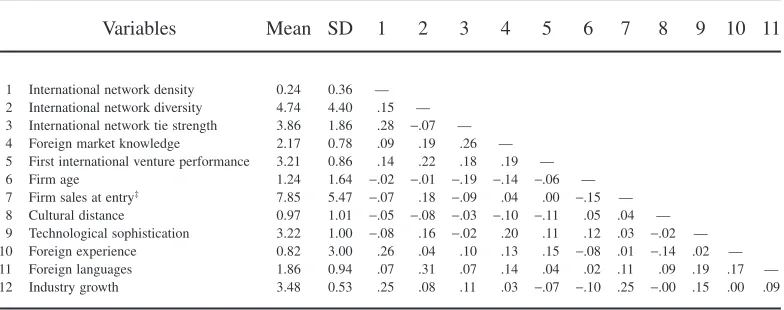
Table 1 reports the means, standard deviations, and zero-order correlations among study variables. The mean age of firms at the time of first foreign market entry was 1.24 years, indicating that many of the firms sought to internationalize their operations soon after their founding. Sample firms were also relatively small with average total firm sales of CZK 7.85 million at the time of first international entry. CEOs reported having, on average, ties in slightly fewer than four countries at the time of internationalization. Germany was reported most commonly (40% of cases) as the first country entered by the SMEs in our study. It was followed by Slovakia and Austria. Slovakia is culturally, linguistically, and historically the closest country to the Czech Republic. However, our data suggest that Czech companies preferred Germany, perhaps because its large and developed economy offered greater business opportunities. The large number of Czech immigrants in Germany might also have been an important factor in Czech SMEs’ preference for Germany.
To ensure that foreign market knowledge reflects the dimensionality suggested by the literature (Appendix I), we followed the recommendations of Doll, Xia, and Torkzadeh (1994) and Edwards (2001), and used confirmatory factor analysis (CFA) to examine the factor structure of the items. CFA can be used to determine the construct validity of a
Table 1
Descriptive Statistics and Correlations†
Variables Mean SD 1 2 3 4 5 6 7 8 9 10 11
1 International network density 0.24 0.36 — 2 International network diversity 4.74 4.40 .15 — 3 International network tie strength 3.86 1.86 .28 -.07 — 4 Foreign market knowledge 2.17 0.78 .09 .19 .26 — 5 First international venture performance 3.21 0.86 .14 .22 .18 .19 — 6 Firm age 1.24 1.64 -.02 -.01 -.19 -.14 -.06 — 7 Firm sales at entry‡ 7.85 5.47 -.07 .18 -.09 .04 .00 -.15 —
8 Cultural distance 0.97 1.01 -.05 -.08 -.03 -.10 -.11 .05 .04 — 9 Technological sophistication 3.22 1.00 -.08 .16 -.02 .20 .11 .12 .03 -.02 — 10 Foreign experience 0.82 3.00 .26 .04 .10 .13 .15 -.08 .01 -.14 .02 — 11 Foreign languages 1.86 0.94 .07 .31 .07 .14 .04 .02 .11 .09 .19 .17 — 12 Industry growth 3.48 0.53 .25 .08 .11 .03 -.07 -.10 .25 -.00 .15 .00 .09
†n=169. Mean and standard deviation values relate to variables prior to transformations. Correlations with values of .14 or greater are significant atpⱕ.05.
‡Millions of Czech crowns (CZK).
measure by linking observed variables to their underlying constructs (Floyd & Widaman, 1995). Our six-factora prioriCFA model fit the data well. Although thec2was significant, c2
(120)=226.00 (p<.01), the comparative fit index (CFI) at 0.99 and nonnormed fit index
(NNFI) at 0.98 were higher than the suggested 0.95 cutoff value (Hu & Bentler, 1999). The attained standardized root mean square residual (SRMR) of 0.04 also reflected excellent fit, being lower than the recommended value of 0.08 (Hu & Bentler). Moreover, all t-values associated with the items were significant, and standardized factor loadings ranged from 0.60 to 0.92.
Next, we compared thea priori six-factor model with sequentially more restrictive models ranging from five factors (c2
(125)=252.10) to one factor (c2(135)=552.14). Each of
these nested model comparisons resulted in a significant Dc2, demonstrating that the a
priorisix-factor model fit the data significantly better than did any of the alternative factor structures. This provides strong evidence of construct validity and testifies to the appro-priateness of the six-dimensional measure. As such, all subsequent analyses were con-ducted by specifying foreign market knowledge as a second-order construct comprising six first-order factors.
To investigate the convergent and discriminant validity of our constructs as well as any potential biasing effects due to common method variance, we conducted a series of CFAs using all multi-item measures (foreign market knowledge, first international venture performance, and technological sophistication). First, we tested a measurement model where all items were specified to load on theira prioriconstructs. This model fit the data well. Although thec2was significant,c2
(243)=410.24 (p<.01), the CFI and NNFI were high
(CFI=0.98, NNFI=0.98), and the model SRMR of 0.06 was lower than the recommended cutoff value of 0.08 (Hu & Bentler, 1999). In addition, allt-values associated with the items were significant. Also, all standardized factor loadings were high, ranging from 0.61 to 0.92 (see Appendix II). Second, to assess convergent and discriminant validity for the constructs in our measurement model, we followed procedures by Fornell and Larcker (1981). We computed the average variance explained (AVE) for each construct (foreign market knowledge, technological sophistication, and first international venture performance), where AVE is the variance in indicator items explained by a construct as a proportion of variance captured plus variance attributable to measurement error for that construct. Convergent validity is tenable when AVE values are above 0.50 (Fornell & Larcker). For each of the three constructs, the AVE was above 0.50 (foreign market knowledge=0.68, first international venture performance=0.61, technological sophistication=0.53), indi-cating acceptable convergent validity. To demonstrate discriminant validity, the AVE for each construct must exceed the shared variance in the constructs (i.e., the latent variable intercorrelations). If this condition is met, it provides evidence that the variance shared between any two constructs is less than the AVE by the items that compose each scale. For each construct, the AVE was greater than the correlations between the constructs, thereby satisfying the requirements for discriminant validity (Fornell & Larcker). To address concerns about possible common method bias, a factor CFA (i.e., Harmon’s single-factor test using CFA) was performed as an initial diagnostic to determine if common method variance is a major problem in our data (Podsakoff, MacKenzie, Lee, & Podsakoff, 2003). The single-factor model showed questionable fit with the data (c2
(252)=986.35;
p<.01; CFI=0.90; NNFI=0.89; SRMR=0.10). These results provide initial evidence that common method bias is not a major concern. Next, common method variance was examined using the “single unmeasured latent method factor” CFA approach recommended by the decision tree on ways to deal with method bias provided by Podsakoff et al. Although the model including latent measurement factors and a method factor fit the data better than the measurement model alone (Dc2
of variance attributed to the measurement factors was substantially higher than the average proportion of variance attributed to the method factor (66% vs. 5%, respectively). This provides further evidence that substantive relationships, and not common method bias, are responsible for our observed findings.
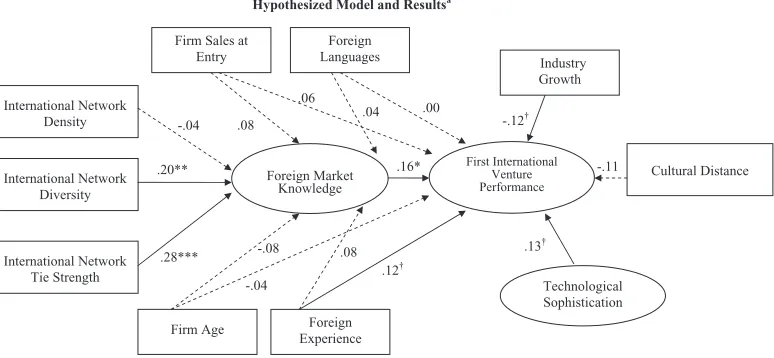
We used structural equation modeling (SEM) to test hypothesized relationships because this procedure allows for the simultaneous evaluation of complex interrelation-ships among several variables and latent constructs such as those proposed in this study. In our study, we hypothesized that network characteristics will affect foreign market knowledge, which, in turn, affects the performance of the first international venture for Czech SMEs. The obtained standardized parameter coefficients from our proposed SEM model are presented in Figure 1.
In addition to our hypothesized model, we also tested a structural model that included possible effects due to nonresponse bias as operationalized by inverse Mills ratio values derived from Heckman’s (1976) correction procedure. This procedure consists of creating two equations: (1) the selection equation and (2) the observation equation specified as:
z* unobserved( )= ′ +γ w u N∼(0 1, ) (1)
where y is observed if and only if z=1. The variance ofuis normalized to 1 because only z, not z*, is observed. The error terms,uande, are assumed to be bivariate, normally distributed with correlation coefficient,r, andgandbare the parameter vectors. To develop the selection model (i.e., model of factors associated with survey nonresponse for the intended population), we created a variable “response,” which took on the value “1” for respondents and “0” for nonrespondents. Firm invested capital and the number of employees were included in the selection model as two known predictors in the selection model. The residuals obtained from the selection model were then used to derive the IMR. The IMR variable was then inserted into our SEM model, along with the control and independent variables.
Neither of the parameter coefficients from IMR to foreign market knowledge nor first international venture performance were significant (p>.10), and all other parameter coefficients derived from the model were very similar to the coefficients derived from the model without IMR. This indicates that nonresponse selection bias was not a problem in our study. For simplicity, we only provide the model results without the effects for IMR.
Our hypothesized model demonstrated good fit (CFI=0.97; NNFI=0.97;
SRMR=0.06). In addition, at 1.55, the ratio ofc2to the degrees of freedom was far less
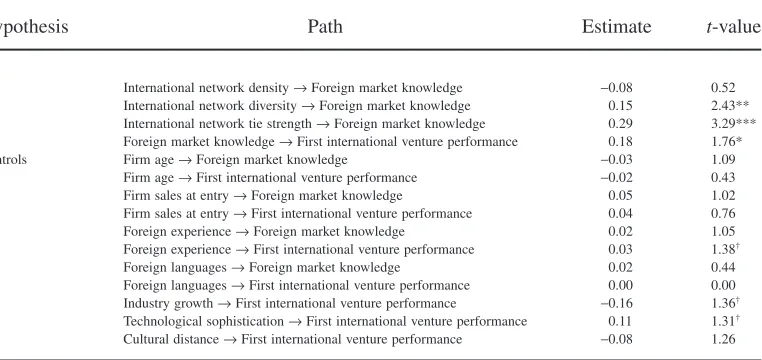
than 3, indicating an acceptable level of model fit (Carmines & McIver, 1981). Table 2 summarizes the unstandardized path coefficients for the structural model and the corre-spondingt-values for the hypothesized relationships. The table also provides the effects of control variables used in the proposed model.
Our results indicate that the relationship between international network density and foreign market knowledge is, as expected, negative. However, the relationship is not statistically significant. Thus, interconnectedness among the international ties of Czech CEOs does not appear to influence foreign market knowledge accumulated prior to the
Table 2
Unstandardized Parameter Estimates and Goodness-of-Fit Indexes From the Hypothesized Model‡
Hypothesis Path Estimate t-value
H1 International network density→Foreign market knowledge -0.08 0.52 H2 International network diversity→Foreign market knowledge 0.15 2.43** H3 International network tie strength→Foreign market knowledge 0.29 3.29*** H4 Foreign market knowledge→First international venture performance 0.18 1.76* Controls Firm age→Foreign market knowledge -0.03 1.09
Firm age→First international venture performance -0.02 0.43 Firm sales at entry→Foreign market knowledge 0.05 1.02 Firm sales at entry→First international venture performance 0.04 0.76 Foreign experience→Foreign market knowledge 0.02 1.05 Foreign experience→First international venture performance 0.03 1.38†
Foreign languages→Foreign market knowledge 0.02 0.44 Foreign languages→First international venture performance 0.00 0.00 Industry growth→First international venture performance -0.16 1.36†
Technological sophistication→First international venture performance 0.11 1.31†
Cultural distance→First international venture performance -0.08 1.26
†p<.10, *p<.05, **p<.01, ***p<.001
‡n=169;c2
(438)=677.30 (p<.01); NNFI=0.97; CFI=0.97; SRMR=.06.
first international entry. However, as hypothesized, international network diversity and tie strength were both positively associated with foreign market knowledge (b =0.20; p<.01; and b =0.28; p<.001, respectively). These results provide support for hypoth-eses 2 and 3, and suggest that Czech CEOs with diverse foreign contacts are able to garner more foreign market knowledge. This is also true with regard to strong ties between CEOs and their international contacts. We also found support for the prediction that foreign market knowledge results in superior first international venture performance (b =0.16; p<.05). Given that we hypothesized that network characteristics will lead to foreign market knowledge and that, in turn, will affect first international venture performance, we assessed the total indirect effect of network variables on first international venture per-formance through foreign market knowledge. The indirect effect was positive and signifi-cant for international network diversity. The indirect effect of the international network tie strength on first international venture performance through foreign market knowledge was also positive and statistically significant. However, the indirect effect of international network density was negative and not statistically significant.
In order to provide a more rigorous test of the hypothesized relationships, we had incorporated several control variables in our research model. Our results in the context of these control variables provide some interesting insights. As expected, we found a positive relationship between CEOs’ foreign experience and the first international venture perfor-mance, and a negative relationship between the cultural distance associated with the first international venture and the performance of that venture. However, industry growth in their home country had a negative impact on the performance of their first international venture. While somewhat unexpected, this result is not completely surprising. We attribute it to the fact that in rapidly growing (and, perhaps, more attractive) industries, firms are more preoccupied with servicing the needs of their domestic markets. In the process, they might neglect their international venture and devote fewer scarce resources, including executive time, than would be required to make them succeed. This is an interesting issue that needs further investigation in future research.
Discussion
larger stock of foreign market knowledge at the time of their first international venture. The relationship between network diversity and the level of foreign market knowledge in our study is consistent with social network theory arguments that network diversity impacts both the quality and quantity of information benefits that accrue to network members (Burt, 1992). Our findings indicate that networks with diverse ties map a broader set of informational domains and provide less redundant knowledge. These findings extend the work of Koka and Prescott (2002) to the international arena by providing direct evidence of the informational benefits associated with internationally diverse networks in the context of firm internationalization.
Second, our findings reveal that when CEOs in our sample firms interacted frequently with their international contacts, their foreign market knowledge is significantly enhanced. Such interactions are also likely to contribute to the development of a higher level of trust between involved individuals, resulting in network ties being more willing to share valuable foreign market information. These findings are consistent with the litera-ture on knowledge transfer (e.g., Argote, McEvily, & Reagans, 2003) that associates interaction frequency with transfer effectiveness.
Based on the social capital literature, we expected sparse networks with few intercon-nections (i.e., more structural holes) to be more efficient in returning nonredundant and valuable knowledge to network members. Our findings, however, failed to provide empirical support. Two possible explanations exist for this unexpected finding. First, the information benefits associated with structural holes may be offset by the lack of trust and undefined norms of behavior in sparse networks. Coleman (1988), for example, suggests that high rather than low network density may be more beneficial to network members because of greater trust and member interaction based on established norms. Second, as Greve (1995) notes, the hypothesized benefits of low-density networks in the form of nonredundant and unique knowledge may be more applicable to older and more established firms.
Our study also highlights the performance benefits associated with the existence of knowledge related to foreign markets from the standpoint of SMEs in transition economies. We observed that firms that had a substantial stock of foreign market knowledge were more likely to be successful in their international ventures. It appears that as firms acquire foreign market knowledge, they are able to better position and strategically market their products in that arena. Moreover, greater knowledge at the time of foreign market entry is likely to translate into firms having more capacity to absorb additional knowledge, thereby enhanc-ing the experiential learnenhanc-ing that is critical for success in international markets.
Study Contributions
Our study’s contributions to the literature are both theoretical and methodological. While there have been some IE studies on the role of networks in the internationalization process, they do not examine the link between the attributes of SME international net-works and specific benefits associated with internationalization. Moreover, most studies on this topic are case based and therefore have limited generalizability. In addition, they do not directly address whether international networks help facilitate the acquisition of foreign market knowledge and whether such knowledge can substitute for experiential knowledge obtained through actual presence in foreign markets. Our study represents a first step toward filling this important gap in the literature.
the role of networks in the internationalization process of such firms has been rather sparse. As such, our study has implications for future research in this area. For example, future studies might examine issues related to the use of international networks in the acquisition of other types of knowledge (e.g., product and technological know-how). In addition, they may explore the role of foreign market knowledge in facilitating interna-tional diversification among such firms as well as their choice of entry mode in accessing international markets.
From a methodological standpoint, an important contribution of our study relates to the development of a scale to assess foreign market knowledge. Future research exploring the role of knowledge in the context of entrepreneurial firms stands to benefit from this instrument. For example, it may be important to gauge how foreign market knowledge evolves over time and whether the role and importance of networks is contingent on the transition stage of the economy. Further, studies can explore whether networks are more relevant in the acquisition of knowledge in more developed and industrialized transition economies (e.g., Czech Republic and Hungary) rather than in less-developed ones (e.g., Mongolia and Albania). In addition, our foreign market knowledge measure may be useful in assessing the effectiveness of government agencies and other sources in providing relevant information to small firms that helps them access foreign markets.
Although they have important implications, our findings should be interpreted in the context of study limitations. For instance, our study is based on a sample comprised only of Czech manufacturing SMEs. Though we are confident that the findings are generaliz-able to other transition economies, additional research needs to be undertaken in other environments (e.g., developing countries and emerging markets) to assess whether our study findings also hold true in other settings. In addition, since we only considered SMEs that had internationalized, the same relationships may not exist among larger firms and firms that focus solely on domestic markets. Another limitation relates to the fact that our study relied primarily on self-report data. As Sedaitis (1997) observes, given the incidence of underreporting of profits for tax purposes, and the strong cultural bias against providing earnings and profitability information to outsiders, respondents may refuse to offer such data or intentionally misreport them. This can introduce biases such as social desirability and nonrandom missingness. While we sought to minimize these biases by collecting responses from a secondary respondent, potential biases should be taken into account when interpreting the findings of our study. Finally, as with most survey-based studies, our results may be impacted by survival bias because it was logistically impossible to collect data on companies that were no longer in business.
Conclusion
In summary, our research contributes to the IE literature by developing and empiri-cally testing a model of SME internationalization in transition economies. In doing so, we focused on understanding the relationships between characteristics of international networks, the acquisition of foreign market knowledge by SMEs, and the resulting performance outcomes.
However, internationalization itself entails considerable risks (Sapienza et al., 2006) and challenges that are daunting to most managers, particularly those who have limited knowledge of foreign markets and do not possess the experience of conducting business in such markets. Given this likelihood, and recognizing the importance of foreign market knowledge in international diversification, governmental investments in institutions that collect and disseminate key information on foreign markets should have important payoffs for their economies. Our findings also suggest that such countries would benefit from investments in programs and activities that help SMEs develop international networks and ties that contribute to successful internationalization. Such investments can take the form of trade fairs, symposiums, or exhibitions that facilitate both access to and increased interactions between SMEs and potential foreign partners.
In conclusion, there has been very little emphasis on the role of networks in extant empirical research pertaining to internationalization of SMEs from transition and emerg-ing economies (Manev & Manolova, 2010). This study fills this void in the literature by demonstrating that SMEs in transition economies benefit significantly from diverse and strong network ties via increased knowledge of foreign markets and improved perfor-mance in such markets. We hope this study provides a springboard for further research aimed at understanding the complex relationships that exist between networks, firm strategy, and associated outcomes in the context of entrepreneurial firms.
Appendix I
Foreign Market Knowledge Theoretical Base and Scale Items
Scale dimension Theoretical base Measure items
Knowledge about foreign competitors
Blomstermo, Eriksson, and Sharma (2004); Eriksson et al. (1997); Lindstrand et al. (2011); Morgan, Zou, Vorhies, and Katsikeas (2003); Zhou (2007)
1. Competitors in foreign markets 2. Level of competition in foreign markets 3. Competitive strategies employed by firms in
foreign markets Knowledge about
foreign culture
Chetty and Blankenburg Holm (2000); Lindstrand et al. (2011); Morgan et al. (2003); Petersen, Pedersen, and Lyles (2008); Zhou (2007)
1. Values and norms in foreign markets 2. Differences in the business practices in foreign
markets
3. Impact of cultural differences on business Knowledge about
foreign political/legal environment
Hadjikhani and Ghauri (2001); Lindstrand et al. (2011); Lord and Ranft (2000); Zhou (2007)
1. Differences in the legal systems in foreign markets 2. Risks associated with doing business in foreign
markets
3. Foreign government rules and regulations Knowledge about
foreign customers
Chetty and Campbell-Hunt (2004); Eriksson and Chetty (2003), Eriksson et al. (1997); Lamb and Liesch (2002); Lindstrand et al. (2011); O’Gorman and Evers (2011); Zhou (2007)
1. Customer demographics and segments in foreign markets
2. Foreign customer needs and preferences 3. Trends in customer needs and preferences in
foreign markets
4. Existence of unmet customer needs in foreign markets
Knowledge about business opportunities in foreign markets
Burgel and Murray (2000); Chetty and Blankenburg Holm (2000); Chetty and Campbell-Hunt (2004); Hadjikhani and Ghauri (2001); Harris and Wheeler (2005); Lamb and Liesch (2002); O’Gorman and Evers (2011)
1. Opportunities for partnering in foreign markets 2. Opportunities for potential new customers
Knowledge about foreign channels of distribution
Burgel and Murray (2000); Chetty and Campbell-Hunt (2004); Harris and Wheeler (2005); Morgan et al. (2003)
1. Types/quality of available distribution channels in foreign markets
2. Appropriateness of existing foreign distribution channels to your firm
Appendix II
Confirmatory Factor Analysis (CFA) Factor Loadings and Reliabilities of Multi-Item Study Variables
Scale dimension/items Factor loading† Reliability
Foreign market knowledge 0.95
Foreign competitors 0.76 0.83
Competitors in foreign markets 0.73 Level of competition in foreign markets 0.83 Competitive strategies employed by firms in foreign markets 0.81
Foreign culture 0.85 0.76
Values and norms in foreign markets 0.61 Differences in the business practices in foreign markets 0.81 Impact of cultural differences on business 0.72
Foreign political/legal environment 0.83 0.89 Differences in the legal systems in foreign markets 0.82
Risks associated with doing business in foreign markets 0.91 Foreign government rules and regulations 0.86
Foreign customers 0.94 0.88
Customer demographics and segments in foreign markets 0.72 Foreign customer needs and preferences 0.86 Trends in customer needs and preferences in foreign markets 0.86 Existence of unmet customer needs in foreign markets 0.82
Foreign business opportunities 0.91 0.82 Opportunities for partnering in foreign markets 0.85
Opportunities for potential new customers 0.81
Channels of distribution 0.92 0.93
Types/quality of available distribution channels in foreign markets 0.88 Appropriateness of existing foreign distribution channels to your firm 0.92 Quality of existing distribution channels abroad 0.91
Technological sophistication 0.76
Being the first company to introduce new technology to the market 0.72 Investing heavily in product-related R&D activities 0.76 Investing heavily in proprietary, breakthrough technologies 0.68
First international venture performance 0.81 Achievement of venture goals and objectives 0.69
Profits generated from the venture 0.77 Revenues generated by the international venture 0.88
†Standardized factor loadings are reported. Second-order factor loadings are given in bold. All loadings are statistically
significant (p<.01).
REFERENCES
Aldrich, H., Rosen, B., & Woodward, W. (1987). The impact of social networks on business foundings and profit.Frontiers of Entrepreneurship Research,7, 154–168.
Argote, L., McEvily, B., & Reagans, R. (2003). Managing knowledge in organizations: An integrative framework and review of emerging themes.Management Science,49, 571–582.
Autio, E., Sapienza, H.J., & Almeida, J.G. (2000). Effects of age at entry, knowledge intensity, and imitability on international growth.Academy of Management Journal,43, 909–924.
Batjargal, B. (2010). Network dynamics and new ventures in China: A longitudinal study.Entrepreneurship and Regional Development,22(2), 139–153.
Beckman, C.M. & Haunschild, P.R. (2002). Network learning: The effects of partners’ heterogeneity of experience on corporate acquisitions.Administrative Science Quarterly,47, 92–124.
Bliese, P.D. (2000). Within-group agreement, non-independence, and reliability: Implications for data aggre-gation and analysis. In K.J. Klein & S.W.J. Kozlowski (Eds.),Multilevel theory, research, and methods in organizations(pp. 349–381). San Francisco, CA: Jossey-Bass.
Blomstermo, A., Eriksson, K., & Sharma, D.D. (2004). Domestic activity and knowledge development in the internationalization process of firms.Journal of International Entrepreneurship,2, 239–258.
Bohata, M. & Mladek, J. (1999). The development of the Czech SME sector.Journal of Business Venturing, 14(5/6), 461–474.
Brislin, R.W. (1970). Back-translation for cross-cultural research.Journal of Cross-Cultural Psychology,1, 185–216.
Burgel, O. & Murray, G.C. (2000). The international market entry choices of start-up companies in high-technology industries.Journal of International Marketing,8(2), 33–62.
Burt, R.S. (1984). Network items and the General Social Survey.Social Networks,6, 239–339.
Burt, R.S. (1992). The social structure of competition. In N. Nohria & R.G. Eccles (Eds.),Networks and organizations(pp. 57–91). Boston, MA: Harvard Business School Press.
Carmines, E. & McIver, J. (1981). Analyzing models with unobserved variables: Analysis of covariance structures. In G. Bohrnstedt & E. Borgatta (Eds.),Social measurement: Current issues(pp. 65–115). Beverly Hills, CA: Sage.
Chandra, Y., Styles, C., & Wilkinson, I. (2009). The recognition of first time international entrepreneurial opportunities: Evidence from firms in knowledge-based industries.International Marketing Review,26(1), 30–61.
Chetty, S. & Blankenburg Holm, D. (2000). Internationalization of small to medium-sized manufacturing firms: A network approach.International Business Review,9, 77–93.
Chetty, S. & Campbell-Hunt, C. (2004). A strategic approach to internationalization: A traditional versus a “born-global” approach.Journal of International Marketing,12, 57–81.
Cieslik, J. & Kaciak, E. (2009). The speed of internationalization of entrepreneurial start-ups in a transition environment.Journal of Developmental Entrepreneurship,14(4), 375–392.
Cohen, W.M. & Levinthal, D.A. (1990). Absorptive capacity: A new perspective on learning and innovation. Administrative Science Quarterly,35, 128–152.
Coleman, J.S. (1988). Social capital in the creation of human capital.American Journal of Sociology,94, 95–120.
Coviello, N.E. (2006). The network dynamics of international new ventures.Journal of International Business Studies,37, 713–731.
Coviello, N.E. & Munro, H. (1997). Network relationships and the internationalization process of small software firms.International Business Review,6, 361–386.
Doll, W.J., Xia, W., & Torkzadeh, G. (1994). A confirmatory factor analysis of the end-user computing satisfaction instrument.MIS Quarterly,18, 453–461.
Edwards, J.R. (2001). Multidimensional constructs in organizational behavior research: An integrative analytical framework.Organizational Research Methods,4, 144–192.
Elfring, T. & Hulsink, W. (2007). Networking by entrepreneurs: Patterns of tie-formation in emerging organizations.Organization Studies,28(12), 1849–1872.
Ellis, P. (2000). Social ties and foreign market entry.Journal of International Business Studies,31, 443–469.
Ellis, P. & Pecotich, A. (2001). Social factors influencing export initiation in small and medium-sized enterprises.Journal of Marketing,38, 119–130.
Ellis, P.D. (2011). Social ties and international entrepreneurship: Opportunities and constraints affecting firm internationalization.Journal of International Business Studies,42(1), 99–127.
Eriksson, K. & Chetty, S. (2003). The effect of experience and absorptive capacity on foreign market knowledge.International Business Review,12(6), 673–696.
Eriksson, K., Johanson, J., Majkgard, A., & Sharma, D.D. (1997). Experiential knowledge and cost in the internationalization process.Journal of International Business Studies,28, 337–360.
European Commission on Industry and Enterprise. (2003). Small and medium-sized enterprises (SMEs). Available at http://ec.europa.eu/enterprise/policies/sme/facts-figures-analysis/sme-definition/index_en.htm, accessed 14 November 2011.
European Commission on Industry and Enterprise. (2010). Internationalisation of European SMEs. Available at http://ec.europa.eu/enterprise/policies/sme/market-access/files/internationalisation_of_european_smes_ final_en.pdf, accessed 14 November 2011.
Fink, M., Harms, R., & Kraus, S. (2008). Cooperative internationalization of SMEs: Self-commitment as a success factor for international entrepreneurship.European Management Journal,26(6), 429–440.
Fink, M. & Kraus, S. (2007). Mutual trust as a key to internationalization of SMEs.Management Research News,30(9), 674–688.
Floyd, F.J. & Widaman, K.F. (1995). Factor analysis in the development and refinement of clinical assessment instruments.Psychological Assessment,7, 286–299.
Fornell, C. & Larcker, D.F. (1981). Evaluating structural equation models with unobservable variables and measurement error.Journal of Marketing Research,18, 39–50.
Franicevic, V. & Bartlett, W. (2001). Small firm networking and economies in transition: An overview of theories, issues and policies.Zagreb International Review of Economics and Business,4(1), 63–89.
Freeman, S., Hutchings, K., Lazaris, M., & Zyngier, S. (2010). A model of rapid knowledge development: The smaller born-global firm.International Business Review,19(1), 70–84.
Granovetter, M. (1973). The strength of weak ties.American Journal of Sociology,78, 1360–1380.
Greve, A. (1995). Networks and entrepreneurship—An analysis of social relations, occupational background and use of contacts during the establishment process.Scandinavian Journal of Management,11, 1–24.
Hadjikhani, A. & Ghauri, P.N. (2001). The behaviour of international firms in socio-political environments in the European Union.Journal of Business Research,52(3), 263–275.
He, X. (2009). The development of entrepreneurship and private enterprise in the People’s Republic of China and its relevance to transitional economies.Journal of Developmental Entrepreneurship,14(1), 39–58.
Heckman, J. (1976). The common structure of statistical models of truncation, sample selection and limited dependent variables and a simple estimator of such models.Annals of Economic and Social Measurement,5, 475–492.
Hoang, H. & Antoncic, B. (2003). Network-based research in entrepreneurship: A critical review.Journal of Business Venturing,18(2), 165–188.
Hofstede, G. (1980).Culture’s consequences. Beverly Hills, CA: Sage.
Hu, L.-T. & Bentler, P.M. (1999). Cutoff criteria for fit indices in covariance structure analysis: Conventional criteria versus new alternatives.Structural Equation Modeling,6, 1–55.
Inkpen, A.C. & Tsang, E.W.K. (2005). Social capital, networks, and knowledge transfer. Academy of Management Review,30, 146–165.
Johanson, J. & Vahlne, J. (2006). Commitment and opportunity development in the internationalization process: A note on the Uppsala internationalization process model.Management International Review,46, 165–178.
Johanson, J. & Vahlne, J. (2009). The Uppsala internationalization process model revisited: From liability of foreignness to liability of outsidership.Journal of International Business Studies,40(9), 1411–1431.
Khanna, T. & Palepu, K. (1997). Why focused strategies may be wrong for emerging markets.Harvard Business Review,75(4), 41–51.
Khanna, T. & Palepu, K. (2000). The future of business groups in emerging markets: Long run evidence from Chile.Academy of Management Journal,43(3), 268–285.
Kiss, A. & Danis, W. (2008). Country institutional context, social networks, and new venture international-ization speed.European Management Journal,26(6), 388–399.
Klyver, K. & Hindle, K. (2010). The role of “professional advisors on financial matters” in entrepreneurial networks.Journal of Enterprising Culture,18(1), 1–27.
Knight, G.A. & Liesch, P.W. (2002). Information internalisation in internationalising the firm. Journal of Business Research,55, 981–995.
Kogut, B. & Singh, H. (1988). The effect of national culture on the choice of entry mode. Journal of International Business Studies,19(3), 411–432.
Koka, B.R. & Prescott, J.E. (2002). Strategic alliances as social capital: A multidimensional view.Strategic Management Journal,23, 795–816.
Kontinen, T. & Ojala, A. (2011). Network ties in the international opportunity recognition of family SMEs. International Business Review,20(4), 440–453.
Lamb, P.W. & Liesch, P.W. (2002). The internationalization process of the smaller firm: Re-framing the relationships between market commitment, knowledge and involvement.Management International Review, 42, 7–26.
Levin, D.Z. & Cross, R. (2004). The strength of weak ties you can trust: The mediating role of trust in effective knowledge transfer.Management Science,50, 1477–1490.