The Role of Fishermen in Assisting Maritime Law Enforcement … | Anta Maulana Nasution | 19
THE ROLE OF FISHERMEN IN ASSISTING MARITIME LAW ENFORCEMENT
AGENCIES TO PREVENT MARITIME SECURITY THREATS
Anta Maulana Nasution1
Lembaga Ilmu Pengetahuan Indonesia ([email protected])
Abstract – Indonesia’s sea is approximately 2/3 wider than the mainland, with very strategic geographical posisition located at the cross point of Indian and Pacific Oceans. This geographical posisition serves as strategic route for shipping, with every shipment from the west to east and the opposite will sail through the Indonesian sea. This can be both opportunity or challenge, depending on how Indonesia will manage it. If the State did not manage it well, it will increase the maritime security threats, such as IUU fishing, smuggling, and piracy. These threats may seriously disrupt the marine economics development, given the limited number of armaments and personnel of marine law enforcement agencies. Therefore, the capacity of fishermen in assisting marine law enforcement agencies to prevent the maritime security threat is inevitable. This study uses descriptive qualitative method. There are two types of data sources, primary and secondary data sources. Primary sources is obtained through interview with stakeholders and fishermen organization, while secondary data source is obtained by literature study. The role of fishermen in assisting maritime law enforcement agencies, in this case PSDKP KKP and Navy, to prevent maritime security threats is prescribed role or recommended role. The prescribed role is shown by the community group program established by PSDKP and Coastal Development in Rural area which is established by the Navy. With this program, the fishermen can supply informations about maritime security threats to PSDKP and the Navy so that they can act immediately to prevent these threats.
Keywords: Maritime Security Threats, Fishermen, Community Group Supervisor (Pokmaswas), Development Of Coastal In Rural Area (Bindesir)
Background
ndonesia’s sea territorial comprises
over two-thirds larger than the
mainland. Indonesia's geographical
position is strategically located at the
cross point of the Indian and Pacific
Oceans. In addition, this cross position
provides a strategic route for world
shipping with every shipment from the
1 Author is an alumnus of the Indonesia Defense University, he studied Maritime Safety and Marine
Observation and currently works at the Indonesian Institute of Sciences (LIPI).
2 P. Nainggolan, World Maritime Axis Agenda and Strategic Environmental Change, (Jakarta: P3DI, 2015).
west to east hemisphere and vice versa
will sail through Indonesian sea territory.
Please note that currently almost 90% of
world trade is shipped by sea and
approximately 75 % of its traded
commodities are shipped through
Indonesian marine territory. 2 This can be both opportunity or challenge, depending
on how Indonesia manage it.
20 | Journal of Defense & State Defense | April 2018, Volume 8 Number 1 As a country that has ratified the
United Nations Convention On the Law of
the Sea 1982 (UNCLOS'82), Indonesia can
be categorized as an archipelagic country,
a many islands state. As an archipelagic
state, Indonesia needs to focus on its sea
territorial to manage its maritime
potential since Indonesia has neglected
the sea for decades and only focus on the
development of land territory. However,
since 2014 during the administration of
President Joko Widodo, the maritime
sector development has been
re-established. With the vision of the World
Maritime Axis as stipulated under the
Presidential Regulation No. 16 of 2017 on
the Indonesian Maritime Policy, a policy
that oversees all development related to
the maritime sector. It surely brings some
new horizon, but as mentioned above, the
maritime sector development can pose as
both opportunities or challenges. It can be
a great opportunity if the developments
can have an impact for economic
improvements in the community, while
the challenge comes from the maritime
security threats. According to Indonesian
3 B. Prihartono, "Development and
Implementation of Sea Toll in RPJMN 2015-2019
2015", in
http://www.bappenas.go.id/files/Pengembang an%20Tol%20Laut%20Dalam%20RPJMN%202015
Chamber of Commerce, the projected
value of Indonesia's marine reaches 171
billion US dollars, equivalent to 2046
trillion, assuming the fishery sector
contribute 380 trillion rupiah, coastal
sector contribute 670 trillion rupiah,
biotechnology sector contributes 480
trillion rupiah, maritime tourism sector
contributes 24 trillion rupiah, the
petroleum sector amounted to 252 trillion
rupiah, and sea transportation amounted
to 240 trillion rupiah.3
Threats can be defined as a business
or activity undertaken by a group of
people to interfere the security by taking
harmful action.The maritime security
threats can be divided into traditional
threats and non-traditional threats.In the
context of maritime security in Southeast
Asia, traditional threats are often
interpreted as a sea boundary dispute
issue that could lead to armed conflict
(military) at sea. 4 While non-traditional threats of maritime security are threats
fromnon-state actorsor perpetrators
rather than state institutions, like criminal
groups operating at sea, among others
2019%20Dan%20Implementasi%202015.pdf, accessed on 20 February 2018.
4 Alban Sciascia, "A Herculian Task", in Back to
The Role of Fishermen in Assisting Maritime Law Enforcement … | Anta Maulana Nasution | 21 are: piracy, ship hijacking, terrorism, drugs
smuggling, timber, and illegal goods,
human trafficking by sea,illegal fishing,
and other crimes.
As the proverb says, sugar will
attract the ants, which means that an
economic turnaround will attract ill willing
people seeking for the opportunity to
involve illegally. Therefore, Indonesia
requires strong sea power to prevent
these threats. Sea power is the ability of a
state to control its sea territory for
maintaining the state sovereignty, sea
power also serves to prevent unwanted
actors from exploiting the state sea
territory.5
The maritime sector development is
strongly related with the role of maritime
security as a way to establish a stable and
sustainable development. Maritime
security becomes inevitable to achieve
maximum maritime development.6 Nowadays, studies on maritime security
continue to grow rapidly, 7 since the
5 Marsetio, Indonesia’s Sea Power, (Jakarta : Defense University of Indonesia, 2014).
6 Anta Maulana Nasution, "Urgency of Maritime
Security in Maritime Economic Development of Indonesia", in Back to the Sea: Maritime Industries and Services in the Vision of the World Maritime Axis, (Jakarta: Ministry of Communication on Maritime, 2016), p. 175-201.
7 Some maritime security studies from Roell et al
(2013) Maritime Security - Perspectives for a Comprehensive Approach, Makmur Keliat
increasingly high marine potential hence
threats in maritime security is also
increasingly evolved. Particularly now that
some developed countries like America,
China, and Japan are focusing on the
exploration of marine potential that often
interfere with other countries interest.
Maritime security from the perspective of
marine economic development can be
interpreted as a condition or circumstance
in which all economic activities
undertaken and related to the sea are free
from all threats and dangers that can
cause financial losses and casualties and
disrupt marine economic development. 8 To establish the maritime security, a
state requires sea power that is not only
relying on the Navy. Sea power also
includes existing non-military aspect at
sea, as long as these aspects can aid the
naval task and encourage engagement of
government and society.9 Currently there are other terminology besides sea power,
which is maritime power and naval power.
(2009) Maritime Security and Implications for Indonesia, Sam Bateman et al (2009) Good Order at Sea In Southeast Asia and Christian Bueger (2015) What Is Maritime Security? 8 Ibid.
9 Geoffrey Till,Sea power, A guide for the
22 | Journal of Defense & State Defense | April 2018, Volume 8 Number 1 In principle, these three terminologies are
similar, because the domain are equally at
sea, but considering the condition of the
Indonesian sea, there are some significant
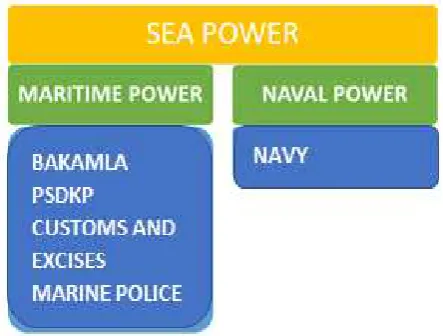
differences. Indonesia’s Sea power is a
combination of maritime power and naval
power (Figure 1), because the sea power
cannot be realized without the
cooperation of maritime power and naval
power.
Figure 1. Sea Power of Indonesia
Source: Processed by the Author
Naval power of Indonesia is the
Indonesian National Army (TNI) Navy (AL).
According to Ken Booth the role of the
Navy is divided into; the role of the military
to maintain the state sovereignty by
performing the defense and prevention of
sovereignty threat at sea. While the role of
the konstabulari is the use of naval power
for law enforcement function at sea
against the threats of crime and as a
safeguard over marine resources. The last
is the diplomacy role that is implemented
to support the government's foreign
policy.
Maritime power implementation in
Indonesia involved every law enforcement
institutions in the sea, such as the Navy,
such as Marine Police, Indonesian Sea and
Coast Guard (KPLP), Directorate-General
of Surveillance and Control of Marine and
Fishery Resources (PSDKP), Customs and
Excise, and Indonesian Maritime Security
Agency (Bakamla). However, the maritime
power practically cannot be separated
from the support of private sectors
involved in maritime industry and services.
Maritime power has an important role to
play during the peaceful period, because
the military warfare are no longer as
threatening as it did during the world war.
Instead, more threats are perpetuated by
the non-state actors in robbery, piracy,
smuggling of illegal goods, and so on.
In accordance to the applicable
regulation in Indonesia, particularly the
1945 National Constitution of the Republic
of Indonesia 2nd amendment and article 30, which explained that every Indonesian
citizen is entitled and obliged to
participate in the defense and security of
the state, where citizen is assigned as the
supporting component. In regards to the
The Role of Fishermen in Assisting Maritime Law Enforcement … | Anta Maulana Nasution | 23 fisherfolk is the most relevant community
to be engaged as supporting component
for marine law enforcement agencies.
According to Law No. 45 of 2009,
fishermen is defined as an individual who
make his/her livelihood from fishing.
Obviously, fishermen know more about
the sea than the people living in the
mainland. Thus, fishermen have a
significant role to prevent maritime
security threat and they can be great
potential component to realize the
maritime security of Indonesia. China as a
continental state has already involved
their fishermen to assist in maritime law
sector. China has established a militia
consisted of well-trained and properly
organized fishermen and seafarers. They
are also called as hybrid civilian-naval force
because they are indirectly engaged as
unofficial law enforcement and auxiliary
components of the Navy. 10 Japan also has plans to involve their local fishermen to
participate in patrols alongside the coast
guard in order to maintain their seafood
10 J. Kraska, dan M. Monti, “The Law of Naval Warfare and China’s Maritime Militia”, 91 INT’L L. STUD. 450. International Law Studies, U. S Naval War College, Stockton Center for the Study of International Law,2015.
11 "Japan's Ministry of Fisheries Spends 12 Billion
Yen to Help Fishermen Dealing with North Korea", December 12, 2017, in http:
resource that are illegally exploited by the
North Korean fishermen. 11
Indonesia is currently focused on
maritime security threats from the marine
and fishery sectors, mainly the Illegal,
Unreported, Unregulated Fishing (IUU
Fishing). This threat has become an
international problem and has been
classified as a transnational organized
crime because it involves many actors
from various countries. IUU Fishing is an
official terms that was launched by the
Food and Agriculture Organization (FAO)
through the Code of Conduct for
Responsible Fisheries (CCRF). Illegal
fishing can be briefly defined as illegal
fishing activities, which are not regulated
under the regulations, and fishery
activities that are not reported to the
competent authorities the fisheries sector
management.12
According to Task Force 115, there
are 12 IUU Fishing modus operandi that
has been identified in Indonesia:
1. Falsification of ship registration
documents.
//www.tribunnews.com,diakses on February 20, 2018.
12 A. Sinulingga, "Handling Illegal Fishing in
24 | Journal of Defense & State Defense | April 2018, Volume 8 Number 1 2. Use of double flags and double
registrations.
3. Illegal fishing / shipping documents
(SLO and SPB).
4. Modify the ship without notice such
as mark down.
5. Employing foreign Captain and ship
crew.
6. Deactivating VMS and AIS transmitters.
7. Illegal transhipment.
8. Filling out logbook data incorrectly.
9. Violation of fishing lane.
10.Use of prohibited fishing gear.
11.Does not have UPI.
12.Unloading the fish on a port that is not
designated in the permit.
If the matters are not appropriately
addressed, the IUU Fishing in Indonesia
will massively expand in the future,
especially if we refer to the Maximum
Sustainable Yield, Indonesia's marine
fisheries are increasing every year (1997:
6.19 Million Ton , 1999: 6.4 million tons,
2001: 6.41 million tons, 2013: 7.31 million
tons, 2015: 9.93 million tons, 2016: 12.54
million tons). 13 According to data from the
13 National Commission for Assessment of Fish
Resources 2016 in the Scientific Presentation of the Minister of Marine Affairs and Fisheries, 10 November 2017, Airlangga University.
14 Presentation of Operating Assistant of the Navy
Chief at "Law Enforcement Seminar on Illegal
Navy, from January to October 2017 there
are 64 Foreign Fishing Vessels (KIA)
committing IUU Fishing in the Indonesian
Exclusive Economic Zone. 14 The government took a firm stand against the
perpetrators of IUU Fishing from other
countries as well as from Indonesia, by the
end of 2017 in accordance to Law No. 45 of
2009, the Ministry of Marine Affairs and
Fisheries has drowned 317 illegal fishing
vessels consisting of 304 foreign fishing
vessels and 13 Indonesian fishing vessels.15 The situation of limited defense
weaponry system of Indonesia’s law
enforcement agencies, especially those
who are dealing with many actors of IUU
Fishing should be acknowledge as a
problem. This has been admitted by Rear
Admiral (Ret) Eko Djalmo as the former
Director General of Supervision of Marine
Resources and Fisheries (PSDKP) MoMAF,
that the ideal capacity of PSDKP should
include 70 units of Surveillance Ship Orca
(60 m), with each Technical Services Unit
(UPT) of PSDKP to control at least 5 units
of Orca Ship, since PSDKP currently
supervise 14 UPTs. The actual capacity of
Fishing by Foreign Boats at ZEEI", October 24, 2017, University of Indonesia.
15 Presentation of Task Force Coordinator 115 at
The Role of Fishermen in Assisting Maritime Law Enforcement … | Anta Maulana Nasution | 25 PSDKP is only have 4 units of Surveillance
Ship Orca and 30 other ships below 60
meters. Therefore, the role of fishermen is
needed as an extension of law
enforcement agencies in Indonesia to help
in monitoring and preventing threats over
Indonesian marine resources from the
illegal fishing perpetrators. In addition,
fishermen can potentially become a
critical component of marine defense
support. Indonesian fishermen have been
involved in assisting the role of the
maritime law enforcement agency such as
the Directorate General of Supervision of
Marine Resources and Fisheries (PSDKP)
in maintaining and overseeing the marine
resources. These fishermen is organized
into a Group of Community Surveillance
Group (Pokmaswas). In addition, there are
also fishermen who was trained by the
Navy in the program for Coastal Village
Development (Bindesir). This study will
discuss the extent of fishermen role who
joined the Pokmaswas and Bindesir
program in preventing the threat of
maritime security .
Research Method
This research uses qualitative descriptive
method with primary data source and
secondary data. Primary data were
obtained by conducting interviews with
stakeholder and fishermen organization,
while secondary data was obtained
through literature study. Data analysis is
conducted through data collection, data
reduction, data presentation, and
conclusion.
The Community Surveillance Group
(Pokmaswas)
The Community Surveillance Group is
established by the Directorate General of
Supervision of Marine Resources and
Fisheries (PSDKP) Ministry of Marine
Affairs and Fisheries as a form of
community participation, especially the
fishermen in supporting the government
to maintain and prevent threats against
Indonesia's marine resources. The marine
resources is providing an open access or
open to all, especially for those who earn
their livelihood from the sea, hence it is
only natural if this resources is not only
guarded by the government. The
government is supposed to be the one
who draft the policy and the regulation,
but community will need to engage for an
effective implementation.
Pokmaswas was formed by PSDKP is
in accordance to local wisdom that has
been preserved for a long time in
Indonesia to raise awareness with the
26 | Journal of Defense & State Defense | April 2018, Volume 8 Number 1 established by imitating the ancient local
wisdom existed in Indonesia, such as
awig-awig in Lombok and Panglima Laot in Aceh.
Until now, Pokmaswas is still
perceived as the extended arms and hands
of PSDKP at sea, considering the
limitations of the surveillance vessels fleet
of PSDKP. Fishermen who are members of
Pokmaswas are granted with the authority
to provide information related to marine
resources management to PSDKP officers.
The formation of Pokmaswas is based on
several applicable laws and regulations in
Indonesia, that are:
1. Law No. 31 of 2004 Juncto Law 45 of
2009 article 67 on Fisheries. Chapter 67
explained that in the community in
general and specifically the coastal
communities can be engaged in
supporting the fisheries surveillance
effort.
2. Indonesian penal code article 111 on
being caught red-handed. Article 111 of
the Penal Code states that when one is
being caught red-handed, everyone is
entitled and has the authority in the
duty of tranquility, security and public
order to arrest the suspect and handed
him/her over to the competent
authority.
3. Decree of the Minister of Marine Affairs
and Fisheries No. 58 of 2001 on
Community Surveillance Systems.
The Ministerial Decree describes
various matters relating to a
community-based surveillance system.
According to the ministerial decree No.
58 community-based surveillance
system is:
"Surveillance system by involving the active role of communities in supervising and controlling the management and use of marine and fishery resources responsibly, in order to gain the benefits in a sustainable manner."
The objective of this
community-based marine and fishery resource
surveillance system is to establish an
integrated community oversight
mechanism by the government, the
public, NGOs and business actors in
accordance with applicable regulations
as well as to increase community’s
participation in monitoring the marine
and fishery resources with the joint
implementation of surveillance on
marine and fishery resources
performed by both law enforcement
and the community.
The Community Based
MonitoringSystem (Siswasmas) is
The Role of Fishermen in Assisting Maritime Law Enforcement … | Anta Maulana Nasution | 27 awareness to participate. The nature of
this group can be referred to as
Community Surveillance Group
(Pokmaswas) consisting of elements
from traditional leaders, religious
leaders, community leaders, NGOs,
farmers, fishermen and other
communities.
4. Decree of the Minister of Marine Affairs
and Fisheries No. 14 of 2012 on
Institutional Main Fishing Actors. The
decree states that the Pokmaswas
established by the community for
supervising the management and
utilization of marine and fishery
resources are included in the
institutional form of fisheries actors.
The definition of the main fisheries
actors is several key actors who are
informally bounded on the basis of
harmony and mutual benefit and within
the sphere of influence and leadership
of a chairman of the main maritime and
fishing actor group.
5. Local Customary Law
Local customary law also refers to the
Decree of the Minister of Marine Affairs
and Fisheries No. 58 of 2001 on
Community Surveillance Systems. On
the basic part of this Decree, it
explained that the existing potential
and surveillance system in society has
become a culture and custom in some
places as a traditional form of
awareness and responsibility towards
the environment. Examples of local
customs for oversight of marine
resources are Awig-awig in Lombok and
Bali, Sasi in Maluku, Panglima Laut in
Aceh and many others.
The main duty of Pokmaswas is to
supervise, monitor, and maintain marine
and fishery resources according to their
capability and authority as a community
who have better awareness on the
surrounding environmental conditions.
Pokmaswas is an official organization
whose legality is issued through a Decree
of the Provincial Office of Marine and
Fisheries.
According to the Sub Directorate of
Center for Control and Operation MoMAF
2017 the requirements for the formation
of Community Surveillance Group
(Pokmaswas) includes:
1. A group consist of minimum 10 people
were formed.
2. Have the name and address as the
community group.
3. Have group administrator consists of
chairman, secretary, treasurer.
4. The surveillance group is determined by
28 | Journal of Defense & State Defense | April 2018, Volume 8 Number 1 The Minister delegating the
establishment of the community
surveillance group to the Director General
of PSDKP and subsequently affirmed by
the Regent/Mayor/Head of Service Unit
where the community group is
established. The newly established
Pokmaswas will received an assignment
certificate and will be trained by the
marine and fisheries agencies, Technical
Implementation Unit (UPT) of PSDKP and
PSDKP center. This training is organized by
inviting the newly established Pokmaswas
to a meeting and distribute materials
related to supervision of marine and
fishery resources.
The development of Pokmaswas is
critical because PSDKP also has a ban on
Pokmaswas. Coaching is conducted so
that the community is aware of their rights
and responsibilities as Pokmaswas
members. Subjects forbidden to be
performed by Pokmaswas are as follows:
1. Judging offenders of offenses .
2. Acting as a law enforcer.
3. Enforcing rules that have no basis.
4. Utilize the role of Pokmaswas for
profit / interest, personal / group.
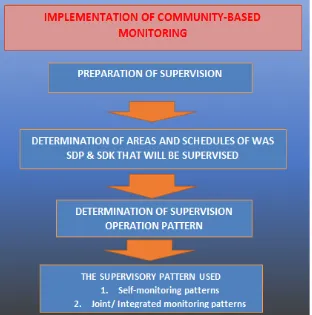
Figure 2. Community Based Monitoring Patterns
Source: PSDKP Presentation on Community Based Monitoring on
The Role of Fishermen in Assisting Maritime Law Enforcement … | Anta Maulana Nasution | 29 5. Allowing a violation/offense to take
place without any responses/ attempts
that may prevent/stop, a breach of such
a fishery crime.
Practically, each Pokmaswas is
provided with a mobile phone facility to
report any offense or other related crime
to the supervisor. This reporting can be
done either through "SMS gateway
Pokmaswas" or can be directly sent to the
officers both at sea and on shore.
Related substance of the report
violations reported by Pokmaswas is the
location of the offense, time of the
incident, the type of violation, identities of
those committing the offense, a witness
who saw the violation, and chronological
offense. 16 In general, if drawn through a diagram, the implementation pattern of
community-based surveillance is
described in Figure 2.
Until 2017, PSDKP has established
1640 Community Surveillance Groups
(Pokmaswas) in 34 provinces in Indonesia
(Table 2) and has issued the decree
indicating that the group has been
authorized.
16 Presentation of PSDKP KKP PSDKP on
Community-Based Marine Resource and Fisheries Surveillance, 2017
Coastal Village Development (Bindesir)
Coastal Village Development Program
(Bindesir) was implemented by the
Department of Maritime Potential
(Dispotmar) of the Navy based on the
policies stipulated by the Navy
Headquarter, Chief of Naval Staff (Kasal).
The implementation of coastal
village development activities is carried
out in a structured and pre-programmed
level on Dispotmar Fleet Command in the
Western Region and Fleet Command in
the Eastern Region. The Bindesir program
of the western and eastern fleet
commands is continued through the
Dispotmar in each of the Navy's Main Base
(Lantamal) and directly managed on the
ground by the Naval Base (Lanal). In
addition to Dispotmar , there is a new
organization under the Fishermen's Ship in
2016, the Maritime Potential Staff
(Spotmar), in charge for formulating
policies of marine defense area
empowerment, namely the Coastal Village
Development.
Coastal Village Development
30 | Journal of Defense & State Defense | April 2018, Volume 8 Number 1 areas included in the Marine Potential
Development program. The legal basis
was stipulated under TNI Law No. 34 of
2004 Article 7, paragraph 2 related to
non-war military operations (OMSP) which is
"Empowering the defense area and its
supporting forces early in accordance with
the defense system of the universe". In
Defense Areas Empowerment
(Dawilhanla), objective of Dawilhanla is an
early effort in preparing the maritime
defense area and all its supporting
components, in accordance to the
Indonesian defense system, that is a
universal defense. Through efforts to
build, maintain, enhance the fostering of
maritime potential. Further information of
Perkasal elucidating that:
“Empowerment of Maritime Defense Area is implemented in order to build and develop a naval force and help the Government to set up national potentials into maritime defense power and its supporting power to implement War Military Operations (OMP) and Military Operations Other Than War (MOOTW). Understanding the preparation of the Defense Area and
its supporting forces is strongly correlated with the preparation of space, tools and combat space for the implementation of guidance and the empowerment of maritime potential. The geography sector is strengthen the supporters of State Defense. While the guidance on the demographic sector is to prepare the combat gear that is prepared as a backup component and supporting components that can be utilized to help the main component. The fostering of social conditions during peacetime is the preparation of a struggling condition directed to help the Government to improve the Territorial Resilience and can be transformed into State Defense power during wartime.
Implementation of Marine Defense Empowerment involved activities of planning, development, deployment and control of marine defense area for the objective of National Defense in accordance with Sishanta, implemented by strengthening the ability and capability to develop and empower the national potential in the maritime sector. The Principle Implementation for Maritime Defense Areas Empowerment are provisions that must be safeguarded, so that the empowerment of the Maritime Defense Area can achieve its expected. objectives".
The empowerment of the marine
The Role of Fishermen in Assisting Maritime Law Enforcement … | Anta Maulana Nasution | 31 have been established earlier, further Case
/ 39 / VII / 2011 dated July 4, 2011 explains
that Dawilhanla is divided into two forms,
during peacetime and wartime. During the
period of Peace, Empowerment of Marine
Defense Areas is carried out in three
forms:
1. Empowerment of Marine Defense Area
as regular activity (coaching). This
activity to be undertaken selectively
throughout the year by the Navy and its
staffs in its respective districts with
annual budget plan.
2. Empowerment of Marine Defense
Areas as an integrated Navy program, is
an activity implemented by the Navy as
an integrated task organization
involving all levels, the priority target
areas are chosen by taking into account
on local conditions, troop capacity,
transportation and target achieved.
This program is proposed by the
community to get the approval from
the Chief of Naval Staff.
3. Empowerment of the Defense Area as a
form of Military Operations Other than
War/ is an activity carried out by the
Navy and its staff as an operations by
taking into account special targets area,
especially in areas prone to horizontal
conflict, vertical conflict, mass riots,
natural disasters and other
extraordinary events. This operation is
under the order of Chief of Naval Staff
in accordance to the State political
decisions.
During the war period,
Empowerment of Marine Defense Area is
implemented in the form of military
operation (supervised by the Opsla) as
follows:
1. Before the War. Implementation of
Empowerment of Maritime Defense
Areas aims to create space, gears and
conditions of combat as a deterrent
strategy in order to thwart the
opponent's intention to attack.
2. During the War. The Implementation of
Marine Defense Empowerment is
utilized for the deployment of Backup
Components and Supporting
Components to support the Main
Components, through conventional
operations, regional resistance
operations, and counterattack
operations.
3. After the War. The Implementation of
Empowerment of Maritime Defense
Area plays a role in restoring and
containing the situation and condition
and supporting the community to
rebuild its territory.
Referring to the case as mentioned
32 | Journal of Defense & State Defense | April 2018, Volume 8 Number 1 work and activities related with planning,
organizing, implementing, supervising and
controlling all aspect in effective and
efficient manner.Coastal Village
Development (Bindesir)is defined asa
program implemented by providing
coaching, training, counseling, and raising
awareness (Binlatluhgal).For example the
Navy may conduct maritime security
development in the fishermen community
by providing legal counseling,family
planning, health and others.Also
providing training to process the captured
fish, fish cultivation and fish
processing.Furthermore, the Navy
provided training so that fishermencan
support the Navy task by providing useful
information for the Navy.Coastal village
development is a strategic step of the
Navy to develop the community role in
supporting the Navy task of enforcing
security at sea.17
The pattern of coastal village
development is targeted to the citizen,
especially fishermen community, to
prevent maritime security threats. Navy,
under the central and regional Dispotmar,
conducted series of extension activities
17 Adin Nurawaluddin, "The Synergy of Navy and
MoMAF in Empowering Community Surveillance Groups to Address Marine Crime", Thesis, Graduate Program, Faculty of Defense Strategy, Indonesia Defense University, 2017.
regarding the laws at sea. In addition,
there was also introduction on the threats
that often occur from IUU fishing to
piracy. As explained by Chief of Progla
Dispotmar Colonel Ganda Wilaga:
"There has been several community extension services, in 2016 and 2017 the Lanal or Fleet has engaged approximately 1000 to 2000 coastal communities of fishermen in the village hall and shared some information about the law, about their position in the community. The point is, the socialization of maritime security has not been entirely routine because it's still partial."18
Further explanation on the
development program to prevent
maritime security threats is explained by
Paban VI Aspotmar Colonel Retarto which
states that legal counseling is given so that
fishermen can have better understanding
and can recognize all forms of crime at
sea. The expectation is that when
fishermen witnessed any acts of violation,
they can identify and immediately report it
to the Navy. According to data from the
Maritime Portfolio Office of the Navy, the
Navy has built 505 coastal villages in
Indonesia by 2017.
18 Interview with Colonel Ganda Wilaga,
The Role of Fishermen in Assisting Maritime Law Enforcement … | Anta Maulana Nasution | 33 The Actual Role of Fishermen in
Preventing Maritime Security Threats
The Community Surveillance Group
Program established by the Ministry of
Marine Affairs and Fisheries in coastal
villages and coastal communities,
especially for fishermen who are fostered
through Coastal Village Development by
the Navy, is an actual implementation of
community engagement (fishermen) to
participate in maintaining and preventing
maritime security threats within
Indonesia’s territorial sea.
Cohen explains that a role is an
action or behavior expected by someone
else from someone who is occupying a
certain status. Furthermore, the role can
be divided into two categories, the first is
the enacted role. This role is an act or
behavior performed by an individual on a
certain role, then there is prescribed role
which is an additional behavior expected
by others from an individual in performing
specific roles. In this case, the fishermen
performing a prescribed roleby taking
some additional roles to assist law
enforcement agencies in preventing
maritime security threats. Because the
actual main role of a fisherman is fishing.19
19 B. J. Cohen, An Introduction to Sociology, (Terj.),
(Jakarta: Rineka Cipta,2009).
20 Interview with Prof Hasjim Djalal, 30 October
2017 in Jakarta.
According to Professor Hasjim Djalal
, the weakness of law enforcement at sea
has become national problem for
Indonesia including IUU Fishing, all forms
of smuggling, piracy, shipping safety and
so forth. These problems are not merely
the responsibility for law enforcement but
also require a comprehensive marine
management. One of the step that can be
conducted in marine management is to
engage the role of fishermen and
seafarers.20
Meanwhile, according to the CTF
Pusopsdal Kasubdit Yeppi Sudarja, today
Pokmaswas capacity can only prevent
threats on marine and fishery sector only.
However, there is a future possibility, that
in order to prevent other threats outside
fisheries sector, including prevention of
illegal goods smuggling through the sea,
but the group must be trained and
properly developed in advance.21
While the roles of fishermen
engaged in Bindesir program by the Navy
is to identify and prevent various forms of
maritime security threats such as IUU
fishing, illegal logging and mining, illegal
goods smuggling by providing information
to the Navy personnel. As explained by
21 Interview with Kasubdit Pusopsdal KKP Yeppi
34 | Journal of Defense & State Defense | April 2018, Volume 8 Number 1 Kasubdis Progla Dispotmar Navy Colonel
Ganda Wilaga, that there are examples of
cases in Tangerang where fishermen who
have been trained and educated about the
theft of submarine cable, has reported
many incidents on the theft of submarine
cable hence it can be addressed by the
Navy.22 Other cases as described by Paban VI Aspotmar Colonel Retarto, is from his
personal experience in preventing
tugboats robbery in Batam area, because
he obtained some informations from
trained local fishermen and when he was
commanding the KRI in patrol routine, he
used to get informations on illegal foreign
ships location from the fishermen he
encountered in the sea.23
According to the Secretary General
of DPP HNSI Anton Leonard, the
Fishermen Association of Indonesia
(HNSI) will support the government effort
in engaging the fishermen to play a role in
maritime security. However, the program
must be comprehensive throughout
Indonesia and developed into a national
program, both Pokmaswas and Bindesir
should be implemented in many locations
22 Interview with Colonel Ganda Wilaga,
September 27, 2017, at the Navy's Office of Maritime Potential Service.
23 Interview with Paban VI Aspotmar Kolonel
Retaro, October 17, 2017, at TNI AL Headquarters.
and shall involve fisherman organization in
Indonesia to be able to synergize in its
implementation.24 In that regards, the
Executive Chairman of Indonesian
Traditional Fishermen Association (KNTI)
Martin Hadiwinata, explained that
fishermen are happy and willing to
collaborate with marine law enforcement
to prevent the maritime security threats,
reflecting the vastness of Indonesia's sea
and limited supervision ability, it is already
obvious that the role of fisherman is
needed. In some cases fishermen have
been empowered and showing some
positive results such as when there is a
plane crash in Kalimantan waters,
fishermen are involve in searching of
victims and flakes from the fuselage.25
Fishermen as Maritime Defense Support
Component
Indonesia implements the universal
defense system, where all resources
owned by Indonesia such as its human,
natural and artificial resources, can be
mobilized to support the state defense.
Supporting components can be divided
24 Interview with HNSI Secretary General Anton
Leonard, October 10, 2017, at the HNSI Central Secretariat.
25 Interview with DPP Chairman of KNTI Daily
The Role of Fishermen in Assisting Maritime Law Enforcement … | Anta Maulana Nasution | 35 into three categories, the first being the
human resources consisting national
guard, experts and professionals, and
citizens. While for the natural and artificial
resources consist of regional logistics and
strategic material reserves, and the last is
the facilities and infrastructure covering
the land, sea and air. According to the
Director of Support Component (Komduk)
Tristan Sumarjono, Komduk are all
national resources which can be enhanced
to support the state defense. Komduk
involved the human resource, who is later
selected and sorted to be used as a
component of reserves as well as natural
resources and artificial resources.26
The legal basis of the Supporting
Components in Indonesia has not enter
the implementation stage. It remains at
the basic law level, according to 1945
National Constitution Article 30 and Law
No. 3 of 2002 on state defense. The 1945
National Constitution of the Republic of
Indonesia in the second amendment of
Article 30 states that every Indonesian
citizen is entitled and obliged to
participate in the defense and security of
the state, in which the people are placed
as supporting forces. Law No.3 of 2002
stated that the state defense is all efforts
26 Direct interview with the Director of
Supporting Components of the Ministry of
to defend the sovereignty of the state, the
territorial integrity of the Unitary Republic
of Indonesia, and the safety of the whole
nation from the threat and disruption
against the integrity of the nation and
state. In addition, the state defense must
be prepared by taking into account to the
geographical conditions of Indonesia as an
archipelagic country. Later in the Defense
White Paper of Indonesia of 2015, it is
described that there are the main
components, the reserve components,
and support components. The main
component of Law No.34 of 2004 on the
Indonesian National Army (TNI) in article 6
stating that the TNI is the main component
of national defense.
Prior to this law, there was a Bill
(draft law) that has been formulated and
currently discussed in the House of
Representatives, namely Komcad and
Komduk Bill. But the discussion on this bill
has been halted, and the was no updates
on the process. According to the Director
of the Supporting Component of the
Ministry of Defense, this occurs because
many Indonesians think that the bill will
lead to a conscription program or
militarization. When they are not so as
thought, because in the universal defense
36 | Journal of Defense & State Defense | April 2018, Volume 8 Number 1 system, when the state is in an emergency
situation or at war, all the nation
components will be summoned to join the
fight. Currently the Ministry of Defense is
already preparing another bill to replace
the Bill of Komcad and Komduk, known as
the National Resource Management Bill
(PSDN) for National Defense.
Supporting components have a vital
role in the universal defense, because
there will be no backup component
without developing the supporting
components. In conclusion, Indonesia has
no backup component to this extent,
because the backup component must be
prepared from the supporting
components that have been selected and
enhanced its ability. Until recently, we
have only the main component, the
Indonesian National Army. The upgraded
Komduk that has been improved into
Komcad can only be mobilized when the
state is under serious condition or at war
situation.
The fishing communities have a big
role to play as the Supporting
Components of Maritime Defense.
Because fishermen knows better about
the maritime area where they fish.
Director of Supporting Component of
Minsitry of Defense explained that not all
fishermen can be referred as supporting
components, the potential must be
assessed, at least by age. There are several
supporting components of marine
element that have the potential to be
upgraded into Reserves Component,
including Pramuka Saka Bahari,
professional group (fisherman and sailor),
National Guard includes Polair, Bakamla,
PSDKP, KPLP and other law enforcement
agencies.
Regarding the marine supporting
components, we shall learn from the
China’s action by establishing Maritime
Militia of fishermen, it can be categorized
as supporting component of marine
defense forces involving professional
elements such as fishermen. In fact, this
concept represent the universal defense
by engaging the community, by
empowering them during the time of
peace. The development of Pokmaswas
and Bindesir can be referred as part of the
Supporting Components preparation.
Although it has not been implemented
under the Ministry of Defense, but it is
necessary to consider the development of
state defense program for fishermen to
strengthen their sense of nationalism. So
whenever the state needs them, the
fishermen who have been equipped with
The Role of Fishermen in Assisting Maritime Law Enforcement … | Anta Maulana Nasution | 37 upgraded its ability into reserve
component.
Programs conducted by the
Community Surveillance Group
(Pokmaswas) is organized by PSDKP, it
focus more on preventing threats in
marine sector and fishery resources in
accordance to the mandate of PSDKP
which is to oversee the marine and fishery
resources. While for the community, in this
case the fishermen who have been trained
by the Navy does not focused only for
preventing the marine and fisheries threat
but includes other acts of infringement
such as theft, robbery and illegal goods
smuggling.
Engaging the fishermen for maritime
security threats prevention is also part of
the strategy in strengthening the maritime
power, according to Geoffrey Till theory
which states that the maritime power is
not only relying on the Navy power but
shall also involves community
participation, in this case the fishermen. In
addition, the role of fishermen also to
maintain order at sea and to ensure
security for the implementation of state
interests at sea. Because the lack of order
27 Joshua Ho, Bateman, S, and J. Chan, Good Order
at Sea In Southeast Asia, (Singapura: Rajaratnam
at sea can have a negative impact on
marine resources.27
Conclusion
The role of fishermen in assisting law
enforcement agencies, in this case PSDKP,
KKP and Navy, to prevent maritime
security threats is defined as prescribed
role or recommended role, because the
main role of fishermen as a profession is
for fishing. It is designated as a Prescribed
role in accordance to the establishment of
the Community Surveillance Groups
program that was formed by PSDKP and
Coastal Village Development under the
Navy. In this case, fishermens role is to
supply information related to maritime
security threats such as IUU fishing,
smuggling, piracy and other threats to
PSDKP and the Navy, so the respective
institution can immediately take action to
address these potential threats from
occuring. Currently, the role of fishermen
is still limited as the extended arms and
eyes of the law enforcement agencies at
sea given the vastness of Indonesia's
maritime territories and the limited
defense weaponry system and personnel
38 | Journal of Defense & State Defense | April 2018, Volume 8 Number 1 of law enforcement agencies in the sea.
Fishermen can be incorporated into the
Marine Defense Supporting Components
which are the embodiment of the
universal defense system.
Bibliography
Books
Cohen, B. J. (Terj2009 . Sociology An Introduction. Jakarta: Rineka Cipta.
Ministry of Defense of the Republic of Indonesia. 2015. Book of the
Doctrine of National Defense 2015 . Jakarta: Ministry of Defense RI.
Nainggolan, P. 2015. World Maritime Axis Agenda and Strategic Environmental Change. Jakarta: P3DI.
Nasution, Anta Maulana. 2016" Maritime Security Urgency in Maritime Economic Development of Indonesia ", in Back to the Sea: Maritime Industry and Services in the Vision of the World Maritime Axis . Jakarta: Ministry of Maritime Affairs.
Marsetio. 2014. Sea Power Indonesia. Jakarta : Defense University of Indonesia.
Sciascia, Alban. . 2016. "Securing Ports and Sea Lanes of Communications: A Herculian Task", in Back to the Sea: The Maritime Industry and Services in the Vision of the World Maritime Axis . Jakarta: Ministry of Maritime Affairs.
Till, Geoffrey. 2009. Sea power, A guide for the Twenty-First Century. Second edition.New York: Routledge.
Journals
Ho, Joshua, Bateman, S, dan Chan, J. 2009. Good Order at Sea In Southeast Asia. Singapura: Rajaratnam School of International Studies. Nanyang Technological University. Stockton Center for the Study of International Law.
Thesis
Nurawaluddin, Adin. 2017. " Navy and KKP Synergy in Empowering Community Groups of Supervisors in Overcoming Marine Crime " . Thesis. Graduate Program, Faculty of Defense Strategy, Defense University of Indonesia.
Sinulingga, A. 2016. "Handling Illegal Fishing in Indonesian Waters, Case Study: Illegal Fishing Period 2009-2014". Thesis. Post Graduate Program, Faculty of Defense Management, Defense University of Indonesia .
Websites
"Development and Implementation of Sea Toll In RPJMN 2015-2019", in www.bappenas.go.id , accessed on February 20, 2018.
" Japan's Ministry of Fisheries Supports 12 Billion Yen Help Fishermen Against North Korea".2017. www.tribunnews.com , accessed on February 20th.
Regulations and Legislation
The Role of Fishermen in Assisting Maritime Law Enforcement … | Anta Maulana Nasution | 39 Law No. 3 year 2002 on State Defense
Law No. 31 year 2004 Juncto Law No. 45 year 2009 on Fisheries.
Law No. 34 year 2004 on Indonesian National Army.
Law 45 year 2009 on Fisheries.
Decree of the Minister of Marine Affairs and Fisheries No. 58 of 2001 on Community Monitoring Systems.
Decree of the Minister of Marine Affairs and Fisheries No.14 of 2012 on Institutional Main Fishing Actors.