Basic and Applied Research
The Planning of Ecotourism Opportunities Spectrum of
Elephant Related Ecotourism Activities on Sumatran
Elephant Home Range in Bukit Barisan Selatan National
Park Province Lampung Indonesia
Gunardi D. Winarno
a*, Ricky Avenzora
b, Sambas Basuni
c, M Bismark
da,b,c Post Graduate Study on Management of Ecotourism and Environmental Services, Department of Forest
Conservation and Ecotourism, Faculty of Forestry, Bogor Agriculture University, Indonesian.
d
Research and Development Bureau of Forestry Ministry Bogor
aEmail: [email protected]
bEmail: [email protected]
cEmail: [email protected]
dEmail:[email protected]
Abstract
Wildlife ecotourism has economical benefits and become important to be used as a strategy in conserving
wildlife. One of the interesting animals that can be utilized as tourism object in Indonesia is wild elephant
(Elephas maximus sumatranus) in National Park of Bukit Barisan Selatan (NPBBS). In fact, wild elephant is
difficult to find, but the satisfaction level of wildlife ecotourism merely can be gained when the tourists
successfully encounter the wild animals. Therefore, a design of Elephant Ecotourism Opportunities Spectrum
(EEOS) in NPBSS is important to be made. The ecotourism scientific planning approach (Avenzora, 2008) has
been used to identify the EEOS of the elephants population in Pemerihan and Way Haru Resorts. The
GPS-collar technology used to detect the elephant moving pattern and home-range; as well as the Landsat Imagery
TM-7 with Erdas Imagine was used to analyze the habitat characteristics.
---
* Corresponding author.
The design of EEOS was developed by mapping observed potentials into human-attracted points (Avenzora,
2013). The results of this study show that the total area of elephant home range is 15,301.20 Ha, which is equal
to 32-folds of Camp Elephant Patrol (CEP) area that has been used as single focal point of elephant ecotourism
for the last 6 years. Furthermore, a habitat-characters-based-EEOS design can improve the varieties of elephant
tourism activities. Its quantity an quality are increasing into 30 varieties, which can be distributed in the home
range for the whole year and improve the benefits of wild elephant ecotourism activities.
Keywords: Sumatran Elephant; NPBBS; Ecotourism Scientific Planning.
1. Introduction
Beside economical benefits, the growth of wildlife ecotourism is also important to be seen as an important
strategy to conserve the animal and its habitat. The wildlife ecotourism activities are very potentials to shift the
recently cost center wildlife management to become a benefit center wildlife management.
According to [26], the number of tourists in the worlds reach 637-956 million people in 2000. The Author in
[13] state that the high number of tourists can be considered as the biggest industry in the world. Specifically,
until 1999 tourism has built 55 million jobs and contributed US $ 3.5 billion income per year.
In relation to ecotourism and wildlife tour, The Author in [10] estimates that there are 30 million trips in the
worlds. The Author in [5] states that the global market of wildlife tour is about 12 million trips per year, which
increases 10% every year; for instance, the wildlife tourism activities become important in Canada, Congo,
Costa Rica, New Zealand, India, and elephant in Thailand, Indonesia, Malaysia, and Maldives. The Author in
[8] reports that the tourists who enjoy seeing whale are about 9 million people (financial contribution US $
1.049 million), tourists who enjoy under sea beauty are about 2 million people (financial contribution US $ 150
million), and tourists who enjoy zoo visit are 600 million people. It is also reported that in Australia there were
68% of tourists who interacted with wild animals.
In the context of wildlife conservation importance, the successfull wildlife tourism in the world is proved in
several cases stated by [4]. They state that the developement of ecotourism in National Park of Yala Srilanka has
increased farmers’ income and replaced the loss of plants caused by elephant. The Author in [6] affirm that the
success of wildlife conservation in Costa Rica is linked to a wildlife tourism that contributes to provide a
sustainable income. Then, according to [9], elephant ecotourism in Thailand has become an important tourism
industry resource and improved elephant population. As well as [24] states that Rwanda and Uganda have
became tourism places where the tourists are charged US $ 120-150 to encounter gorilla.
Since Indonesia has a high number of wildlide potential, which is distributed in all conservation areas, therefore
there are a great numbers of ecotourism objects that can be developed. According to [22], the percentage of
wildlife speciesin Indonesia includes 515 species of mammal (12%), 781 species of reptile and amphibian
(16%) and 1539 species of birds (17%). From those varieties of animals species, one of the important and
The recent figure of elephant population in Indonesia can be based on [21] who state that the population of
elephantin Indonesia can be found in Sumatera (E. maximus sumatranus) and North Kalimantan (E. maximus
borneensis). The population of elephant in Sumatera is approximately 2,800-4,800 population that are
distributed in 44 population groups in Aceh to Lampung provinces.
One of the elephant population group in Lampung is located in NPBBS. The Author in [7] reports that there are
498 elephants in NPBBS, which are distributed in 8 locations, namely Sekincau, Lemong, Bengkunat,
Sumberejo, Tampang Belimbing, Way Nipah, Sukaraja and Pemerihan.
Generally, the utilization of elephant as object of ecotourism can be classified into 3 types, as proposed by [9],
namely semi captive elephant attraction, captive elephant attraction, and wild elephant attraction. However, up
to now those activity patterns are still limited in numbers and have not been well developed.
In the context of wildlife tourism, the difficulty to meet wild animals are caused by several reasons; since the
animals have sensitivity to human presence, the animals move dynamically in the forest, as well as the animals
will hide whenever they feel predator threat, and the animals are distributed in different areas in the forest. The
elephant is even more difficult to find [15], [11]; since it has a high sensitivity. It attacks whenever near, and it
leaves whenever far. Elephants also have seismic sensor on their sole of feet and a sharp voice sensor in their
ears. Elephants can easily detect human presence.
Further, elephants move in a wide range of area and over dynamically day and night. If those elephant’s
behaviors are linked to satisfaction level of tourists, therefore the tourists chances to enconter elephant should be
assured and this is important to be investigated.
This study is important to be conducted in order to optimalize wild elephants tourism development in their
habitat, for at least in its relation to: (a) the pattern of elephants movements, (b) the types of land covers, and (c)
other tourism objects related to elephants ecotourism; which is an elephant ecotourism activities can be
understood as all activities related to those aforementioned factors.
The objectives of this study are: a). to describe the pattern of elephants movements, b). to identify habitat
condition in elephants home range, and c). to arrange the spectrum of elephant ecotourism activities (that so
called by [17] as Recreational Opportunity Spectrum /ROS). According to Parkin, the ROS is a conceptual
framework designed to help clarify relationships between recreational settings, activities and experiences.
The planning method in this study used the ecotourism scientific planning approach [3]. As an output of this
study, a measureable, sytematic and objective spectrum of ecotourism activities is expected to be made; as
stated by [3] that a main indicator of an academic (wissenschaftslich) ecotourism planning and program have to
2. Materials and Methods
2.1. Research Site and Schedule
The research was conducted in Pemerihan and Way Haru Resorts, which are located in National Park of Bukit
Barisan Selatan (NPBBS). These two resorts are near Pekon Pemerihan, Sumberejo and Way Haru, Kabupaten
Pesisir Barat, Lampung.
The data of elephants movement in 3 years (December 2009 - December 2011, and October 2012 - April 2013)
were provided by WWF Lampung. The data include geographic coordinate position, time record-keeping,
movement distance, altitude, and temperature. Those data were taken from GPS Collar that was installed into
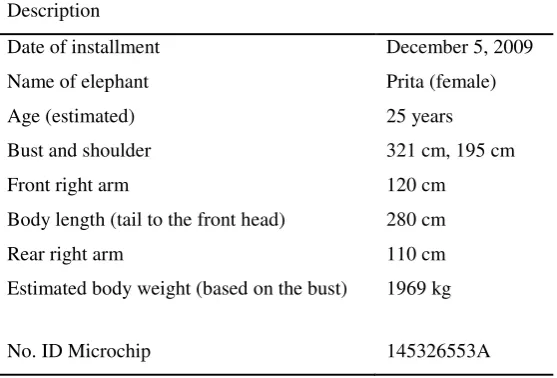
the leader of elephant herds (Table 1). Meanwhile the ground survey was done in January to September 2014.
Table 1: Data of elephant attached with GPS Collar.
2.2. Procedure and Technique
There are three important aspects that become focus of this research, namely: a). pattern of elephant movement,
b). types of land covers, and c). tourism objects related to elephant home range. First, the pattern of elephant
movement is important to determine elephant existance for tourists and tour route of elephant ecotourism based
on the space dimension and time. Second, the types of land covers data are used to develop activities in elephant
ecotourism which are made based on the types of land covers. Last, the data in related ecotourism objects are
used to complete tourists satisfaction.
The measurement of elephant movement pattern uses MCP (Minimum Convex Polygon) and Kernel methods.
[19] state that MCP is the most used method in measuring home range. While, Kernel Home-range Estimator is
used because of its consistency and accuracy; it isthemost widely used method that results an estimation of
possible distribution of finding animals in certain location in their home range. Description
Date of installment December 5, 2009
Name of elephant Prita (female)
Age (estimated) 25 years
Bust and shoulder 321 cm, 195 cm
Front right arm 120 cm
Body length (tail to the front head) 280 cm
Rear right arm 110 cm
Estimated body weight (based on the bust)
No. ID Microchip
1969 kg
In order to get the pattern of home range and the intensity of elephant movement from time to time, hence in this
research the data home range area which provided from aforementioned MCP and Kernel methods were mapped
into 1 km2 grids. After that, the pattern of elephant movements from grid to grid can be gained and be used to
design a tour track of elephant ecotourism, which provides higher possibility to encounter elephants in their
home range.
Further, collected data of land cover age was checked by ground-survey, which then analyzed by using Erdas
Imagine program. The observed characteristics of land coverage are forestry area, agriculture areas, garden,
residence or opened area, bushes, river, and sea.
The potential of related ecotourism objects and facilities are investigated by using GPS. Then, the data were
overlayed into home range map; in order to see the distribution.
The spectrum of elephant ecotourism activities are drawn into 12 months period. The activities were arranging
the themes of ecotourism activities and the managing the branding for the market.
The determination of potential ecotourism activities spectrum was done by mapping and defining kinds of
resources in elephant home range into interesing activities and attraction. Those activties were donein order to
fulfill human’s basic attracted points. [3] states that human attracted points can be simplify divided into: a).
physical realm, b). five-senses realm, c). thought realm, d). soul realm, and e). spiritual realm. Specifically
explained that physical realmis related to human power aspects in moving. In the context of elephant
ecotourism, it is related to walking in the forest, riding elephant, swimming, fishing, etc. Next, the five-senses
realm (eyes, nose, ear, tounge and skin) is linked to activities that rely on human’s senses. The thought realmis
part of brain activities that receives information for the environment to think about natural phemonon. Afterthat,
the soul realm involves human’s feeling to state their happiness, sadness, anxiety, worry, tense, love, and care
about the environment. Last, spiritual realmis the capacity and effort of human to find many absolute values
created by God in the universe.
3. Results
3.1 The Pattern of Elephant Movements
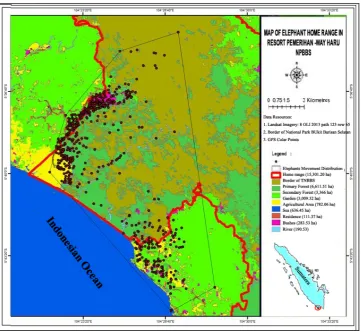
The implementation of MCP method showed that the total area of elephant home range in Pemerihan-Way Haru
Resorts is 15,301.20 ha (Figure 1). This total area is similar to the total area of Asian Elephant home range;
since the total area of elephant home range in South India is about 10,500 – 32,000 ha (Sukamar: 1989, in
Suhartono et.al., 2007: 6). In line with this, IUCN (2012) also reports that the total area of female elephant
home range in Sri Lanka is about 3,000 – 16,000 ha.
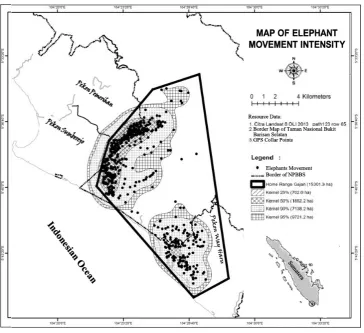
In Figure 2 can be seen that the concentration of elephants movement in the border of Pemerihan and
Sumberejo villages and forest area is involving 25% of Kernel Intensity; with 703 ha total area. This condition is
presumably influenced by loads of fodder availability in agriculture area or garden. Another reason is the
movement and space usage are determined by the environment (like fodder availability, water, etc.), and also
interspecific and intraspecific interactions.
Figure 1: Map of elephant home range in Resort Pemerihan-Way Haru, NPBBS.
The observation showed that elephant herds leave the forest to agriculture area at night, and return to the forest
in the morning. They keep doing this moving pattern, specifically they make lines on their way to agriculture
area, then spread away when they eat. Bothin Pemerihan and Sumberejo, the elephants like to feed corn (Zea
mays), rice (Oryza sativa), chocolate (Teobroma cacao), and coconut (Cocos nucifera).
On the contrary, the total area of African Elephant home range is wider. The Author in [13] state that the total
area of elephant home range in Tanzania is about 32,800 – 690,500 ha. The Author in [16] estimates that the
difference total area of home range is influenced by the intensity of rainfall. He described that total area of home
range is inverse with rainfall intensity; if the intensity of rainfall is low, then the total area of home range is
wide, and vice versa. However, a research in Zimbabwe shows that even though the intensity of rainfall is
similar, but there is a significant difference between total area of elephant home range in protected areas and
people’s residence.
Furthermore, the total area of home range is not only influenced by climate and human, but also by elephant’s
feeding behavior. The Author in [26] report that mammal sexhibit widely diverse movement can sometimes lead
information shows that extending home range area is temporary, since the elephants will return to their usual
track.
In relation to utilizing home range for the activities of elephant ecotourism in NPBBS, the data show that
recently there is only a limited part of home range have been used for elephant ecotourism activities. Up to now,
the area used for this activity in the NPBBS is only around Camp Elephant Patrol (CEP); which is only around
475 ha. Considering this phenomenon, it can be said that there are a huge potential that can be developed,
howeverit is remained unexploited.
Figure 2: Map of elephants movement intensity based on Kernel Method
From land ownership point of view, the 31% (4,732.31 ha) of elephant homerange lies in human setlemen area,
and the rest 69% (10,568.89 ha) is part of the NPBBS forest area. However the data from Kernel Method show
that the intensity of elephant existence is concentrated in the border area of human setlemen area and forest
areas.
3.2. Daily Movement
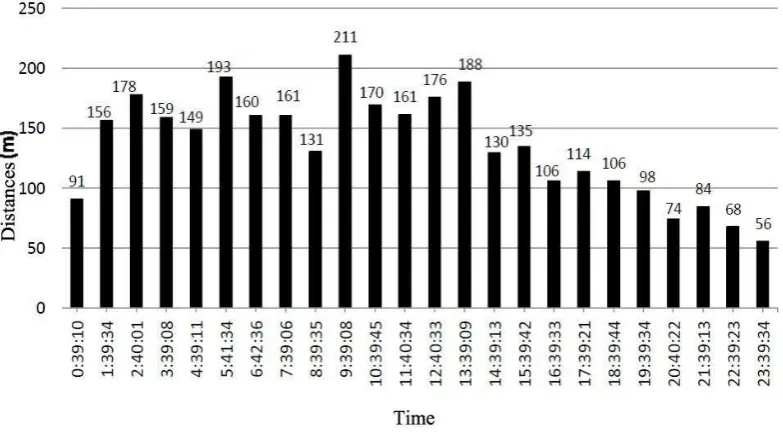
The result of data processing from Kernel Method showed a dynamic moving distance of elephant in NPBBS,
which forms a symmetric pattern (Figure 4). The farthest moving distance is in the morning (at 09.39) that
they perform high movement activities, and in the morning, they perform low movement activities. The mean of
moving distance per hour in the afternoon is 153 metres, and 118 metres in the night. In total, their total moving
distance in one day is about 3,251 metres or 3.2 Km.
Figure 4 shows that the movement of elephant at the dawn is increasing at 01.39 until 02.40 a.m; in which the
moving distance is 178 metres. Then, it is decreasing for 2 hours, and increasing again until 05.41 WIB. As the
sun goes up, elephant activitity is decreasing from 05.40 – 08.39a.m. In the morning their movement tends to be
high until 11.40 a.m. Then, these movements are decreasing since afternoon until the sunsets.
Figure 4: The dynamics of elephants travelled distance per hour for 24 hours
The moving distance of elephant in the night is decreasing until its lowest point at 23.39 p.m. Their rest activity
is started from 19.40-23.39 p.m. Their travelled distance during the day and night is significantly different (χ2
calculation =204 > χ2 tableα=0,05, df=11=19).
The analysis also shows that the intensity of elephant existense is highest in the forest (74.5%), in the garden
(15.3%), and agriculture area (4.1%). Whereas, their movement in the night are: a). in the garden (34.8%),
b). agriculture area (26.3%), and c). forest (18.3%). All of those data above can be used to design a tourism
track, schedule and its recreation activities.
During their moving, the elephants do many activities related to their habitat. The Author in [20] reports that
during his research in Bengkulu, in 4,496 hours of observation of 14 elephants, it can be concluded that their
daily activities are feeding (82.2 ± 5.0%), moving (9.5 ± 4.0 %), resting (6.6 ± 2.1%) and drinking (1.7 ± 0.6%).
Moreover, compared to female elephants, the pattern of male elephant movements is short-and-short and do
In using technology, the elephant existence and its moving pattern can be investigated using Kernel Method,
while in practical field their moving pattern can be recognized from their feces. According to [25], an adult
elephant in Sri Lanka, on average, defeacates at least 100 kg of dung per day, or 4 kg dung per hour. In the
context of elephant ecotourism, this information is beneficial for the tourists; if they find new feces, it means
that their distance with the elephant is 153 metres in the day, and 118 metres in the night.
3.3. Characteristics of Land Coverage
The analysis towards Map of Landsat Imagery TM7 (2011) using Erdas Imagine software shows that there are 8
types of land coverage characteristics in elephant home range, namely: a). primary forest (6,611.51 Ha or
43.2%); b). secondary forest (3,663.43 Ha or 24%); c). garden (3,009.32 Ha or 19.7%); d). agriculture area
(782.06 ha or 5.1%); e). sea (636.45 Ha or 4.2%); f). bushes (293.53 Ha or 1.9%); g). river (190.53 Ha or 1.2%);
and h). human setlemen area (111.37 Ha or 0,7%).
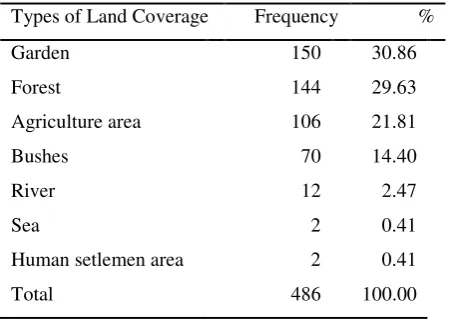
Furthermore, the data of elephant movement pattern analysis result showed that the frequency of elephant visits
are: garden (30.86%), forest (29.63%) and agriculture area (21.81%). The detailed data are presented in Table 2.
Table 2: The Frequency of Elephant Visits based on Types of Land Coverage in the Home Range.
The utilization of land coverage by elephant becomes an indication that the chances to encounter elephant are in
the garden, forest, and agriculture areas. According to [20], the elephants tend to use medium canopy (secondary
forest), and opened canopy (opened space) instead of closed canopy (primary forest).
Moreover, The Author in [1] state that elephants choose secondary forest to find food and primary forest to
protect themselves, rest and mating. On the other hand, The Author in [12] reports that the elephants in India
spend most of their times at mixed forest with 47% of frequency visit, then at agriculture areas (25%), bushes
(15%), and meadow (10%).
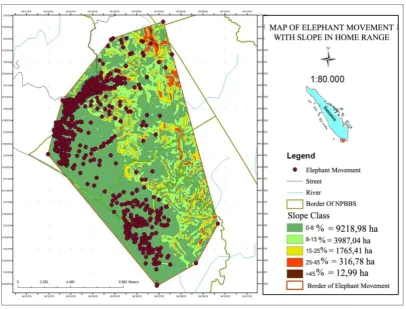
slightly slope area that reaches 9218.98 ha (60.25%), hilly area (316.78 ha or 2%) and steep area (12.99 ha or
0.08%); and they are located in the north side of the home range, whcih are categorized as primary forest
(Figure 5).
Figure 5: Characteristics of elephants habitat based on the clope classification
These data is veru important to determine suitable design of infrastructure and facilities in the track of elephant
ecotourism. Further, the data also important to plan the level of difficulty intensity ofan ecotourism activity
that will be offered to the tourists in NPBBS.
The climate condition in elephant home range of NPBBS shows that the monthly rainfall is medium to high. The
lowest rainfall is 163 mm in April, and the highest is in October for 642.2 mm in 2010. The mean of monthly
rainfall is 335.1 mm. There are no months where the rainfall is below 100 mm during 2010. Referring to the
data of elephant moving patterns, it can be concluded that rainfall does not interfere the moving distance of the
elephant (Table 3). This data is important to be used as consideration in eleminating recreation program threats
caused by climate condition.
3.4. The Distribution of Tourism Related Objects in Elephant Home Range
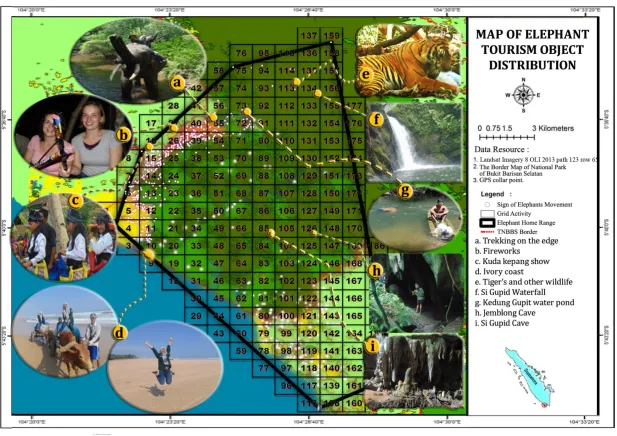
There are at least five tourist attractions associated with elephant ecotourism activities that can be found in
elephant home range area in the National Park of Bukit Barisan Selatan (NPBBS), such as: caves, waterfalls,
ivory coast, new trees plantation, and other wildlife animals scattered around the elephant home range. There are
waterfall with its large and deep pond, and also the Ivory Coast with its clean ivory sands.
The other wildlife animals that can be found in elephant home range are tigers, gibbons, and pheasants. Tigers
can be detected by its foot prints on the trail or on the edge of the river. As for gibbons, they will be known from
their responsive voicein the morning or when it rains in primary forest, so will the pheasants with its distinctive
voice like the sound of people laughing.
Table 3: Monthly rainfall and mean of travelled distances of elephant in Pemerihan-Way Haru Resorts, NPBBS (WCS, 2010)
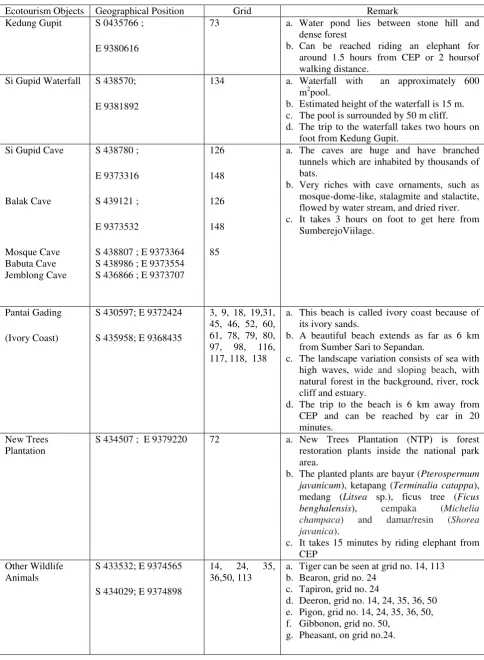
The distribution of potential ecotourism-related object in home range is presented in Figure 6. As to the
description and the geographical position, they are presented in Table 4.
3.5. The Spectrum of Potential Activities of Elephant Ecotourism
The pattern of elephant movement in its home range can be utilized as the track of elephant ecotourism
activities. Since elephants move around different route every week, this can be used for the basis in making
varied activities of elephant ecotourism throughout the year. Employing this approach in the planing of elephant
ecotourism activities in National Park of Bukit Barisan Selatan (NPBBS) will increase the rate of assurance that
the tourists will encounter wild elephant during the activity; this is expected to offer more satisfaction for the
tourist when doing elephant ecotourism activities.
The potential activities and ecotourism track in home range can be developed by recognizing space dimension
and time of activity. Based on the grid distribution, it can be seen that some grids were often visited by the
(42.8%) that show the points of elephant activity.
Along with the different rhythm of elephant movement from grid to grid, the route of ecotourism activity can be
drawn as in Figure 7. The planning of the track is presented every week according to the rhythm of the
elephant’s trip. Switching from one grid to another is repeated, while simultaneously tracing the trail of elephant
movement in its home range. This can be offered as the program of elephant ecotourism activity in National
Park of Bukit Barisan Selatan (NPBBS). The program offers the chance of encountering the elephant, and more
importantly delivers deeper values to the tourist to conserve elephants.
By using the [3] approach in ecotourism planning, the spectrum of annual program of elephant ecotourism
activities in NPBBS can be mapped into five different concepts (Figure 8) comprising: a). elephant
conservation socio-cultural value, b). elephant conservation ecological value, c). elephant conservation
economic value, d). elephant conservation ethical value, and e). elephant conservation esthetical value. Those
values are based on the attractions that are likely to be the main travel destination.
4. Conclusion
The results of the study above show that the elephant ecotourism activities in the NPBBS, that up to now had
only been concentrated in 475 Ha Camp Elephant Patrol (CEP), is quite potential to be developed into various
elephant ecotourism activities covering 15,301.2 Ha elephants home range area. The increase of various
elephant ecotourism activities will not only improve the economy and empower the local community in the
NPBBS, but may also create multiple benefits.
The potential natural resources spread around the elephant home range will offer diverse and extended journey
to the tourists. Thus, it will potentially increase the tourists’ expense during their visit. On the other hand, the
increase of elephant ecotourism activities spectrum will boost the tourists’ satisfaction level; that leads to
expectation of the next visit and creating effective promotional impact.
Recently, visitors only ride elephant around the CEP (with limited sight of secondary forest dominated by 81
species of trees, bushes, and river), but through the development of elephant ecotourism spectrum generated
from this study, elephant ecotourism activities in the NPBBS can be developed into more diverse, meaningful,
and valuable activities in many aspects. In addition to the primary forest; the tourists will be able to see at least
112 species of dominant trees as well. In terms of garden habitat varieties, their knowledge will be greatly
enriched with the other 23 dominant trees. There are also agricultural fields, beach, and sea that add the
richness of attractions and activities in home range area.
The series of elephant ecotourism activities spectrum is not only boosting up the tourists’ satisfaction level, but
also encourage them to come back again in order to enjoy the other sights that cannot be done during the first
trip. The pattern of elephant ecotourism activities, which is now a days inclined to be a daily activities (for
about 2-3 hours) only, can be developed further into overnight ecotourism activities. The implementation of this
overnight ecotourism will certainly require supported activities that involve the local people and could benefit
Table 4: The description of potential ecotourism-object-related in elephant home range
Ecotourism Objects Geographical Position Grid Remark
Kedung Gupit S 0435766 ;
E 9380616
73 a. Water pond lies between stone hill and
dense forest
b. Can be reached riding an elephant for
around 1.5 hours from CEP or 2 hoursof walking distance.
Si Gupid Waterfall S 438570;
E 9381892
134 a. Waterfall with an approximately 600
m2pool.
b. Estimated height of the waterfall is 15 m. c. The pool is surrounded by 50 m cliff.
d. The trip to the waterfall takes two hours on
foot from Kedung Gupit.
a. The caves are huge and have branched
tunnels which are inhabited by thousands of bats.
b. Very riches with cave ornaments, such as
mosque-dome-like, stalagmite and stalactite, flowed by water stream, and dried river.
c. It takes 3 hours on foot to get here from
a. This beach is called ivory coast because of
its ivory sands.
b. A beautiful beach extends as far as 6 km
from Sumber Sari to Sepandan.
c. The landscape variation consists of sea with
high waves, wide and sloping beach, with
natural forest in the background, river, rock cliff and estuary.
b. The planted plants are bayur (Pterospermum
javanicum), ketapang (Terminalia catappa), medang (Litsea sp.), ficus tree (Ficus benghalensis), cempaka (Michelia
champaca) and damar/resin (Shorea
javanica).
c. It takes 15 minutes by riding elephant from
The service of tour guides, porters, and even logistic services (such as rented tent, lighting tools, cooking
utensils, and foods seasoning) needed during the overnight ecotourism activities is an example of services that
can be provided by the local people.
Furthermore, the improvement of tourism activities area will not only increase the spectrum of potential tourism
activity, but also will increase the tourism capacity that can be distributed into the elephant home rangeon land
cover basis; as well as due to the 24 hours time of acitivies, weekly and monrhly during the year.The visitor
capacity, can also be upgraded by tenfold; through the development of new focal points inside the home range.
Further, in line with the tourist distribution in those new focal points, it is also expected to create equitable
distribution of economy among local people.
As the ecotourism program can be promoted and will be equally distributed in terms of time and space
(throughout the year from week to week), thusthe thebeneficial not only for improving the quality and quantity
of elephant tourism product, but also for equalizing the distribution of the tourist that will influence job
opportunities for local people. In addition, it will also reduce the damage to the environment caused by the
increase of visitors in CEP.
5. Recommendations
In order to attain the efficiency and effectiveness of the implementation of overall ecotourism activities
explained above, it will require further research related to the market behavior and the level of tourist
satisfaction towards current condition. Next, in line with the results of the study, the spectrum of potential
elephant ecotourism activities is still relatively in a potential status, thus however it is necessary to conduct
further research on program branding, market penetration strategy, and the measurement of environment
carrying capacity for the sustainable implementation of elephant ecotourism program.
References
[1] Abdullah, J.T Iskandar, D.N. Choesin, and A. Sjarmidi. “Estimasi daya dukung Gajah Sumatera (Elephas
maximus sumatranus Temminck) berdasarkan aktivitas harian dengan menggunakan sistem informasi
geografis sebagai solusi konflik dengan lahan pertanian”. Berkala Penelitian Hayati. Special edition Edisi:
3B: 29–36. 2009.
[2] Avenzora R. Ecotourism: “Evaluasi tentang konsep”. In: Avenzora R (Ed.). Ekoturisme Teori dan Praktek.
BRR NAD-Nias Aceh. 2008. p 1-17.
[3] Avenzora R and P.E. Pratiekto. “Ekowisata Spiritual di Indonesia”. In: Teguh and Avenzora R. (ed.). Ekowisata dan
Pembangunan Pariwisata Berkelanjutan di Indonesia . Gramedia, Jakarta, Indonesia. 2013, p. 396.
[4] Bandara R and C. Tisdel. “Does the economic values of the Asian Elephant to urban dwellers exceed their cost to the farmers?
A Sri Lankan study”. discussion paper No 325. School of Economics University of Qeensland Queensland
[5] Curtin S. Managing wildlife tourism experience: “The importance of tour leaders”. International Journal of Tourism
Reseacrh Int. J. Tourism Res. 12, 219–236. 2010.
[6] Hearne R.R. and Z.M. Salinas “The use of choice experiments in te analysis of tourist preferences for
ecotourism development in Costa Rica: Journal of Environmental Management, 154, 2002.
[7] Hedges S., M.J. Tyson, A.F. Sitompul, M.F. Kinnaird, D. Gunaryadi and Aslan. “ Distribution, status and
conservation needs of Asian elephant (Elephas maximus) in Lampung Province, Sumatra, Indonesia”.
Biological Conservation 124: 35-48. 2005.
[8] Higginbottom K. “Wildlife tourism: growth opportunities for the South Australia”. Sustainable Resources
Program, STCRC. 2012.
[9] Kontogeorgopoulos N. “Wildlife tourism in semi-captive setting: a case study of elephant camps in
northern Thailand”. Current issues in tourism. Vol 12, No. 5-6, 429-449. 2009.
[10] Lennon J.J. “Key Travel and Tourism Trends for the Wildlife Sector”. Retrieved
fromhttp://www.sup.org.uk /PDF/John%20Lennon%2020Key%20 Trends.pdf. [11 July 2012]. 2005.
[11] McComb K, D. Reby, L. Baker, C. Moss and Sayialel. “Long-distance communication of acoustic cues
to social identity in African elephants”. Journal of Animal Behaviour (65:317-329). 2001.
[12] Marcot B.G., A. Kumar, G. Talukdar and A.K. Srivastava. “Habitat Relationships of Asian Elephants in
Shifting-Cultivation Landscapes of Meghalaya, Northeast India”. Journal of Gajah 34: 8-17. 2011.
[13] Mpanduji D.G. and Ngomello KAS. “Elephant movements and home range determinations using
GPS/ARGOS satellites and GIS programme: Implication to conservation in southern Tanzania”. A paper
presented at the 6thTAWIRI Annual Scientific Conference held at the Arusha International Conference
Centre, Arusha Tanzania from 3rdto 6thDecember 2007.
[14] Neil S. and J. Wearing. Ecotourism: Impacts, Potentials and Possibilities. Butterworth-Heinemann.
Oxford, England. 1999.
[15] O’Connell-Rodwell, “Keeping an “Ear” to the Ground: Seismic Communication in Elephants”. Journal of
Physiology Vol. 22 no. 4, 287-294. 2007.
[16] Osborn F.V. “The Concept of Home Range in Relation to Elephants in Afrika”. Pacyderm No.37
July-December 2004.
[17] Parkin D, D. Batt, B. Waring, E. Smith E and H. Phillips. Providing for Diverse Range of Outdoor
Recreation Opportinities: a “micro-ROS” approach to Planning and Management. Australian Parks and
[18] Pe´rez-Garcı´a J.M, A. Margalida, L. Afonso, E. Ferreiro, A. Gardiaza´bal, F. Botella, and J.A. Sa´nchez-Zapata. “ Interannual home range variation, territoriality and overlap in breeding Bonelli’s Eagles (Aquila
fasciata) trackedby GPS satellite telemetry”. Journal Ornithol DOI 10.1007/s10336-012-0871. 2012.
[19] Row J.R and G. Blouin-Demers. “Kernels are not Accurate Estimators of Home-Range Size for
Herpetofauna”. Copeia, 2006(4), pp. 797–802. 2006.
[20] Sitompul A.F. “Ecology and Conservation of Sumatran Elephants (Elephas maximus sumatranus) in
Sumatra Indonesia”. (Disertation). University of Massachusetts–Amherst ScholarWorks@UMass
Amherst, USA. 2011.
[21] Soehartono T, D.H. Susilo, A.F. Sitompul, D. Gunaryadi, E.M. Purastuti, W. Azmi, N. Fadhli, C. Stremme.
Strategi dan Rencana Aksi Konservasi Gajah Sumatera dan Gajah Kalimantan 2007-2017. Departemen
Kehutanan, Jakarta, Indonesia. 2007.
[22] Sugiharta A, S.R. Situmorang, J. Siregar, Kuswandono, A.E. Satrio Q.K. Diah, E. Ristiyanti and A.
Haryanto. Bunga Rampai Gerakan Cinta Alam. CV Merdeka Sama, Jakarta, Indonesia. 2013
[23] Sukumar R. “The Asian Elephant Ecology and Management”. In: Suhartono et al. Strategi dan Rencana
Aksi Konservasi Gajah Sumatera dan Gajah Kalimantan 2007-2017. Departemen Kehutanan. Jakarta,
Indonesia. 1989.
[24] Supriatna J. Berwisata Alam di Taman Nasional. Yayasan Pustaka Obor, Jakarta, Indonesia. 2014.
[25] Wijeyamohan S. 2003. “Biogas from elephant dung: a means of mitigating human-elephant Conflict”.
Gajah 22: July 2003. pp.62-63.
[26] White G.C. and R.A. Garrott. Analysis of Wildlife Radiotracking Data. In: Osborn F.V. “The Concept of
Home Range in Relation to Elephants in Afrika”. Pacyderm No.37 July-December 2004.
[27] WTO. 2000. “Tourism Highlights” http://www3.dogus.edu.tr/DersNotlari/tourism%20highlights2000.
pdf [30 March 2015]. 2000.