*Corresponding author: E-mail: [email protected]
Available online at http://medpet.journal.ipb.ac.id/
Digestibility, Milk Production, and Udder Health of Etawah Goats Fed with
Fermented Coffee Husk
I. Badarinaa,*, D. Evvyernieb, T. Toharmatb, E. N. Herliyanac, & L. K. Darusmand
aGraduate School of Animal Nutrition and Feed Science, Bogor Agricultural University
bDepartment of Nutrition and Feed Technology, Faculty of Animal Science, Bogor Agricultural University cDepartment of Sylviculture, Faculty of Forestry, Bogor Agricultural University
dDepartment of Chemistry, Faculty of Mathematics and Natural Science, Bogor Agricultural University
Kampus IPB Darmaga, Bogor 16680, Indonesia (Received 20-08-2014; Reviewed 17-10-2014; Accepted 05-12-2014)
ABSTRACT
This study was carried out to assess the utilization of coffee husk fermented by Pleurotus ostreatus as feed supplement by measuring the digestibility, milk production and udder health of Etawah goats suffered from subclinical mastitis (+1). There were three experimental diets consisted of T0 (control diet/basal diet without fermented coffee husk), T1 (basal diet with 6% fermented coffee husk) and T2 (basal diet with 6% fermented coffee husk soaked in crude palm oil for an hour before using). Basal diet consisted of napier grass (60%) and concentrate (40%). The results showed that supplementation of lactating Etawah does with fermented coffee husk did not affect the palatability of the diets, but increased the protein and crude fiber consumption (P<0.05). There was no significant effect on nutrient digestibility and milk production while milk composition (protein, fat, total solid) increased in supplemented groups (P<0.05). The persistency of milk production and the somatic cells count were not different. There was an improvement of somatic cells count on supplemented groups. In conclusion, fermented coffee husk could be used as feed supplement without any negative effects on digestibility and milk production. The positive effects to udder health could be expected from including fermented coffee husk in diets.
Key words: coffee husk, Etawah goat, fermented, performance, supplement
ABSTRAK
Penelitian ini bertujuan untuk mengevaluasi pemanfaatan kulit buah kopi yang telah difermentasi dengan Pleurotus ostreatus sebagai pakan suplemen dengan mengukur kecernaan, produksi susu, dan kesehatan ambing kambing Etawah yang menderita mastitis subklinis (+1). Terdapat tiga perlakuan ransum, yaitu T0 (ransum basal tanpa suplementasi kulit buah kopi fermentasi), T1 (ransum basal dengan suplementasi kulit buah kopi fermentasi sebanyak 6%), dan T2 (ransum basal dengan suplementasi 6% kulit buah kopi fermentasi yang telah direndam dalam CPO sebelum digunakan). Ransum basal tersusun atas rumput gajah (60%) dan konsentrat (40%). Hasil penelitian menunjukkan bahwa suplementasi kulit buah kopi fermentasi tidak menurunkan palatabilitas ransum, tetapi meningkatkan konsumsi protein dan serat kasar (P<0,05). Suplementasi kulit buah kopi fermentasi tidak berpengaruh nyata terhadap kecernaan nutrisi dan produksi susu, tetapi meningkatkan komposisi susu (protein, lemak, total padatan) (P<0,05). Persistensi produksi susu dan jumlah sel-sel somatik tidak berbeda nyata di antara perlakuan. Terdapat perbaikan dalam jumlah sel-sel somatik pada kelompok yang disuplementasi. Disimpulkan bahwa kulit buah kopi yang telah difermentasi dapat digunakan sebagai pakan suplemen tanpa menimbulkan pengaruh negatif pada kecernaan dan produksi susu. Pengaruh positif pada kesehatan ambing dapat diharapkan dari suplementasi kulit buah kopi fermentasi dalam ransum.
INTRODUCTION
Application of agricultural by-products as feed resources is one of strategy to reduce the environmental problem and create local feed resources. One of the agri-cultural by-products that is available in large quantities
in Indonesia is coffee husk. Coffee is one of the agricul
-tural crops with significant economic contribution in
Indonesia.
Coffee husk can be converted into several added values products including as a feedstuff. Coffee husks can be used as a feed especially as a source of fiber. Coffee husks consist of 15.0% moisture, 5.4% ash, 7.0% protein, 0.3% lipids, 33.65% crude fiber and 38.65% nitro
-gen free extract (Gouvea et al., 2009). Lignin, caffeine and
polyphenols were some anti-nutrients materials found in
coffee husk (Fan et al., 2006). The pre-treatment of coffee husk before being used as a feedstuff must be done to
overcome the obstacles and improve its utilization.
Fermentation by using Pleurotus ostreatus is one of
the methods to improve the nutritive value of crop
resi-dues. P. ostreatus or oyster mushroom can be cultivated
on wide range of lignocellulotic substrates such as wheat
straw and sugar cane bagasse (Fazaeli et al., 2004; Okano
et al., 2007). P. ostreatus produces ligninolytic extracel-lular enzymes such as laccase, lignin peroxidase and Mn
peroxidase (Periasamy & Natarajan, 2004). Application of bioconversion in lignocellulose residues is the efficient
way because of low cost and positive environmental
benefits.
Besides as primary decomposer of lignocellulotic materials, mushrooms have also been used as food
sup-plement because of their medicinal properties. P.
ostrea-tus possesses a number of biologically active compounds
that function as health-enhancers, has a potency to cure
diseases and biological response modifiers (Wong et al.,
2011: Patel et al., 2012; Novak & Vetvicka, 2009). One of
bioactive substances responsible for biological action is
β-glucan, a part of polysaccharides that form an integral
part of fungal cell wall (Chen & Seviour, 2007). The
actions of β glucan in treating and preventing diseases are through immunomodulator effects. β glucan enters
the proximal small intestine and then is captured by the
macrophages. β glucans are internalized and fragmented
into smaller sizes and are carried to bone marrow and
endothelial reticular system. The small β glucans frag
-ments are then released by macrophages and taken up
by circulating granulocytes, monocytes and dendritic cells. The immune response will then be elicited (Chan
et al., 2009).
Subclinical mastitis is one of the most important diseases in dairy farm including in Etawah dairy goat.
Mastitis is an inflammation of mammary gland paren -chyma which is caused by bacteria and its toxin. This disease is not only the animal welfare problem but also a food safety problem and the biggest economy problem
to the farmer. Mastitis decreases milk production in -creases medical cost and causes the earlier culling of the animal (Sharif et al., 2009). The antibiotic usage is one of the methods often used to treat mastitis. However, due to the growing concern of antibiotic residues and resistance, the use of antibiotic was banned. A potential
alternative to antibiotic is natural or traditional medi-cine. Mushrooms have been exploited for the treatment
of many diseases such as P. ostreatus.
Since coffee husks are rich in the organic substances
and nutrients, these materials are appropriate as sub-strates for mushroom cultivation. Solid state fermenta-tion (cultivafermenta-tion) was made to use this residue and there was an increasing in its nutritive value (Murthy & Mannomani, 2008). Even though some studies for solid
state fermentation for coffee husk were confirmed, no
study was examined with regard to its supplementation in ruminant diets in particular to the biological
proper-ties of fermented coffee husks to animal performance. The fermented coffee husks are full growth of my
-celium in the coffee husk substrate (vegetative phase). It is hoped that cultivation of coffee husk with P. ostretus
not only does enhance the nutrient content but also contains a biological active compound that improves the health of animals consuming it. This study was carried
out to assess the applicability of coffee husk cultivated
with P. ostreatus as a feed supplement by measuring the
digestibility and the milk production of Etawah dairy goat suffering from subclinical mastitis.
MATERIALS AND METHODS
Coffee Husk Cultivation with Pleurotus ostreatus
Coffee husk was solar dried until its moisture content range was 10%-15%. The cultivation method
and the composition of solid substrate were conducted
according to Herliyana et al. (2008) with slight modifica
-tion. The substrate consisted of 82.5% coffee husks, 15% rice bran, 1.5% gips, and 1.0% CaCO3. Distilled water was added into the substrate as much as 65%-70% (v/w).
All the components were composted for 24 h and then were placed into polypropylene bags as much as 400 g per bag. The bag logs were sterilized on 121 oC for 30
min. After cooling, each bag was inoculated aseptically
with P. ostreatus grain spawn and incubated in an
incu-bating room at 23-24 oC and approximately 80% relative
humidity. Each spawned bag was closed with a small
sterile cotton plug inserted in the middle of its opening.
All bags were placed in incubating room and after 60 d the substrates were fully colonized and the primordial started to appear. The fully colonized substrates were solar dried and ready to use as feed. The nutrient
con-tent of coffee husk substrate is presented in Table 1.
Chemical Composition Analysis of Diets
β-glucan contents of fermented coffee husk
substrates were determined by acidic and enzymatic
hydrolysis using mushroom and yeast β-glucan assay
according to the manufactures protocol (Megazyme,
Wicklow, Ireland).
Moisture content, crude protein, ether extract, ash
content and crude fiber of the diet were determined by
proximate method. Celluloses, hemicelluloses, lignin, NDF and ADF were analyzed according to the method
described by Goering & Van Soest (1970). Tannin was
Caffeine and mineral contents (Ca, P, Fe, and Zn) were
determined according to AOAC procedure (2005).
Animals and Treatments
Twelve Etawah dairy goats were used in this
experi-ment. The goats with the 2nd to 3rd lactation period and
the mean of body weight of 40±5 kg were arranged in a randomized complete block design. All experimental goats suffered from subclinical mastitis with the score
+1 based on California Mastitis Test (Shearer & Harris, 2008).
There were three experimental diets with the
crite-ria: T0 (control diet= basal diet without fermented coffee husk supplementation), T1 (basal diet with 6% fer
-mented coffee husk supplementation) and T2 (basal diet supplemented with 6% fermented coffee husk soaked for an hour in 3% crude palm oil). The supplementation of 6% fermented coffee husk gave the best result from
the preliminary in vitro digestibility research that was
done by the authors. The aim of soaking in the palm oil
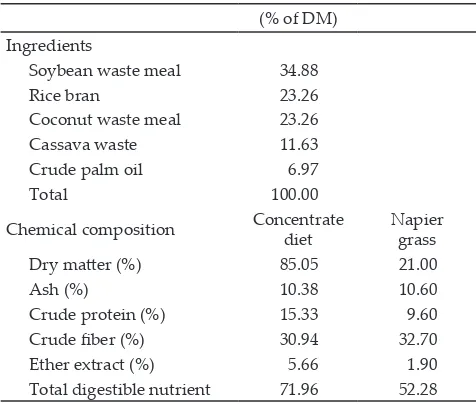
is to protect the bioactive substances in fermented cof-coconut meal, soybean wastes meal, rice bran and crude palm oil. The formulation and chemical analyses of basal diet are presented in Table 2. Goats were fed twice
daily in amounts adequate to ensure dry matter intake of 3.5% body weight per day. The diet was arranged to fulfill the nutrient for goat with crude protein 11%-12% and TDN 55% (NRC, 2001). Feeding trial lasted for 45 d. Goats were milked every day at 07.00 and 17.00. The
Table 1. Nutrient contents of coffee husk substrate fermented
by Pleurotus ostreatus (dry matter basis)
Nutrient components
Table 2. Ingredients of concentrate and chemical composition of basal diet for Etawah goat
Note: T0 (control diet= basal diet without fermented coffee husk supple -mentation), T1 (basal diet with 6% fermented coffee husk supple -mentation), and T2 (basal diet supplemented with 6% fermented coffee husk soaked for an hour in 3%crude palm oil). 1TDN=
To-tal digestible nutrients; calculated by using the equation of NRC (2001).
Chemical composition T0 T1 T2
Dry matter (%) 41.70 42.06 41.76
Ash (%) 9.20 9.45 9.56
Crude protein (%) 11.12 11.92 11.71
Crude fiber (%) 30.65 33.69 32.46
Ether extract (%) 3.09 2.53 2.81
Total digestible nutrient (%)1 55.28 54.91 54.70
Table 3. Chemical composition of diets supplemented with
fer-mented coffee husk for Etawah goat
chemical composition of the experimental diets is pre-sented in Table 3.
Measurements of Feed Intake, Digestibility, and Milk Production
Feed intake. Voluntary feed intake (VFI) for each animal was recorded individually on daily basis. Feed intake was the difference between amount offered and amount left. Dry matter intake (DMI) was estimated from VFI x percentage of dry matter (DM).
Digestibility. Samples of all feed offered, feed left and feces were collected every day during the last week of the experimental period. As much as 10% from the total samples (feed offered, feed left and feces) were collect -ed for determining the nutrients by proximate analysis.
Samples were analyzed for dry matter, organic matter, crude fiber, crude protein and ether extract.
were collected twice daily at regular milking times (07:00 and 17:00). Milk samples were analyzed for fat, protein, total solid (TS) and solid-nonfat (SNF) at Veterinary Pub -lic Health Laboratory of Bogor Agricultural University.
Data Analysis
All statistical analyses of the data obtained were performed with analysis of variance (Steel & Torrie, 2003). Means among treatments were compared by
Duncan Multiple Range Test (DMRT). Statistical differ -ences were expressed at P<0.05.
RESULTS AND DISCUSSION
Feed Intake
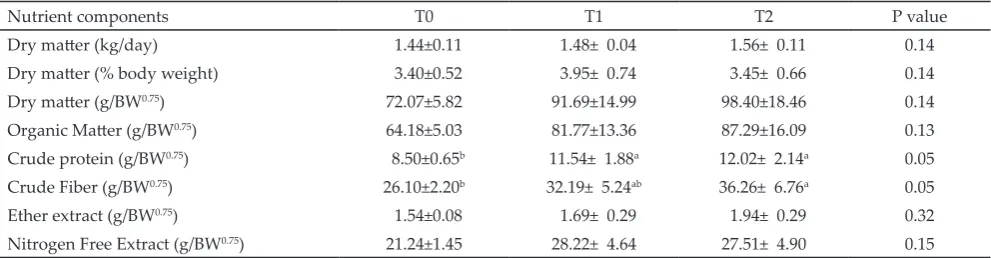
The result showed that the daily intake of dry mat
-ter (DM), organic mat-ter (OM), ether extract (EE), and nitrogen free extract (NFE) were not affected by supple
-mentation of fermented coffee husk (Table 4). This con -dition indicated that the supplementation of fermented
coffee husk did not decrease the palatability of rations.
The improved feed consumption in supplemented ration was possibly related to the improved nutrient quality of
fermented coffee husk (Table 1). Badarina et al. (2013)
re-ported that cultivation of coffee husk with P. ostreatus in-creased its protein and cellulose contents, and dein-creased
its lignin, tannin and caffeine contents. This result was
consistent with another study (Fazaeli et al., 2002), who
reported that the application of rice straw treated with
Pleurotus spp. mushroom in the ration did not influence the dry matter consumption of the ration.
The improved feed consumption in fermented product was probably related to the change in chemical composition or biodegradation of cell wall component of lignocellulose material during fermentation period so that the feeds were easily digested. Sanchez (2009) said that during biodegradation process the conversion of
lignocellulose into a feedstuff, at least one of the three objectives must be reached i.e., the increased protein
content, the enhancement of lignocellulose digestibility and the improved palatability of the dry product.
The crude protein and crude fiber consump -tions in control (T0) group were the lowest (P<0.05) as
compared to the other groups. Results obtained in this
study revealed that supplementation of fermented
coffee husk increased crude protein and crude fiber
consumption (P<0.05). Supplementation of fermented
coffee husk increased the nutrient quality of the rations especially crude protein and crude fiber (Table 3). The
possible reason for the increased quality of ration was
related to good quality of fermented coffee husk. This
result indicated that bioconversion with P. ostreatus
looked promising in increasing the nutritive value of coffee husk. The cultivation of mushroom upgraded the
nutritionally poor residues into a protein-rich material for animal feed. The increased protein content of poor residues during the course of biodegradation was also reported by Parani & Eyini (2012) who found that there
was the protein enrichment in coffee pulp substrate after
biodegradation with white rot fungi.
Digestibility of the Diets
The supplementation of fermented coffee husk in the diet did not affect the digestibility of nutrients (Table
5). The TDN contents were also statistically similar among the diets. The possible reason for this result was that mushroom in the cultivation improved the
digestibility of the coffee husk so that supplementation of fermented coffee husk did not influence the nutrient
digestibility of the basal diets.
The cultivation of coffee husk with P. ostreatus could breakdown the lignin and cellulotic linkage that
facilitates the penetration of the celluloses produced by
rumen microbes that finally improved the crude fiber
digestion. This result is consistent with another study
(Hassim et al., 2012) reporting that the fungal
pre-treat-ment using white rot fungi increases the degradability of palm oil frond in the rumen. This improvement in degradability is contributed by the mushroom that degrades the lignin of palm oil fronds. The removal of lignin barrier causes, cellulose becomes easily accessible for bioconversion.
Note: Means in the same row with different superscripts differ significantly (P<0.05). T0 (control diet= basal diet without fermented coffee husk supple -mentation), T1 (basal diet with 6% fermented coffee husk supple-mentation), and T2 (basal diet supplemented with 6% fermented coffee husk soaked for an hour in 3% crude palm oil).
Nutrient components T0 T1 T2 P value
Dry matter (kg/day) 1.44±0.11 1.48± 0.04 1.56± 0.11 0.14
Dry matter (% body weight) 3.40±0.52 3.95± 0.74 3.45± 0.66 0.14
Dry matter (g/BW0.75) 72.07±5.82 91.69±14.99 98.40±18.46 0.14
Organic Matter (g/BW0.75) 64.18±5.03 81.77±13.36 87.29±16.09 0.13
Crude protein (g/BW0.75) 8.50±0.65b 11.54± 1.88a 12.02± 2.14a 0.05
Crude Fiber (g/BW0.75) 26.10±2.20b 32.19± 5.24ab 36.26± 6.76a 0.05
Ether extract (g/BW0.75) 1.54±0.08 1.69± 0.29 1.94± 0.29 0.32
Nitrogen Free Extract (g/BW0.75) 21.24±1.45 28.22± 4.64 27.51± 4.90 0.15
Milk Production and Composition
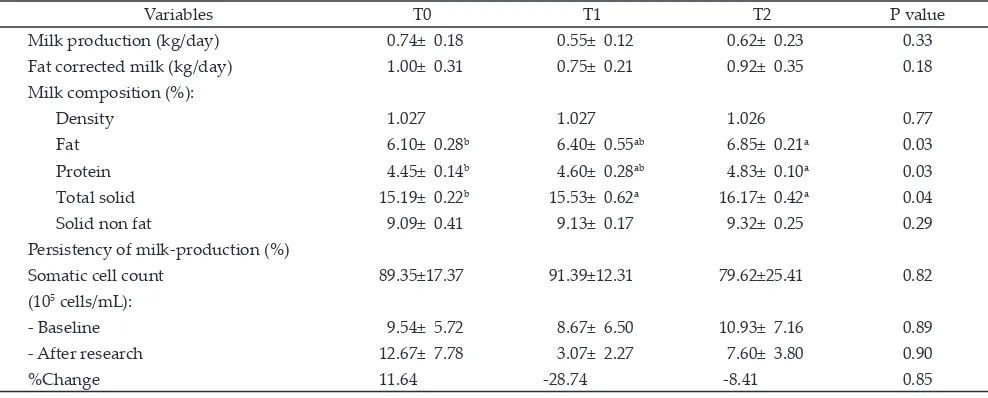
Table 6 shows the average milk yield and its com
-position. The results indicated no significant different in milk yield and fat corrected milk (FCM) among
treatments. It means that supplementation of fermented
coffee husk did not affect milk yield. A possible reason for the lack response in milk yield is because the feed intakes (DM and OM) among treatments were not differ
-ent. The quantity and quality of milk production depend
upon nutrition supply (Min et al., 2005).
The supplementation of fermented coffee husk had a significant effect on milk composition (P<0.05). The
concentration of fat, protein and total solid increased in the supplemented group. This condition may be related
to the milk production. The milk nutrients concentra
-tions were higher in the lower milk production where milk was more concentrate (Table 4).
The persistency of milk production was not different
among treatments. The persistency of T1 treatment was
the highest (91.39±12.31%) than T0 (89.35±17.37%) and T2 (79.62±25.41%). The supplementation of fermented
coffee husk especially on T1 group can maintain the milk
level production for a longer time period. This condition
may be related to the better udder health on T1 group.
The udder’s health was evaluated by determining the somatic cells count (SCC). Somatic cells are indica-tors of both resistance and susceptibility to mastitis and can be used to monitor the level or occurrence of subclinical mastitis in herds or individual cow (Sharif
& Muhammad, 2008; Sudarwanto & Sudarnika, 2008). The somatic cells count were not significant different.
However, there was a tendency that somatic cells count in T1 and T2 groups (supplemented groups) were lower than in T0. The percentage of SCC change was the lowest
in T1 (-28.74%). This condition suggested that there was
the improvement of udder health in the lactating Etawah
goats supplemented with fermented coffee husk (T1 dan T2). The goats supplemented with fermented coffee husk in T1 group could be classified into no infection
condition, while in T2 group, the lactating goat could be
classified into minor pathogen (Sharma et al., 2011). This
study indicated that fermented coffee husk can give the positive effect on animal health by decreasing somatic
Table 5. Nutrients digestibility and total digestible nutrient (TDN) of diets supplemented with fermented coffee husk
Note: Means in the same row with different superscripts differ significantly (P<0.05). T0 (control diet= basal diet without fermented coffee husk supple -mentation), T1 (basal diet with 6% fermented coffee husk supple-mentation), and T2 (basal diet supplemented with 6% fermented coffee husk soaked for an hour in 3% crude palm oil).
Variables T0 T1 T2 P value
Dry matter (%) 76.74±2.76 75.67± 1.52 74.50±3.02 0.57
Organic matter (%) 78.15±3.29 77.44± 1.33 76.26±2.87 0.66
Crude protein (%) 81.47±3.81 80.50± 0.75 78.67±3.30 0.53
Crude fiber) 79.04±6.74 82.88±10.04 76.97±3.00 0.55
Ether extract (%) 85.87±5.14 84.07± 0.91 80.58±2.94 0.11
Nitrogen free extract (%) 82.04±3.31 79.54± 1.98 78.81±3.30 0.25
Total digestible nutrient (%) 61.07±6.45 67.33± 4.05 63.43±2.29 0.29
Table 6. Milk production and milk composition of Etawah goats fed with diets supplemented with fermented coffee husk
Note: Means in the same row with different superscripts differ significantly (P<0.05). T0 (control diet= basal diet without fermented coffee husk supple -mentation), T1 (basal diet with 6% fermented coffee husk supple-mentation), and T2 (basal diet supplemented with 6% fermented coffee husk soaked for an hour in 3% crude palm oil).
Variables T0 T1 T2 P value
Milk production (kg/day) 0.74± 0.18 0.55± 0.12 0.62± 0.23 0.33
Fat corrected milk (kg/day) 1.00± 0.31 0.75± 0.21 0.92± 0.35 0.18
Milk composition (%):
Density 1.027 1.027 1.026 0.77
Fat 6.10± 0.28b 6.40± 0.55ab 6.85± 0.21a 0.03
Protein 4.45± 0.14b 4.60± 0.28ab 4.83± 0.10a 0.03
Total solid 15.19± 0.22b 15.53± 0.62a 16.17± 0.42a 0.04
Solid non fat 9.09± 0.41 9.13± 0.17 9.32± 0.25 0.29
Persistency of milk-production (%)
Somatic cell count 89.35±17.37 91.39±12.31 79.62±25.41 0.82
(105 cells/mL):
- Baseline 9.54± 5.72 8.67± 6.50 10.93± 7.16 0.89
- After research 12.67± 7.78 3.07± 2.27 7.60± 3.80 0.90
cell count. This result was consistent with the results
reported by Wasser (2002) who found that consumption
of mushroom could improve health condition.
CONCLUSION
Fermented coffee husk could be used as ruminant feed supplement without any negative effect on digest
-ibility and milk production. Biodegradation of coffee husk with Pleurotus ostreatus increased its nutritional
value. The positive effects on udder health could be expected from including fermented coffee husk in diets.
ACKNOWLEDGEMENT
This work was supported by research fund from
Directorate General of Higher Education, Ministry of
Education through HIBAH BERSAING with research
agreement No. 2011/UN30.10.06.01/HK/2012/h30.10/
p1/2011 on date March 2nd 2012.
REFERENCES
AOAC. 2005. Official Method of Analysis. 15th edition.
Asso-ciation of Official Analytical Chemist. Washington, DC. USA.
Badarina, I., D. Evvyernie, T. Toharmat, E. N. Herliyana, & L. K. Darusman. 2013. Nutritive value of coffee husk fermented
with Pleurotus ostreatus as ruminant feed. Med. Pet. 36:58-63. http://dx.doi.org/10.5398/medpet.2013.36.1.58
Chan, G. C. F., W. F. Chan, & D. M. Sze. 2009. The effect of
β-glucan on human immune and cancer cells. J. Hematol. Oncol. 2:1-11. http://dx.doi.org/10.1186/1756-8722-2-25
Chen, J. & R. Seviour. 2007. Medicinal importance of fungal
β-(1- 3), β-(1-6) - glucans. Mycol. Res. 3:635-652. http://dx.doi. org/10.1016/j.mycres.2007.02.011
Fan, L., A.T. Soccol, A. Pandey, L. P. S. Vandenberghe, & C. R. Soccol. 2006. Effect of caffeine and tannins on cultiva -tion and fructifica-tion of Pleurotus on coffee husks. Braz. J. Microbiol. 37:420-424. http://dx.doi.org/10.1590/S1517-83822006000400003
Fazaeli, H., H. Mahmodzadeh, J. B. Liang, A. Azizi, & A. Os-man. 2002. Effect of fungal treated wheat straw on the diet
of lactating cows. Asian-Aust. J. Anim. Sci. 15:1573-1578. http://dx.doi.org/10.5713/ajas.2002.1573
Fazaeli, H., H. Mahmodzadeh, A. Azizi, Z. A. Jelan, J. B. Liang, Y. Rouzbehan, & A. Osman. 2004. Nutritive value of wheat straw treated with Pleurotus fungi. Asian-Aust. J. Anim. Sci. 17:1681-1688. http://dx.doi.org/10.5713/ajas.2004.1681
Goering, H. K. & P. J. Van Soest. 1970. Forage Fiber Analysis. Agriculture Handbook No. 379. Agricultural Research
Harborne, J. B. 1989. General Procedures and Measurement of Total Phenolics. In: J. B. Harborne (Ed). Methods in Plant Biochemistry. Volume I. Plant Phenolics. Academic Press, London.
Hassim, H. A., M. Laurenco, Y. M. Goh, J. J. P. Baars, & V. Fievez. 2012. Rumen degradation of oil palm fronds is im -proved through pre-digestion with white rot fungi but not
through supplementation with yeast or enzymes. Can. J. Anim. Sci. 92:79-87. http://dx.doi.org/10.4141/cjas2011-097
Herliyana, E. N., D. Nandika, Achmad, L. I. Sudirman, & A. B. Witarto. 2008. Biodegradation of sengon-wood sawdust substrate by Pleurotus group fungi from Bogor. Journal of Tropical Wood Science and Technology 6:75-84.
Min, B. R., S. P. Hart, T. Sahlu, & L. D. Satter. 2005. The effect
of diets on milk production and composition, and on lacta -tion curves in pastured dairy goats. J. Dairy. Sci. 88:2604-2615. http://dx.doi.org/10.3168/jds.S0022-0302(05)72937-4
Murthy, P. S. & K. Mannomani. 2008. Bioconversion of cofffee
industry wastes with white rot fungus Pleurotus Florida. Res. J. Environ. Sci. 2:145-150. http://dx.doi.org/10.3923/ rjes.2008.145.150
Novak, M. & V. Vetvicka. 2009. Glucans as biological response modifiers. Endocrine, Metabolic & Immune Disorders-Drug Targets. 9:67-75. http://dx.doi.org/10.2174/18715300 9787582423
NRC. 2001. Nutrient Requirement of Dairy Cattle. Revised Ed.
National Academic Press, Washington DC.
Okano, K., S. Fukui, R. Kitao, & T. Usagawa. 2007. Effect of
cultural length of Pleurotus eryngii grown on sugarcane bagasse on in vitro digestibility and chemical composi-tion. Anim. Feed. Sci. Technol. 136: 240-247. http://dx.doi. org/10.1016/j.anifeedsci.2006.08.024
Parani, K. & M. Eyini. 2012. Biodegradation of coffee pulp
waste by different fungal associations. Bioscience Discov -ery 3: 222-228
Patel, Y., R. Naraian, & V. K. Singh. 2012. Medicinal properties of Pleurotus species (Oyster mushroom): A review. World Journal of Fungal and Plant Biology 3:01-12.
Periasamy, K. & K. Natarajan. 2004. Role of lignocellulosic en -zymes during basidiomata production by Pleurotus djamor var roseas. Indian Journal of Biotechnology 3: 577-583
Sanchez, C. 2009. Lignocellulosic residues: Biodegradation and bioconversion by fungi. Research review paper. Biotechnol. Adv. 27:185-194. http://dx.doi.org/10.1016/ j.biotechadv.2008.11.001
Sharif, A. & G. Muhammad. 2008. Somatic cell count as an indicator of udder heallth status under modern dairy pro-duction: A Review. Pakistan Vet. J. 28:194-200.
Sharma, N., N. K. Singh, & M. S. Bhadwal. 2011. Relation -ship of somatic cell count and mastitis: An Overview. Asia-Aust. J. Anim. Sci. 24:429-438. http://dx.doi.org/10.5713/ ajas.2011.10233
Shearer, J. K. & Jr. B. Harris. 2008. Mastitis in Dairy Goats. IFAS Extention. University of Florida, USA.
Steel, R. G. D. & J. H. Torrie. 2003. Principles and Procedures of Statistics. 2ed. Mc. Graw-Hill Book Co. Inc., New York. Sudarwanto, M. & E. Sudarnika. 2008. The relationship
be-tween pH value of milk and the somatic cell count as a parameter of sub-clinical mastitis detection. Med. Pet. 31: 107-113.
Tabrizi, M. H. R., H. Sadeghipanah, M. Chamami, Y. Ebra-him-Nejad, & H. Fazaeli. 2011. In-vitro gas production of wheat grain flour coated with different fat types and lev -els. African J. Biotechnol. 10:7710-7716.
Wasser, S. P. 2002. Medicinal mushrooms as a source of anti-tumor and immunomodulating polysaccharides (mini-review). Appl. Microbiol. Biotechnol. 60: 258-274. http:// dx.doi.org/10.1007/s00253-002-1076-7