INTRODUCTION
In Worldwide, coffee is the most valuable traded commodity after oil (DaMatta, Ronchi, Maestri, & Barros, 2007). Coffee sector has demonstrated remarkable resilience, during economic crisis. Coffee production value has grown at over 3.5 % per year since 2008, in agriculture, which is faster 2.5 % than overall growth (FAO, 2015). Arabica dominated world’s coffee production ca. 60 %, while robusta is 40 %. In China and Indonesia, robusta is now the bean of choice. From 2013 to 2014, arabica and robusta increase in prices from US$ 2.90 to US$ 4.18 and from US$ 1.96 to US$ 2.09 respectively (FAO, 2015).
Morphological, physiological and biochemical aspects are affected by soil and water availability, C/N ratio, temperature, light, crop load and genotype influence flowering process on coffee (DaMatta,
Ronchi, Maestri, & Barros, 2007). For coffee production, drought and unsuitable temperatures are the main climatic limitations (DaMatta & Ramalho, 2006).
There is a positive impact related to abundance of bee and flower’s number on the number of coffee berries harvested. The increasing of coffee production is caused by the increasing of bee abundance, and this effect is initially by an increase in flower’s number (Boreux, Kushalappa, Vaast, & Ghazoul, 2013). In addition, the increasing of fruit set on both sterile and fertile coffee are caused by cross pollination of bee (Klein, Steffan-Dewenter, & Tscharntke, 2003). Fruit set on both Coffea canephora and C. arabica is increased by social bee, however it has different ways of pollination. Common visitors of coffee flowers is honey bees and stingless bees (Ngo, Mojica, & Packer, 2011).
Floral Stimulation and Behavior of Insect Pollinators Affected by Pyraclostrobin on
Arabica Coffee
Hagus Tarno1*), Karuniawan Puji Wicaksono2) and Edson Begliomini3)
1) Plant Protection Department, Faculty of Agriculture, Universitas Brawijaya, Indonesia 2)Department of Agronomy, Faculty of Agriculture, Universitas Brawijaya, Indonesia 3) Regional APA R&D Asia Pacific, BASF South East Asia
ARTICLE INFO
Coffee is the most valuable traded commodity after oil. On coffee, bees act to support a pollination that is shown by the number of harvested berries. This research aimed to evaluate the use of pyraclostrobin on flowering stage and insect pollinators on Arabica Coffee. Experiment was conducted in Kalisat Coffee Farm, Jampit, Bondowoso, ca. 1600 meters after sea level from October 2013 to April 2014. Randomized Block Design was adopted in this experiment. Three doses of pyraclos-trobin and control were used as treatments such as 1.0, 1.5 and 2.0 cc L-1 of pyraclostrobin, and repeated three times. Percentage of fallen flower, fruiting stage, fruit production, frequency of bee`s visitation, and bee`s behavior was observed as variables in this experiment. Results showed that 1) percentage of fallen flowers was reduced by applying pyraclostrobin at 1.5 and 2.0 cc L-1 up to 50 % compared to control, 2) flowering rate was faster than control at 1.5 and 2.0 cc L-1 of pyraclos
-trobin, 3) application of 1.5 – 2.0 cc L-1 of pyraclostrobin increased the
number of young fruits and pinheads, and 4) pollinatorspreferred to vis -it flowers of coffee trees which sprayed by pyraclostrobin than control treatment especially Apis mellifera.
In Indonesia, there are several species of insects contributing in pollination of C. arabica e.g. Apis nigrocincta, A. dorsata, A. cerana, Lepidotrigona terminata, Megachile frontalis, and Nomia thoracica. Apis dorsata, A. cerana, A. nigrocincta, L. terminata, and M. frontalis contributed in C. canephora pollination (Klein, Steffan-Dewenter, & Tscharntke, 2003; Ngo, Mojica, & Packer, 2011). Management in the cultivation of coffee influence the insect pests, natural enemies and pollinators. Conventional management is commonly applied agricultural chemicals on farm to control the pests and diseases. Chemical inputs on agriculture cause people and the environment to expose the toxic substances easily. To pursue alternative pest control strategies, and to reduce the risks on human and pollinator as well as to minimize costs of inputs, choosing friendly chemicals are better solution than unfriendly ones (Gemmill-Herren, Allara, Koomen, van der Valk, & Roubik, 2012). The pollinator visitation is highly dependent on a particular management intervention (Boreux, Kushalappa, Vaast, & Ghazoul, 2013). Agricultural chemicals can be devided into three groups based on effect on bee pollinators such as (1) harmless to bees (e.g., pymetrozine, essential oils, dicofol); (2) harmful to honey bees (e.g., coumaphos, cyfluthrin, fluvalinate, permethrin); and (3) repellents on honey bees (e.g., butyric acid, citronella) (De Stefano, Stepanov, & Abramson, 2014)
In enhancing plant heath, and rise production, prophylactic fungicides have been suggested to manage foliar diseases (Mahoney, Vyn, & Gillard,
2015). Strobilurin as group of pyraclostrobin, increased plant health, yield and reduced foliar disease (Mahoney, Vyn, & Gillard, 2015). In addition, pyraclostrobin also can be applied to delay plant viral and bacterial diseases on tomato under controlled environmental conditions (Skandalis et al., 2016). Considering pyraclostrobin benefits and the important value of coffee, it is important to evaluate the effect of pyraclostrobin on flowering and insect pollinators of arabica coffee.
MATERIALS AND METHODS
This research aimed to evaluate the use of pyraclostrobin on the flowering stimulation and the activity of pollinators on Arabica Coffee. Research was conducted in Kalisat Coffee Farm, Jampit, Bondowoso (PTPN XII Tbk.), at ca. 1600 meters after sea level (masl) from October 2013 to April 2014. Randomized Block Design was adopted in this experiment. Three doses of pyraclostrobin (F500) and control were used as treatments in this research and repeated three times. The treatments were 1.0, 1.5 2.0 cc L-1, and control (0 cc L-1) of
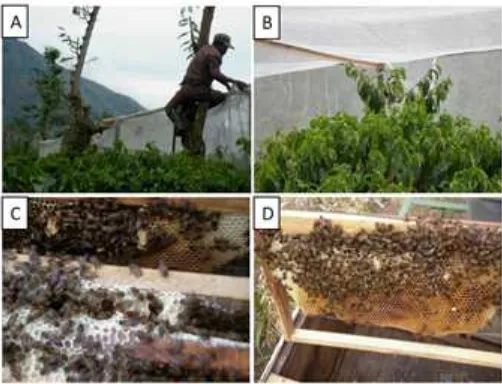
pyraclostrobin. Preparing cages for coffee trees and bees for experiments were described in Fig. 1.
Pyraclostrobin was sprayed three times on bud nodes (sleeping, waxing and pinhead stages): 1st spraying on 23 October 2013, 2nd spraying on 9
November 2013 and 3rd spraying on 25 November
2013. Honey bees were released after the flowers bloom. Two insect pollinators were used i.e.: Apis indica and A. mellifera.
Percentage of fallen flower (flowering stage), fruiting stage, fruit production (crop variables), frequency of bee`s visitation, and bee`s behavior (bee`s variables) were observed as variables in this experiment.
Data were analysed using Sigmaplot 12 software. Descriptive analysis, and Analysis of Variance (ANOVA) were adopted in this research to create the diagram and to check the differences between all treatments (SigmaPlot, 2013).
RESULTS AND DISCUSSION
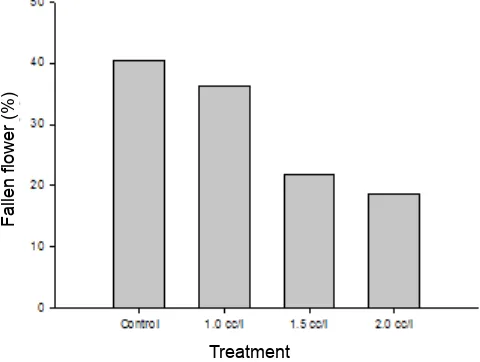
Based on the results, there are several facts shown by pyraclostrobin application on arabica coffee related to flowering stages. Percentage of fallen flowers is reduced by application of pyraclostrobin at 1.5 and 2.0 cc L-1 up to 50 % compared to control (Fig. 2). Percentage of fallen flowers can be declined from ca. 40 % to 20 % or less by applying pyraclostrobin at 1.5 and 2.0 cc L-1 doses. It is in line with soybean case in which under low levels of foliar disease, and delayed maturity, pyraclostrobin stimulate plant health and increase yield (Mahoney, Vyn, & Gillard, 2015). In addition, pyraclostrobin significantly reduced leaf defoliation, when it is applied at R3 growth stage on all tested cultivars (Mahoney, Vyn, & Gillard, 2015).
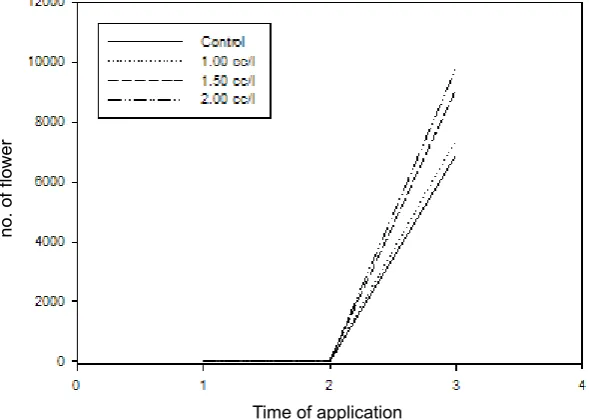
Based on total average number of flowers, application of pyraclostrobin at 1.5 and 2.0 cc L-1 enhances flowering rate of arabica coffee starting from 2nd to 3rd application (Fig. 2). Average number
of flowers for each treatment is presented in Fig.
3. Application of pyraclostrobin at 1.5 and 2.0 cc L-1 is higher number than control. Application of
pyraclostrobin increased vegetative (Camargo, Weber, Júnior, Ono, & Rodrigues, 2015; Skandalis et al., 2016) and generative phases of plants (Hausladen, Adolf, & Leiminger, 2015; Hardiansyah, Sulistyaningsih, & Putra, 2017). In addition, disease incidence of Cucumber Mosaic Virus (CMV) on tomato was reduced and based on gene expression analysis, application of pyraclostrobin affected MAPKs transcript levels and a possible interference with plant stress responses (Skandalis et al., 2016). Vegetative development of ‘Niagara Rosada’ grapevine seedlings can be assisted by application of putrescine and pyraclostrobin separately (Camargo, Weber, Júnior, Ono, & Rodrigues, 2015). Pyraclostrobin caused changes in the metabolism of plants resulting in higher biomass and yield (Kanungo & Joshi, 2014).
Based on number of young fruits and pinheads per branch and per tree, pyraclostrobin at 1.5 and 2.0 cc L-1 increases the number of young fruits and
pinheads of arabica coffee (Fig. 4). Application of pyraclostrobin could increase indoleacetic acid (IAA) content, and the numbers of flower and fruit were stimulated by the increasing of IAA content in plant tissue (Hardiansyah, Sulistyaningsih, & Putra, 2017). In addition, IAA can contribute to stimulate the plant growth and the plant growth promotes rhizobacteria such as Pseudomonas putida (Leveau & Lindow, 2005).
Fig. 2. Percentage of fallen flowers after 3rd evaluation for each treatment
Treatment
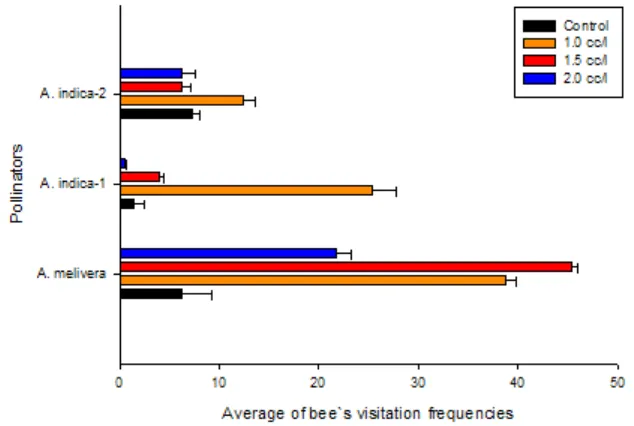
Based on insect pollinator variable, Apis mellifera prefers to visit trees which are sprayed by pyraclostrobin Fig. 5 and Fig. 6. The intensity of bee’s visit is caused by the number of flower. Pyraclostrobin plays a role to stimulate the number of flower on coffee and the number of flowers can stimulate and increase the intensity of bee’s visit. Pyraclostrobin are typically seen as fairly safe for honey bees (Pettis et al., 2013).
Number of bee species on flower of C. canephora was higher than C. arabica significantly.
was also higher than C. arabica (Klein, Steffan-Dewenter, & Tscharntke, 2003). About 15.8% increased fruit set was caused by bee pollination compared to wind pollination plus autogamy (Klein et al., 2003). Pollen removal, pollen deposition, and fruit set were influenced by the most effective pollinators, rather than visitor frequency (Barrios, Pena, Salas, & Koptur, 2016). Highly mutualistic between flower and pollinator can be shown by morphological and behavioral adaptations of bee, as well as nectar production by the flower (Shimizu Fig. 3. Pattern of flowering rate based on three times observation for each treatment
Time of application
no. of flower
Fig. 4. Number of young fruits and pinheads for each treatment, per branch (A) and per tree (B); Asteric (*) showed significant differences based on 5% significant level of Tukey’s HSD
Treatment Treatment
No. of young fruits and pinheads
Both honey bees, A. mellifera and A. indica have similar activities such as they fly out from their colonies at 05.00 a.m. Before that, they clumped and lined together with others and oriented around their nest. When temperature is increased, they fly around plot and fly away vertically and then fly down to the flower. Generally, honey bees live in large colonies with a caste system (Kimball & Wilson, 2009) and it’s classified into eusocial insect (Crespi & Yanega, 1995). Classification of sociality separate eusocial and semi-social or sub-semi-social insect (Crespi & Yanega, 1995).
Honey bee such as A. mellifera and A. indica clearly described eusocial insect that infertile female workers, a fertile queen bee, and male drones are constructed a caste system (Crespi & Yanega, 1995)(Kimball & Wilson, 2009) and semi-social or sub-social insects was described by Platypus quercivorus (Tarno, Qi, Yamasaki, Kobayashi, & Futai, 2016) Collecting of pollen was conducted by worker bees actively. Hiving of pollen by worker bees aimed to support the developing young as feed (Kimball & Wilson, 2009). Fig. 5. Average number of bee`s visitation on flowers (go out from their nest) for each treatment
CONCLUSION
There are several items that can be concluded in this research i.e.: percentage of fallen flowers is reduced by application of pyraclostrobin at 1.5 and 2.0 cc L-1 up to 50 % compared to control, flowering
rate is faster than control treatment especially at 1.5 and 2.0 cc L-1 of pyraclostrobin, application of pyraclostrobin at 1.5 – 2.0 cc L-1 increases the
number of young fruits and pinheads of Arabica Coffee, and pollinators prefers to visit flowers of coffee trees which are sprayed by pyraclostrobin especially Apis mellifera.
REFERENCES
Barrios, B., Pena, S. R., Salas, A., & Koptur, S. (2016). Butterflies visit more frequently, but bees are better pollinators: The importance of mouthpart dimensions in effective pollen removal and deposition. AoB PLANTS, 8, 1–10. https://doi. org/10.1093/aobpla/plw001
Boreux, V., Kushalappa, C. G., Vaast, P., & Ghazoul, J. (2013). Interactive effects among ecosystem services and management practices on crop production: Pollination in coffee agroforestry
systems. Proceedings of the National Academy
of Sciences of the United States of America, 110(21), 8387–8392. {Formatting Citation}
Camargo, R. B., Weber, R., Júnior, W. J., Ono, E. O., & Rodrigues, J. D. (2015). Cytokinin, pyraclostrobin and putrescine: Influence in the development of grape vitis labrusca cultivar Niagara Rosada.
American International Journal of Biology, 3(31), 19–31. http://doi.org/10.15640/aijb.v3n1a2
Crespi, B. J., & Yanega, D. (1995). The definition of eusociality. Behavioral Ecology, 6(1), 109–115. https://doi.org/10.1093/beheco/6.1.109
DaMatta, F. M., & Ramalho, J. D. C. (2006). Impacts of drought and temperature stress on coffee physiology and production: A review. Brazilian Journal of Plant Physiology, 18(1), 55–81. http:// doi.org/10.1590/S1677-04202006000100006
DaMatta, F. M., Ronchi, C. P., Maestri, M., & Barros, R. S. (2007). Ecophysiology of coffee growth and production. Brazilian Journal of Plant Physiology,
19(4), 485–510. http://doi.org/10.1590/S1677-04202007000400014
De Stefano, L. A., Stepanov, I. I., & Abramson, C. I. (2014). The first order transfer function in the analysis of agrochemical data in honey bees (Apis mellifera L.): Proboscis extension reflex (PER) studies. Insects, 5(1), 167–198. https://doi.org/10.3390/ insects5010167
FAO. (2015). FAO statictical pocketbook coffee 2015.
Rome, IT: FAO. Retrieved from http://www.fao. org/3/a-i4985e.pdf
Gemmill-Herren, B., Allara, M., Koomen, I., van der Valk, H., & Roubik, D. W. (2012). Chapter 1: An agroecosystem approach to protecting pollinators from pesticides. In Pollinator safety in agriculture (pp. 1-14). Retrieved from http:// www.fao.org/3/a-i3800e/i3800e01.pdf
Hardiansyah, A. N., Sulistyaningsih, E., & Putra, E. T. S. (2017). Effects of Pyraclostrobin on Growth and Yield of Curly Red Chili (Capsicum Annum L.).
Ilmu Pertanian (Agricultural Science), 2(1),
009-014. http://doi.org/10.22146/ipas.12841
Hausladen, H., Adolf, B., & Leiminger, J. (2015). Evidence of strobilurine resistant isolates of A. solani and A. alternata in Germany. Paper presented
at Fifteenth Euroblight Workshop, PPO –
Special Report No. 17, Brasov – Romania, 10-13 May (pp. 93-100). Retrieved from http:// euroblight.net/fileadmin/euroblight/Workshops/ B r a s o v / P a p e r s / 1 2 . _ H a u s l a d e n _ A d o l f _ resistance-p93-100.pdf
Kanungo, M., & Joshi, J. (2014). Impact of pyraclostrobin (F-500) on crop plants. Plant Science Today, 1(3), 174–178. http://doi.org/10.14719/pst.2014.1.3.60
Kimball, S., & Wilson, P. (2009). The Insects That Visit Penstemon Flowers. Bulletin of the American Penstemon Society, 68, 20–28.
Klein, A. M., Steffan-Dewenter, I., & Tscharntke, T. (2003). Bee pollination and fruit set of Coffea arabica and C. canephora (Rubiaceae). American Journal of Botany, 90(1), 153–157. http://doi.org/10.3732/ ajb.90.1.153
Leveau, J. H. J., & Lindow, S. E. (2005). Utilization of the plant hormone indole-3-acetic acid for growth by
Pseudomonas putida strain 1290. Applied and
Mahoney, K. J., Vyn, R. J., & Gillard, C. L. (2015). The effect of pyraclostrobin on soybean plant health, yield, and profitability in Ontario. Canadian Journal of Plant Science, 95(2), 285–292. http:// doi.org/10.4141/cjps-2014-125
Ngo, H. T., Mojica, A. C., & Packer, L. (2011). Coffee plant – pollinator interactions: A review. Canadian Journal of Zoology, 89(8), 647–660. http://doi. org/10.1139/z11-028
Pettis, J. S., Lichtenberg, E. M., Andree, M., Stitzinger, J., Rose, R., & VanEngelsdorp, D. (2013). Crop pollination exposes honey bees to pesticides which alters their susceptibility to the gut pathogen
Nosema ceranae. PLoS ONE, 8(7), e70182.
http://doi.org/10.1371/journal.pone.007 0182
SigmaPlot. (2013). What can SigmaPlot do for you?
Retrieved from http://www.solutions4u-asia.com/ PDT/SYSTAT/sigmaplot/SPlot-Overview.html.
Shimizu, A., Dohzono, I., Nakaji, M., Roff, D. A., Miller, D. G., Osato, S., … Yoshimura, J. (2014). Fine-tuned bee-flower Coevolutionary state hidden within multiple pollination interactions. Scientific Reports,
4, 1–9. https://doi.org/10.1038/srep03 988