LADDER, AND WINDMILL GRAPH WITH A PATH
Retia Kartika Dewi, Mania Roswitha, Titin Sri Martini Department of Mathematics
Faculty of Mathematics and Natural Sciences Sebelas Maret University
Abstract. A simple graphG= (V, E) admits anH-labeling if every edgee∈E(G) belongs to a subgraph ofGisomorphic toH. Furthermore,GcontainsH-labeling if there exists a bijection functionf :V(G)∪E(G)→ {1,2,· · ·,|V(G)|+|E(G)|}, such that for each subgraphH′
ofG isomorphic toH,f(H′
) =∑v∈Vf(v)×
∑
e∈Ef(e) =m(f) wherem(f) is a magic sum. Then
Gis anH-supermagic iff(V) ={1,2,· · ·,|V(G)|}. This research aims to findH-super magic labeling on corona product, which: a fan graph with a path (Fn⊙Pm) wheren ≥4, m ≥3,
a ladder graph with a path (Ln⊙Pm), where n, m ≥ 3, and a windmill graph with a path
(W3,m⊙Pm) wherem≥3. The result show thatFn⊙Pmform≥3 and n≥4 is C3⊙Pm
-supermagic, a Ln⊙Pm for m, n≥ 3 is C4 ⊙Pm-supermagic, and W3,m⊙Pm form ≥3 is
C3⊙Pm-supermagic.
Keywords: H-supermagic labeling, fan graph, ladder graph, windmill graph, path
1. Introduction
Gallian[1] defined a graph labeling as an assignment of integers to the vertices or edges, or both, subject to certain conditions. Magic labeling was first introduced by Sedl´aˇcek [3] in 1963.
The concept ofH-magic graphs was introduced by Guti´errez and Llad´o [4] in 2005. Suppose G= (V, E) admits an H-covering. We say that a bijective functionf :V(G)∪ E(G)→ {1,2, . . . ,|V(G)|+|E(G)|}is anH-magic labeling of Gif there exists a positive integerm(f), called magic sum, such that for any subgraphH′
= (V′, E′
) ofGisomorphics to H, the sum ∑
v∈V′f(v) +
∑
e∈E′f(e) is equal to the magic sum, m(f). If f(V) = {1,2, . . . ,|V(G)|}, then we say that f is anH-supermagic labeling ands(f) is a constant supermagic sum.
Llad´o and Moragas [5] proved thatC3-supermagic labeling on a wheel graphWnfor
n ≥5 odd and a C4-supermagic labeling of a prism graph and a book graph. Roswitha et al. [7] proved H-supermagic labeling for some classes of graphs such as a Jahangir graph, a wheel graph for even n, and a complete bipartite graphKm,n form= 2. In this paper we found that a corona product of fan graph with a path (Fn⊙Pm) is a C3⊙Pm -supermagic forn≥4, m≥3, a corona product of a ladder graph with a path (Ln⊙Pm) is a C4⊙Pm-supermagic form, n≥3, and a corona product of windmill graph with a path (W3,m⊙Pm) is a C3⊙Pm-supermagic form≥3.
2. Main Results
2.1. k-balanced multiset. In [6] had introduced a technique of partitioning a multiset, called k-balanced multiset.
Let k ∈ N and Y be a multiset that contains positive integers. Y is said to be k-balanced if there exist k subsets of Y, say Y1, Y2, . . . , Yk, such that for everyi ∈[1, k],
|Yi| = |Yk|,ΣYi = ΣkY ∈ N, dan ⊎ki=1Yi = Y. If this case for every i ∈ [1, k] then Yi is called a balanced subset ofY.
Lemma 2.1. (Roswitha et al.[7]) Let x and y be non negative integers. Let X = [x+ 1, x+k]with|X|=kandY = [y+ 1, y+k]where|Y|=k. Then the multiset K =X⊎
Lemma 2.2. (Maryati [6]) Let x, y and z be positive integers. Then multiset Y = [x+ 1, x+k]⊎[y+ 1, y+k]⊎[z+ 1, z+k]isk-balanced fork≥3 odd.
Lemma 2.3. (Maryati [6]) Let x, y and k be integers, such that 1≤x≤y and k >1. If X = [x, y]and |X| is a multiple2k, then X is k-balanced.
2.2. (k, δ)-anti balanced multiset. Inayah [2] also introduced (k, δ)-anti balanced as follows. Letk∈N andXbe a multiset containing positive integers. ThenX is said to be (k, δ)-anti balanced if there existsksubsets of X, sayX1, X2,· · · , Xk, such that for every
i∈[1, k],|Xi|=|Xk|,ΣXi = ΣXk ∈N,⊎ik=1Xi =X and fori∈[1, k−1],ΣXi+1−ΣXi =δ is satisfied.
Lemma 2.4. Let x, yand zbe non negative integers. LetY = [x+ 1, x+k]⊎[y+ 1, y+ k]⊎[z+ 1, z+k] is (k,1)-anti balanced fork≥4 even.
Proof. For evenk≥4 and every i∈[1, k], we define the multisetsYi ={a1, bi, ci}, where ai = x+i
bi = y+k+ 1−i
ci = z+i Furthermore, we define
A= {ai|1≤i≤k} = [x+ 1, x+k]
B = {bi|1≤i≤k} = [y+ 1, y+k]
C = {ci|1≤i≤k} = [z+ 1, z+k].
For everyi∈ [1, k] we obtain |Yi|= 3 ;Yi ⊂Y and ⊎ki=1Yi =Y wherek ≥4 even, because ΣYi =x+y+z+k+ 1 +i, so for every i∈[1, k], Σ(Yi+1)−Σ(Yi) = 1. Hence, for every i∈[1, k], Y is (k,1)-anti balanced.
Lemma 2.5. Letx andybe non negative integers, then multisetY = [x+ 1, x+k]⊎[y+ 1, y+k] is (k,1)-anti balanced for k≥3 odd.
Proof. For oddk≥3 and every i∈[1, k], we define the multisetsYi ={a1, bi, ci}, where ai = i+ 1,
bi =
{
2k+ 1− ⌊k
2⌋ − ⌊
i+1
2 ⌋, fori even;i∈[1, k]
2k+ 2− ⌈i
2⌉, fori odd;i∈[1, k].
Furthermore, we define
A ={ai|1≤i≤k} = [x+ 1, x+k]
B ={bi|1≤i≤k} = [y+ 1, y+k],
we obtain|Yi|= 2 ; Yi⊂Y and ⊎ki=1Yi=Y where k≥3 odd, because ΣYi =
{
x+y+k+⌈i
2⌉, for iodd;i∈[1, k],
x+y+ (k+1 2 ) +⌊
i+1
2 ⌋, for ieven;i∈[1, k],
so Σ(Yi+2)−Σ(Yi) = 1. Hence, for every i∈[1, k],Y is (k,1)-anti balanced. Lemma 2.6. Let x and k be non negative integers, then multiset X = [1, k+ 1]\{k
2 + 1} ⊎[x+ 1, x+k] is (k,1)-anti balanced fork≥4 even.
Proof. For oddk≥4 and every i∈[1, k], we define the multisetsXi ={a1, bi, ci}, where ai =
{
i fori∈[1,k2]
i+ 1 fori∈[k
2+ 1, k]
bi =
{
2k+ 1−2i+ 3, fori∈[1,k
2]
3k−2i+ 2, fori∈[k
Furthermore, we define
A={ai|1≤i≤k} = [1, k+ 1]\{k2+ 1},
B ={bi|1≤i≤k} = [x+ 1, x+k],
we obtain|Yi|= 2 ; Yi⊂Y and ⊎ki=1Yi=Y where k≥3 odd, because ΣXi =
{
x+k+ 2−i, fori∈[1,k2], 2x+k+ 1−i, fori∈[k
2 + 1, k],
so Σ(Xi)−Σ(Xi+1) = 1. Hence, for everyi∈1 andi∈ k2+1,Y is (k,1)-anti balanced. Here we provide three examples of those lemmas as follows.
(1) Let Y = [55,60]⊎[61,66]⊎[67,22] where x = 54, y = 60, z = 66, and k = 6. According to Lemma 2.4, we have 6-subsets ofY as follows. Y1 ={55,66,67}, Y2=
{56,65,68}, Y3={57,64,69}, Y4 ={58,63,70}, Y5 =
{59,62,71},and Y6 ={60,61,72}. Hence, Σ(Yi+1)−Σ(Yi) = 1 for i∈ [1,6] and ΣYi = 187 +i, thenY is (6,1)-anti balanced.
(2) Let Y = [2,4]⊎[5,7] wherex= 1, y = 4,and k= 3. According to Lemma 2.5, we have 3-subsets of Y as follows. Y1 ={2,7}, Y2 ={3,5}, and Y3 = {4,6}. Hence, Σ(Yi+2)−Σ(Yi) = 1 for i∈[1,3] and
ΣYi = {
8 +⌈i
2⌉, ifiodd, for i∈[1,3] 7 +⌊i+1
2 ⌋, ifieven, for i∈[1,3], and we have thatY is (3,1)-anti balanced.
(3) Let X= [1,5]\{3} ⊎[6,9] wherex= 5 and k= 4. According Lemma 2.6, we have 4-subsets ofX as follows. X1 ={1,9}, X2 ={2,7}, X3 ={4,8} and X4 ={5,6}. Hence, Σ(Xi)−Σ(Xi+1) = 1 for i∈1 andi∈3. Furthermore,
ΣXi = {
11−i, fori∈[1,2] 15−i, fori∈[3,4], thenX is (4,1)-anti balanced.
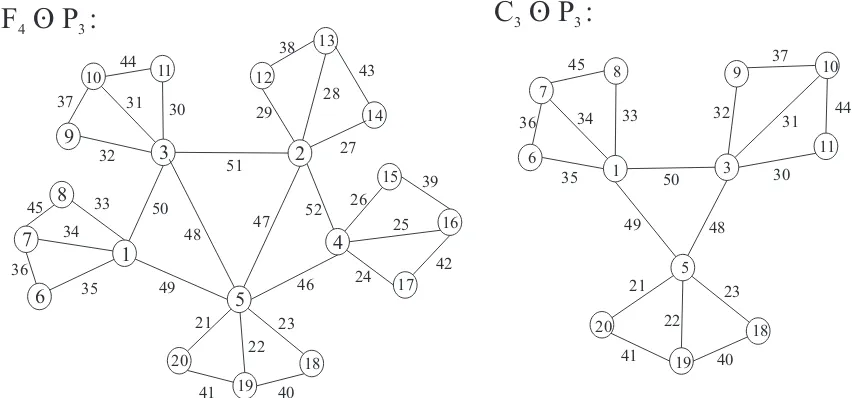
2.3. C3⊙Pm-Supermagic Labeling On Corona Product of A Fan and A Path. Theorem 2.1. A graphFn⊙Pm isC3⊙Pm-supermagic for m≥3, n≥4.
Proof. LetGbe a graph Fn⊙Pm. ThenV(G) ={vi; 0≤i≤n} ⊎ {bj; 1≤j ≤m(n+ 1)} and E(G) ={v0v1, v0v2,· · · , vn−1vn} ⊎ {cj; 1≤j≤m(n+ 1)}⊎
{ai
j; 1≤i≤n+ 1; 1≤j≤m−1}where|V(G)|= (n+1)+m(n+1) and|E(G)|= 2m(n+ 1)n−2. We have bijective function f : V(G)∪E(G) → {1,2, . . . ,3m(n+ 1) + 2n−1}. Given a set of labels for all vertices and edges of Gdenoted by Z, where Z = [1,3m(n+ 1) + 2n−1]. PartitionZ into 5 sets : A= [1, n+ 1], B= [n+ 2,(n+ 1) +m(n+ 1)], C= [(n+ 1) +m(n+ 1) + 1,(2m+ 1)(n+ 1)], D = [(2m+ 1)(n+ 1) + 1,3nm+ 3m], E = [3mn+ 3m+ 1,3mn+ 3n+ 2n−1].
All vertices and edges of subgraphHi labeled with some certainty. The setAis used to label vertices vi where 0≤i≤n,E is used to label edges {v0v1,· · · , v0vn,· · ·, vn−1vn,
vnv1}.
Label each vertex ofFn graph other than central vertex by f(vi) =
{ 1
2(i+ 1), foriodd;i∈[1, n],
⌊1
2(n+i+ 1)⌋, forieven;i∈[1, n],
f(v0vi) = 3mn+ 3m+n+ 1−i, fori∈[1, n],
if we set, f(v0) = n+ 1, then the constant supermagic sum of C3 is f(C3) = proof we divided the proof by 2 cases, based on values ofm.
Case 1. m is odd (m≥3).
The constant supermagic sum of subgraphC3⊙Pm as follows.
f(C3⊙Pm) =
Figure 1, illustrates an example ofC3⊙P3-supermagic labeling on aF4⊙P3 graph.
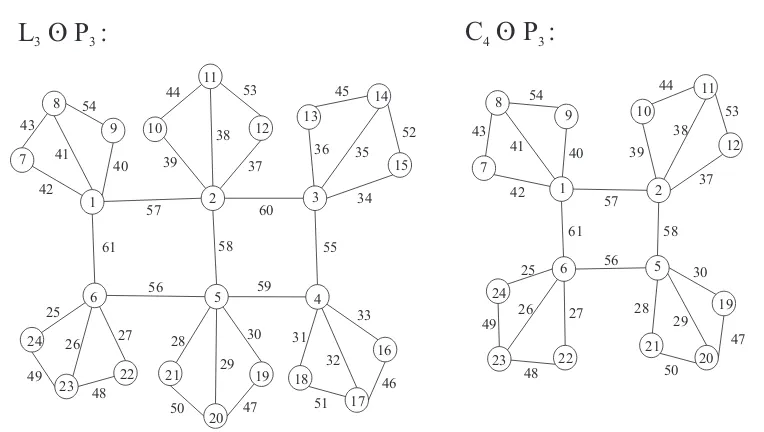
2.4. C4⊙Pm-Supermagic Labeling On A Ladder Corona with A Path Ln⊙Pm. Theorem 2.2. A graphLn⊙Pm is C4⊙Pm-supermagic for m, n≥3.
Proof. Let G be a graph Ln ⊙Pm. Let V(G) = {ui; 1≤i≤n} ⊎ {vi; 1≤i≤n} ⊎
{bj; 1≤j ≤2nm} and E(G) = {u1u2,· · · , un−1un, v1v2,· · · , vn−1vn, u1v1,· · · , unvn} ⊎
{cj; 1≤j ≤2nm}⊎{aij; 1≤i≤2n; 1≤j≤m−1}where|V(G)|= 2n(m+1) and|E(G)|= 4nm+n−2. We have a bijective functionf :V(G)∪E(G)→ {1,2, . . . ,3n(2m+ 1)−2}. Given a set of label for all vertices and edges of G denoted byZ, whereZ = [1,3n(2m+ 1)−2]. PartitionZ into 5 sets : A = [1,2n], B = [2n+ 1,2nm+ 2n], C = [2nm+ 2n+ 1,4nm+ 2n], D= [4nm+ 2n+ 1,6nm], E = [6nm+ 1,6nm+ 3n−2].
All vertices and edges for each subgraphHi labeled with some certainty. The setAis used to label verticesvi where 1≤i≤n,Eis used to label edges{u1u2,· · · , un−1un, v1v2,
· · · , vn−1vn, u1v1,· · · , unvn}.
Label each vertex and edges of Ln graph by.
f(x) =
i, ifx=ui; fori∈[1, n],
2n+1-i, ifx=vi; fori∈[1, n],
6nm+3i, ifx=uiui+1; fori∈[1, n−1],
6nm+3i-1, ifx=vivi+1; fori∈[1, n−1],
7nm-3m+10-3i, ifx=uivi; fori∈[1, n].
Hence, the constant supermagic sum ofC4 isf(C4) = 26nm+ 4n−6m+ 18. Furthermore, the set B is used to label bj where 1 ≤ j ≤ 2nm and C is used to label cj where 1≤j≤2nm. LetK =B⊎C, according to Lemma 2.1 withx = 2n and
k= 2nm, we have 2nm-balanced where ΣKi = 4nm+ 4n+ 1.
Next, we usedDto label edges aij where 0≤i≤2n and 1≤j≤m−1. The proof is divided by 2 cases, based on values of m.
Case 1. m is odd (m≥3).
According to Lemma 2.3 withx= 4nm+ 2n+ 1, y= 6nm and |D|= 2n(m−1), we have 2n-balanced where ΣDi= 2nm4n−2n(10nm+ 2n+ 1).
Case 2. m is even (m≥4).
Partition D into 2 subsets : D1 = [4nm+ 2n+ 1,4nm+ 8], D2 = [4nm+ 8n+ 1,6nm]. For m = 4 defined D=D1. Let D= D1⊎D2 form ≥6, according to Lemma 2.4 with
x= 4nm+ 2n, y= 4nm+ 3n+ 3, z= 4nm+ 3n+ 3, we obtain (k,1)-anti balanced where ΣD1i = 12nm+ 12n+ 7 +i. Then based on Lemma 2.1 for x= 4nm+ 8n, y= 6nm−2n and |D2| = 2n(m−4), we have 2n-balanced where ΣD2i = 2(4nm+ 10n)−1. Then ΣDi= 20nm+ 32n+ 8 +i.
The constant supermagic sum of subgraphC4⊙Pm as follows.
f(C4⊙Pm) =
16m2n+ 56nm+ 8n+ 4m+ 4, form is odd;m≥3
16m2n+ 90nm+ 52n−2m+ 60, form= 4
16m2n+ 122nm+ 132n−2m+ 64, form is even;m≥6.
L ʘ P :
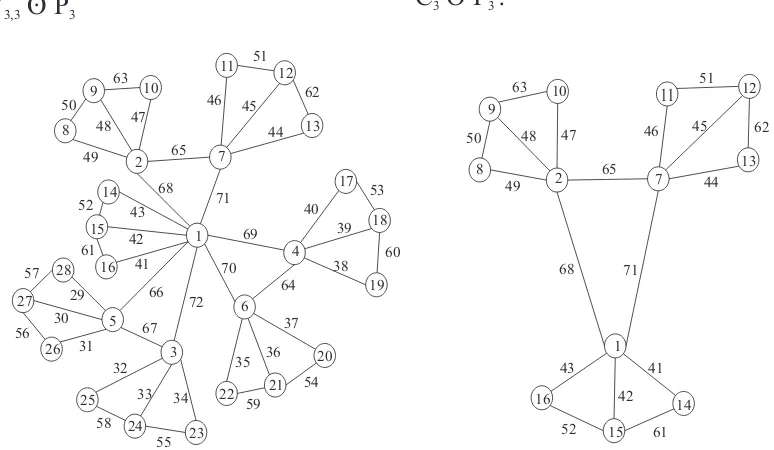
3 3All vertices and edges for each subgraphHi labeled with some certainty. The setAis used to label verticesviwhere 1≤i≤m,Eis used to label edges{v0v1, v0v2,· · · , v0vn, v0u1,
v0u2,· · · , v0un, v1v1, v2u2,· · · , vnun}. Case 1. m is even (m≥4).
(1) Lemma 2.6 is applied to label each vertex of W3,m graph other than central vertex by. (2) Label each edge of W3,mgraph as follows.
f(v0ui) =
(1) Lemma 2.5 is applied to label every vertex of W3,m graph as follows.
f(ui) =
(2) Label each edge of W3,mgraph as follows. f(v0vi) = proof is divided by 2 cases, based on values of m.
Case 1. m is odd (m≥3). Furthermore, the constant supermagic sum of a subgraph C3⊙Pm is.
[1] Gallian, J. A. A Dynamic Survey of Graph Labeling, The Electronic Journal of Combinatorics 18
(2015), #DS6.
[2] Inayah, N.,Pelabelan(a, d)−H−Anti Ajaib pada Beberapa Kelas Graf, Disertasi, Institut Teknologi Bandung, Bandung, 2013.
[3] Sedl´acek, J., Theory of Graphs and its Applications, House Czechoslovak Acad. Sci. Prague,(1964), 163-164.
[4] Guti´errez, A. and A. Llad´o ,Magic Coverings, J. Combin. Math. Combin. Comput55(2005), 43-56. [5] Llad´o , A. and J. Moragas,Cycle-magic Graph, Discrete Mathematics307(2007), 2925-2933. [6] Maryati, T. K., Karakteristik Graf H-Ajaib dan Graf H-Ajaib Super, Disertasi, Institut Teknologi
Bandung, Bandung, 2011.