Indonesian Journal of Biotechnology
VOLUME 22(2), 2017, 86–91 | RESEARCH ARTICLE
Gela n extrac on from the indigenous Pangasius catfish bone using
pineapple liquid waste
Yoni Atma1,∗and Hisworo Ramdhani1
1Faculty of Bioindustry, Trilogi University, Jalan Taman Makam Pahlawan, Kalibata, Jakarta Selatan 12760, Indonesia
∗Corresponding author:[email protected]
ABSTRACTGela n extrac on from fish bone has tradi onally involved hydrogen chloride and/or sodium hydroxide during pre-treatment. However, these chemicals have begun to be abandoned because of their associated safety and environmental issues. Several studies have looked at the use of citric acid as a safer alterna ve in fish bone gela n extrac on. The aim of this research was to extract gela n from the bone of Pangasius catfish with pineapple liquid waste. The extrac on was performed in two steps: pre-treatment followed by main extrac on at various mes (24–56 h) and temperatures (45–75°C). Sodium dodecyl sulfate polyacrylamide gel electrophoresis (SDS-PAGE) was used as a confirma on test and showed a band for gela n at ~120 kDa. Gela n yields were calculated as the ra o of weight of dried gela n to the total weight of fishossein. The results indicated that pineapple liquid waste can be used for fish bone gela n extrac on. The recommended condi ons for extrac on of fish bone gela n using pineapple liquid waste are 56 h of pre-treatment and 5 h of main extrac on at a temperature of 75°C. The gela n yield was 6.12% and the protein concentra on 4.00 g/100 g.
KEYWORDSextrac on; fish bone; gela n; green solvent; pineapple waste
1. Introduc on
Gelatin is a polypeptide (biopolymer) that has been used widely in food, pharmaceutical and cosmetic industries. In the food industries, gelatin is used both as food addi-tive and functional food (Mariod and Fadul 2013) since gelatin has unique physical characteristic. Gelatin is thus used as a stabilizer, thickener, emulsifier, adhesive, as a biodegradable film, as well as a foaming, gelling, and microencapsulation agent for foods product such as con-fectionary, jelly, milk, yoghurt, ice cream, cheese, and canned foods (Koli et al. 2012). Gelatin also has bioactive properties including antimicrobial or antioxidant proper-ties and is antihypertensive by inhibition of angiotensin converting enzyme (ACE) (Gómez-Guillén et al. 2011).
In the past, most gelatin came from pigs (41%), cattle skin (28.5%) and cattle bone (29.5%) (Jeya Shakila et al. 2012). Gelatin made from pigs is prohibited in both Is-lam and Judaism, while gelatin from cattle origin is unac-ceptable in Hinduism. In addition, the presence of cases of mad cow disease or bovine spongiform encephalopathy (BSE) as well as nail and mouth disease are increasingly pushing the need for new alternative sources of gelatin (Sanaei et al. 2013). The most potential as alternative source of gelatin is shown by skin and bone of fish (Nurul and Sarbon 2015). Around 30% of the total weight of fish
comes from its skin and bones (Shyni et al. 2014). Fish skin is sometimes still used for consumption and further processing, but fish bones are often disposed of as waste. Utilization of fish bones as a source of gelatin can mini-mize waste and provide value-added fishery products.
Gelatin produced from warm-water fish has better thermostability, rheological and viscosity properties com-pared to cold-water fish (Gómez-Guillén et al. 2009). Pa-ngasius catfish has a life habitat in the rivers and estuar-ies in Indonesia. Mahmoodani et al.(2014) reported that the physical characteristics of gelatin extracted from Pa-ngasius catfish bones resembles gelatin from cattle bone. Only the ash content of gelatin from Pangasius catfish bone that confirm with standard of gelatin in proximate parameter compared another warm-water fishes (Atma 2017). Therefore, it is necessary to explore method of gelatin extraction from bone of Pangasius catfish.
Pa-ngasius catfish using pineapple liquid waste. Pineapple liquid waste contains citric acid at approximately 0.18– 0.32% (Hajar et al. 2012). Imandi et al.(2008) reported that 1 kg of pineapple waste produced around 202.35 g cit-ric acid. This research therefore aimed to replace harmful chemicals and utilize a readily available waste in gelatin extraction technology, as well as to minimize the waste of fisheries and agriculture, enabling an eco-friendly process in the future.
2. Materials and methods
2.1. Raw material and prepara on
Bones of Pangasius catfish were obtained from the waste of a filleting industry in Cikarang, Bekasi, West Java. This by-product of Pangasius catfish filleting was transported to the laboratory on ice. In the laboratory, the Panga-sius catfish bones were separated from other waste mate-rial such as the head, fin, scale and viscera. The bones were scraped with a knife and washed in warm water (60– 70°C) for 30 min to remove attached flesh. Then, the fish bones were washed using tap water and stored in a freezer (-20°C). The solvent, pineapple liquid, was prepared by peeling pineapple fruit (Ananas comosus). The peel and stems (central core) of the pineapple were chopped into small pieces and blended. The resulting pulp was fil-tered through cheesecloth, and the obtained liquid extract, termed pineapple liquid waste, was sterilized at 121°C, 2 atm for 15 min. The pineapple liquid waste was stored at 4°C prior to the experiment.
2.2. Gela n extrac on
Gelatin extraction was performed in two steps, the first step being pre-treatment and second main extraction. Dur-ing the pre-treatment step, the cleaned bones were minced in a meat grinder (Fomac MGD-G31, Taiwan) and then soaked in the pineapple liquid waste (1:5 w/v) at room temperature with varying time periods (24–56 h) for dem-ineralization. The leached bones (ossein) were separated from the pre-treatment solvent (pineapple liquid waste) by centrifugation for 10 min at 10,000xg at 4°C (Hitachi CR21GIII, Japan). The ossein was then neutralized by washing it with distillated water until reaching pH 7. The neutralizedosseinwas transferred to an Erlenmeyer flask, and then distillated water was added at a ratio of 1:5 (bone/water, (w/v)) for the main extraction step. The main extraction was carried out for 5 h at various temperatures (45–75 °C). Finally, the gelatin extracted was filtered with a filter paper and refrigerated at 4 °C. The resulting ex-tracted gelatin was dried at 55 °C for 24–48 h and stored until subsequent analyses.
2.3. Sodium dodecyl sulfate-polyacrylamide gel elec-trophoresis (SDS-PAGE)
The extracted fish bone gelatin was prepared for SDS-PAGE analysis according to the discontinuous
Tris/HCl/glycine buffer system method described by
Laemmli(1970) with some modification. The SDS-PAGE was performed using a 10% separation gel and a 3.9% stacking gel composed of 0.5–1.5 M Tris HCl pH 6.8– 8.8, 40% acrylamide, 10% ammonium persulfate (APS), tetramethylethylenediamine (TEMED), and distillated wa-ter. The sample and molecular weight marker proteins (PM 2700 SMOBIO, Taiwan) were each loaded at 20 µL and then run in a Mini Electrophoresis Set (ATTO WSE-1500MW PageRunAce, Japan) for 25 min at a constant current of 15 mA/gel. After electrophoresis, the gel was stained with Coomassie Brilliant Blue R-250 for 24 h. Destaining was carried out in a methanol/acetic acid/water solution (5:1:4, v/v/v) until the zones on the blue back-ground were clear.
2.4. Determina on of extrac on yield
Protein concentration of fish bone gelatin was determined using a bicinchoninic acid (BCA) assay kit (Thermo Fisher Scientific). Bovine serum albumin (BSA) (Thermo Fisher Scientific) was used as protein standard in range 0–2 mg/mL. A 10-µL sample and nine standard concentrations respectively were loaded in a 96-well plate. Then, 200 µL BCA reagent solution, containing reagent A (sodium car-bonate, sodium bicarcar-bonate, bicinchoninic acid, sodium tartrate in 0.1 M sodium hydroxide) and reagent B (cop-per (II) sulfate), was added at the ratio of 50:1 (v/v). The mixture was mixed for 30 s and incubated for 30 min. Ab-sorbance was measured against a blank at 560 nm using a ELISA Micro-plate Reader (Multiskan Ex, Thermo Elec-tron Corp. USA). The analysis was replicated three times.
2.5. Determina on of gela n yield
The gelatin yield was calculated as the ratio of weight dried fish bone gelatin to the total weight of leached bone (ossein) on wet basis (Mahmoodani et al. 2014) using the formula below:
Yield of fish bone gelatin (%)
= Dry weight of fish bone gelatin (g)Wet weight of ossein (g) ×100%
3. Results and discussion
3.1. Molecular weight distribu on of fish bone gela n
FIGURE 1SDS-PAGE of fish bone gela n from Pangasius catfish ex-tracted using pineapple liquid waste. P1, P2, P3, P4= pre-treatment 24, 36, 48 and 56 h, respec vely at 45°C; P5, P6, P7, P8 = pre-treatment 24, 36, 48 and 56 h respec vely at 55°C; M = broad protein marker.
broad molecular weight standard protein was used as the marker. These SDS-PAGE patterns of gelatin extracted with pineapple liquid waste treatment are shown in Figure
1and Figure2.
SDS-PAGE was used as a confirmation test for the presence of gelatin after extracting bones of Pangasius catfish using pineapple liquid waste. Figure 1 shows that gelatin molecular weight pattern was absent. This indicates that extraction with pre-treatment for 24–56 h and main extraction at 45–55°C was not successful. The longer pre-treatment time showed a strong protein band but not in the gelatin molecular weight range. Figure
2 shows that that the gelatin molecular weight pattern is noticeable when the extraction condition is 56 h pre-treatment and 75°C main extraction for 5 h. The extraction condition of 36 h pre-treatment and 75°C main extraction for 5 h also indicated a successful extraction. However, the band in the molecular weight gelatin area was stronger and more clearly visible at the extraction condition of 56 h pre-treatment.
A study byZhang et al.(2011) revealed that the molec-ular weights of gelatin extracted from the grass carp fish scale were 117 kDa (α1), 107 kDa (α2), and 200 kDa
(β). The fish bone gelatin extracted from the king weak-fish had a molecular weight ~100 kDa (α2) and ~110 kDa (α1). Gelatin with a higher content of α-chain usually gives a greater of yield compared with β-chain gelatin (da Trindade Alfaro et al. 2009). The fish bone gelatin extracted from the channel catfish had a molecular weight higher than 200 kDa, 100 kDa and less than 97 kDa (Liu et al. 2009). Lizardfish bones were found to have a higher molecular weight portion at 100–120 kDa, which was demonstrated by sharp bands (Taheri et al. 2009). The protein pattern of fish bone gelatin extracted from the red snapper and grouper was found at a molecular weight of > 200 kDa (β and γ chains) and around 130 kDa (α chain). Other authors or researchers have observed that lower molecular weights of gelatin were particularly influ-enced by high temperatures during extraction (Jeya Shak-ila et al. 2012). In addition, (Mahmoodani et al. 2014) optimized fish bone gelatin extraction from Pangasius cat-fish using chemical solvent. The electrophoresis pattern of fish bone gelatin from Pangasius catfish corresponding to α-chain gelatin as demonstrated by intense bands ~116 kDa. It also showed the presence of β-chain gelatin of ~200 kDa as well as some lower band in around 97 kDa (Mahmoodani et al. 2014).
3.2. Extrac on yield
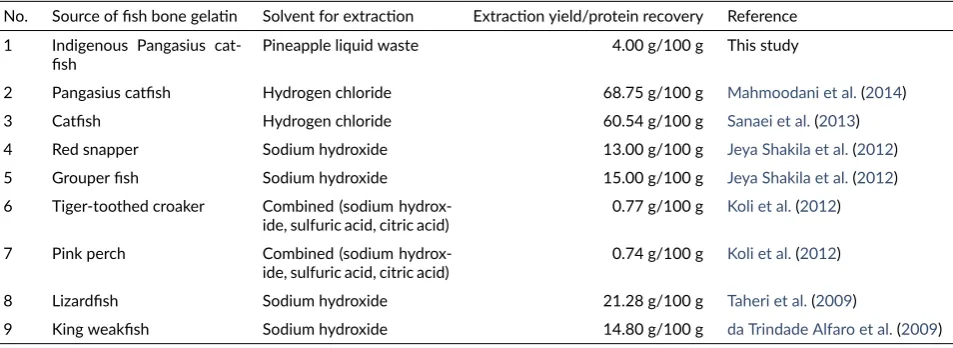
The extraction yield was used to determine both the gelatin recovery and the gelatin purity obtained from the extrac-tion process. This determinaextrac-tion is thus important because it will indicate whether fish bone extraction is successful and effective. Some factors that influence the extraction yield are prior treatment of the raw material, concentration of pre-treatment solvent, time of pre-treatment, as well as time and temperature of main extraction (Mariod and Fadul 2013;Sanaei et al. 2013). The high of protein con-centration obtained in the process described here implies adequate and suitable extraction conditions. The extrac-tion yield or protein quantificaextrac-tion from this study is com-pared with other studies in Table1.
TABLE 1The extrac on yield of fish bone gela n with some kind solvent extrac on.
No. Source of fish bone gela n Solvent for extrac on Extrac on yield/protein recovery Reference 1 Indigenous Pangasius
cat-fish Pineapple liquid waste 4.00 g/100 g This study
2 Pangasius catfish Hydrogen chloride 68.75 g/100 g Mahmoodani et al.(2014)
3 Catfish Hydrogen chloride 60.54 g/100 g Sanaei et al.(2013)
4 Red snapper Sodium hydroxide 13.00 g/100 g Jeya Shakila et al.(2012)
5 Grouper fish Sodium hydroxide 15.00 g/100 g Jeya Shakila et al.(2012)
6 Tiger-toothed croaker Combined (sodium
hydrox-ide, sulfuric acid, citric acid) 0.77 g/100 g Koli et al.(2012)
7 Pink perch Combined (sodium
hydrox-ide, sulfuric acid, citric acid) 0.74 g/100 g Koli et al.(2012)
8 Lizardfish Sodium hydroxide 21.28 g/100 g Taheri et al.(2009)
TABLE 2Fish bone gela n yield from different fish species.
No. Fish bone gela n source Gela n yield (%) Reference
1 Indigenous Pangasius catfish 6.12 This study
2 Pangasius catfish 13.86 Mahmoodani et al.(2014)
3 Catfish 17.52 Sanaei et al.(2013)
4 Red snapper 9.14 Jeya Shakila et al.(2012)
5 Grouper fish 13.66 Jeya Shakila et al.(2012)
6 Tiger-toothed croaker 4.57 Koli et al.(2012)
7 Pink perch 3.55 Koli et al.(2012)
8 Lizardfish 8.90 Taheri et al.(2009)
9 King weakfish 8.20 da Trindade Alfaro et al.(2009)
10 Channel catfish 8.43 Liu et al.(2009)
11 Nila perch 2.40 Muyonga et al.(2004)
The extraction yield of Pangasius catfish and catfish was measured by the hydroxyproline assay method and then predicted using response surface methodology (RSM) (Sanaei et al. 2013;Mahmoodani et al. 2014). The ex-traction yield of fish bone gelatin from red snapper and grouper fish was determined by Kjeldahl conventional method using Kel plus Analyzer (Jeya Shakila et al. 2012). (Koli et al. 2012) measured extraction yield of fish bone gelatin from the tiger-toothed croaker and pink perch by the hydroxyproline assay method. The extraction yield of fish bone gelatin from lizardfish and king weakfish was determined with the Kjeldahl method by Assn. of Offi-cial Analytical Chemist (AOAC) (da Trindade Alfaro et al. 2009;Taheri et al. 2009). The extraction yields illustrated in Table1were thus obtained using different method for analysis. Nevertheless the same goal was to obtain protein concentration. A slight effect of the methods used, which should not significant though, is undeniable.
3.3. Gela n yield
The gelatin yield indicates the weight of real gelatin, which is obtained from the raw material, in this case fish
FIGURE 2SDS-PAGE of fish bone gela n from Pangasius catfish extracted using pineapple liquid waste. P9, P10, P11, P12 = pre-treatment 24, 36, 48 and 56 h, respec vely at 65°C; P13, P14, P15, P16= pre-treatment 24, 36, 48 and 56 h, respec vely at 75°C; M = broad protein marker.
bone. The fish bone gelatin yield of Pangasius catfish ex-tracted using pineapple liquid waste in this research was 6.12%. Fish bone gelatin yields have been reported to vary among difference species. It is due to difference of gelatin or collagen content between species and di-verse pre-treatment and main extraction methods ( Muy-onga et al. 2004;Jongjareonrak et al. 2006). The compar-ison of fish bone gelatin yield is presented in Table2.
According toda Trindade Alfaro et al.(2009), gelatin yield increases as temperature, time and solvent extrac-tion concentraextrac-tion increase. While these condiextrac-tions are favorable for higher gelatin yields, they also cause greater chain degradation and hydrolysis. Chain degradation and hydrolysis will in turn decrease the gel strength, which is an important physical characteristic of gelatin (Sanaei et al. 2013). In addition, the variation of gelatin yield ob-tained from different fish bone gelatin sources may be due to a loss of gelatin or collagen during extraction, leaching during washing phase and incomplete protein or collagen denaturation or hydrolysis during the extraction process (Jeya Shakila et al. 2012).Koli et al.(2012) observed and reported that the optimal swelling of bone during the
pre-(a) (b)
treatment step correlates with higher yields of fish bone gelatin due to opening the cross-linking of collagen or pro-tein. A high degree of cross-linking by covalent bonds in the collagen or protein source can cause low solubility and extractable gelatin.
4. Conclusions
The optimal extraction conditions to extract fish bone gelatin from Pangasius catfish bones using pineapple liq-uid waste were 56 h pre-treatment, and 5 h of main extrac-tion at a temperature 75°C. The gel electrophoresis pat-tern showed that fish bone gelatin had a noticeable band at a molecular weight of ~120 kDa, indicating the α-chain. The extraction yield of fish bone gelatin using pineapple liquid waste was 4.00 g/100 g. In addition, the gelatin yield of fish bone gelatin from Pangsius catfish was 6.12%. Pineapple liquid waste can thus be recommended as a sol-vent for gelatin extraction that can contribute to a safer and greener environment.
Acknowledgments
We would like to acknowledge Direktorat Riset dan Pengabdian Masyarakat (DRPM), the Ministry of Re-search, Technology, and Higher Education of the Repub-lic of Indonesia (MENRISTEKDIKTI) which provided the Research Grant of Penelitian Dosen Pemula (PDP) Scheme.
Authors’ contribu ons
YA and HR designed the study. YA conducted all the lab-oratory work, data analysis and wrote the manuscript. HR reviewed the study and manuscript. All authors read and approved the final version of the manuscript.
Compe ng interests
The authors declare no competing interest.
References
Atma Y. 2017. Amino acid and proximate composi-tion of fish bone gelatin from different warm-water species: A comparative study. IOP Conf Ser: Earth Environ Sci. 58:012008. doi: 10.1088/1755-1315/58/1/012008.
da Trindade Alfaro A, Simões da Costa C, Graciano Fon-seca G, Prentice C. 2009. Effect of extraction param-eters on the properties of gelatin from king weakfish (Macrodon ancylodon) bones. Food Sci Technol Int. 15(6):553–562. doi:10.1177/1082013209352921. Gómez-Guillén M, Giménez B, López-Caballero M,
Mon-tero M. 2011. Functional and bioactive proper-ties of collagen and gelatin from alternative sources:
A review. Food Hydrocolloids 25(8):1813–1827. doi:10.1016/j.foodhyd.2011.02.007.
Gómez-Guillén M, Pérez-Mateos M, Gómez-Estaca J, López-Caballero E, Giménez B, Montero P. 2009. Fish gelatin: a renewable material for developing ac-tive biodegradable films. Trends Food Sci Technol. 20(1):3–16. doi:10.1016/j.tifs.2008.10.002.
Hajar N, Zainal S, Nadzirah K, Roha AS, Atikah O, El-ida TT. 2012. Physicochemical properties analysis of three indexes pineapple (ananas comosus) peel ex-tract variety n 36. APCBEE Procedia 4:115–121. doi:10.1016/j.apcbee.2012.11.020.
Imandi SB, Bandaru VVR, Somalanka SR, Bandaru SR, Garapati HR. 2008. Application of statistical exper-imental designs for the optimization of medium con-stituents for the production of citric acid from pineap-ple waste. Bioresour Technol. 99(10):4445–4450. doi:10.1016/j.biortech.2007.08.071.
Jeya Shakila R, Jeevithan E, Varatharajakumar A, Jeyasekaran G, Sukumar D. 2012. Functional char-acterization of gelatin extracted from bones of red snapper and grouper in comparison with mammalian gelatin. LWT -Food Sci Technol. 48(1):30–36. doi:10.1016/j.lwt.2012.03.007.
Jongjareonrak A, Benjakul S, Visessanguan W, Prodpran T, Tanaka M. 2006. Characterization of edible films from skin gelatin of brownstripe red snapper and big-eye snapper. Food Hydrocolloids 20(4):492–501. doi:10.1016/j.foodhyd.2005.04.007.
Karayannakidis PD, Zotos A. 2016. Fish processing by-products as a potential source of gelatin: a re-view. J Aquat Food Prod Technol. 25(1):65–92. doi:10.1080/10498850.2013.827767.
Karim AA, Bhat R. 2009. Fish gelatin: properties, challenges, and prospects as an alternative to mam-malian gelatins. Food Hydrocolloids 23(3):563–576. doi:10.1016/j.foodhyd.2008.07.002.
Koli JM, Basu S, Nayak BB, Patange SB, Pagarkar AU, Gudipati V. 2012. Functional characteristics of gelatin extracted from skin and bone of Tiger-toothed croaker (Otolithes ruber) and Pink perch (Nemipterus japonicus). Food Bioprod Process. 90(3):555–562. doi:10.1016/j.fbp.2011.08.001.
Laemmli UK. 1970. Cleavage of structural proteins during the assembly of the head of bacteriophage T4. Nature 227(5259):680–685. doi:10.1038/227680a0.
Liu HY, Han J, Guo SD. 2009. Characteristics of the gelatin extracted from channel catfish (Ictalurus punctatus) head bones. LWT -Food Sci Technol. 42(2):540–544. doi:10.1016/j.lwt.2008.07.013. Mahmoodani F, Ardekani VS, See SF, Yusop SM, Babji
Mariod AA, Fadul H. 2013. Gelatin, source, extraction and industrial applications. Acta Sci Pol, Technol Al-iment. 12(2):135–147.
Muyonga JH, Cole CGB, Duodu KG. 2004. Ex-traction and physico-chemical characterisation of Nile perch (Lates niloticus) skin and bone gelatin. Food Hydrocolloids 18(4):581–592. doi:10.1016/j.foodhyd.2003.08.009.
Nurul A, Sarbon N. 2015. Effect of pH on functional, rhe-ological and structural properties of eel (Monopterus
sp.) skin gelatin compared to bovine gelatin. Int Food Res J. 22(2):572–583.
Sanaei AV, Mahmoodani F, See SF, Yusop SM, Babji AS. 2013. Optimization of gelatin extraction and physico-chemical properties of catfish (Clarias gariepinus) bone gelatin. Int Food Res J 20(1):423–430.
Shyni K, Hema G, Ninan G, Mathew S, Joshy C, Lak-shmanan P. 2014. Isolation and characterization of gelatin from the skins of skipjack tuna ( Katsu-wonus pelamis), dog shark (Scoliodon sorrakowah), and rohu (Labeo rohita). Food Hydrocolloids 39:68– 76. doi:10.1016/j.foodhyd.2013.12.008.
Taheri A, Abedian Kenari AM, Gildberg A, Behnam S. 2009. Extraction and physicochemical charac-terization of greater izardfish (Saurida tumbil) skin and bone gelatin. J Food Sci. 74(3):E160–165. doi:10.1111/j.1750-3841.2009.01106.x.
Zhang F, Xu S, Wang Z. 2011. Pre-treatment opti-mization and properties of gelatin from freshwater fish scales. Food Bioprod Process. 89(3):185–193. doi:10.1016/j.fbp.2010.05.003.