Comparing the Determining Factor on Consumer Visits at Convenience Store in Palembang
M. Eko Fitrianto, Islahuddin Daud
Departement of Management, Economic Faculty, Universitas Sriwijaya Inderayala, South Sumatera.Indonesia
Abstract—Convenience stores become an essential part of modern society. They can fulfill their daily needs in a way that is easier and more convenient. There are several brands of convenience store available, that can affect their decision. This study aims to determine the factors that influence consumer visits to two brand convenience store. The data used is ordinal data obtained from questionnaires distributed to 200 visitors convenience store. Convenience store which is the object of this research is Alfamart and Indomaret. Sample method used was purposive sampling. The results showed there are 4 factors that formed on each brand. Each factor is named and formed by similar variable items or related one and another. On factors 1 and 3 the two brands have the same final factor, but on factor 2 and 4 produce different final factor. The results show the factors that determine a visit to the convenience store is generally same, differences happen only at certain items. When the final factors can be identified, then marketing strategy may be adjusted based on these factors.
Keywords: Convenience store, Factors analysis
INTRODUCTION
Convenience stores are an important part of modern society. The product sold are a daily product, or we call "convenience goods" (Guberman, 1971). These products such as toiletries products, snacks, drinks, eggs, milk, ice cream.etc. (Cheng et al., 2009).This product provided by a store called "convenience store"(Richard, 1958). Consumers go to the convenience store does not always for fulfilling their daily needs in quickly and easily, but also want to get the comfort and pleasure in shopping (Bansal, 2014; Garg & Steyn, 2015; Gupta & Sharma, 2014; Yip et al., 2012).The shop owner realizes that give pleasure to the consumers can produce a consumer's lovely feeling to the shop, and the lovely feelings will form consumer's loyalty(Lloyd et al., 2014).
There are several factors that determines visits to convenience stores, which are: ease of access, store atmosphere, promotions and price, and the human resources factor. First factors related to the magnitude of physical effort by the consumer to reach locations. Ideally, the store is located in a place that is very easy to reach, so that consumer have an easiness in access, parking lots, and security. The second factor is the store atmosphere factors, where these factors are
aimed at the consumer senses that give positive feelings towards the store. Promotions and price factors considered have correlation because of sales promotion activities became a bundling strategy. The bundling strategy is implemented as discounts and rewards. The last factor is the human resources where the convenience store is actually a service business, and human resources play an important role in the successful delivery of services
The first factor is location. The choice of location for the convenience store is very crucial. Selection of the right location can help increase store sales (Litz & Rajaguru, 2008). Stores can easily change the pricing policy, promotion, services and product variants, but not with the location (Levy & B., 2004). Consideration of the development of the store in the future should also be taken into account, such as an urban development plan (Terasaka, 1998). The location must be easy to access, both for consumers or for suppliers. For convenience products, consumers will choose the most accessible store(Baltas et al., 2010). Ease of access also simplifies the supply process for a supplier to supply the merchant's products.
2011). Convenience store creates store atmosphere to give satisfaction to the consumer (Hussain & Ali, 2015; Massara, 2003; Wilson, 2005). Store atmosphere may be the facilities provided by the store, such as interior and exterior design is attractive, temperature is cool (Lina & Chiang, 2010), the place is clean (Chen & Hsieh, 2011; Nguyen et al., 2015), the layout of the store comfortable (Grewal & Levy, 2007), neat shelves (Keel & Padgett, 2015), adequate lighting(Baker et al., 1992; Verma, 2014), played the right music(Hosseini & Jayashree, 2014), the diversity of choice (Kwak et al., 2015), until the store’s aroma (Bradford & Desrochers, 2009). All these stimuli can be a consumer experience (Borghini et al., 2009; Hosseini et al., 2014; Puccinelli et al., 2009).
Consumer experience can be obtained from the responses of the five senses. The sense of sight catching visual elements of the experience. Several attempts were made by stores, such as designing an attractive interior (Elottol & Bahauddin, 2011; Orth et al., 2012; Yip et al., 2012), so that attract buyers. Visually, consumers prefer stores with an attractive appearance, neat and clean because it will cause a sense of fun and convenient when visited. The temperature can generate negative emotional feelings if is too high or low (Hussain & Ali, 2015). The smell (aroma), if is very strong, can influencing consumer emotions too (Hosseini & Jayashree, 2014). Consumers will feel comfortable and have a pleasant mood when the smell is fragrance. Music played as background sound to influence the shop feeling (mood) of the buyer, and persuade them to form an opinion with respect to shops and services (Herrington & Capella, 1994).
Promotions and prices become the third important factor. In accordance with the products offered, and price promotion strategy adopted is a strategy for the products of daily necessities. Promotional activity only focusing on promotional discounts, gifts, product catalog, and the privileges given to members (giving member card). The principal may have a "seeding product program", by giving discounts or free for a special particular product (Nejad et al., 2015). The impact of seeding product is a store indirectly would benefit the promotion, such as the program "Buy baby milk product gets a bonus of oil 1 liter". When stores advertise this program, and consumers will come to get the sales promotion.
The fourth factor is the performance of employees. According to Berry (1986), the retail
business is a service business, so that the core of the business is the services that are offered to consumers. A crucial element of the service is the man as a conveying of services. The employees are the company's front group to conveying services for consumers. They interact directly with consumers who want to satisfy their needs in getting a product. In order to provide the best service, it needs several elements that should be owned by the employees. There are five dimensions that can be used to measure the quality of service, ie: Tangible, Responsiveness,
Reliability, Assurance and Empathy
(Parasuraman et al., 1991; Yu et al., 2008). Selection of wrong employees can result in the bad services delivery, so it can lead to customer dissatisfaction.
These four factors are an important factor in determining consumer interest towards convenience store. When it appears the desire to visit a convenience store, direct consumers to imagine the convenience and ease of shopping (Jain et al., 2014). Changes in consumer behavior began to consider shopping is part of the lifestyle will keep growing convenience store market. Along with changes in consumer behavior and the growth of convenience store, raising the question of "What is the crucial factor that determining consumer visit to the convenience store?", whether these factors are the same or different to every brand of convenience store?
METHODOLOGY
have considered the minimum threshold for factor analysis.
The method in the sample collection is Non-Probability sampling, that every member of the population does not have the same opportunities of being selected into the sample. The sample selection using purposive sampling that is selected according to the needs of research. There are 4 main variables in this study, namely: location, atmosphere Store, promotion & pricing, and employee services. Explanation of research variables, namely: identification of variables, indicators. The main analytical techniques used by researchers in this study is the analysis of factors, to do factorization of items variables studied. Factor analysis is used to provide an overview and understanding of the issues based on the examined sample. As for the use of data processing software IBM SPSS for Windows ver. 22.0
RESULT
This part is a result of research. This section will contain the analysis of factors related to factors that determine a visit to Indomaret, factors that determine a visit to Alfamart, and a comparison of both convenience store's determining factors.
A. Analysis of the factors that determine a visit to
Indomaret (as portrayed in table 1)
Factor 1 consists of items: Employees are attentive to the customers (F.16-Indomaret), The employees are very helpful (F.15-Indomaret), Employees show their empathy to the consumer (F.18-Indomaret), If consumers need help on shopping activity, employees quickly respond (F.17-Indomaret), Employees provide a comfort service when serving the consumer (F.14-Indomaret), and Shopping membership has many benefits (F.13-Indomaret)
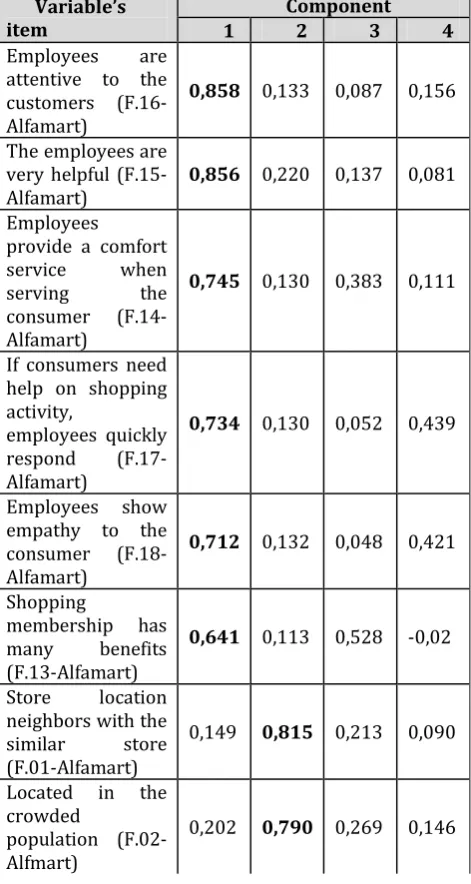
Factor 2 consisted of items: Located in the crowded population (F.02-Indomaret), Store location neighbors with the similar store (F.01-Indomaret), Located in a place where a lot of people walking around (F.04-Indomaret), Interesting interior design (F.05-Indomaret), Near with your residence (F.03-Indomaret), and The temperature setting is comfortable (F.06-Indomaret).
Factor 3 consists of items: Frequent do promotional sales activity (such as: buy 1
get 1 free, buy "Product A" free "Product B", etc.) (F.11-Indomaret), Product's promotional posters is available (F.10-Indomaret), Catalog shopping is always available (F.09-Indomaret), and A special discount is offered often (F.12-Indomaret). Factor 4 consists of items: Played favorable
music (F.08-Indomaret), and Store's aroma is fragrant (F.07-Indomaret).
B. Analysis of the factors that determine a visit to
Alfamart (as portrayed in table 2)
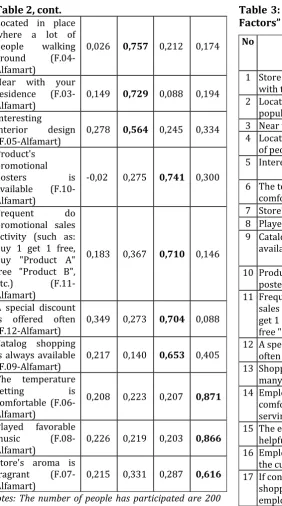
Factor 1 consists of items: Employees are attentive to the customers (F.16-Alfamart), The employees are very helpful (F.15-Alfamart), Employees provide a comfort service when serving the consumer (F.14-Alfamart), If consumers need help on shopping activity, employees quickly respond (F.17-Alfamart), Employees show empathy to the consumer (F.18-Alfamart), and Shopping membership has many benefits (F.13-Alfamart).
Table 1: Analysis of the factors that determine to visit Indomaret
Variable’s
item Component
1 2 3 4
Employees are attentive to the customers (F.16-Indomaret)
0,876 0,145 0,096 0,193
The employees are very helpful (F.15-Indomaret)
0,865 0,182 0,150 0,032
Employees show their empathy to the consumer (F.18-Indomaret)
0,820 0,151 0,060 0,212
If consumers need help on shopping activity,
employees quickly respond (F.17-Indomaret)
0,816 0,233 0,025 0,232
Employees provide a comfort service when serving the consumer (F.14-Indomaret)
Table 1, cont. population (F.02-Alfmart), Located in place
where a lot of people walking around (F.04-Alfamart), Near with your residence (F.03-Alfamart), and Interesting interior design (F.05-Alfamart)
Factor 3 consists of: Product's promotional posters is available (F.10-Alfamart), Frequent do promotional sales activity (such as: buy 1 get 1 free, buy "Product A" free "Product B", etc.) (F.11-Alfamart), A special discount is offered often (F.12-Alfamart), and Catalog shopping is always available (F.09-Alfamart)
Factor 4 consists of The temperature setting is comfortable (F.06-Alfamart), Played favorable music (F.08-Alfamart), dan Store's aroma is fragrant (F.07-Alfamart).
Table 2, cont.
C. Comparing the Determining Factor on
Consumer Visits at Convenience Store in Palembang (Indomaret and Alfamart)
In this section, we will compare the factors that have been generated in the previous analysis. Each store has a form factor, these factors may contain items that are the same or different. The items come from "The beginning factor" that is based on theory. The beginning factors illustrated in Table 3. The results of the factor analysis collate such items into the new arrangement, as illustrated in Tables 1 and 2. The comparison of these factors are as follows:
Table 3: Questions Items and The Beginning
Factors
No Items Code The
Beginning factor
1 Store location neighbors with the similar store
F.01 Location
of people walking around
F.04
5 Interesting interior design F.05 Store atmosphere
6 The temperature setting is comfortable
F.06 Factors
7 Store's aroma is fragrant F.07 8 Played favorable music F.08 9 Catalog shopping is always
available
F.09 Promotion and price factor 10 Product's promotional
posters is available
F.10
11 Frequent do promotional sales activity (such as: buy 1 get 1 free, buy "Product A" free "Product B", etc.)
F.11
12 A special discount is offered often
F.12
13 Shopping membership has many benefits
F.13
14 Employees provide a comfort service when serving the consumer
F.14 Employee service factors 15 The employees are very
helpful
F.15
16 Employees are attentive to the customers
18 Employees show their empathy to the consumer
F.18
Notes: the beginning factor referred from theory, as a mention in Introduction
the second factor in Indomaret named Location and Store atmosphere, while the second factor in Alfamart named: Location and interior design. In fourth factors in Indomaret named by Music and store aroma factor, while the fourth factor Alfamart named with Music, aroma and temperature store factor.
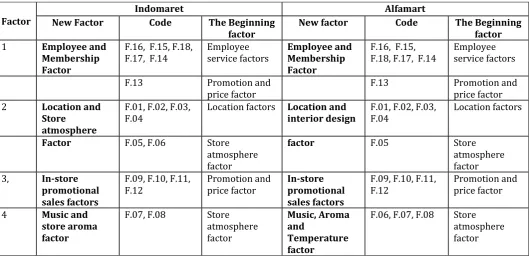
According to the table 4, there is similarities formation of factors on both the convenience store. The similarities have occurred in first and third factor. In the first factor (Employee and Membership Factor), composed by items: Employees are attentive to the customers (F.16), The employees are very helpful (F.15), Employees show their empathy to the consumer (F.18), If consumers need help on shopping activity, employees quickly respond (F.17), Employees provide a comfort service when serving the consumer (F.14), and Shopping membership has many benefits (F.13). While the third factor (In-store promotional sales factors), consisting of: Frequent do promotional sales activity (such as: buy 1 get 1 free, buy "Product A" free "Product B", etc.) (F.11), Product's promotional posters is available (F.10), Catalog shopping is always available (F.09), and A special discount is offered often (F.12).
Based on Table 4, there are two factors that have a difference in constituent items, ie the second and fourth factor. On 2nd factors in Indomaret (Factor location and ambiance stores) consists of six items, namely: Located in the crowded population (F.02), Store location neighbors with the similar store (F.01), Located in place where a lot of people walking around (F.04), Interesting interior design (F.05), Near with your residence (F.03), and The temperature setting is comfortable (F.06). While for the Alfamart brand consists of 5 items: Store location neighbors with the similar store (F.01), Located in the crowded population (F.02), Near with your residence (F.03), Located in a place where a lot of people walking around (F.04), and Interesting interior design (F.05).
According to the table 4, there are four main factors that are arranged based on the theory that there is. The first factor is the location factor, based on the theory of items forming these factors are: Store location neighbors with the similar store, Located in the crowded population,
Near with your residence, and Located in a place where a lot of people walking around. The second factor is the factor of store atmosphere, items forming these factors are: Interesting interior design, The temperature setting is comfortable, Store's aroma is fragrant and Played favorable music. The third factor is the factor of promotion and price consists of: Catalog shopping is always available, Product's promotional posters is available, Frequent do promotional sales activity (such as: buy 1 get 1 free, buy "Product A" free "Product B", etc.), A special discount is offered often, and Shopping membership has many benefits. The fourth factor is: Employees provide a comfort service when serving the consumer, The employees are very helpful, Employees are attentive to the customers, If consumers need help on shopping activity, employees quickly respond, and Employees show their empathy to the consumer.
Based on table 4, there is information that shows the relationship between factors starters, item-forming and new factors that have been named. Factors starters consist of variable items that make it up after factor analysis was then formed a new factor that can be filled by items from the beginning of the same factors, or can also be filled by a combination of several items originating from different starters factor.
Table 4: Recapitulation Naming a new factor, Item forms and beginning Factor
Factor
Indomaret Alfamart
New Factor Code The Beginning
factor
New factor Code The Beginning
factor
1 Employee and
Membership Factor
F.16, F.15, F.18, F.17, F.14
Employee service factors
Employee and Membership Factor
F.16, F.15, F.18, F.17, F.14
Employee service factors
F.13 Promotion and
price factor
F.13 Promotion and
price factor
2 Location and
Store atmosphere
F.01, F.02, F.03, F.04
Location factors Location and interior design
F.01, F.02, F.03, F.04
Location factors
Factor F.05, F.06 Store
atmosphere factor
factor F.05 Store
atmosphere factor
3, In-store
promotional sales factors
F.09, F.10, F.11, F.12
Promotion and price factor
In-store promotional sales factors
F.09, F.10, F.11, F.12
Promotion and price factor
4 Music and
store aroma factor
F.07, F.08 Store atmosphere factor
Music, Aroma and
Temperature factor
F.06, F.07, F.08 Store atmosphere factor
Notes: For code information, see table 3. The new factor is the factor arranged by factor analysis provided by SPSS. The Beginning factor is The factor was referred by related theory in this research.
DISCUSSION
The diversity of backgrounds visitor becomes an important thing that must be understood. Stores considering the demographic factors in the strategy. For example obtained the fact that most of the visitors are coming from young people is aged around 20-25 years (50.5%), then the matters relating to young people must be accommodated as the availability of related products segments. Many consider the convenience stores to provide seating outside the store to accommodate the needs of young children who like to enjoy the time while chatting with each other. Factors visitors. In general, variable items grouped in accordance with the existing theory, only some of which are not appropriate. Supposedly on the theory of location factors exist, factors store atmosphere, promotion and price factors and factors of employee service.
At a factor of 1 for both brands of convenience stores: the factors that form filled out by all of the items that come from employee service factor and the membership factor (which should be in the price). At this factor means for both brands convenience store can apply the same strategy that is focused on serving employees coupled with a focus on membership.
On the second factor there is a difference in the convenience store brand: In Indomaret factor 2 is filled with all the items related to the location and the second item from the store atmosphere, while for Alfamart also filled by all of the items associated with the location and the first item of the store atmosphere.
At the third factor,both of convenience store brands have in common are the determining factors of promotions and price factors. The similarity of these factors can be interpreted that generally visitors regard the promotion and offer prices of both branded convenience stores are the same. At the 4th factor, both of convenience store brands have in common origin factor is factor store atmosphere, but there is little difference forming items. In Indomaret items forming factors consisted of musical items and aroma store, while at Alfamart item forming factors is the music, aroma, and temperature of the store. This indicates that there are Alfamart’s visitors more aware about temperature setting.
FUTUREWORKS
such as buying interest, satisfaction, as well as the purchase decision.
Due to the heterogeneity of its community or society still adheres to the local culture, it is necessary to study about cultural factor values.
Keep investigated the influence of modernization on people's behavior, such as the impact of technology, social media, lifestyle, etc.
Results showed that 71% of visitors do not prepare a shopping list, this needs further investigation regarding the consumer decision-making process in the convenience store, whether it is impulse buying or not.
REFFERENCES
Baker, Levy, & Grewal. (1992). An experimental approach to making retail store environmental decisions. Journal of Retailing, 68(4), 445–460. Baltas, Argouslidis, & Skarmeas. (2010). The Role of
Customer Factors in Multiple Store Patronage: A Cost–Benefit Approach. Journal of Retailing, 86(1), 37–50.
Bansal. (2014). The impact of point of purchase displays on consumer decision making.
International Journal of Marketing and
Technology, 4(11), 94–107.
Berry. (1986). Retail Businesses Are Services Businesses. Journal of Retailing, 61(1).
Bianchi. (2009). Investigating Consumer Expectation of Convenience Store Attributes in Emerging Markets: Evidence in Chile. Journal of
International Consumer Marketing, 21(4), 1–28.
Borghini, Diamond, Kozinets, McGrath, Muñiz, & Sherry. (2009). Why Are Themed Brandstores So Powerful? Retail Brand Ideology at American Girl Place. Journal of Retailing, 85(3), 363–375. Bradford, & Desrochers. (2009). The use of scents to
influence consumers: The sense of using scents to make cents. Journal of Business Ethics,
90(SUPPL. 2), 141–153.
http://doi.org/10.1007/s10551-010-0377-5 Chen, & Hsieh. (2011). The effect of atmosphere on
customer perceptions and customer behavior responses in chain store supermarkets. African
Journal of Business Management, 5(24), 10054–
10066. http://doi.org/10.5897/AJBM10.608 Cheng, Blankson, Mada, & Wang. (2009). Hybrid
convenience stores – the changing role of
convenience stores in Taiwan. Asian Pacific Journal of Marketing, 21(3), 417–432.
Elottol, & Bahauddin. (2011). The relationship between interior space design and visitors" satisfaction: A case study of Malaysian museums ( Interior Circulation Scheme). International
Journal of Organization Innovation, 3(4), 158–
180.
Garg, & Steyn. (2015). The Ideal Tenant Mix and Shopping Centre Size for the Proposed Thatchfield Convenience Centre. International
Journal of Business and Management, 10(1),
243–257.
http://doi.org/10.5539/ijbm.v10n1p243
Grewal, & Levy. (2007). Retailing research: Past, present, and future. Journal of Retailing, 83(4), 447–464.
Guberman. . Convenience stores : Past and Present. Journal of Food Distribution Research, 36.
Gupta, & Sharma. (2014). Dimensions of Retail Service Convenience in Emerging Market Settings - A Qualitative Investigation. Journal of Services Research, 14(1), 100–122.
Herrington, & Capella. (1994). Practical applications of music in service settings. Journal of Services Marketing, 8(3), 50–65.
Hosseini, & Jayashree. (2014). Influence of the Store Ambiance on Customers’ Behavior—Apparel Stores in Malaysia. International Journal of
Business and Management, 9(10), 62–69.
http://doi.org/10.5539/ijbm.v9n10p62
Hosseini, Jayashree, & Malarvizhi. (2014). Store Image and Its Effect on Customer Perception of Retail Stores. Asian Social Science, 10(21), 223– 235. http://doi.org/10.5539/ass.v10n21p223 Hussain, & Ali. (2015). Effect of Store Atmosphere on
Consumer Purchase Intention. International
Journal of Marketing Studies, 7(2), p35.
http://doi.org/10.5539/ijms.v7n2p35
Jain, Takayanagi, & Malthouse. (2014). Effects of show window on female consumers' shopping behavior. Journal of Consumer Marketing, 31(5), 380–390. http://doi.org/10.1108/JCM-04-2014-0946
Keel, & Padgett. (2015). The effects of adjacent competitors and promotion on brand sales.
Journal of Consumer Marketing, 32(1), 43–50.
http://doi.org/10.1108/JCM-02-2014-0860 Kwak, Duvvuri, & Russell. (2015). An Analysis of
of Retailing, 91(1), 19–33. http://doi.org/http://dx.doi.org/10.1016/j.jret ai.2014.10.004
Levy, & B. (2004). Retailing Management. Boston: McGrawHill-Irwin.
Lina, & Chiang. (2010). The influence of store environment on perceived experiential value and behavior intention. Asia Pacific Management Review, 15(2), 281–299.
Litz, & Rajaguru. (2008). Does Small Store Location Matter ? A Test of Three Classic Theories of Retail Location. Journal of Small Business and
Entrepreneurship, 4(4), 477–492.
Lloyd, Y.K. Chan, S.C. Yip, & Chan. (2014). Time buying and time saving: effects on service convenience and the shopping experience at the mall. Journal of Services Marketing, 28(1), 36–49. http://doi.org/10.1108/JSM-03-2012-0065 Massara. . Store atmosphere : still a fledgling
art. ECR Journal, Vol.3(No.2), 47–51.
Nejad, Amini, & Babakus. (2015). Success Factors in Product Seeding: The Role of Homophily.
Journal of Retailing, 91(1), 68–88.
http://doi.org/10.1016/j.jretai.2014.11.002 Nguyen, Phan, & Vu. (2015). The Impact of Marketing
Mix Elements on Food Buying Behavior: A Study of Supermarket Consumers in Vietnam.
International Journal of Business and
Management, 10(10), 206–216.
http://doi.org/10.5539/ijbm.v10n10p206 Orth, Heinrich, & Malkewitz. (2012). Servicescape
interior design and consumers’ personality impressions. Journal of Services Marketing,
26(3), 194–203.
http://doi.org/10.1108/08876041211223997 Parasuraman, Berry, & Zeithaml. (1991). Refinement
and Reassessment of the SERVQUAL Scale. Journal of Retailing, 67(4), 420–450.
Park, Easwar, & Smith. (2011). The Effects of Situational Behavior : and Factors The Time on Grocery of Store Shopping Role Environment for Shopping Available. Journal of Consumer Research Inc., 15(4), 422–433.
Puccinelli, Goodstein, Grewal, Price, Raghubir, & Stewart. (2009). Customer Experience Management in Retailing: Understanding the Buying Process. Journal of Retailing, 85(1), 15– 30. http://doi.org/10.1016/j.jretai.2008.11.003 Richard. (1958). The Distinction Between
Convenience Goods, Shopping Goods, and Specialty Goods. Journal of Marketing, 23, 53.
Terasaka. . Development of new store types : the role of convenience stores in Japan. GeoJournal, 45, 317–325.
Verma. (2014). Is the Pleasure of Scent in Luxury Store Different Than Convenience Store? Arabian Journal of Business and Management
Review (OMAN Chapter), 3(9), 74–86.
Wilson. (2005). Atmosphere Key to Well-Being. Chain Store Age, 81(10), 94.
Yip, Chan, & Poon. (2012). Attributes of young consumers' favorite retail shops: a qualitative study. Journal of Consumer
Marketing, 29(7), 545–552.
http://doi.org/10.1108/07363761211275045 Yu, Hong, Gu, & Wang. (2008). An epistemological
critique of gap theory based library assessment: the case of SERVQUAL. Journal of