I NT R O D UC T I O N
T he following experiment deals wi th the isolation process of an essential oil
from seeds by means of hydro-distillation technique. Hydro-distillation is a method
of distillation employing boiling water to extract essential oils from certain raw
materials. Hydro-distillation is so far becoming the cheapest and most general
distillation method employed in the isolation of essential oils from plant materials.
In practice, the raw material is soaked in water, then the mixture is heated to
boiling and the distillates are collected after being cooled in the condenser. D ue to
polarity difference between isolated essential oils and water, the essential oils
normally do not mix with water and accordingly separate from the water layer.
Separation of the oils by means of an external separating funnel would result in the
production of crude essential oi ls. F urther purification technique is often required to
obtain pure components present in the isolated essential oils.
T he plant material used in this experiment is the fruit and the seed of Myristica
fragrans Houtt, an evergreen tree, native of the E ast Moluccas, Indonesia. T he seed
of plant is known as ‘ nutmeg’ and attached with arillus (specialized covering of a seed
that partly or completely covered the seed), and is used for flavoring food and
medicinal purposes. In this experiment, the participants will perform the following
experiments related to “nutmeg and hydro-distillation”.
In this competition, you will perform the experimental procedure that will be
used to answer all the questions in Physics, B iology and C hemistry. R ead each step of
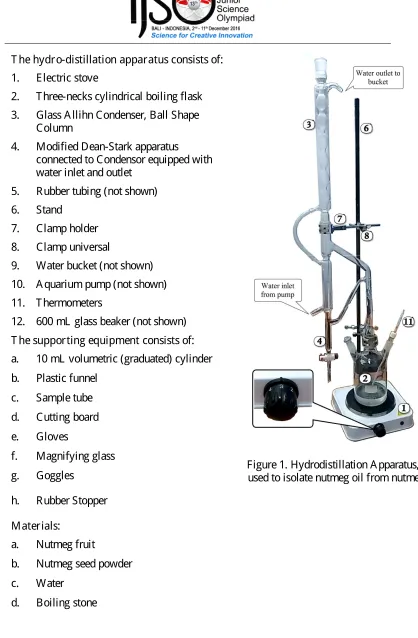
T he hydr o-distillation appar atus consists of:
F igure 1. Hydrodistillation A pparatus, will be used to isolate nutmeg oil from nutmeg seeds 1. E lectric stove
2. T hree-necks cylindrical boiling flask
3. Glass A llihn C ondenser, B all Shape
C olumn
4. Modified D ean-Stark apparatus
connected to C ondensor equipped with water inlet and outlet
T he suppor ting equipment consists of:
a. 10 mL volumetric (graduated) cylinder
E xper imental Pr ocedure
1. Make sure that the experimental equipment has been installed properly.
2. F ill the flask with 400 mL of water. Put the thermometer into the flask. E nsure
that the tip of thermometer does not touch the bottom of the flask.
3. T urn on the electric stove (adjust the power of the electric stove to setting number
3) and at the same time push the stopwatch ST A R T button. B E C A R E F UL . D O
NOT T OUC H T H E E L E C T R I C ST OV E PL A T E . T he stove is equipped with
automatic O N-OF F to mai ntain the temper atur e and to pr event over heating.
4. R ecord the temperature of the water every 0.5 minute up to 12 minutes. W rite the
data on the answer sheet. A fter an interval of 12 minutes turn off the stove, and
turn off the stopwatch.
5. T ake the thermometer out and replace with cap provided.
6. W ith the water still in the flask, add more water up to 500 mL . Pour nutmeg
powder that has been provided (120 grams) to the flask by using a funnel that has
been provided. A dd 3-5 pieces of boiling stone provided to the flask as well.
7. T urn on the electric stove, adjust the power to maximum setting ( setting number
5). C ontinue heating until 90 minutes. Use stopwatch provided.
8. W hile waiting the 90 minutes, answer the P A R T O NE : Physics, T he
effectiveness of ener gy absor ption by water questions on the answer sheet.
9. A fter you finish working on the problems of PA R T ONE , continue to work on
B iology exper iments as follows.
10. On the table you have been provided with a nutmeg fruit (including seed), the
longitudinal and cross sections of nutmeg fruits and seeds.
11. E xamine the nutmeg fruit and its parts carefully.
12. E xamine the longitudinal and cross sections of fruit and seed and their parts.
13. A nswer P A R T T W O : B iology, C har acter istics of Nutmeg questions on the
answer sheets provided.
14. A fter 90 minutes heating of the flask, turn off the electric stove. Measure the
volume of nutmeg oil that has been produced in the D ean-stark. Y ou may have to
15. T ransfer the entire collected nutmeg oil in the sample tube provided, close it, label
it and leave it together with your answer sheets. W rite your team code on the label
provided and stick it to the sample tube.
16. A nswer P A R T T H R E E : C hemistr y, Nutmeg Oil D istillation questions on the
QUE S T I O NS
PA R T ONE : Physics, T he effectiveness of energy absor ption by water [13 point]
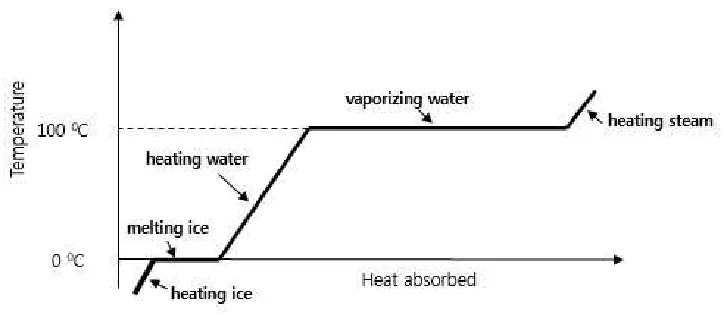
T ransitions between solid, liquid, and gaseous phases typically involve large
amounts of heat absorbed. If heat were added at a constant rate to a mass of ice to take
it through its phase changes to liquid water and then to steam, the energies required to
accomplish the phase changes (called the latent heat of fusion and latent heat of
vaporization) would lead to plateaus in the temperature vs time graph. T he graph
below (F igure 1) presumes that the pressure is one standard atmosphere.
F igure 1. G raph of temperature versus heat absorbed
P h-1 [3.0 points] Make a graph of the temperature ( C ) of water as a function of
time (in minute).
P h-2 [1.5 points] D etermine the linear range of water temperature change ( DT )
and time change (Dt).
P h-3 [2.0 points] C alculate the rate of change of temperature of water (in C /s)
with respect to ti me by using the linear part of the graph (which
means linear process in water) .
P h-4 [2.0 points] C alculate how much electrical energy (in J oule) is used within
the linear part of the graph (electric power used by the stove is
P h-5 [1.5 points] C alculate how much heat (in J oules) is used to increase the
temperature of the water in the linear part of the graph. (Note
that =4180
water
c J /kg. C and ρ = 1000 kg/m
3
).
P h-6 [1.5 points] C alculate how much heat (in J oule) is released into the
environment within the linear part of the graph.
P h-7 [1.5 points] C alculate the percentage of energy used to raise the temperature
of water with respect to the total energy of the stove within the
PA R T T W O : B iol ogy, C har acter istics of Nutmeg [13 points]
A . Nutmeg F r uit
B i-1 [2.0 points] D raw the l ongitudi nal section of the fruit with the seed intact.
B i-2 [3.0 points] L abel parts of the fruit with reference provided on the answers
box.
Show the fruit parts by arrows. C hoose the corresponding parts
from the answers box and write down the answer by writing the
letter only (for exampl e A , B , C etc.).
B . Nutmeg S eed
B i-3 [3.0 points] D raw the cross section of the seed.
B i-4 [2.0 points] L abel parts of the seed with reference provided on the answers
box.
Show the seed parts by arrows. C hoose the corresponding parts
from the answers box and write down the answer by writing the
letter only (for example A , B , C etc).
Simple fruit : A fruit that develops from a single pistil
C ompound fruit : A fruit in which one fl ower contains several separate ovaries which merge during
development (aggregate) or a fruit in which several flowers, each with an ovary, develop
into small fruits that are clustered or fused together into a larger fruit (multiple)
T rue fruit A fruit in which all tissues are derived from a
ripened ovary and its contents
ovaries but includes a signi ficant portion
derived from non-ovarian tissue
F leshy fruit : A fruit that has a soft and pulpy wall at
maturity
D ry fruit : A fruit that has a dry wall at maturity
Pome : A fruit that derived from several carpels,
receptacle and outer portion
D rupe : A fruit that derived from a single carpel and containing (usually) one seed
Monocotyledon : Having a single cotyledon in the seed
D icotyledon : Having two cotyledons in the seed
R ound : Having the shape of a sphere or ball
B i-5 [3.0 points] E xamine the fruit and the seed carefully. T ick ( √) one correct
answer on each classification categories (A -F ) in the box provided below.
Question: A nswer:
A . F ruit origin: S imple fruit C ompound fruit
B . F ruit composition:
T rue fruit A ccessory fruit
C . F ruit descri ption:
F leshy fruit D ry fruit
D . F ruit type: Pome D rupe
E . S eed
cotyledon:
Monocotyl edon D icotyledon
PA R T T H R E E : C hemi str y, Nutmeg O il D istillation[14.0 points]
A fter conducting experiment by using 120 g of ground nutmeg seed, you have
obtained certain amount of nutmeg oil.
C h-1 [4.50 points] How much is the volume of nutmeg oil you have obtained?
C h-2 [1.50 point] It is known that the mass of exactly 1.00 mL of nutmeg oil is
0.862 g at 25 oC . W hat is the percentage by mass of nutmeg
oil in nutmeg seed according to your experiment if it is
measured at 25 oC ?
C h-3 [3.00 point] It is known that the main component of nutmeg oil is
myristicin. A ssume that your sample of nutmeg oil contains
65% of myristici n (C11H12O3)by mass.
(a) [1.5 point] C alculate the number of myristicin molecules
in your sample.
(b) [1.5 point] C alculate the mass of the carbon in grams in
the myristicin in your sample. (atomic mass of C = 12, H =
1, and O = 16)
C h-4 [1.00 point] B ased on the result of your experiment, calculate how many
kilograms of nutmeg seed powder are required to produce 100
grams of nutmeg oil?
C h-5 [0.50 point] W hat is the function of boiling stones added in your
experiment?
(a) to accelerate the heating of water
(b) to speed up the separation of nutmeg oil from water
(c) to assist the distribution of heat inside the cylindrical flask
content.
C h-6 [0.50 point] W hat is the main aim of using nutmeg seed powder rather than
nutmeg seed granules in your experiment?
(a) to increase the solubility of nutmeg seed in water
(b) to increase the contact surface of nutmeg seed and water
C h-7 [0.75 point] T he separation of water and nutmeg oil in the D ean-Stark
apparatus reflects the principle of ...
(a) like dissolves like
(b) vapor pressure difference
(c) chemical equilibrium.
C h-8 [0.75 point] If the flow of cooling water in your experiment is changed
from upper to lower part of the condensor, the condensation of
the steam and nutmeg oil will be ...
(a) more effective
(b) less effective
(c) no effect.
C h-9 [0.75 point] W hich of these following alternative separation techniques
can be used to obtain nutmeg oil from the seed of nutmeg
(a) C entrifugation
(b) Solvent extraction
(c) Paper chromatography
C h-10 [0.75 point] W hat kind of changes in the experimental design would not
reduce the yield of nutmeg oil
(a) Heating too rapidly
(b) Using more boiling stones
(c) Using too short water condensor