BIOLOGICAL CONTROL OF PLANT DISEASES CAUSED BY BACTERIA
PENGENDALIAN BIOLOGI PENYAKIT TUMBUHAN YANG DISEBABKAN OLEH BAKTERI
Triwidodo Arwiyanto
Department of Plant Pest and Disease, Faculty of Agriculture, Universitas Gadjah Mada Jln. Flora 1, Bulaksumur, Sleman, Yogyakarta 55281
E-mail: [email protected]
ABSTRACT
Bacterial diseases in plants are difficult to control. The emphasis is on preventing the spread of the bacteria rather than curing the diseased plant. Integrated management measures for bacterial plant pathogens should be applied for successfull control. Biological control is one of the control measures viz. through the use of microorganisms to suppress the growth and development of bacterial plant pathogen and ultimately reduce the possibility of disease onset. The study of biological control of bacterial plant pathogen was just began compared with of fungal plant pathogen. The ecological nature of diverse bacterial plant pathogens has led scientists to apply different approach in the investigation of its biological control. The complex process of entrance to its host plant for certain soil-borne bacterial plant pathogens need special techniques and combination of more than one biological control agent. Problem and progress in controlling bacterial plant pathogens biologically will be discussed in more detail in the paper and some commercial products of biological control agents (biopesticides) will be introduced.
Key words: bacterial plant pathogen, biocontrol
INTISARI
Penyakit tumbuhan karena bakteri sulit dikendalikan. Penekanan pengendalian adalah pada pencegahan penyebaran bakteri patogen dan bukan pada penyembuhan tanaman yang sudah sakit. Untuk suksesnya pengendalian bakteri patogen tumbuhan diperlukan cara pengelolaan yang terpadu. Pengendalian secara biologi merupakan salah satu cara pengendalian dengan menggunakan mikroorganisme untuk menekan pertumbuhan dan perkembangan bakteri patogen tumbuhan dengan tujuan akhir menurunkan kemungkinan timbulnya penyakit. Sifat ekologi bakteri patogen tumbuhan yang berbeda-beda mengharuskan pendekatan yang berbeda pula dalam pengendaliannya secara biologi. Masalah dan perkembangan dalam pengendalian bakteri patogen tumbuhan secara biologi didiskusikan secara detail dalam makalah ini.
Kata kunci: bakteri patogen tumbuhan, pengendalian biologi
INTRODUCTION
Bacterium (bacteria, pl) is a unicellular procaryotic organism or simple associations of similar cells based upon growth habit, planes of division and cell separation (Murray, 1984). Most bacteria have cell walls and the shape of bacterium are round (cocciform), spiral shaped, and rod-shaped or bacilliform (Murray, 1984). Plant associated bacteria may be beneficial or detrimental (Vidaver & Lambert, 2004; Beattie, 2006; Arwiyanto, 2008) and most of plant-pathogenic bacteria are bacilliform (Goto, 1990). Bacteria can be found almost everywhere, in soil, water, food; inside and on the surface of human, animal, and plant but almost all plant pathogenic bacteria develop mostly in the host plant as parasites, on the plant surface, especially buds, as epiphytes, and partly in plant debris or in the soil as saprophytes (Agrios, 2005).
TJ Burril (1839–1916) was best known for discovery of the first bacterial disease of plants-bacterial blight of pear tree. He isolated the pathogen
and gave name Micrococcus amylovorus, later
changed to Erwinia amylovora (Tanner & Tanner,
1948). Since then, the bacterial plant pathology develop rapidly.
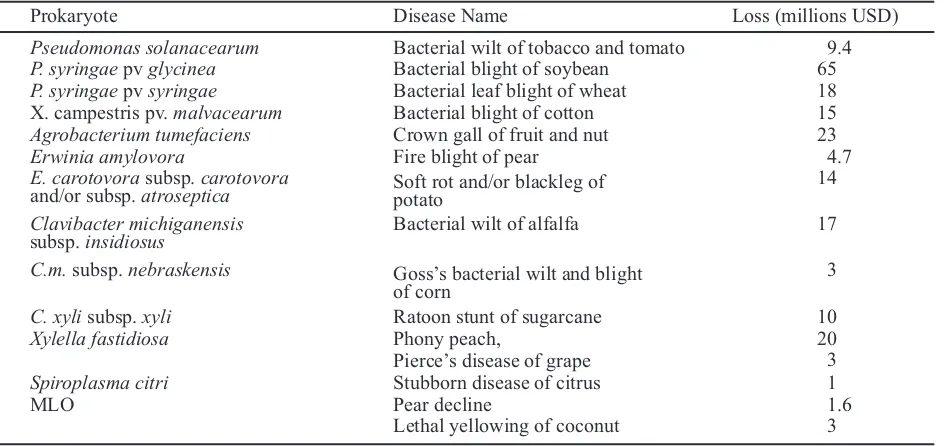
The importance of plant disease caused by bacteria is varied depending on the region because the economic of crops vary in each region. However, the available statistical data on yield loss caused by bacteria are very limited. Data from 1976 (Table 1) showed that bacterial leaf blight of rice was not in the list, indicated the minor importance in USA but, actually was very destructive and caused severe losses in Asia (Mew et al., 1993). Even after more than three
decades, there was no more statistical data about yield loss, additional data does not mention the number of losses (Table 2).
the spread of the pathogen is more reliable method to reduce disease incidence. Integration of various compatible methods will minimize yield losses, minimize environmental pollution, and keep crop production stable.
Biological control is one of the crop protection methods which is relatively new in the field of bacterial plant pathology. However, this field of study gain much more interests recently. Two specific symposium on biological control of bacterial plant diseases with great papers attended by many plant pathologists around the globe indicating the growing interest of this field (Zeller & Ulrich, 2005; Anonymous, 2008).
PRINCIPLES OF BIOLOGICAL CONTROL OF BACTERIAL PLANT PATHOGENS
[image:2.595.57.531.91.314.2]Biological control of plant pathogens is a reduction of inoculum or disease producing activity of a pathogen accomplished by one or more organisms other than man (Cook & Baker, 1983). The definition, however, do not accommodate virus particle as a biological control agent, since virus is not an organism. The interrelationships of many environmental variables can result in multiple interactions among organisms and their environment, several of which might contribute to effective biological control. Furthermore, natural products and chemical compounds discovered as a result of basic research into the molecular mechanisms of Table 1. Loss estimate for plant pathogenic prokaryotes
Table 2. Losses of yield caused by plant pathogenic bacteria
Prokaryote Disease Name Loss (millions USD)
Pseudomonas solanacearum Bacterial wilt of tobacco and tomato 9.4 P. syringaepv glycinea Bacterial blight of soybean 65 P. syringaepv syringae Bacterial leaf blight of wheat 18
X. campestris pv. malvacearum Bacterial blight of cotton 15
Agrobacterium tumefaciens Crown gall of fruit and nut 23 Erwinia amylovora Fire blight of pear 4.7 E. carotovora subsp. carotovora
and/or subsp. atroseptica Soft rot and/or blackleg of potato 14
Clavibacter michiganensis
subsp. insidiosus Bacterial wilt of alfalfa 17
C.m.subsp. nebraskensis Goss’s bacterial wilt and blight
of corn 3
C. xylisubsp. xyli Ratoon stunt of sugarcane 10
Xylella fastidiosa Phony peach, 20
Pierce’s disease of grape 3
Spiroplasma citri Stubborn disease of citrus 1
MLO Pear decline 1.6
Lethal yellowing of coconut 3
Source: Kennedy & Alcorn (1980)
Note: current scientific name of procaryote in the table could be consulted in Bull et al. (2010)
Prokaryote and disease Location Comments
Citrus canker
(Xanthomonas citripv. citri)
Asia, Africa, Brazil, USA Caused eradication of millions of trees in Florida in 1910s and again in the 1980s and 1990s Fire blight of pome fruits
(Erwinia amylovora) North America, Europe Kills numerous trees annually Soft rot of vegetables
(Erwinia carotovorasubsp. carotovora) Worldwide Huge losses of fleshy vegetables
Bacterial leaf blight of rice
(Xanthomonas oryzaepv. oryzae) Asia Destructive in Japan and India; spreading
Bacterial wilt of banana Worldwide Destructive in the Americas;
spreading elsewhere
Citrus greening disease Asia and spreading
[image:2.595.58.522.373.545.2]pathogenesis and biological control have led to the development of “biorational” pesticides. Here, the term biological control is used in the broader sense.
Bacteria that reduce the incidence or severity of plant diseases are refered as biocontrol agents and if they exhibit antagonistic activity toward a pathogen, it is called an antagonist. Recent advances in microbial and molecular techniques have significantly contributed to new insights in underlying mechanisms by which introduced bacteria function. Thus, biocontrol agents reduce disease incidence of bacterial plant diseases by competition of (space, nutrient, gas, oxygen), antibiosis, induced resistance, and interference with their life.
Survival of plant pathogenic bacteria in nature occurs most commonly in plant debris left on the soil surface, in and on seeds, in soil, and in association with perennial hosts (Vidaver & Lambrecht, 2004). Knowledge of their survival is usually essential to manage the disease and to control biologically. Aerial bacterial plant pathogens survived temporarily on the plant surface before infection while the soil-borne plant pathogenic bacteria could survive for long time in the soil. Accordingly, the control of aerial plant pathogenic bacteria is easier to be accomplished. However, the fact is not always the case. Occurrence of low number of plant pathogenic bacteria in the leaves of symptomless resistant hosts is a factor of greater significance in the epidemiology of foliar plant pathogens. Bacteria may survive as an internal resident in the resistant plants (Hayward, 1974).
Lindow and Brandl (2003) noted that compared to other habitats, such as the soil, rates of plasmid transfer on leaves are very high and may make the genetic and phenotypic stability of inocula introduced onto plants unpredictable with time. It is tempting to speculate that the nutrient-rich but localized leaf sites that support cell aggregates and at which bacteria at least transiently retain high levels of metabolic activity are also the sites at which gene transfer occurs. If so, this would suggest that leaves are at least transiently less oligotrophic than other habitats, such as soil.
The rhizosphere is commonly perceived as a site where there are high levels of microbial activity and large numbers of bacteria (Foster, 1988). This is true since young roots themselves are so nutritious and because they secrete a wide range of metabolites into the soil; root surfaces are the main locations for soil organisms of all types (Rovira 1965). Thus, rhizosphere has been a point of entry for most plant pathologist working in biological control (Cook & Baker, 1983) even until today.
Plant pathogenic bacteria do not form resting spores or structures comparable to fungi or nemathodes; they remain dormant during the period in association with: seeds, perennial plant hosts or parts, insect, epiphytes, plant residues, soil, and other non host material (Schuster & Coyne, 1974). By understanding the nature of survival site and infection process, one can design the delivery method of a biological control agent and introduce a desire trait that improve their competitiveness and capability in producing antimicrobial or inducing resistance in plant. Biological control agents used for bacterial plant pathogen include Bacillus, Erwinia, Streptomyces, Pseudomonads especially
fluorescent pseudomonad, avirulent form of the pathogen, bacteriophage, protozoa, and bdellovibrio (Goto, 1990).
BIOLOGICAL CONTROL OF BACTERIAL DISEASES OF FOOD CROPS
Bacterial diseases of food crops develop rapidly when the environmental condition conducive for disease development. Control of the disease should be performed as soon as possible due to its short disease cycle. Thus, scouting for the first symptom to individual plant in a crop plantation is mandatory. Seed dressing/coating with a biological control agent, dipping the seedling in a bacterial suspension are the visible methods to deliver a biological control agent onto plant surface effectively.
RICE BACTERIAL LEAF BLIGHT (Xanthomonas oryzaepv. oryzae)
Bacterial leaf blight caused by Xanthomonas oryzaepv. oryzaeis one of the destructive diseases in
rice (Figure 1). Whenever susceptible rice varieties are grown in environments that favor bacterial blight, very high yield losses over 70% may be happened (Anonymous, 2011). Nowadays, however, yield losses of 1% or less are the norm, as resistant varieties have been deployed in the main rice-producing zones of Asia (Savary et al., 2000). However, in areas of high
Phenazine has been known for long time having suppression activity against X. oryzae pv. oryzae
(Oda et al., 1966). Certain members of the fluorescent
pseudomonads produce and secrete phenazines (Goto, 1996). Pseudomonas fluorescens(strain 2-79) produced
phenazine and has been studied intensively for biocontrol of take-all of wheat caused by Gaumanomyces graminis
var tritici (Cook & Rovira, 1976). This antagonistic
bacterium have been studied intensively from its basic to molecular aspects for decade until now. There is only one paper concerning with the use of Pseudomonas fluorescensfor controlling rice bacterial leaf blight and
this existing publication is not accessible to scientific community (Arunatha & Gananamanickam, 1987 cit.
Anonymous, 2011), making difficult to extent the study. The lack of funding and the lack of interest from scientists to this important field might be the reasons. However, from next year Bill and Melinda Gates foundation will donate a sum of money to grant research on crop protection, including biocontrol of this important disease (http://www.grandchallenges.org/ Explorations/Topics/Pages/ProtectPlantCrops Round8.aspx).
In rice fields, populations of the bacterial blight pathogen Xanthomonas oryzaepv. oryzaeare diverse
and dynamic (Adhikari et al., 1995). Antagonistic
interactions between closely related strains of both gram-negative and gram-positive bacteria are often influenced by the production of bacterial toxins termed bacteriocins (Konisky, 1978). It has been reported that antagonistic interactions occur between several wild-type strains of the rice bacterial blight pathogen Xanthomonas oryzaepv. oryzae(Dardick et al., 2003). The use of bacteriocin producing strain is
promising for biocontrol of this important bacterial plant pathogen.
Species of Bacillus have been applied to rice plants as seed treatment before sowing, a root dip prior to transplantion, and two foliar sprays prior to inoculation could suppress 59% of bacterial leaf blight (Vasudevan et al., 2002).
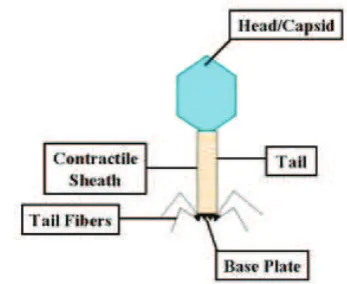
Bacteriophage (phage) are obligate intracellular parasites that multiply inside bacteria by using some or all of the host biosynthetic machinery (Mayer, 2007). Phages specific to X. oryzaepv oryzaeare
[image:4.595.91.495.78.268.2]found in the water of rice field, irrigation canal, and rivers. The population density of bacteriophage is correlated with the number of its bacterial host. However, the problem in using of bacteriophage in the biocontrol of this pathogen was its inactivation by UV light, variable bacterial sensitivity, and the rapid development of bacterial resistance to the phage (Okabe & Goto, 1963).
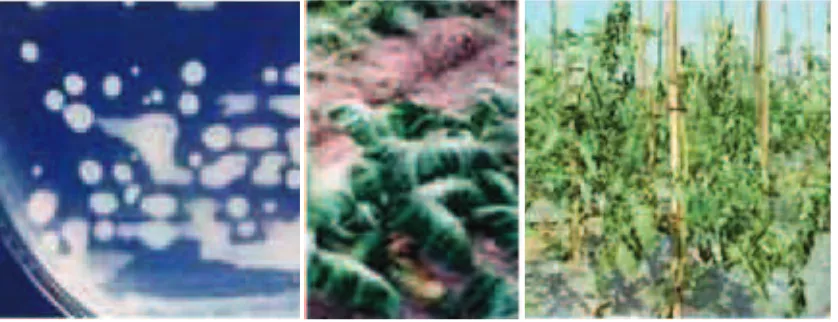
Figure 1. Colonies of Xanthomonas oryzaepv. oryzae(left), typical symptoms of bacterial blight on leaves
(right) (IRRI, 2011)
Figure 2. Structure of T4 bacteriophage
[image:4.595.316.490.595.737.2]For a long time, phages are mainly used for typing bacterial strains and for analyzing the ecological behaviour of pathogenic bacteria. However, after phage has been patented for biocontrol of plant diseases (Jackson, 1989), many reports on the use of phage as a biological control agent could be found anywhere but it is difficult to find the paper of it for rice bacterial leaf blight (Lang et al., 2007).
BACTERIAL WILT (Ralstonia solanacearum) Bacterial wilt caused by Ralstonia solanacearum
(Figure 3) is one of the most important bacterial diseases of plants of commercial value in the tropics, subtropics and warm temperature regions of the world. The disease affects plants in more than 35 families (Kelman, 1953) and more than 20 additional families of plants contain hosts of R. solanacearumfor
a period of almost more than four decades (Hayward, 1994). The pathogen is difficult to control due to their genetic variability, its multiple site of infection, and its wide range of host plant.
R. solanacearumwhile in the host plant, grow
within plant tissues in highly selective niches. On such conditions, therefore, the biological control agents should be applied during the early stages of infection when the pathogen is on the host surface. It should be noted that the bacterium can survive in the soil for extended periods of time without a host and enters the plant through any types of wound (Hayward, 1991).
Biocontrol of R. solanacearum are mostly
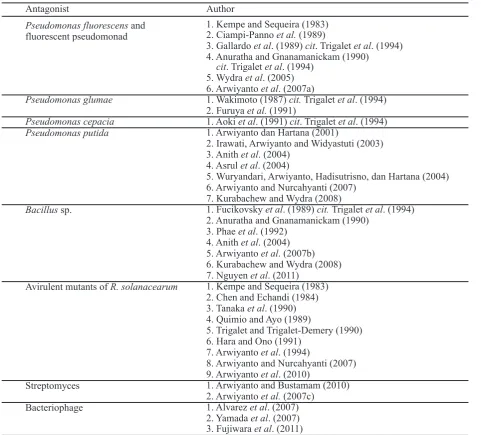
based on antagonism (antibiosis) activity and the antagonistic bacteria have been isolated form various sources (Table 3). Antibiosis activity is the easiest to perfom in laboratory by dual test culture, and it can screen thousand candidates efficiently. However, this method will eliminate the candidate
of biological control agents that have mechanism other than antibiosis such as induced resistance and competition (Fravel, 1988; Arwiyanto et al., 2007a).
Solanaceous crops other than potato and other vegetatively propagated crop were protected biologically from bacterial wilt by dipping the root system of seedlings before transplanting (Figure 5).
Pseudomonas putidastrain Pf-20 (Figure 4) has been
developed for management of tobacco and tomato bacterial wilt. The bacterium inhibited the pathogen growth in vitro, suppressed the disease development in the green house and suppressed disease development of cigar-tobacco bacterial wilt in the field.
The dipping method was effectively deliver the biological control agent into the surface of plant root, thus covering the outer layer of root and keep the pathogen away from the plant. This one time application of biological control agent, however, does not give consistent satisfactory control. Population densities of introduced antagonist bacteria in the rhizosphere usually are greatest soon after planting and gradually decline throughout the growing season, often drop below the detection limit (Weller, 2007). This fact point out the importance of adding an amount of the biological control agent into root surface, periodically, which is often not visible in the field condition.
Other method to deliver bacterial antagonist is by seed treatment, either by seed dressing, seed coating, or seed pelleting. Treatment of tomato seed with water suspension of P. putidastrain Pf-20 suppressed
bacterial wilt into some degree (Asrul et al., 2004).
When the P. putida Pf-20 was mixed with solid
matrix and used for pelleting the tobacco seed (Figure 6), the bacterium could survive in the coated tobacco seed, colonize root system, but the degree of protection was inferior compare with seedlings treatment (Wuryandari et al., 2004).
Figure 3. Colonies of Ralstonia solanacearum on CPG medium (left), the wilt symptom on tobacco
[image:5.595.97.516.602.763.2]Table 3. Some antagonistic bacteria against R. solanacearum
Antagonist Author
Pseudomonas fluorescensand fluorescent pseudomonad
1. Kempe and Sequeira (1983) 2. Ciampi-Panno et al.(1989)
3. Gallardo et al. (1989) cit. Trigalet et al. (1994)
4. Anuratha and Gnanamanickam (1990)
cit. Trigalet et al. (1994) 5. Wydra et al. (2005)
6. Arwiyanto et al. (2007a)
Pseudomonas glumae 1. Wakimoto (1987) cit.Trigalet et al. (1994)
2. Furuya et al.(1991)
Pseudomonas cepacia 1. Aoki et al. (1991) cit. Trigalet et al. (1994) Pseudomonas putida 1. Arwiyanto dan Hartana (2001)
2. Irawati, Arwiyanto and Widyastuti (2003) 3. Anith et al. (2004)
4. Asrul et al. (2004)
5. Wuryandari, Arwiyanto, Hadisutrisno, dan Hartana (2004) 6. Arwiyanto and Nurcahyanti (2007)
7. Kurabachew and Wydra (2008)
Bacillussp. 1. Fucikovsky et al. (1989) cit.Trigalet et al. (1994) 2. Anuratha and Gnanamanickam (1990)
3. Phae et al. (1992) 4. Anith et al. (2004)
5. Arwiyanto et al. (2007b) 6. Kurabachew and Wydra (2008) 7. Nguyen et al. (2011)
Avirulent mutants of R. solanacearum 1. Kempe and Sequeira (1983)
2. Chen and Echandi (1984) 3. Tanaka et al. (1990)
4. Quimio and Ayo (1989)
5. Trigalet and Trigalet-Demery (1990) 6. Hara and Ono (1991)
7. Arwiyanto et al. (1994)
8. Arwiyanto and Nurcahyanti (2007) 9. Arwiyanto et al. (2010)
Streptomyces 1. Arwiyanto and Bustamam (2010)
2. Arwiyanto et al.(2007c)
Bacteriophage 1. Alvarez et al. (2007)
2. Yamada et al. (2007)
[image:6.595.73.516.551.743.2]3. Fujiwara et al. (2011)
CROWN GALL CAUSED BY Agrobacterium tumefaciens
Crown gall, caused byAgrobacterium tumefaciens,
is distributed worldwide and is responsible for nursery and field losses among a large variety of plants, especially stone fruit trees (Jones et al., 1991). A
practical way to control of this disease has been developed, initially with strain K84 of A. radiobacter
(Kerr, 1980). Although the disease has never been reported in Indonesia, this is undoubtedly, as mentioned by Goto in his book (Goto, 1992), the control is one of the most innovative and important advances in biological control of bacterial plant diseases.
The method of control is by inoculation of planting material with non-pathogenic A. radiobacter strain
K84 immediately before sowing or planting. For over 15 years, crown gall on many different host plants has been successfully controlled by K84 in many countries. The control involving inhibition of the pathogen by Agrocin84 (a bacteriocin produced by K84), biological site competition, and competition of certain nutrient that common these bacteria (Kerr, 1980). This is the only biological control of plant pathogenic bacteria that act in two ways, specific competition and antibiosis.
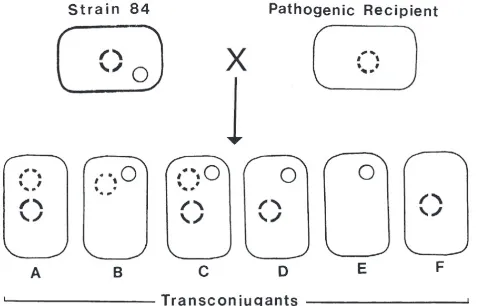
[image:7.595.88.516.77.282.2]The biological control of crown gall by K84, however, create a problem by which the pathogen mutate and no longer subject to control. This was happened because strain K84 has a plasmid governing production of agrocin84 and resistance against it (pAgK84) has been transferred to the pathogenic bacteria (see Figure 7).
Figure 5. Dipping cigar-tobacco seedlings in water suspension of Pseudomonas putidastrain Pf-20 (left)
before planting in the field (right) (Arwiyanto & Hartana, 2001)
Figure 6. Tobacco seed coated with solid matrix containing Pseudomonas putidaPf-20 (Wuryandari et al.,
[image:7.595.163.436.337.511.2]A new strain (K1026), a transfer-defficient (tra-) deletion mutant of strain K84 then was constructed and this strain controls crown gall as effectively as strain K84. The strain is commercially available under tradename of NoGallTM, a peat-based formulation containing 109 bacteria per gram (Jones et al., 1991).
Strain K1026 is regarded safe to use in biological control of crown gall because (Jones et al., 1991):
1. Strain K84, the progenitor of strain K1026, has been registered as a pesticide and used commercially in many countries for over 15 years with no reports of harm;
2. Strain K1026 is indistinguishable from K84 except it lacks a portion of agrocin84 plasmid and preventing plasmid transfer;
3. No foreign DNA remains in strain K1026; 4. Strain K1026 contains no Ti-plasmid-encoded genes
involved in crown gall induction;
5. Strain K1026 can not grow at 37ºC (human body temperature);
6. Agrocin84 is spesifically toxic to agrocinopine-catabolizing agrobacteria, most of which are crown gall pathogens.
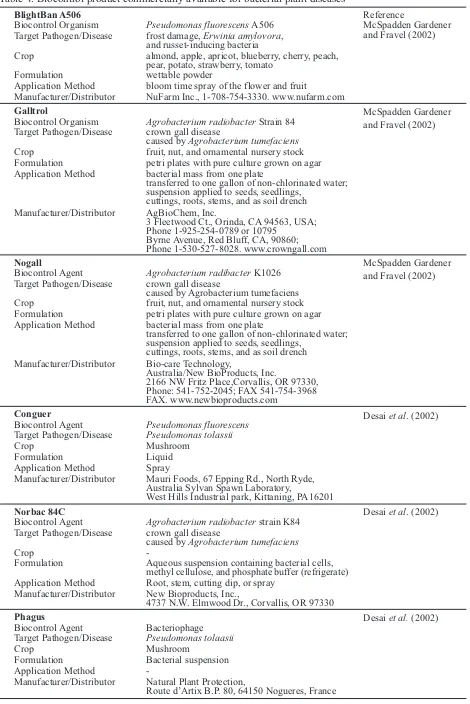
COMMERCIAL BIOLOGICAL CONTROL AGENT FOR BACTERIAL PLANT PATHOGEN There is a limited product of commercially biological control agent for bacterial diseases of plant compare with those for fungal diseases (Table 4). Mention of trade names or commercial products in this publication is solely for the purpose of providing scientific information. Mention within this article does not imply recommendation or endorsement by the University of Gadjah Mada, nor does it reflect prejudice against other commercial products or ventures that are not described.
FUTURE PROSPECT
There is a growing demand for sound, biologically-based pest management practices suggesting that the market potential of biocontrol products will increase in coming years. The author encourage young plant pathologist in Indonesia to study more and more about biological control of plant diseases. Be a scientist who love of science with an insatiable curiosity. As Louis Pasteur said that “Let me tell you the secret that has led me to my goal. My only strength lies in my tenacity”
[image:8.595.177.416.83.236.2](Beveridge, 1957).
Figure 7. Diagrammatic representation of a cross between strain 84 and a pathogenic recipient of Agrobacterium tumefaciens; chromosomes are not shown; strain 84 contains two plasmids, one (solid line) coding
Table 4. Biocontrol product commercially available for bacterial plant diseases
BlightBan A506 Reference
Biocontrol Organism Pseudomonas fluorescensA506 McSpadden Gardener
and Fravel (2002)
Target Pathogen/Disease frost damage, Erwinia amylovora,
and russet-inducing bacteria
Crop almond, apple, apricot, blueberry, cherry, peach,
pear, potato, strawberry, tomato
Formulation wettable powder
Application Method bloom time spray of the flower and fruit
Manufacturer/Distributor NuFarm Inc., 1-708-754-3330. www.nufarm.com
Galltrol McSpadden Gardener
and Fravel (2002)
Biocontrol Organism Agrobacterium radiobacterStrain 84
Target Pathogen/Disease crown gall disease
caused by Agrobacterium tumefaciens
Crop fruit, nut, and ornamental nursery stock
Formulation petri plates with pure culture grown on agar
Application Method bacterial mass from one plate
transferred to one gallon of non-chlorinated water; suspension applied to seeds, seedlings,
cuttings, roots, stems, and as soil drench
Manufacturer/Distributor AgBioChem, Inc.
3 Fleetwood Ct., Orinda, CA 94563, USA; Phone 1-925-254-0789 or 10795
Byrne Avenue, Red Bluff, CA, 90860; Phone 1-530-527-8028. www.crowngall.com
Nogall McSpadden Gardener
and Fravel (2002)
Biocontrol Agent Agrobacterium radibacterK1026
Target Pathogen/Disease crown gall disease
caused by Agrobacterium tumefaciens
Crop fruit, nut, and ornamental nursery stock
Formulation petri plates with pure culture grown on agar
Application Method bacterial mass from one plate
transferred to one gallon of non-chlorinated water; suspension applied to seeds, seedlings,
cuttings, roots, stems, and as soil drench
Manufacturer/Distributor Bio-care Technology,
Australia/New BioProducts, Inc.
2166 NW Fritz Place,Corvallis, OR 97330, Phone: 541-752-2045; FAX 541-754-3968 FAX. www.newbioproducts.com
Conguer Desai et al. (2002)
Biocontrol Agent Pseudomonas fluorescens
Target Pathogen/Disease Pseudomonas tolassii
Crop Mushroom
Formulation Liquid
Application Method Spray
Manufacturer/Distributor Mauri Foods, 67 Epping Rd., North Ryde,
Australia Sylvan Spawn Laboratory,
West Hills Industrial park, Kittaning, PA16201
Norbac 84C Desai et al. (2002)
Biocontrol Agent Agrobacterium radiobacterstrain K84
Target Pathogen/Disease crown gall disease
caused by Agrobacterium tumefaciens
Crop
-Formulation Aqueous suspension containing bacterial cells,
methyl cellulose, and phosphate buffer (refrigerate)
Application Method Root, stem, cutting dip, or spray
Manufacturer/Distributor New Bioproducts, Inc.,
4737 N.W. Elmwood Dr., Corvallis, OR 97330
Phagus Desai et al.(2002)
Biocontrol Agent Bacteriophage
Target Pathogen/Disease Pseudomonas tolaasii
Crop Mushroom
Formulation Bacterial suspension
Application Method
-Manufacturer/Distributor Natural Plant Protection,
LITERATURE CITED
Adhikari, T.B., C.M. Vera Cruz, Q. Zhang, R.J. Nelson, D.Z. Skinner, T. W. Mew, & J.E. Leach. 1995. Genetic Diversity of Xanthomonas oryzaepv. oryzaein Asia. Applied and Environmental Microbiology61: 966–971.
Agrios, G.N. 2005. Plant Pathology. 5thed. Elsevier
Academic Press, California. 922 p.
Álvarez, B., M.M. López, & E.G. Biosca. 2007. Influence of Native Microbiota on Survival of
Ralstonia solanacearumPhylotype II in River Water
Microcosms. Applied and Environmental Microbiology
73: 7210–7217.
Anith, K.N., M.T. Momol, J.W. Kloepper, J.J. Marois, S.M. Olson, & J.B. Jones. 2004. Efficacy of Plant Growth–promoting Rhizobacteria, Acibenzolar-S-methyl, and Soil Amendment for Integrated Management of Bacterial Wilt on Tomato. Plant Disease88: 669–673.
Anonymous. 2011. Bacterial Blight. http://www. knowledgebank.irri.org/ipm/ index.php/bacterial-blight. Arwiyanto, T., M. Goto, & S. Tsuyumu. 1994. Biological Control of Bacterial Wilt of Tomato by an Avirulent Strain of Pseudomonas solanacearum. Annals of the Phytopathological Society of Japan60: 421–430.
Arwiyanto, T., I. Hartana, & Sudarmadi. 1995. Characteristics of the Causal Agent of Deli-Tobacco Bacterial Wilt. Paper presented at the Scientific Seminar and XIII Congress of Indonesian Phytopathological Society. Mataram, September 25–27, 1995. Indonesia. (In Indonesian).
Arwiyanto, T. 1997. Biological Control of Tobacco Bacterial Wilt (Pseudomonas solanacearum):
1. Isolation of Antagonistic Bacteria. Indonesian Journal of Plant Protection3: 54–60.
Arwiyanto, T. & I. Hartana. 2001. Field Experiment of Biological Control of Tobacco Bacterial Wilt (Ralstonia solanacearum). Mediagama3: 7–14. (In
Indonesian).
Arwiyanto, T., F. Yuniarsih, T. Martoredjo, & G. Dalmadiyo. 2007a. Direct Selection of Fluorescent Pseudomonad in the Field for Biological Control of Lincat Disease of Tobacco. Journal of Tropical Plant Pest and Diseases7: 1411–7525. (In Indonesian).
Arwiyanto, T., Y.M.S. Maryudani, & A.E. Prasetyo. 2007b. Charactherization and Activity Tests of Bacillus
spp. as A Biological Control Agent of Lincat Disease on Temanggung Tobacco. Indonesian. Journal of Biological Researches12: 93–98. (In Indonesian).
Arwiyanto, T., K. Haryono, A. Priyatmojo, T. Martoredjo, & G. Dalmadiyo. 2007c. Suppression of Temanggung Tobacco Bacterial Wilt with Streptomyces
spp. Journal of Indonesian Plant Protection13: 13–21.
Arwiyanto, T. & S.D. Nurcahyanti. 2007. Antagonism among Isolates of Ralstonia solanacearumand against
Strain Pf-20 of Pseudomonas putida. Paper presented
at 2nd Asian Congress of Mycology and Plant Pathology. December 19–22, 2007. Hyderabad, India. Arwiyanto, T. & H. Bustamam. 2010. Biological Control of Ginger Bacterial Wilt (Ralstonia solanacearum) with Streptomyces. Poster presented at
12th International Conference on Plant Pathogenic
Bacteria. Reunion-France.
Arwiyanto, T., Y.M.S. Maryudani, & S.D. Nurcahyanti. 2010. Protection of Eggplant and Chilli from Bacterial Wilt (Ralstonia solanacearum) with Antagonistic
Bacteria. Paper presented at 28th International
Horticultural Congress. August 22–28, 2010. Lisbon, Portugal.
Asrul, T. Arwiyanto, & Maryudani. 2004. Effect of Tomato Seed Treated with Pseudomonas putidaPf-20
against Bacterial Wilt (Ralstonia solanacearum). Agrosains17: 419–430. (In Indonesian).
Beattie, G.A. 2006. Plant-associated Bacteria: Survey, Molecular Phylogeny, Genomics and Recent Advances, p. 1–56. In S.S. Gnanamanickam (ed.), Plant-associated Bacteria, Springer. Dordrecht.
Beveridge, W.I.B. 1957. The Art of Scientific Investigation.
Vintage Books. New York. 210 p.
Bull, C.T., S.H. De Boer, T.P. Denny, G. Firrao, M. Fischer-Le Saux, G.S. Saddler, M. Scortichini, D.E. Stead, & Y. Takikawa. 2010. Comprehensive List of Names of Plant Pathogenic Bacteria, 1980–2007.
Journal of Plant Pathology92: 551–592.
Chen, W.Y. & E. Echandi. 1984, Effects of Avirulent Bacteriocin Producing Strains of Pseudomonas solanacearumon the Control of Bacterial Wilt of
Tobacco. Plant Pathology33: 245–253.
Ciampi-Panno, L., C. Fernandez, & P. Bustamante. 1996. Biological Control of Bacterial Wilt of Potatoes Caused by Pseudomonas solanacearum. American Potato Journal66: 315–332.
Cook, R.J., & A.D. Rovira. 1976. The Role of Bacteria in the Biological Control of Gaeumannomyces graminisby Suppressive Soils. Soil Biol. Biochem. 8:
269–273.
Cook, R.J. & K.F. Baker. 1983. The Nature and Practice of Biological Control of Plant Pathogens.
APS Press. St Paul, Minnesota. 539 p.
Dardick, C., F.G. da Silva, Y. Shen, & P. Ronald. 2003. Antagonistic Interactions between Strains of
Xanthomonas oryzaepv. oryzae. Phytopathology93:
Desai, S., M.S. Reddy, & J.W. Kloepper. 2002. Comprehensive Testing of Biocontrol Agents, p. 387– 420. In S.S. Gnanamanickam, (ed.), Biological Control of Crop Diseases. Marcel Dekker, Inc., New
York.
Foster, R.C. 1988. Microenvironments of Soil Microorganisms. Biology and Fertility of Soils6:
189–203.
Fravel, D. 1988. Role of Antibiosis in the Biocontrol of Plant Diseases. Annual Review of Phytopathology
26: 75–91.
Fujiwara, A., M. Fujisawa, R. Hamasaki, T. Kawasaki, M. Fujie, & T. Yamada. 2011. Biocontrol of Ralstonia solanacearumby Treatment with Lytic Bacteriophages. Applied and Environmental Microbiology 77: 4155–
4162.
Furuya, N., Y. Kushima, & K. Tsuchiya. 1991. Protection of Tomato by Pretreatment with Pseudomonas glumae
from Infection with Pseudomonas solanacearumand its
Mechanisms. Annals of the Phytopathologicial Society of Japan57: 363–370.
Goto, M. 1990. Fundamental of Bacterial Plant Pathology. Academic Press. Tokyo. 342 p.
Hara, H. & Ono, K. 1991. Effect of Weakly-virulent Bacteriocin-producing Strain of Pseudomonas solanacearumon the Protection of Tobacco Plant from
Bacterial Wilt. Annals of the Phytopathological Society of Japan57: 24–31.
Hayward, A.C. 1974. Laten Infections by Bacteria.
Annual Review of Phytopathology12: 87–98.
Hayward, A.C. 1991. Biology and Epidemiology of Bacterial Wilt Caused by Pseudomonas solanacearum. Annual Review of Phytopathology 29:65–87.
Hayward, A.C. 1994. The Hosts of Pseudomonas solanacearum, p. 9–24. InA.C. Hayward & G.L.
Hartman (eds.), Bacterial Wilt, The Disease and its Causative Agent, Pseudomonas solanacearum. CAB.
Wallingford.
Irawati, A.F.C., T. Arwiyanto, & S.M. Widyastuti. 2003. Induced Resistance of Tomato against Bacterial Wilt with Pseudomonas putidaand avirulent strain
of Ralstonia solanacearum. Paper presented at the
Scientific Seminar and XVII Congress of Indonesian Phytopathological Society. Bandung, Indonesia, 6th−8thAugust 2003. (In Indonesian).
Jackson, L.E. 1989. Bacteriophage Prevention and Control of Harmful Plant Bacteria. US Patent, Patent No. 4,828,999.
Jones, D.A., M.H. Ryder, B.G. Clare, S.K. Farand, & A. Kerr. 1991. Biological Control of Crown Gall Using Agrobacterium Strains K84 and K1026, p
161−170. InH. Komada, K. Kiritani, J. Bay-Petersen
(eds.), The Biological Control of Plant Diseases. FTC
Book Series No. 42, Vol. 42. Food and Fertilizer Technology Center for the Asian and Pacific Region, Taipei, Taiwan.
Kelman, A. 1953. The Bacterial Wilt Caused by
Pseudomonas solanacearum: A Literature Review and
Bibliography. North Carolina Agricultural Experimental Station Technical Bulletin No. 99. 194 p.
Kempe, J. & L. Sequeira. 1983. Biological Control of Bacterial Wilt of Potatoes: Attempts to Induce Resistance by Treating Tubers with Bacteria. Plant Disease67: 499–503.
Kennedy, B.W. & S.M. Alcorn. 1980. Estimate of US Crop Losses to Prokaryote Plant Pathogens.
Plant Disease64: 674–676.
Kerr, A. 1980. Biological Control of Crown Gall Through Production of Agrocin 84. Plant Disease
64: 25–30.
Konisky, J. 1978. The Bacteriocin, p. 71–136. InL.N.
Ornston & J.R. Sokatch (eds.) The Bacteria: A Treatise on Structure and Function.Vol. VI: Bacterial Diversity.Academic Press, New York.
Kurabachew, H. & K. Wydra. 2008. Characterization of Bacterial Antagonists and their Resistance Inducing Effect Against Bacterial Wilt Caused by
Ralstonia solanacearumin Tomato. Abstract of 2nd
International Symposium on Biological Control of Bacterial Plant Diseases November 4–7, 2008, Orlando, FL, USA.
Lang, J. M., D.H. Gent, & H.F. Schwartz. 2007. Management of Xanthomonas Leaf Blight of Onion with Bacteriophages and a Plant Activator. Plant Disease 91: 871–878.
Lindow, S.E. & M.T. Brandl. 2003. Microbiology of the Phyllosphere. Applied and Environmental Microbiology69: 1875–1883.
Mayer, G. 2007. Bacteriology - chapter seven Bacteriophage.http://pathmicro.med.sc.edu/mayer/phage .htm, modified 21/3/14.
McSpadden Gardener, B.B., & D.R. Fravel. 2002. Biological Control of Plant Pathogens: Research, Commercialization, and Application in the USA. Online. Plant Health Progress doi:10.1094/PHP-2002-0510-01-RV.
Mew, T.W., A.M. Alvarez, J.E. Leach, & J.Swings. 1993. Focus on Bacterial Blight of Rice.Plant Disease
77: 5–12.
Murray, R.G.E. 1984. Kingdom Procaryotae, p. 21–22.
InBuchanan, R.E. & N.E. Gibbons (eds.), Bergey’s Manual of Determinative Bacteriology. 8thed. Williams
Nguyen, M.T., S.L. Ranamukhaarachchi, & D.B. Hannaway. 2011. Efficacy of Antagonist Strains of
Bacillus megaterium, Enterobacter cloacae, Pichia guilliermondiiand Candida ethanolicaAgainst Bacterial
Wilt Disease of Tomato. Journal of Phytology3: 1–10.
Oda, M., Sekizawa, Y. & Watanabe, J. 1966. Phenazines as Disinfectants against Bacterial Leaf Blight of the Rice Plant. Applied Microbiology 14: 365−367.
Okabe, N. & M. Goto. 1963. Bacteriophages of Plant Pathogens. Annual Review of Phytopathology1: 397−418.
Phae, C.G., M. Shoda, N. Kita, M. Nakano, & K. Ushiyama. 1992. Biological Control of Crown and Root Rot and Bacterial wilt of tomato by Bacillus subtilis. Annals of the Phytopathological Society of Japan58: 329–339.
Quimio, A.J. & Ayo, A.L. 1989. Biological Control of Tobacco Bacterial Wilt with Avirulent Bacteriocin Producer Strain of Pseudomonas solanacearum. 7th
Int. Conf. Plant Path. Bact. Budapest.
Rovira, A.D.1965. Plant Root Exudates and their Influence Upon Soil Microorganisms, p 170–184. In
K.F. Baker & W.C. Snyder (eds.), Ecology of Soil-borne Plant Pathogens. University of California Press,
Berkeley, Los Angeles.
Savary, S., L. Willocquet, F.A. Elazegui, P.S. Teng, P.V. Du, D. Zhu, Q. Tang, X. Lin, H.M. Singh, & R.K. Srivastava. 2000. Rice Pest Constraints in Tropical Asia: Characterization of Injury Profiles in Relation to Production Situations. Plant Disease84:
341–356.
Schuster, M.L. & D.P. Coyne. 1974. Survival Mechanisms of Phytopathogenic Bacteria. Annual Review of Phytopathology12: 199–221.
Tanaka, H., H. Negishi, & H. Maeda. 1990. Control of Tobacco Bacterial Wilt by Avirulent Strain of
Pseudomonas solanacearum M4S and its
Bacteriophage. Annals of the Phytopathological Society of Japan56: 234–246.
Tanner, F.W. & F.W. Tanner Jr. 1948. Bacteriology, a Textbook of Microorganisms. 4th edition. John
Wiley & Sons. New York. 625 p.
Trigalet, A. & D. Trigalet-Demery. 1990. Use of Avirulent Mutants of Pseudomonas solanacearum
for the Biological Control of Bacterial Wilt of Tomato Plants. Physiological and MolecularPlant Pathology36: 27–38.
Trigalet, A., P. Frey, & D. Trigalet-Demery. 1994. Biological Control of Bacterial Wilt Caused by
Pseudomonas solanacearum: State of the Art and
Understanding, p. 225–233. InA.C. Hayward &
G.L. Hartman (eds.), Bacterial Wilt, the Disease and its Causative Agent, Pseudomonas solanacearum.
CAB. Wallingford.
Vasudevan, P., S. Kavitha, V.B. Priyadarisini, J. Babujee, & S.S. Gnanamanickam. 2002. Biological Control of Rice Diseases, p. 11−32. In S.S. Gnanamanickam (ed.), Biological Control of Crop Diseases. Decker, New York.
Vidaver, A.K. & P.A. Lambrecht 2004. Bacteria as Plant Pathogens. The Plant Health Instructor. DOI:
10.1094/PHI-I-2004-0809-01.
Weller, D.M. 2007. Pseudomonas Biocontrol Agents of Soilborne Pathogens: Looking Back Over 30 Years. Phytopathology97: 250–256.
Wuryandari, Y., T. Arwiyanto, B. Hadisutrisno, & I. Hartana. 2004. Survival of Pseudomonas putida
Pf-20 strain in Several Formulation. Indonesian Journal of Plant Protection10: 33–41. (In Indonesian).
Wydra, K., J. Semrau, E. Dannon, & R. Diogo. 2005. Characterization of the Interaction of Antagonistic Bacteria and of Silicon (SiO2) with Tomato Infected with Ralstonia solanacearum, p. 112–118. In W.
Zeller & C. Ullrich (eds.), Proceedings of the 1st
International Symposium on Biological Control of Bacterial Plant Diseases. Seeheim/Darmstadt,
Germany, 23rd–26thOctober 2005.
Yamada, T., T. Kawasaki, S. Nagata, A. Fujiwara, S. Usami, & M. Fujie. 2007. New bacteriophages that Infect the Phytopathogen Ralstonia solanacearum. Microbiology153: 2630–2639.
Zeller, W. & C. Ullrich (eds.). 2005. Proceedings of the 1stInternational Symposium on Biological Control
of Bacterial Plant Diseases. Seeheim/Darmstadt,