English Training for the Productive Age Society in
Janggalan, Kudus
M
UHS
HOFIYUDDINIslamic University of Nahdlatul Ulama’ (UNISNU) Jepara, Indonesia
Abstract: In facing globalization and ASEAN Economic Community,
English is urgent to be used in working necessity in Indonesia. That’s why
the writer tried to find the way how to help people in meeting this urgency. Then the writer hold such effective English course for those who are in 18-25 years old in Janggalan Kota Kudus. The course is aimed at: (1) providing English training to the people concerned to meet the demands of employment; (2) helping to improve human resources in Janggalan; (3) driving the spirit of productive age community in Janggalan to work harder; (4) starting English training implementation for free in Janggalan, and (5)
being a community engagement program. The course’s learning process is by
using 30% speaking, 30% writing, 20% listening and 20% reading with 50% English language using in teaching. This program has been proved quite effective. The participants who were almost totally unable to understand and use English, at the end they could obtain an average score of 66.33. Although it is not too high, it shows conclusion that they are capable enough to understand and use English after joining the program. This program is very useful to help people in productive working age to master English in order to get a proper job so as to help the government in reducing unemployments.
Keywords: Community engagement, English course, productive age society.
Introduction
and used in national examination1. Besides, Baswedan2 stated “penguasaan
bahasa asing khususnya Bahasa Inggris sudah menjadi suatu hal penting dan keharusan dimiliki para siswa untuk bisa bersaing mendapatkan
pekerjaan di era Masyarakat Ekonomi ASEAN.” The statement says that
English that must be mastered by every person in Indonesia.
In the globalization era, Indonesian must interact to other citizens in direct or indirect communication, especially in dealing with MEA (ASEAN Economic Community). Consciously or unconsciously, nearly 100% of them use English to interact among citizens from different countries. In addition, mostly all products, technology, information, and everything coming from abroad also facilities offered by citizens from other country use English.
In fact, nowadays English has been absolutely one of the requirements of jobs. It is proved that English has been used by all companies, government agencies or private institutions, or even entrepreneurs both home and abroad as a condition to fulfill the jobs offered. Baswedan3 expressed “Era global
termasuk di MEA menjadikan penguasaan bahasa asing menjadi salah satu keterampilan yang harus dimiliki siswa sebagai calon pekerja atau
pengusaha. Tanpa keterampilan bahasa itu dipastikan akan sulit bersaing”.
It is like what the writer has found 30 samples of jobs taken randomly from some media on internet as survey, the list factually showed that the whole companies or agencies offered job vacancies for people in the productive age work who master the English language both from undergraduate program and senior high. It is also proven by Abdullah4. He is a citizen graduated from high school. When he applied for a job in one of major companies in Kudus, he was interviewed in English, then he was rejected because of being not able to answer the questions given to him and could not interact in English even though the terms of acceptance had been acceptable. Similarly, it illustrates that currently English has become a real necessity that must be mastered by
1Muh Shofiyuddin. “Improving Speaking Skill of the Tenth Grade Students of MAN I Kudus in Academic Year 2020/1011 by Using Dubbing and Role-Play.” (SPd Thesis, Muria Kudus University, 2011), 1.
2 Achmad Fauzi,, “Mendikbud: Penguasaan Bahasa Asing Jadi Keharusan Siswa,” Indone-sian Times, January, 10, 2015, accessed June 26, 2016, http://wartaekonomi.co.id/berita41-782/mendikbud-penguasaan-bahasa-asing-jadi-keharusan-siswa.html
everyone who wants to work in a company or agency although they are only able to use receptive English.
On the other hand, there are many people or companies in Indonesia or abroad use English as a daily spoken language. The demands of corporate management that requires every worker must master English properly and correctly, either in writing or speaking. Thus, we should be able to socialize on the application of English to public in order to live in Indonesia, especially in the productive working age. 18-25 years old are the ages of productive community; and be used as minimum and maximum thresholds in terms of jobs in reality often offered. However there are still many of them are unemployed around us. It is not absolutely because they are too lazy to find a job or do not want to work, but they do not get the job or are rejected. The difficulty of selection in getting a job could be because the majority of them cannot meet the entry requirements requested by a company or a related agency. One of them is being able to use English. Sometimes they want to learn English by following a course, but we do know that the cost of the course is now very high. Then what can we do? They are in the middle or lower of economic level.
By these realities in life and our minds, an engagement program of community in the form of "English training for people in the productive age" is potential to address the problems that they experience, by giving them skills and English competence to the people in productive age of work for free. It will help them solve their problems to get more chances on getting job. So that they will get a better job and will not become unemployed again. Furthermore, it is also expected to help the government to reduce the amount of unemployment that has proliferated in our country. In this case the writer chose community of Janggalan Kudus as the objects.
Statements of the Problem
Based on the background, the problems of this community engagement program are:
1. Is an English training program able to help people in productive age of Janggalan village master English?
Objectives of the Program
The goals to be achieved in this community engagement program through a free course are:
1. To know whether an English training program able to help people in productive age of Janggalan village master English?
2. To know how an English training program help people in productive age of Janggalan master English?
Benefits of the Program
Training activities by community engagement entitled "English Training for the Productive Age Society in Janggalan Kota Kudus" is expected to generate productive working age of Janggalan people for being eligible to get a job, in which majority of jobs using English as the main requirement. Through this activity, people can acquire skills and abilities to communicate by using English, so that it can help them as a basic capital to get a job.
This activity is also expected to give a recommendation to the government of Kudus particularly, to conduct similar activities in places that are still vulnerable to unemployment. It is as efforts to tackle unemployment and to reduce its amount that is increasingly growing in our country. Furthermore, this activity is expected to be continueed after this program ends.
Besides, the benefits of this program are:
1. For Janggalan Government; to help improving the community resources available for work in Janggalan in order to find employment, thereby helping to reduce unemployment in the village Janggalan Kota Kudus; and to initiate the implementation of free English training for productive age people in Janggalan.
2. For the Community; providing a free English training for the people; and being able to help people acquire knowledge, skills, and English skills so that they have a basic capital, more opportunities and easier to be accepted in an institution or company.
Review to Related Literature
Community EngagementCommunity engagement is an activity undertaken to assist communities to develop or increase the development, independence and the ability of people’s preformance in order to improve the welfare and the nation. As stated in Permendikbud number 49 of 2014 “Standar hasil pengabdian kepada masyarakat merupakan kriteria minimal hasil pengabdian kepada masyarakat dalam menerapkan, mengamalkan, dan membudayakan ilmu pengetahuan dan teknologi guna memajukan
kesejahteraan umum dan mencerdaskan kehidupan bangsa5”. Noor6 also
said “Pengabdian masyarakat merupakan kegiatan yang memanfaatkan ilmu pengetahuan dalam upaya memberikan sumbangan demi kemajuan
masyarakat.” In this case, community engagement activities deemed
necessary to be done to help people of Janggalan Kota Kudus improve English proficiency in order to enhance the resources and the welfare of the people’s concerned.
Community in Productive Age of Work
Productive is the resulting in or providing a large amount or supply of something7. Meaningly, productive age is the age when a person is able to work and produce something. So the definition of "persons in productive age" is people who are in the age having ability to produce. In this case the point meant is jobs. In the labor law number 13 In 2003, they were classified as workers, in the age between 15 years to 64 years.
It can be concluded that people in the productive age of work are people who are in the age between 15 to 64 years who are able to work and produce something. In this community engagement activity, the author chose people in the age of 18 to 25 as a trainee by those ages which become the minimum and the maximum of most jobs offered by companies or agencies.
5Permendikbud. No. 49 Tahun 2014 Tentang Standar Nasional Pendidikan Tinggi
6 Muhibbin, “Pengabdian Kepada Masyarakat Dan Pengembangannya Dalam Otonomi Daerah (Alternatif Melalui KKNT)” Indonesian times, November 1, 2010, accessed June 26,
2016,
http://muhibbin-noor.walisongo.ac.id/?op=informasi&sub=2&mode=detail&id=23&page=1
English Teaching
Traditionally, teaching is defined as showing or helping someone to learn how to do something, giving instructions, guiding in the study of something, providing with knowledge, causing to know or to understand8. No definition is very simple and does not regard the role of learner who is learning.
The purpose of English Learning in Indonesia as noted in Peraturan
Menteri Pendidikan Nasional (Permendiknas) No. 22/ 2006 about Content
Standard of Elementary and Intermediate level is to make the students develop the four language competence (reading, writing, listening and speaking). It is in order to make them literate and communicative in certain level of literacy9.
Dixson10 notes at an International Seminar organized by UNESCO (United Nation Educational, Scientific, and Cultural Organization) to discuss the teaching of modern languages, the general principles were subscribed to by the majority of the delegates. Further he mentioned principles as follows: 1. The approach – to the teaching of all foreign languages – should be
primarily oral.
2. Active methods of teaching should be used as far as possible.
3. The greatest possible use of the foreign tongue should be made in the classroom.
4. The difficulties of the foreign tongue in the matter of pronunciation, vocabulary, and grammar should be carefully graded for presentations. 5. The teaching of a language should be considered most as the imparting of
a skill than as the provision of information about he forms of the language.
It means that in teaching English, the teacher has to consider about: oral activity that is more emphasized than writing activity in learning English, active learning, classroom activity, attention of pronunciation,
8 H. Douglas Brown. Teaching by Principles An Interactive Approach to Language Pedagogy. Second Edition. (San Francisco: Longman, 2001), 7.
9 Permendiknas RI Nomor 22 Tahun 2006 tentang Standar Isi untuk Satuan Pendidikan Dasar dan Menengah.
grammar, and vocabulary, and the enhancement of the four language competence. Thus, in this program, the participants did not only learn about written language but also spoken language by practicing in the learning process. Beside, spoken was used around 50% in the process.
Implementation and Results
The Timeline of Program Implementation
This community engagement program is implemented within a period of three months. Before implementing the program, it was preceded by a survey realized two weeks before the day of training. It was intended to determine the number of citizens who needed English skills and ability training to follow the training. The survey was conducted by logging the number of people who are in the productive age of work and where the average economic ranking was. Besides, it included data collection about the work of the majority of the community. After conducting the training, it was completed with reporting and submission of recommendations to the government within two weeks after the training is completed.
Schedule of the Program Activities
they are the people who are still vulnerable to unemployment, because they cannot meet the requirements which are something of jobs offered, in this case should be able to use English.
Besides, the majority of the community are in the middle-ranking economy on the day of conducting this program, so they could not acquire English skills through a course, because the cost of the course was getting higher.
Kudus is a small town that is so productive, in the sense that it has become part of the industrial city in Indonesia, it is proven many big and small companies in Kudus. Then, English has become a necessity in getting a job in Kudus particularly and the whole parts of Indonesia generally.
The reason for selecting the object and the target number was based on the state of human resources, economic, and also based on the consideration of the allocation of funds. The people selected was assumed to be more in need of English to find employment.
In this case, the writer chose Janggalan Kota Kudus as an object to carry out the community engagement program in the hope that this activity would be able to help the community concern particularly to meet the demands of jobs. It was done so that they would get more value and competent in using English as well as get a better chance to be able to work in a company or agency.
Implementation of the Program
In this community engagement program, the writer decided to use the naturalistic approach, which according to Lindeman11 is “Adult education will become an agency of progress if its short-term goal of self-improvement can be made compatible with a long-term, experimental but resolute policy of changing the social order”. Thus, adult learning techniques is learning how to make learning processes in tune with the real life. The activity was carried out with the shape of fun activities.
1. Meeting Agenda in the Activity
This English language training activities was carried out in the form of a training activity of English for people in productive age of Janggalan Kota Kudus. The program covered the following agendas:
o Deliberating preparation and implementing publication
o Opening ceremony
o Learning activities
o Closing Ceremony
o Reporting and Submission of Recommendations.
2. Activities the Implemented in the Program
The activities carried out under this program entirely with details of activities as follows:
a. Agenda : Deliberating preparation and implementing
publication
Place : Janggalan hall Kota Kudus Time : 2 weeks before training
Activity : Deliberating and Publishing Brochures Participants : Janggalan People
Guest : Local government and socialite of Janggalan
Total : 40 people
Result : the government and people Janggalan people support the implementation of community engagement by English training for people in productive age in Janggalan Kota Kudus.
: the government and Janggalan people wanted to help to distribute and to share the brochure.
Pictures 1. Opening ceremony.
b. Agenda : Opening Ceremony
Place : a house of Janggalan people Activity : Ceremonial
Time : before the training process started Participants : Janggalan people
Result : opening formally the training activitiy.
c. Agenda : Learning process
Place : a house of Janggalan people Activity : Learning
Time : 3 months (3 times in 1 week)
Participants : 29 people (in and around Janggalan)
Result : the participants could follow the learning process and were able to use spoken and written English.
d. Agenda : Closing Ceremony
Place : a house of Janggalan people Activity : Ceremonial
Time : the last meeting of learning process Participants : Janggalan people
Guest : Local government and socialite of Janggalan Result : Learning process was formally ended
e. Agenda : Reporting and Submiting Recommendations
Place : Sending it to DIKTI then Delivering it to Janggalan local government
Time : After the community engagement program.
Results of the Program
age is different from people in school ages. Then, a result showed that this program could only be attended by 29 people.
Picture 2. Preparation activities with the socialite and local government
In applying this community engagement program by English training to people, the writer used a course activity as a means to help the Janggalan people in the productive age. The technique used in the learning process tended to use collaborative learning. The writer assumed that collaborative learning is a great way for the training program. In the end, the program could run in accordance with the previous plans of methods, techniques, and schedule. This program has produced some of the community in the productive age of work to be able to use and understand English in the form of conversations and written. It is shown by the practice and exam form of Writing, Listening, Reading, and Speaking applied in the end of the learning activities.
the teachers must have used English in communication, at least while in the classroom. The writer also wrote "No English No Service" in the classroom, as they would get punishment like memorizing irregular verbs, explaining a material (which they can), and singing a song (English song) if they were deliberately not to use English in class or during the learning.
Picture 3. The photo was taken when the participants were giving speech.
The implementation of this program has been implemented 100%. There were some materials that need to be added, namely passive voice, conditional sentence and wishes. In addition, the agenda of the speech program was attended by an English native speaker from American named "Mark Sullivan" for two (2) meetings while he lived in Kudus for several weeks. That happened purposively to give more spirit to the participants in practice by talking directly to English native. So that participants want to practice their English speaking in their daily lives. In the meeting, Mark Sullivan also helped the writer to convey materials and provide motivation more to the participants to keep the spirit in participating in the training program and want to practice it outside the meeting so that they can improve their English language skills more effectively. This program provided certificates to the participants, along with a use-value as a measurement of basic ability for participants to speak English. In addition, the certificate can also be used as a supporting material at the time of applying for jobs for the participants.
even though by basic English. Especially for those who want to go abroad and work in a big city such as Jakarta, Surabaya, etc. The program was also intended to encourage and to give stimulus to the participants to learn and improve their English so that human resources in villages, in Janggalan Kota Kudus especially and in our country generally can be increased and better. Certificates given to the participants were only as a benchmark for their abilities. That was because the cost was not adequate for the manufacture of an official certificate (with permission). At least they were getting supplies in English, and if they wanted to get official certificates, they can easily follow a program of an official agency of English because they have got the skills in the program.
Picture 4. Mark (an American) help the writer to convey the materials and give more motivation to the participants to practice English.
The Presented Materials
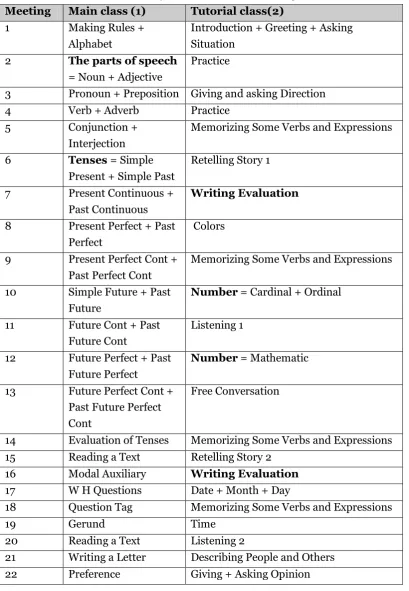
In accordance with agreement of the schedule, the activities in the learning process in the community engagement program "English Training for The Productive Age Society in Janggalan Kota Kudus" are as follows:
Table 1. The Daily Class Schedule of the Program
Meeting Main class (1) Tutorial class(2)
1 Making Rules +
3 Pronoun + Preposition Giving and asking Direction 4 Verb + Adverb Practice
14 Evaluation of Tenses Memorizing Some Verbs and Expressions 15 Reading a Text Retelling Story 2
16 Modal Auxiliary Writing Evaluation 17 W H Questions Date + Month + Day
18 Question Tag Memorizing Some Verbs and Expressions
19 Gerund Time
20 Reading a Text Listening 2
Meeting Main class (1) Tutorial class(2)
23 Conditional sentence Tell me about your dream!
24 Reported Speech I Memorizing Some Verbs and Expressions 25 Reading a text Retelling Story 3
26 Reported Speech II Writing Evaluation 27 Relative Pronoun Dialog
28 Passive Voice Whishes
29 Writing a Letter Memorizing Some Verbs and Expressions
30 Evaluation Evaluation
31 Evaluation Evaluation
32 Evaluation Evaluation
33 Evaluation Evaluation
Program Implementation Phase
This community engagement program was implemented by the total overall time for 4 months, which was divided into preparation and surveying, publications and collecting data, implementation of learning, program evaluation, and reporting. Specifically for the implementation of training, it took 3 months.
1. Preparation and survey
This stage was done on 10 days of the beginning of the first month on the implementation of this community engagement programs in order to determine the condition and the situation of the target and the adjustment program implementation. In preparation activities and the survey, the writer had been getting rave reviews from the village government and local people. The government and people there supported this activity by helping the preparations the writer needed; they also helped the writer in the stage of collecting data collection as required. 2. Publications and Data Collection
Publication was carried out at the same time as the preparation and survey. On the implementation of publication, the writer invited 30 Janggalan people (candidates or targets), the government, and some of the Janggalan socialite. This activity was done in order to determine who participated in these activities with number of them.
who were in the productive age, the results of the data collection were taken to the publication for registration. Number of the community related to the entire village area, Janggalan. After that, there were only 30 people of candidates who wanted to join the training program. However, there was one of them, who resigned. It was probably due to the interest and enthusiasm for learning of productive age population working less than the community at school age.
3. Implementation of Training Programs
The program was carried out after preparation, surveys, publications, as well as the determination of the participants. Learning program started by the event of opening ceremony in the middle of the first month. On this occasion was attended by the village chief and his staff, people around the implementation place, and participants of the program. In the opening ceremony the writer conveyed some information, i.e. about the program objectives, frequency and timing of the training program, the materials to be delivered, and the technique of delivery. Then, this agenda was followed by the implementation of the program in the next meeting until the middle of the last month.
In the implementation of the program, the learning activities were conducted for three months carried out with a frequency of 3 times a week that lasted for two hours. Each meeting consisted of the main class for 75 minutes which contained materials subject, on the main points of English as the use of grammar, arranging of correct sentences, and others, and tutorial classes (additional class) for 45 minutes with evaluations in it consisting of writing in the form of questions and composing, reading a provided text, free conversation with a way to practice speaking in front of the classroom by delivering speech or talk to the other participants, either listening used tapes of conversations, music, or using video.
4. Analysis of Program Success
From a description and note of the results the writer made above, it can be said that the ability to use English, especially, the community of the village in productive age of work could be improved through the process of giving the course. Moreover, the provision of free courses due to the economic level of the community and their lack of interest need encouragement from the outside.
English training on community engagement program to the community in productive age of work in Janggalan. The results of collecting data from this program were taken from the participants. The analysis was done by the recapitulation of the attendance lists. Since it was considered that the activity of a participant could be seen from the discipline of the person, and the activeness of the participant or the object was very influential in the success to be able to master and use the English language were delivered. In addition, the object of the activity was also good or bad effect the results of the training that the writer carried out.
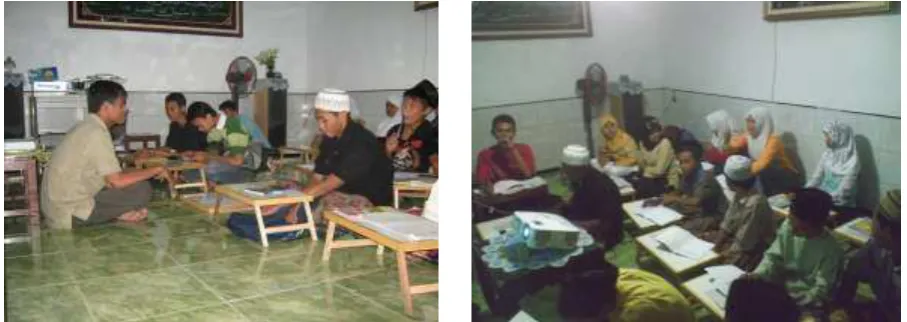
Picture 5. These pictures show about the condition of learning process.
Activeness analysis of participants was not only done through the attendance list, but was also done through the activity during learning activities. It was applied during the learning process.
In the final stages of collecting the data, collecting data was done through evaluation tested to the participants who performed well through writing and practical skills such as interview, retelling stories or speaking, listening and reading. It was in which performed well at the end of the learning activities as well as on evaluations conducted several times during training and learning took place. The recapitulation of the values as follows:
Table 3. Recapitulation of Evaluation of Learning Result in English Training for Age Productive People of Janggalan Kota Kudus
No Initial Test i
Test ii
Test iii
Test iv
Test v
Test vi
Test
vii Total Avg
No Initial Test
though not so good. Then, 28% remained on less levels meaningfully that they were not so able to understand and follow the learning program.
In the third month or last month, participants on good level of the previous 40% of all participants increased into 48%. Then the participants were on a moderate level were in 36%, and the rest or 16% remained on a less level. These rates illustrate that learning activities can be followed by most of the participants.
5. Evaluation
The evaluation was conducted within the learning programs as well as at the end of the program. In the evaluations having been conducted, it states that the implementation of the learning program on English skills and mastery for the community or participants always increased from the beginning until the end of the implementation. Even though there were still some who had not been able to follow the training materials properly, as described above.
In carrying out this training, the writer had a problem. It was the interest in learning of the community in productive age or the participants were in getting ups and downs. So the writer had a little confusion on deciding of the participants.
Conclusion
After the writer observed an increase of English competence and skills of Janggalan people in the productive age through a course or training and got the final result of the participants’ excercise during English training, it can be concluded as follows:
1. English language training to people in the productive age of work of Janggalan Kota Kudus can help such communities to improve their ability to use English.
2. English training to people in productive age of work can be done through intensive course.
3. English competences they got can help them as a foundation in searching a job, in which so far have been a lot of jobs using English as necessity to be accepted in a company or agency.
Daftar Pustaka
Brown, H. Douglas. Teaching by Principles An Interactive Approach to
Language Pedagogy. Second Edition. San Francisco: Longman, 2001.
Cambridge English Dictionary & Thesaurus, accessed june 25, 2016. http://dictionary.cambridge.org/dictionary/english/productive.
Dixson, Robert J. Practical Guide to the Teaching of English as a Foreign
Language. New York: Regents Publishing Company. Inc, 1960.
Eduard C. Lindeman. What is adult education?. New York: Unpublished manuscript, Columbia University, Butler Library Lindeman Archive, 1925.
Fauzi Achmad. “Mendikbud: Penguasaan Bahasa Asing Jadi Keharusan Siswa,” Indonesian Times, January, 10, 2015, accessed June 26, 2016, http://wartaekonomi.co.id/berita41782/mendikbud-penguasaan-bahasa-asing-jadi-keharusan-siswa.html
Noor Muhibbin, “Pengabdian Kepada Masyarakat Dan Pengembangannya
Dalam Otonomi Daerah (Alternatif Melalui KKNT)” Indonesian times,
November 1, 2010. accessed june 26, 2016. http://muhibbinnoor.-walisongo.ac.id/?op=informasi&sub=2&mode=detail&id=23&page=1
Permendikbud. Nomor. 49 Tahun 2014 Tentang Standar Nasional Pendidikan Tinggi
Permendiknas RI Nomor 22 Tahun 2006 tentang Standar Isi untuk Satuan Pendidikan Dasar dan Menengah.