CHRISTIAN CHUA
NATIONAL UNIVERSITY OF SINGAPORE
CHRISTIAN CHUA
(M.A., University of Göttingen/Germany)
A THESIS SUBMITTED
FOR THE DEGREE OF DOCTOR OF PHILOSOPHY
DEPARTMENT OF SOCIOLOGY
NATIONAL UNIVERSITY OF SINGAPORE
ACKNOWLEDGEMENTS
Throughout the years working on this study, the list of those who ought to be mentioned here grew tremendously. Given the limited space, I apologise that these acknowledgements thus have to remain somewhat incomplete. I trust that those whose names should, but do not, ap-pear here know that I am aware of and grateful for the roles they played for me and for this thesis.
However, a few persons cannot remain unstated. Most of all, I owe my deepest thanks to my supervisor Vedi Hadiz. Without him, I would not have begun work on this topic and in-deed, may have even given up along the way. His patience and knowledgeable guidance, as well as his sharp mind and motivation helped me through many crises and phases of despair. I am thankful, as well, for the advice and help of Mary Heidhues, Anthony Reid, Noorman Ab-dullah, and Kelvin Low, who provided invaluable feedback on early drafts.
During my fieldwork in Indonesia, I was able to work as a Research Fellow at the Centre for Strategic and International Studies (CSIS) in Jakarta thanks to the kind support of its direc-tor, Hadi Soesastro. Not only did my colleagues and friends at CSIS help make my time so en-joyable, I am not sure if I could have survived the nine months in Jakarta without them. I am also grateful to all of my respondents – those listed in the Appendices and those who preferred to remain anonymous – for taking the time to talk and explain to me the often very opaque world of business and politics in Indonesia, as well as to Evy Heliana, Agung Wicaksono, and my mother Susantiana Ciptawijaya, who helped me in one way or the other.
and its encouragement, together with that of my former supervisor Ingrid Wessel, to switch from Humboldt University Berlin to Singapore.
No academic work can be done if one does not have a life outside university. To all those who were part of it, to my parents in Germany, and to my friends, who struggled with me through endless library days, stimulating discussions, and joyful nights over a Beck’s Bier in Göttingen, Tiger Beer in Singapore, or Bir Bintang in Jakarta: You are the best! I am very happy to know you.
TABLE OF CONTENTS
Acknowledgements ... i
Table of contents ... iii
List of tables and figures ... v
Summary ... vi
1 Introduction: Capital and the state ... 1
1.1FOCUS AND DEFINITIONS... 3
The Chineseness of capital ... 3
Chinese ‘big business’... 6
States and regimes... 8
1.2CENTRAL ARGUMENT:THE EMERGENCE OF PLUTOCRACY... 11
1.3METHODOLOGY... 12
1.4OUTLINE... 15
2 Theoretical framework: Power configurations of state and capital ... 17
2.1APPROACHES TO CHINESE INDONESIAN CAPITALISTS... 18
Culturalist perspectives ... 18
Structuralist perspectives ... 23
An analysis of Chinese capital’s ethnic and material conditions ... 26
2.2IDENTIFYING THE ‘RULING CLASS’:CAPITAL AND THE STATE... 29
Theories of the capitalist state... 30
The New Order state... 32
Forms of capitalism... 36
2.3FROM BUREAUCRATIC TO PLUTOCRATIC CAPITALISM... 39
3 Limited capitalists: Chinese big business and the state before 1998 ... 41
3.1DETERMINANTS:CHINESE CAPITAL IN HISTORICAL PERSPECTIVE... 42
Pre-colonial times (From the ‘dawn of history’ to 1600)... 43
Colonial rule (1600–1949) ... 44
The post-colonial state (1949–65)... 49
3.2THE NEW ORDER ACCOMMODATION... 53
Conditions: The creation of a pariah business class... 54
Marginalisation: Extinguishing Chineseness ... 55
Discrimination: Making the Chinese visible ... 58
Stigmatisation: The Chinese as expropriators ... 60
Implications for the Chinese capitalists... 63
The formation of the alliance (1966–74)... 64
Raising Chinese cukongs ... 64
The foundations of symbiosis ... 68
The consolidation of bureaucratic power (1974–82) ... 70
The system of dominance: Authoritarianism, centralism, and protectionism... 72
Indigenous capital ... 75
The expansion of oligarchic capitalism (1982–97) ... 78
The politico–business oligarchy... 79
Contradictions... 82
4 Capital in crisis: The conglomerates and the end of the New Order ... 88
4.1THE CRISIS IN CONTEXT... 90
Interpretations ... 90
Capital on the eve of the crisis ... 93
Monetary crisis... 95
Regime crisis ... 97
4.2ECONOMIC IMPACT:THE DISMANTLING OF THE BUSINESS EMPIRES... 100
Financial collapse ... 100
Debt settlement ... 103
4.3POLITICAL IMPACT:THE DISSOLUTION OF PREDATORY ARRANGEMENTS... 104
The end of authoritarianism ... 105
The end of centralism ... 110
The end of protectionism ... 112
4.4THE END OF THE CONGLOMERATES? ... 116
5 Capital’s reaction: The survival of the conglomerates ... 119
5.1REFORMASI IN INDONESIA:ECONOMIC AND POLITICAL CONTEXTS... 120
Economic necessities: The indispensability of the conglomerates ... 120
Structural continuities: The limits of political reform ... 123
5.2THE CONGLOMERATES AND THE NEW REGIME... 125
Democratisation ... 126
Decentralisation ... 130
Deregulation... 131
5.3ECONOMIC RECOVERY:RECOUPING THE LOSSES... 135
The Lippo Group ... 138
The Salim Group ... 144
5.4CAPITALIST CONSOLIDATION, CONSOLIDATED CAPITAL... 155
6 Capital unlimited: Towards a new accommodation ... 158
6.1CAPITAL IN POST-SOEHARTO INDONESIA:UN-LIMITING CHINESE BIG BUSINESS... 160
Democracy: Social de-marginalisation... 160
Decentralism: Political strengthening... 165
Free markets: Economic resurgence... 166
6.2MODES OF TRANSITION:PATTERNS OF POLITICAL BUSINESS... 168
The restoration of KKN ... 169
Money politics ... 170
Patronage ... 171
Infiltration ... 175
The politicisation of business ... 177
Political activism... 177
Premanism ... 179
6.3FORMATS OF REPRESENTATION:THE RISE OF AN AUTONOMOUS CAPITALIST CLASS... 182
Autonomy... 183
Dominance ... 185
Immediacy ... 187
6.4PLUTOCRACY IN THE MAKING... 189
7 Conclusion: The state of capital... 190
Bibliography... 198
Newspapers, magazines... 213
Appendices... 218
List of people interviewed ... 219
LIST OF TABLES AND FIGURES
Figure 1: Typology of capitalist systems ... 37
Figure 2: Development of capitalism in Indonesia ... 39
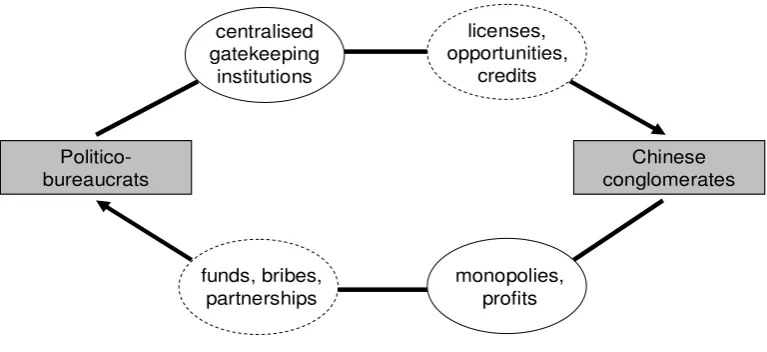
Figure 3: Patronage networks in the New Order... 69
Figure 4: Anti-Chinese/anti-capitalist cartoons ... 83
SUMMARY
The disintegration of Indonesia’s New Order regime in 1998 put an end to the crude forms of centralised authoritarianism and economic protectionism that were essential for the emergence and rise of large Chinese conglomerates, which have dominated the country’s private sector. What were the consequences of the democratic transition for Chinese big business? How do business groups adapt to changes in the political environment? Despite massive problems and contrary to expectations, most of the major capitalist groups have in fact succeeded in getting through the economic and political crisis that brought down Soeharto, and are now presiding over refashioned but still thriving corporations. This study identifies the strategies the tycoons employed to survive in an unfamiliar, initially threatening post-authoritarian regime, thereby revealing the dynamics of power and the particular structural position of big business in the post-Soeharto Indonesian political economy.
I argue that it is important to take the ethnicity of private capital in Indonesia into consid-eration, which – since colonial times – has been ‘Chinese’. Discriminatory policies marginal-ised this ethnic minority both socially and politically, confining it to distinctively economic functions. A small group of Sino-Indonesian capitalists was thus ideally suited to be co-opted as business clients of the New Order powerholders from 1966 onwards. Without direct access to political power, these ‘limited capitalists’ could not pose a threat to the state managers and were therefore nurtured to grow into huge business groups. The combination of economic strength and political weakness allowed them to become an integral part of the New Order rul-ing oligarchy, in which the politico-bureaucrats prevailed.
tremen-dously from the changed political conditions. The new regime could not ignore their capital due to its indispensability to an Indonesian economy re-emerging from deep crisis. Continui-ties in Indonesia’s predatory form of capitalism as well as the discontinuation of overtly anti-Chinese policies allowed the major business groups to survive, recoup their losses, and even placed them in a position to help determine future economic and political directions. Tradi-tional modes of conducting political business, along with the significant rise of money politics, enhanced the Chinese capitalists’ bargaining power and provided the setting for the emancipa-tion of the businessmen from their former bureaucratic patrons.
‘Money politics will be less and less in our open, more democratic economy. […] We are heading towards an improved capitalism.’ (Former President Abdurrahman Wahid)1
‘It is part of my responsibility to help the country to democratize. […] We are built to become the main engine of democracy in Indonesia.’ (Artha Graha Group boss Tomy Winata)2
1
INTRODUCTION:
CAPITAL AND THE STATE
Plutocracy, literally, means the rule of wealth. This study analyses the transformations in In-donesia from a bureaucratic regime to one which is plutocratic. It will demonstrate how the hierarchy inside the state–business oligarchy shifted in favour of capital.
One may argue that all societies are ruled by the wealthy (e.g. Miliband 1969: 23). How-ever, this assertion is too general, as state power may also be held by groups that establish their power and authority on sources other than capital. Indonesia during the rule of the so-called New Order (1966–98) was one such case. This regime was by and large dominated by bureaucrats, while the predominantly Chinese capitalists were politically restricted. The more distinct characteristics of plutocracy in post-authoritarian Indonesia thus need to be defined in contrast to the previous regime that was in power until the financial crisis in 1997/1998, in which politico-bureaucrats were a dominant part of the ruling alliance that prevailed.
To suggest the emergence of a plutocratic regime is not in line with commonly purported assessments of the post-crisis development of Indonesia. Mackie’s evaluation represents the widespread expectation of the end of Chinese big business, common especially during the immediate post-Soeharto years:
1
Interview 17 September 2004.
2
Soeharto […] and his major cukong (Chinese financial backers; cronies) have crashed into the
dustbin of history. (Most of the top 20 or 30 are either bankrupt, or nearly so, in any case, and
no doubt many hundreds or even thousands more.)
(Mackie 1999: 189)
One of the major spokespersons of Chinese Indonesian businessmen3, Sofjan Wanandi
(inter-view 1 July 2003), concurred with this appraisal and commented on my research project: ‘Chinese big business? Don’t waste your time. They are all bankrupt!’
Indeed, the events during the upheavals in 1998 painted a fairly desperate picture for these capitalists. Demonstrators held the conglomerates responsible for the economic crisis, politi-cians used them as scapegoats, and rioters destroyed corporate and private property of the big tycoons. With the fall of long-time dictator Soeharto in May 1998, the regime that estab-lished, promoted, and protected them came to an end. The new political environment was per-ceived as being full of unpredictable threats to the interests of big businesses. The sudden dis-sipation of the authoritarian, centralised, and protectionist features of the New Order made Chinese capitalists not only vulnerable to bankruptcy or, at least, to an enforced partial set-tlement of their gargantuan debts, but also to a general reorganisation of the Indonesian econ-omy without them. The immense amount of capital that left Indonesia during the crisis – es-timated to range up to US$165 billion (Merdeka 6 June 1998) – as well as the exodus of most major tycoons who sought shelter in Singapore, Australia, or elsewhere, testified to their pes-simistic perception of the situation in 1998. The end of the New Order was thus widely re-garded as possibly heralding the end of Chinese big business.
However, a few years after the crisis, the boss of Indonesia’s largest conglomerate, An-thony Salim (interview 13 April 2005), claimed that his companies were ‘in fact not only not affected but thriving because of the new conditions’. Reports on other conglomerates and
3
timations by most of my respondents presented the same judgement on the state of Chinese big business. Reformasi, as the post-Soeharto period is called (maybe too euphemistically), obviously failed to disrupt many of the structural foundations of the New Order regime and disempower the oligarchy that presided over it.
The main question is thus how the capitalists proceeded to recover, regain economic strength, and reinvent themselves in a post-authoritarian political environment. How has big business adapted to the monumental political changes in Indonesia? How does the re-emergence of capital affect the state, particularly its managers? Understanding the political economy of Chinese big business in Indonesia and its development after 1998 will help us to better comprehend the current nature of relations between capital and the state.
1.1 Focus and definitions
A study on ‘Chinese big business’ and the state requires careful definitions of its objects and scope of research. Three analytical dimensions have to be clarified, before I elaborate on my central argument: first, the ‘Chinese’ ethnicity of the capitalists in Indonesia, second, the type of ‘big business’ that is of concern here, and third, how I conceive concepts such as state, re-gime, and government. I will differentiate this study from other approaches to the Chinese minority and explain its specific focus on the largest of these conglomerates.
The Chineseness of capital
When speaking of ‘Chinese’, I refer toIndonesians who define themselves as ‘orang Tiong-hoa’/Chinese Indonesians and are seen by others as ‘Chinese’.4 Ethnic Chinese have been
4
ing in Indonesia for generations, if not centuries. It is often impossible to find differences be-tween them and the Indonesians regarded as indigenous, the so-called pribumi. Most of the Sino-Indonesians have Indonesian names, use the Indonesian language, are Indonesian citi-zens, and have never been outside Indonesia. However, until 1998 they constituted the ‘ non-pribumi’, the counterpart of the pribumi-majority. This ‘non-asli’ (‘not original’) attribute not only legally marked the Chinese as outsiders of the nation, but constituted the dominant social reality in Indonesia. In many ways, be it in the institutional enactment of discriminatory laws and unfair practices or publicly in riots, the exclusion of the Chinese took place (Chua 2002).
As I will point out in Chapter 3, the ‘Chinese problem’ – manifest in state-sanctioned dis-crimination – seriously affected the social position of Indonesia’s major capitalists in the New Order. Similarly decisive for capital was the relative but general de-marginalisation of Sino-Indonesians from 1998 onwards. It is for that reason that I apply the commonly used label ‘Chinese’ to refer to big business and to entrepreneurs whose ancestors migrated from China, even though I explicitly seek to analytically de-link the Chinese tycoons from the Chinese minority, with whom they do not share more than the same ethnic ascription. To treat them as one group would mean to neglect their material heterogeneity and eventually reproduce the effective construction of ethnicity by the New Order.
The pervasiveness of the latter was highlighted by the widespread equation of ‘ordinary’ Chinese Indonesians with the big businessmen. The common assertion that ‘the Chinese con-stitute only 3.5 percent of the population but control 70 percent of Indonesia’s economy’ (Far Eastern Economic Review 28 May 1998: 21) was constantly repeated by politicians (e.g. Habibie, cited in Suryadinata 1999: 11) and appeared in popular literature and imagination as well as in academic works (e.g. Huntington 1996: 170). Backman’s description of the eco-nomic domination of ethnic Chinese is worth being quoted at length, as it gives a good exam-ple of how the whole Chinese minority is represented by the wealth of a few tycoons.
Apart from Japan and South Korea, business in Asia largely consists of ethnic Chinese
minor-ity of the population. Approximately 6% of the combined population of the five main
South-East Asian economies (Indonesia, Malaysia, the Philippines, Singapore, and Thailand) is
ethni-cally Chinese, but this 6% controls perhaps as much as 70% of the region’s private corporate
wealth. This tiny minority also accounts for all but one of the 18 South-East Asia billionaires
identified by Forbes magazine in 2000. The dominance of the Chinese is perhaps at its greatest
in Indonesia. In fact, of Indonesia’s top 300 conglomerates just prior to the 1997-98 economic
crisis, 217 (72%) were either wholly or mostly owned by Indonesian-Chinese – not a bad result
for an ethnic group that comprises just 3.5% of the country’s population.
(Backman 2001: 193-4)
The powerful position of the Chinese billionaires is without question; what is problematic was that the remaining 6 million5 Sino-Indonesians were considered to be as powerful, wealthy, and exploitative. As I pointed out elsewhere (Chua 2004b), this prejudice provided the poli-tico-bureaucratic powerholders of the New Order with the possibility to depict the constantly intensifying economic conflict in Indonesia as an ethnic one between the ‘indigenous’ and the Chinese, using the latter as a buffer to deflect criticism of the regime. To instrumentalise Chi-nese ethnicity, ‘ChiChi-neseness’ therefore had to be constantly constructed and negatively stig-matised.
Every study – as well as every newspaper report or magazine article – on Chinese capital in Indonesia bears the risk of fostering anti-Chinese stereotypes. Although I only use the eth-nic marker in a descriptive way that does not refer to any innate etheth-nic characteristics, nor implicate a primordial belonging of the capitalists to a certain ethnic group, I would have pre-ferred to omit the adjective ‘Chinese’ totally. However, the ‘Chineseness’ of big business in
5 This figure is based on the 1930 census that saw the ratio of ethnic Chinese at 2 to 3 per cent.
Indonesia is a social fact and of utmost relevance for this research inasmuch it explains the politically weak position of the capitalists during the New Order and the changes due to the reforms after the crisis. The inclusion of the ethnic dimension (see Chapter 2) thus makes it inevitable to speak of and focus on ‘Chinese big business’.
Chinese ‘big business’
Braudel (2002: 23-5) distinguished between the subsistence, market, and capitalist sectors of the economy. Only in the latter has capital appropriated the means of production; their owners are the capitalists, who command huge amounts of capital and participate in complex opera-tions to accumulate profits and substantiate their wealth. This is the group of people whose power this thesis seeks to assess, thereby regarding the main vehicles of capital in Indonesia, the conglomerates, not as a power in themselves, but as ‘a particular way in which capitalists organize their wealth’ (Greenfield, cited in Wood 2003: 12-13). I refer to them as ‘Chinese big business’.
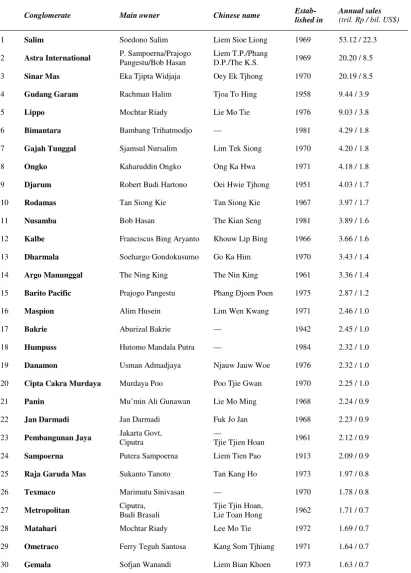
Although ‘big business’ might be considered too vague a term, it has the advantage in that it addresses the largest corporations of any particular space and time. Significant Chinese businesses have been existent since colonial times. However, only from 1966 onwards did they assume the form of large business groups, or ‘conglomerates’. In fact, 23 of the 30 big-gest groups in 1996 were established during the New Order (Sato 2004: 25; see also Appendi-ces, Table 1).6 According to Sato’s (1994: 112) definition, a business group can be regarded as a conglomerate if more than five companies are owned by the same or related persons. The founder, or his successor, and his family are the centre of the highly diversified group, with many – not necessarily related – ventures clustered around one or several core business fields.
6
Another term for the owners of conglomerates is ‘tycoon’ – ‘businessmen of extraordinary wealth and power’ (Mackie 1991: 83).
For this study, the 20 to 30 largest conglomerates in the last years of the New Order – in terms of their annual turnover rates – are at the centre of attention (see Appendices, Table 1). This range is somewhat arbitrary, but there are valid reasons for narrowing down the scope: First, the annual sales of the top 30 groups were significantly higher than those of lower rank-ing business groups. Second, there was a consensus between interviewed experts and busi-nessmen on the frontiers of ‘big business’. Their notion of conglomerates belonging to that category broadly coincided with Sato’s (1994: 121) list of ‘top groups’ vis-à-vis the ‘secon-dary top groups’ on ranks 20 to 47 of her table. However, it is not relevant – and not possible, for that matter (see Chapter 1.3) – to have exact criteria to clearly demarcate the largest con-glomerates. ‘Big’ are the groups that are considered to be the biggest in comparison to other businesses of the country.
In 1996, there were, besides Chinese conglomerates, three other types of private domestic business groups that were listed in the top 30: two conglomerates (Bimantara and Humpuss) mainly owned by the Soeharto family (the so-called Cendana Group7), one by an ethnic
In-dian (Texmaco), and one by a pribumi businessman (Bakrie). These groups emerged under different conditions than Chinese businesses. They were not subject to the same constraints and policies that determined the role of the Chinese. Especially the capitalists from the presi-dent’s family, who effectively depicted themselves as pribumi entrepreneurs, founded their rise upon immediate proximity to the bureaucratic state apparatus and Soeharto’s central posi-tion within it. They were first and foremost bureaucrats or families of bureaucrats, who trans-formed themselves into capitalists. This study will not deal with them particularly.
7
Even though Soeharto family business interests were to be particularly ubiquitous by the 1990s in most major business deals, ‘indigenous capital’ was indeed rather negligible in terms of quantity and significance. In contrast, Chinese owned corporations – including business gi-ants such as the Salim Group, Astra International, and Sinar Mas – constituted by far the larg-est ones and the absolute majority of the top enterprises. In 1996, 26 conglomerates of the top 30 could be categorised as ‘Chinese big business’. Together, their sales added up to about 30 per cent of the Indonesian GDP (Rachbini 1999: 32). Hence, it is not just the immense impor-tance of Chinese private capital for Indonesia’s economy, but also the specific perspective of this study on the political economy of ‘ethnic business’ (Jomo & Folk 2003) that justifies an exclusive focus on the largest Chinese corporations.
States and regimes
consent of those over whom it rules’. Because ‘the ruling ideas of any age are the ideas of the ruling class’8 (Marx & Engels 1969: 47), citizens of all classes subscribe, or are forced to
sub-scribe, to the capitalist logic of permanent capital accumulation, regarding – and experiencing through income, jobs, and stability – that everything that is good for the economy is also good for the individual.
The state and its managers, the bureaucrats, are thus crucial for capital. The specific char-acteristics of states are manifestations of the relative positions of the bureaucracy and capital. The bureaucrats represent the state apparatus and form its government, the ‘legislative and executive branch of the state apparatus and those officials, parties and individuals who oc-cupy its offices’ (Robison & Hadiz 2004: 17). But ultimately, power in the modern capitalist state resides with the capitalists. Their major advantage is that they possess the means of capi-tal accumulation. They are thus the keepers of structural power. Similar to a ‘board of com-missioners’, the supervisory board of Indonesian companies, they usually do not interfere in day-to-day affairs, but they ensure that the long-term vision and interests of the corporation are abided and, in the event they see significant deviations from corporate values and inter-ests, they can veto the course chosen by the board of directors. In certain ventures, the com-missioners might be more powerful than the main executives, intervening directly or taking over the directors’ board or at least their decisions. In others, the supervisory board is muted, or co-opted in ways it loses its critical distance and potential to interfere. This is similar to capitalist states, where the exact form of political influence of capital is highly variable and contingent on the political regime. During the New Order, for instance, capital had to accept its limited and subordinate position. However, I argue that the capitalist class in post-Soeharto Indonesia achieved a more powerful position in relation to the officials of the state than it had during the New Order.
8
In most cases, despite all inter-fractional power struggles, capital and bureaucrats form an alliance of varying hierarchy, dependency, and proximity. This can develop into a relative co-hesive state–business oligarchy, as it was the case in New Order Indonesia. A complete re-moval of this oligarchy from power would require a new system, which, however, can only be realised if the general hierarchies of power are turned upside down, as it only happens through revolutions. As long as the material conditions of capitalist systems remain widely unaffected, power structures as outlined above will continue to prevail.
Regime changes will effectuate not more than a rearrangement of the internal hierarchy in-side the oligarchy. Hence, a new regime comprises nothing but a modified institutional framework to organise the power of the state. It constitutes only a change in the personnel of the state and its style, or, as Marx & Engels (1961: 8) termed it, the ‘legal and political super-structure’ that arises ‘on the economic structure of society, the real foundation’9. The New Order was therefore one regime, and reformasi Indonesia produced another one. As I will demonstrate, the reforms failed to change the underlying class structures of capitalism that enabled the rule of the oligarchy. Instead, they made it stronger and thus increased capital’s resilience in yet another regime.
9 Marx & Engels (1961: 9) further emphasised that ‘in studying such transformations it is always
nec-essary to distinguish between the material transformation of the economic conditions of production, which can be determined with the precision of natural science, and the legal, political, religious, artistic or philosophic – in short, ideological forms in which men become conscious of this conflict and fight it out.’
1.2 Central argument: The emergence of plutocracy
What are the consequences of the regime change in 1998 for Chinese big business? Why – and how – were the conglomerates able to survive in a dramatically changed environment? I argue that the new democratised reformasi regime facilitated the emergence of plutocracy in Indonesia. It did not, as widely expected, terminate the rule of the power bloc consisting of politico-bureaucrats and Chinese capitalists, but it prompted a change of power relations be-tween the two fractions in favour of capital. The oligarchy in which politico-bureaucrats and their families tended to dominate has now given way to one that is composed in a more pluto-cratic fashion – where big business will tend to run the show more unabashedly.
In the New Order, the politico-bureaucrats held instrumental power over the state, success-fully maintaining their dominance through a sophisticated regime of authoritarianism, central-ism, and collusion. One integral component of their largely unchallenged rule was the subju-gation of the capitalists, who were effectively limited by being labelled ‘Chinese’ – a stigma that linked them with a socially marginalised ethnic minority and prevented their access to di-rect power. The Chinese tycoons were thus appropriate partners to be raised and co-opted as compliant partners in a bureaucracy dominated oligarchy. This was, after all, a price they were willing to pay to maintain a stake in a predatory, extremely profitable symbiosis with the state, whose managers allowed and supported them to establish enormous conglomerates that dominated the country’s private sector. The crisis, however, forced an end to this accommo-dation.
Indonesia, enabling them to steadily distance themselves from bureaucratic patrons, extend their autonomy, and perhaps to rise to a more overtly dominant position within the ruling alli-ance.
By showing how the conglomerates dealt with the unravelling of the New Order and its centralised network of patronage, this thesis will demonstrate that the Chinese tycoons man-aged to reorganise in post-Soeharto Indonesia, and that their interests and actions have paved the way for a more plutocratic regime. The study will thus highlight an important case in which big business adjusts to new political conditions, as has happened before in other post-authoritarian environments.
1.3 Methodology
This study provides a sociological analysis of the relations between the state and capital in post-Soeharto Indonesia, focussing on the intangible, unquantifiable question of power. More specifically, this study scrutinises the political economy of those who hold power in Indone-sia. This is per se a tricky task, as research on the rich and powerful in general has to deal with the problem of inaccessibility. In most cases, these people form an exclusive club that makes participant observation or other in-depth scrutiny rather difficult, if the researcher her-/himself does not belong to this class.
Chineseness was even more sensitive, as anti-Sinicism and anti-government feelings increas-ingly overlapped during the evolution of the New Order, turning criticism against the con-glomerates into a powerful political tool against the state elite. Therefore only a little, filtered information on Chinese businesses reached the public, while at the same time most of the Chinese tycoons kept a very low profile. Public relations efforts were unknown, and indeed not needed. The authoritarian, protectionist regime made it possible to do without them. An-other reason for the shortage of facts and figures is the rather late development of private cor-porations in Indonesia, which only became significant through the economic policies at the outset of the New Order in the late 1960s. Hence, the establishment of a stock exchange, usu-ally the major source of information of this kind, came in late as well. Useful data on this ba-sis is only available for the last decade of the New Order. As Sato (1994: 102) pointed out, this led to a scarcity of research interest in private capital in Indonesia.
The new political situation has not brought significant changes in this regard. Most Chi-nese businessmen still shy away from publicity, if not because of state policies or political sensitivity, then because of a general aversion to reveal strategies to others. The struggle for survival and the settlement of their debts with the Indonesian Banking Restructuring Agency (IBRA) constituted a further reason not to disclose the actual property situation and the modi-fied structure of a business group. The end of authoritarianism has put the conglomerates at the centre of attention of journalists and politicians alike, which increased the secretiveness of the actors.10 On the other hand, the relative openness of post-Soeharto Indonesia provided
new sources of information that balanced the lack of data for the New Order. These could be
10
used to supplement the insights of the few seminal works on capital before 1998, most impor-tantly Robison’s (1986) and Shin’s (1989) studies on ‘the rise of capital’ and ‘capitalists-in-formation’ respectively. Established business magazines such as SWA, Eksekutif, Warta Eko-nomi, or Kontan, and the political magazines Tempo or Gatra, as well as the international press (e.g. Far Eastern Economic Review) re-opened several closed cases of the past and fo-cussed – together with the many Indonesian newspapers (such as Jakarta Post, Bisnis Indone-sia, or Kompas) – their gaze on Chinese big business of the present. In addition to this, infor-mation found in compilations of Data Consult (1998) or in business reports, company files, annual reports, and statistics provided further material to consider, although such data was subject to the same constraints and biases as mentioned before and, more often than not, lacked explanatory power as well as sufficient reliability.
In addition, I intended to meet the bosses of the top groups in Indonesia, even though ac-cess was a serious problem.11 The interviews that I eventually conducted with some of the
most important capitalists in Indonesia today – Anthony Salim (Salim Group), Tomy Winata (Artha Graha Group), Eddie Lembong (Pharos Group, also Chair of the Chinese Indonesian Association INTI), and Sofjan Wanandi (Gemala Group, also Chair of the Indonesian Em-ployers Association APINDO) – delivered a wealth of information that I would not have found elsewhere and helped to verify or repudiate hypotheses and substantiate my interpreta-tions.
Altogether, I conducted 62 semi-structured interviews with 51 persons. However, the challenge was to put this kind of information together with the other bits and pieces, to evalu-ate and analyse them and combine my own assessments with the reflections and judgements of these and other observers.
1.4 Outline
Chapter 1 has briefly outlined the major questions, the focus, the central argument, and the methodology of this study. The following chapters will provide theoretical, historical, and empirical analyses to explain the course of capital before, in, and after the crisis.
11 It was immensely difficult to finally get in contact with the manager-owners of the conglomerates.
Chapter 2 discusses theoretical perspectives on capital and the state, including culturalist and structuralist models. It presents an approach appropriate to scrutinising the special power relations between Chinese capitalists and the bureaucratic elite.
Chapter 3 contains the historical background with an emphasis on the New Order accom-modation. It depicts the Chinese businessmen as ‘limited capitalists’, who became part of the bureaucratic oligarchy but lacked appropriate political power.
Chapter 4 seeks to understand the conglomerates during the crisis. Without the authoritar-ian, centralised, and protectionist New Order regime they had to face serious constraints that endangered their existence in reformasi Indonesia.
Chapter 5 scrutinises the reactions of capital to the reforms. The crisis turned out to be not too detrimental; on the contrary, most conglomerates not only managed to survive and con-solidate, but also moulded the new post-Soeharto regime significantly.
Chapter 6 analyses the changing role of Chinese big business in a more democratic, decen-tralised, and deregulated political and economic environment. It points out that capital found new formats of representation and successfully dominated the post-crisis modes of political business.
2
THEORETICAL FRAMEWORK:
POWER CONFIGURATIONS OF STATE AND CAPITAL
The state, according to Brown (1994: xii-xix), determines the boundaries, content, and char-acter of ethnicity by translating ‘sometimes minor linguistic graduations or physical variations into cultural boundary markers which are believed to be intrinsically significant and clearly demarcated’. In the case of Indonesia, the constructed pribumi nation and the assumed soli-darity of a ‘kinship community’ became the ‘psychological and political ideology’ against the Chinese as internal enemy (Brown 1994: xviii-xix). Ethnic policies as tools of state power limited the capitalists in Indonesia significantly. Hence, it is imperative to ask who imple-mented these policies and who benefited from them, or, in a more general sense, who holds control over the state. Traditional class-based accounts have difficulties in attributing power to any non-capitalist class and should therefore be modified to appropriately evaluate the New Order with its weak Chinese business element. To expand definitions of the ‘ruling class’ will thus help in assessing the role of Chinese capitalists vis-à-vis state bureaucracy.
To lay out an appropriate theoretical framework, it is first necessary to discuss the existing literature on Chinese Indonesian capitalists. I shall argue that both culturalist and structuralist perspectives provide useful foci that only in combination deliver a fuller picture. While my study employs a political economy approach, it does not disregard the question of ethnicity.
I suggest that the rulers of New Order Indonesia can be regarded as a complex power bloc consisting of powerful politico-bureaucrats and politically restricted Chinese capitalists that together formed an oligarchy under the hegemony of the bureaucracy. This oligarchy, how-ever, was prone to change, especially after the state managers were considerably weakened through new dynamics induced by the economic crisis of 1997/1998. Capital, no doubt, was also badly wounded, but salient elements have been able to rebound with the help of new strategies. By means of a typology of capitalist systems I will spell out the characteristics of state–business relations during the New Order and outline potential models towards which the post-Soeharto Indonesian state is developing.
2.1 Approaches to Chinese Indonesian capitalists
Very often Chinese businesses were identified as the main engine of growth during the aston-ishing boom of the Southeast Asian economies until 1997. However, what facilitated their business success? Was it due to their ethnicity and its manifestations in values and behaviour patterns, or were the deep-seated structures of capitalism and the role of capitalists (that hap-pened to be Chinese) within them more important? The answers given came from a broad range of disciplines, most notably from scholars working in the frameworks of cultural stud-ies, business administration, economics, and political economy. They can be differentiated into culturalist perspectives on Chinese businessmen as part of the Chinese minority and structuralist perspectives on Chinese capital as part of the capitalist class.
Culturalist perspectives
Heidhues (1974), Mackie (1976), Coppel (1983), and Suryadinata (1986), who gave insight-ful, albeit now outdated, analyses on the socio-cultural background of the ethnic Chinese in Indonesia, tackling a wide spectrum of aspects that ranged from a broad comparative perspec-tive including other Southeast Asian Chinese communities to more specific research on rela-tionships with the pribumi population, minority politics, and anti-Chinese discrimination.12
More recent studies involved further empirical research on, for instance, identities of young Chinese (Thung 1998), on anti-Chinese violence (Purdey 2002), on ethnic Chinese in the ‘outer’ islands (Heidhues 2003) and on the ethnic biases of the legal system (Lindsey 2005). However, most of these works share a similar disposition: They tended to take the eth-nicity of Chinese Indonesians at least implicitly for granted and treated it as a given fact, co-herent and largely unproblematic. The primordiality of ‘Chineseness’, though questionable, was considered to be a useful, independent variable to explain the behaviour and treatment of the people defined as ‘Chinese’. Ethnicity, from this perspective, was thus regarded as the natural and most eminent boundary marker.13
There is little to say against the latter proposition as ethnic segregation constitutes part of social reality in Indonesia. However, culturalist reasoning fails to realise that Chinese ethnic-ity is constructed to be so relevant. Hence it often led to disputable frameworks that overem-phasised the vertical division of society by, for instance, combining owners of small shops with big businessmen into one minority labelled ‘Chinese’. To give one example: Suryadinata accurately stated that ‘the Chinese in Indonesia are not a homogenous cultural group’, con-tinuing that
12
The writings mentioned here are only the most important publications of scholars who actively shaped the academic debate on the Chinese minority.
13 To date, only few studies on Chinese ethnicity deviate from the prevailing paradigm. Most notable
there are two groups: the peranakan Chinese […] and the totok Chinese, who are less
Indone-sianized. […] Despite the peranakanization and Indonesianization process, at this stage, it is still
useful to talk about the totok and peranakan communities, especially when we refer to the elite
level.
(Suryadinata 1997: 9-10)
He emphasised a distinction which has become relatively irrelevant for most Indonesians of Chinese origin. Many cannot even classify themselves as either totok (culturally Chinese) or peranakan (culturally Indonesian), as these communities have no impact on their daily lives. The emphasis on the ‘elite level’ discloses that being ‘Chinese’ was regarded as being more significant than horizontal class partitions. This perspective bears the risk of only reiterating government policies that need to be questioned, thereby reproducing the construction of the category ‘Chinese’ in Indonesia in an essentialist fashion. It is thus an inherent weakness of culturalist approaches to not take more objective stratification criteria, like material condi-tions, into account. For that reason, most of these studies neglect the economic dimension, merely discussing Chinese big business – if at all – in a few paragraphs, and always as part of the broader Chinese minority ‘problem’.14 Characteristically, Suryadinata (1997: 25-74)
in-cluded a chapter on ‘Chinese economic elites in Indonesia’ in a book titled ‘The culture of the Chinese minority in Indonesia’.
Only few of the scholars who specialised on the Indonesian Chinese minority attempted to exclusively focus on the capitalists. Mackie (1988; 2003), for instance, compared the role of Chinese businessmen in Indonesia with that in other countries. Trying to find analogies with Weber’s ‘protestant ethic’ (2004), economic success was attributed to cultural traits, ‘Asian values’, and the ‘Confucian’ spirit of capitalism, which also reflected Weber’s (1991: 208) as-sumption that ‘the Chinese would be, it is expected, as much capable, supposedly even more
14
capable than the Japanese, to adopt the capitalism brought to technically and economically complete development in the culturally modern world’.15 Chineseness or Confucianism –
though not necessarily coterminous, nor homogeneous – were regarded as the same modernis-ing force that Protestantism once had been for European capitalism and were interpreted to have similar views on this-worldliness, education, obedience, materialistic values, etc. The emphasis was thus placed on non-economic factors that were seen to play a crucial role for business in a world that was not only determined by capitalism, but by many other factors as well. Power depended on a variety of sources, which included primordial characteristics. Sig-nificantly, Mackie (1989: 99) claimed that no other people, ‘for reasons which are deeply rooted in the values and cultural systems’, seem to have ‘the same battery of incentives and capacities for commercial success as have the Chinese’. He cited their ‘strong motivation to succeed’, or even ‘the widespread Chinese propensity towards gambling’ as assets that facili-tated the rise of Chinese capitalists.
In contrast to these more anthropological accounts, there has been a range of studies that did not primarily focus on values and ethnicity as causes, but on that which was seen by the culturalists as the very effect of them: the business behaviour of the Chinese. However, these approaches dealing in the framework of business administration agreed on the same basic as-sertion that saw the reasons for entrepreneurial success in ‘uniquely Chinese’ characteristics (e.g. Redding 1990). Of key concern was the position of Chinese firms in the market. The in-dividual group leaders and the impact of their decisions were the major focal point. By exam-ining the corporations and their strategies, research attempted to extrapolate the entrepreneu-rial aspects of ‘Chinese capitalism’ (Yeung 2004) relevant for efficient management. The po-litical setting, however, was only regarded as important if it impinged on market performance. One such example is R. Brown’s (2000) study on ‘Chinese big business and the wealth of
15 Original: ‘Der Chinese würde, aller Voraussicht nach, ebenso fähig, vermutlich noch fähiger sein als
Asian nations’, in which she emphasised institutions that were, however, related to an a priori culture. Hence, she identified ‘the heavy reliance on the family’ and the ‘Chinese attitude to finance’ (R. Brown 2000: 5) as the reason for the crisis, thus remaining in the ethnic perspec-tive. Yoshihara (1988) as well attributed the success of the rent-seeking Chinese ‘ersatz capi-talists’ to culture. Elsewhere he claimed:
One can easily hypothesize that one basic reason [for the poor economic performance of some
countries in the ASEAN region (e.g. Indonesia)] is that their culture lacks a strong work ethic. If
this is true, the dominance of the ethnic Chinese in the capitalist sector of the economy (or the
private sector as a whole) can be a result of it, instead of its cause.
(Yoshihara 1995: 66)
The literature on Chinese business networks is usually founded upon the same culturalist premises. Most accounts confine themselves to pointing out how relationships of xin yong (trust), based on ethnocentric Confucian ethics, have helped the Chinese to span Southeast Asia with their closely-knotted international business networks (e.g. see Tan 2000). A few studies relate their observations to the underlying structural conditions that bear such net-works (as, for instance, Menkhoff & Gerke 2002), but typically they take guanxi (connec-tions) as just another characteristic trait of ethnic Chinese (e.g. Wu 2000; Backman 2001), thereby implying the homo economicus character of the whole Chinese minority and failing to analyse how the state appropriated their ‘political ethnicity’ for its interests.
culturalist perspective. Inevitably, this thesis will draw heavily upon findings by the authors mentioned above.
Structuralist perspectives
In the 1970s, Anderson promoted an alternative to the culturalist approaches employed by ‘anthropologists, sociologists and displaced Sinologists’ (Anderson 1982: 79), as he polemi-cally remarked. He rejected behaviouralist explanations that regarded the Chinese ‘primarily as a racial minority rather than as a commercial bourgeoisie’:
In all kinds of ways, the Chinese commercial bourgeoisie were made a ‘given’ of Indonesian
so-ciety, and then used as a criterion of its satisfactory, or more usually unsatisfactory, progress.
Treated as a racial group, they were a measure of its constitutionalism and humanity; as a
busi-ness interest group, they were a measure of its differentiation and modernity. Nowhere were
they treated […] as classes, whose conflicts and alliances with other classes determine the
desti-nies of civilizations.
(Anderson 1982: 79)
This was indeed a valid objection to the culturalist school. Nevertheless, by stressing the class characteristics of the whole Chinese minority, Anderson made some unavoidable generalisa-tions, implicitly depicting every Sino-Indonesian as capitalist, thereby ignoring the huge het-erogeneity even amongst the businessmen (Coppel 2002). He, however, paved the way for a group of economists and sociologists whose research deviated significantly from the ethnic paradigm, giving attention to the underlying economic structures and the position of Chinese capitalists within.
such as ‘corporate strategies to cope with the given external conditions, ranging from the fields in which to invest, and how to accumulate business resources, to how to organize the corporation on the strategic level’ (Sato 1994: 103). While she did not disregard political fac-tors, her approach remains largely empirical and not particularly theoretically informed, and displays the same technocratic inclinations that characterise the works of neoclassical and neo-institutionalist economists.
The latter consider economic policies as an instrument to find the best solution for prob-lems that are essentially technical in nature (e.g. Hill 1999; Thee 2003). Good governance – ‘widely identified with the following four attributes: transparency, accountability, efficiency and fairness’ (Soesastro 2000: 125) – is seen as a precondition for efficient institutions and vice versa, resulting in economic growth and prosperity. Development can only be obstructed by bad economic policies and interfering politicians. It is thus an approach that disregards the vested interests of the actors as well as the systemic impediments to reform. The inherent shortcoming of such perspectives is that power is not an issue dealt with when the question of Chinese capital arises.
state–business relations, political partnerships, and the composition of certain conglomerates, providing a wealth of information that obviously bore no significance to culturalist accounts. However, the main advantage of this perspective was also its major limitation. By discussing Chinese businessmen as part of the capitalist class and not as members of an ethnic group, class-based approaches merely addressed ethnicity coincidentally. Chinese capital was only worth being dealt with insofar as it was part of a larger bourgeoisie. In fact, ethnicity was im-plicitly regarded as false consciousness; its deep and comprehensive political impact was therefore negligently overlooked.
Robi-son (e.g. 1993) also regarded the ethnic partition of capital to be secondary. Together with Hadiz, he combined ‘powerful bureaucratic and corporate families’ (Hadiz 2001b: 120) in one group that they termed ‘capitalist oligarchy’ (Robison & Hadiz 2002; 2004). Although they frequently referred to internal conflicts, their main focus was on the ascendance of the capital-ist oligarchy rather than on the friction between the components within it. Thus, it was of no major concern for this perspective to explore why the capitalists were predominantly Chinese and how they were instrumentalised.
In the course of this study, I will demonstrate that it is indeed very rewarding to focus on such questions. Notwithstanding the inherent incapability of class-based approaches to take ethnicity into consideration, they, however, offer a more appropriate, albeit incomplete framework for analysing Chinese capital. Logically, Chinese big business has not yet been the main focus of a structural analysis of Indonesia. This study attempts to fill the existing void identified here.
An analysis of Chinese capital’s ethnic and material conditions
Although the two frameworks seem to oppose each other paradigmatically, culturalist and structuralist considerations are not as mutually exclusive as it may appear. Indeed, a judicious and simultaneous application of both is not only useful but also very necessary in order to analyse Chinese capital in its entirety. Reid’s (1961) mediation between the two Australian schools of Indonesian studies, that ‘neither approach is more legitimate or objective than the other, that both have been and will be productive of fine scholarship, and that the tension be-tween the two is likely to be particularly creative’, is as much valid for analyses on Chinese big business in Indonesia.
ethnic factors, making clear himself that ‘it is appropriate […] to take the vertical divisions as the primary point of reference’ (Mackie 1988: 218):
To try to account for their economic, social or political actions solely in class terms, as if they
had a stronger sense of class solidarity with other wealthy capitalists in the Indonesian
bourgeoi-sie, and to disregard their status as members of an ethnic minority also, would require us to
leave out a large part of the story, in many cases the more important part. One of the striking
features of all overseas Chinese communities has been the way their strong sense of ethnic
soli-darity has overridden the wide social differences between towkays and coolies …
(Mackie 1988: 234)
The latter proposition reveals that it remains inadequate to merely add some elements of the structural approach while basically upholding the ethnicity-centred perspective. As long as more weight is given to the ‘strong sense of ethnic solidarity’ between ‘towkays and coolies’ – an assumption that lacks empirical proof16 – it is not possible to analytically isolate the
capi-talists to discuss them in regards to their class position.
Management perspectives do not provide an apposite platform either. The study under-taken here is concerned about the political-economic position of Chinese capitalists and can thus largely disregard entrepreneurial decisions. Corporate strategies per se are not of interest; they only come into the picture if state policies impinge on them or vice versa. Moreover, it is hardly suitable here to use an approach that explains patterns as deriving from values. More helpful in dealing with capital are studies in the field of economics, although they usually lack the political-sociological dimension and ignore the aspect of embedded vested interests. However, contrary to many of the quantitative methods applied by economists, precise figures
16
(on assets, investments, etc.) are not of the utmost importance to this study. Unquestionably, they can be very illustratative of certain points and trends, but without being interpreted in re-lation to the broader political economy, such data alone make little sense. The institutionalist, often functionalist viewpoints of economists additionally obstruct a discussion of issues of power.
Hence, for an analysis of the power of Chinese Indonesian capitalists (and not the values of capitalistic Indonesian Chinese), a perspective, based on the economic divisions of society, has to be adopted, which takes into account the material conditions as well as the interests of the various factions who compete with each other for power, resources, and non-material gains. To categorise the Chinese tycoons as the main element of the capitalist class, therefore, brings us closer to a more accurate and objective analysis than one that is based on their as-cribed affiliation to an ethnic minority. However, ethnicity as a vertical pillar of society and a powerful political instrument must not be neglected as it justifies class divisions. Hence, a class analysis should also include Mackie’s (1988: 234) valid objection that the capitalists ‘are subject to a constant tension between the imperatives of their status as members of that class and the imperatives of their ethnicity, since they cannot cease to be members of a highly vulnerable and politically suspect minority group’.
2.2 Identifying the ‘ruling class’: Capital and the state
If the Chineseness of Indonesia’s capitalists is to be seen as a socially constructed and politi-cally instrumentalised variable and not as a primordial given, we need to shift the focus away from ethnicity to more explanatory categories such as the state, the bureaucracy, and capital, to assess the power configurations in Indonesia. Who has power over the state? In what ways do capitalists exert authority over the state apparatus? How does the state represent and real-ise the interests of capital? This section will discuss the specific Indonesian conditions during the New Order.
As Jessop (1990: 44) rightly claimed, it is ‘debatable whether it is possible to develop a theory of the capitalist state in general. For, since capitalism exists neither in pure form nor in isolation, states in capitalist societies will necessarily differ from one another.’ Moreover, there are not only variations from state to state; one state at a particular point in time hardly resembles the same state in another period. Therefore, different states at different times re-quire a different set of theories to explain them. For the Indonesian case, I will outline the most applicable interpretations of the New Order and potential configurations of future re-gimes, despite their inconclusiveness for other states as well as for other time spans than that which is specified.
Theories of the capitalist state
The most well-known understanding of the state goes back to Weber (1926: 8-9), who attrib-uted three major characteristics to the state: territoriality, monopoly of coercion, and legiti-macy. However, this formal definition mainly refers to the institutional dimension and lacks any evaluation of power relations. It comprehensively describes the state apparatus, but it does not seek to find out who controls it.
Thus it is necessary to turn to class-based approaches to the state. Classical Marxist analy-ses share the basic assumption that capitalist states in general serve the interests of the capital-ist class, i.e. a continuous reproduction and accumulation of its capital. Of main concern are the motives, modes, and the extent of class domination. In that respect, the answers given vary significantly. Most accounts can be broadly distinguished into two perspectives that em-phasise either the instrumental grip of the ruling class on the state or the structural contradic-tions and constraints of the capitalist system mediated by a relatively autonomous state.
The former, instrumentalist approach presupposes that ‘the executive of the modern State is but a committee for managing the common affairs of the whole bourgeoisie’17 (Marx & Engels 1993: 21). The instrumental seizure of state institutions through individuals enables the capitalists to implement policies serving their interests. Miliband (1969: 23) accordingly maintained that ‘the “ruling class” of capitalist society is that class which owns and controls the means of production and which is able, by virtue of the economic power thus conferred upon it, to use the state as its instrument for the domination of society’. Through the method of power structure research (e.g. Mills 1956) instrumentalists seek to reveal the existence and composition of the capitalist class and its links to the state managers and intermediary institu-tions, thereby proving capital’s instrumental domination over the state apparatus. Originally, this approach was intended to confront advocates of the pluralist school that regarded the state
17
as inherently neutral and focussed on individuals and groups and their decisions. However, al-though instrumentalists indeed questioned the neutrality of the state, proponents of the oppos-ing structuralist school argue that most such studies remained largely in the same pluralist framework, totally leaving out the structural context.
Referring to Marx’ (1962: 16) dictum that ‘individuals are dealt with only in so far as they are the personifications of economic categories, embodiments of particular class-relations and class-interests’18, these critics of the instrumentalists reject the latter’s scope and maintain that ‘the direct participation of members of the capitalist class in the state apparatus and in the government, even where it exists, is not the important side of the matter’ (Poulantzas 1969: 245). Instead, they identify the state as a relatively autonomous actor not directly under the control of a ruling class, but nevertheless reconciling the major contradictions of capitalism and thus implicitly accomplishing the long-term interests of the capitalists.
Although instrumentalists and structuralists argue about the nature of power and the re-spective conceptualisation of the state, both approaches define capitalists as the ruling class. Kautsky’s (1902: 13) seemingly paradoxical statement that ‘the capitalist class rules but does not govern. It is satisfied, however, to rule the government’, referred to the variety of ways in which capitalist interests could be represented. Therborn elaborated on the question ‘what then does the ruling class do when it rules?’:
Essentially, it reproduces the economic, political and ideological relations of its domination.
This rule is exercised through state power, that is to say, through the interventions or policies of
the state and their effects upon the positions of the ruling class within the relations of
produc-tion, the state apparatus and the ideological system.
(Therborn 1978: 161)
18
Whether a state was ruled directly or structurally by capital could have perhaps been better depicted as an empirical question rather than a matter of theoretical proposition. The consen-sus was, however, to regard the capitalist state as generally conducive to the advancement of capital.
A study on big business cannot do without the insights of these basic theories. It is inade-quate, however, to rely solely on structural or instrumental explanations. Certainly, no state is totally under control of the capitalists, or structurally completely autonomous. The previously mentioned models describe ideal types to which any existing state is nothing more than an approximation. State–business relations are contingent on time and place and require thor-ough empirical as well as theoretical research to determine whether the bourgeoisie has pre-dominantly instrumental or structural power over the state. In the case of Indonesia, the given characterisation of the capitalists as ruling class further calls for an amended, more differenti-ated analysis. In the following, I will show that – especially for the New Order – classical Marxism does not provide an adequate framework to explain the power relations of Chinese big business and the state.
The New Order state
From the point of view of classical class-based interpretations, the New Order in Indonesia constituted nothing less than an abnormality. As I will show in Chapter 3, the predominantly Chinese capitalist class could hardly be considered as a ruling class, while the governing poli-tico-bureaucrats were primarily self-interested, relatively independent managers of the state and only additionally owners of capital. I will thus outline an alternative perspective to de-scribe the power structure in Indonesia until 1998. For this, it is necessary to briefly discuss the roles and characteristics of bureaucrats and capitalists during the Soeharto regime.
the state managers of the New Order were not mere functionaries, but constituted the ruling class in Indonesia, or at least its predominant part. They succeeded in limiting the power of capitalists by marginalising them through the exercise of ethnic politics on the one hand, while at the same time building up their own capital base on the other. Although some power-ful families – especially the Soehartos – managed to transform themselves into capitalists, their capital was highly related to and dependent on their position inside the state apparatus. Therefore, I regard them – following Robison (1986: xxiv) – as politico-bureaucrats, who merged political and bureaucratic authority, rather than as capitalists-proper. In the years of their rule they appropriated state power so absolutely that the state lost its autonomy and be-came their instrument (see Robison & Hadiz 2004: 69-144).
The capitalist class in New Order Indonesia, in contrast, was severely restricted through its ascribed ethnicity. While, in Marxist schemes, capitalists have at least a structural veto even in the absence of direct political power due to the investment imperatives of the capitalist state that can only be met by them, big business in Indonesia could not count on this source of authority. Unquestionably, the Chinese capitalists were, especially in the latter half of the New Order, increasingly vital for the successful continuation of the state, but their political influence remained widely clientelistic in nature (MacIntyre 1994: 253). Links to state offi-cials as patrons were critical for the emergence of business groups and crucial for further capital accumulation. Riggs (1966) thus termed such businessmen ‘pariah capitalists’, which is indeed a very accurate description (that is also adopted here in this study), although he, as well as most other patron–client-approaches, depicted the capitalists as mere compradors, who were totally dependent upon the bureaucrats.19 In New Order Indonesia, Chinese big
business was indeed restricted, but they were more than the ‘ersatz’ capitalists portrayed by
19 To prevent a misunderstanding of the term ‘patronage’, Robison (1982: 136) emphasised ‘that
Yoshihara (1988) and more than just the financiers of the state elite. They were real capital-ists, and as such part of the oligarchy presiding over the state.
However, their exact position inside this coalition is debatable. Robison & Hadiz (2004) fused both bureaucrats and businessmen into a single entity they called ‘capitalist oligarchy’, perceiving potentially antagonistic political and economic concerns as secondary. Indeed, the two parties’ long-term interests always coincided and it never came to a serious clash throughout the whole Soeharto era. Nevertheless, as I will demonstrate later, the state manag-ers were ultimately in the driver’s seat, because there were severe limitations in the capacity of Chinese capital – even big Chinese capital – to confront and challenge state bureaucrats when it suited their interests.
It is therefore more helpful to talk about a ‘division of labour between those who accumu-late capital and those who manage the state apparatus’ (Block 1987: 54) and view the oligar-chy as a ‘power bloc’, into which the highly fractioned bourgeoisie has organised itself (Pou-lantzas 1969). The ruling class could thus be regarded as a political alliance between a hege-monic bureaucracy totally embedded in the state and a politically circumscribed business class lacking the means of direct political action. This was by far no static ensemble, but a coalition whose internal dynamics were permanently negotiated. Chinese capitalists in the early 1970s were undoubtedly more clientelistic than the ones in the 1990s, and the bureau-cratic authority over capital certainly decreased towards the end of the New Order regime. Nevertheless, it still gives us analytical clarity to regard the politico-bureaucrats as personifi-cation of the state, because the political institutions remained under their complete control un-til 1998. Therefore, investigating the characteristics of the relations between Chinese busi-nessmen and the state elite helps to reveal the general conditions of the state’s power struc-tures.
instrumen-talist assumption that the state can be used as a tool. However, in the case of the Soeharto re-gime it was not the instrument of the capitalist class, but of the politico-bureaucrats. On the other hand, the bureaucrats’ policies were confined to favouring capital accumulation, thereby fulfilling the needs of the Chinese capitalists. The important deviation from conventional class-based approaches, however, was that the state managers’ support of capital was neither an end in itself nor forced upon the state by the capitalists, but a means to an end for the bu-reaucrats, which was to stay in power and to enrich themselves. Block (1987: 84) suggested that ‘state managers collectively are self-interested maximizers, interested in maximizing their power, prestige and wealth’. This view corresponded with Skocpol’s (1979) historical-institutionalist approach, in which she emphasised the disjunctures between state and capital. States – with their ‘administrative and coercive organizations’ as ‘the basis of state power as such’ (Skocpol 1979: 29) – should not be seen as ‘mere analytic aspects of abstractl