CE-4
THE USE OF ICT-BASED MEDIA IN WEB-BASED COLLABORATIVE ASSISTANCE OF HYBRID LEARNING ON CHEMICAL KINETIC TO
IMPROVE STUDENTS’ ACADEMIC PERFORMANCE Jaslin Ikhsan
Department of Chemistry Education, Faculty of Mathematics and Natural Science Yogyakarta State University (UNY)
Karangmalang, Yogyakarta 55281 INDONESIA
Phone: +6281328608258, email:[email protected], [email protected]
Abstract
This research studied the implementation of web-based assistance using opened source Learning Management System (LMS), completed by other learning media on Chemistry, such as e-book and video at Chemistry Education Department, UNY, and its effect to students’ achievement, learning independence and discipline.
Delivery system of learning Chemical Kinetic was carried out by hybrid learning, the. combination between face-to-face and online learning. Online learning was provided as enrichment and assistant supports. Not only are students able to join in online learning, but also parents are. The samples of this research were students attending the lecture of Chemical Kinetics at UNY. Due to the use of web-based assistance, the improvement of students’ achievement, and students’ responses towards their learning independence and discipline were measured.
This research showed that Chemistry learning media including video, e-book that accompanying the LMS were good in quality based on the review of students and Chemistry lecturers of UNY. Students strongly agreed with the advantages of LMS for hybrid learning of Chemical Kinetic, and they did not face significant constraint with internet connection whether at home or campus. Students strongly agreed that this hybrid learning can improve their learning independence and discipline. Whereas, parents supported the use of hybrid learning of Chemical Kinetic and stated that they were able to accompany and to guide students effectively in learning. Moreover, this research showed that by the use of hybrid learning on Chemical Kinetic, students’ cognitive achievement increased significantly.
Keywords: ICT,hybrid learning, learning independence, learning discipline; chemical kinetic.
INTRODUCTION
The advancement of technology has changed paradigm of communication and information. It can affect significantly various sectors of human lives, including education. Information and Communication Technology (ICT) in education can enhance the quality of education (Cabrol and Severin, 2009) with advanced teaching methods, improved learning output and outcomes (Aristovnik, 2012) and enable reform or better management of education systems. ICT are presently driving, moving in many cases from print to the variety of media and to the virtual environments carried through the web, computer-mediated conferencing, and CD- ROM.
position (Jaslin dan Hafid, 2012). Some well-known universities in Indonesia have launched learning methods and delivery systems through internet networks to enlarge access of education. They are called distance learning, web-based education, and e-learning. The delivery systems basically use internet network. Moreover, some overseas universities implement m-learning and ubiquitous-learning, such as in Korea (Park, 2011).
Due to the fast improvement of ICT role in education, educational entities that do not apply ICT for teaching and learning can be left far behind other universities in this global era. Therefore, this is very crucial time for lecturers and students in UNY Indonesia to begin to optimize internet facilities provided by campus as one of potential learning resources to reach educational mission of UNY.
Indonesian government, via the Ministry of Education and Culture has encouraged all educational institutions to integrate ICT into education as stated on the Strategic Plan 2010 – 2014, and based on the government regulation no. 17/2010 j.o. 66/2010 about Management and Organization of Education. The use of multiple mode in learning was based on the regulation of Minister of Education and Culture no. 24/2012 about the Management of Open and Distance Learning (ODL) in Higher Education Institutions. Previously, upgrading Indonesian Elementary school Teachers Qualification also implemented ICT-based ODL through the program called Hybrid Learning for Elementary School Teachers (Hylite), which was based on the regulation of Minister of National Education no. 58/2008. All those regulations in general encourage Indonesian educational institutions to use ICT in education in order to increase dramatically the access of education for Indonesians even for the ones living in boarder and remote areas. ODL as an important part in hybrid learning have become increasingly common in higher education (Rooney et al., 2006). In 2005, about 62% of the 2- and 4-year higher education institutions offered distance education courses (Rooney et al., 2006), up from 56% in 2001 (Waits & Greene, 2003).
The use of internet networks in Indonesia becomes very important for most students. It can be seen from the use of online social networks that are very popular amongst the students of UNY. Unfortunately, few lecturers and students in the Department of Chemistry Education of UNY use the networks for learning purposes whether through official LMS of UNY BeSmart or opened sources LMSs. In fact, web-based learning can be implemented easily in UNY due to the availability of representative infrastructures such as wi-fi connection and computer laboratories. In this point of view, the use of web-based learning assistance and enrichment should be conducted in UNY. This is not only to increase the quality of the output, but also to effectively use the finance that has been paid for the connection and infrastructures.
This study is about the implementation of web-based collaborative assistance through an opened source LMS edmodo as a hybrid learning model on Chemical Kinetic. There are two important terms in this study, e.i. collaborative assistance and hybrid learning. Collaborative assistance is online support given to students by other students, and guidance by parents. So learning was guided not only by lecturer, but also by parents and peers. The collaborative assistance was given to provide more flexible learning in which each student can learn as his/her own learning multiple intelligent, style, and speed. While, hybrid learning is the mixture of regular face-to-face lecture and online learning using edmodo. Hybrid learning that is also known as blended learning by some researchers can affect attitude of students, as reported by Yushau (2006). He found that blended learning affected significantly students’ computer and mathematics attitudes.
competence and achievement. Grouping can also be facilitated by edmodo using smaller group feature. All learning processes of students were documented and saved into folder and library, and can be easily monitored by students themselves, parents and lecturer.
Without ignorance of regular face-to-face learning and based on the wide opportunity for students to improve their achievement which is assisted through ICT tool, this study focuses to examine the improvement of students’ cognitive achievement on Chemical Kinetic and students responses toward the use of edmodo, a secure social networking that has not yet widely utilized in students environment, dealing with students learning independence and discipline.
The research was to answer the questions:
1. How is the iconic model of hybrid learning with the use of multimedia for web-based assistance at Chemistry Education Department, UNY ?
2. What is the advantage and disadvantage of the use of web-based assistance in hybrid learning of Chemical Kinetic at Chemistry Education Department, UNY?
3. Can the use of web-based assistance in hybrid learning of Chemical Kinetic at Chemistry Education Department, UNY improve students’ cognitive achievement?
4. What are the responses of students toward the effect of the use of web-based assistance in hybrid learning of Chemical Kinetic to their learning independence and discipline?
RESEARCH METHOD
Learning design was illustrated by Fig. 1, and was conducted by classroom action.
Fig. 1. the Design of Hybrid Learning Implementation on Chemical Kinetic at UNY
Multimedia were reviewed first both by lecturers as the expert of content, multimedia, and instruction, and by students as the users. Eight lecturers and 25 students involved in the multimedia reviews. Most lecturers were from the Department of Chemistry Education of UNY, and the students were from International group of Chemistry Education Department of UNY. Data were collected from the process of 10 cycles of hybrid learning. The data were about students’ responses toward the advantage and disadvantage of edmodo for Chemical Kinetic lecture, and the effect of hybrid learning using edmodo onto learning independence and discipline, besides the quantitative data of pre-test and post-test.
Data of multimedia reviews were collected using a set of Likert scale questionnaire, with 5 options of answers; very dissatisfied, dissatisfied, neutral, satisfied, and very dissatisfied. The data were analyzed descriptively to determine the quality of multimedia. Multimedia can be used as the enrichment materials and independent learning resources when both lecturers and students feel satisfied with the multimedia.
Pre- and post-students’ achievement were measured by use of sets of test instruments. The data were then analyzed using Wilcoxon Signed Ranks test of SPSS to know the improvement of students due to the use of ICT-based media in web-based collaborative assistance of hybrid learning. Three students did not join to the pre-test, so only 22 cases were for students’ achievement.
While the data about responses of students were also collected by Likert scale questionnaire with five agreements for positive statements that were applied as strongly
X O v X O v X O v X O
S
IE
X : face-to-face learning in class
O :Mediated learning/ online discussion using media throughedmodo or web conferencing tools V : Online assignment through edmodo
disagree = 1, disagree = 2, not sure = 3, agree = 4, and strongly agree = 5, and so gathered qualitative data from Likert scale were converted to become quantitative data, which were then analyzed and reconverted into five categories to conclude students’ response (Table 1) as described by Eko (2009).
Table 1.Determination of response category
Range Mean of Response
Xi +1,8 SBi< Strongly Agree (SA) Xi + 0,6 SBi< ≤ Xi+1,8 Sbi Agree (A)
Xi - 0,6 SBi< ≤ Xi + 0,6 Sbi Doubt (NS) Xi - 1,8 SBi< ≤ Xi - 0,6 Sbi Disagree (DA)
≤ Xi - 1,8 SBi Strongly Disagree (SDA)
Where:
: mean
Xi : ideal mean = ½ x (biggest score + least score)
SBi : ideal deviation standard = 1/6 x (biggest score - least score)
RESULT AND DISCUSSION
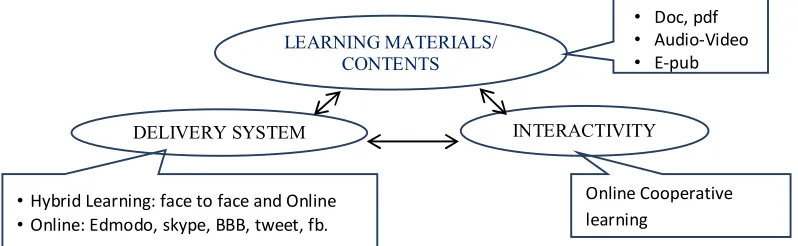
There are three main components on the development of instructional design. They are the contents, interactivity, and delivery system as illustrated on Fig. 2.
Fig. 2. Main components on development of instructional design
Learning materials whether in the format of multimedia or other digital resources must be valid. Therefore, the media were validated first before being used. The multimedia as resources of learning developed in this research were in the formats of mobile based digital e-book (epub) and video. Each of e-pub and video file were validated by 6 Chemistry lecturers. The validation aspects included multimedia and contents. Multimedia reviews were also conducted by 2 lecturers from outside of Chemistry department, in this case they are two lecturers from Mathematics and Physics departments.
Delivery system was defined as the system to deliver learning object materials, on which hybrid learning was chosen. Hybrid learning is the mixture of face-to-face and online using LMS edmodo, in which the proportion of face-to-face and online learning was 1 to 1 as illustrated on Fig. 1.
Interactivity was facilitated by cooperative learning model through online with edmodo and face-to-face. The online interactivity was also supported by chatting, web conferencing using Skype or BigBlueButton (demo.bigbluebutton.org). Main constraints implementing web conferencing were limited bandwidth to which students cannot access well the conferences.
LEARNING MATERIALS/ CONTENTS
DELIVERY SYSTEM INTERACTIVITY
• Doc, pdf
• Audio-Video
• E-pub
• Hybrid Learning: face to face and Online
• Online: Edmodo, skype, BBB, tweet, fb.
Multimedia Reviews by Lecturers
Videos whose duration was about 15 minutes and e-pub (android-based digital book) were reviewed by lecturers. The results of reviews were given by Fig. 3. Based on lecturer reviews both videos and e-pub in general were satisfying to be used as independent learning media and resources.
Fig. 3. Lecturers Reviews for Videos and e-pub
Students’ Responses to the Multimedia
Responses of students toward the multimedia were also very positive. More than 60% of students stated that video and e-pub on Chemical Kinetic were satisfying and had very good quality (Fig. 4). As the reviews by lecturers, the responses of students were also on multimedia and contents aspects.
Fig. 4. Students’ Responses toward the videos and e-pub
Students’ Responses to the LMS edmodo and Hybrid Learning
Fig. 5. Percentage of students’ responses
Students’ Responses to the Advantage and Disadvantages of edmodo as an LMS for Hybrid Learning
Since LMS edmodo was not widely used in the Faculty of Mathematics and Science of UNY, its advantage as a right LMS should be reviewed. Determination of response category using equations in Table 1 for the advantage of edmodo shows that students’ responses were very positive. They strongly agreed with the use of edmodo as an LMS for hybrid learning on Chemical Kinetic because edmodo had some advantages. As reported previously (Warschauer 1996) that students can take much advantages from the use of IT for learning. ICT also enables to sharpen students’ critical thinking and deepen students’ understanding. The integration of ICT into learning in a class becomes very crucial because ICT in learning can be media of collaboration, communication and publication and be useful as learning resources. ICT can facilitate collaborative learning in which students build their own concepts and share experiences (Chou and Chen, 2008).
Advantage of edmodo to which students gave responses included the features, security, types of learning materials included, lecture plan, evaluation and feedback, and parent joining. Most students strongly agreed (52%) and agreed (48%) that edmodo was user-friendly like Facebook. Since most students in Indonesia got used to accessing Facebook as reported by Donny (2012) that Indonesia had 40.6 million Facebook users, the use of edmodo as an LMS would be familiar and easy for students. Based on the response, students strongly agreed (40%) and agreed (60%) that edmodo was suitable to be a good LMS because it provided learning functions as described by Berking and Gallagher (2010) that general functions normally provided by LMS were structure, security, registration, delivery, interaction, assessment, tracking, reporting, record keeping, facilitating reuse, personalization, integration, and administration.
Security was also facilitated by edmodo because only students and parents given access code by lecturer can join. When all students and respective parents joined the group, the class can be closed by locking the group code. Stranger joining the group can be removed and the code should be reset. Based on the fact, most students (64%) agreed that only registered students can join the class and edmodo was very secure for learning.
The materials available in edmodo were kept in library, and can be downloaded and accessed at any time. Various formats of the materials can be stored, such as video, power point, exel, MS word, and pdf files that result in easiness of lecturer and students to upload and download the materials of learning. As stated by Berking and Gallagher (2010) that integration should be the function that provided by an LMS. Learning materials uploaded to edmodo were very useful as enrichment materials for students. Since the access can be done anywhere at any
time, the use of materials can be also very flexible.
The availability of Planner on edmodo provides the easiness of students to check the schedule of next learning session that enable students to prepare better. Therefore, students responded that they know lecture plan of learning. Better planning in learning would result in better achievement of students. Related to evaluation and feedback, students can have better reflection from feedback given by lecturer toward assignment answer. Students could also ask freely to lecturer and check trends of his/her achievement from all remarks given by lecturer.
Edmodo facilitated parents to join the class. Students reviewed that parents participation was very positive aspect for their learning. Therefore, students strongly agreed (36%) and agreed (44%) and expected that their parents could join and attend the Class, even though not all parents finally can actively attend the class due to some constraints. Only five of parents joined to online class. All of them supported the use of edmodo as online assistance for students because they can check students’ participation and scores from the assignments and examinations. Unfortunately, most parents did not actively participate in the class. It can be said that only once on average they logged in by use their own account, the others they just looked at when students logged in.
Students’ responses toward the disadvantages of the use of edmodo were very weak. Based on the analysis as listed in Table 1, students disagreed that the use of edmodo was difficult and that edmodo was not useful for Chemical Kinetic learning. Accessing edmodo was fun, easy with limited constraints from the point of view of internet infrastructure, the features of edmodo, and parent participation. Students stated that they did not face difficulties to access internet because more than 70% of them had internet access at home. Meanwhile, at campus they had 24-hour-internet-coverage a day. As reported by Donny (2012) from ICT Watch Indonesia that Indonesia has 150 Internet Service Provider (ISP), 35 Network Access Provider (NAP), and 5 broadband 3G operator. To interconnect the data traffic within ISPs in Indonesia, there are about 10 nodes of Indonesian Internet eXchange (IIX) managed APJII (Indonesian ISP Association, APJII.or.id). Donny (2012) also stated that from population of Indonesia about 240 million people, now has 55 million Internet users, not including 33 million Internet mobile users who use a smartphone, tablet or modem dongle. There are at least 100 million active mobile numbers used for broadband/ 3G data access. For social media, Indonesia has 29.4 million users of Twitter. This figure puts Indonesia as the most active twitter country in the world, and Jakarta is the most active twitter city in the world. Indonesia also has 40.6 million Facebook users and about 3.3 million bloggers, with 33 local blogger communities.
Based on the fact, it can be concluded that ICT infrastructure in Indonesia, especially in some big cities, like Yogyakarta, was relatively sophisticated either in quantity or quality to support internet or web-based learning or hybrid learning. Some Indonesian communities also got used to using social networks. Consequently, edmodo which was also called facebook for education was not be hard to be used as an LMS in UNY. Therefore, lecturing and learning with assistance of internet connection and edmodo was easily conducted.
Since most students are in native ICT ages and at digital era, they were quite challenged and happy to use ICT as media of learning; 88% of them stated so. However, few of them stated that uploading the answer of assignment through edmodo took a long time as shown by the number of respondents, 12% agreed and 20% were not sure. The easiness on assignment download and upload provided convenience of learning that could be efficient and enhance students learning achievement. Based on the responses, 20% of students stated that most parents could not join to the lecture because of IT skill constraint despite edmodo facilitated parents participation on learning.
assignments. Lecturer can avoid this by comparing documents of students answer, but unfortunately, it took a long time and attention.
Students’ Responses to the Effect of Collaborative Hybrid Learning to Students’ Learning Independence and Discipline
After face-to-face lecture, students were given assignments through edmodo, and this is so called one cycle of hybrid learning. In this point of view, students may spend more time for learning and follow the regulation of credit semester principles that students need structural and independent assignments besides face-to-face lecture on each credit of subject matter. All activities on edmodo were recorded safely and can be downloaded. By edmodo, teacher can manage learning very well, including planning, lecturing, and assessing that affected students learning independence and discipline. Based on the analysis as was in the Table 1 and was depicted in Fig. 8, students strongly agreed (20.73% of 25 students strongly agreed and 56.36% agreed) that collaborative hybrid learning using edmodo could affect students’ learning independence. They also agreed (16% of them strongly agreed and 52% agreed) that those could affect their learning discipline.
Edmodo enabled students to share freely their knowledge and had discussion via online connection. By online discussion students were able to learn with different speed. It also facilitated students to express their arguments via written reports, and that were very good for the ones who did not prefer to express arguments by oral discussion. Therefore, such written discussion provided high flexibility of learning for students. Online discussion on edmodo was always under supervision of lecturer, because the discussion was always on lecturer wall and edmodo did not provide direct post from one student to another. Final result of discussion was then shared in a face-to-face presentation session.
So after long discussion for the assignment through edmodo, representative of the group had strong confidence to present group discussion results. It was quite amazing because the tough constraints in Indonesian education is the eagerness of students to express their arguments or ideas in discussion, and this is a kind of bad learning culture in general. Through written discussion on edmodo, however, students even braved to ask or remind lecturer from mistaken based on their prior knowledge. As reported by Bowker (2010) in his questions-centered pedagogy that the brave of questioning was very important and positive in learning because the questions themselves were the answers, that could improve the quality of learning.
Edmodo facilitated collaborative learning because discussion through edmodo could be knowledge sharing amongst the students. Better students shared their ideas and knowledge to the others, conversely weak students can raise questions for discussion and solution. Positive interdependence, interaction, social and leadership skills, and trust building were developed through this learning. The collaborative become stronger because learning can be observed and guided by parents. Parents could act as observers who were thoughtful care and responsible for the success of learning. Collaborative discussion amongst the students was mainly about the materials of learning, but parents were more likely to collaborate on technical, administrative and psychological aspects.
Edmodo provided high learning flexibility because Planner on edmodo told students about next week activities. As consequences, students can read and prepare well, download materials, and search relevant topics making students had better preparation for next face-to-face lecture. Learning flexibility could also enhance learning independence (Lin, 2008). The Effect of Collaborative Hybrid Learning to students’ achievement
A learning program in which more than one delivery modes are used, with the objectives of optimizing learning outcome and cost.
A combination learning model of web-based technology
A combination learning approach of constructivism, behaviourism, and cognitivism A combination of various instructional technology with face-to-face
The proportion of face-to-face and online component in the combination was very various, and has yet to be implemented with obvious learning regulation. It depended on the characteristics of subjects and lots of condition as reported by Ranganathan et al. (2007), who implemented hybrid learning on six universities in USA. Hybrid learning of Hylite program to upgrade qualification of Indonesian elementary school teachers in 2007–2010, used the proportion of ICT based online learning component with the range of 30-79%, while allowing 30% of delivery to be face-to-face (Paulina et al., 2007). The proportion of web-based learning in Hybrid learning of Chemical Kinetic in this research was about 50%. After face-to-face lecture, students were given assignments or discussion topic that was supposed to discuss via online through edmodo.
Hybrid learning was very effective and efficient by which students can have better understanding. The more frequency to access hybrid learning, the higher of the understanding is. Students can also be challenged to meet their learning progress. As reported by Echo (2011) that most students prefer to have extra hybrid learning after having experiences of learning with hybrid.
Collaborative learning is an umbrella term of a variety of learning approaches requiring intellectual efforts by group of students, or between lecturer and students together. In collaborative learning, students usually work in a 3 or 4-member-group (Gokhale, 1995), who collaborate mutually to understand learning materials or to develop a product. The activities of students in their group of collaborative are various, but the core of collaborative learning is students centered learning in which students build their own concepts, but is not solely knowledge transferred from lecturer or listening or note-taking enforcing students to be very passive. Giving talks methods of teaching when delivering learning materials should not appear in collaborative learning. Lecturer should act as a professional instructional facilitator, motivator, and designer.
The characteristics of collaborative learning are (Felder and Brent, 2007):
Positive interdependence: group members should rely on one another to meet the group goal Individual accountability: each student in a group must share the work for the materials of
learning
Face-to-face interaction: working group must facilitate face-to-face interaction so each student can contribute on feedback for the others and have discussion to encourage each other.
Appropriate use of collaborative skills: students can build their social skill such as leadership, trust-building, conflict management etc. through collaborative works.
Group processing: group members should commit to group goal, access the progress, and make sure that they can reach the goal.
students with disabilities. They could get better academic achievement when they learnt by cooperative learning that incorporate individual accountability and groups rewards (McMaster and Fuchs, 2002).
CONCLUSION AND SUGGESTION
Based on the responses of students, it can be concluded that:
The model of hybrid learning with the use media in web-based learning was initiated by giving 50% proportion of online learning, and the media that were developed were satisfying. Therefore, the media were suitable for independent learning resource and enrichment materials in the web-based assistance.
Edmodo was very good with several advantages and lack of disadvantages to be used as an opened source LMS on web-based assistance in hybrid learning of Chemical Kinetic in UNY Yogyakarta Indonesia.
The use of web-based assistance in hybrid learning of Chemical Kinetic at Chemistry Education Department, UNY can improve significantly students’ cognitive achievement. Students strongly agreed the use of web-based assistance in hybrid learning of Chemical
Kinetic can improve students’ learning independence and discipline?
From the results, it may be good ideas to initiate the use of hybrid learning for studies in universities in Indonesia due to the availability and advancement of internet connection in higher education institutions in Indonesia. The proportion and design of hybrid learning may be extended as the characteristics of the topic of discussions.
REFERENCES
Agus J.,Andi S. (2010). Pengaruh Pembelajaran Pemecahan Masalah Secara Kelompok Kooperatif Terhadap Kemampuan Pemecahan Masalah. Jurnal Pendidikan Matematika dan Sains, Volume 15 No. 1: 13-17.
Aristovnik, A. (2012). The Impact of ICT on Educational Performance and its Efficiency in Selected EU and OECD Countries: a Nonparametric Analysis, MPRA Paper No. 39805, http://mpra.ub.uni-muenchen.de/39805/
Berking, P., Gallagher, S. (2013).Choosing a Learning Management System, Serco Services, Inc., Retrieved on August 10, 2013, http://www.adlnet.gov/wp-content/uploads/2013/05/Choosing_an_LMS.pdf
Bowker, M. H. (2010). Teaching Students to Ask Questions Instead of Answering Them, The NEA Higher Education Journal, retrieved on July 30, 2013 from http://www.nea.org/assets/img/PubThoughtAndAction/Bowkershort.pdf
Buzzetto-More, N. A., Sweat-Guy, R. (2006).Hybrid Learning Defined (Adapted From: Incorporating the Hybrid Learning Model into Minority Education at a Historically Black University), Journal of Information Technology Education, Volume 5.
Cabrol, M., Severin, E. (2009).ICT To Improve Quality In Education — A Conceptual Framework And Indicators In The Use Of Information Communication Technology For Education (ICT4E) (in Assessing the Effects of ICT in education: Indicators, criteria and benchmarks for international comparisons, Edited by Friedrich Scheuermann and Francesc Pedró), ISBN 978-92-79-13112-7, Luxembourg: Publications Office of the European Union, pp. 83 -104.
Chou, P.-N., Chen, H.-H. (2008). Engagement in Online Collaborative Learning: A Case Study Using a Web 2.0 Tool, MERLOT Journal of Online Learning and Teaching, No.4(4). Donny B.U. (2012). Internet Freedom at Indonesia, Retrieved on August 10, 2013 from
http://bestbits.net/wp-uploads/2012/10/internet-freedom-indonesia.pdf
Eko P. W. (2009). Evaluasi Program Pembelajaran. Yogyakarta: Pustaka Pelajar
Felder, R., Brent, R. (2007).Cooperative Learning (in Active Learning: Models from the Analytical Sciences, ACS Symposium Series 970, P.A. Mabrouk, ed., Chapter 4, pp. 34–53. Washington, DC: American Chemical Society.
Gokhale, A. A. (1995).Collaborative Learning Enhances Critical Thinking, Journal of Technology Education Vol. 7 No. 1.
Jaslin I., Hafid S. H. (2012).Strategi Penyebaran Konten Pendidikan Berbasis Digital Video Broadcasting over Satellite, Seminar Nasional ISPI, Pasca Sarjana UNY, Yogyakarta Lin, Q. (2008).Student Views of Hybrid Learning: A One-Year Exploratory Study,Journal of
Computing in Teacher Education, Volume 25 / Number 2 Winter 2008–2009.
McMaster, K. N. and Fuchs, D. (2002). Effects of Cooperative Learning on the Academic Achievement of Students with Learning Disabilities: an Update of Tateyama-Sniezek’s Review, Learning Disabilities Research & Practices 17(2).
Muraya, D. Ng., Kimamo, G. (2011).Effects of Cooperative Learning Approach on Biology Mean Achievement Scores of Secondary School Students' in Machakos District, Kenya, Educational Research and Reviews, Retrieved on August 10, 2013http://academicjournals.org/ERR2,
Park, M.-G.(2011), Integrated Service Platform of Ubiquitous Learning and Ubiquitous Work Systems, Proceeding of International Conference on e-Learning (I-CeL), ITB Bandung Partridge, H., Ponting, D. McCay, M. (2011).Good Practice Report: Blended Learning,
Australian Teaching and Learning Council, ISBN: 978-1-921856 – 81-5, Sydney Paulina P., Rahayu D. R., Esti P. (2007).HYLITE Program: An ICT-based ODL for Indonesian
Teachers Education, Proceeding of the 11th UNESCO APEID Conference on Revitalizing Higher Education, Dec. 12-14, 2007, Bangkok
Ranganathan, S., Negash, S., Wilcox, M. V. (2007). Hybrid Learning: Balancing Face-to-Face and Online Class Sessions, Proceedings of the 2007 Southern Association for Information Systems Conference.
Rooney, P., Hussar, W., Planty, M., Choy, S., Hampden-Thompson, G., Provasnik, S. (2006). The Condition of Education 2006 (NCES 2006-071). Washington, DC: National Center for Education Statistics. Retrieved on July 19, 2013, from http://nces.ed.gov/pubs2006/2006071.pdf
Waits, T., Greene, B. (2003). Distance Education at Degree-Granting Postsecondary Institutions: 2000-2001 (nces 2003-017). Washington, DC: National Center for Education Statistics. Retrieved on July 19, 2006, from http://nces.ed.gov/pubs2003/2003017.pdf
Warschauer, M. (1996). Computer-assisted language learning: An introduction. Tokyo: Logos International
Yatim R. (2010). Paradigma Baru Pembelajaran: Sebagai Referensi bagi Pendidik dalam Implementasi Pembelajaran yang Efektif dan Berkualitas. Jakarta:Kencana Prenada Media Group.