THE POLITENESS STRATEGIES BY TIM AND MARY IN ABOUT TIME MOVIE
A SARJANA PENDIDIKAN THESIS
Presented as Partial Fulfilment of the Requirements
to Obtain the Sarjana Pendidikan Degree in English Language Education
By
Vincentius Yosa Rahardyan Student Number: 141214053
ENGLISH LANGUAGE EDUCATION STUDY PROGRAM DEPARTMENT OF LANGUAGE AND ARTS EDUCATION
FACULTY OF TEACHERS TRAINING AND EDUCATION SANATA DHARMA UNIVERSITY
YOGYAKARTA 2018
i
THE POLITENESS STRATEGIES BY TIM AND MARY IN ABOUT TIME MOVIE
A SARJANA PENDIDIKAN THESIS
Presented as Partial Fulfilment of the Requirements
to Obtain the Sarjana Pendidikan Degree in English Language Education
By
Vincentius Yosa Rahardyan Student Number: 141214053
ENGLISH LANGUAGE EDUCATION STUDY PROGRAM DEPARTMENT OF LANGUAGE AND ARTS EDUCATION
FACULTY OF TEACHERS TRAINING AND EDUCATION SANATA DHARMA UNIVERSITY
YOGYAKARTA 2018
iv
This thesis is dedicated to:
My beloved parents, Yuliana Sabrang Sukendah and Raharja Agustinus who have given their endless supports, sacrifices, and prayers in my life.
vii ABSTRACT
Rahardyan, Vincentius Yosa. (2018). The Politeness Strategies by Tim and Mary in About Time Movie. Yogyakarta: English Language Education Study Program, Department of Language and Arts Education, Faculty of Teachers Training and Education, Sanata Dharma University.
Politeness becomes an important aspect in maintaining the communication between a speaker and a hearer. In relation to the education field, especially for English as Foreign Language (EFL) learners, problems may appear in the use of English in conversation. EFL learners still find difficulties in using polite language to convey their idea. EFL learners usually do not use the polite language and it might hurt the feeling of the hearer. Therefore, using polite language is important to maintain the communication.
This research was conducted to analyze the types and the factors affecting the Tim and Mary‟s politeness in speaking. There are two research questions in this research, namely (1) what are the politeness strategies by Tim and Mary in About Time movie and (2) what are the factors affecting Tim and Mary‟s politeness in speaking. This research analyzed the use of types of politeness strategies and the factors affecting the characters‟ in speaking.
The data in this research were the utterances by Tim and Mary which contained politeness expression. This research employed descriptive qualitative method research. The data collections were categorized based on the types and factors affecting Tim and Mary‟s politeness in speaking. The types of politeness strategies were analyzed based on Brown and Levinson‟s theory (1987) and the factors affecting Tim and Mary‟s politeness in speaking were analyzed based on Spolsky‟s theory (1998).
There were 60 politeness expressions by Tim and Mary. There were four types of politeness strategies by Tim and Mary in About Time movie. They were bald on record strategy, positive politeness strategy, negative politeness strategy, and off record strategy. Moreover, there were three factors affecting Tim and Mary‟s politeness in speaking. They were language style, register and domain, and solidarity.
It is concluded that Tim and Mary in About Time movie applied all of four types of politeness strategies. There were three factors affecting Tim and Mary‟s politeness in speaking. The most frequent type is positive politeness strategy and the most common politeness factor is register and domain. Furthermore, the politeness strategies were used by Tim and Mary to show the degree of imposition based on the context of the conversation. Moreover, the politeness strategies also were used by Tim and Mary as a sign of situation which affect their politeness in the conversation.
Keywords: politeness strategies, About Time movie, positive and negative faces, FTAs
viii ABSTRAK
Rahardyan, Vincentius Yosa. (2018). The Politeness Strategies by Tim and Mary in About Time Movie. Yogyakarta: Program Studi Pendidikan Bahasa Inggris, Jurusan Pendidikan Bahasa dan Seni, Fakultas Keguruan dan Ilmu Pendidikan, Universitas Sanata Dharma.
Kesantunan menjadi sebuah aspek yang penting dalam menjaga komunikasi antara penutur dan pendengar. Dalam hubungan dengan bidang pendidikan, khususnya untuk pelajar Bahasa Inggris sebagai bahasa asing (EFL), permasalahan muncul dalam penggunaan Bahasa Inggris di dalam percakapan.
Pelajar Bahasa Inggris sebagai bahasa asing masih kesulitan dalam menggunakan bahasa yang santun dalam mengungkapkan gagasan mereka. Pelajar Bahasa Inggris sebagai bahasa asing biasanya tidak menggunakan bahasa yang santun dan melukai perasaan pendengar. Maka dari itu, menggunakan bahasa yang santun menjadi penting untuk menjaga komunikasi.
Penelitian ini dilaksanakan untuk menganalisis tipe dan faktor-faktor yang mempengaruhi penutur dalam bertutur. Terdapat dua rumusan masalah dalam penelitian ini, yaitu (1) strategi kesantunan apa sajakah yang diterapkan oleh Tim dan Mary dalam film About Time (2) faktor apa sajakah yang mempengaruhi kesopanan Tim dan Mary dalam bertutur. Penelitian ini menganalisis seluruh penggunaan tipe strategi kesantunan dan faktor kesantunan yang mempengaruhi kesantunan tokoh-tokoh dalam bertutur.
Data-data dalam penelitian ini adalah ucapan-ucapan oleh Tim dan Mary yang mengandung ungakapan kesantunan. Penelitian ini menggunakan metode deskriptif kualitatif. Data dikategorikan sesuai tipe dan faktor yang mempengaruhi kesantunan Tim dan Mary dalam bertutur. Untuk menganalisa tipe, penelitian ini menggunakan teori dari Brown dan Levinson (1987) dan teori dari Spolsky (1998) sebagai teori faktor kesantunan.
Terdapat 60 ungkapan kesantunan oleh Tim dan Mary. Terdapat empat tipe strategi kesantunan yang diterapkan oleh Tim dan Mary, yaitu bald on record strategy, positive politeness strategy, negative politeness strategy, dan off record strategy. Selain itu, terdapat tiga faktor yang mempengaruhi kesantunan Tim dan Mary dalam bertutur, yaitu language style, register and domain, and solidarity.
Peneliti menyimpulkan bahwa Tim dan Mary dalam film About Time menerapkan keempat tipe dari strategi kesantunan. Terdapat tiga faktor yang mempengaruhi kesantunan Tim dan Mary dalam bertutur. Tipe dengan frekuensi terbanyak diterapkan adalah positive politeness strategy dan faktor kesantunan yang paling banyak adalah register and domain. Lebih lanjut, strategi kesantunan digunakan oleh Tim dan Mary untuk menunjukkan tingkat gangguan berdasarkan konteks dalam percakapan. Strategi kesantunan juga digunakan oleh Tim dan Mary sebagai tanda dari situasi yang mempengaruhi kesantunan mereka dalam percakapan.
Kata kunci: politeness strategies, About Time movie, positive and negative faces, FTAs.
ix
ACKNOWLEDGEMENTS
First of all, I would like to thank Jesus Christ, the only God and my savior, who has given me opportunity and strength to finish this thesis.
Foremost, I would like to express my profound gratitude and appreciation to my thesis advisor, Bapak Dr. E. Sunarto, M.Hum., for his advice, guidance, time, criticism and patience to support me complete my thesis.
My deepest gratitude goes to my beloved family, especially my mother Yuliana Sabrang Sukendah, S.Pd., and my father Raharja Agustinus for their endless supports, sacrifices, and prayers in my life. In the process of my study, I would like to thank Angelina Lintang Venta Dewanti for her smile, love, patience, and care even when I was in my worst time. She has made my life meaningful. I also thank my squad members Ignatius Christian Adna Pratama, Yohanes A Deo Damarkrisnadi, Driaz Triasmoro Jati who always cheer me up with their jokes, stupid things and weird personalities. I also thank Tamara Sastra Negara, Johan Tobias Kristiano, Veronika Oktaviani Astuti, Benedicta Laksita Prabawati and all of my friends of PBI batch 2014.
Last but not least, I would like to thank everyone who has supported me and them whom I have not mentioned here.
Vincentius Yosa Rahardyan
x
TABLE OF CONTENTS
Page
TITLE PAGE...i
APPROVAL PAGE...ii
DEDICATION PAGE...iv
STATEMENT OF WORK‟S ORIGINALITY...v
PERNYATAAN PERSETUJUAN PUBLIKASI...vi
ABSTRACT...vii
ABSTRAK...viii
ACKNOWLEDGEMENTS...ix
TABLE OF CONTENTS...x
LIST OF TABLES...xii
LIST OF FIGURES...xiii
LIST OF APPENDICES...xiv
CHAPTER I. INTRODUCTION...1
A. Research Background...1
B. Research Questions...4
C. Research Significance...4
D. Definition of Terms...6
CHAPTER II. REVIEW OF RELATED LITERATURE...8
A. Theoretical Description...8
1. Pragmatics...8
2. Context of Situation...9
3. Intonation...11
4. Positive and Negative Faces...14
5. Face Threatening Acts (FTAs)...15
6. Types of Politeness Strategies...15
xi
7. Factors Affecting the Characters‟ Politeness...22
8. Construction...24
B. Theoretical Framework...24
CHAPTER III. RESEARCH METHODOLOGY...26
A. Research Method...26
B. Type and Source of Data...28
C. Instrument and Data Gathering Technique...29
D. Data Analysis Technique...30
E. Triangulation and Trustworthiness...33
CHAPTER IV. RESEARCH RESULTS AND DISCUSSION... 34
A. Types of Politeness Strategies by Tim and Mary...34
1. Bald on Record...36
2. Positive Politeness...40
3. Negative Politeness...44
4. Off Record...48
B. Factors Affecting Tim and Mary‟s Politeness in Speaking...52
1. Language Style...53
2. Register and Domain...55
3. Solidarity...57
CHAPTER V. CONCLUSIONS, IMPLICATIONS, AND RECOMMENDATIONS...60
A. Conclusions...60
B. Implications...61
C. Recommendations...63
REFERENCES...65
APPENDICES...67
xii
LIST OF TABLES
Table Page
3.1 Blueprint of the Data Sheet of Types of Politeness Strategies in About Time
Movie………32
3.2 Blueprint of the Data Sheet of Politeness Factors in About Time Movie….33 4.1 Politeness Strategies by Tim and Mary………35
4.2 Bald on Record by construction………...37
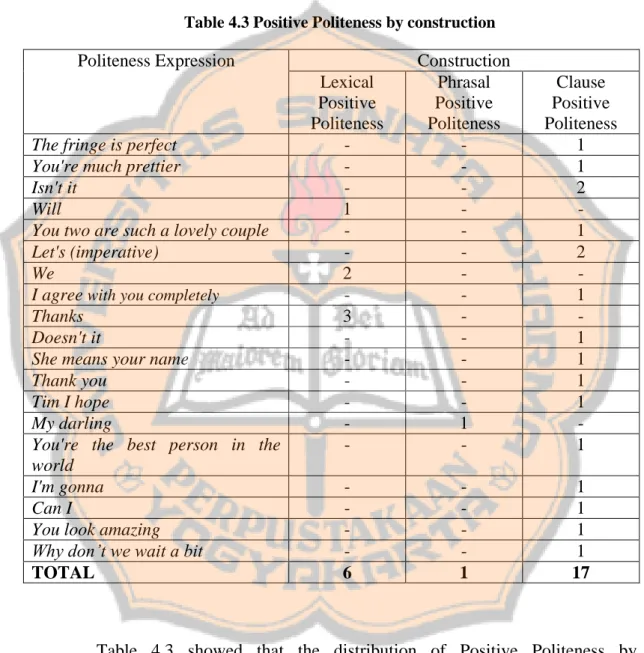
4.3 Positive Politeness by construction………..41
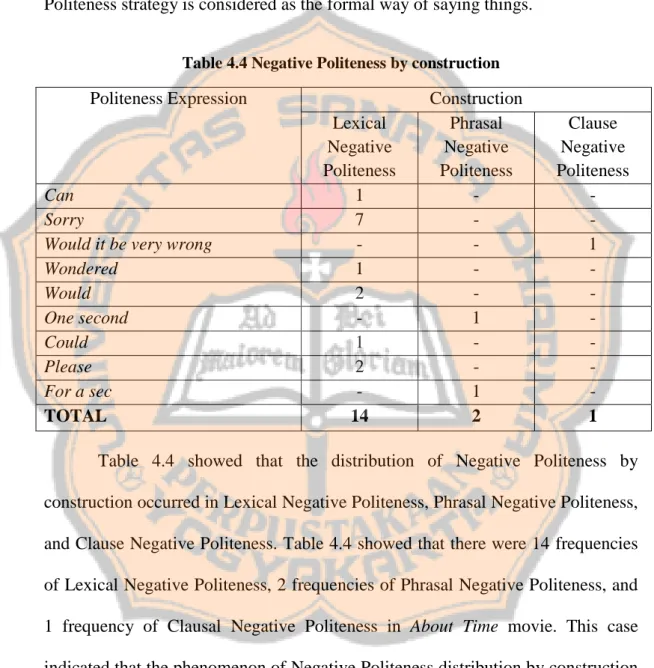
4.4 Negative Politeness by construction……….45
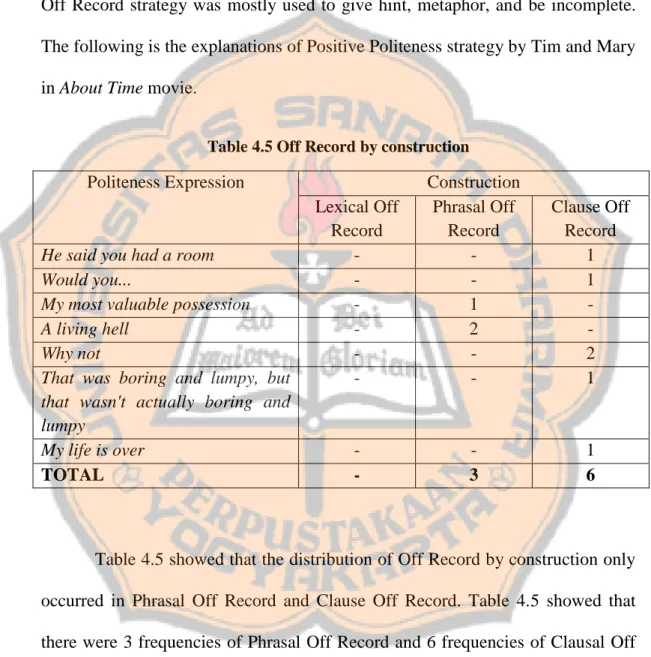
4.5 Off Record by construction……..………49
4.6 Language Style by Tim and Mary………54
4.7 Register and Domain by Tim and Mary………...56
4.8 Solidarity by Tim and Mary……….58
xiii
LIST OF FIGURES
Figure Page
2.1 Politeness Strategies……….16 4.1 The Frequency of the Types of Politeness Strategies………...35 4.2 The Frequency of Politeness Factors………53
xiv
LIST OF APPENDICES
Appendix Page
A. The Data Collection of Types of Politeness Strategies...68 B. The Data Collection of Politeness Factors………74
1 CHAPTER I INTRODUCTION
This chapter discusses the introduction of this research which consists of four parts. The first section is research background. This section explains the general information related to the topic and the reason why the topic is chosen.
The second section is research questions. This section mentions the questions to be answered in this research. The third section is research significance. This section contains the advantages of this research. The fourth section is definition of terms. It provides the specific definition of the keywords used in this research.
A. Research Background
Politeness becomes an important aspect in communication in maintaining the communication between a speaker and a hearer. Watts (2003) describes politeness as “the ability to please others through one‟s external actions” (p.39).
There is a rational reason why people need to think politeness. People somehow get problems or difficulties in conveying their idea or wants to other people. There are some aspects which affect the ways speakers convey utterances. Those are educational background, ethnicity, age, power, gender, context, and the other aspects which can affect the ways of speaking.
Then, the lack of conveying their idea might ruin the communication. For example, the speakers might hurt someone`s feeling, embarrass other people or make other people feel uncomfortable. Of course the communication would not run well. In order to keep the hearer`s feeling and treat the hearer well, people
need to be polite. According to Mills (2003) being polite means “expressing respect towards the person you are talking to and avoiding offending them” (p. 6).
Further, Brown and Levinson (1987) explain that politeness comes as the mitigating device to create a harmony in communication. Further, Spolsky (1998) explain four factors affecting the speaker‟s politeness in speaking. They are language style, register and domain, slang and solidarity, and language and gender.
In relation to the education field, especially for English as Foreign Language (EFL) learners, problems may appear in the use of English in conversation. EFL learners still find difficulties in using appropriate polite language to convey their idea. For instance, a learner asks the teacher for the handouts using imperative sentence, such as “Give me the handouts!” This expression may be considered impolite. The other example is related to the culture. When a native speaker gives compliment to EFL learner, he often denies to the compliment. The English learner`s response is uncommon in western culture and considered impolite. It is important for English learners to learn not only the language but also the culture related to politeness in speaking. The examples show that inappropriate language can cause problems. The speakers need to adjust their language based on the social situations. Therefore, concerning politeness is important for the speakers since appropriate language choice is related to politeness.
English learners are supposed to concern about the hearer`s feeling since they want to share their idea to other people. It is clear that politeness strategies
could support English teaching and learning. The writer believes that by understanding the politeness, English learners will be able to communicate politely in daily life. The use of politeness strategies in About Time is chosen as the focus in this research. Therefore, this research will observe and analyze the politeness strategies in conversation by employing politeness theory proposed by Brown and Levinson (1987). They are bald on record, positive politeness, negative politeness, and off record strategy.
About Time movie tells a love story of a lawyer named Tim and a reader in a publisher named Mary. Tim has a special ability that he can travel back in time.
Tim repeats his first meeting with Mary for three times since he has to fix some problems in the past. From those three meetings, Tim and Mary show the respect and formality in their utterances which are different from the way they speak with the people who have close relationships with them, for example best friend. Tim and Mary show the of politeness strategies in various social context since this story starts from the beginning, from strangers until they become a family. Indeed, there are moments when they have to apply high degree of politeness strategies and also the moments when they can simply apply low degree of politeness strategies. From the reason above, About Time movie is considered as a good example of the politeness strategies in different social context.
The reason why the writer choose About Time movie is because this movie shows the phenomena of politeness. For instance, it contains the formal and informal language. Besides, movie can be a good medium to learn politeness
strategies since movie could show how the politeness strategies are conveyed in various social contexts. Specifically, About Time movie tells about the differences of using politeness strategies from the far relationship until the close relationship.
This research presents the data on the politeness strategies in About Time movie and factors affecting the characters‟ politeness in speaking.
B. Research Questions
Based on the background of the research, there are two research questions formulated as follows.
1. What are the politeness strategies by Tim and Mary in About Time movie?
2. What are the factors affecting Tim and Mary‟s politeness in speaking?
C. Research Significance
It is believed that this research could be beneficial for English teachers, English learners, future researchers and the readers.
1. English Teachers
This research supports English teachers in conducting the lesson related to politeness strategies. This research provides examples about the use of politeness strategies and the factors affecting the politeness in a movie.
2. English Learners
This research hopefully could support English learners who study sociolinguistics and pragmatics, especially politeness strategies to identify each type of politeness strategies and also comprehend the politeness factors. The main case of this research is the application of politeness strategies in the utterances by Tim and Mary in About Time movie. This research could be a material to learn about politeness strategies in a movie.
3. Future Researchers
From this research, some equal level readers in linguistics studies know the application of the types and speech functions of politeness strategies in About Time movie. This research helps future researchers in conducting a research about the politeness strategies of the utterances in a movie. This research may be used as a reference of politeness strategies in a movie and support them to conduct similar research.
4. Readers
This research hopefully could present the importance of politeness strategies. This research provides the analysis of the types and factors of politeness strategies of the utterances by Tim and Mary in About Time movie.
Furthermore, the readers are expected to comprehend politeness strategies.
Therefore, the readers could use English expression politely and consider the politeness factors in daily conversation.
D. Definition of Terms
In order to make the reader understand the whole research, the terms used in this research are defined as follows.
1. Positive and Negative Faces
Brown and Levinson (1987) state that face as the “personal territories and public self-image as a person‟s wants (p. 61).” The statement was directed to the two notions, namely positive face and negative face proposed by Brown and Levinson (1987). Positive face is the every person‟s want that his wants are desired by at least some other people. Thus, positive face means the desire of a person to be accepted by other people. Besides, negative face is the person‟s want that his action is unimpeded by other people. Thus, negative face means the desire of a person to have freedom of action.
2. FTA (Face Threatening Act)
Face threatening acts are the acts which contain the threat directed to the hearer‟s wants. The source can be from the diction, expression and the other factors that are used by the speaker that can lead the FTA. Brown and Levinson (1987) define Face Threatening Act (FTA) as acts which oppose to the hearer‟s face wants. It is the threat which requires a verbal repair or politeness expression.
There are the positive and negative faces which could be threatened by the speakers. In this research, the FTA can be found in Tim and Mary‟s utterances which may threaten the other characters.
3. Politeness Strategies
Politeness is related to how people talk in certain situation or to whom the speaker talks to. Brown and Levinson (1987) state that politeness is “the mitigating device used to mitigate the conflict between the speaker and the hearer” (p. 52). It concerns with how language is expressed in an appropriate way to support or maintain interpersonal relationships. It contains the appropriate linguistic choice in a certain social and situational context. Thus, politeness strategies are the strategies dealing with politeness when the speaker talks to the hearer in order to maintain the relationship with the hearer. In this research, the focus would be on the verbal aspect of politeness. Therefore, the utterances where the politeness strategies are produced by the characters in About Time movie will be the focus of the research.
8 CHAPTER II
REVIEW OF RELATED LITERATURE
This chapter discusses about two main parts, namely, theoretical description and theoretical framework. Theoretical description presents the theories which are used in this research. Theoretical framework presents the summary of the theories which supports the writer to answer the research questions and the correlation between the research questions and the related theories.
A. Theoretical Description
This section will discuss some terms in order to know more on the phenomenon of politeness strategies in conversation. Therefore, this section consists of context of situation, the definition of positive and negative faces, intonation patterns, definition of face threatening acts (FTAs), types of politeness strategies, and factors affecting the characters’ politeness.
1. Pragmatics
Yule (1996) states that Pragmatics is a study of speaker meaning, contextual meaning, how more gets communicated than is said, and the expression of relative distance. Meanwhile, Levinson (1983) argues that Pragmatics is the study of the relation between language and context that are encoded in the structure of a language. It means that Pragmatics is a study which concerns with the meaning of language usage. In daily conversation, people usually will
communicate not only explicitly but also implicitly. The speaker realizes that he or she needs to modify the utterances to get successful communication. Speaker is supposed to pay attention to the context of speaking. As Pragmatics concerns with the meaning, the context of speaking is needed. Context means the situation in the conversation. It means that physical, social, or conceptual factors should also be considered to get the understanding of the speaker meaning.
2. Context of Situation
In analyzing Pragmatics language feature, context becomes the important aspect which is used to analyze the language usage. According to Asher (1994) context is one of those linguistics terms which are constantly used in all kinds of context but never explained. In other words, context is implicitly found in all conversation. Since context is existed in the conversation, it is needed to comprehend the factors in context. Hymes in Wardhaugh (1998) gives a model for describing context of situation, namely SPEAKING as an acronym for the factors to describe context of situation. The following are the parameters.
a.) S (Setting)
Setting refers to the time and place. It is the concrete physical circumstances in which the speech event takes a place.
b.) P (Participants)
The participants are various combinations which include speaker and listener, addressor and addressee, sender and receiver. They generally fill certain
socially specified roles such as gender, status, age or profession of the participants.
c.) E (End)
End refers to the expected outcomes of a conversation that participants seek to accomplish on particular occasions. In other words, it can be said as the purpose or the goal of the participants in speech event.
d.) A (Act Sequence)
Act sequence refers to the actual form and content of what is said: the precise words used, how they are used, and the relationship of what is said to the actual topic at the hand.
e.) K (Key)
Key refers to the tone, manner or spirit in which a particular message is conveyed: light-hearted, serious, precise, pedantic, mocking, sarcastic, and so on.
The key also be marked by certain kinds of behavior, gesture, and posture.
f.) I (Instrumentalities)
Instrumentalities refer to the choice of channel, e.g., oral, written, or telegraphic, and to the actual forms of speech employed or register that is chosen.
Formal, written, legal language is one instrumentality.
g.) N (Norms of Interaction and Interpretation)
Norms of interaction and interpretation refer to the specific behaviors and properties that attach to speaking and also to how these may be viewed by someone who does not share them, e.g., loudness, silence, gaze return and so on.
In other words, the meaning of norms here are the social rules that governs the event and the action and reaction of participants.
h.) G (Genre)
Genre refers to clearly demarcated types of utterances; such things as poems, proverbs, riddles, sermons, prayers, lecture and editorials.
3. Intonation
In conversation, there is other factor which can show the way that the speaker conveys the idea. Wichmann (2004) states that intonation has the power to render a polite utterance in more and less polite. The different tones might affect the politeness in the utterance. Besides, the same sentence which is spoken in different tones might have the different meaning. Analyzing intonation of the utterance is important since it is used to gain the real meaning and comprehend the politeness from the speaker.
a.) Intonation Patterns
Gimson (2001) explains the intonation patterns occurring in English.
There are three groups of intonation patterns, which are as follows:
1) The Falling Tone
This tone pattern in speech marks matter of fact statements. The falling tone shows the speaker‟s opinions, intentions, and wishes are expressed firmly and confidently through the falling tone and it implies finality. Example of statement: He’s from Spain.
2) The Rising Tone
Speakers use it for Yes/No questions, to indicate unfinished and continuative utterances, showing overtones of politeness, and encouragement.
Example of Yes/No question: Are you coming?
3) The Fall-rise Tone
A fall-rise expresses non-finality and the speaker‟s tentativeness about what he says. Wells (2006) explains that a speaker also uses the fall-rise when he or she “makes a statement but at the same time implies something more” (p. 30).
This is called implicational fall-rise.
b.) The Use of Intonation
These are the examples of the intonation used in some different utterances.
There are yes/no questions (requests and offers), question tags, imperatives, and please-utterances.
1) Yes/No Questions (Requests and Offers)
Brazil (1994) explains that a rising tone is believed to be dominant whereas a fall-rise is less straightforward. In other words, when people make requests, a fall-rise would be much more appropriate. Swan (2005) also explains that a fall-rise makes requests sound more interested, friendly, and it is considered polite. When people offer help to someone, they can comfortably adopt the dominant role.
2) Question Tags
Gimson (2001) comments that both the falling and rising tone in question tags express an expectance of agreement, the fall demanding it, and the rise leaving open the possibility of disagreement. That would mean that a rising tone is more polite than a falling tone in question tags.
3) Imperatives
According to Gimson (2001), “Polite imperatives, which are at least suggesting that the listener has a right to refuse, are said with a rising tone. The use of a rising tone rather than a falling tone is to soften the imperative” (p. 271).
4) Please-utterances
Wichmann (2004) investigates how please-utterances are realized intonationally. “Please” is generally realized with a high level tone followed by a falling contour.
4. Positive and Negative Faces
The term face, according Goffman (1967) refers to “the positive social value a person effectively claims for himself that he has taken during a particular contact” (p. 213). This means that in communication, every person has tendency to be respected, either the want to be liked or the want that he is not imposed by other people. The face has characteristics of being lost, maintained and embarassed. Further, Brown and Levinson (1987) state that face as the “personal territories and public self-image as a person‟s wants” (p. 61). The statement was directed to the two notions, namely positive face and negative face proposed by Brown and Levinson (1987). Positive face is the every person‟s want that his wants are desired by at least some other people. It involves the desire that he is appreciated and approved. It means that in society, people have wants to be liked by other people in their community. Thus, positive face means the desire of a person to be accepted by other people.
On the other hand, negative face is the person‟s want that his action is unimpeded by other people. It is the fundamental claim to territories of a person to have freedom of action and freedom from particular imposition. Thus, in society a person has natural wants, not only the want to be liked by other people but also the want that he is not imposed by other people in his community. Thus, negative face means the desire of a person to have freedom of action.
5. Face Threatening Act (FTA)
Face Threatening Act are dealing with the positive face and negative face since everyone has those two faces. People will have the tendency to maintain the face of the hearer, neither positive face nor negative face. However, the problems appear when people fail to maintain the hearer‟s face. The threats given to the hearer‟s face will ruin the relationship among them. Brown and Levinson (1987) define Face Threatening Act (FTA) as acts which oppose to the hearer‟s face wants. It is the threats which require a verbal repair or politeness expression.
Furthermore, there are two basic parameters in identifying the FTA. Those two basic parameters are the person and the type of face which is being threatened.
The person here means the role or the reationship between the speaker and the hearer. For example, husband and wife, friend and friend, boss and employee, and the others. The FTA is mainly from verbal communication, such as utterances. In addition, inflection, tone and the other non-verbal communication can trigger FTA. For example, the use of question tags with falling tone can trigger FTA because the falling tone implies that the speaker does not give the possibility of disagreement.
6. Types of Politeness Strategies
Politeness is related to how people talk to others in certain situation.
According to Leech (2014), politeness is “a social phenomenon which largely manifested through the use of language and generally thought to be a good thing, and socialization of children includes learning to be polite” (p. 4). The importance
of politeness can be seen when a speaker talk to the people who have more power than the speaker. The speaker will respect those people as much, thus, politeness becomes our consideration to make other people feel more pleasant. In addition, Brown and Levinson (1987) state that politeness is “the mitigating device used to mitigate the conflict between the speaker and the hearer” (p. 52). Being polite means that a person shows the awareness to maintain the relationship with a hearer. Politeness involves the act of a person to make others feel more pleasant.
For instance, politeness deals with how language is expressed appropriately as the effort of a speaker to minimize the imposition. It contains the appropriate choice of words in a certain social and situational context.
In order to maintain the relationship with the hearer, people are likely to use strategy dealing with politeness when they talk to other people. A speaker needs to be aware of the threat given to the hearer and apply the appropriate strategy to minimize the face threat. Brown and Levinson (1987) classify four politeness strategies, namely bald on record, positive politeness, negative politeness, and off record.
Figure 2.1: Politeness Strategies Proposed by Brown and Levinson (1987, p. 60)
a.) Bald on Record Strategy
Brown and Levinson (1987) state that bald on record is the most direct, clear unambiguous way of saying things. This strategy is applied when the speaker does nothing to minimize threats to the hearer‟s face. The main reason for applying this strategy is to do the FTA with maximum efficiency instead of satisfying the hearer`s face. This type of strategy is commonly found in situation where both speakers and the addressees know each other very well, and who are very comfortable in their environments, such as a close friend and family. For example, “Watch out!” It shows that the speaker does not minimize the threat to show great urgency. Bald on Record is also applied when the speaker has more power than the hearer. The speaker might say, “Put your bag away!” It shows an imperative utterance when he directly requests other people to perform actions without an effort to minimize the threat, thus the speaker will use Bald on Record strategy. The following section discusses the sub strategies of Bald on Record strategy.
[1] “Look, this is the book you are looking for.”
The speaker might provide attention-getters to apply bald on record strategy. The attention-getter is used to get the attention from the hearer. The word
‘look’ is chosen in order to make the hearer look at the book.
[2] “Give me the book!”
In the example [2], the speaker gives a command to the hearer. Task- oriented is included into bald on record strategy since there is no minimization of the threat given to the hearer.
[3] “Good bye.”
Greetings and farewells are also included into bald on record strategy. In greetings of farewells, the speaker has no other choice to use the other strategy.
b.) Positive Politeness Strategy
According to Brown and Levinson (1987), Positive Politeness attempts to minimize the threat to the hearer`s positive face. This strategy is used to fulfill the hearer`s interests, needs, wants, and goods. By applying Positive Politeness strategy, the speaker could minimize the distance with the hearer. Compliment is the clear example of this strategy. The other usage of positive politeness strategies are using identity markers, joking, and giving or asking for reason. Positive Politeness strategy is usually applied when the speaker and the hearer know each other well, such as in groups of friends. Positive politeness strategy shows friendliness and solidarity in the hearer's needs to be respected. The following section discusses the sub strategies of Positive Politeness strategy.
[4] “Your house is very cool!”
The speaker exaggerates his compliment. Compliment is the common positive politeness strategy used by people.
[5] “Isn't this room beautiful?”
By raising a safe topic, the speaker can get an agreement from the hearer.
[6] A: Do you work at Kompas?
B: I work at Antara.
Instead of claiming the mistake, the speaker answers by avoiding disagreement.
[7] “You haven’t learned it, have you?”
The speaker states his belief of something before it is proven and uses tag question.
[8] “I will help you doing your assignment.”
Promise is the other example of positive politeness strategy. The speaker promises the hearer by considering the hearer‟s want.
[9] “Let’s start the lesson now.”
In the example [9], the speaker includes both speaker and hearer in the activity. Including the hearer in an activity can show the cooperation among them.
c.) Negative Politeness Strategies
Brown and Levinson (1987) define Negative Politeness strategy as the redressive action towards the hearer‟s negative face. This strategy is used to minimize particular imposition from the FTA. The speaker can respect the hearer`s basic want to maintain claims of territory and self-determination. Thus, the hearer will have freedom of action. Negative Politeness strategy focuses on
minimizing the imposition by attempting to soften it. This strategy can be used to show politeness and formality. The main point is that negative politeness is able to show that the speaker gives freedom of action to the hearer. In other words, the hearer will have the freedom of action. In addition, this strategy can also show the social distance between the speaker and hearer. The following section discusses the sub strategies of Negative Politeness strategy.
[10] “Could I ask you a question?”
This strategy uses indirect request. The word ‘could’ indicates that the speaker asks for the hearer‟s permission first before he asks the intended question.
[11] “Would it be very wrong if I asked you for your number?”
By choosing words showing the minimum state of a matter, the speaker can minimize the imposition.
[12] “Excuse me sir, could I get the handout?”
The speaker may give deference to show formality. The speaker realizes that the hearer has more power than him and wants to show it in order to give respect.
[13] “I’m sorry for interrupting you but I need to talk to you now.”
The speaker apologizes for the FTA to the hearer‟s face. It shows that the speaker does not want to impinge on the hearer‟s face.
d.) Off Record Strategy
Off Record strategy is also known as indirect strategy. Brown and Levinson (1987) explain that off record is “a communicative act which contains not only one particular intention” (p. 211). The speaker will give an utterance which has more than one meaning. In order to know the real meaning, the hearer has to interpret the speaker`s utterance. If the speaker decides to avoid the responsibility of doing FTA, he can apply Off Record strategy and let the addressee decide how to interpret it. The following section discusses the sub strategies of Off Record strategy.
[14] “Are you going to market tomorrow?” (p. 216)
The speaker gives an utterance related to the act required of the hearer based on the precedent in the speaker-hearer‟s experience or by their mutual knowledge. The speaker actually asks for a ride to the market.
[15] “Well, you are listening to me and you are not listening to me.”
The speaker gives two contradictive things in order to show that he cannot tell the truth. Thus, he let the hearer interpret it. From the example, the speaker actually asks the hearer to listen carefully.
[16] “This party is like a living hell.”
The hearer should interpret the intended meaning by analysing the situation since the speaker uses metaphors in his utterance. The utterance actually means that the party is uninteresting or boring.
[17] “How many times do I have to tell you?” (p. 223)
The speaker asks a question without intention of receiving an answer. He let the hearer interpret the meaning.
7. Factors Affecting the Characters’ Politeness
This research also analyses the factors which affect the characters`
politeness in About Time movie. This research employed the theory of Spolsky (1998) about the factors which affect the characters‟ politeness. According to Spolsky (1998), there are language style, register and domain, slang and solidarity, and language and gender which will determine the use of language in speaking politeness. The explanation of each factor is described as follows.
a.) Language Style
In communication, people are usually aware with the hearer. They can choose whether to speak formally or informally according to the person they are talking to. Spolsky (1998) states that people can consciously choose how to use language by applying formal or informal expressions to people that they address.
Further, he states that people are engaged in a favoured and educated norm of their society when they speak formally since they are able to speak appropriately.
b.) Register and Domain
Spolsky (1998) emphasizes that people with particular occupation may create terms for new concepts. People who work at hospital will be different from people who work at market in terms of language. Each occupation will develop
the terms which may not be familiar for people who do not work in the same place. Thus, register is a variety of language involving roles and statuses, which is used in certain situation. The other key to determine politeness in speaking is social situation. Spolsky (1998) says that there is a typical domain which defines the way people speak in terms of social situation. Further, he states that domains are named usually for a place or an activity in it. Two common domains are home and work.
c.) Slang and Solidarity
Spolsky (1998) mentions that slang is used as special kinds of intimate or in-group speech. Slang has social functions as a sign of identity membership and solidarity among people who use it. Further, Spolsky (1998) explains that solidarity has a major impact on language. People tend to show group solidarity to others by applying the same language use, such as accent or word choice. This factor has the goal to intimate both the speaker and the hearer.
The importance of language in establishing social identity is also shown in the case of slang. Slang is a kind of jargon marked by its rejections of formal rules and its marked use to claim solidarity. Slang regularly transgresses other social norms, making free use of taboo expressions.
d.) Language and Gender
Spolsky (1998) states that both men and women share differences in vocabulary. As for children, they tend to pick women‟s and men‟s talk as social stereotypes. They assume women‟s talk has something to do with home and
domestic activities, whereas men‟s talk is associated with the outside world and economic activities.
8. Constrution
This research uses the construction classifications in order to find the types of politeness expressions based on the construction. The politeness expressions are categorized into three types. They are lexical, phrasal, and clausal construction. Lexical construction is a single word or a chain of words. Phrasal construction is a related group of words. It consists of two or more words without a verb. Clausal construction is a group of words. It consists of a subject and a verb. The utterances in the construction classifications table are only the utterances which imply the politeness expressions, not all the utterances.
B. Theoretical Framework
This section describes the summarized and the synthesized theories which are used to answer the research questions. This research has two research questions related to the politeness strategies and politeness factors in About Time movie. Therefore, there are theories of politeness strategies and factors affecting the characters‟ politeness.
The first research question is “What are the politeness strategies by Tim and Mary in About Time movie?” In order to answer the first research question, this research employs the SPEAKING model proposed by Hymes (1998), Gimson‟s theory of intonation in speaking (2001), and Brown and Levinson‟
politeness theory (1987). There are four politeness strategies, namely Bald on Record, Positive Politeness, Negative Politeness, and Off Record. Those four strategies are used to classify the utterances done by Tim and Mary in About Time movie. The following is the analysis example of the first research question.
1. Tim: Right, follow me!
The conversation above happened when Tim helped her sister to fix the past. Tim gave seriousness and convinced her to believe in him. The other reason why Tim applied Bald on Record strategy was that he was talking to his sister.
The close relationship allowed him not to minimize the imposition. In his utterance, Tim used imperative sentence and he did not minimize the imposition.
He used the rising tone in his utterance.
The second research question is “What are the factors affecting Tim and Mary‟s politeness in speaking?” In order to answer the second research question, this research employs theory of Spolsky (1998). According to Spolsky (1998), there are four factors affecting someone to speak politely, namely language style, register and domain, and solidarity. The following is the analysis example of the second research question.
2. Tim: No. You're much prettier. It’s a nice fringe, by the way.
The conversation above happened when Tim met Mary for the first time in the road. Tim gave compliment to Mary about her fringe. The compliment here is used to solidarity among them.
26 CHAPTER III
RESEARCH METHODOLOGY
This chapter explains the description of research method which is used to answer the two research questions which are mentioned in Chapter I. This chapter is divided into five parts, namely research method, research subject, instrument and data gathering technique, data analysis technique, and triangulation and trustworthiness. Research method defines the method used in this research.
Research subject informs the elaboration of the subject of this research.
Instrument and data gathering technique explains the instrument employed in carrying out the research. Data analysis technique explains the ways how the findings are analysed so as to answer the research questions. The last section is triangulation and trustworthiness which explain how the researcher validated the data.
A. Research Method
This research used descriptive and qualitative method research to gather and analyze the data. According to Leedy and Ormrod (2016), descriptive research is employed to describe characteristics of a phenomenon or population being studied. The focus is on the “what” question rather than “why” question.
Moreover, this research presented the data in numarical statistics in order to answer the research question. Flick (2009) describes qualitative research as “a research that is centrally concerned with the production and analysis of texts, such
as transcripts of interviews or field notes and other analytic materials” (p. 45).
Ary, Jacobs, and Razavieh (2002) state that qualitative research focuses on understanding social phenomena from the perspective of the human participants and in a form of interpretative descriptive research.
This research employed the descriptive research to present the data in a form of statistics. Qualitative research is employed to interpret and present the data analysis in a form of narrative. Furthermore, descriptive qualitative research is employed to gain the better understanding by combining the numeric data from quantitative research and the explanation from qualitative research. The total of the data was presented in the form of table or the visualization the total of the data. This was the way of this research to give the image or the visualization of the total of the findings. This research showed it in the form of figure in the Chapter IV and table of categorization in the Appendices.
This research was conducted to analyze the utterances of Tim and Mary which contained politeness strategies by using Brown and Levinson (1987) theory about the types of politeness strategies and Spolsky (1998) theory about the factors affecting the characters‟ politeness in speaking strategies. Ary, Jacobs, Sorensen, and Razavieh (2010) explain that “written documents may be used as source to gain an understanding of the certain phenomenon in a qualitative research. Documents may be personal, such as autobiographies, diaries, letters, books, films, and videos” (p. 442).
There were two main steps which had been done in succeeding this research. The first step was data gathering. The second step was data analysis. The data was collected from Tim and Mary‟s utterances which contained politeness strategies.
B. Type and Source of Data
There were primary data and the secondary data source in this research.
The primary data were taken from the movie transcript of About Time movie. This research used document as the source of the data. Bogdan and Biklen (1982) state,
“The researcher makes use of materials or documents that already exist” (p. 97).
The document can be either personal or official documents. Considering that the document is in the form of movie transcript of About Time movie, the documents is involved in official document. Since this research used movie transcript as the written data, the data in this research was actually from spoken data taken from About Time movie. The movie transcript was retrieved from https://www.springfieldspringfield.co.uk/movie_script.php?movie=about-time.
In order to support the primary data source, this research used About Time movie (2013) as the secondary data source. The movie is used to gain more detail of how the politeness strategies were conveyed. It was related to the context of situation and the intonation patterns in the utterances. The primary data and the secondary data source provided the information to answer the two research questions. In order to be specific, the data were taken from the utterances by Tim
and Mary in About Time movie which related to politeness strategy. Tim and Mary had provided sufficient examples of the four types of politeness strategies and also the factors affecting the choice of politeness strategies.
C. Data Gathering Technique
In this part, the steps in gathering the data collected would be explained.
There were five steps in gathering the data. They were reading the movie transcript, watching the movie, synchronizing the movie script and the movie, colecting utterances by Tim and Mary, and analyzing the context of situation.
1. Reading the Movie Transcript
This was the fundamental step in gathering the data. The writer read the movie transcript for three times to gain the understanding about the characters in the movie.
2. Watching the Movie
The movie was also needed to gain more understanding about the utterances by the characters. The movie could give clear examples of how the utterances were conveyed by Tim and Mary.
3. Synchronizing the Movie Script and the Movie
In order to get the valid data source, the movie script and the movie were checked by synchronizing the movie script and the movie. In synchronizing
process, the names of the two characters were also added since the movie transcript did not mention the name of the two characters.
4. Collecting Utterances by Tim and Mary
The process of collecting the data involved considering the fragment, identifying the clue, and identifying the politeness expressions. The length of the conversation was around two or three before and after the politeness expressions.
It would provide the clue and also the context of the conversation to get the clarity of politeness expressions.
5. Analyzing the Context of Situation
Afterwards, this research employed the SPEAKING model proposed by Hymes (1998) to describe context of situation in the utterances. This research also employed the theory of intonation in speaking by Gimson (2001) in order to reveal the intended meaning of the utterances. The focus was not only on the utterances but also the situation in the movie.
D. Data Analysis Technique
In this part, the steps in analyzing the data collected would be explained.
The data analysis was related to the selected utterances which contained of politeness strategies. The analysis was based on the two research questions, the types of politeness strategies and factors affecting the characters‟ politeness in speaking.
1. Identifying the Types of Politeness Strategies
This research listed all the politeness strategies by Tim and Mary in About Time movie then coding and classifying the data collection based on the theory of Brown and Levinson (1987). The codes were presented in the form of table of categorization. Ary, Jacobs, Sorensen, and Razavieh (2010) state that coding is
“developing concepts from the raw data by labeling or giving some codes to the unit which has a particular expression” (p. 483). It allows the data to be collected based on particular categorization. The table was made based on the four types of politeness strategies. There were four types of politeness strategies, namely bald on record, positive politeness, negative politeness, and off record strategy. This research also uses the construction classifications in order to find the types of politeness expressions based on the construction. The politeness expressions are categorized into three types. They are lexical, phrasal, and clausal construction.
The utterances in the construction classifications table are only the utterances which imply the politeness expressions, not all the utterances.
Having arranged the table of categorization, the data were classified into the suitable column. Checkmark () was used to indicate that an utterance was included to a certain variable. Thus, the total of each category of politeness expression were counted to show the percentage of each category. The following table is the blueprint of data sheet of types of politeness strategies by Tim and Mary in About Time movie.
Table 3.1 Blueprint of the Data Sheet of Types of Politeness Strategies in About Time Movie
NO. DIALOGUE PE
CNT TYPES OF PS
TIME L P C B P N O
1. …
Notes:
Abbreviations:
PE : Politeness Expression B : Bald on Record
L : Lexical P : Positive Politeness
P : Phrasal N : Negative Politeness
C : Clausal O : Off Record
PS : Politeness Strategies
There were 60 politeness expressions found from Tim and Mary‟
utterances in About Time movie. Since About Time movie was a romance movie, the characters‟ utterances in their dialogues were commonly contained politeness strategies, especially Positive Politeness strategy.
2. Identifying the Politeness Factors
This research also analyzed the politeness factors from Tim and Mary‟s utterances. Based on Spolsky (1998), the factors affecting the characters‟
politeness in speaking are language style, register and domain, slang and solidarity, and language and gender. From the four politeness factors, only three factors found in this research, namely were language and style, register and domain, and solidarity. The following table is the blueprint of data sheet of politeness factors by Tim and Mary in About Time movie.
Table 3.2 Blueprint of the Data Sheet of Politeness Factors in About Time Movie
NO. CHARACTER UTTERANCE FACTOR
1. …
E. Triangulation and Trustworthiness
This research used investigator triangulation to minimize the bias.
Onwuegbuzie and Leech (2007) explain that triangulation involves the use of multiple and different investigators, sources and theories to support the evidence.
Investigator trangulation is the type of triangulation in qualitative research which uses multiple observers in analyzing the problem. Klein, Erchul, & Pridemore (1994) say that to build the trustworthiness, multiple observers are necessary to remove the subjectivity. Also, triangulation was used to examine the different perceptions from the observers.
There were two qualifications in choosing the observer. First, the observer must be an English graduate. Second, the observer had conducted similar research. There were two observers including the researcher. The other observer was an English Language Study Program graduate of Sanata Dharma University.
The two observers analyzed the data in the same place and time. Before analyzing the data, the observers studied about the politeness strategies and politeness factors first. After that, the two observers including the researcher started to analyze the politeness strategies and politeness factors in a movie.
34 CHAPTER IV
RESEARCH RESULTS AND DISCUSSION
This chapter discusses the research findings and the discussion of the two research questions in the qualitative description way. There are two main parts in this chapter, namely types and factors of politeness strategies. The first discussion is the analysis of the politeness strategies types by Tim and Mary. The second discussion is the analysis of the factors affecting Tim and Mary‟s politeness in speaking.
A. Types of Politeness Strategies by Tim and Mary
The first question discussed in this research was the types of politeness strategies by Tim and Mary in About Time movie. This research used Brown and Levinson (1987) theory about the types of politeness strategies to discuss and explain all of the use of politeness strategies by Tim and Mary in About Time movie qualitatively. There were four types of politeness strategies; bald on record (B), positive politeness (P), negative politeness (N), off record (O).
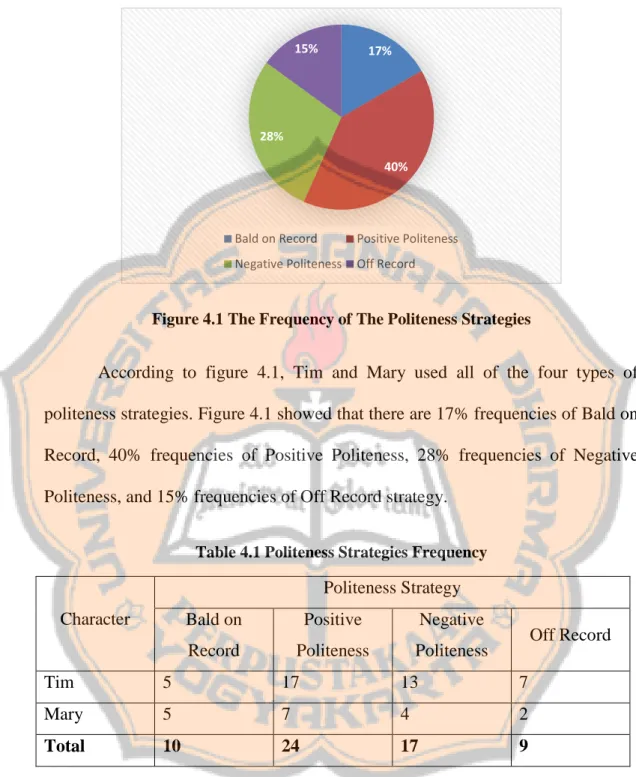
This part presents the findings from the total of the use of politeness strategies by Tim and Mary in About Time movie which were illustrated in Figure 4.1 and for more details see Appendix A.
Figure 4.1 The Frequency of The Politeness Strategies
According to figure 4.1, Tim and Mary used all of the four types of politeness strategies. Figure 4.1 showed that there are 17% frequencies of Bald on Record, 40% frequencies of Positive Politeness, 28% frequencies of Negative Politeness, and 15% frequencies of Off Record strategy.
Table 4.1 Politeness Strategies Frequency
Character
Politeness Strategy Bald on
Record
Positive Politeness
Negative
Politeness Off Record
Tim 5 17 13 7
Mary 5 7 4 2
Total 10 24 17 9
Table 4.1 showed the total number of politeness strategies used by Tim and Mary in About Time movie. It showed that the positive politeness strategy was the most type found in the utterances in About Time movie with the 24 frequencies. The frequency of bald on record strategy was 10 politeness
17%
40%
28%
15%
Bald on Record Positive Politeness Negative Politeness Off Record
expressions. The frequency of negative politeness was 17 politeness expressions.
Whereas, there were 9 politeness expressions of off record strategy. Therefore, the total data was 60 politeness expressions in the utterances by Tim and Mary.
There were all of the four types of politeness strategies which became the framework to conduct this research. The four types of politeness strategies were adopted from Brown and Levinson (1987) about politeness theory. It was used to give an explanation about the types of politeness strategies. There were bald on record, positive politeness, negative politeness, and off record strategy. This research also uses the construction classifications in order to find the types of politeness expressions based on the construction. The politeness expressions are categorized into three types. The classification of the construction of politeness expressions were lexical (L), phrasal (P), and clausal (C). The utterances in the construction classifications table are only the utterances which imply the politeness expressions, not all the utterances. The writer in this research made the clarification in the font style of the politeness strategies by Tim and Mary. The bold-typed words were the politeness strategies and the italic-typed words were the original utterance by Tim and Mary. The explanation of each type will be presented in the following part.
1. Bald on Record
The first type of politeness strategies is bald on record. This strategy is considered as the least polite strategy. This strategy is applied when the speaker does nothing to minimize threats to the hearer‟s face. The main reason for
applying this strategy is to do the FTA with maximum efficiency instead of satisfying the hearer`s face. As a result, speakers usually will shock or embarrass hearers. According to Brown and Levinson (1987), bald on record is the most direct, clear unambiguous way of saying things. A speaker will not attempt to minimize the threats to the hearer‟s face. Mostly, bald on record is used when the speaker and the hearer have close relationship, such as family, close friend, and colleague. It is also applied when the speaker wants to show power over the hearers. The speaker might say, “Put your bag away!” It shows an imperative utterance when he directly requests other people to perform actions without an effort to minimize the threat, thus the speaker will use Bald on Record strategy.
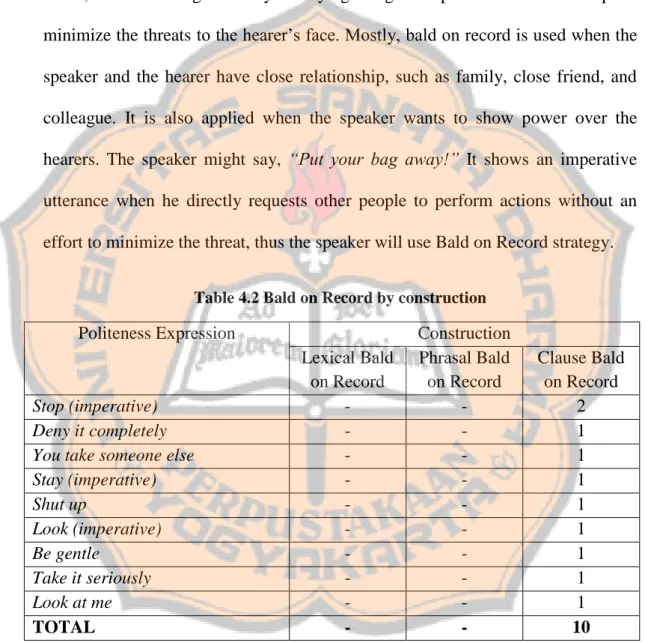
Table 4.2 Bald on Record by construction
Politeness Expression Construction
Lexical Bald on Record
Phrasal Bald on Record
Clause Bald on Record
Stop (imperative) - - 2
Deny it completely - - 1
You take someone else - - 1
Stay (imperative) - - 1
Shut up - - 1
Look (imperative) - - 1
Be gentle - - 1
Take it seriously - - 1
Look at me - - 1
TOTAL - - 10
Table 4.2 showed that the distribution of Bald on Record by construction only occurred in clausal construction. As a result, there were 10 frequencies of Clausal Bald on Record by Tim and Mary. Table 4.2 also showed a phenomenon that the 10 frequencies of Clausal Bald on Record were in the form of imperative
sentences. The following is the explanations of Bald on Record strategy by Tim and Mary in About Time movie.
[18] Kit Kat : Is Mary here?
Tim : Yes.
Kit Kat : Where?
Tim : Downstairs. You be gentle. Be gentle! (Kit Kat leaves Tim).
Be gentle!
Tim and Kit Kat were in their house when they talked about Mary. Kit Kat had not met Mary, therefore she was interested to meet Mary. Tim realized that his sister was childish and she used to exaggerate her emotions. As a result, Tim gave a command to her sister by saying “Be gentle”. The utterance “Be gentle” in dialogue [18] was indicated as a sentence. Therefore, the classification of the utterance “Be gentle” was clausal construction. It was used as a direct command.
He used rising tone and spoke in a pedantic manner of speaking. As stated by Gimson (2001), that the use of rising tone is to soften the command. The manner of speaking was in pedantic way because he repeated the command and spoke slower than the command before. It was used to give clarity of the command.
Further, they spoke informally since the role relationship was brother and sister.
From the explanation about the context of situation and the intonation in dialogue [18], it can be considered that Tim used Bald on Record strategy with the sub strategy task-oriented. The use of this sub strategy in dialogue [18] was to give the command or the FTA with maximum efficiency. As stated by Brown and