Individual Events
SI P 30 I1 a 100 I2 a 3 I3 see the remark*a 2 I4 a 1
*Q
see the remark 120 b 5 b 600 b 7 b 7
R 11 c 0 c 2 c 4 c –61
*S
see the remark 72 d 2 d 36 d 3
1
4 d 69
Group Events
SG q 3 G1 unit digit 5 G2 minimum r 1 G3 m3 – n3 1387 G4 no. of digits 34
k 1 Integral part 1 s 40 Maximum 31 2000
w 25 24 t –0.5 ab
3 1
2519
p 2 3
Greatest A 3 u 120 BC 9 A+B+C+D+E 15
Errata
FI1.2 "the remainder of ... divided by" is changed into "the remainder when ... is divided by" FI1.4 "Find the maximum possible value of" is changed into "Find the value of"
FI2.2"增加 (2b – a) cm2" is changed into "增加 (2b – a) cm3" FI3.1 "integer" is deleted, 求 a 的整數值更改為求 a 的值。。
FI3.3 "The remainder of 392 divided by" is changed into "The remainder when 392 is divided by"
FI4.4
2 6
2 2
c y x yx y x xy
is changed into
2 6
2 2
c y x xy y x xy
FG1.2 "integer" is changed into "integral"
FG1.3 "three-digit numbers how many" is changed into "three-digit numbers, how many". FG2.4 wrong figure 1 on the internet
http://www.edb.gov.hk/attachment/tc/curriculum-development/kla/ma/res/sa/2012d.pdf
Sample Individual Event (2009 Final Individual Event 1)
SI.1 Let a, b, c and d be the roots of the equation x4 – 15x2 + 56 = 0. If P = a2 + b2 + c2 + d2, find the value of P.
x4 – 15x2 + 56 = 0 (x2 – 7)(x2 – 8) = 0 a = 7 , b = 7, c = 8 , d = 8 P = a2 + b2 + c2 + d2 = 7 + 7 + 8 + 8 = 30
SI.2 In Figure 1, AB = AC and AB // ED.
If ABC = P and ADE = Q, find the value of Q.
ABC = 30 = ACB (base s isos. )
BAC = 120 (s sum of )
ADE = 120 (alt. s, AB // ED) Q = 120
Remark: Original question AB // DE.
It is better for AB and ED to be oriented in the same direction. Figure 1
SI.3 Let F = 1 + 2 + 22 + 23 + + 2Q and R =
2 log
1 log F
, find the value of R.
F = 1 + 2 + 22 + 23 + + 2120 = 1 2
1 2121
= 2121 – 1
R =
2 log1 log F
=
2 log
2 log 121
= 11
SI.4 Let f (x) be a function such that f (n) = (n – 1) f (n – 1) and f (1) 0. If S =
3
1
f R
R R f
, find the value of S.
f (n) = (n – 1) f (n – 1) = (n – 1)(n – 2)f (n – 2) =
S =
3 11 1111
f f
=
8 10
8 8 9 10
f f
= 98 = 72
Remark: Original question:
Let f (x) be a function such that f (n) = (n – 1) f (n – 1). If S =
31
f R
R R f
, find the value of S.
Individual Event 1
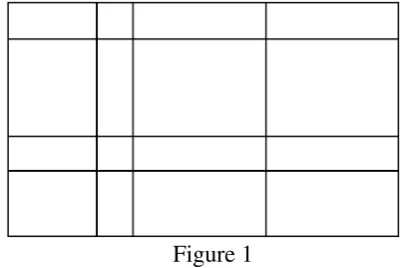
I1.1 Figure 1 has a rectangles, find the value of a.
Reference: 1993HG9 a = 25
5
2 C
C = 100
Figure 1
I1.2 Given that 7 divides 111111. If b is the remainder when
times a
111111
111111 is divided by 7,
find the value of b.
times
100
111111
111111 =111111 110000
96
times
+ 1111
= 111111
s
' 1 ' 16
1000001
1000001 10000 + 7158 +5
= 7m + 5, where m is an integer. b = 5
I1.3 If c is the remainder of
2
4b2
1
2b2 b2
b b
b divided by 3, find the value of c.
100 50 25
5 4 2
5 = 3100 + 450 + 525
= 3100 + (3 + 1)50 + (32 – 1)25
= 3100 + 3m + 1 + 3n – 1 (by binomial theorem, n, m are integers)
The remainder c = 0
I1.4 If |x + 1| + |y – 1| + |z| = c,find the value of d = x2 + y2 + z2.
Reference: 2005 FI4.1, 2006 FI4.2, 2009 FG1.4, 2011 FI4.3, 2015 HG4, 2015 FI1.1
Individual Event 2
I2.1 Given that functions f (x) = x2 + rx + s and g(x) = x2 – 9x + 6 have the properties that the sum of roots of f (x) is the product of the roots of g(x), and the product of roots of f (x) is the sum of roots of g(x). If f (x) attains its minimum at x = a, find the value of a.
Let , be the roots of f (x).
+ = –r = 6; = s = 9
f (x) = x2 – 6x + 9 = (x – 3)2 + 0
f (x) attains the minimum value at x = a = 3
I2.2 The surface area of a cube is b cm2. If the length of each side is increased by 3 cm, its volume is increased by (2b – a) cm3, find the value of b.
Let the original length of each side be x cm. Old surface area b cm2 = 6x2 cm2
Original volume = x3 cm3
New length of side = (x + 3) cm. New volume = (x + 3)3 cm3
Increase in volume = [(x + 3)3 – x3] cm3 = (2b – a) cm3 9x2 + 27x + 27 = 2(6x2) – 3
3x2 – 27x – 30 = 0 x2 – 9x – 10 = 0 (x – 10)(x + 1) = 0 x = 10
b = 6x2 = 600
I2.3 Let f (1) = 3, f (2) = 5 and f (n + 2) = f (n + 1) + f (n) for positive integers n. If c is the remainder of f (b) divided by 3, find the value of c.
f (1) = 3, f (2) = 5, f (3) = 8, f (4) = 13, f (5) = 21, f (6) = 34, f (7) = 55, f (8) = 89,
0, 2, 2, 1, 0, 1, 1, 2 (mod 3) f (9) 0, f (10) 2, f (11) 2, f (12) 1, f (13) 0, f (14) 1, f (15) 1, f (16) 2 (mod 3)
When f (n) is divided by 3, the pattern of the remainders repeats for every 8 integers. 600 = 875
c = 2
I2.4 In Figure 2, the angles of triangle XYZ satisfy
ZYX and cX = 6Z.
If the maximum possible value of Z is d, find the value of d.
2X = 6ZX = 3Z Let Z = z, Y = y, X = 3z z + y + 3z = 180 (s sum of ) y = 180 – 4z
ZYX
z 180 – 4z 3z
7 180
z and z 36
d = the maximum possible value of z = 36
Individual Event 3
Reference: 2015 FI4.2
2Reference: 1985 FI3.3, 1990 HI3, 2015 FI4.3 f (x) = x – 2 such 2-digit positive integers, find the value of c.
392 – 7 = 385 = 577 = 5711
Individual Event 4
I4.1 Let f (x) be a real value function that satisfies f (xy) = f (x) f (y) for all real numbers x and y and f (0) 0. Find the value of a = f (1).
Reference: 2015 FI1.3 f (00) = f (0) f (0)
Reference: 2015 FI2.4
The three roots are 1, 2 and 3. Let the fourth root be .
Reference: 1993 HG8, 2010 FI1.3
From (2): xy(x + y) + x + y – 61 = 2 6(x + y) + (x + y) – 63 = 0
x + y = 9
Sample Group Event (2009 Final Group Event 1)
SG.1 Given some triangles with side lengths a cm, 2 cm and b cm, where a and b are integers and a 2 b. If there are q non-congruent classes of triangles satisfying the above conditions,
find the value of q.
SG.3 Given that x and y are non-zero real numbers satisfying the equations
12
The first equation is equivalent to
12
Method 2 The first equation is equivalent to
12
Sub. these equations into (1):
The sum of two non-negative numbers = 0 means each of them is zero
Group Event 1
G1.1 Find the unit digit of (213 + 1)(214 + 1)(215 + 1)(216 + 1).
210 = 1024, 211 = 2048, 212 = 4096, 213 = 8192, 214 = 16384, 215 = 32768, 216 = 65536
(213 + 1)(214 + 1)(215 + 1)(216 + 1) = 8193163853276965537 3597 5 (mod 10)
Unit digit = 5
G1.2 Find the integral part of 16 (0.40 + 0.41 + 0.42 + + 0.59). 0.40 + 0.41 + 0.42 + + 0.59 =
0.40 0.59
2
20
= 9.9
1 = 9.9 9.9 < 16 9.9 < 18 9 = 2 Integral part = 1
G1.3 Choose three digits from 1, 2, 4, 6, 7 to construct three-digit numbers. Of these three-digit numbers, how many of them are divisible by 3?
126, 246, 147, 267 are divisible by 3.
The permutations of the digits of 126, 246, 147, 267 are also divisible by 3. Total number of such integers = 3!4 = 24
G1.4 Using numbers: 1, 2, 3, 4, 5, 6 to form a six-digit number: ABCDEF such that A is divisible by 1, AB is divisible by 2, ABC is divisible by 3, ABCD is divisible by 4, ABCDE is divisible by 5, ABCDEF is divisible by 6. Find the greatest value of A.
Reference: http://www2.hkedcity.net/citizen_files/aa/gi/fh7878/public_html/Number_Theory/1234567890.pdf ABCDEis divisible by 5 E = 5
(A, C) = (1, 3) or (3, 1)
AB is divisible by 2, ABCD is divisible by 4, ABCDEF is divisible by 6
B, D, F are even.
ABC is divisible by 3 1 + B + 3 is divisible by 3 B = 2
(D, F) = (4, 6) or (6, 4)
ABCD is divisible by 4 CD is divisible by 4 When C = 1, D = 6 (1)
When C = 3, D = 6 (2)
F = 4
Group Event 2
G2.1 If 43 + 4r + 44 is a perfect square and r is a positive integer, find the minimum value of r.
43 + 4r + 44 = 22(42 + 4r–1 + 43) = 22(80 + 4r–1)
The least perfect square just bigger than 80 is 81 = 92. 4 r–1 = 1 r = 1
The minimum value of r is 1.
G2.2 Three boys B1, B2, B3 and three girls G1, G2, G3 are to be seated in a row according to the
following rules:
1) A boy will not sit next to another boy and a girl will not sit next to another girl, 2) Boy B1 `must sit next to girl G1
If s is the number of different such seating arrangements, find the value of s. First, arrange the three boys in a line, there are 3! permutations.
B1B2B3, B1B3B2, B2B1B3, B2B3B1, B3B1B2, B3B2B1.
If B1 sits in the middle, there are two different cases. For instance, B2 B1 B3. Then the
possible seating arrangements are:
B2 G2 B1 G1 B3 G3, B2 G3 B1 G1 B3 G2, G2 B2 G1 B1 G3 B3 or G3 B2 G1 B1 G2 B3,
G3 B2 G2 B1 G1 B3, G2 B2 G3 B1 G1 B3, B2 G1 B1 G3 B3 G2 or B2 G1 B1 G2 B3 G3.
If B1 sits in the left end or right end, there are four different cases. For instance, B2 B3 B1,
then the possible seating arrangements are:
B2 G2 B3 G3 B1 G1, B2 G3 B3 G2 B1 G1, G2 B2 G3 B3 G1 B1, G3 B2 G2 B3 G1 B1,
B2 G2 B3 G1 B1 G3, B2 G3 B3 G1 B1 G2.
Total number of seating arrangements = 28 + 46 = 40
Method 2 Label the 6 positions as 1 2 3 4 5 6
B1 and G1 sit next to each other, their positions can be 12, 23, 34, 45 or 56, altogether 5 ways.
B1 and G1 can interchange positions to G1B1, 2 different ways.
For the other positions, the two other boys and the two other girls can sit in 22 = 4 ways.
For instance, if B1G1 sit in the 2-3 positions, 1 B1 G1 4 5 6
then B2, B3, G2, G3 can sit in the following 4 ways:
G2 B1 G1 B2 G3 B3, G3 B1 G1 B2 G1 B3, G2 B1 G1 B3 G3 B2, G3 B1 G1 B3 G2 B2.
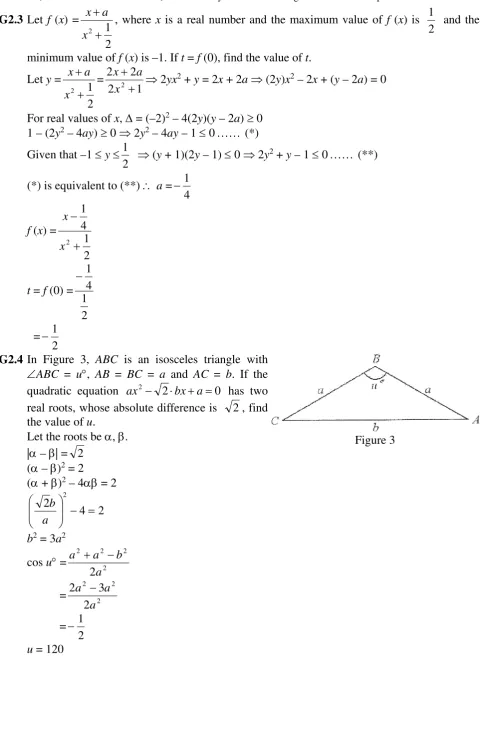
G2.3 Let f (x) =
Group Event 3
G3.1 If m and n are positive integers with m2 – n2 = 43, find the value of m3 – n3. (m + n)(m – n) = 43, which is a prime number.
1 43 n m
n
m
m = 22, n = 21
m3 – n3 = (m – n)(m2 + mn + n2) = 1[(m + n)2 – mn] = 432 – 2221 = 1849 – 462 = 1387
G3.2 Let x1, x2, , x10 be non-zero integers satisfying –1 xi 2 for i = 1, 2, , 10.
If x1 + x2 + + x10 = 11, find the maximum possible value for x12 x22 x102 .
In order to maximize 102
2 2 2
1 x x
x , the number of “2” appeared in x1, x2, , x10 must be as
many as possible and the remaining numbers should be “–1”. Let the number of “2” be n and the number of “–1” be 10 – n. 2n – 1(10 – n) = 11
n = 7
Maximum = 22 + 22 + 22 + 22 + 22 + 22 + 22 + 1 + 1 + 1 = 31
G3.3 If f (n) = an + bn, where n is a positive integer and f (3) = [f (1)]3 + f (1),
find the value of ab. f (1) = a + b
f (3) = (a + b)3 + a + b = a3 + b3
a2 + 2ab + b2 + 1 = a2 – ab + b2 3ab = –1
ab =
3 1
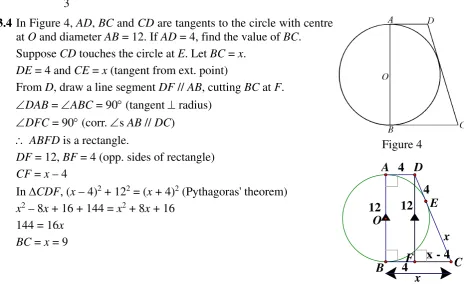
G3.4 In Figure 4, AD, BC and CD are tangents to the circle with centre at O and diameter AB = 12. If AD = 4, find the value of BC. Suppose CD touches the circle at E. Let BC = x.
DE = 4 and CE = x (tangent from ext. point)
From D, draw a line segment DF // AB, cutting BC at F.
DAB = ABC = 90 (tangent radius)
DFC = 90 (corr. s AB // DC)
ABFD is a rectangle.
DF = 12, BF = 4 (opp. sides of rectangle) CF = x – 4
In CDF, (x – 4)2 + 122 = (x + 4)2 (Pythagoras' theorem)
x2 – 8x + 16 + 144 = x2 + 8x + 16 144 = 16x
BC = x = 9
Figure 4
12 4
4
x 12
x - 4 x 4F
E D
C O
A
Group Event 4
G4.1 In P be the product of 3,659,893,456,789,325,678 and 342,973,489,379,256 , find the number of digits of P.
Reference: 2015 FG1.3
3,659,893,456,789,325,678 = 3.71018 (correct to 2 sig. fig.)
342,973,489,379,256 = 3.41014 (correct to 2 sig. fig.)
P 3.710183.41014 = 12.581032 = 1.2581033
The number of digits is 34.
G4.2 If
4 7 1 2013
1 4 4
1
x , find the value of
2013 2013 48
1872
x x
.
2 3 2013
2013
4
x x
3 8 2013
2013
x x
2013 2013 48
1872
x x
=
3 8 48
1872 = 1872 + 128 = 2000
G4.3 The remainders of an integer when divided by 10, 9, 8, , 2 are 9, 8, 7, , 1 respectively. Find the smallest such an integer.
Reference: 1985 FG7.2, 1990 HI13
Let the integer be N.
N + 1 is divisible by 10, 9, 8, 7, 6, 5, 4, 3, 2. The L.C.M. of 2, 3, 4, 5, 6, 7, 8, 9, 10 is 2520.
N = 2520k – 1, where k is an integer.
The least positive integral of N = 2520 – 1 = 2519
G4.4 In Figure 5, A, B, C, D, E represent different digits. Find the value of A + B + C + D + E.
9EE (mod 10) E = 0 or 5
Consider the multiplication of ten thousands digit 9A + carry digit = 10 + AA = 1 or 2
Possible products are 122205, 111105, 122200, 111100. Of these 4 numbers, only 111105 is divisible by 9.
ABCDE= 1111059 = 12345
A + B + C + D + E = 1 + 2 + 3 + 4 + 5 = 15