P. Sharma; J. Sharma
Workaholism and Its Correlates: A Study of Academicians
1
J. Sharma, 2*P. Sharma
1,2*
Department of Business, School of Business, College of Management, Shri Mata Vishno Devi University, Jammu and Kashmir, India
Int. J. Manag. Bus. Res., 1 (3), 151-160, Summer 2011 © IAU
Received 17 August 2011, Accepted 22 October 2011
INTRODUCTION
In the midst of the development of modern societies, the working competition has become increasingly severe. The employees face a lot of rapid and complex changes that have marked an entirely new era of business characterized by increasing work pressures, day to day challenges, stretched working hours and so on. The elongated burden of work is leading the employees to work for long hours and it is not surprising that people work harder and longer nowadays to become potential victims of workaholism progressively.
The term workaholism was coined by Oates in 1968. It is akin to addiction to alcohol in excess and refers to people whose needs to work has become so exaggerated that it may constitute a danger to their health, personal happiness, interpersonal relations and social functioning (Oates, 1968). Another definition proposed by Spence and Robbins (1992), stated that
A B S T RA C T: This study examined the relationship of the personality factors (Openness, Conscientiousness,
Extraversion, Agreeableness, and Neuroticism) with each of the three workaholism components i.e. working compulsively, working excessively and combined workaholics. As the study is of exploratory in nature, a sample of 145 academicians was drawn from the two universities of Jammu region (India), namely, Shri Mata Vaishno Devi University, Katra (India) and the University of Jammu, Jammu (India). The internal consistencies of each dimension of Dutch Work Addiction Scale (DUWAS) ranged from 0.883 to 0.837 and Cronbach’s α reliability coefficient value of scale- measuring Extraversion, Agreeableness, Conscientiousness, Neuroticism and Openness to experience- ranged from 0.75 to 0.83, which is within the specified limit. Three dependent variables, namely, combined workaholics, working compulsively workaholics and working excessively workaholics were regressed with age, monthly salary, family type, family size, marital status; whereas extraversion, agreeableness, conscientiousness, neuroticism, and openness to experience vary individually. The study has identified neuroticism and conscientiousness as the significant personality traits causing the negative impact on all the three dimensions of workaholics. Whereas, salary is negatively correlated and has a significant impact on the two dimensions of workaholism, namely, combined workaholics and working compulsively workaholics. However, the designation is significant variable and is positively affecting the working compulsively workaholics.
Key word s:Combined workaholism, Working compulsively, Working excessively, Academicians, BFI, Multiple regression
the common element in the discussions of workaholism is that the affected individual is highly committed to work and devotes a good deal of time to it. However, some writers view workaholics as unhappy, obsessive, tragic figures, who are not performing their jobs properly and create difficulties for their co- workers (Oates, 1971; Naughton, 1987) as they have a single aim in mind, i.e. to work more and more and stretch themselves to the point of exhaustation and are constantly worried about meeting deadlines and achieving success (Porter, 1996).
The wor kah olics possess differen t types of workaholic behaviour patterns. These are compulsive-dependent, perfectionist and achievement- oriented (Naughton, 1987; Scott et al., 1997). Each of these beh aviour al patter ns has potentially differ en t antecedents (Scott et al. 1997; Burke, 2000; McMillan et al., 2002) which include demographic characteristics,
J. Sharma; P. Sharma
work situation characteristics (Spence and Robbins, 1992; Burke, 1999) and personality characteristics (Burke et al., 2006).
Previous Studies on Workaholism and P ersona lity Very few studies have examined the relationship between the personality and workaholism. The studies conducted by researchers like Burke et al. (2006) made an attempt to look at the relationship between generalized self-efficacy, the big five personality traits (Neuroticism, Extraversion, Conscientiousness, Openness to Experience and Agreeableness) and the three dimensions of workaholism (drive to work, joy in work, and work involvement). They found that neuroticism was related to feeling driven to work, extraversion was related to work involvement and joy in work and generalized self-efficacy was related to all the three dimensions of workaholism. Eysenck (1997) revealed that there would be a casual relationship between personality factors, namely, psychoticism, extraversion and neuroticism and biological factors (genetic factors) which, in turn, produce addictive work behaviour. Andreassen et al. (2010) and Clark et al. (1996) examined personality correlates of workaholism dimensions, namely, work involvement, drive to work and enjoyment of work using Big Five Inventory (BFI) and concluded that conscientiousness was positively related to all the components of workaholism. Negative relation was observed between neuroticism and enjoyment of work and also between agreeableness and drive to work dimension of workaholism. Mudrack (2004) proposed that workaholism may be the by-product of the combination of high job involvement with an obsessive compulsive personality which consisted of six distinct traits, i.e., obstinacy, orderliness, parsimony, perseverance, rigidity and super ego. Th e study in dicated th at h igh job in volvement coupled with h igh scor es on the obstinacy, orderliness, rigidity and superego traits would lead to high scores on tendencies to engage in non-required work. Burke et al. (2008) specified that workaholics indicate greater perfectionism, find difficulty in delegating tasks and are less satisfied with their jobs. Ng et al. (2007) mentioned that achievement related traits, i.e., Type-A personality, obsessive compulsive personality and need for achievement influence individuals to become addicted to work. Scott et al. (1997) revealed obsessive compulsive personality trait as the dominating factor which
promotes addiction towards work and makes people workaholic. Naughton (1987) suggested that high job involvement coupled with high scores on measures of obsessive- compulsive personality might produce individuals, who are workaholics.
Liang and Chu (2009) indicated that obsessive compulsion, achievement orientation, perfectionism and conscientiousness are the key personality factors which lead an individual towards workaholism. Zhdanova et al. (2006) examined the antecedents and consequences of workaholism and concluded that Type-A personality trait and perfectionism were positively related to workaholism. In another attempt, Schwartz (1982) indicated that individuals with a Type-A personality trait presents a strong example of the obsessive style and is commonly addicted to work. Moving in the same direction, Robinson (1998) found positive relationship between Type-A behaviour and workaholism in individuals. Furthermore, strong link between workaholism and personality types including Type-A behaviour patterns, namely, competitive, achievement-orientated individuals and obsessive-compulsive traits have also been pointed out at different point of time (Naughton, 1987; Byrne and Reinhart, 1989). Chesnut (1990) found that workaholics exhibited nine behavioural patterns i.e. are usually in hurry, have strong need to control, are perfectionists, find difficulty in relationships, binge on work, feel difficulty in relaxing and having fun, impatient and irritable, feel inadequate and are self – neglectful.
The above discussion on literature shows that most of the studies have been conducted about Type-A behaviour and obsessive compulsive behaviour. Though Big Five Inventory can play a potential role in explaining workaholism in organisations (Burke et al., 2006), yet the research in this area has received scant attention.
The present study has been designed specifically to examine the relationship of the personality factors (Open n ess, Con scien tiousn ess, Extr aver sion , Agreeableness, and Neuroticism) with each of the three workaholism components derived by (Schaufeli, 2004) i.e., working compulsively workaholics and working excessively workaholics.
RESEARCH METHOD
P. Sharma; J. Sharma
Int. J. Manag. Bus. Res., 1 (3), 151-160, Summer 2011
Jammu (India). As the study is of exploratory in nature, so a sample of 145 employees was drawn from the two universities of Jammu region (India). The choice for the academician is due to the reason that academician acts as a liaison between the student and the outside world. Moreover they work hard to keep themselves updated. Besides, studies of Spence and Robbins (1992) and Narayan et al. (1999) have also found university professors overloaded with the work which, further, reinforces the decision of targeting the academicians working in university for the present study.
The responses of the employees were taken through the pre-tested structured questionnaire during the months of April to July 2010. The correlates relating to personal factors of workaholism amongst the academicians were analyzed. A standardized 4 point scale DUWAS (Dutch Work Addiction Scale) ranging from almost never to almost always comprising of 20 statements developed by (Schaufeli, 2004) has been used to measure the level of workaholism. The scale used is a combination of two constructs, namely,
working compulsively including seven statements,
and working excessively with nine statements.
Accordingly a respondent, who has scored high on wor kin g excessively as well as on wor kin g compulsively, categorised as workaholic using the Schaufeli’s scoring key (Schaufeli, 2004).
This scale has been preferred over two frequently used workaholism scales, namely, Work Addiction Risk Test (Robinson, 1999) and the Workaholism Battery (Spence and Robbins, 1992) as the Work Addiction Risk Test is misleading because of referring to working hard without any reference to underlying motivation (Libano et al., 2010). Whereas, workaholism battery has failed to confirm three factor model of workaholism that included work involvement, work enjoyment and drive to work (Kanai et al. 1996; McMillan et al., 2002). Both these scales have failed to prove core components of workaholism (Schaufeli et al., 2006).
The personality traits of the employees have been captured using the Big Five Inventory (BFI) model developed by Goldberg (1992). This is comprised of forty four statements measured on five point likert type scale ranging from strongly disagree to strongly agree. Though there are various limitations to the construct of Big Five model which has observed that it is not theory driven, the five factors are not
independent of each other and are very broad for the applied work (Depue and Collins, 1999), yet the big five remains on the very popular personality model because it gives an accurate and fast way of assessing the main drivers of someone’s personality and is a comprehensive scale wh ich covers most of the personality dimensions (Sinclair, 1990).
The Big Five Inventory has been preferred as the valid predictor scale of personality traits (Popkins, 1998). The previous use of Dutch Work Addiction Scale (DUWAS) has shown the internal consistencies of each dimension of scale to be reliable and satisfactory (Metin, 2010; Shimazu, et al. 2010). The Cronbach’s α reliability coefficient value of BFI scale measuring Extraversion, Agreeableness, Conscientiousness, Neuroticism and Openness to Experience is higher than the minimum acceptable level (Goldberg, 1992; McCrae and John, 1992). The responses of the focal group for these scales in the present study also indicate that Cronbach’s α reliability coefficient value ranges from 0.75 to 0.83 which is above the threshold limit.
D ef i n i t io n o f t h e Va r ia b le s
The following definitions of the terms are used for the purpose of the study:
9Working Excessively Workaholics: It is the tendency to work hard and is a behavioural dimension.
9Working Compulsively Workaholics: It is an
obsession with work and is a cognitive dimension. 9Combined Workaholism: It is the combination of both behavioural and cognitive dimensions.
9Neuroticism: It indicates instability, stress proneness, insecurity and depression features in an individual. 9Extraversion: It is associated with sociability, domin an ce, ambitiousn ess, an d asser tiven ess characteristics of an individual.
9Conscientiousness: It is an indication of persistence, dependability and being organized traits of an individual.
9Agreeableness: It connotes the cooperative, caring and likeable traits in an individual.
9Openness to experience: It is an indication of sen sitivity, in tellectual, imagin ative, curious, broadminded traits of personality.
P. Sharma; J. Sharma Workaholism and Its Correlates
The independent variables used in all the three models were age, monthly salary, family type, family size, marital status,extraversion, agreeableness, conscientiousness, neuroticism, and openness to experience. The average score of each respondent was estimated on differ ent dimensions of Big Five Inventory. This average score was used to estimate the Z scores for which each respondent has the same mean (Mean=0) and standard deviation (S. D. =1). A positive value indicates that it is above the norm while a negative value indicates that it is below the norm (Verma and Larson, 2002).
Accordingly respondents with positive value have been specified as employees with more contents of that personality trait whereas those with negative value possess less content of those personality traits. As all the variables were categorical in nature and so were converted into dummy variables to make the data fit for the regression analysis and is presented below.
Co n ver sion of Va ri a b le s in to D u mmy Va r ia b l es Age if 30 -40 years. then 1, otherwise 0
Monthly Salary if less than Rs.35000 then 1, otherwise 0 Family type if Nuclear then 1, otherwise 0
Family Size if 3-5 members then 1, otherwise 0 Marital Status if married then 1, otherwise 0 Designation if Lecturer then 1, otherwise 0 Extraversion if high then 1, otherwise 0 Agreeableness if high then 1, otherwise 0
Con scientiousness if high then 1, other wise 0 Neuroticism if high then 1, otherwise 0
Openness to Experience if high then 1, otherwise 0
The data was checked for the existence of any problem of multicollinearity. However, the collinearity indices in all the three models indicates VIF<10 and the tolerance value above 0.1. Both these values lie between the limit r an ge an d indicates n o multicollinearity (Hair et al. 2008). Further the correlation matrix also indicates the presence of low correlation between the independent variables (less than 0.5 in all the cases) (Annexure I) which further suggest that multiple regression may be used as an appropriate tool for analysis. The regression equation for the three models is as under:
Y= f (X1, X2, X3………X11)
Where Y represents the dependent variables (i.e. Combined Workaholic, Working Compulsively Workaholic and Working Excessively Workaholic)
X1= Salary, X2 = Designation, X3= Marital Status, X4= Openness to Experience X5= Neuroticism, X6= Conscientiousness, X7= Agreeableness X8= Extraversion, X9= Age, X10= Family Type, X11= Family Size
The demographic profile of the focal group divulge that the sample is predominantly of males (65%), married (68%), having 3-5 members in the family (60%), lived in nuclear families (59%) and are falling in the 30-40 years of age group (53%). The respondents are mostly lecturers (56%) and maximum respondents (40%) fall in the monthly salary category of INR 25000-35000 out of four categories of salary i.e. salary less than 15000, salary between 15000-25000 and salary above 35000.
Percentage- wise distribution
Job hours
Strictly 9 to 5 38.0
Normally extends beyond 5 51.0
Quite Flexible, If no work can go home 11.0
Time spent at home for completing official work
1-2 Hours 56.0
2-4 Hours 22.0
Above 4 Hours 15.0
NA 7.0
Addition of associates results in optimal workload in the organization
Yes 71.0
No 23.0
May Be 6.0
Table 1: Hours devoted for work
P. Sharma; J. Sharma
Int. J. Manag. Bus. Res., 1 (3), 151-160, Summer 2011
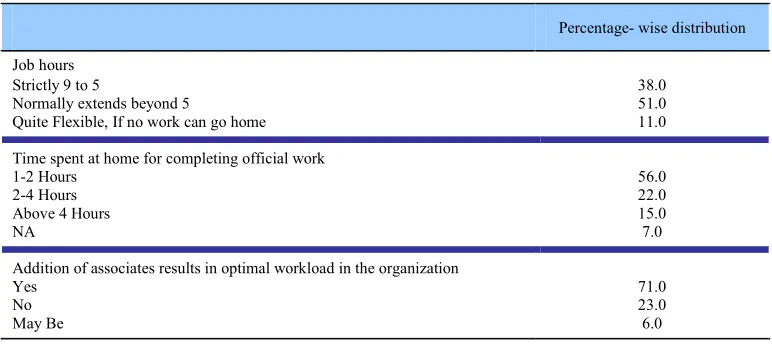
The number of hours devoted by employees for their work (refer table 1) depicts that they normally work beyond 5 (51%) and even spend 1-2 hours at home for completing their official work (56%) and consider addition of associates results into the optimal workload (71%).
The most obvious characteristic of workaholics is that they work beyond what is required (Schaufeli et al., 2006). Consequently, they devote much more time to their work than do others (Scott et al., 1997; Mudarack and Naughton, 2001; Brett and Stroh, 2003; Buelens and Polemans, 2004). It appears that largely the focal group in the study tends to show workaholic characteristics because most of them work beyond the official hours and even spend 1-2 hours at home for completing their official work. Moreover, majority of the people feel overloaded with the work due to the shortage of persons in the organization.
RESULTS AND DISSCUSSION
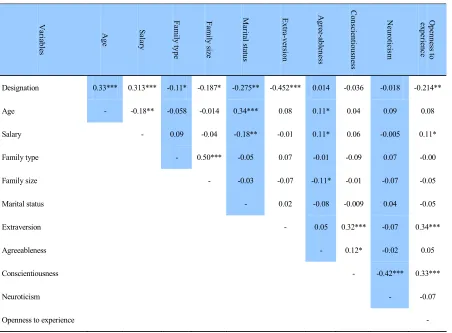
The descriptive statistics for three components of workaholism, namely, combined workaholics, working compulsively workaholics and working excessively workaholics with demographics and personality factors were estimated. The inter correlations among all the independent variables used in the study specifies that five of the ten correlations (50%), namely, extraver sion an d con scien tiousn ess (p<0.01), agreeableness and conscientiousness (p<0.10), con scien tiousness and openn ess to experience (p<0.01), conscientiousness and neuroticism (p<0.01), and extraversion and openness to experience (p<0.01) are significantly different from zero (refer Annexure I). The nine of the fifteen correlations (60%) of the demographic variables, namely, age and salary (p<0.05), age and marital status (p<0.01), salary and marital status (p<0.05), family type and family size (p<0.01), designation and age (p<0.01), designation and salary (p<0.01), marital status and designation (p<0.05), family type and designation (p<0.10) and family size and designation(p<0.10) are significantly different from zero. Examination of the correlation matrix (refer Annexure II) reveals that combined workaholics and working compulsively workaholics are negatively correlated with age, salary, marital status, extr aversion, conscientiousness, neuroticism and openness to experience. Combined workaholics are positively correlated with the family type, family size, designation and agreeableness whereas, working compulsively
R e g r e s s i o n R e s u l t s
Regression analyses was undertaken in which workaholic behaviour patterns, namely, combined workaholics, working compulsively workaholics and working excessively workaholics were regressed on eleven predictors i.e. age, salary, designation, family type, family size, extraversion, conscientiousness, agreeableness, neuroticism and open to experience.
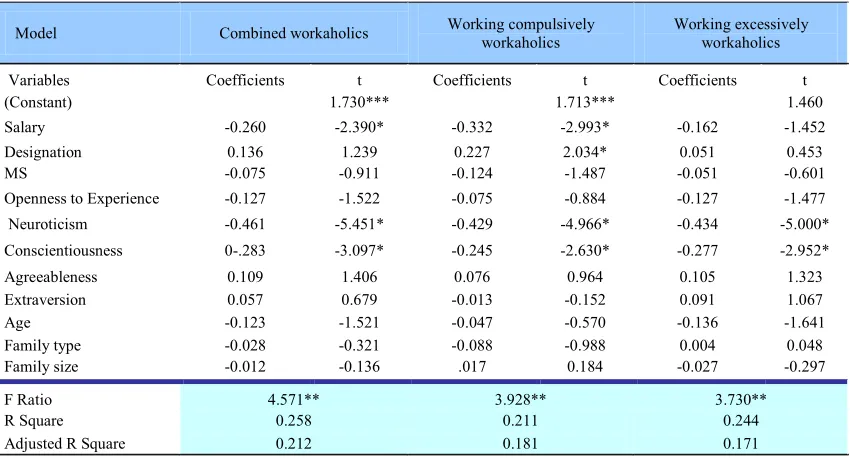
The table 2 reveals that in case of dependent variables, namely, combined workaholics, working compulsively workaholics and working excessively workaholics, F- ratio is significant at 1 per cent level of significance and the value of adjusted R-square explains 21, 18 and 17 per cent of the total variance, respectively.
The analyses, further, reveal that neuroticism, con scien tiousn ess an d salar y ar e foun d to be significant (p<0.05) and negatively correlated with combined workaholics and working compulsively workaholics. While designation is another significant predictor (p<0.05) which has shown a positive correlation with the working compulsively workaholics
whereas neuroticism and conscientiousness are
sign ificant (p<0.05), but n egatively correlated determinants of working excessively workaholics.
J. Sharma; P. Sharma
workaholics, working compulsively workaholics and working excessively workaholics. As a neurotic personality always experiences excessive worry, instability, lack of confidence and has affinity to experience negative emotions which reduces the possibility of developing positive attitude towards their work and that may be the probable explanation for devoting less time to th eir work by neur otics (Bozionelos, 2003), either behaviourally or cognitively. Another important determinant in all the three models is conscientiousness. In the present study, all the three workaholic behaviour patterns, namely, working excessively, working compulsively and combined workaholics (working excessively and working compulsively) are negatively correlated to conscientiousness. This may be because of the reason that the individuals with this type of personality trait are self-disciplined, aim for high achievement and achieve high level of success through purposeful planning and persistence (Bono, 2009), which may forbid them to devote more time to their work. Furthermore, the results reveal that designation is positively correlated with working compulsively workaholics. Working compulsively workaholics find work pleasurable and feel guilty or anxious in non-work activities. Therefore if an individual with this type of work behaviour is promoted, there may be increase in
th e pr obability of an individual’s exposure to prolonged wor king hour s which in cr ease th e possibility of being addicted to work cognitively. Porter (2001) has also mentioned that people working on higher positions are under more pressure to work for long hours and hence develop workaholic tendencies.
CONCLUSION
The findings of the study will be helpful in formulating preventing and remedial strategies to keep the employees away from prolonged working hours. It is seen that conscientiousness is negatively correlated with all the workaholic behaviour patterns. Employees scored high on conscientiousness personality traits usually have a positive approach towards their life and can do good planning and follow the plan in an organ ized way. To r ein for ce th is beh aviour, organizations can conduct training programmes, seminars and workshops that can lead to the up gradation of organization and management skills. These types of training programmes can help in increasing conscientiousness trait of behaviour in employees (Spears, 2011). Besides, study has identified neuroticism as a variable which is negatively correlated with all the three types of workaholics. To embark upon with these types of employees, organizations can organize counselling sessions or hold seminars that
Model Combined workaholics Working compulsively
workaholics
Working excessively workaholics
Variables Coefficients t Coefficients t Coefficients t
(Constant) 1.730*** 1.713*** 1.460
Salary -0.260 -2.390* -0.332 -2.993* -0.162 -1.452
Designation 0.136 1.239 0.227 2.034* 0.051 0.453
MS -0.075 -0.911 -0.124 -1.487 -0.051 -0.601
Openness to Experience -0.127 -1.522 -0.075 -0.884 -0.127 -1.477
Neuroticism -0.461 -5.451* -0.429 -4.966* -0.434 -5.000*
Conscientiousness 0-.283 -3.097* -0.245 -2.630* -0.277 -2.952*
Agreeableness 0.109 1.406 0.076 0.964 0.105 1.323
Extraversion 0.057 0.679 -0.013 -0.152 0.091 1.067
Age -0.123 -1.521 -0.047 -0.570 -0.136 -1.641
Family type -0.028 -0.321 -0.088 -0.988 0.004 0.048
Family size -0.012 -0.136 .017 0.184 -0.027 -0.297
F Ratio 4.571** 3.928** 3.730**
R Square 0.258 0.211 0.244
Adjusted R Square 0.212 0.181 0.171
Table 2: Results of regre ssion analysis
P. Sharma; J. Sharma
Int. J. Manag. Bus. Res., 1 (3), 151-160, Summer 2011
157 can help the employees to have better control over their lives and reduce the level of anxiety and instability in their emotions. It has been proved that eighty per cent of the people with emotional instability can be treated through counselling (Hart, 1993).
Moreover, organizations can also organize yoga and meditation classes for such employees. Encouraging yoga and meditation practices can help in reducing anxiety and emotional instability (Singh, 2011). Besides
Va
Designation 0.33*** 0.313*** -0.11* -0.187* -0.275** -0.452*** 0.014 -0.036 -0.018 -0.214**
Age - -0.18** -0.058 -0.014 0.34*** 0.08 0.11* 0.04 0.09 0.08
Table 3: Inter-co rrelation matrix (Annexure I)
Note: ***p<0.01;**p<0.05;*p< 0.01
P. Sharma; J. Sharma Workaholism and Its Correlates
REFERENCES
Andreassen, C. S., Hetland, J. and Pallesen, S. (2010). The Relationship between Workah olism, Basic Needs Satisfaction at Work and Personality. European Journal of Personality, 24 (1), pp. 3-17.
Bono, E. D. (2009). The Big Five Test. Available: http:// w w w . i n t e l l i g e n c e - s t r a t e g i e s . c o m / c o u r s e s / personality%20Test.html (September 23, 2010). Bozioneles, N. (2003). The Big Five Personality and Work
Involvement. Journal of Managerial Psychology, 19 (1), pp. 69-81.
Brett, J. M. and Stroh, L. K. (2003). Working 61 Plus Hours a Week: Why Do Managers Do It. Journal of Applied Psychology, 88 (1), pp. 67-78.
Buelens, M. and Poelmans, S. A. Y. (2004). Enriching the Spence an d Robbins’ Typology of Workaholism: Demographic, Motivational and Organizational Correlates.
Journal of Organizational Change Management, 17 (5), pp. 440-458.
Burke, R. J. (1999) .Workaholism among Women Managers: Work and Life Satisfactions and Psychological Well- Being.
Equal Opportunities International, 18 (7), pp. 25-35. Bu rke, R. J. (2 000 ). Workaholism in Organization s:
Psychological and Physical Well-being Consequences.
Stress Medicine, 16 (1), pp.11-16.
Burke, R. J., Burgess, Z. and Fallon, B. (2006). Workaholism among Australian Female Managers and Professionals.
Equal Opportunities International, 25 (3), pp. 200-213.
Bu rke,R., Koyuncu, M. and Fiksen baum, L. (2008 ). Workaholism, Work an d E xtra Satisfaction s an d Psychological Well being among Professors in Turkey.
Cross Cultural Management: An International Journal,
15 (4), pp. 353-366.
Byrne, D. G. and Reinhart, M. (1989). Work Characteristics, Occupational Achievement and the Type a Behavior Pattern.
Journal of Occupational Psychology, 62 (2), pp. 123-134. Chestnu t, M. (1 99 0). Women in Bu siness, 42 (6),
pp. 31-33.
Clark, L. A., Livesley, W. J., Schroeder, M. L., and Irish, S. L. (1996). Convergence of Two Systems for Assessing Specific Traits of Personality Disorder. Psychological Assessment, 8 (3), pp. 294-303.
Clark, M. A., Lelchook, Ariel, M. and Taylor, M. L. (2010). Beyond the Big Five: How Narcissism, Perfectionism and Dispositional Affect Relate to Workaholism. Personality and Individual Differences, 48 (7), pp. 786-791. Depue, R. A. and Collins, P. F. (1999). Neurobiology of the
Structure of Personality: Dopamine, Facilitation of Incentive Motivation, and Extraversion. Behavioral and Brain Sciences, 22 (3), pp. 491-569.
Eysenck, H. J. (1997). Addiction, Personality and Motivation.
Human Psychopharmacology, 12 (2), pp. 79-87. Goldberg, L. R. (1992). The Development of Markers for
the Big-Five Factor Structure. Psychological Assessment, 4 (1), pp. 26-42.
Table 4: Inte r-correlation bet ween the dependent and inde pendent v ariables (Annexure II)
P. Sharma; J. Sharma
Int. J. Manag. Bus. Res., 1 (3), 151-160, Summer 2011 Hair, J. F., Black, W. C., Babin, B. J., Anderson, R. E., and
Tatham, R. L. (2008). Multivariate Data Analysis, New Delhi: Pearson Education Inc. Publisher, Taj Express, Hart, A. D. (1993). Dark Clouds, Silver Linings. Available:
http://www.ccel.us/hart.ch8.html (September 4, 2011), pp. 132-138.
Kan ai, A., Wakabayash i, M., an d Filing, S. (1 99 6). Workaholism among Employees in Japanese Corporations: An Examination Based on the Japanese Version of the Workaholism Scales. Japanese Psychological Research, 38 (4), pp. 192-203.
Koretz, G. (2001). Why Americans Work So Hard. Availabe: http://www.businessweek.com/smallbiz/content/jun2001/ sb2001066_605.htm (June 6, 2001).
Liang, Y. W. and Chu, C. C. (2009). Personality Traits and Personal and Organizational Inducements: Antecedents of Workaholism. Social Behavior and Personality, 37 (5), pp. 645-660.
Libano, M. D., Llorens, S., Salanova, M., and Schaufeli, W. (2010). Validity of a Brief Workaholism Scale. Psicothema, 22 (1), pp. 143-150.
Locke, R. W. (2007). Stress And Workaholism - What E verybody Sh ou ld Know. Available: http:// ezinearticles.com/?Stress-And-Workaholism—What-Everybody-Should Know&id=827595 (September 8, 2010).
McCrae, R. R. and John, O. P. (1992). An Introduction to the Five-factor Model and Its Applications. Journal of Personality, 60 (2), pp. 175–215.
McMillan, L. H. W. and O’Driscoll, M. P. and Marsh, N. V. (2002). A Multifaceted Validation Study of Spence and Robbin s (199 2) Workaholism Battery. Jo urn al of Occupational and Organizational Psychology, 75 (3), pp. 357-368.
Mudrack, F. E. and Naughton, T. I. (2001). The Assessment of Workaholism as Behavioural Ten dencies: Scale Development and Prelimin ary Empirical Testing.
International Journal of Stress Management, 8 (2), pp. 93-111.
Mudrack, P. E. (2004). Job Involvement, Obsessive-compulsive Personality Traits and Workaholic Behavioral Ten dencies. Jou rn al o f Org an ization al C ha ng e Management, 17 (5), pp. 490-508.
Narayanan, L., Menon, S., and Spector, P. E. (1999). Stress in th e Workplace: A Comparison of Gen der an d Occupations. Journal of Organizational Behaviour, 20 (1), pp. 63–73.
Naughton, T. J. (1987). A Conceptual View of Workaholism and Implications for Career Counselling and Research.
The Career Development Quarterly, 35 (3), pp. 180-187. Ng, T. W. H., Sorensen, K. L., and Feldman, D. C. (2007). Dimensions, An tecedents and Consequ ences of Workaholism: A Conceptual Integration and Extension.
Journal of Organizational Behaviour, 28 (1), pp. 111-136.
Oates, W. E. (1968). On Being a Workaholic: A Serious Jest.
Pastoral Psychology, 19 (8), pp. 16-20.
Oates, W. E. (1971). Confessions of a Workaholic: The Facts about Work Addiction. New York: World.
P opkins, N. C. (19 98 ). Available: http:// www.person alityresearch .org/papers/popkin s.h tml accessed on pp.1 (July 22, 2010).
Porter, G. (1996). Organizational Impact of Workaholism: Suggestions for Researching the Negative Outcomes of Excessive Work. Jo urna l of Occup atio na l Health Psychology, 1 (1), pp. 70-84.
Porter, G. (2001).Workaholic Tendencies and the High Potential for Stress among Co-workers Management.
International Journal of Stress Management, 8 (2), pp. 147-164.
Robinson, B. E. (1998). Chained to the Desk: A Guidebook for Workaholics, Their Partners and Children, and the Clinicians Who Treat Them. New York: New York University Press.
Robinson, B. E. (1999). The Work Addiction Risk Test: Development of a Tentative Measure of Workaholism.
Perceptual and Motor Skills, 88 (1), pp. 199-210. Rynes, S. L., Gerhart, B., Minette, K. A. (2004). The
Importance of Pay In Employee Motivation : Discrepancies between What People Say And What They Do. Human Resource Management, 43 (4), pp. 381-394. Schaufeli, W. B., Bakker, A. B. and Van Rhenen, W. (2009). How Changes in Job Demandsand Resources Predict Burnout, Work Engagement, and Sickness Absenteeism.
Journal of Organizational Behavior, 30 (7), pp. 893–917. Sch au feli, W. B., Taris, T. an d Rh en en , W. (2 00 8). Workaholism, Burnout and Work Engagement: Three of a Kind or Three Different Kinds of Employee Well-being.
Applied Psychology: An International Review, 57 (2), pp. 173-203.
Schaufeli, W. B., Taris, T. W. and Bakker, A. (2006). Dr. Jekyll and Mr. Hide: On the Differences between Work Engagement and Workaholism In R. Burke (Ed.): Research Companion to Working time and Work Addiction. Edward Elgar: Northampton, MA, pp. 193-217.
Schaufeli, W. (2004). The Dutch Work Addiction Scale (DUWAS). Available: http://www.sch au feli.com/ downloads/tests/Scoring%20DUWAS.pdf (July 4, 2010). Schwartz, H. S. (1982). Job Involvement as Obsession-Compulsion. Academy of Management Review, 7 (3), pp. 429-432.
Scott, K. S., Moore, K.S. and Miceli, M. P. (1997). An Exploration of the Mean in g and Conseq uen ces of Workaholism. Human Relations, 50 (3), pp .287-314. Sinclair, P (1990). The ‘Big Five’ Factors Personality Model.
Available: http://www.themotivator.in/bigfive_Profile.pdf (July 12, 2010), pp. 3-7.
J. Sharma; P. Sharma Seybold, K. C. and Salomone, P. R. (1994). Understanding
Workaholism: A Review of Causes and Counseling Approaches. Journal of Counseling and Development,
73 (1), pp. 4-9.
Spears, M. (1993). Supervisory and Management Training. Available: h ttp://www.man agemen ttraining.biz/ management_training_management-skills-Techniques-to-Bost-Employee-Morale.html (August 2 4, 2 01 0), pp. 32-34.
Spence, J. T. and Robbins, A. S. (1992). Workaholism Definition, Measurement and Preliminary Result. Journal of Personality Assessment, 58 (1), pp. 160-178. Verma, S. and Larson, R. W. (2002). Television in Indian
Adolescents’ Lives: A member of the family. Journal of Youth and Adolescence, 31 (3), pp. 177-183.