Basic Terminologies in Convex Optimization
Koredianto Usman Telkom University
Faculty of Electrical Engineering Indonesia
November 2, 2017
This short tutorial will explain some very basics terminologies re-lated to convex optimization. These terminologies should be well un-derstood before we learn convex optimization.
There are five terms that would be explained here which are :
1. Linear combination
2. Affine combination
3. Convex combination
4. Convex area
5. Convex function
We start from a linear combination.
1 Linear combination
Consider a 2D cartesian coordinate with x1 variable for horizontal axis, and x2 for vertical axis. Let say that there are two points in this axis namely A(xA1, xA2)=(2,2) and B(xB1, xB2)=(7,3) as shown in the
Fig.1.
It is more convinience to write coordinate point A and point B in
form of vector, thus A =
2 2
and B =
7 3
.
A(2,2)
B(7,3)
x1 x2
Figure 1: Two points onx1-x2 cartesian coordinate.
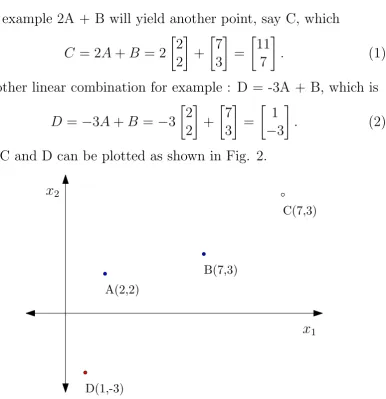
For example 2A + B will yield another point, say C, which
C = 2A+B = 2
Another linear combination for example : D = -3A + B, which is
D = −3A+B = −3
Figure 2: The linear combination of A and B to produce C and D.
By this simple illustration, we can produce any point in x1 − x2
We can state this simple statement mathematically as:
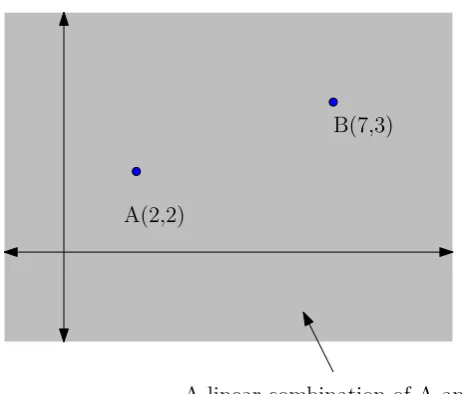
Let A and B any points (A6=B) in cartesian coordinate x1 −x2. Then any points P in this coordinate can be expressed as linear combination of A and B. That is
P = a1 ·A+a2 ·B (3)
for any real values a1 and a2.
This statement is illustrate in Fig.3.
A(2,2)
B(7,3)
A linear combination of A and B
can produce any point inx1-x2 cartesian coordinate.
Figure 3: Area of possible results of linear combination of A and B.
2 Affine combination
We consider again Point A(2,2) and point B(6,3) as in previous ex-ample. Also, we consider again a linear combination of Point A and Point B as
P = a1 ·A+a2 ·B (4)
but this time we cannot select a1 and a2 freely. Instead, we select that
a1 +a2 = 1 (5)
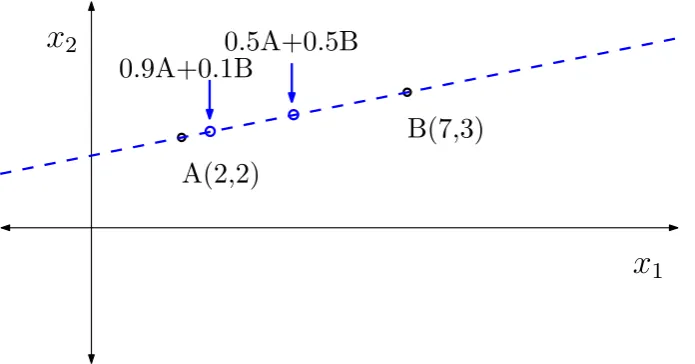
P = 0.5·A+ 0.5·B = 0.5
This point is just middle point of A and B.
Again we choose another combination, which is a1 = 0.9 and a2 =
0.1, then we have
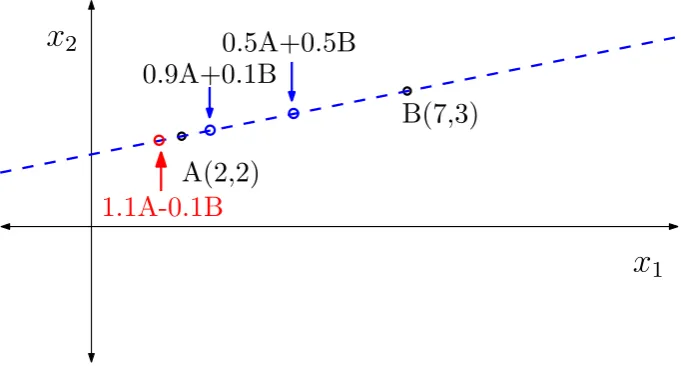
This point is lie to the line segment AB and close to A (Fig.4)
A(2,2)
A(2,2)
B(7,3)
x
1x
2 0.5A+0.5B0.9A+0.1B
1.1A-0.1B
Figure 5: Ilustration of a linear combination of point A and B fora1= 0.5a2= 0.5 anda1= 0.9
a2= 0.1
of A (Fig.5).
From this illustration, we conclude this simple fact from linear com-bination of P = a1A+a2B with a1 + a2 = 1 gives the result of point
P that lies on straight line that connects A and B.
The parametera1 controls the influence of point A to P. Starting from
a1 = 0.5 and increase it to 1 means that the point P shift from middle
of segment AB to point A itself. If a1 is increased so that it greater than 1 (and a2 less than 0), then the point P now move to the left of A (i.e. outside of the segment AB, but still in the straight line that connect A and B).
From this simple observation, we can further generalize the role of a2.
The parameter a2 on the other hand controls the point B. Starting
from a2 = 0.5 we are at mid point of line segment AB. Increasing a2
to 1, we move point P from mid point to the point B itself along the line segment AB. If we further increasea2 greater than 1 (i.e. a1 ≤ 0),
then the point P move outside of the segment AB at the right side of point B.
AFFINE combination is combination of point A and B (i.e. P = a1A + a2B with a1 + a2 = 1) produces a point P that lies on
the straight line that connects A and B. In other word, AFFINE combination is a special case of linear combination wherea1+a2 = 1 for any real value a1 and a2.
3 Convex combination
In previous section we know that Affine combination is a special case of linear combination where a1 +a2 = 1 and a1 and a2 are real
num-bers. Now we will consider a special case of Affine combination, which is called Convex combination. In affine combination, we can select a1 any real number and a2 adjusts correspondingly. In convex
combi-nation, we havea1+a2 = 1 AND a1 and a2 arepositives real number.
Convex combination is a special case of affine combination, where a1 and a2 should be positives.
In complete words: Convex combination of point A and B is P = a1A+a2B where a1 +a2 = 1 and a1 ≥0 and a2 ≥ 0.
What is physical interpretation of convex combination?
Recall again affine combination in previous section. If a1 = 0.5 and
a2 = 0.5 then we know P is at the mid-point of line segment AB. If
a1 = 0.9 and a2 = 0.1 then P is at line segment AB and closed to point A. If a1 = 1 and a2 = 0 then we are at point A. If a1 = 0.1 and a2 = 0.9 then point P is at line segment AB and closed to point B. If a2 = 1 and a1 = 0, then point P is point B itself.
Fig.??
From this short discussion, we are quite clear now with the terminology of linear combination, affine combination and convex combination.
A(2,2)
B(7,3)
x1 x2 Possible result of convex combinationof point A and B.
Figure 6: The possible result of Convex combination of point A and B is the line segment AB itself.
4 Convex area
We consider three shapes as shown in Fig.7.
S1 S2
S3
c1 c2 c3
Figure 7: Example of three areas
Lets call first area be S1 and bounded by curve c1, second area be S2 bounded by c3 and the last curve S3 and bounded by c3.
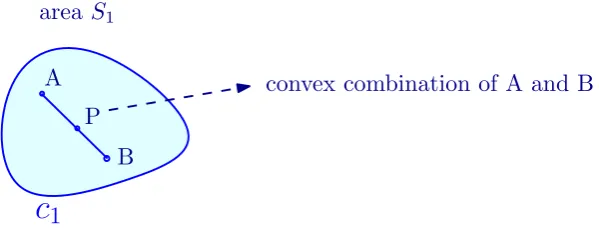
If we take any two points in S1, says A and B, than any convex
com-bination of A and B will produce point a P which is also inS1 (Fig.8).
area S1
c
1A
B P
convex combination of A and B
Figure 8: Convex combination of any two points in S1is also in S1
With similar reasoning, we also know that area S2 (which is a
poly-tope) is also a convex area.
Now we consider area S3. S3 is not a convex area, since we can select
point A and B as shown in Fig.9, and some convex combinations of A and B do not lie in S3. Therefore S3 is not a convex area.
area
S
3c
3A
B P
some convex combination of A and B do not lie in S3
Figure 9: Ilustration of area S3.
From this illustration, we now can state a convex area as
An area S is called convex, if for any convex combination of two points in S is also in S.
Mathematically: S is convex if A ∈ S and B ∈ S then point P which is P = a1A+a2B for a1 +a2 = 1 and a1 ≥ 0 and a2 ≥ 0 is
also ∈ S.
5 Convex function
In convex optimization, we often encounter the terminology of convex function. Consider two functions f(x) and g(x) as shown in Fig.10.
First, let us discuss the plot of f(x) as shown in Fig. 10.
Let xA and xB any two distinct points in x-axis. The values of
function at these points are f(xA) and f(xB) respectively.
x y
x y
(A) (B)
y= f(x) y =g(x)
Figure 10: Two function of different nature f(x) and g(x)
x y
(A)
xA xB
f(xA)
f(xB)
xP f(xP)
a1f(xA) +a2f(xB)
M
Figure 11: Functionf(x) in detail.
a1xA+a2xB, for any non-negative a1 and a2 and a1+a2 = 1. In other
word
f(xP) =f(a1xA +a2xB) (9)
The value of f() at xP is f(xA) as shown in the Fig.11.
Now we do a similar convex combination on f(xA) and f(xb) using a1
and a2 that we have used for xA and xB to produce xP. That is
M = a1f(xA) + a2f(xB) (10)
Now from Fig.11, it is very clear that M ≥f(xP). In other word,
a1f(xA) +a2f(xA) ≥ f(a1xA+ a2xB) (11)
Eq. 11 just simply want to say that M ≥ f(xP).
If for any xA and xB and a1 ≥ 0 and a2 ≥ 0 and a1 + a2 = 1 and the
Equation 11 holds, then the function f(x) is said to be convex. We can summarize this result into following note:
A function f(x) is said to be convex if
a1f(xA) +a2f(xB) ≥f(a1xA +a2xB)
for any xA and xB (xA 6= xB) and for any a1 ≥ 0 and a2 ≥ 0 and
a1 +a2 = 1.
The reader can easily understand the physical interpretation on convex function as shown in Fig.10.
Now, it is Reader’s task to prove that function g(x) as shown in Fig.11.(B) is not a convex function.
6 Cite this document
If you find this document useful, please cite it as :
Usman, Koredianto, 2017, Basic Terminologies in Convex Optimization, Telkom University, Online, available :