Reduction of Cadmium Uptake of Rice Plants Using Soil Amendments in
High Cadmium Contaminated Soil: A Pot Experiment
Dian Siswanto1, Parinda Suksabye2, Paitip Thiravetyan3*
1
Biology Department, Faculty of Mathematics and Natural Sciences, Brawijaya University, Indonesia
2
Department of Environmental Science, Faculty of Science and Technology, Suan Dusit Rajabhat University, Thailand
3
Division of Biotechnology, School of Bioresources and Technology, King Mongkut’s University of Technology
Thonburi, Thailand
ABSTRACT
The aims of this study were to investigate the effect of agricultural residues on reducing cadmium uptake in rice plants. The rice plants growing on no cadmium/free cadmium soils (N), Cd soils (Cds), and Cd soils each amended with 1% w/w of coir pith (CP), coir pith modified with sodium hydroxide (CPm) and corncob (CC) under high cadmium contaminated soil with an average 145 mg Cd kg-1 soil
were investigated. The results showed that the cumulative transpiration of rice grown in various
treatments under high cadmium contaminated soil followed the order: Cds > CPm ≥ CP ≥ CC. These
transpirations directly influenced cadmium accumulation in shoots and husks of rice pla nts. The CC and CP seemed to work to reduce the cadmium uptake by rice plants indicated by accumulated cadmium in the husk that were 2.47 and 7.38 mg Cd kg-1 dry weight, respectively. Overall, transpiration
tended to drive cadmium accumulation in plants for rice grown in high cadmium contaminated soil. The more that plants uptake cadmium, the lower cadmium that remains in the soil.
Keywords: transpiration, cadmium uptake, rice plant, agricultural residues
INTRODUCTION
The study concerned in the rice-based agricul-tural system on Mae Sot District, Thailand re-ported that the area contained natural Zn-Cd silicate ore which caused the total cadmium in soil to have wide ranges from 0.5 to 284 mg Cd kg-1 soil with most of them higher than
European Economic Community (EEC) maxi-mum permissible level for cadmium soil concen-tration of 3.0 mg Cd kg-1 soil. Most of the
cad-mium concentrations of grain yielded from rice farming ranged from 0.05 to 7.7 mg Cd kg-1 dry
weight which is higher thanthe Thai standardof 0.15 mg Cd kg-1dry weight. As a consequence,
theestimation values of weekly in-take (WI) of cadmium from people living around the area ra-nged from 20-80 µg Cd kg-1 body weights [1].
Rice is a staple food that is rich in cadmium with the potential to cause negative health effects such as diarrhea, stomach pains, and severe
*
Corresponding Address: Paitip Thiravetyan
Division of Biotechnology, School of Bioresources and
Technology, King Mongkut’s University of Technology
Thonburi, Thailand
E-mail: [email protected]
vomiting, bone fractures, reproductive failure and possibly even infertility, damage to the cen-tral nervous system, damage to the immune sys-tem, psychological disorders, DNA damage or cancer development [2]. Cadmium not only causes chronic and acute effects to humans and animals as plant consumers but also disturbs plants themselves. A summary from many re-searchers and authors [3] stated that cadmium induced the inhibition of root Fe (III) reductase which led to Fe (II) deficiency and, finally, it seriously affected photosynthesis and/or caused chlorosis. Cadmium toxicity could also affect the plasmamembrane permeability which causes reduction in water content.
chemical precipitation, membrane filtration, re-verse osmosis, ion exchange, and adsorption can be done but most of them are inefficient and expensive. On the other hand, one of the mo-dern techniques that can be adapted to solve this problem is the aided phytostabilization technique [4, 5].
The aided phytostabilization technique em-phasizes to immobilize or fix metals in soil which uses plant root absorption as the secondary role metal mobility by rhizosphere-induced absorp-tion, and precipitation processes [4, 5, 6]. Bio-mass raw materials used as amendments in this technique can be from agricultural residues which are abundant such as coir pith and corn-cob. Moreover, the enhanced adsorption capacity of the amend-ments was also studied focusing on biomass modification [7, 8, 9].
Investigation and development of agricultural residues to adsorb metal ions or other conta-minants in aqueous solutions have been done by many researchers [10, 11, 12, 13, 14, 15] but a few studies have been conducted on the appli-cation of adsorbent on the plant-soil system. The aims of this study were to investigate whether a variety of agricultural residues as soil amend-ments reduced Cd uptake of rice plants in high cadmium contaminated soil.
MATERIALS AND METHODS
Preparation of agricultural residues for soil amendment
There were three kinds of agricultural resi-dues which have been used as soil amendments involving coir pith (CP), corn corb (CC), and coir pith modification (CPm). CP and CC have been available as remediation laboratory proper-ties where the initial sources came from compa-nies from Prachuapkhirikan and Bangkok provinces; however, CPm was prepared in this study. CPm was made from CP modified with 0.1 NaOH as follows: 300 g of CP was mixed with 3000 mL of 0.1 M NaOH for 2 hours. After treatment with 0.1 M NaOH, the excess NaOH from treated coir pith was washed with tap water until the pH was constant (7.75) [8].
Culturing rice plants
The rice variety that was used was known as 75 days rice. This variety is usually harvested
af-ter 65-75 days in the field. Scientific information of the rice is not provided because this variety seems to be under a development project. Rice seeds were soaked with tap water for 1 day and spread on normal soil. After 40 days of seeding, rice plants were transferred to pots.
Effect of agricultural residues on plant transpiration growth under high cadmium contaminated soil
The relationship between cumulative transpi-ration and plant cadmium uptake on soil amend-ment treatamend-ments were investigated. 40 day rice plants were used as the test plants. After prepa-ration of the media which contained 700 g of solid materials mixed with 350 mL tap water, 2 rice plants were cultured in the media. After one day of incubation, 200 mL water was added into the experimental pots.
The combination of treatments for solid media were as follows: no cadmium/free cadmi-um soil (N) as the control, cadmicadmi-um soil (Cds), Cds with CP 1% (w/w), Cds with CPm 1% (w/w) and Cds with CC 1% (w/w). The serial pot was made into three replicates for 50 days of observation. Pot media without plants were also provided as blanks which were made into three replicates. Transpiration was measured as water was lost from the plants every three to five days by weighing the blank and treated pots. This was done by following the modified gravimetric me-thod [16], but the values were converted into milliliter units by multiplying by the water speci-fic density.
Determination of cadmium distribution in plants
then furthermore analyzed by Inductive Coupled Plasma Spectroscopy (ICP). The concentration was reported in mg kg-1 of the dry weight.
Determination of remaining cadmium in soil
Soil samples were dried at 60 °C for 48 hours and then ground. Samples were digested with 65 % of HNO3 and 95-97 % of H2SO4 and then
300,240
Cds Cds+CC Cds+CPm Cds+CP N
C using the SPSS Program for Windows.
RESULTS AND DISCUSSION
Effect of agricultural residue additions in high cadmium contaminated soil on transpi-ration, dry weight and cadmium (cd) uptake in rice plants
To confirm the ability of CC, CPm and CP to reduce cadmium uptake in rice plants, the effect of these agricultural residues was investigated in rice grown under high cadmium concentrations. The initial cadmium concentration in contamina-ted soil was in the range of 96.26 to 215 mg Cd kg-1 soil with an average of 145.01 mg Cd kg-1
soil. The addition of agricultural residues affects the transpiration of rice grown under high cad-mium concentrations; therefore, the treated rice transpired water in different levels which were in
the following order: CPm ≥ CP ≥ CC (Figure 1).
They were similar to rice transpiration grown under low cadmium concentratiosn which were in the following order: CPm > CP > CC (data not shown).
Previous research reported that the low cadmium concentration of soil that is equivalent to a range of 0.11 to 0.56 ppm can retard root growth without toxic effects in leaves resulting in increased transpiration [17]. Transpiration of rice grown in normal soil indicated that the plant metabolism reached the optimal level because
there were no stress conditions. Therefore, the transpiration value was the highest (Figure 1 and 2). Contrarily, rice grown in Cds was assumed in metal stress conditions. High transpiration values probably indicated the defense mechanism of plants from high cadmium accumulation in its organs by such kinds of continuous dilutions; therefore, plants could minimize the toxic effects of cadmium. However, the detailed mechanism to explain the increase of transpiration affected by higher cadmium accumulation is still unclear.
The cumulative transpiration of rice grown in various treatments under high cadmium contami-nated soil was in the following order: Cds >
CPm ≥ CP ≥ CC (Figure 2). These transpiration
values affected cadmium accumulations in the shoots which were in the following order: Cds >
CPm ≥ CP ≥ CC and cadmium accumulations in the husk which were in the following order: Cds = CPm > CP > CC (Table 1 and Figure 3). By enced by the end product compounds of agricul-tural residue degradation by soil microbial acti-vity. It was assumed that the end products of de-gradation contained high and low molecular the presence of humic acid (HA), as an example of a high molecular weight compound, decreased the
Figure 1. Cumulative transpiration of rice plants (P) grown in no cadmium/free cadmium soil (N) and high cadmium contaminated soil (Cds) in 45 days (a) and under various treatments: (CC: corncob, CPm: modified coir pith and CP: coir pith) (b). Note: Values followed by the same notation indicate that there is no significant difference (α = 0.05)
N Cds Cds+CPm Cds+CC Cds+CP
Table 1. Cumulative transpiration, dry weight and cadmium concentration of rice plants grown in high cadmium contaminated soils (Cds) under various treatments
Treatments
Rice cadmium concentration at 50th day (mgCd/kgDW)
Root Shoot Husk
Cds 300.24±17.31 c 0.991±0.233 a 594.324±40.597 b 73.878±21.10 d 13.55±1.66 c
Cds+CC 154.45±12.52 a 0.626±0.131 a 139.651±37.315 a 11.071±3.70 ab 2.47±0.82 a
Cds+CPm 232.74±38.08 b 0.747±0.112 a 919.328±226.922 bc 40.47±3.96 c 15.63±3.10 c
Cds+CP 177.53±0.18 ab 0.780±0.145 a 1188.996±246.429 c 37.16±10.11 bc 7.38±0.77 b
Figure 3. Cadmium concentration of the rice plants grown in high cadmium contaminated soil (Cds) under various treatments: (CC: corncob, CPm: modified coir pith and CP: coir pith). Values followed by the same notation above the bar indicate that there is no significant difference (α = 0.05). Root (a), shoot (b), and husk (c).
Figure 4. Regression between transpiration and plant cad-mium and between transpiration and plant dry Regression between transpiration (mL) and root Cd (mg Cd. Kg-1 DW) Linear (Regression between transpiration (mL) and root Cd (mg Cd. Kg-1 DW))
y = 0.340x - 33.005
Regression between transpiration (mL) and shoot Cd (mg Cd. Kg-1 DW)
Linear (Regression between transpiration (mL) and shoot Cd (mg Cd. Kg-1 DW))
Regression between transpiration (mL) and husk Cd (mg Cd. Kg-1 DW)
Linear (Regression between transpiration (mL) and husk Cd (mg Cd. Kg-1 DW))
uptake of Cd in the root on the base of total Cd concentration and free Cd ion activity. Two rea-sons may explain the decrease in the uptake of Cd. First, the reduced availability of cadmium may be due to complexation with HA, where insoluble precipitates are furthermore formed.
Second, the HA was adsorbed on the root surface and decreased the uptake sites for inter-nalization of Cd, and thus decreased the uptake of Cd. Contrarily, [18] it was also argued that ci-tric acid (CA), the small organic ligand as an citrate decreased Cd transferring to the cytosol. Third, the increased pH decreased the compe-tition of H+ with Cd2+ for the uptake sites on the
surface root and enhanced the uptake of Cd. The relationship between transpiration and accumulation of cadmium in the plant organs showed that transpiration mainly increased plant cadmium concentration in shoots and husks with the Pearson correlations 0.824 and 0.778, respectively (Figure 4 and Table 2).
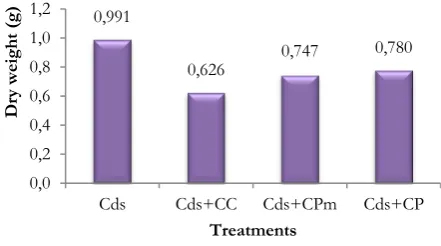
Based on the dry weight measurement of rice grown under various treatments, it is assumed that the rice variety used in this experiment, namely 75 days rice, is a resistant variety of cad-mium contamination. There was no significant difference among the dry weights of rice grown in all treatments.
Figure 5. Total dry weight of 50th day rice plants grown in high cadmium contaminated soil (Cds) under various treatments: (CC: corncob, CPm: modified coir pith and CP: coir pith). Values followed by the same notation above the bar indicate that there is no significant difference (α = 0.05)
Plant resistance might come from many de-fense mechanisms in plants. Besides producing phytochelation that restricts cadmium just in the
roots and inhibiting its movement to the shoots, plants also produce exudates as a defense mecha-nism to prevent cadmium from entering into the plant roots. Root secretion includes organic ligands and inorganic ligands (e.g., Cl–, SO42–,
NH4+, CO32–, PO43–, etc.). These substances
function not only as the energy source of micro-organisms, but also as ligands to be chelated with heavy metal ions and then influence the pH and Eh conditions as well as chemical characteristics in the rhizosphere [19].
Table 2. Correlation between transpiration with plant cadmium and plant dry weight of rice grown in high cadmium contaminated soil
Transpiration transpiration of rice grown in various treatments under high cadmium contaminated soil was in the following order: Cds > CPm ≥ CP ≥ CC. These transpiration values directly influenced cadmium accumulation in shoots and husks of rice plants. The CC and CP seemed to work to reduce the cadmium uptake by rice plants indi-cated by accumulated cadmium in the husk that were 2.47 and 7.38 mg Cd kg-1 dry weight,
res-pectively. Overall, transpiration tended to drive cadmium accumulation in plants for rice grown in high cadmium contaminated soil. It was shown that the higher the plant uptake of cadmium, the lower remaining cadmium that was found in the soil.
REFERENCES
1. Simmons RW, Pongsakul P, Saiyasitpanich D,
Klinphoklap S (2005) Elevated levels of cadmium and zinc in paddy soils and elevated levels of cadmium in rice grain downstream of a zinc mineralized area in Thailand: Implication for public health. Environmental Geochemistry and Health 27: 501-511.
2. Kumbar SK (2011) Cadmium poisoning,
http://eco.neterect.co.in/. Accessed date:
3. Benadives MP, Galleo SM, Tomaro ML(2005) Cadmium toxicity in plants. Brazilian Journal Plant Physiology 17(1): 21-34.
4. Alvarenga P, Goncalves AP, Fernandes RM, de
Varennes A, Vallini G, Duarte E (2009) Organic residues as immobilizing agents in aided phyto-stabilization: (I) Effect on soil chemical charac-teristics. Chemosphere 74: 1292-1300.
5. Volesky B (2001) Detoxification of metal-bearing
effluent: Biosorption for the next century. Hydrometallurgy 59: 203-216.
6. Prasad MNV, Freitas HMDO (2003) Metal
hyperaccumulation in plants–Biodiversity pros-pecting for phytoremediation technology. Elec-tronic Journal of Biotechnology 6 (3): 285-321.
7. Abbas A, Munir M, Aslam F, Naheed S, Zafar, A
(2010) Removal of chromium (IV) by biosorption using different agricultural byproducts of some important cereal cropsas biosobents. Middle-East of Journal of Scientific Research6 (5): 512-516.
8. Ewecharoen A, Thiravetyan P, Nakbanpote W
(2008) Comparison of nickel adsorption from electroplating rinse water by coir pith and modi-fied coir pith. Chemical Engineering Journal137: 181-188.
9. Sha L, Xue-yi G, Ning-chuan F, Qing-hua T
(2010) Effective removal of heavy metals from aqueous solutions by orange peel xanthate. Trans. Nonferrous Met. Soc. China 20: 187-191.
10. Suksabye P, Worasith N, Thiravetyan P,
Nakajima A, Goodman BA (2010) A reinvesti-gation of EXAFS and EPR spectroscopic mea-surements of chromium (VI) reduction by coir pith. Journal of Hazardous Materials180: 759-763.
11. Suksabye P, Nakajima A, Thiravetyan P, Baba Y,
Nakbanpote W (2009) Mechanism of Cr (VI) adsorption by coir pith studied by ESR and adsorption kinetik. Journal of Hazardous Materials 161: 1103-1108.
12. Suksabye P, Thiravetyan P, Nakbanpote W
(2008) Column study of chromium (VI) adsorp-tion from electroplating industry by coconut coir pith. Journal of Hazardous Materials160: 56-62.
13. Suksabye P, Thiravetyan P, Nakbanpote W,
Chayabutra S (2007) Chromium removal from electroplating wastewater by choir pith. Journal of Hazardous Materials 141: 637-644.
14. Aworn A, Thiravetyan P, Nakbanpote W(2009)
Preparation of CO2 activated carbon from
corn-cob for monoethylene glycol adsorption. Colloid and Surfaces A: Physicochemical and Enginee-ring Aspects 333: 19-25.
15. Twardowska I, Kyziol J (2003) Sorption of
metals onto natural organic matter as a function of complexation and adsorbent-adsorbate contact mode. Environment International 28: 783-791.
16. Ventakaraman S (1959) Evapo-transpiration as a
agronomic factor. Unesco/NS/AZ/460, Madrid Symposium Paper No.24, August 24: 1-8.
17. Prasad MNV (1995) Cadmium toxicity and
tole-rance in vascular plants. Environmental and Experimental Botany 35 (4): 525-545.
18. Li D, Zhou D (2012) Toxicity and subcellular
distribution of cadmium in wheat as affected by dissolved organic acids. Journal of Environ-mental Sciences 24 (5): 903-911.
19. Dong J, Mao WH, Zhang GP, Wu FB, Cai
Y(2007) Root excretion and plant tolerance to
cadmium toxicity – A review. Plant Soil