Event Strategy:
Planning
Function
The planning function
What is planning?
the planning process consists of
What is planning?
In other words, the planning process is concerned with end results and the
Elements of the strategic event planning process
Concept or content to bid
1. duration
2. location/venue, 3. Timing
4. key program elements that will serve to
Conti’d
Feasibility study:
1. budget requirements 2. managerial skill needs 3. venue capacities
4. host community and destination area impacts
5. availability of volunteers, sponsors and supporting services (for example,
Conti’d
projected visitation/ attendance
infrastructure requirements
availability of public/private sector
fnancial supporto
level of political support for the evento
the track record of the event in terms of
Conti’d
Bid preparation process:
1. identifying resources that can be employed
to support the event (for example, venues and government grants
2. developing a critical path for the preparation
and presentation of a bid document to the ‘owners’ of the event
3. developing an understanding of the
Conti’d
4. identifying the key elements of past
successful bids preparing a bid document 5. presenting and/or submitting a bid to the ‘owners’ of the event, such as a
sporting body
Establishment of
organizational structure
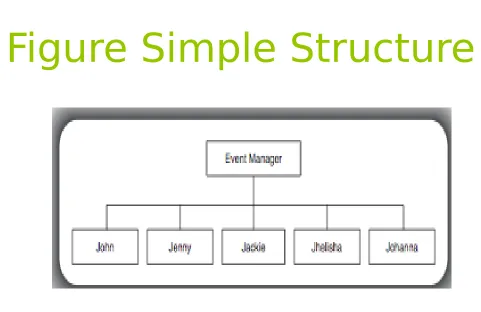
Simple structure
a simple structure has a low level of complexity.
Event manager has control over all staf activities.
Advantages:
Common in small event management businesses
as it is fexible, adaptable to changing
Conti’d
The fexibility of this structure
Conti’d
Disadvantages:
staf do not have the opportunity to
specialize, they may not achieve a high level of expertise in any one area.
once an event organization grows beyond a certain size, decision making can become very slow – or even non-existent – as a
Conti’d
if the manager has an autocratic style of
management, staf can become
demoralized when their expertise is not fully utilized. There is also an inherent risk in concentrating all event
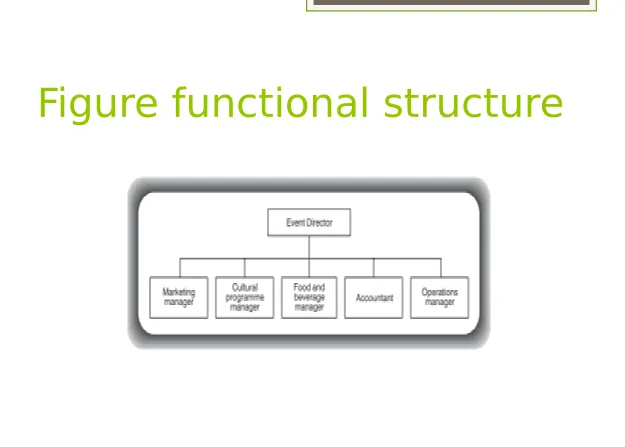
Functional structures
a functional structure departmentalizes
(that is, groups related tasks) in a way that encourages the specialization of labor (paid/voluntary).
Benefts: individuals or groups (such as
committees) can be given specifc task areas, thus avoiding any overlap of
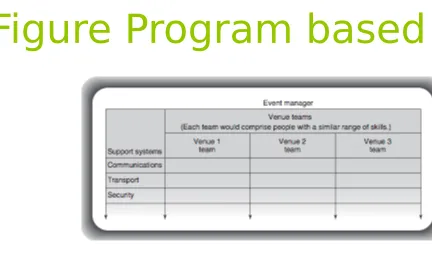
Program-based matrix
structures
Organizers of a multi-venue sporting
event, for example, may choose to have separate committees with responsibility for all tasks associated with event
delivery at each location.
each committee/group leader would be
Conti’d
several inherent advantages:
allowing groups/individuals to engage directly with the task (producing and delivering an event) and facilitating intergroup communication and
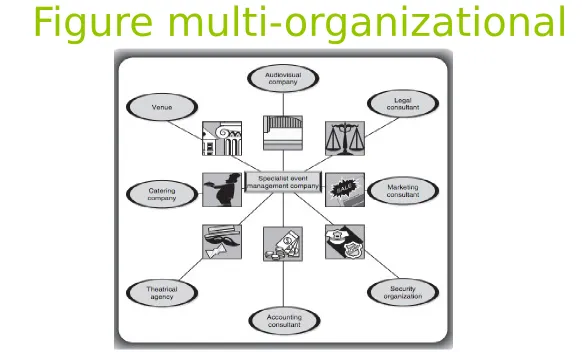
Multi-organizational or network
structures
Event management companies create “virtual
organizations” to conduct large and complex events, while they are relatively small in size (fewer than 20 people).
Advantages:
there is no ‘down time’ because of contracting specialist
businesses with current expertise and experience on need-only basis.
Budgeting can also be more exact because most costs are
contracted and, therefore, known beforehand. This
Disadvantages:
These include issues associated with
quality control and reliability of the contractors who are involved in
performing tasks, and coordinating employees (from various other
Developing a strategic plan
Purpose, vision and mission statements
purpose is required to provide sufcient direction
and focus.
An example of a purpose statement is one
developed for Brain Awareness Week, an annual international event coordinated by Dana Alliance (USA) and the European Dana Alliance for the Brain (2005), a non-proft organization that seeks to
Conti’d
Brain Awareness Week is a worldwide celebration of the brain that grows more successful every year. It is an
opportunity to let people know what is being done to diagnose, treat and
prevent disorders of the brain, such as Alzheimer’s, Parkinson’s, stroke,
Cont’d
Vision statements usually describe what the event seeks to become and to achieve in the longer term (Thompson with Martin, 2005). They are also often brief, precise and motivational in nature. The
Windsor Festival (2005), for example, states, ‘...we ofer a unique experience, which entertains and
enhances the community, linking social, educational and commercial interests. . . Building on these
Conti’d
. The Windsor Festival (2005), for example,
states, ‘...we ofer a unique experience, which entertains and enhances the
community, linking social, educational and commercial interests. . . Building on these foundations, we will increase the breadth and variety of the program, increase
Conti’d
a combination of both vision and mission. The
Liverpool Women’s International Music Festival (WIMFEST, 2004) state their mission:
‘ to be a festival that will celebrate diversity,
tolerance, tradition, history and story telling; by women, through music and song. It will involve schools, young people, local communities,
professional and amateur performers. The festival will encourage both individual and collective
endeavor, empowering and enabling women to
Objectives
The establishment of objectives are summed up by the
acronym SMART, which refers to the fact that objectives should be:
. specifc: focused on achieving an event goal (or, if no
goals have been developed, its purpose)
. measurable: expressed in a way that is quantifable . agreeable: agreed on by those responsible for
achieving them
. realistic: in terms of the event organization having the
human, fnancial and physical
resources to achieve them
Examples of objectives
Economic objective
– Percentage return on money invested or overall gross/net proft sought – Financial value of sponsorship attracted
– Percentage of income to be raised from fundraising activities
– Percentage increase in market share (if the event is competing directly with
other
similar events)
Attendance/participation
– Total attendance/attendance by specifc groups (for example, people from
outside the area, specifc age groups, professions)
– Size of event in terms of stallholders/exhibitors/performers/attendees – Number of local versus outside artists
Conti’d
Quality
– Percentage level of attendee/exhibitor/sponsor/volunteer
satisfaction
– Number of participants/speakers/performers of international reputation – Number of complaints from
attendees/exhibitors/volunteers
Awareness/knowledge/attitudes
– Percentage of attendees or others exposed to the event that have
changed levels of awareness/knowledge as a result of the event
– Percentage of attendees or others exposed to the event who have
altered their attitudes as a result of it
Human resources
– Percentage of staf/volunteer turnover
SWOT analysis
This process may involve referring to a
SWOT analysis
The external environment is usually
assessed frst, and consists of many factors. The main factors include:
Political/legal
Economic
Conti’d
Technological
Demographic
Physical/environment
Strategy option
Growth strategy: Growth can be expressed as more revenue, more
event components, more participants or consumers, or a bigger share of the event market.
Conti’d
Consolidation/ stability strategy:
maintaining attendance at a given level. Strong
demand for tickets to T In The Park, for example,
has allowed the event to sell tickets well in advance, cap attendance numbers and further enhance the quality of its program. By capping ticket sales in a climate of high demand, this event has also created a situation in which it has greater pricing freedom.
Strategy option
Retrenchment strategy:
reduce the scale of an event but add value to its existing components.
Conti’d
Combination strategy:
includes elements from more than one
of these generic strategies. An event manager could, for example, decide to cut back or even delete some aspects of an event that no longer appeal to their event target market(s), while
Strategy evaluation and
selection
3 Main Criteria:
Appropriateness/suitability – strategies and their component
parts should be consistent. That is, strategies selected should complement each other and be consistent with the environment, resources and values of the event organization.
Feasibility – the proposed strategy should be feasible. It should
work in practice, considering the resources available (for
example, fnance, human resource, time). The strategy should also meet key success factors (for example, quality, price, level of service).
Acceptability/desirability – strategies should be capable of
Conti’d
important and disregard the
unimportant. Event companies should, however, be careful not to overlook
Operational Plans
Operational plans will be needed for all areas central to the achievement of an event’s
objectives and the implementation of its strategy.
Areas for operational planning such as
budgeting, marketing, administration, staging, research and evaluation, risk management,
sponsorship, environmental waste management, programming, transportation, merchandising
Operational Plans
Each area that develops operational plans
will require a set of objectives that
progress the overall event strategyo action plans and scheduleso details of individuals responsible for carrying out the various
aspects of the plano monitoring and control systems, including a budgeto and an
Control systems
Once operational plans are implemented, mechanisms are required to ensure that actions conform to plans.
Meetings and reports are generally central to the control process, as are
budgets. Budgets allow actual costs and expenditure to be compared with those projected for the various operational