Correlation of Muscle Fiber and Perimysium Thickness …
121
Research Article
THE CORRELATION OF MUSCLE FIBER AND
PERIMYSIUM
THICKNESS TO THE QUALITY
OF TURKEY BREAST MEAT
Afrida Fatkhiatul Musfiroh, Sabine Janisch, V. Priyo
Bintoro, Michael Wicke, Yoyok Budi Pramono,
ABSTRACT:
Turkey meat is one kind of poultry meat which gives contribute for consumer meat demand. Germany
as a second exporter of turkey meat has always improving the quality of turkey meat. One of the important
attribute which play main role in meat quality is tenderness. The objectives of the research were to measure of
muscle fiber and
perimysium
of two male turkeys in particular amount then makes comparison of the
measurement between them. Tracing identifying factors which have strong influence to the tenderness of turkey
meat also was done. The data also supported by the values from pH, EC, color, drip loss, grill loss, and shear force.
Hybrid XL and Big 6 as two lines of genetically turkeys was used in this study. They lines have different weight in
part of carcass where Hybrid XL is bigger than Big 6. Concerning to the diameter of muscle fiber, Hybrid XL has
smaller diameter than Big 6. The type of muscle fiber in turkey meat is II B. The analysis of the data was used
software Statistic 10.0 ed. The results showed that pH value gives influences to the meat colour. L* would be
increasing when pH value was decreasing and meat color turning pale. L* determined by amount of myoglobin
inside of meat. The other factors were influenced each other concerning the tenderness of turkey meat. Big 6
breast meat has better tenderness quality and Hybrid XL meat was more profitable because they have heavier
part of carcass. Diameter of muscle fiber has strongest factors than others.
Key words: turkey, tenderness, pH, muscle fiber, perimysium
.
INTRODUCTION
The demand of turkey meat consumption has increasing every year. There are several considerations from consumer to make decision to consume. Germany is the second biggest consumer of turkey meat after France (AVEC, 2010; Jones and Berk, 2012). On the other hand, demand of turkey meats in Indonesia is just needed by specific consumer only such us hotel or catering. The demand of turkey is vary from 50 to 500 head per month in big town, such as Jakarta, Surabaya, Medan, etc.
Qualities of meat are based on slaughtering way, pH value (Werner et al., 2008); electrical conductivity (EC), colour, grill loss, and shear force (Werner et al., 2009). These are two side to measure quality of meat; the first is a quality attributes (QA) to indicate the quality of meat which justify by consumer; and the second is a quality characteristics (QC) to indicate quality which need scientifically measure (Ledward, 2002). For example consumers can measure
colour with their eyes, but for the other cannot do by sensory perception such as EC, grill loss, and shear force.
Concerning the taste and palatability of meat, tenderness is an important consideration and should do special measurement because it belongs to non-‐visual
factor. Tenderness is unpredictable but important to determine palatability and acceptance of consumers regarded to healthiness for their body. It has relation with type of fat and fatty component inside (Thu, 2006). Muscle fiber types are dividing into 3 types in general. They are type I, IIA, IIB or IIC. Duck breast contained 73.3% type IIB and 26.7% type IIA, breast of chicken contained 100% type IIB. Sheep also has high number of muscle fiber type II B (Scanes 2003; Thu, 2006). Muscle fiber types of pig are type I, IIA, and IIB (Klont et al., 1998) also for broiler and turkey.
Tenderness influences by genetic, number and size of muscle fiber, thickness of perimysium, and thickness of
endomysium (An et al., 2010). Number and size of muscle
fiber depend on the growth, even turkey fast growing will have more muscle and bigger than growth slowly. They are happened in perimysium and endomysium connective tissues as well (Dransfield and Sonsnicki, 1999). Therefore, meat of young turkey is tenderer than meat of old turkey.
The objectives of the research were to measure of muscle fiber and perimysium of two male turkeys in particular amount then makes comparison of the measurement between them. Tracing identifying factors which have strong influence to the tenderness of turkey meat also was done.
MATERIALS AND METHODS Animal and slaughtering
The poultry animal were used in this research consist of two turkey lines, Big 6 (British United Turkey Ltd., Tattenhall, United Kingdom) and Hybrid XL (Hendrix Genetics, Ontario, Kanada). Numbers of sample were 25 turkeys for each line with age 22 weeks. The fattening of the Submitted 04/07/2013, accepted 08/12/2013. Author Afrida Fatkhiatul
Musfiroh from Department of Animal Science, Faculty of Animal and Agricultural Sciences, Diponegoro University, Semarang, Indonesia. Authors V. Priyo Bintoro and Yoyok Budi Pramono from Department of Food Technology, Faculty of Animal and Agricultural Sciences, Diponegoro University, Semarang, Indonesia. Authors Sabine Janisch and Michael Wicke Department of Animal Science, George August Goettingen University
Correlation of Muscle Fiber and Perimysium Thickness …
animals was in accordance with standardized conditions in a commercial slaughterhouse. For slaughtering, the animals were transferred to a commercial slaughterhouse. First, the stunning with 160 mA for 24 s and the slaughter was initialised by mechanical cutting of the A. carotis communis. The birds were scalded with 58–60°C for 4.5 minutes, than the birds were defeathered and automatically eviscerated followed by the veterinary inspection. The carcasses were removed from the slaughter chain and weighed, before cooling. Furthermore, breast muscle (M. pectoralis
superficialis (MPS)) and leg muscles (M. gastrocnemius
(MG)) were carefully excised from the carcasses by an experienced person and weighed after removal of the skin. During the investigations the samples were individually packed in plastic bags and stored less than 4°C.
Methods
The samples have been measured after 20 minutes and 24 hours post mortem (p.m.). The parameter for measurement were pH value, electrical conductivity (EC), colour, drip loss, grill loss and shear force.
pH Measurement
The pH was measured for 20 minutes and 24 hours post mortem with a portable pH meter (pH-‐star, Matthäus GmbH, Poettmes, Germany) and combined with a glass electrode (InLab 427, Mettler-‐Toledo, Urdorf, Switzerland). The pH meter was calibrated before using to measure the samples. pH meter was calibrated prior to experiment and adjusted for the temperature of meat samples (MPS and
MG) (4°C). Measurement of pH was inserted in the centre of the left breast muscle until the value stable.
EC Measurement
The EC was measured for 20 minutes and 24 hours after slaughtering used EC meter equipped with two parallel stainless steel electrodes (LF-‐Star, Matthäus GmbH) which are calibrated before. EC determination was inserted the electrode in the centre of the MG and MPS.
Color Measurement
Color of turkey meat was expressed by lightness (L*) and redness (a*). The values were measured by colorimeter (Minolta CR 400, Minolta GmbH, Langenhagen, Germany) on the bone side, inside of MPS, inside of MG, and surface of
MG. Before the samples are measuring, the tools calibrated using the specific white board (Minolta CR 400, Minolta GmbH). The surface was exposed to the air for 15 minutes at room temperature before the color of the muscle was measured, each value was an average at least six measurements.
Drip Loss
The drip loss was calculated as the loss of weight and expressed in a percentage , the muscle was stored at 4°C in an individual plastic container between the measurements. The breast muscle was weighed and wrapped in aluminium foil and grilled on a plate contact grill (Neumärker GmbH, Hemer, Germany) until the core temperature reached 73°C.
The core temperature was controlled by inserting the electrode of a digital thermometer (Testo AG, Lendzkirch, Germany) into the centre of the meat sample for the duration of the grilling process. After that, the sample was cooled to room temperature, and reweighed.
Grill Loss and Shear Force
The grill loss was calculated as the loss as weight during the heating process and was expressed as a percentage. Cores with diameter of 1.27 cm were removed from the sample at different positions parallel into fiber orientation. Determination of shear force were conducted on an Instron universal testing machine (model 4301, Instron, High Wyoombe, UK) equipped with a Warner-‐ Bratzler shear force head vertical to the fiber direction. The shear velocity was 200 mm/min. Each value was an average of at least 5 measurements.
Histology
Muscles sample for histological analysis was collected from left breast with a block shape (1 x 1 x 1 cm) and freeze the sample in liquid nitrogen until analysis. Furthermore, the sample as a material to make slides transferred into cryomicrotome (Cryocut CM 1900, Leica GmbH, Nussloch, Germany) which have to equilibrate to -‐20°C. Cutting the samples up to 3-‐4 slices with thickness of 12 µm and allowed to stand for 1 hour before saved in freezer. The next step is colouring used ATPase methods which have 18 steps. The principal of this method is relay on the ability of the enzyme to remove terminal phosphate from ATP. Then, it combined with calcium in the incubation solution to form an insoluble calcium phosphate. Cobalt would be exchanged the calcium and reacted with ammonium sulphide. As a result the colour is black that show insoluble cobalt sulphide at the site of enzyme activity. The aim of ATPase reaction is to indicate differentiation of muscle fiber type.
Measurement of muscle fiber
The pictures of muscle fiber were obtain using a stereo microscope (Nikon GmbH, Düsseldorf, Germany) at a low magnification (10 x) in three pictures each sample. The measurement of muscle fiber used LUCIA software (Nikon GmbH) in personal computer. Total of muscle fibers that measured are 30 each picture, in total 90 muscle fiber each sample. Muscle fiber had been measuring with make a line as a shape of muscle. The values are area and diameter of muscle fiber. The measurement of 30 muscle fiber each picture have to in one part without separated each other. This aim is for getting an objective values, sample of muscle fiber shows in Figure 1 and Figure 2.
Measurement of perimysium
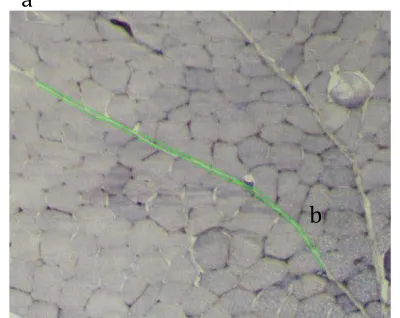
Picture of perimysium had been taken by a stereo microscope (Nikon GmbH, Düsseldorf, Germany) at a low magnification (10x). Total sample of perimysium was taken 10 samples each line. The measurement had been taking length and thickness of perimysium. Length of perimysium was measured as long as 12 cells from top and above
perimysium while the thickness was measured five part
Correlation of Muscle Fiber and Perimysium Thickness … influenced by haem concentration or oxidative status.
The coefficient among drip loss, grill loss, EC for 20 Table 2. Physiochemical Post Mortem Characteristics of Breast Turkey Meat
Correlation of Muscle Fiber and Perimysium Thickness …
of consumer; study of Saha et al. (2008) explained that tenderness is first judgement before they buy meat. More than 50% of panellists prefer meat with good tenderness, not too tough and not too tender as well.
L* value would increase when pH decreased (Sarica et al., 2011). Based on that statement, this study was show that pH value for 20 minutes p.m. (Table 2) values of Hybrid XL and Big 6 are synchronized with L* 20 minutes p.m value either inside or surface of breast. Colour of meat showed the level of tenderness, study of Abdullah and Matameh (2010) that lighter carcass of breast meat tenderer than heavier carcasses. The tenderness influenced by aging which is improves the tenderness of breast meat either male or female. L* and a* value are influenced by pH, pH value is decrease (Table 2) from the pH value for 20 minutes p.m. to
the pH value for 24 hours p.m. because there is conversion
glycogen to the lactic acid, it also depends on the muscular glycogen amount at slaughter (Lefaucheur and Gerrard, 2000). This situation happened in Hybrid XL and Big 6 as well, lower pH value causes the meat paler. When pH value is decrease, it will cause the drip loss increase. The effect is the grill loss decrease because of lost much water. Furthermore, shear force will increase and the tenderness of meat decrease.
Colour of meat is influenced by amount of myoglobin inside. Myoglobin is the main compound pigment that have amount for about 50-‐80%. If the meat has high myoglobin, they should be darker than the meat with less amount of myoglobin because they make intensity of colour increase. Compare with the others poultry as like duck (Schneller, 2010), pork or beef (Miller, 2002) turkey has less myoglobin. Therefore, poultry divide to migratory and non-‐migratory, this differences because of the total of myoglobin. It is important especially for beef; some of studies were trying to increase of myoglobin through feed of cattle. The redness of beef is important characteristics to increase of consumer acceptability (Lefaucheur and Gerrard, 2000).
Rapid growth both of lines in the same age showed in the Table 1, there is no significant differentiation between them and it has similar growth rapidity. On the other hand, Table 3 showed that diameter of muscle fiber of Big 6 significantly higher than Hybrid XL. This condition is different with the statement that if turkey has fast-‐growth, it will have larger diameter of muscle fibers (Remignon et al., 1993;
Dransfield and Sosnicki, 1999). Larger diameter fibers must have higher tenderness because of the effect of larger diameter is less perimysium inside of meat. However, this study is opposite with that statement. Hybrid XL muscle fiber is smaller diameter than Big 6 (Table 3) as of this result showed Big 6 more tender than Hybrid XL.
The measurement of muscle fiber on the several parameters which are influence of tenderness shows that Big 6 value bigger than Hybrid XL (Table 3). Because of Big 6 has bigger diameter, it would be more tender because they should have less perimysium number. Differentiation of muscle fiber characteristics maybe modified in the environmental and genetic selection during life (Klont et al., 1998). The size of muscle fiber diameter is influence by sex, age, and genetic. They are influence each others, variation of genetic regarding to the development of muscle depend on the sex and age as well. It a
lso happened in lamb meat, study of Wojtysiak et al. (2010) showed that sex has the effect to the diameter of fibers which male lamb meat has bigger muscle fiber diameter (type IIB and IIA) than female lamb meat, that means it would be influence the tenderness of lamb meat as well.
In this study shows that line has influence to the size of breast muscle fiber and no influence to the leg muscle fiber, this result opposite with Gosnak et al. (2010) which explained that line only influence on the diameter of leg muscle fiber. They found selective hypertrophy fibers in leg muscle. Higher growth of animal would be potential to deposit more skeletal muscle tissues because of hyperplasia and hypertrophy (Merly et al., 1998; Gosnak et al., 2010). Muscle fiber cross-‐sectional area increases by age, chickens with fast growing have larger diameter fibers than slow-‐ growing lines (Remignon et al., 1993; Dransfield and Sosnicki, 1999). Study of McCormick (1994) explained that change of texture meat due to age increase and become mature. It is regarding to the maturation of muscle collagen which is located in perimysium. Amount of muscle fibers in turkey meat is 99.8% fast twitch glycolytic (FTG, white fibers) (Wicke et al., 1993; Fiedler et al., 1999; Lengerken et al., 2002).
CONCLUSION
The results from this study showed differentiation performance, diameter of muscle fiber, and perimysium
Figure 1. Muscle fiber of Hybrid XL
Figure 2. Measurement of Perimysium (from a to b)
a
Correlation of Muscle Fiber and Perimysium Thickness …
between Hybrid XL and Big 6 of male turkey meat. Big 6 breast meat has better quality for the tenderness and physiochemical characteristics. On the other hand, from the part of carcass side, Hybrid XL meat was profitable because they have heavier part of carcass than Big 6 on the same age.
Tenderness and colour were the most important factors which influenced the demand of meat. When consumers see the meat, they would prefer fresh colour than paler. Concerning to the tenderness, in this study the strongest factors which influence were diameter of muscle fiber. Turkey meat which has smaller size of diameter would be tougher than big size of muscle fiber diameter.
ACKNOWLEDGEMENTS
The authors would like to say thanks to Beasiswa Unggulan (BU) of Education Ministry of National Education Indonesia for giving scholarship, Magister of Animal Science Diponegoro University and Sustainable International Agriculture George August University for their Master Degree cooperation.
REFERENCES
Abdullah, A. Y. and S. K. Matarneh. 2010. Broiler performance and the effects of carcass weight, broiler sex, and post chilling carcass aging duration on breast fillet quality characteristics. J. Applied Poultry Research. 19 (1): 46-‐58.
An, J. Y., J. X. Zheng, J. Y., Li, D. Zeng, L.J. Qu, G.Y. Xu and N. Yang. (2010). Effect of myofiber characteristics and thickness of perimysium and endomysium on meat tenderness of chickens. J. Poultry Science. 89 (8): 1750-‐ 1754.
Dransfield, E. 1994. Optimisation of tenderisation, aging and tenderness. J. Meat Science. 36: 105-‐121.
Dransfield, E. and A. A. Sosnicki. 1999. Relationship between muscle growth and poultry meat quality. J. Poultry Science. 78: 743-‐746.
Gosnak, R. D., I. Erzen, A. Holcman and D. Skorjanc. 2010. Effects of divergent selection for 8-‐week body weight on postnatal enzyme activity pattern of 3 fiber types in fast muscles of male broilers (Gallus gallus domesticus). J.
Poultry Science. 89: 2651-‐2659.
Jones, T. A. and J. Berk. 2012. Alternative Systems for Meat Chickens and Turkey: Production, Health, and Welfare (Alternative Systems for Poultry). CABI. London.
Klont, R. E., L. Brocks and G. Eikelenboom. 1998. Muscle fiber and meat quality. J. Meat Science. 49 (1): 219-‐229. Ledward, D. 2002. Consumer Perceptions of Quality (Meat
Processing Improving Quality). Woodhead Publishing Limited. England.
Lefaucheur, L and D. Gerrard. 2000. Muscle fiber plasticity in farm mammals. American Society of Animal Science. 1: 1-‐19.
Lengerken, G. von, S. Maak, and M. Wicke. 2002. Muscle metabolism and meat quality of pigs and poultry. J. Veterinarija ir zootechnika. 20 (42): 82-‐86.
Miller, R. K. 2002. Factor Affecting the Quality of Raw Meat (Meat Processing Improving Quality). Woodhead Publishing Limited. England.
Saha, A., A. V. S. Perumalla, Y. Lee, J. F. Meullenet, and C. M. Owens. 2008. Tenderness, moistness, and flavour of pre-‐ and postrigor marinated broiler breast fillets evaluated by consumer sensory panel. J. Poultry Science. 88: 1250-‐1256.
Schneller, T. 2010. Poultry identification, fabrication, utilization. The Gulinary Institute. America.
Thu, D., T., N. 2006. Meat quality : understanding of meat tenderness and influence of fat content on meat flavour. J. Science and Technology Development. 9 (12): 65-‐70.
Werner, C., J. Riegel and M. Wicke. 2008. Slaughter performance of four different turkey strains, with special focus on the muscle fiber structure and the meat quality of the breast muscle. J. Poultry science. 87 (9). 1849–1859.
Werner, C., S. Janisch, U. Kuembet, and M. Wicke. 2009. Comparative study of the quality of broiler and turkey meat. J. British Poultry Science. 50 (3): 318-‐24.
Wojtysiak, D., U. Kaczor, K. Poltowicz, and K. Krzysztoforski. 2010. The effects of sex and slaughter weight on muscle fiber characteristics and physico-‐chemical properties of lamb longissimus thoracis muscle. Animal Science Papers and Reports. 28 (1). 61–69.