Proceedings of 14th Asian Chemical Congress (14ACC)
PO-G5-37
Vanillin Structure Modification of Isolated Vanilla Fruit
(Vanilla Planifolia Andrews) to form Vanillinacetone
S. Handayani1, R. Arianingrum1 and W. Haryadi2
1 Department of Chemical Education, Faculty of Mathematics and Natural Sciences, Yogyakarta State
University, Karangmalang, Yogyakarta, Indonesia
2 Department of Chemistry, Faculty of Mathematics and Natural Sciences, Gadjah Mada University,
Bulaksumur,Yogyakarta, Indonesia E-mail address: [email protected]
Abstract
The research has been conducted to isolate vanillin from Vanilla fruit (Vanilla Planifolia Andrews) and to modify its structure to form vanillinacetone. Generally, vanillin isolation was conducted by soxhlet extraction of vanilla fruit with ethylacetate as solvent, continued by hydrolysis with sodium hydroxide and acidic by hydrochloric acid. The resulting solution was then extracted with chloroform. The vanillin target has been separated by evaporation, and then purified by recrystallization from ethanol-water. Structure modification of vanillin was conducted through crossed aldol condensation between vanillin and excess acetone under basic condition to form vanillinacetone. The resulting material was characterized using FTIR spectrometer, 1H and 13C NMR including 2D-NMR techniques (HMQC and HMBC).
Keywords: vanillin isolation, vanillinacetone, aldol condensation
1. Introduction
Vanilla (Vanilla planifonia Andrews) is one of natural source material availably overflowing in tropical area especially in Indonesia. In international market, Indonesian vanilla has known as Java Vanila Beans. The area of planting vanilla in Indonesia refered to the data of Directorate General of Plantation, Department of Agriculture, Republic Indonesia year 2008 is 25.429 ha[1]. Foreign exchange earnings through export of vanilla on year 2000 amounted to US $31.4, overwhelmingly in the form of raw material. Therefore, the effort to increase the production of vanilla is always performed by practitioners of plantation researcher [2,3].
Vanilla fruit consists of two main parts, the peel of green fruit (60%) and white (20%), which plays an important role in the biosynthesis of vanillin. The vanillin content in the vanilla fruit is about 1.5 – 3 grams/100 of vanilla fruits. Minor compounds in the vanilla fruit are p-hydroxybenzaldehyde and p-methoxybenzyl methylether.
Proceedings of 14th Asian Chemical Congress (14ACC)
Some benzalacetone derivatives [7], asymmetric dibenzalacetones [8] and hydroxydibenzalacetone [9] that were synthesized from benzaldehyde derivatives have been reported as antioxidant material. Vanillin as one of pontential benzaldehyde derivative is expected to be modified to yield vanillinacetone.
2. Materials and Methods
2.1 Vanillin isolation
Procedure of soxhlet extraction was conducted as following: Fresh vanilla fruit that have been destructed were heated in the oven for 5 hours to reduce the water content before soxhlet extraction process. The extraction proceeds using ethylacetate and the circulation process was conducted for 25 times. Extract of ethylacetate was strained then evaporated with buchner subsequently and hydrolyzed with 1 N NaOH continued by adding HCl. The acidic solution was then extracted with chloroform to obtain vanillin which separated from the solvent by evaporation. The resulting powder was then purified by recrystallization. The physical properties such as colour, weight and melting point were determined.
2.2 Vanillin structure modification
0.02 mol NaOH was solved in 10 mL water, cooled with ice bath and 0.01 mol vanillin was slowly added under stirring until completely solved. 0.03 mol acetone was slowly dropped to the solution. The temperature was kept on room temperature during 3 hours stirring or until precipitant was produced. Afterward, 3 mL water was added before filtered using buchner and washed with water until pH below 7 was reached. The purified product was conducted using recrystallization method or gravitation column chromatography. The physical properties were determined based on its colour, weight and melting point. The purity test was conducted using TLC and TLC-scanner with some organic solvent. Structure elucidation was conducted using FTIR, 1H and 13C NMR, HMQC and HMBC. This procedure was repeated by substituted the solvent with ethanol-water and methanol and also replace the entering reagent method in to the reaction system to obtain the optimal result.
3. Results and Discussion
3.1 Vanillin isolation from Vanilla planifolia Andrews
Vanillin isolation from vanilla fruit was conducted using soxhlet extraction with ethylacetate. The result showed yield of 2.01 % with melting point of 81 °C and mild chocolate colour. The method provided good result since the vanillin content in vanilla fruit is around 1.5 – 3 % [4].
Proceedings of 14th Asian Chemical Congress (14ACC) Figure 1. Hydrolysis reaction of vanillin glycosides
Based on standard vanillin melting point, it is known that vanillin melting point is 83oC, so it could be predicted that the vanillin isolation using ethyl acetate solvent resulting high purity of vanillin. The structure of isolated material was determined with spectroscopy, FTIR and NMR.
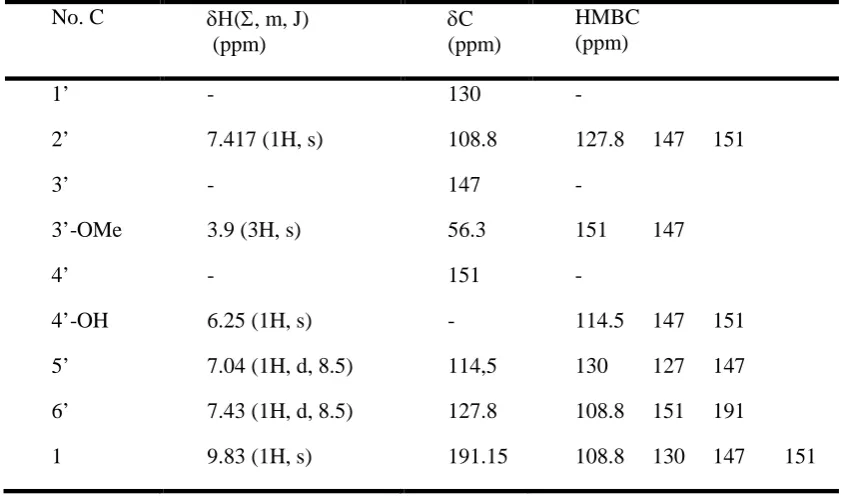
FTIR spectral data of isolated vanillin showed the existence of characteristic peak from aldehyde C–H stretching vibration at 2924 and 2854 cm-1, whereas absorption at 1666 cm-1 showed stretching vibration of C carbonyl group. Strong absorbtion at 3186 cm-1 is characteristic of stretching vibration of O–H and at 1597 cm-1 and 1157 cm-1 refer to vibration of aromatic group and ether. It could be concluded from spectrum that resulting isolated material have functional group of aldehyde, aromatic ring, hydroxyl and ether. To elucidate the structure more detailed, then it was analyzed by two dimensional NMR and the data was shown at Table 1.
Table 1. NMR spectral data of isolated vanillin including HMBC and HMQC spectral data
No. C δΗ(Σ, m, J)
(ppm)
δC (ppm)
HMBC (ppm)
1’ - 130 -
2’ 7.417 (1H, s) 108.8 127.8 147 151
3’ - 147 -
3’-OMe 3.9 (3H, s) 56.3 151 147
4’ - 151 -
4’-OH 6.25 (1H, s) - 114.5 147 151
5’ 7.04 (1H, d, 8.5) 114,5 130 127 147
6’ 7.43 (1H, d, 8.5) 127.8 108.8 151 191
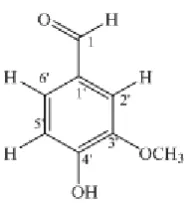
Proceedings of 14th Asian Chemical Congress (14ACC) Figure 2. 4-hydroxy-2-methoxybenzaldehyde (Vanillin)
Based on the Table 1, it could be concluded that resulting isolated material from vanilla fruit is 4-hydroxy-2-methoxybenzaldehyde (vanillin) which showed in Fig. 2. This vanillin was then used as basic material of vanillin acetone synthesis.
3.2Vanillin structure modification
The structure modification of vanillin was conducted using crossed aldol condensation reaction between vanillin with acetone and acetophenone (molar ratio 1:3). In this reaction, excess acetone was used to prevent the formation of dibenzalacetone as side product. The synthesis was highly solvent dependent so it used aquadest, ethanol-aquadest and methanol as solvent variation.
Figure 3. Scheme of vanillin structure modification
Proceedings of 14th Asian Chemical Congress (14ACC) Table 2. Data of vanillin structure modification
No Solvent Synthesis sequence Colour of resulting material
yield %
1 H2O NaOH, acetone, vanillin Dark yellow 13.06 2 H2O NaOH, vanillin, acetone Dark yellow 73.86 3 EtOH- H2O 1:1 NaOH, acetone, vanillin yellow 94.3 4 EtOH- H2O 2:3 NaOH, vanillin, acetone yellow 76.70 5 MeOH NaOH, acetone, vanillin Light yellow 90.2
The result of the synthesis using water have darker colour than ethanol-water and the lighter yellow was provided by methanol solvent. All resulting material was recrystallized using ethanol-water pr ovided yellow gradated colour to dark brown for target compound number 1, 3, 4 and 5. It could be occured due to the uncompleted reactions which reverse to result the reactant again, which confirm from TLC that showed those four materials were still vanillin. The compound no 2 was then analyzed by spectroscopy IR and NMR.
The FTIR data of vanillinacetone by structure modification showed sharp peak at 1620.21 cm-1 (C-O carbonyl), shoulder on 3300 cm-1 which indicated hydroxyl group. Methyl group was existed at 1327 cm-1 and C-O-C appeared around 1000-1100 cm-1. Characteristic absorption of aromatic appeared at 3055 cm-1 was supported by sharp peak at 1573.91 cm-1. C-H aldehyde characteristic at 2800 and 2700 cm-1 was already disappearing. It could be hold up that the synthesis resulting vanillinacetone compound.
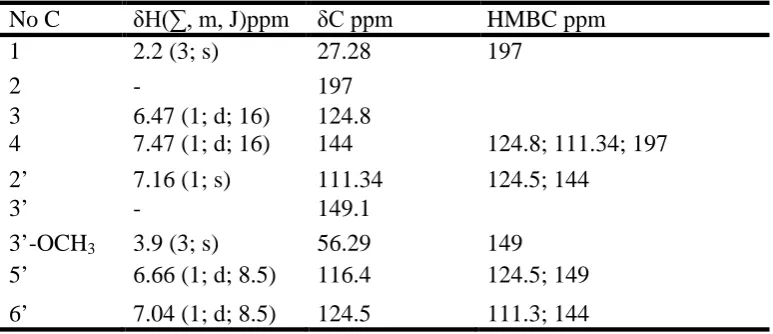
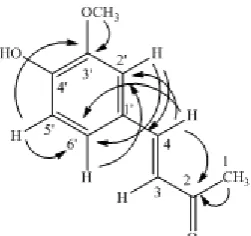
Data two dimensional of NMR spectrometer were needed to determine proton position at vanillin structure modification result and listed at Table 3 and the structure was shown in Figure 4.
Table 3. HNMR, HMQC and HMBC spectral data of vanillinacetone
No C δH(∑, m, J)ppm δC ppm HMBC ppm
1 2.2 (3; s) 27.28 197
2 - 197
3 6.47 (1; d; 16) 124.8
4 7.47 (1; d; 16) 144 124.8; 111.34; 197
2’ 7.16 (1; s) 111.34 124.5; 144
3’ - 149.1
3’-OCH3 3.9 (3; s) 56.29 149
5’ 6.66 (1; d; 8.5) 116.4 124.5; 149
Proceedings of 14th Asian Chemical Congress (14ACC) Figure 4. HMBC the modification of vanillinacetone
IR and NMR datas showed that the product of vanillin structure modification is vanilllinacetone with dark yellow colour and give 73.86% in yield.
4. Conclusions
The conclusion of the research could be remark as:
4.1Vanillin isolation with soxhlet extraction method using ethylacetate solvent resulted yield of 2.01 % with melting point of 81oC.
4.2Vanillinacetone could be synthesized from isolated vanillin through its structure modification using crossed aldol condensation reaction to give yield of 73.86%.
5. Acknowledgments
The financial support from the Directorate General of Higher Education, Government of Indonesia, through the Project of Strategi Prioritas Nasional is gratefully acknowledged.
6. References
[1]. Meynarti S.D.I., Laba U. dan Endang H., 2010, Balittri.litbang.deptan.go.id [2]. Unang Mansur,2009, Teknik Penggunaan Naungan Paranet untuk
MeningkatkanPertumbuhan dan Produksi Vanili (Vanilla planifoli Andrews), Buletin Teknik Pertanian, Vol. 14, No. 2, 76-79.
[3]. Cecep Virman, 2008, Teknik Inokulasi Mikoriza Arbuskula pada Bibit Vanili, Buletin Teknik Pertanian, Vol. 13 No. 2.
[4]. Indriana, S.M., 2006, Ekstraksi Vanili Secara Enzimatik dari Buah Vanili (Vanila Planifolia Andrews) Segar, Sekolah Pascasarjana, Bogor
[5]. Dnyaneswar, J., Rekha B.N., Parag R. Gogate and Virendra K. Rathod, 2009, Extraction of Vanillin from Vanilla Pods : A Comparison Study of Conventional Soxhlet and Ultrasound Assisted Extraction, Journal of F00d Engineering, Vol. 93, Issue 4, 421-426.
[6]. V.E. Tarabanko, Yu.V. Chelbina, V.A. Sokolenko, N.V. Tarabanko, 2007, A Study of Vanillin Extraction by Octylamine, Solvent Extraxtion and Ion Exchange, Vol. 25, 99-107