ISSN: 2502-2318 (Online) ISSN: 2443-2911 (Print)
Homepage: http://omega.uhamka.ac.id/
ω
o m e g a
Omega: Jurnal Fisika dan Pendidikan Fisika3(2), 31 - 34 (2017) (Journal of Physics and Physics Education)
Effect of Task Through Test Rankings Based Learning Model REACT to
the Achievement of Physics
Dessy Amirudin
1,∗, A. Kusdiwelirawan
2, Y. Soenarto
21
Master Programme in Physics Teaching, Department of Physics, Institut Teknologi Bandung Jl. Ganesha 10, Bandung 40132, Indonesia
2
Physics Education Study Programme, Universitas Muhammadiyah Prof. DR. HAMKA Jl. Tanah Merdeka, Jakarta 13830, Indonesia
(Received 15 September 2017; published 29 November 2017)
Abstract
The aim of this study is to find out the effect of test-based on the ranking task through the learning model of REACT (relating, experiencing, applying, cooperating, and transferring) toward physics learning achievement. The research is held in 105 Senior High School in Jakarta on the even semester of 2015-2016. The population in this research is around 32 students roommates are all investigated. The sampling technique that use is purposing sampling technique. This research use quantitative research. After the data is distributed normally and the ho-mogeneity based on the normality test and hoho-mogeneity, the data that is gained theℓcount< ℓtable(0.11<0.156).
The hypothesis test is done by using thet-test and the resulttcount> ttable(8.575>1.689) (on the 0.05 significant
extent) or 8.575>2.456 (on the 0.01 significant extent) which meansH0is rejected,H1is therefore accepted. All
in all this research could bring the effect of test-based on the ranking task learning model through the REACT toward physics learning achievement.
c
2017 The Authors. Published by Pendidikan Fisika UHAMKA
Keywords: learning model, REACT, physics learning achievement
∗Corresponding author. E-mail address: [email protected]
Introduction
Physics is the fundamental science [1]. Physics lesson is different from other subjects, because to solve a problem in physics is not enough just to memorise formulas, but students are required to understand a concept. Understanding the concept is not the same as reading the theory, to under-stand a concept of physics needed a good reasoning power and systematic mind. This is in accordance with the opinion of I Wayan Santyasa that ”Physics is a human effort that relies on reasoning, insight, energy, skill and creativity” [2]. However, not all students have good reasoning power, therefore the majority of students consider physics is a difficult
subject. This can lead to lazy students to learn, so they become bad grades and learning achievement will decrease.
Dessy Amirudinet al. / Omega: Jurnal Fisika dan Pendidikan Fisika3(2), 31 - 34 (2017)
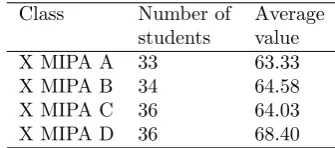
of students, which makes the power of reason stu-dents are not developing. Thus the value of stustu-dents to be bad and learn achievement also declined, this can be proved by the average value of daily test stu-dents who did not pass the minimum completeness criteria (KKM) which is set at 75. Table 1 shows the average value of daily tests of class X MIPA SMA 105 Jakarta.
Table 1: Average value of daily tests of class X MIPA SMAN 105 Jakarta in mathematics.
Class Number of Average
students value
X MIPA A 33 63.33
X MIPA B 34 64.58
X MIPA C 36 64.03
X MIPA D 36 68.40
That is why this mistake should be corrected, is necessary in the selection of appropriate learning models and appropriate, so that students become interested in hooking and understand the interrela-tionships concepts in every material being taught. If students are interested in learning to understand a concept, it is not impossible feat of learning can be improved. Many models of learning in this case, but not all models can be used as a perfect solution, especially in learning physics. The learning model used must be able to make students understand the concept of linkage with their knowledge. Not only that, should the learning model used to make the students construct their own think so that the pro-cess of thinking of students can be seen. One model of learning appropriate to address these problems is learning model REACT (relating, experiencing, ap-plying, cooperating, and transferring). REACT is a part of contextual learning.
According to Agus Suprijono contextual learn-ing is learnlearn-ing that develops high-level cognitive level [3]. Michael L. Crawford states that ”In the REACT study model there are 5 stages namely: (1) relating, (2) experiencing, (3) applying, (4) coop-erating, and (5) transferring” [4]. According Siti-atava Rizema, ”This learning to train students to think critically and creatively in collecting the data, understand the issues, and solving problems. This learning model to direct and facilitate students in finding a new knowledge through the discovery it-self is not what the teacher said” [5]. Then the findings are associated in everyday life to under-stand. So it should be able to construct the minds of students and encourage their curiousity in learn-ing. With the construction of the mind, students will be more active and skilled in developing their knowledge, so that students are not only oriented towards the mastery formula but also to further de-velop towards the process of thinking with an
un-derstanding of the concepts.
Zainal Arifin said that ”To support the students thinking process required an indicator of achieve-ment” [6]. This achievement indicator function to see the successful achievement and the development of cognitive abilities of students, so in this case can be made in the form of tests. Many types of tests that are used by teachers to improve and de-velop the cognitive abilities of students in the un-derstanding of the concept. In this study, we use the rankings task test. David W. Hudgins stated that ”Ranking task is a conceptual exercise design which allows for students to construct the thought itself ”[7]. According to Maloney in David. W. Hugens ”In this test, the students were directed to exam-ine the phenomenon of faces through pictures or diagrams that have been provided, variations mat-ter in this test emphasis on a conceptual exercise design which allows for students to not memorise the formula” [7], so students can easily understand the physics without memorising so that the learning achievement can be improved.
Based on the presentation, by using model RE-ACT and tests ranking task in the learning process, it is expected to develop the cognitive abilities of the students in understanding the concepts of physics, when students have grasped a concept in physics then any issues that arise in physics lessons will be solved properly, so students will get better grades.
Methods
This study was conducted in class X SMA 105 Jakarta in the academic year 2015/2016. This re-search was conducted in March and August 2016. The research method using the quantitative method with type research pre-experimental and research design one group pre-test post-test design. This study uses only one experimental class without con-trol [8].
Experimental class is determined using the aver-age observation smaller values of X class A to class X MIPA D. The average value of the smallest class used as the experimental class.
Classes are defined as the experimental class will be given treatment with REACT learning model, but prior to being treated, the students in the ex-perimental class is given a pre-test, it is necessary to look at the students’ knowledge. Then after a given treatment, the students in the experimental class is given a test ranking task at each meeting. In tests ranking task students are exposed to three stages of image analysis stage, the stage of rank and phase argument [9]. The third stage in task rank-ing taken in the assessment of student achievement for the cognitive domain. Rate affective and psy-chomotor taken when students are treated REACT
Dessy Amirudinet al. / Omega: Jurnal Fisika dan Pendidikan Fisika3(2), 31 - 34 (2017)
learning models, each using observation sheet and practical assessment rubric.
The population in this study were students of class X of SMAN 105 Jakarta academic year 2015/2016. The sampling technique used in this re-search is purposive sampling. Purposive sampling is sampling the researchers used in determining the sample for a particular purpose. The purpose of a particular goal is, because this study uses the learn-ing achievement of the object, in this study experi-mental class determination using the average value as a reference smaller. The result is the average value of the smallest class is determined as the ex-perimental class A and class X MIPA treated using learning models and REACT ranking task tests.
The independent variables using REACT learn-ing model, while the dependent variable consists of cognitive learning achievement. Sources of data in this study compiled research relevant variables and methods of data collection. The instruments are used mainly in research is divided into two in-struments learning implementation and data collec-tion instruments. The instrument consists of learn-ing the implementation of the syllabus and lesson plans, while the data collection instrument consists of instruments cognitive, affective and psychomotor with as complementary.
Cognitive instruments measured using a test based ranking task, whereas affective instruments measured using observation sheet of students and psychomotor instruments measured using an assess-ment rubric in accordance with the material practi-cal optipracti-cal devices. All the instruments to be used, previously had to be validated by experts. After that the data collection instruments be tested in-struments for measuring the validity, reliability, dis-tinguishing features, and level of difficulty of the questions.
Results and Discussion
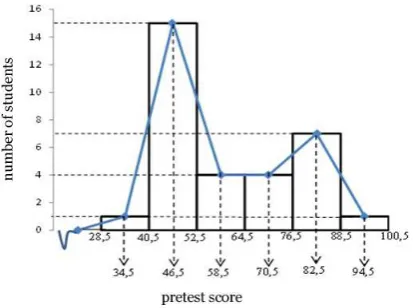
The research data was taken from student achievement scores in the cognitive domains in the material optical instruments. The frequency dis-tribution of pre-test and post-test are presented in Figure 1 and 2. Figure 1 shows that the highest value obtained was in the range of 41-52 as many as 15 students, while the minimum completeness criteria (KKM) is 75. This occurs because the ini-tial test or pre-test, students have not been given treatment based test ranking task REACT through learning model, so there is no cognitive improve-ment for students just beginning its armed capa-bility. While the frequency distribution graph of post-test is presented in Figure2.
Figure 1: Frequency distribution of pre-test. The high-est value obtained was in the range of 41-52 as many as 15 students, while the minimum completeness criteria (KKM) is 75.
Figure 2: Frequency distribution of post-test. The highest value obtained by the student after being given treatment that is in the range of 80-86 as many as 11 students.
Figure2can be explained that the highest value obtained by the student after being given treatment that is in the range of 80-86 as many as 11 students, when the minimum completeness criteria (KKM) established in the school is 75, then from the chart can be seen that there are 28 or 87.5% of students who qualify completeness, it means that there are cognitive changes in students in terms of the pre-vious value before being given treatment (pre-test). After being given treatment based test ranking task REACT through learning model there is a signifi-cant increase in cognitive, which has a range of cog-nitive rise of 62.57%.
From the data analysis has been done it can be concluded that, based test rankings task through learning model REACT influence on stu-dent achievement, this is evidenced by the signif-icant increase students’ cognitive, reviewed of the pre-test post-test students. Here are the details of the pre-test post-test students’ percentage obtained by each test.
Dessy Amirudinet al. / Omega: Jurnal Fisika dan Pendidikan Fisika3(2), 31 - 34 (2017)
Table 2: Details value pre-test post-test class X MIPA included in complete minimal criteria.
Test Number of students Percentage
Pre-test 8 24.53%
Post-test 28 87.50%
By comparing the average value before and af-ter the test treatment based ranking task REACT through learning model, it is known that an increase in students who pass the KKM by 62.97% in Table
2. It can be concluded that the cognitive improve-ment from the previous high enough, it indicates that the test-based ranking task REACT through learning model has a higher impact than by using conventional learning models. It is relevant to re-search by Diyan Novianti that states that the learn-ing model REACT effect on student achievement [10].
Table 3: The results of testingt as summary data of study hypothesis.
Class N tcount
ttable
α= 0.05 α= 0.01
Experiment 32 8.56 1.698 2.456
Based on Table 3 values obtained from table t with a significance level α = 0.05 and degrees of freedom df = 31 obtained ttable on the
signifi-cant level of 0.05 is 1.698 and ttable at significant
level of 0.01 is 2.456. While the calculation is ob-tainedtcount equal to 8.56. Becausetcount > ttable
or 8.56 > 1.698 (at significant level 0.05) and tcount > ttable or 8.56 > 2.456 (at a significant
level (0.01), thenH0 is rejected. ThusH1 received
stating that there are significant based test ranking task REACT through learning model of learning achievement physics.
Conclusion
Based on the results of the research, it can be concluded that there is the influence of test-based
ranking task through learning model REACT to physics learning achievement.
Acknowledgments
Acknowledgments delivered to all those who have helped the implementation of the research project. Especially to Mr. Acep Kusdiwelirawan, Mr. Soenarto, physics teachers and some staff of SMAN 105 Jakarta who have provided advice and support for this thesis.
References
[1] P. A. Tipler and G. Mosca,Physics for Science and Engineering Volume 1, (Erlangga, Jakarta, 1998). [2] I. W. Santyasa, Assessment and Evaluation of
Physical Education, (Graha Science, Yogyakarta, 2014).
[3] A. Suprijono, Coorperative PAIKEM Learning Theory and Applications, (Ar-Ruzzmedia, Yog-yakarta, 2012).
[4] M. L. Crawford,Contextually Teaching, (CCI Pub-lishing, Texas, 2001).
[5] S. R. Putra, Desain Belajar Mengajar Kreatif Berbasis Sains, (DIVA Press, Yogyakarta, 2013). [6] Z. Arifin,Evaluation of Learning, (Bandung Rosda
Paper, Bandung, 2011).
[7] D. W. Hudgins, D. J. Grayson, E. E. Prather, and D. P. Smits,Effectiveness of Collaborative Ranking Tasks on Student Understanding of Key Astron-omy Concepts, (University of South Africa, Preto-ria, 2006).
[8] M. Yusuf, Qualitative Research Methods, Quanti-tative and Combined, (Kencana, Jakarta, 2014). [9] T. L. O’Kuma, D. P. Maloney, and C. J. Hieggelke,
Ranking Task Exercise in Physics, (Prentice Hall, New Jersey, 2000).
[10] D. Novianti, Thesis Influence Learning Model REACT towards Achievement of Physics Class X-MIA SMAN 1 Lawang, (Universitas Negeri Malang, Malang, 2016).