25 © EUROSIS-ETI
VR, AR, MR SIMULATIONS AND INSPIRATIONS FROM “IRON MAN 3”
Helena Barbas
Faculdade de Ciências Sociais e Humanas – Universidade Nova de Lisboa Av. de Berna, 26-C
1069-061 Lisboa, Portugal e-mail: [email protected]
KEYWORDS
Digital Humanities; Human-computer interaction; Design Fiction; Iron Man 3; Female Super-heroes
ABSTRACT
Considering that all kinds of simulations are based on verisimilitude and take their referents from the real world, this presentation will focus on the tools – exosuit, helmet – holographic prototypes, and «design fiction» elements in the film “Iron Man 3”. Some Sci-fi works can become prophetic a-posteriori, or more humbly show what is presently called “design fiction” objects, scenarios, or human behaviour in its context. Presented items and interfaces deserve to be explored, mainly because they have, and are, impelling the creation of real life objects and procedures.
INTRODUCTION
Simulation is the imitation of a real-world process or system; or «the production of a computer model of something, especially for the purpose of study» (O.E.D), so entering the scope of «fiction». All simulations rely on «re-presentations» of any kind of thing, or image, having the «real world» as a referent. So, they need to be as verisimilar as possible – in aristotelic and narratological terms.
In the real-world the simulation’s verisimilar intention is restricted by the technical possibilities allowed by the implements being tested; their effects need to be graphically presented (2D or 3D) in order to be correctly shared (Dozortsev, 2017; Forkel, 2017).
In opposition to the linearity of narratives, Sci-fi Comics give 2D images of the worlds, functions, scenarios and characters created by their authors. Cinema supplements them with movement and, the advances in computer software, special effects techniques, and VRX, add the possibilities of translating them into 3D (or even 4D).
Some Sci-fi works can become prophetic a-posteriori, or more humbly show what is presently called “design fiction” objects, scenarios, or human behaviour in its context. Some items and interfaces seen in movies deserve to be studied either because they are influencing the creation of real life objects, or because the fictional technical hypothesis is worthy of closer critical attention.
The case study here will be “Iron Man 3”.
The main curiosity about Iron Man as a superhero is that he is only too human, with no particular superpowers and,
moreover, handicapped. So, in its way, the exosuit Extremis is multifunctional, varying from a prosthesis (it extends bodily functions), to a cocoon, to an autonomous robot, and a weapon.
Other «design fiction» artefacts presented in this movie will also be explored here, namely the Helmet(s) - HUD (head-up displays); how these FUI (Fantasy User Interfaces) are being adapted (or not) considering HITLs (human-in the loop situations); how the model mock-ups conform to human factors’ requirements. The importance of the methods by which information is visually conveyed to the character as part of the user’s interface; and how the character reacts, creates, and uses these new «design fiction» interfaces (i.e. holograms) re-presenting or exhibiting «design fiction» behaviour/gestures to deal with this new sort of data.
Considering that Marvel has already created a new female character as Iron Man’s counterpart, with a similar biography and background to Tony Stark, it seems relevant (from a literary, psychological, social or economic perspective) to address the issues of female super-hero(in)s, their recent boom as male super-hero counterparts - and their fiasco. Riri Williams, the next “Iron Heart”, is a 15-year-old MIT African-American girl who reverse-engineered one of Tony’s exosuits in her dorm room. The film is expected to be premiered in November 2017.
Immersion/presence issues will not be discussed here, nor the implications of/from Cognitive Sciences implied by the several related experiences, to be object of a future work.
ABOUT “IRON MAN 3”
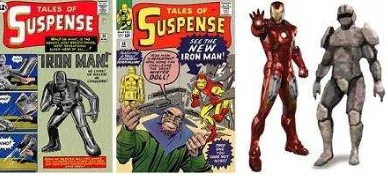
Iron Man – aka Tin Man, Iron Patriot, The Mechanic - is a fictional superhero created by writer and editor Stan Lee, developed by scripter Larry Lieber, and designed by artists Don Heck and Jack Kirby. The character made his debut appearance in Tales of Suspense #39 (March 1963), published by Marvel Comics.
In the basic plot, Antony Edward ‘Tony‘ Stark is a millionaire, a playboy and a scientist. He is kidnapped, and suffers a severe chest injury. His captors intend to force him to build a weapon of mass destruction. Instead he creates a powered suit of armour (Mark I) to save his life and escape captivity.
The exosuit Extremis
On its own, the exosuit Extremis is a multifaceted prosthesis, extending bodily functions. It provides medical health check-ups and some first aid medical treatments. Sometimes called a cocoon, it works as a command centre, an autonomous robot. It is an armour and a weapon – and also a prison when Tony Stark uses Mark XLII to immobilize by force his enemy Aldrich Killian.
It is the suit (from Mark I to XLVI) that features the several re-incarnations of the Invincible Iron Man’s Comic book series and, with its continuous upgrades and add-ons, is translated into film (2008, 2010, 2013).
In “Iron Man 3” the exosuit is brain-commanded by its user (live-feed). Mark XLVI has been worn by others than Tony (his girl-friend Pepper Potts; or the American army general James Rhodes), consequently, in the plot, it can be and is hacked by friends and foes.
Concerning the exosuit’s AI utilities it has memory; it has access to, and can deal with, big data in the cloud. Due to its training – kindly voiced through J.A.R.V.I.S. (Just A Rather Very Intelligent System) – it knows exactly what is necessary to Tony’s survival at every moment. Nevertheless, the brain-connections are still challenging. The exosuit is not switched off when Tony goes to sleep, and from this ‘glitch’ results that the suit/robot is activated by Tony’s nightmares: its AI system has not learned how to distinguish between human vigil and sleep states.
Another more standard of this world problem is the mechanism’s need to be charged: without power it becomes very vulnerable, and presents the symptoms of dead/sleep (it is rescued by a boy, in a village).
Exosuit ersatz and exoskeletons
Announced still during Obama’s presidency, The Pentagon is preparing a military version of the exosuit: «TALOS, or Tactical Assault Light Operator Suit, is a battery-powered robotic exoskeleton designed to protect the lives of soldiers on the front lines, especially those who lead the army in a mission». «In August 2018, Iron Man may go beyond fictional comic books, saving the day in real life. The U.S. Army is developing an advanced military suit that people have been likening to Tony Stark's high-tech armor» (Lanaria 2015). Also, «SOCOM expects ‘Iron Man’ suit testing by summer 2018» and «The Tactical Assault Light Operator Suit (TALOS), which became known as the “Iron Man” suit shortly thereafter, became its endgame.» (Douglas 2017).
Figure 1 – Iron Man Comics, Exosuit and TALOS
In this case, both Extremis and TALOS share the same power failure issues. Besides, the latter will not yet allow the wearer to fly.
Some other researchers inspired by “Iron Man 3” urge to divert the focus from its military uses: «The attitudinal framing of the exoskeleton asks that people aspire to transhumanism, and that they “imagine the possibilities in the near future of dramatically enhance[ed] human mental and physical capacities”» (Penderson, 2017).
Following this stance, in the EXOSKELETON REPORT (2015) - http://exoskeletonreport.com (i.e.) - a catalogue of applications, software, body parts addressed, and companies and firms (listed on the Stock Market) dedicated to the development of assistive wearable technology is provided, not only for medical rehabilitation purposes, but also for education, commerce and industry.
THE HELMET - HUD
Harder and more interesting to emulate is the “Iron Man 3” helmet. It is an aesthetical, cinematic, special effects and VRX feat. Done in stereo to avoid flatness (Townsend 2013) the software used allowed every piece to be dimensionalised, and adapted in/for every film sequence.
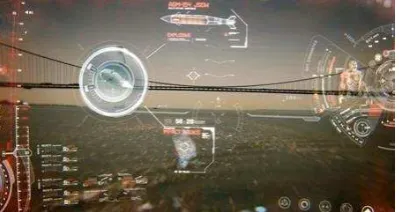
The helmet is also a HUD (head-up display) replicating the status bar in video gaming (i.e. the main character's health, items, game progression), the method by which data is visually relayed to the player as part of a game's user interface. It took its name from the monitoring in modern aircraft (pilots’ helmets).
In “Iron Man 3” the VRX for the helmet’s visor varies in accordance with each situation. Its creators wanted to «minimize the visual clutter» (Townsend 2013) always easily decipherable by Tony – a character that is «comfortable with dense data displays». Five icons are kept persistently in the lower part: suit status-, targeting- and optics-, radar-, artificial horizon-, and map-; sometimes augmented with goal-, person, location-, and object-sensitive awareness.
They chose the minimum pixels or phosphors possible, resorted to thin faint lines, and aimed to improve reactions to out-the-window events in a: «full-field-of-vision, very high-resolution, full-colour display» offering stereoscopic imaging. According to the VRX creators (Cantina.co), the design work was inspired by medical MRI diagnostic pattern-recognition and graph theory, namely the circular ‘connectograms’ used by connectomics – the study dedicated to mapping and interpreting all of the white matter fibre connections in the human brain.
The HUD’s visor allows Tony to see the world around him as if he were not wearing the helmet, and lets him read his most useful data in milliseconds.
27 © EUROSIS-ETI Through the several scenes three different angles are shown:
Tony’s point of view; the impossible camera, as the audience looking back at Tony’s face; and a lateral perspective.
Figure 2 – Tony Stark’s perspective
Figure 3 – Outer (impossible camera) perspective
Figure 4 – Lateral Perspective
The special effects and VRX cinematic achievement result in an (apparent) identical and proportionate 3D architectural experience of the images, multi-layered, projected over the scenarios of Tony’s “real world”. The closest to this experience – according to their creators – could now be provided by Google/Samsung glasses and Microsoft HoloLens, but still on flatland.
Aviation HUDs
Besides medical optical equipment, the creators were also inspired by «steampunk props, precision scopes and combat aviation systems» (Townsend 2013).
In aviation HUDs (i.e. Rockwell Collins) what is (or could) be happening out the window is almost always more important than what is shown on the display.
Presently, Enhanced Flight Vision Systems (EFVS) are heavily controlled by the FAA (Federal Aviation Administration). One of the latest releases (2017) expands its applicability to business aircraft owners and operators, but
does not even come close to the experience provided by Tony’s visor.
Figure 5 – EFVS - Enhanced Flight Vision System - FAA
In these real world areas, the problems faced by users with current data feeds is excessive information, making them overwhelming, unreadable – useless. Tony’s speed in deciphering his HUD’s details belongs to the field of gestural/behavioural «design fiction».
In real life, the more sophisticated the HUDs become, the easier they trap the pilots’ attention, distracting them, slowing their reactions to out-of-the screen events. The classic report from NASA (Fisher, Haines, and Price, 1980) refers that, in their simulator study, a couple of pilots landed their planes on top of another without even noticing it.
The utility of CBTS (Computer-based training systems), either for accident reduction or in economic terms is not questioned: «Computer-based training systems (CBTS) for process operators are both a generally recognized highly efficient tool for operator training and a major global business» (Dozortsev 2017:37), and the author cautions: «the distortion of reality, or of operators perception, give way to the development of false skills».
Other wearables
From the VR, AR, MR perspectives, the HUD anticipates – or has its counterpart – in Samsung Gear, Google Oculus Rift, Konica Minolta or Microsoft HoloLens.
VR developers now have access to unprecedented physical interfaces and interactions – including wearables, curved spaces, and complex object physics.
From the medical fields (i.e. Neurosky, Mindwave) come alternative affordable solutions for health and wellness, education and entertainment.
New gadgets/biosensors can turn PC’s into body or brain activity (EEC, ECG) monitors, check the attention levels of individuals. Some even allow the user to send short twitter or e-mail messages via a Google app.
AR, VR, MR SCENES – THE HOLOGRAMS
Technically, the hologram scenes in “Iron Man 3” were created using Lidar scans, and other 3D software (i.e. Pixar Renderman). Reality scenarios were transformed into a geometry «capable of being rendered as lines» (Townsend 2013) which allowed the interaction between Tony Stark and the settings.
Tony Stark’s holograms
Inside the narrative, Tony uses three-dimensional holographic horizontal interfaces, projected by J.A.R.V.I.S. into mobile vertical transparent “screens”.
The Interfaces presented in the film are, likewise, a combination of actually existing digital technologies and their «design fiction» extensions. From the audience’s perspective, Tony is immersed in 3D demonstrations that he can watch from all sides, and fully interact with, very easily. Tony’s behaviour and swift handling of the holographic prototypes fits, again, into gestural «design fiction».
Figure 6 – 3D development – Simon Maddison
Supposedly these are inspired by Microsoft’s Kinect (2010) and Holodesk (2012), that provide DIY scenes activated by natural user voice and gesture commands for Windows. In its turn, they were initially simulations of the controls in the narrative “Minority Report” (Philip K. Dick, Steven Spielberg, 2002), and of the HoloDeck in “Star Trek” (1966, 1979). Microsofts’ Kinect research group (Alex Kipman) has now moved to HoloLens (2016).
Figure 7 – Microsof HoloLens experience
In real life, the illusion of touching and moving objects, mainly with computer projections, has to deal with several
fields of Physics. The first one being the images’ absence of density (inspiring kinetic and haptic perception research); computer and human vision issues (parallax, stereopsis and perspective to be differently addressed in humans and machines); the lack of adequate tools – either software (Faath, 2017), or cameras (Forkel 2017; Milliron, 2017).
In spite of all this, Tony’s holograms are said to be emulated by Elon Musk (2017), the Tesla CEO, in the 3D printing of a rocket part – shown in a video.
Aldrich Killian’s holograms
Aldrich Killian tosses a rolling ball 3D projector, a holographic device used to show the inside of his brain, his thoughts, to Pepper Potts.
Figure 8 – Previs design – Killian device by John Koltai
For the creators (Koltai, 2012), Killian’s brain hologram was something new in the Marvel world. They resorted to real 3D mapping data on academic studies, once more related to the definition of the fibre pathways of the human brain. For the mind exterior and differences in depth, they resorted to three dissimilar kinds of software and image renders.
Figure 9 – Aldrich Killian’s thoughts shown to Pepper Potts
Not even with very special VRX is it (yet) possible to give verisimilar information from inside the human head.
29 © EUROSIS-ETI Presently, there are micro-sized projectors widely available,
with several companies offering them in smartphone attachment form.
WOMEN IN IRON MAN 3 AND GIRL HERO(IN)S
The female characters in “Iron Man 3”, namely the girl-friend Pepper Potts, are narrative ‘clichés’. From a literary (psychological, social and economic) perspective, and in spite of the boom of female super-hero counterparts shaped in the last years – about 7 for Marvel, 121 for DC – Comics’ super-heroins suffer the highest lack of credibility.
The resuscitation of “Wonder Woman” (2016) – even by a lady director, Patty Jenkins – resorting to super-powers endowed by some props, has not improved the situation.
In this scenario, Marvel has created a new character, “IronHeart”, with the same background as Tony Stark: a 15 year old MIT African-American girl named Riri Williams, who reverse-engineered an exosuit in her dorm room. The film is expected to be premiered in November 2017. But the project does not raise high expectations – the student is working on an existing machine, not creating anything of her own, by herself.
From the long panoply of Comics’ wonder-girls, the only one with an acceptable biography is the Scottish “Super Gran” (Forrest Wilson, 1980; TV adaptation by Jenny McDade 1985-1987).
Her theme lyrics start: «Stand back Superman, Iceman, Spiderman. Batman and Robin too […] Hang about - Look out! For Supergran». Granny Smith is hit by a ray that enhances her normal human senses into superpowers. She has some engineering skills, dealing with her flycycle, a super sleigh and an anti-gravity belt, migrating from TV to an Arcade Game for ZX Spectrum 48K (1985).
Figure 10 – Super Gran (1980-1985)
CONCLUSION
This short tour around Iron “Man 3” artefacts – the exosuit and helmet – and VRX holographic effects has shown the evolution and dissimilarities concerning Sci-Fi model mock-ups and their possible uses by humans in real-life. The interactions of Tony Stark’s character with the film interfaces have become a data representation epitome that has been imitated in all fields – army, commerce and industry.
The real-life letdowns can be attributable either to the unreadiness of the tools available (software, equipment), or to HITLs issues. A latent concern is the need to translate the available 2D information into 3D, and a persistent one is to respect verisimilitude: «changes in reality must be reproduced in the interface» (Dozortsev, 2017). In non-fictional terms, out of games and films, VR, AR, MR and reality have to coincide without flaws.
Concerning female super-hero(in)s verisimilitude could also be achieved with a mere exploration of the development of more modern human skills.
REFERENCES
Blattgerste J, Strenge B, Renner P, et al (2017) Comparing conventional and augmented reality instructions for manual assembly tasks. Proc 10th Int Conf Pervasive Technol Relat to Assist Environ - PETRA ’17 75–82. doi:
10.1145/3056540.3056547
Colgan A (2014) How Do Fictional UIs Influence Today’s Motion Controls? In: LEAP / Blog.
http://blog.leapmotion.com/fictional-uis-influence-todays-motion-controls/. Accessed 13 Sep 2017
Cuervo E (2017) Beyond Reality: Head-Mounted Displays for Mobile Systems Researchers. GetMobile Mob Comput Commun 21:9–15.
D’Elia N, Vanetti F, Cempini M, et al (2017) Physical human-robot interaction of an active pelvis orthosis: toward ergonomic assessment of wearable robots. J Neuroeng Rehabil 14:29. doi: 10.1186/s12984-017-0237-y
Dozortsev VM, Frolov AI, Novichkov AY, Pogorelov, alery P. Honeywell JSC (2017) Field Operator’s Interface in Computer Simulator: Virtual Tours vs Virtual Reality. In: SCIFI-IT’2017 - The 2017 International Science Fiction Prototyping
Conference. Eurosis - ETI, Brugge, pp 37–41
Fischer E, Haines RF, Price TA (1980) Cognitive Issues in Head-Up Displays. NASA Tech Pap 1711 1–28.
Forkel E, Baum J, Schumann C-A (2017) Applications of 3D-Measurement for Process Innovation. In: SCIFI-IT’2017 - The 2017 International Science Fiction Prototyping Conference. Eurosis - ETI, Brugge, pp 65–67
Matzen K, Cohen MF, Evans B, et al (2017) Low-cost 360 stereo photography and video capture. ACM Trans Graph 36:1–12. doi: 10.1145/3072959.3073645
Milliron T, Szczupak C, Green O (2017) Hallelujah: The World’s First Lytro VR Experience. doi: 10.1145/3089269.3089283 Pedersen I, Mirrlees T (2017) Exoskeletons, Transhumanism, and
Culture: Performing Superhuman Feats. IEEE Technol Soc Mag 36:37–45. doi: 10.1109/MTS.2017.2670224
Thies J, Zollhöfer M, Stamminger M, et al (2016) FaceVR: Real-Time Facial Reenactment and Eye Gaze Control in Virtual Reality. doi: 10.1145/3084822.3084841
Vosmeer M, Schouten B (2017) Project Orpheus a research study into 360° cinematic VR. TVX 2017 - Proc 2017 ACM Int Conf Interact Exp TV Online Video. doi: 10.1145/3077548.3077559 Wagemakers AJ, Fafard DB, Stavness I (2017) Interactive Visual
Calibration of Volumetric Head-Tracked 3D Displays. In: Proceedings of the 2017 CHI Conference on Human Factors in Computing Systems - CHI ’17. pp 3943–3953
Werrlich S, Kai Nitsche bmwde, Notni G (2017) Demand Analysis for an Augmented Reality based Assembly Training. doi: 10.1145/3056540.3076190
Yandell MB, Quinlivan BT, Popov D, et al (2017) Physical interface dynamics alter how robotic exosuits augment human movement: implications for optimizing wearable assistive devices. J Neuroeng Rehabil 14:40. doi: 10.1186/s12984-017-0247-9
WEB REFERENCES
Bartenbach V (2016) EduExo: The First Robotic Exoskeleton Kit for STEM Education. In: Kickstarter.
https://www.kickstarter.com/projects/1485976654/eduexo-the-first-robotic-exoskeleton-kit-for-stem. Accessed 01 Sep 2017 David (2012) Interview: Jayse Hansen (The Avengers). In: Invent.
Interact.
http://www.inventinginteractive.com/2012/07/08/interview-jayse-hansen/. Accessed 01 Sep 2017
Ernst D (2017) Special Operations Command expects TALOS “Iron Man” suit testing by summer 2018 - Washington Times. In: Washingt. Times.
http://www.washingtontimes.com/news/2017/feb/16/special-operations-command-expects-talos-iron-man-/. Accessed 01 Sep 2017
Grady M (2016) FAA Expands Enhanced Vision Capabilities – AV web flash Article.
https://www.avweb.com/avwebflash/news/FAA-Expands-Enhanced-Vision-Capabilities-228201-1.html. Accessed 01 Sep 2017
Grouchnikov K (2016) The magic of visual effects – interview with Venti Hristova. In: Push. Pixels.
http://www.pushing- pixels.org/2016/04/17/the-magic-of-visual-effects-interview-with-venti-hristova.html. Accessed 01 Sep 2017
Grozdanic L (2015) Elon Musk uses Iron Man-inspired holographic 3-D user interface to print a rocket part. In: inhabitat - Green Des. Innov. Archit. Green Build. http://inhabitat.com/elon- musk-unveils-his-iron-man-inspired-hand-manipulated-3d-holographic-technology/. Accessed 01 Sep 2017
Internet Movie Database (2014) Avengers: Age of Ultron (2015) - IMDb. In: Internet Movie Database.
http://www.imdb.com/title/tt2395427/faq?ref_=tt_faq_sm#.2.1. 5. Accessed 01 Sep 2017
Koltai J (2012) IRON MAN 3 - Previs Design.
http://www.johnkoltai.com/IRON-MAN-3-Previs-Design. Accessed 01 Sep 2017
Konica Minolta Develops the World’s First Automotive 3D Augmented Reality Head-up Display - News Releases | KONICA MINOLTA. In: 2017.
https://www.konicaminolta.com/about/releases/2017/0227_01_ 01.html. Accessed 01 Sep 2017
Lanaria V (2015) U.S. Military To Deliver Its First Bulletproof, Weaponized Iron Man Suit In 2018.
Russon M-A (2014) MIT Recreates Tony Stark’s Iron Man Transparent Projection Screen. Int. Bus. Times
The Fuzzy Future of Holographic Display Interfaces [Video] - Tested. http://www.tested.com/tech/405-the-fuzzy-future-of-holographic-display-interfaces-video/. Accessed 01 Sep 2017 Saeed A (2012) Meet The Man Behind The Fantastical Technology
In The Avengers, Rise Of The Planet Of The Apes, 2012 And More. In: Creators.
https://creators.vice.com/en_us/article/vvz8yx/meet-the-man- behind-the-fantastical-technology-in-ithe-avengersi-irise-of-the-planet-of-the-apesi-i2012i-and-more-qa. Accessed 01 Sep 2017 (1985) Super Gran. In: ZX Spectr. Rev.
http://www.zxspectrumreviews.co.uk/review.aspx?gid=5615&r id=5628. Accessed 29 Sep 2017
(2013) Simon Maddison. In: 13 CO. http://13co.io/simon-maddison/. Accessed 01 Sep 2017
(2015) Exoskeleton Report. http://exoskeletonreport.com/. Accessed 01 Sep 2017
(2017) Christopher Townsend. In: IMDb.
http://www.imdb.com/name/nm0870102/?ref_=fn_al_nm_1. Accessed 01 Sep 2017
(2017) Worth the Wait —FAA’s New EFVS Rule FAR 91.176 – Rockwell Collins blogs.
https://blogs.rockwellcollins.com/2017/01/17/worth-the-wait-faas-new-efvs-rule-far-91-176/. Accessed 01 Sep 2017.
BIOGRAPHY
HELENA BARBAS (1951) is Professor-Lecturer of the Department of Portuguese Studies – F.C.S.H. – U.N.L. She holds a MA (1990) and a PhD (1998) in Portuguese Studies – Comparative Literature – Literature and the Arts. In 2005 she gained her “Habilitation” (2008) in Literature and Cyberarts.
In 2003 Helena attended a M.Sc. in Applied AI at F.C.T.-U.N.L. (Campus da Caparica) and from then on centred her research in the field of Digital Humanities: human-machine interaction, e-learning, interactive digital narrative, cloud computing, and serious games.
She was a member of the InStory team (2005-2007) – best Portuguese web mobile project 2006. She prepared a project on serious games, PlatoMundi, aiming to introduce e-learning and ethical issues in game playing; she is developing a new project – Numina.
In 2011 she received the (2nd.) SANTANDER Award for the Internationalization of the F.C.S.H. Scientific Production 2010, and in 2015 the «Best paper Award» for Cloud Computing and (new) mobile storytelling in the Internet of Things, presented at EUROMEDIA’2015, I.S.T., Lisbon, Portugal.