The Integrity of Elections:
The Integrity of Elections:
he Role of Regional Organizations
Contributors:
Julio Amador III Franck Balme Amor Boubakri Raul Cordenillo Andrew Ellis Pablo Gutiérrez Henry Ivarature Shumbana Karume Gillian McCormack María Teresa Mellenkamp Betilde Muñoz-Pogossian Eleonora Mura
Domenico Tuccinardi
Editors:
International IDEA
Strömsborg, SE-103 34, STOCKHOLM, SWEDEN Tel: +46 8 698 37 00, fax: +46 8 20 24 22 E-mail: [email protected], website: www.idea.int
The electronic version of this publication is available under a Creative Commons Licence (CCl) – Creative Commons Attribute-NonCommercial-ShareAlike 3.0 Licence. You are free to copy, distribute and transmit the publication as well as to remix and adapt it provided it is only for non-commercial purposes, that you appropriately attribute the publication, and that you distribute it under an identical license. For more information on this CCl, see: <http://creativecommons.org/licenses/by-nc-sa/3.0/>
International IDEA publications are independent of speciic national or political interests. Views expressed in this publication do not necessarily represent the views of International IDEA, its Board or its Council members.
Graphic design by: Turbo Design, Ramallah
Cover photo: (Photo of the hands in the cover illustration) is taken from Corbis/Scanpix Printed by: Trydells Tryckeri, Sweden
Preface
Elections can further democracy, development, human rights and security, or undermine them. For this reason, promoting and protecting the integrity of elections is critically important. Only when elections are credible can they legitimize governments, as well as efectively safeguard the right of citizens to exercise their political rights.
Regional organizations today increasingly play a role in promoting and protecting the integrity of elections. heir initiatives range from election observation to technical assistance at the national and local levels, in line with their respective mandates and the legitimacy that they draw from their member states. heir activities constitute a unique resource that needs to be harnessed.
It is therefore highly relevant that, at the inaugural meeting of the Inter-Regional Dialogue on Democracy, the heads of regional organizations agreed to focus on the integrity of elections. Launched on 15 April 2011 at the headquarters of the Organization of American States in Washington, DC, the Inter-Regional Dialogue on Democracy is a platform for engagement among regional organizations on democracy and related issues. It draws on existing cooperation between regional organizations and with International IDEA and builds on the spirit of the biennial retreat with regional organizations convened by the United Nations Secretary-General to promote inter-regional cooperation.
Commission on Elections, Democracy and Security, which outlines a strategy to improve the integrity of elections worldwide. he Global Commission is a high-level panel chaired by former UN Secretary-General Koi Annan and its recommendations highlight the role regional organizations can play in improving the integrity of elections. In particular, the Global Commission recommends that regional organizations should determine and communicate clearly their ‘red lines’ in relation to electoral malpractice that, if violated, would trigger multilateral condemnation and sanction. he Global Commission also recommends that regional organizations should be more proactive and engaged throughout the electoral cycle and stand up for electoral integrity before elections actually take place.
International IDEA is proud to be the facilitator of the Inter-Regional Dialogue on Democracy. I would like to express my thanks to the participating regional organizations, which have generously shared their inputs and supported this publication.
Contents
Preface ... 5
Acronyms and abbreviations ... 12
Introduction ... 15
Raul Cordenillo and Andrew Ellis Background ... 15
An overview of the chapters ... 17
Notes ... 19
1. Relections on African Union Electoral Assistance and Observation ... 21
Shumbana Karume and Eleonora Mura Introduction ... 21
he background to AU election observation and monitoring ... 22
he OAU/AU Declaration on the Principles Governing Democratic Elections in Africa ... 25
he African Charter on Democracy, Elections and Governance ... 27
he establishment of the Democracy and Electoral Assistance Unit ... 29
Current AU initiatives and policy orientations ... 29
From short- to long-term observation ... 31
Improved coordination between the AU and the regional economic communities ... 31
Strengthening technical and governance assistance... 33
Conclusions ... 34
References ... 35
Notes ... 37
2. Giving ASEAN a Role in Philippine Elections: The Case for Regional Participation in Deepening Democratization Processes 41
he ASEAN institutional context and policies ... 46
ASEAN and elections ... 49
Laying institutional foundations ... 50
Conclusions ... 53
References and further reading ... 54
Notes ... 55
3. The Evolution of Election Observation in the European Union: From Fraud Prevention to Democracy Support ... 57
Domenico Tuccinardi, Franck Balme and Gillian McCormack Introduction ... 57
he Declaration of Principles for International Election Observation ... 59
No longer just ‘free and fair’ ... 61
What international standards? ... 62
he impact on EU election observation ... 64
he underrated value of domestic election observation ... 66
Domestic observers and observation around the electoral process ... 68
he regional dimension of international observation ... 70
Conclusions ... 72
References ... 74
Notes ... 75
4. The League of Arab States and the Electoral Gap ... 77
Amor Boubakri Introduction ... 77
he Arab League and democratization in the Arab region ... 79
he Arab League and elections ... 81
A modest involvement ... 81
he legal and institutional framework ... 82
Electoral assistance... 84
he observation missions ... 85
he geographical focus of election observation missions ... 86
A focus on presidential elections ... 86
A trend towards collaborative action ... 86
he main diiculties of the Arab League’s observation missions ... 88
A lack of means ... 88
A lack of guidelines ... 88
What role for the Arab League in future elections? ... 89
Selected bibliography ... 90
Notes ... 92
5. The Responsibility to Expose: The Role of OAS Electoral Observation Missions in the Promotion of the Political Rights of Women ... 95
Betilde Muñoz-Pogossian Introduction ... 95
Making women’s participation in the electoral process visible: a theoretical framework ... 96
Gender equality in the Americas ... 97
he role of the OAS ... 98
he methodology at work: beyond the theoretical framework ... 101
Paraguay ... 101
Peru ... 103
Guatemala ... 104
Colombia ... 105
Guyana ... 106
Mainstreamed perspective in OAS EOMs: the example of Saint Lucia ... 106
Conclusions ... 107
References ... 111
Notes ... 111
Table 5.1 Women’s participation in elections in Latin America: a comparative overview ... 108
Figure 5.1 Participation by women in OAS electoral observation missions 99 Figure 5.2 he concept of democratic elections ... 100
6. Quality Management Systems and their Contribution to the Integrity of Elections ... 115
María T. Mellenkamp and Pablo Gutiérrez Introduction ... 115
Quality management systems ... 117
Certiication under ISO quality management standards ... 117
Quality management principles ... 118
Certiication process actors ... 119
Promoting electoral quality ... 119
OAS electoral technical cooperation on QMS and ISO standards certiication... 121
OAS methodology for the introduction of QMS and ISO certiication for EMBs ... 121
he Costa Rican certiication ... 128
he adoption of an international electoral ISO standard... 129
Conclusions ... 131
References and further reading ... 132
Notes ... 132
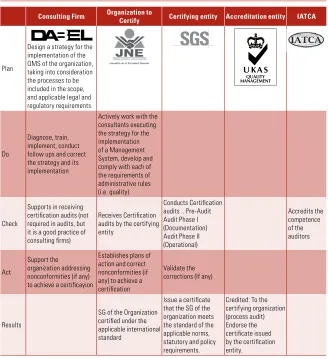
Figure 6.1 he actors involved in the QMS implementation process and certiication under ISO quality standards for the Jurado Nacional de Elecciones de Perú ... 120
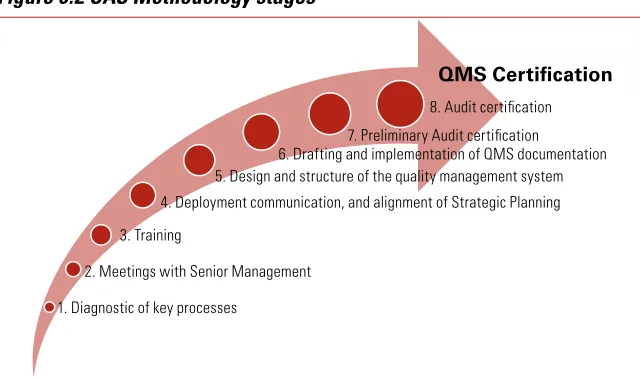
Figure 6.2 OAS Methodology stages ... 122
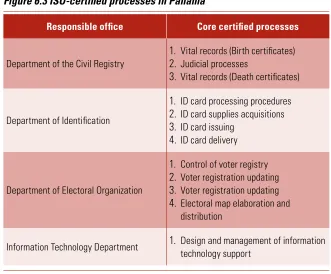
Figure 6.3 ISO-certiied processes in Panama ... 125
Figure 6.4 Four key certiied processes in Peru ... 126
Figure 6.5 Courses and training sessions in Peru ... 127
Figure 6.6 Objectives and scope of the diagnostic in Costa Rica ... 129
Box 6.1 he JNE quality policy ... 128
7. Election Observation by the Paciic Islands Forum: Experiences and Challenges ... 135
Henry Ivarature Introduction ... 135
he Paciic Islands Forum and its Secretariat ... 136
A mandate to observe elections ... 137
he Biketawa Declaration and the three key principles ... 137
EOMs and the PIF Observer Group: an extension of the ‘Secretary General’s good oices role’ ... 138
Domestic guidelines for international election observers ... 140
he PIF’s endorsement of the Declaration of Principles and Code of Conduct ... 141
Joint EOMs: the PIF and the Commonwealth ... 142
Strengths and weaknesses ... 143
Case study 1: he Solomon Islands ... 143
Case study 2: he Autonomous Region of Bougainville ... 145
Case study 3: he Republic of Nauru ... 146
Prospects and recommendations ... 147
From the short-term to the long-term ... 147
Follow-up ... 148
Development of regional norms ... 149
Alternatives to election observation: meetings of EMBs ... 150
Recommendations on gender in EOM reports and EOMs ... 151
References ... 153
Notes ... 155
Table 7.1 Summary of EOMs and observers on Forum EOMs from 2001 to 2011 ... 152
Conclusions ... 157
Raul Cordenillo and Andrew Ellis Election observation missions ... 158
Technical assistance or cooperation ... 159
Gender mainstreaming ... 160
Domestic observation ... 160
Is there convergence? ... 160
Relections ... 161
Notes ... 161
ANFREL Asian Network for Free Elections
APRM African Peer Review Mechanism
APSC ASEAN Political-Security Community
ASCC ASEAN Socio-Cultural Community
ASEAN Association of Southeast Asian Nations
AU African Union
CFSP Common Foreign and Security Policy (European Union)
COMELEC Commission on Elections (the Philippines)
DEAU Democracy and Electoral Assistance Unit (of the African Union)
DECO Department for Electoral Cooperation and Observation (Organization of American States)
EISA Electoral Institute for Sustainable Democracy in Africa
EMB electoral management body
ENEMO European Network of Electoral Monitoring Organizations
EOM election observation missions
EOP election observation programme (Paciic Islands Forum)
FOG Forum Observer Group (Paciic Islands Forum)
EU European Union
FIC Forum island countries (Paciic Islands Forum)
IOF Organization Internationale de la Francophonie
ISO International Organization for Standardization
JNE Jurado Nacional de Elecciones de Perú (National Electoral Jury of Peru)
LAS League of Arab States
NAMFREL National Citizens’ Movement for Free Elections (the Philippines)
NEEDS Network for Enhanced Electoral and Democratic Support
NDI National Democratic Institute for International Afairs
NEPAD New Partnership for Africa’s Development
NGO non-governmental organization
OAS Organization of American States
OAU Organization of African Unity
ODIHR Oice for Democratic Institutions and Human Rights (Organization for Security and Co-operation in Europe)
OSCE Organization for Security and Co-operation in Europe
PIF Paciic Islands Forum
PNG Papua New Guinea
PVT parallel vote tabulation
QMS Quality Management System
REC regional economic community
RMI Republic of the Marshall Islands
SAARC South Asian Association for Regional Cooperation
Introduction
Raul Cordenillo and Andrew Ellis
Background
Regional organizations are among the key actors in present-day international relations. hey foster dialogue among states and serve as a platform for the discussion of various transnational economic, political and social issues. hey also play an increasingly important role in elections.
Elections are a cornerstone of democracy. hey empower people to participate in the selection of their political representatives. Protecting and promoting the integrity of elections is therefore a top policy priority.
Troubled electoral processes and their fall-out have challenged the credibility of democracy in recent years. Elections that are recognized as free and fair result in a peaceful transition of power, while electoral processes that are deemed fraudulent or violent, or to have been manipulated, can either lead to or exacerbate political instability.
Ultimately, protecting and promoting the integrity of elections is the responsibility of all national stakeholders. To this end, states not only pass legislation, set up institutions or draw up codes of conduct and other enforcement mechanisms at the national level, but also commit themselves to regional and international principles of democracy. his is where regional organizations draw their respective mandates to work on elections. heir initiatives range from election observation missions (EOMs) to dialogue and cooperation on various issues with the electoral management bodies (EMBs) of their member states. Some regional organizations also provide technical assistance or cooperate on the implementation of recommendations emanating from EOMs, which seek to improve or correct speciic aspects of democratic elections.
undertaking EOMs. he Association of Southeast Asian Nations (ASEAN) has also begun monitoring elections and the South Asian Association for Regional Cooperation (SAARC) has undertaken EOMs in the past. In some of these regional organizations, meetings among the EMBs of their member states are held regularly and electoral technical assistance and cooperation are part and parcel of their political cooperation.
he experiences of regional organizations are a unique resource that needs to be harnessed and shared not only with their peers, but also with other democracy actors. he meeting of the Inter-Regional Dialogue on Democracy, a platform for engagement among regional organizations on democracy and related issues which was launched on 15 April 2011, agreed to focus initially on the role that regional organizations can play in promoting and protecting the integrity of elections.
his publication is a collection of background papers prepared for the Inter-Regional Workshop on Inter-Regional Organizations and the Integrity of Elections, which took place in Stockholm in December 2011. he papers, presented here as chapters, focus on the regional organizations that participate in the Inter-Regional Dialogue on Democracy.1
he diferent chapters aim to highlight the mandates and election-related initiatives of the regional organizations, including gender mainstreaming, as well as their achievements, challenges and limitations. Some are written from an insider perspective, since they are contributions from oicials within the regional organizations. Others contain perspectives from observers in the respective regions. he chapters discuss policy implications and make recommendations that regional organizations and policymakers should consider and may wish to take further.
Introduction
An overview of the chapters
Since the 1990s, the AU has observed close to 250 elections across a majority of its 54 member states. It has developed a framework for election observation that allows for the institutionalization of its mandate and for the increased professionalization and standardization of its procedures and methodologies. Beyond EOMs, its current initiatives extend to electoral assistance and governance support. A designated unit, the Democracy and Electoral Assistance Unit, has been established within the Political Afairs Department. Chapter 1, Relections on African Union Electoral Assistance and Observation, captures the AU experience, highlighting in particular its policy interventions, new initiatives and future priorities.
Chapter 2, ‘Giving ASEAN a Role in Philippine Elections: he Case for Regional Participation in Deepening Democratization Processes’, was written prior to ASEAN’s observation mission to the 1 April 2012 by-elections in Myanmar. It essentially advocates a role for ASEAN in the conduct of elections in its member states by highlighting ASEAN’s commitments to deepening democracy and achieving good governance in the proposed ASEAN Community. Using the Philippines as an example of a member state in which ASEAN might play a role as an observer of the conduct of national elections, it advances the view that ASEAN could act as an intermediary for electoral praxis and technology. he mission to Myanmar may have started this process, but there is as yet no institutionalization of such practice in ASEAN.
Chapter 3, ‘he Evolution of Election Observation in the European Union: From Fraud Prevention to Democracy Support’, highlights the emergence of EOMs as a democracy support instrument of EU external policy. Placed in the context of the key developments in international election observation since 2000, the chapter discusses the role that EOMs play in the EU strategy for democracy promotion in the post-Lisbon Treaty setting. Recognizing the impact, as well as the limitations, of EOMs, it sets out options for further programming in the ield of election observation.
the LAS to meet international standards and bolster its modest achievements to date.
As the regional organization that has been undertaking EOMs for the longest time, the OAS has rich experience of innovation, and particularly of implementing the recommendations of such EOMs. Chapter 5, ‘he Responsibility to Expose: he Role of OAS Electoral Observation Missions in the Promotion of the Political Rights of Women’, describes a pioneering initiative by the OAS to design a standardized methodology for incorporating a gender perspective into its election observation eforts. It argues that the incorporation of a gender perspective would allow OAS EOMs to bring issues of gender equity and women’s political rights to the fore and help place these concerns on the political agenda. he chapter also identiies and exposes the barriers to the equal participation of women and men in electoral processes, and provides food for thought for policymakers and other organizations that conduct EOMs.
Chapter 6, ‘Quality Management Systems and their Contribution to the Integrity of Elections’, presents a new phase of cooperation between the OAS and the EMBs of its member states. his is the implementation of a Quality Management System (QMS), which ends in the certiication of electoral processes or structures under International Standard ISO 9001. he chapter highlights the maturity required by EMBs to make a qualitative leap in their structure and operations, as well as the way in which they relate to their ‘clients’. It concludes that this form of technical cooperation could be applicable to other organizations that carry out electoral technical assistance or cooperation.
Chapter 7, ‘Election Observation by the Paciic Islands Forum: Experiences and Challenges’, highlights the political features and region-speciic aspects of PIF EOMs and makes policy recommendations to strengthen the PIF’s election monitoring programme.
Notes
1 he participants in the Inter-Regional Dialogue on Democracy are the AU,
ASEAN, the EU, the LAS, the OAS, the PIF and SAARC with International IDEA as the facilitator. Eforts were made to obtain a paper focused on SAARC, but these were unsuccessful, largely due to the fact that SAARC does not have a direct mandate to engage in election-related initiatives. It should be noted, however, that there have been a few EOM-related initiatives by SAARC, including the deployment of non-governmental election observers to the parliamentary elections in Bangladesh, held on 12 June 1996.
2 See <http://www.idea.int/democracydialog/workshop-on-regional-organizations.
cfm>.
Relections on African Union
Electoral Assistance and
Chapter 1
Shumbana Karume and Eleonora Mura
Relections on African Union
Electoral Assistance and
Observation
Introduction
he predecessor to the African Union (AU), the Organization of African Unity (OAU), began showing a marked interest in the promotion of democracy and the integrity of elections in Africa in the early 1990s. he involvement of the OAU was marked by the adoption of declarations and resolutions, and by its undertakings in the ield of election observation and assistance.
he irst of the declarations in which African heads of state and government agreed that the OAU must involve itself in the democratization process on the African continent was the Declaration of the Assembly of Heads of State and Government of the Organization of African Unity on the Political and Socio-Economic Situation in Africa and the Fundamental Changes Taking Place in the World, which was formally adopted in July 1990. At the beginning of the new millennium, the OAU and then the AU adopted numerous declarations and decisions on the promotion of democracy and good governance.1 hese include, irst and foremost, the Constitutive Act of the
African Union, the founding document of the AU and the irst document to enshrine the promotion of democracy as part of the core mandate of the AU. Other important declarations are the Lomé Declaration of July 2000 on the Framework for an OAU response to unconstitutional changes of government, the Declaration on the Principles Governing Democratic Elections in Africa (the Durban Declaration) of 2002 and the African Charter on Democracy, Elections and Governance (May 2007).
institutions and good governance in Africa. hese legal instruments are the foundation for the comprehensive legal and institutional framework for the AU’s action in the ield of democracy building.
his chapter provides a holistic overview of the work of the AU in the ield of democratization, focusing in particular on election observation and electoral assistance. It describes the evolution of the legal and institutional framework for the AU’s work in the ield of democratization, and relects on recent AU initiatives and policy orientations.
The background to AU election observation and
monitoring
Election observation emerged as a signiicant mechanism for supporting democratic development in the post-Cold War period. he 1989 elections in Sandinista Nicaragua and the referendum on self-determination in Namibia were early examples. On both occasions, the United Nations (UN) deployed observers jointly with regional organizations to report on the democratic quality of electoral practices.2
he OAU’s irst involvement in election observation was in 1989, when it joined the UN in monitoring elections in Namibia to ensure the fulilment of United Nations Security Council Resolution 435 (1978), to oversee an internationally agreed decolonization plan for Namibia.
In 1990, the majority of African countries were one-party states. A combination of the end of the Cold War and increasing domestic demand for political reform triggered a process of transition to democracy in many African countries, and therefore multiparty and recurrent elections.
It was in this context that most African countries turned to the OAU for assistance. In response, the OAU Secretary General, Salim Ahmed Salim, stressed that it was the duty and responsibility of the OAU to respond positively and efectively to appeals from its constituent members to assist in the democratic transitions, in particular through election observation. He also stressed the need to build the capacity of the OAU Secretariat to deal with electoral observation.3
Reflections on African Union Electoral Assistance and Observation
to promote the principle of self-determination and to foster the establishment of truly sovereign states, free from all forms of external interference’.4 his
strong respect for the non-interference principle has to be understood from a historical perspective and in the context of decolonization.
Its involvement in election observation began a new era for the OAU and its role in the democratization of the African continent. Secretary General Salim Ahmed Salim expressed this new attitude on several occasions, conirming that the OAU would now play a role in democratization.5 he OAU soon
began to undertake election observation missions independently, and its interest in election observation developed hand in hand with its growing involvement in the democratization of Africa. It was with the Declaration on the Political and Socio-Economic Situation in Africa and the Fundamental Changes Taking Place in the World that the OAU oicially engaged with the democratization process on the African continent.6
Towards the end of the 1990s, the OAU recognized the importance of democratization processes in Africa, formally condemning changes of government which violated the constitution of the relevant country. In 1999, during its 35th Ordinary Session of the Assembly of Heads of State and Government, in Algiers, the OAU took a tougher stance and strengthened the measures against unconstitutional changes in power (the Algiers Declaration, July 1999). On this occasion, the Assembly of the OAU adopted two decisions on the issue: the irst concerned the imposition of sanctions on governments that came to power through unconstitutional means; and the second called on the OAU Secretary General to assist countries intending to return to constitutional rule and monitor their progress after the constitutional order was restored. Following up on the Algiers Declaration, as is noted above, in July 2000, the Assembly of Heads of State and Government adopted the Lomé Declaration on the Framework for an OAU response to unconstitutional changes of government. he Lomé Declaration was an important step forward in the formulation by the OAU of a global approach to the problem of unconstitutional changes of government. It was structured around four elements: a set of common values and principles for democratic governance; a common deinition of what constitutes unconstitutional change; measures and actions that the OAU could progressively take to respond to an unconstitutional change; and an implementation mechanism.
unconstitutional change, the perpetrators of such a change refused to restore the constitutional order (Tazorora 2008). It is evident that OAU attitudes to democracy, human rights and good governance had become more forthright. hese developments prepared the ground for issues of governance, democracy and human rights to become the centrepiece of the agenda of the emergent AU.
he AU Constitutive Act was the irst document of the new AU era to declare that the AU ‘shall promote democratic principles and institutions’. he Preamble to the Constitutive Act speciies the determination of member states ‘to promote and protect human and peoples’ rights, consolidate democratic institutions and culture, and to ensure good governance and the rule of law’.
Articles 3 and 4 of the Constitutive Act codify the promotion of ‘democratic principles and institutions, popular participation and good governance’ and ‘the right of the Union to intervene in a Member State pursuant to a decision of the Assembly in respect of grave circumstances, namely: war crimes, genocide and crimes against humanity’, respectively. Article 4 thus gives the AU unprecedented powers of intervention: a true watershed moment marking the end of the absolute dominance of the principle of non-interference.
Article 30 of the Constitutive Act unambiguously enshrines a categorical rejection by the AU of unconstitutional changes of government. Article 30 stipulates that ‘Governments which shall come to power through unconstitutional means shall not be allowed to participate in the activities of the Union’.
Rights, adopted in Nairobi in June 1981, recognizes the right of every citizen to participate freely in the government of his or her country either directly or through democratically elected representatives.
Two additional documents must be cited in this review: the African Charter for Popular Participation in Development, adopted in Addis Ababa in July 1990, which emphasizes the need to involve the people of Africa in the spheres of economic and political governance; and the Cairo Agenda for Action, adopted in Cairo in 1995, which stresses the imperative of ensuring democratic governance through popular participation based on respect for human rights and dignity, free and fair elections, and respect for the principles of freedom of the press, free speech, and freedom of association and conscience.
However, the milestones for AU work in the ield of democratization are the OAU/AU Declaration on the Principles Governing Democratic Elections in Africa, also known as the Durban Declaration, and the African Charter on Democracy, Elections and Governance. hese two documents allow the AU to be fully engaged in election observation and in the strengthening of election processes. Together, all these documents form the foundations for the work of the AU in the ield of democratization.
The OAU/AU Declaration on the Principles Governing Democratic Elections in Africa
he OAU/AU Declaration on the Principles Governing Democratic Elections in Africa or Durban Declaration, which was endorsed at the 38th Ordinary Session of the OAU Assembly, is the foundation on which the AU has sought to drive the development of democratic election processes across the continent. It embraces fully the principle that democratic elections are the sole legitimate basis for authority for a representative government, and cites the holding of regular elections as an important tool for conlict prevention, conlict management and conlict resolution.
he Durban Declaration lists the responsibilities of the OAU/AU member states to: (a) take measures to implement the principles contained in it; (b) establish, where they are lacking, appropriate institutions to decide on issues such as codes of conduct, citizenship requirements, residency requirements, age requirements for eligible voters and the compilation of electoral registers; (c) establish impartial, inclusive, competent and accountable national electoral management bodies (EMBs) stafed with qualiied personnel, as well as competent legal entities, including efective constitutional courts,
with authority of arbitration in the event of disputes arising from the conduct of elections; and (d) safeguard the human and civil liberties of all citizens, including the freedom of movement, assembly, association, expression and to campaign, as well as access to the media by all stakeholders, particularly during the electoral process.
Moreover, the Durban Declaration sets out rights and principles relating to democratic elections, such as that: (a) every citizen shall have the right to participate freely in the government of his or her country, either directly or through freely elected representatives in accordance with the provisions of the law; (b) every citizen has the right to participate fully in the electoral processes of the country, including the right to vote or be voted for, according to the laws of the country and as guaranteed by the constitution, without any kind of discrimination; (c) every citizen shall have the right to free association and assembly in accordance with the law; and (d) every citizen shall have the freedom to establish or to be a member of a political party or organization in accordance with the law.
hus, in the Durban Declaration, the heads of state and government mandate that the OAU/AU be fully engaged in strengthening the democratization process, particularly by observing elections in member states. In addition, the Durban Declaration provides strict guidelines and mandates for the OAU/ AU to take all necessary measures to ensure its implementation. In particular it strengthens the role of the OAU/AU in observing elections in accordance with a memorandum of understanding reached with the country concerned, and in mobilizing extra-budgetary funds to augment the OAU/AU’s resource base in order to facilitate the implementation of the Declaration.
he irst rule for OAU/AU election observers is that they shall operate within the guidelines of the Commission, based on the Durban Declaration. he Commission is required to keep an up-to-date election calendar for the OAU/ AU member states. According to Paragraph V of the Durban Declaration, the country holding elections should send a formal invitation to the OAU through the national electoral commission, another electoral authority or the government. he OAU, on receiving an invitation to observe an election, shall ensure that adequate lead time is available for preparation; access is secured to essential planning information; there is access to competent and relevant expertise; and there are suicient inancial and other resources to undertake election observation and related activities.
an election assessment team to the country planning the election. he assessment team should establish whether conditions exist in the country for organizing credible, legitimate, free and fair elections in accordance with the Durban Declaration. he head of the assessment team should then advise the OAU/AU Commission accordingly.
In addition, the Durban Declaration mandates the OAU/AU to compile and maintain a roster of African experts in the ield of election observation and democratization, and to avail itself of their expertise by deploying competent and professional observers whenever necessary. his provision marks the beginning of the professionalization of election observation by the African Union. To this end, the OAU/AU Secretariat must also formulate standards for procedures, preparations and the treatment of personnel selected to serve in OAU/AU observer missions.
Compared to previous commitments, the Durban Declaration provides clear and speciic guidelines with regard to free and fair elections and with respect to the monitoring role of the OAU/AU. However, it must be underlined that the Declaration is still a soft law instrument that is not legally binding, and therefore the application of its provisions relies fully on the ‘goodwill’ of the member states.
he Durban Declaration is also important because it provided a mandate for the creation in 2006 of a dedicated Democracy and Electoral Assistance Unit within the Political Afairs Department of the OAU/AU Commission. he raison d’être for the establishment of this unit can be clearly identiied in the need for the Commission to implement its programme on the advancement of democracy and democratic elections on the continent.
The African Charter on Democracy, Elections and Governance
he African Charter on Democracy, Elections and Governance is the most comprehensive commitment by the AU to deepening and consolidating democratic governance in Africa. It builds on the commitments and declarations that were cited earlier and serves as a consolidated point of reference for all AU eforts aimed at enhancing democracy, elections and governance across the continent.
Many of the policy documents that frame the mandate of the AU in the ield of electoral assistance and observation are of a non-binding nature and therefore can only provide guidance. he Charter, by contrast, is a legally binding document.
Since its entry into force on 15 February 2012,7 the Charter has set the legal
framework of the AU’s work on democratization. he next step for the AU will be to secure an efective commitment from the national leaderships to the principles of the Charter, including adoption of the measures needed to institutionalize good economic and corporate governance, and to incorporate the provisions of the Charter into national laws, policies and regulations. It is important to ensure that signing the Charter is seen not just as a symbolic act but as one backed by a genuine commitment.
he provisions contained in the Charter are premised on universal values of democracy, respect for human rights, the rule of law, and the supremacy of the constitution and the constitutional order in the political arrangements of AU member states. In addition, and in relation to electoral assistance, the Charter emphasizes the importance of pre-election observation, election observation missions (EOMs) and special advisory missions as well as the need to create an environment that is conducive to independent and impartial national observation mechanisms.
Among other provisions, the Charter re-addresses issues around unconstitutional changes of government, putting strong emphasis on the obligation to ensure the independence of the judiciary. With regard to electoral management, the Charter promotes best practices in the management of elections and the obligation to hold transparent, free and fair elections in accordance with the Durban Declaration. In addition, the Charter includes provisions on the strengthening of national mechanisms for redress in election disputes and a binding code of conduct for political stakeholders. he Charter also contains provisions regulating the free and equitable access by political parties to state-controlled media during elections.
The establishment of the Democracy and Electoral Assistance Unit
As highlighted earlier, in July 2002 during the 38th Ordinary Session of the OAU Assembly in Durban, the OAU Council of Ministers, through the Durban Declaration, decided to establish an administrative unit to observe elections, follow up the implementation of recommendations and generally assist the Commissioner in charge of the Political Afairs Department, which was responsible, in collaboration with the oicial authorities of the countries concerned, for coordinating the OAU/AU’s observation of elections.
Following a feasibility study and consultations with evaluations for independent and governmental experts in the ield, in June 2006, the Executive Council of the AU decided to set up the Democracy and Electoral Assistance Unit (DEAU) within the Political Afairs Department of the AU Commission. he DEAU was made responsible for coordinating and implementing all AU Commission actions aimed at promoting democracy and elections in Africa. It has a broad mandate to promote democracy, observe elections and provide electoral assistance.
In addition to approving the creation of the DEAU, the Executive Council also approved the establishment of a dedicated trust fund, the Democracy and Electoral Assistance Fund, to support the activities of the DEAU. his fund is proof of the AU’s concrete commitment to strengthening democratization. However, in practice the fund remains heavily dependent on international donors. In this regard it has been noted elsewhere that ‘for democracy to advance and deepen, African States should be prepared to earmark resources for democratic and electoral processes’ (Pretorius 2008).
Current AU initiatives and policy orientations
More than 20 years have passed since the initial engagement by the OAU in the ield of democratization. In this time, African countries have made remarkable progress in instituting the core principles and practices of democratic governance. However, there is no denying that the results achieved so far have been mixed (AU 2009). he violence that has accompanied recent elections highlights the importance of further enhancing the AU’s efectiveness in dealing with such situations.
Since 2002, the AU has developed a clear and efective framework for election observation that has allowed for the institutionalization of its mandate and the increased professionalization and standardization of its procedures and methodologies in matters of electoral observation. Since the 1990s, the
OAU and then the AU have observed close to 250 elections in a majority of the 54 AU member states. Building on the broad overview of the legal and institutional framework of the AU electoral observation and assistance instruments, this section discusses the work that has been implemented so far and describes recent initiatives and policy orientations undertaken by the AU.
Since 2008, following the absence of any invitation to observe the 2007 elections in Kenya, the AU has taken unprecedented steps to observe elections even when not invited. his must be acknowledged as fundamental progress in the AU’s practice of election observation. he decision to observe elections without an invitation to do so from the host country must be seen as an extremely positive development as it underlines a strong commitment by the AU to be the driver of democratic change on the continent. In addition, ensuring the observation of all elections held by its member states reinforces the role of the AU in promoting and protecting the integrity of elections at the regional level.
AU election observation is currently regarded as a peer-pressure mechanism within Africa that can exercise powerful inluence for the establishment of democratic governments. Electoral observation and assistance are tangible and visible tools for the implementation of the commitments to democratization made by the AU at its creation—commitments that distinguish it from its predecessor, which was often criticized for its weakness in monitoring human rights and good governance. Many authors have noticed how the AU took stock of the failures of the OAU and adopted an increasingly interventionist stance through its legal frameworks and institutions, moving from a non-interventionist stance to an open non-indiference approach (Mwanasali 2008). As one commentator wrote, ‘until very recently, the principles of national sovereignty and non-intervention were the oicial norms of the OAU. In contrast, the Constitutive Act of the AU proclaimed a paradigmatic shift towards collective responsibility in matters of human and state security’ (Melber 2006).
methodologies. Building on these important elements, following the establishment of the DEAU, several initiatives have been implemented to further enhance the efectiveness of the work of the African Union in this ield.
From short- to long-term observation
AU election observation still mainly deploys short-term missions. In many cases, observers are deployed one week before the elections and are therefore unable to observe procedures related to voter registration or to monitor the media and how political parties inance their campaigns. In this respect, the balance between short- and long-term observation has become a priority for the AU Commission. Long-term observation allows for the efective observation of all the stages of elections, that is, the pre-voting, voting and post-voting stages, demarcation of electoral boundaries, political party registration, candidate nomination, party funding, political campaigns, the role of the security forces, the use of state resources, and the media environment. Long-term observation also allows comprehensive reporting and stocktaking on how the electoral process is conducted, leading to broader learning. he AU Commission would then have a comprehensive overview at its disposal, leading to better targeting of any technical or governance assistance projects to be implemented in the member states. Furthermore, by improving the information available during the pre-election period, election monitors could have an impact on defusing post-election disputes (Beaulieu 2011).
he Political Afairs Department, through the DEAU, is implementing a road map that will allow the African Union Commission to make a paradigm shift from short- to long-term election observation based on the electoral cycle approach. his means that the AU will be able to pilot long-term election observation by the end of 2012, and later mainstream it further.
Improved coordination between the AU and the regional economic communities
One of the main challenges that regional organizations commonly face is the high inancial cost of deploying EOMs. One way for the AU to counterbalance the limited availability of resources would be to enhance its collaboration with the regional economic communities (RECs). Better coordination of the election observation eforts of the AU and the RECs would enhance their efectiveness. In this regard, the establishment of the African Governance Architecture is a positive efort by the AU Commission to
establish synergies and interactions between African institutions and organs with a formal governance mandate. he African Governance Architecture aims to strengthen and enhance the capacity of the AU institutions working in the ield of democratic governance and to produce ‘shared agendas’. In this context, the African Governance Platform was established to strengthen cooperation and coordination between diferent stakeholders. Efective collaboration between the AU, the RECs and other regional and national civil society organization networks will improve the efectiveness of election observation and minimize duplication of efort in the ield, as well as costs, thereby helping the AU and the other actors to better channel their limited resources.
It should be emphasized that collaboration between the AU Commission and the RECs is mandated in the African Charter on Democracy, Elections and Governance. he concrete steps towards more integrated activities started with a meeting in Sudan in 2009. Further momentum was provided and the need for deeper collaboration identiied at a meeting held with national EMBs in Accra in December 2009, and in numerous follow-up meetings organized to discuss the African Charter on Democracy, Elections and Governance. hese meetings serve to ensure that the AU Commission and the RECs move beyond rhetoric on collaboration to enhance their impact through more efective cooperation.
Many of the uncoordinated election observation activities by the AU Commission and the RECs were a direct result of their diferent mandates. Not enough time was spent building modalities for working together on African elections. As election observation became more common and more rooted in continental electoral practices, the need to ensure consistency in and uniformity of election observer missions among regional and continental organizations increased.
Strengthening technical and governance assistance
As is noted above, the DEAU has a mandate to implement all the activities deined by the AU Commission aimed at promoting democracy and democratic elections in Africa, ofering electoral assistance and support to democracy in all member states. he African Charter on Democracy, Elections and Governance recognizes the role of the AU in strengthening the capacity of electoral authorities to manage elections. Article 18, Sub-section 1 of the Charter states that ‘State Parties may request the Commission, through the Democracy and Electoral Assistance Unit and the Democracy and Electoral Assistance Fund, to provide advisory services or assistance for strengthening and developing their electoral institutions and processes’. It is complemented by Article 18, Sub-section 2, which states that ‘the Commission may at any time, in consultation with the State Party concerned, send special advisory missions to provide assistance to that State Party for strengthening its electoral institutions and processes’.
Within the Electoral Assistance Portfolio, the DEAU has undertaken a series of projects focused on EMBs, aimed at sharing best practices, creating regular exchanges and undertaking necessary reforms to improve the capacities of EMBs. he activities undertaken are regional training for EMBs, capacity building and forthcoming projects within a framework of horizontal cooperation in collaboration with the Organization of American States, aimed at peer exchanges of best practices between African and Latin American EMBs. Lastly, in order to remedy the absence of an AU framework for post-election observation, the DEAU will implement post-election audit workshops in any sub-region in which three elections have been held in the past six months. hese workshops will enable a stocktake of an EMB’s performance during the elections. hese actions will allow the AU to follow up on the recommendations made by EOMs.
Despite the growing number of activities being implemented, the work of the AU in the ield of technical and governance assistance has been somewhat limited compared to the work carried out on election observation. he main reason for this limited involvement is the scarcity of funding that the DEAU can dedicate to such assistance projects. In this sense, electoral assistance by the AU is still in its initial stages. However it is worth noting that the AU is gaining an increasing role in responding to the challenges entailed in building sustainable democracies on the continent.
In future years, the AU will extend its work on technical assistance from enhancing the institutional capacity of EMBs to developing the institutional
capacity and democratic culture of political parties and designing electoral systems that broaden representation, recognize diversity, and respect equity and majority rule while at the same time protecting minority rights. hese areas of activity are a priority because when political parties lack a clear commitment to democracy and their interparty relations are marked by intolerance and a disregard for electoral rules and codes of conduct, this can contribute to political tensions which can trigger election-related conlicts before, during or after elections. In addition, civil society organizations, including faith-based organizations, will be supported in their various eforts to strengthen democratic culture, in particular through voter education, civic education and conlict management initiatives (African Union 2010).
Conclusions
his chapter has presented developments and the accomplishments of the AU in the ields of democratization and, in particular, election observation and assistance. Since the 1990s, the OAU and then the AU have progressively increased their role and mandate with regard to protecting and promoting the integrity of elections. he AU currently operates under a clear and efective legal and institutional framework for electoral observation and assistance, further articulated since the entry into force of the African Charter on Democracy, Elections and Governance in February 2012.
Since the 1990s, the OAU/AU has observed close to 250 elections in a majority of its member states and has implemented important programmes for technical assistance and governance through the DEAU.
However, notwithstanding the marked progress that has been made by the AU and its member states in the ield of democracy promotion and ensuring the integrity of elections, the recent upsurges of electoral violence in Côte d’Ivoire, Kenya and Zimbabwe testify to the need to further strengthen the democratic processes and structures of the AU member states. his will need to be done with tailored interventions in those member states which are still plagued by political violence and conlicts.
design of electoral systems that broaden representation, recognize diversity, respect equity and ensure that majority rule respects minority rights.
he journey towards deepening and consolidating democratic governance in Africa is ongoing and open-ended. Now that the African Charter on Democracy, Elections and Governance has entered into force the AU must convince its member states to domesticate it. he Charter is to date the most comprehensive commitment by the AU member states to democracy, the integrity of electoral processes and good governance.
Finally, the AU, through the DEAU, is moving towards dedicating more resources to the implementation of its programmes on technical and governance assistance. Strengthening the institutional capacities of the EMBs, promoting a democratic culture among political parties and assisting with the design of electoral systems will contribute not only to the integrity of elections but also to the defusing of election-related conlicts and political tensions.
References
APRM Secretariat, he African Peer Review Mechanism (APRM) (Midrand, South Africa, 2003)
African Union (AU) Panel of the Wise, ‘Election-related Disputes and Political Violence: Strengthening the Role of the African Union in Preventing, Managing and Resolving Conlict’, he African Union Series, New York, International Peace Institute, July 2010
AU, ‘Interim Report of the Chairperson of the Commission on the Prevention of Unconstitutional Changes of Government though Appropriate Measures and Strengthening the Capacity of the African Union to Manage Such Situations’, AU, Sirte, July 2009
AU, Declaration on Democracy, Political, Economic and Corporate Governance of the New Partnership for Africa’s Development (NEPAD), AU, Addis Ababa, 2002a
AU, Guidelines for African Union Electoral Observation and Monitoring Missions, AU, Addis Ababa, 2002b (mimeo)
AU, OAU/AU Declaration on the Principles Governing Democratic Elections in Africa, AU/OAU, Addis Ababa, 2002c (mimeo)
AU, Protocol to the African Charter on Human and Peoples’ Rights on the Rights of Women in Africa, AU, Addis Ababa, 2003
AU, African Charter on Democracy, Elections and Governance, AU, Addis Ababa, 2007
Beaulieu, Emily, ‘Interregional Organizations and Election Integrity: Resolving Conlict and Promoting Democracy’, Background paper for the workshop ‘Regional Organizations and Integrity of Elections’, organized by International IDEA, Stockholm, 14–15 December 2011
Garber, Larry, ‘he OAU and Elections’, Journal of Democracy, 4/3 (July 1993), pp. 55–59
Hammerstad, A., ‘African Commitments to Democracy in heory and in Practice: A Review of Eight NEPAD Countries’, AHSI Paper (June 2004)
Lopez-Pintor, R., ‘Election Observation: Twenty Years of Learning’, Miradas al Exterior (January 2010)
Lopez-Pintor, R., ‘Reconciliation Elections: A Post-Cold War Experience’, in Krishna Kumar (ed.), Rebuilding Societies After Civil War: Critical Roles for International Assistance (Boulder, CO.: Lynne Rienner Publishers, 1997)
Melber, Henning, AU, ‘NEPAD and the APRM: Democratization Eforts Explored’,
Current African Issues, 32 (July 2006)
Mozafar, S. and Schedler, A., ‘he Comparative Study of Electoral Governance: Introduction’, International Political Science Review, 23/1 (January 2002), pp. 5–27
Mwanasali, Musiiky, ‘From Non-Interference to Non-Indiference: he Emerging Doctrine of Conlict Prevention in Africa’, in J. Akokpari, A. Ndinga-Muvumba and T. Murithi (eds), he African Union and its Institutions (Auckland and Cape Town: Jacana Media and Centre for Conlict Resolution, 2008)
National Endowment for Democracy (NED), Final Report, ‘OAU Elections Training Program’ NED Core Grant 92-4 (2540)
Novicki, M., ‘Interview with Salim Ahmed Salim,’ Africa Report 36 (May–June 1992)
Organization of African Unity (OAU), African Charter on Human and Peoples’ Rights, OAU, Addis Ababa, 1981
OAU, Declaration on the Political and Socio-Economic Situation in Africa and the Fundamental Changes Taking Place in the World, OAU, Addis Ababa, 1990a
OAU, African Charter for Popular Participation in Development, OAU, Addis Ababa, 1990b
OAU, Cairo Agenda for Action, Addis Ababa, 1995
OAU, Grand Bay (Mauritius) Declaration and Plan of Action on Human Rights in Africa, OAU, Addis Ababa, 1999
OAU, Lomé Declaration on the Framework for an OAU Response to Unconstitutional Changes of Government, OAU, Addis Ababa, 2000
OAU, 2000, Protocol to the Treaty Establishing the African Economic Community Relating to the Pan-African Parliament, OAU, Addis Ababa, 2000
OAU, Conference on Security, Stability, Development and Cooperation (CSSDCA) Solemn Declaration, OAU, Addis Ababa, 2000
Pretorius, J., African Politics: Beyond the hird Wave of Democratization (Cape Town: JUTA, 2008)
Strom, M., Promoting the African Charter on Democracy, Elections and Governance: A Four-Part Guide for Study Circles (Pretoria: IDASA, 2009)
Tazorora, T. G. Musarurwa, Creating Sustainable Democracy in Africa: An African Supranational Body for the Efective Supervision of Elections in Africa (Pretoria: University of Pretoria, 2008)
Notes
1 he Organization of African Unity (OAU) was established in 1963. It evolved
into the African Union after the adoption in July 2000 of the Constitutive Act of the African Union, which entered into force in 2001. he Constitutive Act of the African Union replaced the 1963 OAU Charter.
2 Groups of people had previously monitored the outcome of speciic elections
on-site from the period of the Crimean War up to the 1980s in Uruguay, El Salvador and Chile (Lopez-Pintor 1997, 2010).
3 In this respect, Secretary General Salim Salim asked the African American
Institute (AI) and the National Democratic Institute (NDI) to develop training programmes for OAU staf from 1992. See National Endowment for Democracy (NED), Final Report, OAU Elections Training Program, NED Core Grant 92-4 (2540); and Garber (1993).
4 ‘Governance Challenges in Africa and the Role of the African Union’, Public
Lecture to mark the 20th Anniversary of the European Centre for Development Policy Management, 19 December 2006 (European Institute for Public Administration, Maastricht), by Amb. J. K. Shinkaiye, Chief of Staf, Bureau of the Chairperson African Union Commission.
5 See Novicki (1992), p. 36. It is important to note that one of the irst oicial
documents calling for a greater involvement of the OAU in electoral observation and in democratization processes is the Report of the Secretary General on the
Process of Election Monitoring by the OAU issued during the 64th Session of the Council of Ministers, held in July 1996 in Yaoundé, Cameroon.
6 In line with the principle of non-interference, the OAU had to be formally invited
to observe elections by its member states. In addition, the mandate of each election observation mission was carefully negotiated between the OAU and the host government. he typical election observation mission included ambassadors from OAU countries and one or two OAU staf members. his team of observers reported to the OAU Secretary General. he election observation reports were shared with the government of the country involved, but not always with the wider public (Garber 1993).
7 Although AU heads of state adopted the Charter in January 2007, it only entered
Giving ASEAN a Role in
Chapter 2
Julio S. Amador III1
Giving ASEAN a Role in
Philippine Elections: The Case
for Regional Participation in
Deepening Democratization
Processes
Introduction
Southeast Asia is signiicant as a focus for international politics because of its potential for both conlict and cooperation. Analysing political phenomena at the regional level is important because ‘he regional level is where the extremes of national and global security interplay, and where most of the actions occur’ (Buzan and Wæver 2003: 43). Regional integration processes lead states to create regional organizations, the functions of which generally include providing an organized avenue for diplomatic dialogue and interstate cooperation. Regional organizations are important in many ways. One of the main purposes of regional organizations is what Edward Best and homas Christiansen (2008) call the management of interdependence, because these regional organizations seek to guarantee peace and security and reduce conlict, and to promote economic cooperation and social interaction among states. In Southeast Asia, the most enduring regional organization is the Association of Southeast Asian Nations (ASEAN), which was established in 1967.
governance, the rule of law, human rights and fundamental freedoms (Article 1, purposes; and Article 2, principles), including the creation of an ASEAN Human Rights Body (Article 14). However, before 2012 ASEAN had not been actively involved in the election processes of its member states. he outcome of national elections within member states is sometimes reported and analysed in news reports because of the potential impact of the policies of the successful candidates on ASEAN. hese reports are generally silent, however, on the role of ASEAN as a regional organization in national elections. he only time ASEAN has taken any action in relation to national elections is in response to the situation in Myanmar.
Elections are important because they provide avenues for political accountability, which is at the core of the democratization process. In practice, elections are a procedural aspect of democracy. Holding them does not in itself mean that the will of the people is being relected or followed: democracy is deeper than elections. Nonetheless, how elections are conducted plays a major role in how the international community, national stakeholders and its citizens perceive a state. If states hold elections that are free and fair, investors and other states can believe that the government in power can be trusted. his goodwill may translate into increased trade or more aid.
It has long been conventional wisdom that regional organizations should not play a role in national elections because states have no business being involved in each other’s political processes. Non-interference is a key norm in the practice of sovereignty. his chapter asks whether regional organizations should play a role in their member states, if only to foster opportunities for skills, knowledge and technology transfer. In particular, it:
1) examines the institutional context that might allow ASEAN to participate actively in deepening democracy within its member states by providing a clear analytical framework for the relevant context and mandate of ASEAN in the ield of electoral observation and support in line with the ASEAN Political-Security Community (APSC) Blueprint;
2) provides an overview of the current practices of ASEAN in the ield of elections, speciically electoral observation and support;
3) argues that ASEAN as a regional organization should be invited to act as an observer of the conduct of elections in the Philippines to help the country deepen its democratization processes; and
Giving ASE AN a Role in Philippine Elections: The Case for Regional Par ticipation in Deepening Democratization Processes
he Philippines was chosen as a case study primarily because it is still deepening its democracy. It regularly conducts elections which are tainted with news of violence and allegations of cheating. However, it is also open to international observers. If the Philippines were to consent to invite in oicial observers from ASEAN, this would have two important impacts. First, it would make the Philippines more active in preventing disruptions and preserving the integrity of elections; and, second, it would provide avenues for other ASEAN member states to learn from its experience and perhaps adopt electoral processes that would move them towards greater openness and accountability to their own people.
A brief overview of elections in the Philippines
he Philippines has held free elections regularly since the fall of the Marcos dictatorship in 1986. hese elections, however, have been characterized by reports of fraud and violence, especially in, but not limited to, rural areas in the far-lung islands of the archipelago. Nevertheless, the Philippines has several signiicant accomplishments in the ield of electoral reforms. hese achievements highlight the capacity of the Philippines to reform its electoral processes in response to citizens’ demands and the changing social and political environment. One of the most signiicant accomplishments is its active partnership with civil society to promote free and fair elections.
he National Movement for Free Elections, which later became the National Citizens’ Movement for Free Elections (NAMFREL), was founded in 1951 as a ‘non-partisan election monitoring group, in time for the 1951 elections, to help deter and prevent election fraud’ (Calimbahin 2010). In 1986, NAMFREL provided an alternative, more credible count of the votes because the oicial Commission on Elections (COMELEC) was seen as compromised by the government in power (Calimbahin 2010). According to Calimbahin, COMELEC sufered from a ‘credibility deicit’ during this period and the public looked to NAMFREL not only to protect the ballot but also to provide a credible count of the votes.
observers to validate the oicial tabulation of votes, which helps to expose divergences in vote counts as well as other irregularities. NAMFREL has been accredited as a non-governmental partner of COMELEC to conduct PVT, although in the 2010 elections the Parish Pastoral Council for Responsible Voting was selected instead. he PVT activities of non-governmental election ‘watchdogs’ have become accepted practice in the conduct of elections in the Philippines and are seen as a powerful tool for keeping elections free, fair and credible.
he Overseas Absentee Voting (OAV) Act was signed into law in 2003, enfranchising Filipino migrant workers based in other countries. Although OAV has been criticized in some quarters as a very expensive activity, it remains one of the most innovative election reforms in the region. For a developing country such as the Philippines, OAV is one way of ensuring that all its citizens are given the opportunity to participate in the conduct of democratic activities such as elections.
he automatic election system already had a long history in the Philippines before it was fully implemented for the 2010 elections. Kimura (2010) documents the history of electoral automation in the Philippines and traces its origins to COMELEC’s vision and strategy for the period 1992 to 1998: ‘Operation Modernization and Excellence’, or MODEX.2 In this
strategy, COMELEC aimed to collaborate with all relevant stakeholders, including policymakers and civil society organizations, to produce a legal and policy framework for adapting and modernizing the political process. he automation of elections has been slow and beset with various challenges, but there has nonetheless been steady and incremental progress which could further improve the service provided by COMELEC.
One of the most comprehensive reports on the 2004 elections was written by the National Democratic Institute for International Afairs (NDI). Representatives from that organization came to the Philippines to serve as electoral observers. he NDI has sent various delegations in cooperation with other organizations to observe elections in the Philippines since 1986 (NDI 2004). In 2007, the People’s International Observers’ Mission sent a delegation with members from Australia, Belgium, Canada, Germany, South Korea, Japan, Myanmar, the Netherlands, Norway, Scotland, Switzerland and the United States (he People’s International Observers’ Mission 2007).
he Asian Network for Free Elections sent observers to the Autonomous Region of Muslim Mindanao during the 2007 elections. he region is notorious for election-related violence, but ANFREL relected in its report that it was diicult to determine whether alleged violations of human rights committed before the elections were related to the elections. he group ielded 21 observers to various parts of Mindanao to observe the elections and published a report which analysed diferent situations before and after the conduct of the polls (ANFREL 2007). he group also published a more comprehensive report on the conduct of the 2010 elections, during which it ielded 47 observers in cooperation with local groups (ANFREL 2010). COMELEC accredited all these organizations, which allowed them access to various regions and provinces as well as COMELEC oices.
Elections are essential to democracy, and democratizing states need to continually improve their processes to ensure that the voice and will of the people are relected in the outcome when they choose their leaders. While the focus should rightfully be on those states which are undergoing transition from military-authoritarian leadership, advocates of democracy should not forget that there are states such as the Philippines which are continuing the democratization process. More than 20 years after the fall of the Marcos dictatorship, the Philippines still faces many challenges related to economic and political development. Among these challenges is ensuring that elections are free and fair. Without clean elections, the Philippines will not be able to deepen its commitment to democracy.
here are compelling reasons why ASEAN member states should learn from one another in improving the conduct of each other’s elections. Election systems in the Philippines beneit from external observation and comments because it is in the interests of a democratic state to improve its processes to ensure that the rights of its citizens are not violated but promoted and protected. his chapter suggests going one stage further. ASEAN observers could bring an additional dimension to complement the contributions of