Vol 10, Issue 2, 2017
Online - 2455-3891 Print - 0974-2441
A SUBCHRONIC TOXICITY TEST OF ETHANOL EXTRACT FROM TUNJUK LANGIT RHIZOME
(
HELMINTHOSTACHYS ZEYLANICA
) ON ALBINO RATS,
RATTUS NOVERTICUS
(WISTAR STRAIN)
FITRYA
1*, NAJMA ANNURIA FITHRY
1, MUHARNI
21Department of Pharmacy, Faculty of Mathematics and Natural Sciences, University of Sriwijaya, Jl. Raya Palembang-Prabumulih Km 32, Indralaya, Ogan Ilir, South Sumatra, Indonesia. 2Department of Chemistry, Faculty of Mathematics and Natural Sciences, University of
Sriwijaya, Jl. Raya Palembang-Prabumulih Km 32, Indralaya, Ogan Ilir, South Sumatra, Indonesia. Email: [email protected]
Received: 06 October 2016, Revised and Accepted: 10 November 2016
ABSTRACT
Objective: Traditionally, Tunjuk langit (Helmynthostachis zaylanica) rhizome has been used as anticancer and anti-inflammation drugs; however, it may have toxic effects on major organs for a long-term continuously consecutive consumption. Therefore, this study was carried out to test sub-chronic toxicity of the ethanol extract of the rhizome on Albino rats, Rattus noverticus (Wistar strain).
Methods: A total of 100 male and female rats were divided into five groups. Groups I, II, III, and IV were orally administered with ethanol extracts of 68, 136, 272, and 554 mg/kg body weight (BW), respectively. Meanwhile, Group V used as a control was no treatment with the extract. A toxic symptom has been observed by analyzing several parameters, namely BW, hematologic and biochemical properties, macroscopic organs, and relative organ weight.
Results: In general, the results show that there is no any toxic symptom and statistically insignificant differences in these parameters between treated and control groups.
Conclusion: We conclude that the ethanol extract of Tunjuk Langit rhizome does not have effects of subchronic toxicity. Keywords: Tunjuk langit rhizome, Ethanol extract, Subchronic toxicity.
INTRODUCTION
Previous studies on chemical contents of the Tunjuk Langit rhizome had found ugonstilbene A-C, eight flavonoids, and ugonin A-L [1-3]. The flavonoids have significant effects of anticancer [3], antioxidant [4,5], and anti-inflammation activities [6]. We also successfully identified a secondary metabolite from endophitic fungi Cohlibulus lunatus of Tunjuk langit rhizome [7]. Furthermore, the extract of this rhizome has aphrodisiac, neuroprotective, and antihyperuricemia activities [8-10]. The use of traditional medicine has been based on scientific authentication for chemical, pharmacology, toxicity herbs, and their standard quality to guarantee a direct impact on their safety and efficacy [11]. Our previous study showed that an ethanol extract of tunjuk langit rhizome could decrease in uric acid level in blood and this ethanol extract was standardized [12]. A median effective dose (ED50) of ethanol extract as antihyperuricemia is 135.67 g/kg body weight (BW) and this extract fulfills the standard parameter [10,12,13]. The tunjuk langit rhizome has been traditionally used as anticancer and anti-inflammatory medicines. If the extract is used as a long-term continuously consecutive consumption, it may have toxic effects on vital organs. However, a detailed study on the toxic effects of this extract has not been conducted yet. Therefore, this research aims to test subchronic toxicity of the ethanol extract of tunjuk langit rhizome.
METHODS
The rhizomes of tunjuk langit plant were collected from the district of Sekayu, Musi Banyuasin Regency, South Sumatra, Indonesia. The plant can be found in other places in South Sumatera, such as Indralaya and Lahat, and they were used in our previous studies [3]. Other materials used in this study were 96% ethanol, microhematocrit, pentobarbital, andAlbino rats, Rattus noverticus (wistar strain). The experiments were performed after accepting an approval letter of the protocol “Ethical
Clearance” from the Ethics Committee of Gadjah Mada University (No. 166/KEC-LPPT/VI/2014) and were carried out in accordance with current guidelines for the care of laboratory animals.
The rhizome of tunjuk langit was powdered using a blender and the 96% ethanol was distillated using distillation apparatus. The extract of the rhizome was obtained from maceration of 3 kg the rhizome with 20 L distillated ethanol for 2 days. The maceration was then concentrated using a rotary evaporator. 100 albino rats as tested animals with BW of 180-200 g were divided into 5 groups, 10 male and 10 female rats per group. Four groups were treated with the extract of tunjuk langit rhizome and another one as a control. Group I-IV were treated with ethanol extract of 68 mg/kg BW; 136 mg/kg BW; 272 mg/kg BW; and 554 mg/kg BW, respectively. Group V as a control was no treatment with the extract. The treatment by oral administration was once per day for 12 weeks. As long as the treatment, the tested rats were fed with normal food and drink constantly every day.
Toxic symptoms were observed by means of analyses of BW, hematologic and biochemical parameters, and macroscopic organs. This analysis was also done to test chronic of the extract of Pellionia heyneana Wedd. Leaf [14]. A dose (ED50) used in this research is 135.67 g/kg BW [9]. The behavior and motoric activity of the tested animals were monitored every day and their BW was measured every week. On the 45th and 91st
day blood of tested rats was taken from plexus retro orbitalis of their eyes by microhematocrit to measure blood parameters. The rats were also surgically cut using a scalpel knife and take out their vital organs, that is, liver, heart, and kidney, from their body using a pinset to do an organ inspection on the 91st day. Before surgical cutting, euthanasia
was applied to the rats with 15 mg/100 g BW sodium pentobarbital through intra peritoneal. Parameters of hematologic and biochemical tests include levels of hemoglobin, leukocytes, erythrocyte, protein, © 2017 The Authors. Published by Innovare Academic Sciences Pvt Ltd. This is an open access article under the CC BY license (http://creativecommons. org/licenses/by/4. 0/) DOI: http://dx.doi.org/10.22159/ajpcr.2017.v10i2.15563
271
Asian J Pharm Clin Res, Vol 10, Issue 2, 2017, 270-273 Fitrya et al.
urea, creatinine, serum glutamic oxaloacetic transaminase (SGOT), and serum glutamic-pyruvic transaminase (SGPT). Meanwhile, the analyses of macroscopic organs were performed by comparing color and appearance of the vital organs of treated rats with those of control rats. Furthermore, the relative organ weights (ROWs) were also calculated. The weight of the vital organ of the treated rats was then compared to that of the control group [14].
We used one-way analysis of variance followed by Dunnet’s post-hoc
to evaluate differences among groups. The significance level was set at 5% (p<0.05).
RESULTS AND DISCUSSION
Subchonic toxicity is adverse effects occurring after the repeated or continuous administration of a test sample for a part of the animal’s lifespan. First, we analyzed the motoric activity and BW of albino rats as signs of toxicity to observe treatment effects. 1 hr after administrating the ethanol extract of tunjuk langit rhizomes showed no decrease in motoric activity and no death of treated rats. The treated rats could normally walk and climb after the administration. It indicates that the extract had no an effect on their motoric activity as shown in Table 1.
In addition, a BW is important to initially describe a health of human and animal because changes in the BW are a highly sensitive indicator [15]. During 12-week treatment, average BWs of both male and female rats increased 15-17 g/week as shown in Table 2. From statistical analysis, the significance value is 0.146. It means that the extract administration had no adverse effects on BW.
Besides the motoric activity and BW, biochemical parameters were evaluated to observe liver and kidney functions. The damage in the liver can be used to indicate toxic substances. Two aminotransferase enzymes that are most commonly associated with liver cell damage are SGOT and SGPT. Measurement of the enzyme concentration in the blood by measuring the level of SGOT and SGPT can provide important information regarding the level of liver dysfunction. In general, one-way variance analysis showed that the levels of SGOT and SGPT of treated groups were insignificantly different from those of control group as shown in Table 3. However, the treated Group I (especially male rats) has significantly different level of SGOT from the control group. To clarify this result, some factors can be useful in differentiating a significant difference from control values, from
Table 3: The SGPT and SGOT levels for male and female rats
Group Gender SGPT level SGOT level
(U/L) p (U/L) p
I Male 17.00±1.09 0.144 59.80±20.49 0.037*
Female 17.20±1.60 0.503 37.80±17.30 0.611 II Male 16.80±1.46 0.184 67.22±13.30 0.171 Female 16.20±2.31 1.000 31.40±16.44 0.877 III Male 14.00±2.36 0.591 75.00±15.29 0.555 Female 13.08±2.03 0.112 39.40±25.68 0.502
IV Male 14.20±1.93 0.687 73.60±6.83 0.464
Female 18.80±2.07 0.086 52.20±11.34 0.053
V Male 14.80±2.70 - 80.80±10.13
-Female 16.20±1.16 - 32.80±3.37
-*Significantly different from control group. SGPT: Serum glutamic-pyruvic transaminase, SGOT: Serum glutamic oxaloacetic transaminase
Table 4: Average levels of urea and creatinine in tested rats
Group Gender Urea level Creatinine level
(mg/dl) p (mg/dl) p
I Male 19.7±5.47 0.972 1.06±0.42 0.080
Female 18.7±2.01 0.483 0.90±0.37 1.000
II Male 15.5±2.17 0.154 0.70±0.25 0.916
Female 18.1±6.53 0.363 1.00±0.55 0.600
III Male 12.9±0.74 0.023* 0.75±0.05 0.875
Female 20.0±1.36 0.648 0.82±0.39 0.675
IV Male 20.0±4.74 0.888 0.75±0.11 0.875
Female 24.1±4.42 0.236 0.93±0.10 0.875
V Male 19.6±8.51 - 0.72±0.08
-Female 20.7±0.97 - 0.90±0.10
-*Significantly different from control group
Table 1: The toxic symptom to tested rats after extract injection
Group Treatment Number
of rats
Motoric activity
I Extract dose 68 mg/kg BW 20 Normal
II Extract dose 136 mg/kg BW 20 Normal
III Extract dose 272 mg/kg BW 20 Normal
IV Extract dose 554 mg/kg BW 20 Normal
V No extract treatment (control) 20 Normal
BW: Body weight
Table 2: BW increase of tested rats
Group Gender BW (g) Significance value (p)
I Male 15.95±1.32 0.967
a treatment-related effect [16]. This difference is less likely to be an effect of treatment if There is no obvious dose response; it is due to finding(s) in one or more animals that could be considered outlier(s) and/or it is within normal biological variation (within the range of reference value).
Analyses of creatinine and urea levels aim to investigate of kidney function. An increase in blood urea and creatinine level is an indication of kidney disfunction. Statistical analysis showed there is no significant difference in creatinine level between treated and control groups (p=0.569). In general, urea concentrations are no significant difference between treated and control groups. According to some factors [16] and as in the SGOT level above, this difference is less likely to be an effect of treatment. Moreover, there were no differences in both the appearance and physical parameters of kidney between treated and control groups. Overall, the results of statistical analysis can be shown in Table 4 and it can be indicated that the extract had no an adverse effect in kidney function.
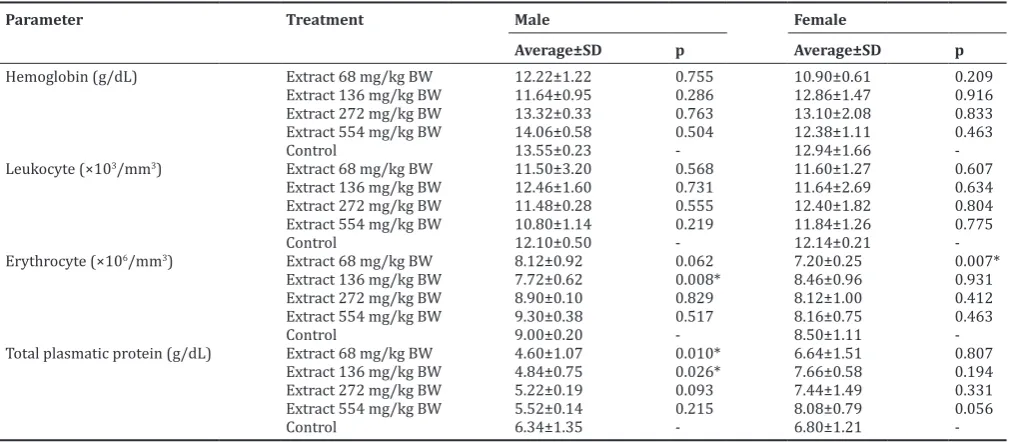
Parameters of rat’s blood hematological test include hemoglobin, erythrocyte, leucocyte and total plasmatic protein as shown in Table 5. There were no significant differences in hematologic parameters between treated and control groups. From statistical analysis, significance values of hemoglobin, leukocyte, and total protein are 0.07, 0.890, and 0.219, respectively, whereas erythrocyte is significantly different. This difference is clearly shown between male Group II (p=0.008) and female Group I (p=0.007); however, average level of erythrocyte is still normal, that is, 6.7-20×106 mm3 [17]. Moreover, the
272
Asian J Pharm Clin Res, Vol 10, Issue 2, 2017, 270-273 Fitrya et al.
on the BW, hematologic and biochemical parameters, and macroscopic organs. They indicated no death observed and no significant differences in motoric activity, BW, biochemical and hematologic parameters, and macroscopic organs between treated and control groups. The results showed that ethanol extracts of tunjuk langit rhizome in dose 68, 136, 272 and 554 mg/kg BW had no significant toxicity.
ACKNOWLEDGMENT
We gratefully acknowledge the support Sriwijaya University, sponsored by “Penelitian Hibah Bersaing,” Ministry of Research Technology and Higher Education, Indonesia. The authors would also like to thank Dr. Mokhamad Yusup Nur Khakim for his very helpful assistance and suggestions of this manuscript.
REFERENCES
1. Murakami T, Hagiwara M, Tanaka K, Chen CM. Chemicshe untersuchungen uber die inhaltsstoffe von Helminthostachys zeylanica (L). Chem Pharm Bull 1973;21:1851-2.
2. Chen CC, Huang YL, Yeh PY, Ou JC. Cyclized geranyl stilbenes from the rhizomes of Helminthostacys zeylanica. Planta Med 2003;69(10):964-7.
3. Fitrya, Anwar L, dan Eliza M. Ugonin J flavonoid from tunjuk langit (Helmynthostchys zeylanica) root extract. Indones J Chem Univ Gadjahmada 2010;10:226-31.
4. Muharniic F. Antioxidant Flavonoids from Tunjuk Langit (Helminthostachys zaylana), Proceeding of International Seminar Exploring Research Potentials, Palembang; 2011.
5. Huang YL, Yeh PY, Shen CC, Chen CC. Antioxidant flavonoids from the rhizomes of Helminthostachys zeylanica. Phytochemistry 2003;64(7):1277-83.
6. Huang YC, Hwang TL, Chang CS, Yang YL, Shen CN, Liao WY, et al. Anti-inflamatory flavonoids from the rhizome of Helminthostachys zeylanica. Nat Prod 2009;72(7):1273-8.
7. Fitrya. Secondary metabolite from endophitic fungi cohlibulus lunatus of tunjuk langit (Helminthostachys zaylanica) rhizome. Indones J Chem 2013;13(3):193-8.
8. Suja SR, Latha PG, Pushpangadan P, Raasekharan S. Aphrodisiac property of Helminthostachys zaylanica in male mice. J Trop Med Plants 2002;3:191-5.
9. Suja SR, Latha PG, Pushpangadan P, Rajasekharan S. Evaluation of hepatoprotective effects of Helminthostachys zeylanica (L.) Hook against carbon tetrachloride-induced liver damage in Wistar rats. J Ethnopharmacol 2004;92(1):61-6.
10. Fitrya, Muharni. An antihyperuricemia effect of ethanol extract of tunjuk langit rhizome (Helminthostachys zaylanica Linn Hook) on
Table 5: The results of hematologic evaluation
Parameter Treatment Male Female
Average±SD p Average±SD p
Hemoglobin (g/dL) Extract 68 mg/kg BW 12.22±1.22 0.755 10.90±0.61 0.209
Extract 136 mg/kg BW 11.64±0.95 0.286 12.86±1.47 0.916
Extract 272 mg/kg BW 13.32±0.33 0.763 13.10±2.08 0.833
Extract 554 mg/kg BW 14.06±0.58 0.504 12.38±1.11 0.463
Control 13.55±0.23 - 12.94±1.66
-Leukocyte (×103/mm3) Extract 68 mg/kg BW 11.50±3.20 0.568 11.60±1.27 0.607
Extract 136 mg/kg BW 12.46±1.60 0.731 11.64±2.69 0.634
Extract 272 mg/kg BW 11.48±0.28 0.555 12.40±1.82 0.804
Extract 554 mg/kg BW 10.80±1.14 0.219 11.84±1.26 0.775
Control 12.10±0.50 - 12.14±0.21
-Erythrocyte (×106/mm3) Extract 68 mg/kg BW 8.12±0.92 0.062 7.20±0.25 0.007*
Extract 136 mg/kg BW 7.72±0.62 0.008* 8.46±0.96 0.931
Extract 272 mg/kg BW 8.90±0.10 0.829 8.12±1.00 0.412
Extract 554 mg/kg BW 9.30±0.38 0.517 8.16±0.75 0.463
Control 9.00±0.20 - 8.50±1.11
-Total plasmatic protein (g/dL) Extract 68 mg/kg BW 4.60±1.07 0.010* 6.64±1.51 0.807
Extract 136 mg/kg BW 4.84±0.75 0.026* 7.66±0.58 0.194
Extract 272 mg/kg BW 5.22±0.19 0.093 7.44±1.49 0.331
Extract 554 mg/kg BW 5.52±0.14 0.215 8.08±0.79 0.056
Control 6.34±1.35 - 6.80±1.21
-*Significantly different from control group. BW: Body weight, SD: Standard deviation
Table 6: Relative organ weight of tested and control rats Group Gender ROW of liver ROW of heart ROW of
kidney
×10−2 p ×10−3 p ×10−3 p
I Male 2.65±1.0 0.744 3.7±1.4 0.995 5.9±1.8 0.694 Female 3.25±0.0 0.277 3.4±0.1 0.938 7.0±0.9 0.245 II Male 2.95±0.0 1.000 3.5±0.3 0.992 7.2±1.8 0.997 Female 3.54±0.1 0.902 4.2±1.5 0.700 7.5±2.1 0.755 III Male 3.85±1.3 0.300 4.0±1.1 0.985 8.1±1.8 0.894 Female 3.92±0.0 0.076 3.8±0.4 0.645 8.8±1.7 0.420 IV Male 2.93±3.8 0.823 4.2±0.3 0.974 7.7±0.6 0.851 Female 3.06±0.0 0.341 2.9±0.4 0.938 5.8±1.1 0.368
V Male 3.25±1.0 - 4.2±0.7 - 8.5±0.9
-Female 3.31±0.0 - 3.0±0.7 - 6.8±1.8
-ROW: Relative organ weight
This study also carried out a macroscopic evaluation on vital organs (i.e., liver, heart, and kidney). This analysis aims to correlate toxic properties with changes in the organ structure of treated rats. From the macroscopic evaluation including color, appearance, and ROW showed that there were not significantly different and no specific anomalies on treated groups compared to control group. There were no lesion, inflammation or fattening on liver. Moreover, the color and physical appearance were normal. Statistical analysis showed no influence the extract administration to ROWs of liver (p=0.88), heart (p=0.952), and kidney (p=0.332). It can be indicated that there were no significant differences between treated and control group as shown in Table 6.
Overall, this study showed that there were insignificant differences in observed parameters between treated and control rats during extract administration. Thus, it can be said that this extract can be continuously consecutive consumed for long-term. In fact, the extract has properties as hepatoprotective [18] and neuroprotective [19]. Finally, the results of this study provide important information of the use of the tunjuk langit rhizome as traditional medicine, especially in South Sumatra, Indonesia.
CONCLUSION
In this study, we evaluate the subchronic toxicity of ethanol extract of tunjuk langit rhizome (Helminthostachys zeylanica) on albino rats,
273
Asian J Pharm Clin Res, Vol 10, Issue 2, 2017, 270-273 Fitrya et al.
Swiss furrow male mice. Traditional Med J 2014;19(1):4-18. Available from: https://www.jurnal.ugm.ac.id/TradMedJ/article/view/8085. 11. Departement Kesehatan RI. Pedoman pelaksanaan uji klinik obat
tradisional. Direktorat Jenderal Pengawasan Obat dan Makanan. Direktorat Pengawasan Obat Tradisional. Jakarta: Departement Kesehatan RI; 2002.
12. Fitrya, Muharni. Standardisasi Ekstrak Aktif Akar Tunjuk Langit, Seminar Nasional Biodiversitas. Solo, Indonesia: Universitas Negeri Surakarta; 2013.
13. Ditjen POM Depkes RI. Parameter Standar Umum Ekstrak Tumbuhan Obat, Direktorat Jenderal Pengawasan Obat dan Makanan, Direktorat Pengawasan Obat Tradisional. Jakarta: Departemen Kesehatan; 2000.
14. Vilash V, Suja SR, Latha PG, Shine VJ, Sekharan SR. Chronic oral toxicity studies of ethanolic extract and ethanolic fraction extract of PellioniaHeyneana wedd. Leaf in Wistar rats. Int J Pharm Pharm Sci 2016;8(8):306-12.
15. El Hilaly J, Israili ZH, Lyoussi B. Acute and chronic toxicological studies of Ajuga iva in experimental animals. J Ethnopharmacol 2004;91(1):43-50.
16. Lewis RW, Billington R, Debryune E, Gamer A, Lang B, Carpanini F. Recognition of adverse and nonadverse effects in toxicity studies. Toxicol Pathol 2002;30(1):66-74.
17. Mitruka BM, Rawnsley HM. Clinical Biochemical and Hematological Reference Values in Normal Experimental Animals and Normal Humans. 2nd ed. New York: Masson; 1981.
18. Suja SR, Latha PG, Pushpangadan P, Shine VJ, Anuja GI, Bijukumar BS. Evaluation of antihepatotoxic potential of Helminthostachys zeylanica (Linn.) Hook. f., A medicinal fern against ethanol induced liver damage: In vitro and in vivo studies. Am J Exp Biol 2014;1(1):16-30.