Page 52
The value of x that maximizes the volume fo the box is in the
interval [0, 8] and can occur at either 0, 8 or at some critical number which satisfies the calculation V'(x) = 0. The values of 0 and 8 do not make sense as far as possibilities so therefore we must determine the critical values.
Since x = 8 was eliminated previously, the value of x that yields the maximum volume is
Page v
Contents
Chapter 1: Functions, Sequences, Limits, and Continuity
1
Chapter 2: Differentiation
17
Chapter 3: Maxima and Minima
35
Chapter 4: Differentiation of Special Functions
53
Chapter 5: The Law of the Mean, Indeterminate Forms, Differentials, and Curve Sketching
69
Chapter 6: Fundamental Integration Techniques and Applications 89
117
Appendix A: Differentiation Formulas for Common Mathematical Functions 129
Appendix B: Integration Formulas for Common Mathematical Functions 131
Index
Page i
Page iv Frank Ayres, Jr., was formerly Professor and Head of the
Department of Mathematics at Dickinson College, Carlisle, Pennsylvania.
Elliot Mendelson is Professor of Mathematics at Queens College.
George J. Hademenos has taught at the University of Dallas and performed research at the University of California at Los Angeles and the University of Massachusetts Medical Center. He earned a B.S. degree in Physics from Angelo State University and the M.S. and Ph.D. degrees in Physics from the University of Texas at Dallas. Copyright © 2000 by The McGraw-Hill Companies, Inc. All Rights Reserved. Printed in the United States of America. Except as
permitted under the Copyright Act of 1976. no part of this
publication may be reproduced or distributed in any form or by any means, or stored in a data base or retrieval system, without the prior written permission of the publisher.
1 2 3 4 5 6 7 8 9 10 11 12 13 14 15 DOC DOC 9 0 9 8 7 6 5 4 3 2 1 0 9
ISBN 0-07-052710-5
Sponsoring Editor: Barbara Gilson Production Supervisor: Tina Cameron Editing Supervisor: Maureen B. Walker
Page 1
Chapter 1
Functions, Sequences, Limits, and Continuity
In this chapter:
• Function of a Variable • Graph of a Function • Infinite Sequence • Limit of a Sequence • Limit of a Function • Right and Left Limits • Theorems on Limits • Continuity
• Solved Problems
Function of a Variable
A function is a rule that associates, with each value of a variable x in a certain set, exactly one value of another variable y. The variable y is then called the dependent variable, and x is called the
change in a function y = f(x) evaluated between x = xo and x = xo +
Page 35
Chapter 3
Maxima and Minima
In this chapter:
• Tangents • Normals
• Angle of Intersection
• Maximum and Minimum Values
• Applied Problems Involving Maxima and Minima • Solved Problems
Page 53
Chapter 4
Differentiation of Special Functions
In this chapter:
• Differentiation of Trigonometric Functions
• Differentiation of Inverse Trigonometric Functions
• Differentiation of Exponential and Logarithmic Functions • Differentiation of Hyperbolic Functions
Page 69
Chapter 5
The Law of the Mean, Indeterminate Forms,
Differentials, and Curve Sketching
In this chapter: f'(x) exists everywhere on the interval except possibly at the
endpoints, then f'(x) = 0 for at least one value of x, say x = xo,
Page 89
Chapter 6
Fundamental Integration Techniques and Applications
In this chapter:
• Fundamental Integration Formulas •Integration by Parts
• Trigonometric Integrals • Trigonometric Substitutions • Integration by Partial Fractions • Miscellaneous Substitutions • Other Substitutions
• Integration of Hyperbolic Functions •Applications of Indefinite Integrals •Solved Problems
If F(x) is a function whose derivative F'(x) = f(x) on a certain interval of the x axis, then F(x) is called an antiderivative or indefinite
Page 117
Chapter 7
The Definite Integral, Plane Areas by Integration,
Improper Integrals
In this chapter: • Riemann Sums
• The Definite Integral
• Plane Areas by Integration • Improper Integrals
• Solved Problems
Riemann Sums
Let be an interval on which a given function f(x) is
continuous. Divide the interval into n subintervals h1, h2, . . ., hn by
the insertion of n- 1 points 1, 2, . . ., n-1, where a < 1 < 2 < n-1 <
b, and relabel a as o and b as n. Denote the length of the subinterval
Page 129
Appendix A
Differentiation Formulas for Common Mathematical
Functions
Polynomial Functions
Page 131
Appendix B
Integration Formulas for Common Mathematical
Functions
Polynomial Functions
Page 133
Average rate of change,
8
C
Chain rule,
23-24
Concavity,
Derivatives of higher order,
27-28
Differentials
approximations,
rules,
Extended law of mean,
Page ii Other Books in Schaum's Easy
Outline Series include:
Schaum's Easy Outline: College Algebra
Schaum's Easy Outline: College Physics
Schaum's Easy Outline: Statistics
Schaum's Easy Outline: Programming in C++
Schaum's Easy Outline: College Chemistry
Schaum's Easy Outline: French
Schaum's Easy Outline: Spanish
Schaum's Easy Outline: German
Page iii
Schaum's Easy Outlines Calculus
Based on Schaum's
Outline of Differential and Integral Calculus by Frank Ayres, Jr. and
Elliot Mendelson
Abridgement Editor: George J. Hademenos
SCHAUM'S OUTLINE SERIES MCGRAW-HILL
Page 37 The equation of the tangent is y - 4 = 4(x - 2) or y = 4x - 4.
The equation of the normal is
Example 3.2 Find the equation of the line containing the point (2, -2), which is tangent to the hyperbola x2 - y2 = 16.
Let Po(xo, yo) be the point of tangency. Then, Po is on the hyperbola,
so
Also,
Hence, at (xo, yo), the slope of the line joining Po and (2, -2) is
Then,
or
5x - 3y = 16
Angle of Intersection
Page 79
Example 5.9 Find dy for each of the following:
Approximations By Differentials
If dx = x is relatively small when compared with x, dy is a fairly good approximation of y, that is, .
Example 5.10 Take y = x2 + x + 1, and let x change from x = 2 to x
= 2.01. The actual change in y is y = [(2.01)2 + 2.01 + 1] - (22 + 2 +
1) = 0.0501. The approximate change in y, obtained by taking x = 2 and dx = 0.01, is dy = f'(x) dx = (2x + 1) dx = [2(2) + 1](0.01) = 0.05.
Approximations of Roots of Equations
Let x = x1 be a fairly close approximation of a root r of the equation
y = f(x) = 0, and let . Then y1 differs from 0 by a small
amount. Now if x1 were changed to r, the corresponding change in
f(x1) would be y1 = - y1. An approximation of this change in x1 is
Page 82
Extent
The horizontal extent of a curve is given by the values of x, for which the curve exists. The vertical extent is given by the range of y. A point (xo, yo) is called an isolated point of a curve if its
coordinates satisfy the equation of the curve while those of no other nearby point do.
Asymptotes
An asymptote of a curve is a line that comes arbitrarily close to the curve as the abscissa or ordinate of the curve approaches infinity. Specifically, given a curve y = f(x), the vertical asymptotes x = a can be described by the infinite limits: . Likewise, the
horizontal asymptotes y = b can be defined as the limits at infinity: .
The maximum and minimum points, points of inflection, and concavity of a curve are discussed in Chapter 4.
Example 5.12 Discuss and sketch the curve y2(1 + x) = x2(1 - x).
Page 8 Theorems on Limits
The following theorems on limits are listed for future reference:
Theorem 1-1: If f(x) = c, a constant, then .
Theorem 1-2: , where k is any constant
Theorem 1-3:
Theorem 1-4:
Theorem 1-5:
Theorem 1-6:
Continuity
A function f(x) is called continuous if it is continuous at every point of its domain. A function f(x) is continuous at x = xo if f(xo) is
exists; .
Page 23 Then, by Rule 12,
The Chain Rule
For two functions f and g, the function given by the formula f(g(x)) is called a composite function. If f and g are differentiable, then so is the composite function, and its derivative may be obtained by either of two procedures. The first is to compute an explicit formula for f(g(x)) and differentiate.
Example 2.7 If f(x) = x2 + 3 and g(x) = 2x + 1, then
The derivative of a composite function may also be obtained with the following role:
Rule 13. The Chain Rule: Dx(f(g(x))) = f'(g(x))g'(x)
If f is called the outer function and g is called the inner function, then Dx(f(g(x))) is the product of the derivative of the outer function
[evaluated at g(x)] and the derivative of the inner function.
Page 44 Example 3.5 Examine y = |x| for maximum and minimum values.
The function is everywhere defined and has a derivative for all x except x = 0. Thus, x = 0 is a critical value. For x < 0, f'(x) = - 1; for x > 0, f'(x) = + 1. The function has a minimum (= 0) when x = 0.
Concavity
An arc of a curve y = f(x) is called concave upward if, at each of its points, the arc lies above the tangent at that point. As x increases, f'(x) either is of the same sign and increasing (as on the interval b < x < s of Figure 3-3) or changes sign from negative to positive (as on the interval c < x < u). In either case, the slope f'(x) is increasing hence f"(x) > 0.
An arc of a curve y = f(x) is called concave downward if, at each of its points, the arc lies below the tangent at that point. As x increases, f'(x) either is of the same sign and decreasing (as on the interval s < x < c of Figure 3-3) or changes sign from positive to negative (as on the interval a < x < b). In either case, the slope f'(x) is decreasing and f"(x) < 0.
Point of Inflection
A point of inflection is a point at which a curve changes from concave upward to concave downward, or vice versa. In Figure 3-3, the points of inflection are B, S, and C. A curve y = f(x) has one of its points x = xo as an inflection point if f''(xo) = 0 or is not defined
and f''(x) changes sign between points x < xo and x > xo. (The latter
condition may be replaced by when f'"(xo) exists.)
Page 39 Maximum and Minimum Values
Increasing and Decreasing Functions
A function f(x) is said to be increasing on an open interval if u < v implies f(u) < f(v) for all u and v in the interval. A function f(x) is said to be increasing at x = xo if f(x) is increasing on an open interval
containing xo. Similarly, f(x) is decreasing on an open interval if u <
v implies f(u) > f(v) for all u and v in the interval, and f(x) is decreasing at x = xo if f(x) is decreasing on an open interval
containing xo.
If f'(xo) > 0, then it can be shown that f(x) is an increasing function at
x = xo; similarly, if f'(xo) < 0, then f(x) is a decreasing function at x =
xo. If f'(xo) = 0, then f(x) is said to be stationary at x = xo.
In Figure 3-3, the curve y = f(x) is rising (the function is increasing) on the intervals a < x < r and t < x < u; the curve is falling (the function is decreasing) on the interval r < x < t. The function is stationary at x = r, x = s, and x = t; the curve has horizontal tangents at points R, S, and T. The values of x (that is, r, s, and t), for which the function f(x) is stationary [that is, for f'(x) = 0] are critical values for the function, and the corresponding points (R, S, and T) of the graph are called critical points of the curve.
Page 81
Then,
Thus, to four decimal places, the roots are 1.0217 and -1.0217.
Curve Sketching
Symmetry
A curve is symmetric with respect to:
1. The x axis, if its equation is unchanged when y is replaced by -y, that is, f(x) = y and f(x) = -y both hold.
2. The y axis, if its equation is unchanged when x is replaced by -x, that is f(-x) = f(x).
3. The origin, if its equation is unchanged when x is replaced by -x and y by -y, simultaneously, that is, f(-x) = - f(x).
4. The line y = x, if its equation is unchanged when x and y are interchanged, that is, y = f(x) implies x = f(y).
Intercepts
Page 118 by , of h2 by , . . ., of hn by . (This is done
in Figure 7-1. The lengths are directed distances, each being positive in view of the above inequality.) On each subinterval, select a point (x1 on the subinterval hl, x2 on h2, . . ., xn on hn) and form the
Riemann sum
each term being the product of the length of a subinterval and the value of the function at the selected point on that subinterval. Denote by n the length of the longest subinterval appearing in Eq. (7.1).
Now let the number of subintervals increase indefinitely in such a manner that . (One way of doing this would be to bisect each of the original subintervals, then bisect each of these, and so on.) Then
exists and is the same for all methods of subdividing the interval , so long as the condition is met, and for all choices of the points xk in the resulting subintervals.
Figure 7-1
The Definite Integral
Theorem: The fundamental theorem of calculus states the
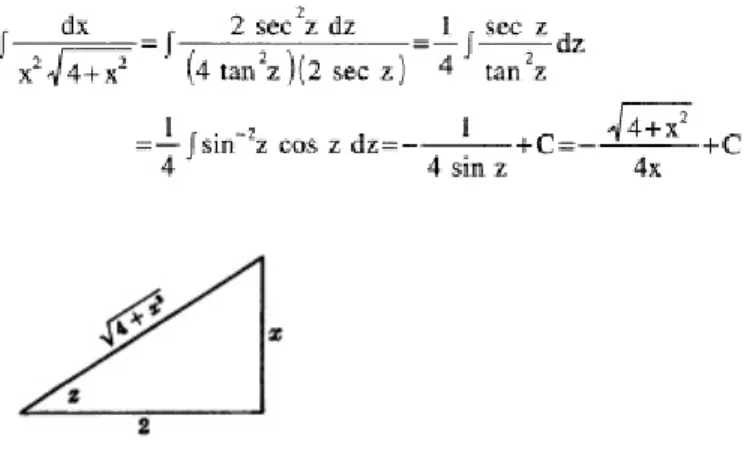
Page 100 In each case, integration yields an expression in the variable z. The corresponding expression in the original variable may be obtained by the use of a right triangle as shown in the following example.
Example 6.8 Find
Let x = 2 tan z, so that x and z are related as in Figure 6-1. Then dx = 2 sec2z dz and , and
Figure 6-1
Integration by Partial Fractions
A polynomial in x as a function of the form ,
where the a's are constants, , and n, called the degree of the polynomial, is a nonnegative integer.
and real irreducible quadratic factors of the form ax2 + bx + c. (A
Page 27 when |x| < 3 and y < 0. This describes an ellipse determined by the given equation, which should be thought of as consisting of two arcs joined at the points (-3, 0) and (3, 0).
Derivatives of Higher Order
• The first method is to differentiate implicitly the derivative of one lower order and replace y' by the relation previously found.
Page 77
Then,
and is of the type 0/0. L'Hospital's role gives
since , and the last limit above is of the type 0/0. L'Hospital's role now gives
Since
Differentials
For the function y = f(x), we define the following:
1. dx, called the differential of x, given by the relation dx = x
Page 57
Now, we can define the trigonometric functions in terms of the usual variable x (rather than denoting the angle argument ). Then, we can derive the following formulas:
Page 61 Let In x = logex. Then In x is called the natural logarithm of x. See
also Figure 4-5. The domain of logax is x > 0; the range is the set of
real numbers.
Figure 4-5.
Differentiation Formulas
Page 62 Example 4.6 Find the first derivative of y = 1n sin 3x.
Logarithmic Differentiation
If a differentiable function y = f(x) is the product and/or quotient of several factors, the process of differentiation may be simplified by taking the natural logarithm of the function before differentiation since
This amounts to using the formula
Example 4.7 Use logarithmic differentiation to find the first derivative, given the function y = (x2 + 2)3(1 + x3)4.
Differentiation of Hyperbolic Functions
Page 25 Higher Derivatives
Let y = f(x) be a differentiable function of x, and let its derivative be called the first derivative of the function. If the first derivative is differentiable, its derivative is called the second derivative of the (original) function and is denoted by one of the symbols
In turn, the derivative of the second derivative is called the third derivative of the function and is denoted by one of the symbols
and so on.
Note!
The derivative of a given order at a point can exist only when the function and all
derivatives of lower order are differentiable at the point.
Example 2.11 Given
which suggests f(n)(X) = 2(n!)(1- x)-(n+1). This result may be
Page 21
Example 2.4 Differentiate .
Inverse Functions
Two functions f and g such that g(f(x)) = x and f(g(y)) = y are said to be inverse functions. Inverse functions reverse the effect of each other. Specifically, if f(a) = b, then g(b) = a.
Page 58
Differentiation of Inverse Trigonometric Functions
The Inverse Trigonometric Functions
If x = sin y, the inverse function is written y = arcsin x. (An
alternative notation is y = sin-1 x.) The domain of arcsin x is ,
which is the range of sin y. The range of arcsin x is the set of real numbers, which is the domain of sin y. The domain and range of the remaining inverse trigonometric functions may be established in a similar manner.
The inverse trigonometric functions are multivalued. In order that there be agreement on separating the graph into single-valued arcs, we define in Table 4-3 one such arc (called the principal branch) for each function. In Figure 4-4, the principal branches are indicated by a thicker curve.
y = arcsec x
Page 18
is called the average rate of change of the function on the interval between x = xo and x = xo+ x.
Example 2.1 When x is given the increment x = 0.5 from xo= 1, the
function y = f(x) = x2 + 2x is given the increment y = f(1 + 0.5)
-f(1) = 5.25 - 3 = 2.25. Thus, the average rate of change of y on the interval between x = 1 and x = 1.5 is
The derivative of a function y = f(x) with respect to x at the point x = xo is defined as
provided the limit exists. This limit is also called the instantaneous rate of change of y with respect to x at x = xo.
Example 2.2 Find the derivative of y = f(x) = x2 + 3x with respect to
x at x = xo. Use this to find the value of the derivative at (a) xo = 2
Page 20 Differentiation Rules
In the following formulas, u, v, and w are differentiable functions of x, and c and m are constants.
Page 9 other words, we ignore what happens to the left of a and to the right of b. A function f(x) is discontinuous at x = xo if one or more of the
conditions for continuity fails there.
Example 1.9. Determine the continuity of:
(a) This function is discontinuous at x = 2 because f(2) is not defined (has zero as denominator) and because does not exist (equals
).
The function is, however, continuous everywhere except at x = 2, where it is said to have an infinite discontinuity. See Figure 1-5.
Figure 1-5
(b) This function is discontinuous at x = 2 because f(2) is not defined (both numerator and denominator are zero), however
Page 102 Case I: Distinct Linear Factors
To each linear factor ax + b occurring once in the denominator of a proper rational fraction, there corresponds a single partial fraction of the form
.
where A is a constant to be determined by the solution of simultaneous equations.
Example 6.10 Find .
We factor the denominator into (x - 2)(x + 2) and write
Clearing of fractions yields:
or
We can determine the constants by either of two methods.
General Method: Equate coefficients of like powers of x in Eq. (6-18) and solve simultaneously for the constants. Thus,
Page 104
For x = - 1, 2 = 4A, and A = 1/2. For x = 1, 8 = 2C and C = 4. To determine the remaining constant, we use any other value of x, say x = 0; for x = 0, 5 = A - B + C and B = - 1/2. Thus,
Case III: Distinct Quadratic Factors
To each irreducible quadratic factor ax2 + bx + c occurring once in
the denominator of a proper rational fraction, there corresponds a single partial fraction of the form
where A and B are constants to be determined.
Example 6.12 Find
. We write
Page 60 Example 4.3 Find the first derivative of y = arctan 3x2.
Example 4.4 Find the first derivative of .
Differentiation of Exponential and Logarithmic Functions
Define the number e by the equation
Then e also can be represented by lim (1 + k)1/k. In addition,
it can also be shown that
Called the ''natural'' number or Euler's number, e will serve as a base for the natural logarithm function.
Assume a > 0 and . If ay = x, then define y = logax. That is, x = ay
Page 71 there is at least one point x = xo between a and b where the tangent is
parallel to the x axis. (See Figure 5-1.)
Example 5.1 Find the value of xo prescribed in Rolle's theorem for
f(x) = x3 - 12x on the interval .
f'(x) = 3x2 - 12 = 0 when x = ±2; then xo = 2 in the prescribed value.
The Law of the Mean
If f(x) is continuous on the interval , and if f'(x) exists everywhere on the interval except possibly at the endpoints, then there is at least one value x = xo, between a and b, such that
Also known as the mean-value theorem, this means, geometrically, that if P1 and P2 are two points of a continuous curve that has a
tangent at each intermediate point between P1 and P2, then there
exists at least one point of the curve between P1 and P2 at which the
Page 103
By either method, we have
Then,
Case II: Repeated Linear Factors
To each linear factor ax + b occurring n times in the denominator of a proper rational fraction, there corresponds a sum of n partial fractions of the form:
where the A's are constants to be determined.
Example 6.11 Find
Page 105 Hence A + C = 1, B + D = 1, 2A + C = 1, and 2B + D = 2. Solving simultaneously yields A = 0, B = 1, C = 1, D = 0. Thus,
Case IV: Repeated Quadratic Factors
To each irreducible quadratic factor ax2 + bx + c occurring n times in
the denominator of a proper rational fraction, there corresponds a sum of n partial fractions of the form:
where the A's and B's are constants to be determined. Example 6.13 Find
We write
Page 24 You Need To Know
An alternative formulation of the chain rule is the following: Write y = f(u) and u = g(x). Then the composite function is y = f(u) = f(g(x)), and we have.
The Chain Rule:
Example 2.9 Let y = u3 and u = 4x2 - 2x + 5. Then the composite
function y = (4x2 - 2x + 5)3 has the derivative:
Note: In the second formulation of the chain rule,
the y on the left denotes the composite function of x, whereas the y on the right denotes the original function of u (what we called the outer function before).
Page 40 Relative Maximum and Minimum
Values of a Function
A function f(x) is said to have a relative maximum at x = xo if f(xo)
for all x in some open interval containing xo, that is, if the
value of f(xo) is greater than or equal to the values of f(x) at all
nearby points. A function f(x) is said to have a relative minimum at x = xo if for all x in some open interval containing xo, that is,
if the value of f(xo) is less than or equal to the values of f(x) at all
nearby points.
In Figure 3-3, R(r, f(r)) is a relative maximum point of the curve since f(r) > f(x) on any sufficiently small neighborhood 0 < |x - r| < . We say that y = f(x) has a relative maximum value (= f(r)) when x = r. In the same figure, T(t, f(t)) is a relative minimum point of the curve since f(t) < f(x) on any sufficiently small neighborhood 0 < |x -t| < . We say that y = f(x) has a relative minimum value (= f(t)) when x = t. Note that R joins an arc AR which is rising (f'(x) > 0) and an arc RB which is falling (f'(x) < 0), while T joins an arc CT which is falling (f'(x) < 0) and an arc TU which is rising (f'(x) > 0). At S, two arcs BS and SC, both of which are falling, are joined; S is
neither a relative maximum point nor a relative minimum point of the curve.
If f(x) is differentiable on and if f(x) has a relative maximum (minimum) value at x = xo, where a < xo < b, then f'(xo) = 0.
First Derivative Test
continuous.
1. Solve f'(x) = 0 for the critical values.
2. Locate the critical values on the x axis, thereby establishing a number of intervals.
3. Determine the sign of f'(x) on each interval.
4. Let x increase through each critical value x = xo; then:
(a) f(x) has a maximum value f(xo) if f'(x) changes from + to -(Figure
Page 90
All indefinite integrals of f(x) = 2x are then described by the general form of the antiderivative F(x) = x2 + C, where C, called the constant
of integration, is an arbitrary constant.
The symbol is used to indicate the indefinite integral of f(x) where the function f(x) is called the integrand. Thus we write
where dx denotes the antiderivative being taken with respect to x.
Fundamental Integration Formulas
A number of the formulas below follow immediately from the standard differentiation formulas of earlier sections, while others may be checked by differentiation. Formula 25 displayed below, for example, may be checked by showing that
Absolute value signs appear in several of the formulas. For example, for Formula 5 displayed below, we write
Page 96
Reduction Formulas
The labor involved in successive applications of integration by parts to evaluate an integral may be materially reduced by the use of reduction formulas.
Note!
Page 101 Remember!
If two polynomials of the same degree are equal for all values of the vanable, then the coefficients of the like powers of the vanable in the two polynomials are equal.
factored into polynomials of lower degree.) By the quadratic
formula, ax2 + bx + c is irreducible if and only if b2 - 4ac < 0. (In that
case, the roots of ax2 + bx + c = 0 are not real.)
Example 6.9
(a) x2 - x + 1 is irreducible, since (- 1)2 - 4(1)(1) = - 3 < 0.
(b) x2 - x - 1 is not irreducible, since (- 1)2 - 4(1)(- 1) = 5 > 0 In fact,
A function F(x) = f(x)/g(x), where f(x) and g(x) are polynomials, is called a rational fraction. If the degree of f(x) is less than the degree of g(x), F(x) is called proper; otherwise, F(x) is called improper. An improper rational fraction can be expressed as the sum of a polynomial and a proper rational fraction. Thus,
Every proper rational fraction can be expressed (at least,
theoretically) as a sum of simpler fractions (partial fractions) whose
positive integer.