soils from the Islands of Okinawa and Java
Article in Australian Journal of Soil Research · January 1998 DOI: 10.1071/S97084
CITATIONS
5
READS
112
5 authors, including:
Some of the authors of this publication are also working on these related projects:
Variation of the Soil Layers Developed on the Past Depositional Series on Merbabu VolcanoView project Mohammad Nurcholis
Universitas Pembangunan Nasional "Veteran" Yogyakarta Indonesia
12PUBLICATIONS 13CITATIONS SEE PROFILE
All content following this page was uploaded by Mohammad Nurcholis on 09 September 2015.
Aust.
J. Soil
Res.,1998, 36, 411-21Relationship between clay mineralogy
and
exchangeable
Al
in
red
and yellow
soils
from
the
Islands
of
Okinawa and
Java
Mohammad
Nurchoti.fc,
Yosh'ihiro Tokashi,ki,^,Kazuh'iro
oyaA, Moritaka
sh,imoA,and
N obofumi, Miyauchi,B A Colleg" of Agriculture,University of the Ryukyus, Okinawa, 903-01 Japan.
"
Facultyof
Agriculture, Kagoshima University, Kagoshima, Japan.^
Corresponding author; email: [email protected]."
Permanent address: Department of Soil Science, Faculty of Agriculture,University of Pembangunan Nasional'Veteran', Yogyakarta, Indonesia.
Abstract
Red and yellow soils from tropical regions are generally more mature than
their
subtropical counterparts. Most of these soils contain kaolin as the dominant clay mineral. Exchangeable aluminium(Al)
generally balances permanent negative charges and occupies stronglyLidic
exchange sites of the soil clay. The objective of this study was to identify those claymineralsthat
aremost highly
implicatedin
contributing exchangeableAl
to
red
and yellow soils collected from the Islands of Okinawa and Java.All
soils exhibited an acid reactionbut
variedin
their
exchangeableAl
coptent and clay mineralogy.Clay
content washigh
in all
Javan soilsbut
variedin
thosefrom
Okinawa. Javan soils were dominatedby
kaolinite, and Okinawan soilsby
an associationof
illite
andhalloysite.
However,2:l-2:1:1
intergrades rvere significant componentsin
both the oku
red soils (Okinawa Island) and
the
Pamagersari red soils (JaraIsland).
Javan soils werecharacterised
by
a
more mature (advanced) stateof
weatheringthan
thosefrom
Okinawa. The source of exchangeableAl
was halloysitein
Okinawan soils and2:I-2:1 :1
intergra.desin
Javan soils.Ad'ditional heyuord,s:
2:r-2:1:1
intergrade minerals,clay content,
halloysite, kaolinite, weathering process.Introduction
Red and yellow soils
in
the
tropics differ
from
those
in
subtropical
regionswith
respect
to
the maturity of
soil development.
In
the
tropics,
the
soils
areclay-textured
and acidic
in nature,
and
the
weathering
processat its
most mature
stage results
in
clay minerals
of
the
1 :1 group (Goenadi and
ran
19gg;
Hirai
et
al. l99l).
some 2: 1 group minerals,
however,
may
also
occur
in
these
soils(Bennema
1962).The
2:
1
type
minerals
possessa
permanent negative
charge
resulting from
isomorphic substitution
in
the
octahedral
(Mgr+
for
Al3+) and/or
tetrahedral
(Al3+
for
Si4+)
sheet
of the
clay
lattices.
Under acidic conditions aluminium
(Al)
is
mobilised and, having
a
positive
charge,
will
be attracted
to
negatively
charged sites
in
the clay structure
to
form
exchangeableAl.
Marshall (roao)
ani
Pratt
and
Bair
(1961) postulated
that the
permanent negative
charge
of
clayminerals contributes
to
the
occurrence
of
exchangeableAl in
soils. Minerals of
1
i
ri )
1
@ CSIRO Australia 1998 0004-9573
the
2:1
type
also have
an ability
to fix
Al
in
their
interlayer
space.
Intercalation
of
Al in
the
interlayer region
of
swelling
2 :1 silicates
leads
to
the
blocking of
the
interlayers and
the
resultant
formation
of
2:l-2:1:1 intergrades
similar in
characteristics
to
Al-chlorite (Dixon and
Jackson 1962; Carstea
et aI.
Ig70).
This type
of
interlayering
is very
common
in
most naturally acid
soils,
not only
in
those
from
the
tropics
(Uehara
and Gillman 1981).
Generally
2:L-2:7:L
intergrades
constitute
a
resource
of
exchangeableAl
in
acid
soils. Goenadi
andTan
(1989)
reported
that
Oxisols and
Ultisols,
which contain hydroxy-interlayered
vermiculite,
have
a high
exchangeableAl
content.
Data
from
Hirai
et
al. (1991), however, show that
red and yellow soils
from
subtropical
regions that
are dominated by kaolin
also have
a high
exchangeableAl
content.
Shamshuddin
and
Ismail
(1995) reported
that
Malaysian
Ultisols,
which
contain kaolinite
and
mica-chlorite
as
the
dominant
clay
mineral,
hada
higher content
of
exchangeable
Al
than
Oxisols,
which were dominated
by
kaolinite, gibbsite, and
geothite.
M.
Nurcholis
et aI.
(1997) have
developed
asimple method
to
predict the
content
of
exchangeableAl
in
red-yellow soils
with
pH on
apower regression.
In that
study
interesting characteristics
were displayedin
the
buffer curve,
particularly
in
the
relationship
between exchangeable
Al
and clay contentfclay mineralogy.
It
was
the
objective
of
this
study
to
report
those clay minerals
that
are
associatedwith the
occurrence
of
exchangeableAl
in
tropical and subtropical
red-yellow
soils.Materials and
methods
Samples of 5 red soils and 5 yellow soils formed under a subtropical climate were collected from Okinawa Island. According to the National Land Agency (1977), red and yellow soils in the northern
part
of Okinawa Island developed from sandstones or phyllites and slates. The soils collectedfor
the present study were representative ofthis
precursor material. Seven of the soils had developed fromphyllitic
parent rock, 2 soils (Sokonia and Sosu) from Kunigami gravel, and1
(Arume) from sandstone (Table1).
Samples of3
red soils and 2 yellow soilswere collected from Java Island, which has a tropical
climate.
All
Javan soils formed from volcanic material (Table1).
Dudal and Soepraptohardjo (1960) and Tan andTroth
(1982)reported
that
soils from Java were generally influenced try volcanic activities, both past andrecent.
Surface (0-15cm)
as well as subsurfqce (20-35 cm) samples were collectedat
eachsite.
Only samplesthat
showed an acidic reaction were includedin
this study.The soil samples were air-dried and ground
to
pass througha
2-mm sieve. Subsamplesof soils were used
to
determine pH(HzO) and exchangeableAl.
The pH was measuredin
aL : 2
'5
soil--solution suspension. ExchangeableAl
was extractedwith
1 rr.r KCI (Mcl,ean 1965),and quantified colorimetrically using. ferron (Davenport 1949). Soil texture was determined
by
mechanical analysis after removing the organic matterwith
hydrogen peroxide. The soil was dispersed ultrasonically and adjustedto
pH 10with
NaOH; a clay fraction (<2 pm) wasthen syphoned after sand and
silt
fractions had settlcd.The
clay fractions were treatedwith
citrate
bicarbonatedithionite (CBD;
(Mehra and Jackson 1960) andtheir
mineral composition was determinedby
X-ray diffraction using anoriented specimen after a treatment involving saturation, solvation, and heat: Mg2+ saturation
air-dry and
glycerol-solvated;K*
saturationair-dry
and heatedto
100, 300, and 550oC.Preliminary
X-ray diffrartion
analysis showed peaksfor
neither chlorite nor smectitein
all samples. Therefore,a
semiquantitative analysisof
the
clay mineralogy was conducted by measuring the relative intensity (1) of each mineral species:4t3
I
@i
a
a,
5
fr
€€€
o.
oo
n
=e$er.s
Ig"gee
esE
eF
EE=?=
'b'EtE=
Et:
=i=
"o 91J 9'd I H i I 0 g'o'o t ! 5 ! e
' i k L J I I I 9r_l
6;6;6 f Ji=66 6;H 5+
- di\d.6d y,- +- vr ur +jd !\>(ddd d.o.y - doo.
0.otuttu ootiF.0.
tuto+
0.9
OOOOO OOOOU .*,i OOO A ii O}l€
AAAOA OOOOO OOx. Oo
t-.FFFF
FFFFF
FFF,
FO
9^
6^ OH uC)
.v
cH.9H
HH
F>F
FrF
o a) Fr )u 5l
s
0 p o L & (J p (J\
oF
\i
Li € ds
p O*
J-FiEe!
g,
EEf
Ei
t+flqt
igf-t
ege
ga
$ae95
$es;?
;,+E
f
q
"cqTig;':T;?€
-H'E$safi
:i$;f$ss$$sE
g$sggsg
uab.<cnFGU)t zt1a
EurvcoS'
d
ao (!(6
!L
bo bo
o.i
ooo:o =oooo
il*i"of i'"n.ts.j.ts.t
>>'-
=
> :
>>>'>
tuAdv0.
140.tutu0,
@@@@@ @ (o-@ \-\ .\'\ -\6 -\{J.\ u) <1 $ ro ro <) \- l-- .^-
b.-ddd&&
d\d#d
rO\OrOrD\O rOr'r!if^M)
61 6t 6t 6l ct t.- i t.- F-
ts-o L O o )u s. € a ie
o
(3 a JAo
5 p L 6 (/)\ \\
(o(oIo (or0
>>d
J'}>
dd
l<l-n bn
//
to|o6r
F-b.-Clay mineralogy and exchangeable Al
where
16
is the relative intensity of kaolin and1/8.5
is a correction factorfor
the intensity of the second peak of vermiculite (Wada 1966);It:I
- 10A(Mgz*-t1";where 11 is the relative intensity of illite;
L,:f
- IOA(K+"
)
-t
' 1OA(M82+ " -sly)where
fy
is the relative intensity of vermiculite;rv-r
:
11ro-rai.1vgr+-gryy1(2)
(3)
(4)
where
1y-1
is the intensity of the vermiculite/illite mixed laver and-
f,-^
{ro-ra'i1v*'+-"t"1; -, is the intensity of the peak between 1ro1 andlrni.
i.
Mg'*-gly;
f2,t-2,t,1
:
1rn.i,1r"r*-rty)-
Iv
where 12,1-2,r,r is the relative intensity of these intergrade minerals.
Relative amounts of phyllosilicates were calculated from the integrated intensity fraction (Harris et
al.
1989)t"(%)
:
I"/(1"
+
It
*
...1*)x
1oo%where
I
is the peak intensity of each mineral type (a,b,...
n).To
differentiate between halloysite and kaolinite, formamide was a.ddedto
the
air-dried Mg2+-saturatedclay
specimen, which wasthen
x-rayedafter 30
min
(Churchmanet
al.1e84).
Results
and
dissussielrPhysicoche'inical
and,mineralogical properties
Soils
from Okinawa, both red
and yellow, were characterised
by a high
degreeof textural
variability
with
clay
contents
being
highest
in
the red soil of Arume
B
(49'0%) and
lowest
in
the yellow soil of
Takae
B
(S.0%; Table
2). Generally
illite
and halloysite were
the
dominarrt clay minerals. Soils
oku A
and
B
andTaira
A
and
B
were an exception.
However,
the
Oku
samples
were
dominated
by
2:l-2:1:1
intergrades and
the Taira
samplesby
illite
and kaolinite. The
soil
reaction
was
acidic
in
all
sampleswith
pH
values
ranging from
5.9
to 4.2.
The
highest content
of exchangeable
Al
was
recorded
for
the
red soil
of
Arume
B
(52.49 mg/100
g clay), which
contained
halloysite
asthe dominant clay fraction,
while
the
lowest content
of
exchangeableAl
wasfound in the
yellow soil
of
TakaeA
(0.53
mg/100
g
clay), which
was
predominantly
illitic.
All
soils
from
Java
had
a pH
<4.81
and
a
high clay
content (Table
2).Kaolinite dominated the clay fraction
in
most
samplesexcept
for the red soil of
Pamagersari
B,
which was dominated
by
2:t-2:l:1
intergrades.
ExchangeableAl
washighest
in the
red soil of
PamagersariB
(214.83 mg/100
gclay), which
had(5)
^^+
EEMMCIt4|drdv
€ € € I € € $oo6ICA@|o66lCOt-id€@f--t--6rcn(ncY)
^^€
€
^^^^^
FHVVHFHHHHHH g******
6r o) O b- f.- O C\r S i b.- 3 O, cO i C) Ot
d i diiii ii
(o N- o d dirdii (o t- o or @ o) co (o ro c.o <r <r
ridHd ro(ooooocncocos
oooooo(Y)-foo
o(oro$o(ac{isilro
roro dd
(o o o o b.- @ ri b- cY) o d i 6t <) <r co
@ 00 0 0 eI (Y) s $ 6r o i o o c\r i o
co t$ o o (a 61 rJ (o i o o i i o c\r c\ C\l i (o o o o o ca $ rr) 3
sF{FFSqFSrqFF?Fry Fq{+$FFFqq
R
F +
6
\ $;
n
+.
-
p:
*
g
S
EX
ffiS
-.
F
g
N
g
i i i o H co <r o f-- ob., o, o)o, cy) co c\r o.+ (o c\r i c-l c-t c-t co
T
? 9
T
T
T
Y
"
I I9
Y
f
T
9
T
9 9
f f I
T
9
f
9
Y<r <. $ $ $.+ ui u) <r ro !. <..$ u) {r <r <{ !i $ t$ $ $ $ <r $ $
?
P Y
9
Y
9
9?:
T
9I
T
T
9?
Y T
T
?
Y Y
9I9 f
v) oQ o @ ro o, ro o |J. ro @ t- (o i 61 6 (o @ F (o @ @ ol ro $ o)
S $ i i <{ $ c.J lir 6I i C\r 6r cO cO C\r F F @ 6 F F $ < tj,) 6
(o il (o cn o (o o, 6-r o cy) @ d @ o o o c\ (o i i o (o 1(: o 6 d
u? !9 { s $ c{ i 6t d r) lo (o ir d 6t 6r (o (Y) t- t- i o ts- t- i i
S (A rO cO 61 6r Ol cY) CO Cl i (Od) aA C.r C\r i i i i H i 6l N
Y:9 i
T
T
9
P
9
Y
T
T
?
I9 T
Y T
I
?
9I
?
T
9
Y o dctdcoc\r$6t$tot-cDcfjca<r$ ro I t- Q Q Cl ts- co o, (o (o o, b.,- (o or b..- @ ro (o o o o t- id<mci: (o o)..oml
4P {a
::
33I
$ii$$;I$
sg€!€
g$3$FFggs$
Clay mineralogy and exchangeable Al
q dH oa a d
il
::-
oi-A'
d -! \JC F' bo.io
OO xd tr o o. '4 d-t
J
ti
;t
d c) a) dc) no> .t6 Oa>U
.H
.XaQ o.r
e=
o.; oo.EF
k iioO Y€
E
-'E
H
<9
Eo>
.€ -iZ^
8lfv
'Sflr
.! C'; iD qa
'H.sE
c
IS1
bo|f.1,i ba
?.Et
.x-b
tr..c
9 *'F
,-r ..
trdd
b..
36r
x-€)€
9E€
3U
o.: o-ch .=a clay content of.78.3% and 2:
l-2:r:1
intergrades
dominating the clay fraction
(567o). Lowest
occhangeable
Al
levels
were
recorded
for the
red soil
singajaya
A
(3'92mg/100g
clay),
which
had an
almost identical clay content
but
wasdominated
by
kaolinite (78%).
In
contrast
to
the
okinawa soils,
exchangeableAl
and clay content
in the
Java subsurface soils were
higher than
in
the
surfacehorizons (Table
2). These
results are
in
line
with
findings by
Goenadi
and
Tan
(1989) and
Funakawa
(1993).Generally speaking, kaolin minerals reflect an
advanced stage
of
weathering.
The
2:t-2:l:1
intergrades may
form
through
Al
interlayering and transform
to
2:l-1:1
interstratifications (Wada
and Kakuto 1983).
This
hypothesis
issupported
by
Araki
(1992), who
regarded hydroxy-interlayered
vermiculite as
atransitional
phase in
the
pedogenic
transformation
of
2:1
to
1:1
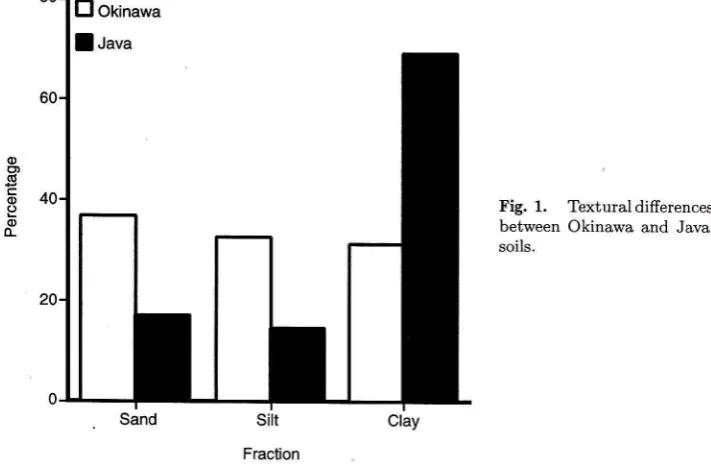
minerals.Fig.
1.
Texturaldifferences between Okinawa and Javasoils.
Clay Fraction
The
dominant
clay
mineral
in
tropical
Javan soils
is
ka.olinite,
while
the
subtropical soils
of
okinawa are
dominated
by an
association
of illite
andhalloysite
(Table
2).
Kaneko and Nagatsuka
(1984) also describedhalloysite
(zA)
from red
and yellow soils
from okinawa.
uehara and Gillman (19s1)
definedthe
stagesof weathering
as
young, mature, and
senile,
basedon the
presenceof
the following minerals: rock-forming
minerals,
mica or montmorillonite,
kaolinite
or
gibbsite,
and
gibbsite nodules
or
iron
stone,
respectively.
A
more highly
weathered
soil
is
alsocharacterised
by
ahigher clay
content.
Average
particle
sizecharacteristics
are
presented
in
Fig.
1.
Okinawan soils have
approximately
equalamounts
ofsand,
silt,
andclay
particles.
Javan soils, bycontrast,
areclay-textured.
The
weathering
processof
Okinawan
soilsis
therefore
inferred
to
be
still
closeto
the mature
stage
which
showsillite
preserved,while
Javan soils are
on the
vergeof
reaching
the
senile stage, as
indicated by the
dominance
of
kaolinite and the
very low
illite content.
oo)
(!
o-Clay mineralogy and exchangeable Al
Relationship
betweenclay
m,ineralogyand
erchangeableAI
Okinawan
soilsIn
the
present study
a
positive relationship
between
the
amount
of
clay
(X)
and
exchangeable
Al
(Y)
has been
established:Y:
-13.14+0'91X
(r
:
0.722**,
n:
16)This
relationship indicates
that
the
permanent
negative charge
and
the
related
number
of
strongly acidic
exchangesites
increaseswith
the amount
of
clay,
andthat
under strongly acidic conditions,
Al
may
occupy these charged sites
aswell
as exchange
sites
in
an
exchangeableform.
The
relationship
between
the
nature
of the
clay fraction and
exchangeableAl
content
in
Okinawan
is shown
in
Table
3.
Exchangeable
Al
increased
with
increasing amounts
of
kaolin minerals (significant
at
P:0.01)
and
illite
andvermiculite/illite
mixed-layer minerals (both significant
atr P:0.05),
while
nocorrelation could be
established
with
vermiculite and
2:7-2:.1:1
intergrades.Thble
3.
Relationship between the nature of the clay haction(X)
and exchangeableAl
(Ii)
in
red and yellow soils from the Okinawa and Java IslandsVariable
(X)
Okinawa(n:
16) Java(n,:1"0)
4r7
Vermiculite
2:l-2:1:1
intergrademinerals
Vermiculite/illite
mixed layer mineralsIllite
Kaolin minerals
Y:3.02X
+9.sI
r
:
0.308Y:A'65X
+12.76
r
:
0.247Y:3.00X
+3.18
r:0.615+
Y:1,.97X
+7.26
r:0.512*
Y:3.05X
+17.25
r
:
0.742*'FY
:11-L2X
+77.78
r
:0'625
Y
--3.10X +9.09
r:0.948*<'k*
Y:-t4.L9X+65.53
r
:
-0.313
Y
:22.00X +2.66
r:0.739*
Y:
-r.37X +
119.92r
:
-0'600
*P
<
0.05,**P <
0.01,***P
<
o.oo1.Halloysite, described
by
Yoshida (1979),
had
a
CEC (m.e./100
g). of
24,
75%
of
which was derived from strongly acidic
exchange
sites,
which had the
ability
to
adsorb
Al in
an
exchangeableform when 0.33
rr.rAlcl3+
was
added.Kaolinite
has
strongly acidic
exchangesites,
which
amounted
to
6L%of the total
CEC
of 4.9
m.e./100g.
According
to
Zhou and Gunter (1992),
the
negativecharge
of
kaolinite
is associated
not
only
with
edge
sites,
but
also
with
basalsurfaces. Results
from
the
present
study
demonstrate
that
the
clay
mineral
which
was
most prominently
associatedwith
the
occurrence
of
exchangeableAl
in
Okinawan soils was halloysite, although
vermiculite/illite
interstratifications
and
illite
also contributed
to
exchangeable Al.
In
acid red
and yellow
soilsfrom
subtropical regions,
AI
was
the
dominant
exchangeable
cation
blocking
permanently
charged
sites
(Hirai et
al.
1997).
These
soils had clay
fractions
dominated
by
kaolin
minerals,
vermiculite,
2:!-2:1
:l
intergrades,
or
vermi-culite/illite
interstratifications.
Present results show
that
halloysite contributed
most
significantly
to
the
exchangeable
Al
pool, while
the
amount
of
clay
was essential
in
providing the
negative
sites required
for
cation
exchange.Jauan
soilsJavan
soils had a higher clay content than
soils
from Okinawa (Table 2), but
no correlation could be
established between
clay
(X)
and
exchangeableAl
(Y)
content:
Y
:29.11
+1.23X
(r
:0.304,
n
:
10)The
relationship between
clay
mineralogy
and
exchangeable
Al
content in
Javan soils
is
presented
in
Table
3.
A
close
relationship
could be
establishedbetween
the
amount
of.2:7-2:1:1
intergrades
and
exchangeableAl
(significant
at
P:0.01).
Exchangeable
Al was
lesssignificantly
related
to
illite
(P:0.05),
while
no
relationship could
beestablished
with vermiculite, vermiculite/illite,
andkaolin
minerals.
In general,
2:1 clays have
a high CEC and resultant strongly
acidic
exchangesites (Yoshida
1979)and may
fix
Al
in their interlayer
space (Shenand
Rich
1962;Hsu and Bates 1964).
This
interlayer
Al
may
then form hydroxy-Al
islands
(Dixon
and
Jackson 1962)
or
gibbsite
layers
(Barnhisel and Rich 1963). The amount of
exchangeable
Al
decreaseswith increasing degree of
interlayering (Matsue
andWada 1988).
Results
from this study
show
that 2:1.-2:L:1
intergrades correlate
most significantly
with
exchangeableAl
(Table
3).The
following
interpretation
of
these results
is
proposed.
There was
aconsiderable
degreeof variability
in
the
negative
chargeand
strongly acidic
ionic
exchange
sites between
the different soil
samples,so
that
an
increasein
the
clay
content
did not
necessarily lead
to
an
increasein
the
negative charge.
The
clay
fractions
of
the red and yellow
soils
from
Java
(tropical region)
were dominated
by kaolinite, which contributed
little to
the
exchangeableAl
pool.
In
okinawan
soils (subtropical region),
in
contrast, halloysite
(zA)
was
the
d.ominant
clay
mineral. This
species possessedstrongly acidic
exchangesites
in
abundance.Combination
of
Okinawan and Jaaan
soilsThe relationship
between
the nature of the clay fraction and
exchangeableAl
content is depicted
in Fig.
2.
A
linear correlation
was establishedfor
exchangeableAl
and
2:1
minerals as
well
as
2:l-2:1:1
intergrades, which was
significant
at
P:0'01.
This
relationship was particularly evident
for
Javan soils,
whereexchangeable
Al
was governed
by
2:l-2:1:l
intergrades. The relationship
wasmuch
lessevident for
Okinawa soils, where
it
wasnot only
affected
by the
nature
of the
clay fraction
but
also
by the
clay
content.
In
Javan
soils,
2:l-2:!:!
intergrades
contributed most
to
the
exchangeableAl,
while halloysite
was most
highly
implicated
in
okinawan soils (Table
3). In
Javan as well as okinawan
soils,
2:
1 phyllosilicates contributed
to
exchangeableAI.
Flom
the results
ofthe
presentstudy,
it
is concludedthat
minerals of
2 :I-2
:I :
I
419
Clay mineralogy and exchangeable Al
(d = (d cO ra
o+
tro
o
o
s8
9. 6)6e
;
ov.r
ER5
o
=6-889980
ol ot(7o) peluoc
Iep
o1 (6u) lV olqeo6ueqcxo lo opBHd qt
.E
'=gE
o Jd g,;9o
oc .E (BES
cE
:-r.
-vo
^q
oo
^ G'
-l?
6 g
9'6
F o =a
o ,iB
o6
-9
(D.E 36
E
--o I *g
.o
E
b6
cD tra
OE'EE
$.gLo
E€
o-
-Ed
ot
..T
9<
o'..
E-Esl r€
Eg"
\d
o: !+
8
E6
L*
I
Yd'
ac.E
8
e
E.E
=a^
o
trq)
3
E
3E
I
gg
o
ho.got
its
*'l
dF
o
H:
HN
I
d
oi;
tb^
:i q)
Ev Oc o c o o (U o o
s
o) Ei
ox
ul I o o o coG o8E
(l) .EC,E
rfq o (d OV at*o
o
o
o
@o^
@s
o O= <r= l^() o? t-(r) +x
(r) o: o I I\
D
con
tO+r
x!
E&
o(g Fcj ll u \r $ o) F-(t +x
(\r@ NT\TF
Javan
soils.
The
mineral
that
supplied
most
of
the exchangeble
Al in
the
Okinawan soils,
however, was
identified
as halloysite.
References:
Ataki,
S. (1992). Charge characteristics and the form of aluminum of red and yellow coloredsoils
in
relationto
clay and iron oxide mineralogy.In'Plant-Soil
Interactionsat
Low pH'. (Ed.T.
Sakuma.) pp. 1-6. (Faculty of Agriculture, Hokkaido University: Sapporo, Japan.) Barnhisel,R.
I.,
and
Rich,C.
I.
(1963). Gibbsite formationfrom
aluminum-interlayers inmontmorillonite. SoiI Science Society of America Proceedings 27,632-5.
Bennema,
J.
(1962). The red and yellow soils ofthe
tropical and subtropical uplands. .9oilScience 92, 250-7.
Carstea, D.
D.,
Harward,M.
E., and Knox, E. G. (1970). Comparison of iron and aluminum hydroxy interlayers in montmorillonite and vermiculite:II.
Dissolution. Soi,I Science Soci,ety of America Proceedings 34,522-6.Churchman,
G. J., Whitton,
J. S.,
Claridge,G. G. C.,
and
Theng,B.
K.
G.
(1984). Intercalation method using formamidefor
differentiating halloysite from kaolinite. Claysand Clag Minerals 32, 241-8.
Davenport, W. H. (1949). Determination of aluminum in presence of iron. Analgtical Chemistry 21, 7L0-L.
Dixon, J.
8.,
and Jackson,M.
L.
(1962). Properties of intergradient chlorites-expansible layer silicates of soils. Soil Sci,ence Society oJ America Proceed,ings 26, 358*63.Dudal, R., and Soepraptohardjo,
M.
(1960). Some considerations on the genetic relationship between Latosols and Andosolsin
Java (Indonesia).In
'Transactions of 7th International Congress of Soil Science'. pp.229-37. (ISSS: Madison, WI.)Funakawa, S.,
Hirai,
H., and Kyuma,K.
(1993). Speciation ofAl in
soil solution from forest soilsin
northern Kyotowith
special referenceto
their
pedogenetic process. SoiI Scienceand Plant
Nutrition
39, 281-90.Goenadi,
D. H.,
and Tan,K. H.
(1989).A
studyon the
degreeof
developmentof
highly weathered soils. Pemberi,taan Tanah d,an pupuk(in
Indonesian) 8,37*47.Harris,
W.
G., Hollien,K.
A.,
and Carlisle,V. W.
(1989). Pedon distribution in coastal plain Paleudults, Soil Science Society of America Joumtal 53, 1901-6.Hirai, H.,
Yoshikawa,K.,
Sakurai,K.,
and Kyuma,K.
(1991). Characteristicsof
the
soils developed under broa.d-leaved evergreen forests in Okinawa Prefecture and the Kinki districtwith
special referenceto their
pedogenetic processes. Soil Science andPlant
Nutrition 37, 509-19.Hsu,
P. H.,
and
Bates,T.
F.
(1964).Fixation
of
gibbsite crystallizationfrom
partially neutralized aluminum chloride solution, Soi,l Science Soci,etyof
America Proceeding 28, 763-9.Kaneko, S., and Nagatsuka, S. (1984). Soil genesis on the raised coral reef terraces of Ishigaki and Okinawa Islands
in
the Ryukyu Islands, Japan.II.
Chronosequential changes of clay mineralogical composition. Soil Science and PlantNutrition
30, 569-77.Mclean, E. O. (1965). Aluminum. 1n'Methods of Soil Analysis'. (Ed. C. A. Black.) pp. 978-98. Agronomy No. 9,
Part
2. (ASA: Madison, WI.)Marshall,
C.
E.
(1949).'The
Colloid Chemistry of Silicate Minerals.' (Academic Press: New York.)Matsue,
N.,
and Wada,K.
(1988). Interlayer materialsof partially
interlayered vermiculitesin
Dystrocrepts derived fromtertiary
sediments. Journal oJ Soil Science 39, 155-62. Mehra,O.
P., and
Jackson,M.
L.
(1960).Iron
oxide removalfrom
soils and claysby
adithionite-citrate
system bufferedwith
sodium bicarbonate, Clays and, Clay Minerals 7, 3t7-27.National Land Agency. (L977).'Land Classification Map (Okinawa prefecture).'
Nurcholis,
M.,
Tokashiki,Y,,
Oya,K.,
Shimo,M.,
and Shinjo,T.
(1929). Alterations of pH and exchangeableAl
by limingin
the acidic soils of Okinawa and Java Islands. Pedologi,st41
(in
press).Clay mineralogy and exchangeable
Al
421shamshuddin, J., and Ismail, H. (1995). Reactions of ground magnesium limestone and gypsum
in
soilswith
varialSle-charge minerals. SoiI Science Society of America Journal 59, 106-12. Shen,Mu
Ju,
and Rich,C.
I.
(1962). Aluminumfixation
in
montmorillonite. ,9oil ScienceSociety of America Proceed,ings 26' 33-40.
Tan,
K.
il,-and
Troth,
P. S.(i982).
Silica-sesquioxide ratios as aidsin
characterization of some temperate region and iropical soil clays. Soil Science Society of Ameri'ca Journal 46, 1109-14.Uehara,
G.,
and Gillman,G.
(1981). '.The Mineralogy, chemistry, and Physicsof
Thopical Soilswith
Variable Charge Clays.' (Westview: Colorado')Wada,
K.
(1966). Methods;f
ide;tification and quantification of clay mineral. Journal of the Science of Soil and Manure(in
Japanese)!7,
g-L7Wada, K., rnd
Krkuto, Y.
(1983). Inteigra.dient vermiculite-kaolin mineral in a Korean Ultisol. Clays and Clay Minerals 31, 183-90.Yoshid"a,
M.
(1979). Some aspects on soil acidity and its measurement. Journalotthe
scienceof
SoiI and Manure(in
Japanese) 50, 171-80'Zhoi,2.,
and Gunter,w.
o.
lroozl.
The nature of the surface charge of kaolinite. Clays and Clay Minerals 40' 365-8.Manuscript received 20 August 1997, accepted 16 December 1997