A. Research Result
In this part, the researcher discussed the implementation of CAR from cycle 1 to cycle 2. The detailed explanation as follows:
1. The Implementation of cycle 1
In the cycle 1 the researcher with the teacher agreed to conduct CAR in four phases. Those were: planning, acting, observing and reflecting.
a. Planning
This phase began with identifying the students’ problems in learning vocabulary. When the researcher had a look the students in class, the learning process in the class seemed running boring. The students do not have enthusiasm in joining the lesson. They had low motivation in learning English. This condition was because the students had difficult to understand the words. Moreover, lacking vocabulary also made the students difficult for getting the lesson. The students were irresponsive especially in asking question and answering.
In the beginning, teacher gave brainstorming to the students about the things in the house(there is/are) by showing pictures and gives some questions related to the picture, such as: “Have you ever seen those pictures?”, “Do you have those kind
of things?” After that, teacher gave example and explanation of
there is/are. Then, teacher asked the students to make groups
consist of 5-6 students. Teacher distributed Snakes and Ladders to each group and gave some instructions to do the game to the students. Then, asked the students to do the game.
Teacher ask each group to analyzed the vocabulary based on the pictures, teacher asked each group to make 5 sentences of there is/are based on the pictures and ask them to present their
work in front of the class. During learning process, in action 1 in cycle 1, not all students participated in every game actively. There were still passive and shy. But, many students look intersted and happy in learning English through the game.
2) Cycle 1 Action 2
At the opening, the teacher asked the students about the material by showing pictures and gave some questions related to the picture, such as: “Do you know what the pictures are?”. After that, teacher gave the picture as the example of things in the house, then gave some example and explanation of there is/are. Then, teacher asked the students to work in group consist of 5-6 students. Teacher distributed Snake and Ladders game to each understanding about the material, gave feed back to the students, review the material given.
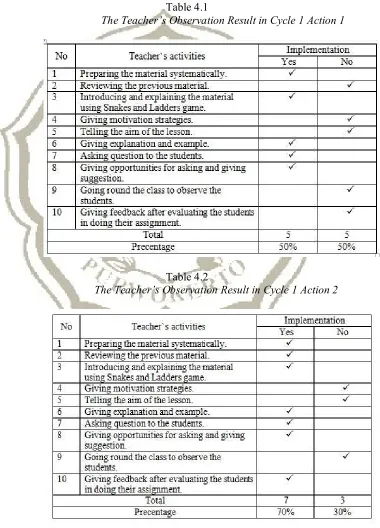
The observation list of teacher activities focused on ten aspects that wanted to be measured. Furthermore, the result of observation was explained in table below:
Table 4.1
The Teacher’s Observation Result in Cycle 1 Action 1
Table 4.2
The table clearly explained about the result of observation from action I and action II. From the table above, it can be concluded that there were improvement from I and action II. The percentage of action I was 50% and action II was 70%. It indicated that there were improvements in the quality of teacher’s activity.
2) Students’ Activities
The students’ observation sheet that contained seven aspects focused on students’ behavior during learning process. The result of observation showed that the use of Snakes and Ladders Game was able to improve students’ activity. The improvement was explained in table below:
Table 4.3
The Students’ Observation Result in Cycle 1
activities reached 27,47% in action I and reached 32,44% in action II, so the average of students’ activities in cycle 1 reached 29,95%. The average of improvement reached 4,98%. Over all observation results proved that Snakes and Ladders Game had motivated students to take a part in the learning process.
d. Reflecting
In this phase, the teacher and the collaborator discussed action 1 and 2 in the cycle 1. Then they could make some conclusions for teaching learning process by implementing Snakes and Ladders Game. The results of discussions were as follow:
a) The teacher had to give more motivation for the students in learning process.
b) The instructions which were given in game actively still made the students confused and only few students became disturber their friends.
c) The group game gave high contribution in learning process. d) The students were interested in learning English through Snakes
and Ladders Game because the game made them felt enjoyable and they could memorize vocabulary easily.
the writer as the collaborator agreed to motivate the students more by conducting Cycle 2.
e. Post Test
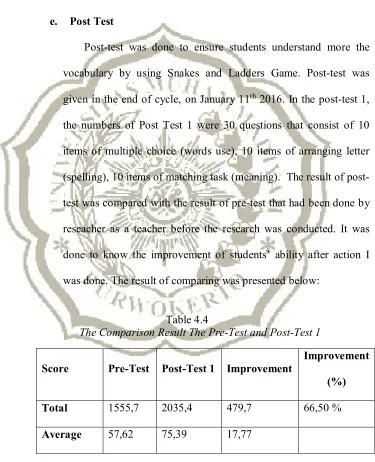
Post-test was done to ensure students understand more the vocabulary by using Snakes and Ladders Game. Post-test was given in the end of cycle, on January 11th 2016. In the post-test 1, the numbers of Post Test 1 were 30 questions that consist of 10 items of multiple choice (words use), 10 items of arranging letter (spelling), 10 items of matching task (meaning). The result of post-test was compared with the result of pre-post-test that had been done by reseacher as a teacher before the research was conducted. It was done to know the improvement of students’ ability after action I was done. The result of comparing was presented below:
Table 4.4
The Comparison Result The Pre-Test and Post-Test 1
Score Pre-Test Post-Test 1 Improvement
Improvement
(%)
Total 1555,7 2035,4 479,7 66,50 %
Average 57,62 75,39 17,77
The average of students’ score also improved, from 57,62 in pre-test to 75,39 in post-pre-test 1. There were some students who reached score more than 70. The number of students got passing grade had improved in post-test 1 than pre-test. It will be explained in the table below:
Table 4.5
The Comparison of Students Who Get Score ≥ 7.0 In Pre-test and Post-test I
Reaching ≥ 70 (KKM) Pre-Test Post-Test 1
Number of Students 8 19
Percentage (%) 29,63 % 70,38%
The table showed that there were 19 students or 70,38% who reached score more than or equal to 70. The improvement was 70,38% toward pre-test 29,63%. It was good result for Cycle 1 as the first step of the research.
2. Implementation of Cycle 2
a. Planning
Ladders game and asked the students to play the game. Teacher asked the students to analyze the vocabulary based on the picture, after playing the game, teacher asked students to make5 sentences based on the pictures and present their work in front of the class. Then, teacher checked the students understanding about the material, gave feed back to the students, reviewed the material given. Finally, the teacher closed the meeting and concluded the material. The teacher informed students about next material to the next meeting.
2) Cycle 2 Action 2
about the material, gave feed back to the students, reviewed the material given. Finally, the teacher closed the meeting and concluded the material that day.
3. Observing
1) Teacher’s activities
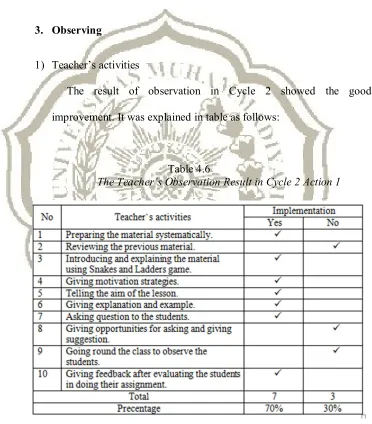
The result of observation in Cycle 2 showed the good improvement. It was explained in table as follows:
Table 4.6
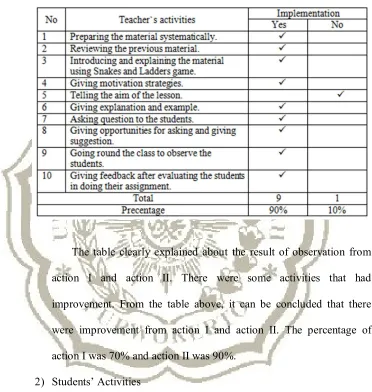
Table 4.7
The Teacher’s Observation Result in Cycle 2 Action 2
The table clearly explained about the result of observation from action I and action II. There were some activities that had improvement. From the table above, it can be concluded that there were improvement from action I and action II. The percentage of action I was 70% and action II was 90%.
2) Students’ Activities
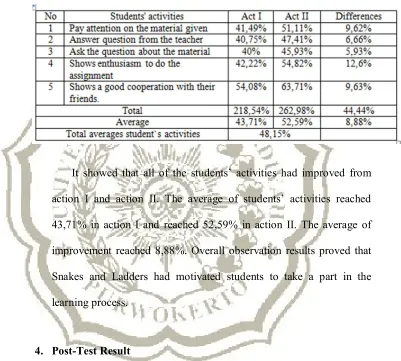
Table 4.8
The Students’ Observation Result in Cycle 2
It showed that all of the students’ activities had improved from action I and action II. The average of students’ activities reached 43,71% in action I and reached 52,59% in action II. The average of improvement reached 8,88%. Overall observation results proved that Snakes and Ladders had motivated students to take a part in the learning process.
4. Post-Test Result
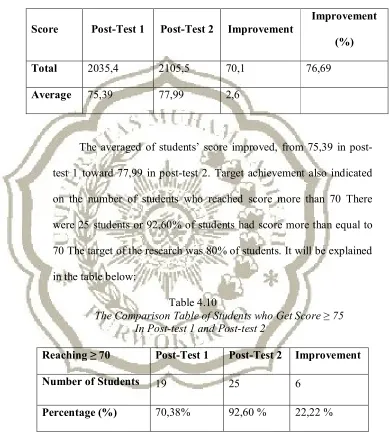
Table 4.9
The Comparison Result of The Post-test 1 and Post-test 2
Score Post-Test 1 Post-Test 2 Improvement
Improvement
(%)
Total 2035,4 2105,5 70,1 76,69
Average 75,39 77,99 2,6
The averaged of students’ score improved, from 75,39 in post-test 1 toward 77,99 in post-post-test 2. Target achievement also indicated on the number of students who reached score more than 70 There were 25 students or 92,60% of students had score more than equal to 70 The target of the research was 80% of students. It will be explained in the table below:
Table 4.10
which had been collected and analyzed through test, observation, and questionnaire.
1. Test Result
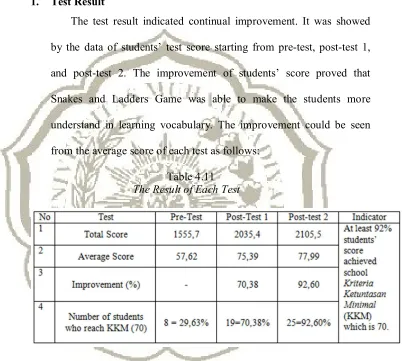
The test result indicated continual improvement. It was showed by the data of students’ test score starting from pre-test, post-test 1, and post-test 2. The improvement of students’ score proved that Snakes and Ladders Game was able to make the students more understand in learning vocabulary. The improvement could be seen from the average score of each test as follows:
Table 4.11 The Result of Each Test
The table showed about the improvement of post-test 1 score toward pre-test score was 70.38%, and there was an improvement as well on post-test 2 score toward post-test 1, that was 22,22%.
and recall it. It helped the students to understand and memorize the vocabulary easily.
2. Questionnaire Result
Based on the result of the questionnaire, it showed positive response toward the implementation of Snakes and Ladders game. The result of questionnaire was satisfying.
Table4.12
Students’ Questionnaire Result
Total Students = 27
game. (the statement number 1), 66.66% students responded “ yes “ from statement “Students more easily understand the English vocabulary by using Snakes and Ladders Game?”. ( Appendix D)
However, all of students (100%) responded “no” from the statement “Students play Snake and Ladders Game dice which can solve students’ problem in learning English vocabulary.” It can be concluded that the average of students (58.8%) gave positive responses toward Snake and Ladders Game as the media in learning vocabulary.
3. Observation Result
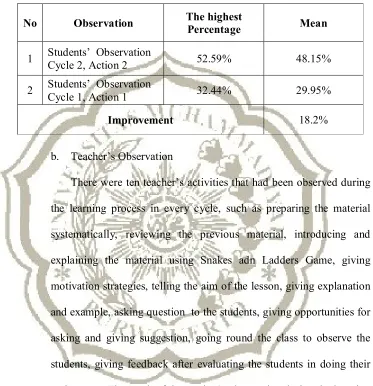
a. Students’ Observation
Table 4.13
The comparison Result of Students Observation
No Observation The highest
Percentage Mean
There were ten teacher’s activities that had been observed during the learning process in every cycle, such as preparing the material systematically, reviewing the previous material, introducing and explaining the material using Snakes adn Ladders Game, giving motivation strategies, telling the aim of the lesson, giving explanation and example, asking question to the students, giving opportunities for asking and giving suggestion, going round the class to observe the students, giving feedback after evaluating the students in doing their assignment. The result of the teacher’s observation during the learning process was satisfied, it could be seen in each cycle. ( Appendix D)
Table 4.14
The Comparison Teacher Observation in Cycle 1
Teacher
observation Action 1 Action 2
Improvement
(%)
Implementation 5 7 2
Table 4.15
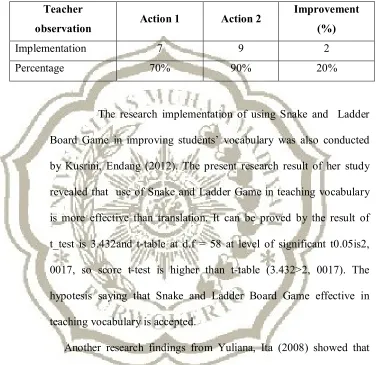
The Comparison Teacher Observation in Cycle 2
Teacher
observation Action 1 Action 2
Improvement
(%)
Implementation 7 9 2
Percentage 70% 90% 20%
means that teaching vocabulary using Snakes and Ladders game game can improve the students’ vocabulary.