ISSN 2502-8723
PROSIDING
SEMINAR NASIONAL
PENDIDIKAN DAN PEMBELAJARAN BAGI DOSEN DAN GURU 2016
MALANG, 07 MEI 2016
“PENGEMBANGAN PROFESIONALISME GURU DAN DOSEN INDONESIA”
DISELENGGARAKAN OLEH:
FAKULTAS ILMU PENDIDIKAN
UNIVERSITAS KANJURUHAN MALANG
Prosiding Seminar Nasional Tahun 2016
“Pengembangan Profesionalisme Guru Dan Dosen Indonesia” Malang, 07 Mei 2016
Copyright Notice
©Fakultas Ilmu Pendidikan, Universitas Kanjuruhan Malang
Seluruh isi dalam Prosiding ini sepenuhnya menjadi tanggungjawab masing-masing penulis. Jika
dikemudian hari ditemukan indikasi plagiasi dan berbagai macam kecurangan akademik yang
dilakukan oleh para penulis maka pihak penyelenggara dan tim penyunting (editor) tidak
bertanggungjawab atas segala bentuk plagiasi dan berbagai macam kecurangan akademik yang
terdapat pada isi masing-masing naskah yang diterbitkan dalam Prosiding ini. Para penulis tetap
mempunyai hak penuh atas isi tulisannya tetapi mengijinkan bagi setiap orang yang ingin
mengutip isi tulisan dalam Prosiding ini sesuai dengan aturan akademik yang berlaku.
Terbitan pertama : Mei 2016 ISSN: 2502-8723
Editor:
Arief Rahman Hakim Devi Permata Sari Romia Hari Susanti Sarrah Emmanuel Yuli Ifana Sari Rina Wijayanti Laily Tiarani
Diterbitkan oleh:
Fakultas Ilmu Pendidika
Universitas Kanjuruhan Malang
Jl.S Supriadi No.48, Malang, Jawa Timur 65148 (0341) 801488
Prosiding Seminar Nasional Tahun 2016
“Pengembangan Profesionalisme Guru Dan Dosen Indonesia” Malang, 07 Mei 2016
KATA PENGANTAR
Seminar Nasional Pendidikan dan pembelajaran bagi guru & dosen tahun 2016 ini mengambil tema “Pengembangan Profesionalisme Guru dan Dosen Indonesia” dan telah diselenggarakan pada tanggal 07 Mei 2016 di kota Malang, merupakan suatu kegiatan ilmiah
tahunan yang diselenggarakan oleh Fakultas Imu Pendidikan, Universitas Kanjuruhan Malang.
Seminar ini merupakan tempat bertukar pikiran para pelaku, pemerhati, dan stakeholder pada
bidang pendidikan, terapan, dan pembelajaran yang meliputi guru, mahasiswa, dosen,
widyaiswara, dan peneliti.
Seminar ini diikuti oleh sejumlah peserta yang terdiri atas tiga orang pembicara kunci
yakni Prof. Dr. H. Punaji Setyosari, M.Ed. (Guru Besar TEP Pascasarjana Universitas Negeri
Malang) dan Dr. Syaiful Rachman, MM., M.Pd. (Kepala Dinas Pendidikan Provinsi Jawa Timur)
dan Prof. Laurens, M.A, P.Hd serta dari berbagai kalangan yang mengikuti presentasi paralel
yang mencakup bidang kebijakan dan perencanaan penilaian pendidikan, inovasi dalam
pembelajaran, penilaian berbasis sekolah, ujian nasional dan dampaknya terhadap pembelajaran,
profesionalisme guru dan dosen, jaminan kualitas dalam pendidikan, pendidikan karakter, praktik
terbaik dalam pembelajaran, dan pembelajaran anak usia dini dan sekolah dasar.
Segenap upaya penyuntingan Prosiding ini telah diupayakan sebaik mungkin, tapi kami
menyadari sepenuhnya bahwa masih terdapat kesalahan dan kekurangan dalam proses
penyuntingan, sehingga kritik dan saran sangat kami harapkan guna perbaikan pada penerbitan
yang akan datang. Kami selaku panitia mengucapkan terima kasih kepada seluruh pihak yang
telah mendukung dan membantu terselenggaranya Seminar ini serta terselesaikannya proses
penyuntingan dan penerbitan Prosiding ini. Tidak lupa juga kami memohon maaf atas segala
kekurangan dan kesalahan baik selama kegiatan Seminar berlangsung maupun masih adanya
kesalahan dalam isi Prosiding ini. Semoga acara Seminar Pendidikan dan pembelajaran bagi guru
dan dosen tahun 2016 dan penerbitan Prosiding ini bermanfaat bagi kita semua.
Sampai jumpa pada Seminar Nasional Pendidikan dan Pembelajaran bagi Guru dan Dosen
yang akan datang.
Malang, Mei 2016
Prosiding Seminar Nasional Tahun 2016
“Pengembangan Profesionalisme Guru Dan Dosen Indonesia” Malang, 07 Mei 2016
SUSUNAN PANITIA PENYELENGGARA
SEMINAR NASIONAL PENDIDIKAN DAN PEMBELAJARAN BAGI DOSEN DAN GURU
TAHUN 2016
Ketua Tim : Drs. F.I. Soekarman, M.Pd
Wakil Ketua Tim : Agus Sholeh, S.Pd, M.Pd
Tim Reviewer : 1. Dr. Suciati, SH, M.Hum
2. Prof. Dr. Soedjijono, M.Hum
3. Drs. Triwahyudianto, S.Pd, MSi
4. Drs. Edy Susilo, M.Pd
5. Dra. Sri Rahayu, M.Pd
6. Rina Wijayanti, M.Psi
7. Laily Tiarani, M.Psi
Dewan Redaksi : 1. Drs. Iskandar Ladamay, M.Pd
2. Romia Hari Susanti, M.Psi
3. Devi Permatasari, M.Pd
4. Yuli Ifana Sari, M.Pd
5. Arif Rahman Hakim, M.Pd
6. Sarah Emmanuel, M.Psi
7. Ludovikus Boomans, M.Pd
Kesekretariatan : 1. Ninik Setiowati, S.Pd
ISSN 2502-8723 Prosiding Seminar Nasional Tahun 2016
“Pengembangan Profesionalisme Guru Dan Dosen Indonesia” Malang, 07 Mei 2016
DAFTAR ISI
Halaman
Kata Pengantar ... ii
Susunan Panitia Penyelenggara ... iii
Makalah Utama ... iv
Daftar Isi ... xxvi
PEMBELAJARAN BERBASIS KONTEKSTUAL PADA ANAK USIA DINI DAN SEKOLAH DASAR Ari Metalin Ika Puspita ... 1
INOVASI DALAM PEMBELAJARAN PENGEMBANGAN MODEL PEMBELAJARAN “COCOK” BAGI MAHASISWA PGSD SEBAGAI PROSES INTERAKSI EDUKATIF Debrine Stefany ... 44
PENDIDIKAN KARAKTER SISWA SDMELALUI DONGENG TANTRIKAMANDAKA Endang Sri Maruti ... 55
MODEL PEMBELAJARAN TSTS UNTUK MENINGKATKAN MOTIVASI BELAJAR SISWA SEKOLAH DASAR Fina Dwi Rosita Dewi ... 71
PRAKTIK PEMBELAJARAN KOOPERATIF TIPE NHT (NUMBERED HEAD TOGETHER) TERHADAP PROGRAM BELAJAR BERCERITA PADA ANAK USIA DINI Anisa Fajriana Oktasari ... 81
PENDIDIKAN KARAKTER DALAM PRE-SERVICE TRAINING BERKONSEP PENDIDIKAN ASRAMA UNTUK CALON GURU PROFESIONAL Eliasanti Agustina ... 93
PEMBELAJARAN KONSEP VEKTOR DENGAN STRATEGI ELABORASI BAGI
Fetty Nuritasari ... 104
MODEL PENDIDIKAN KARAKTER DI PERGURUAN TINGGI MELALUI
PENDIDIKAN KEWARGANEGARAAN
Galuh Kartiko ... 116
PENGEMBANGAN MODUL MEMBACA BERBENTUK BUKU CERITA BERGAMBAR
UNTUK SISWA KELAS V
Adipta ... 132
PEMIKIRAN FILSAFAT PERENIALISME TENTANG NILAI DAN DAMPAKNYA BAGI
PENGEMBANGAN KREATIVITAS DALAM PENDIDIKAN
Marianus Mantovanny Tapung & Sugiyanto ... 139
“CHEMISTRY” ENGLISH PROGRAM AT RAMAPATI RADIO STATION FOR THE STUDENT’S SPEAKING SKILL IMPROVEMENT
Ninik Suryatiningsih ... 153
BACAAN ANAK SEBAGAI MEDIA PEMBINAAN BAHASA INDONESIA DALAM
MENYIAPKAN PESERTA DIDIK BERKARAKTER
Nur Samsiyah ... 173
PENDIDIKAN KARAKTER PADA MATEMATIKA MELALUI PERMAINAN ULAR
TANGGA
Rissa Prima Kurniawati, S.Pd., M.Pd ... 185
PENERAPAN PEMBELAJARAN INKUIRI TERBIMBING BERBANTUAN MEDIA
MANIPULATY UNTUK MENINGKATKAN HASIL BELAJAR SISWA
Yoggy Febriawan, Subanji, Syamsul Hadi ... 195
PENGARUH MEDIA PEMBELAJARAN CNC PU3A MILLING SISTEM FANUC
TERHADAP KUALITAS HASIL BELAJAR MAHASISWA TEKNIK MESIN
UNIVERSITAS NEGERI MALANG
Riana Nurmalasari ... 207
ANSWER RELATIONSHIP (QAR) STRATEGY AT STMIK-STIE ASIA MALANG
Tri Wahyuni ... 216
PENGUATAN PENDIDIKAN SEKOLAH DASAR DALAM RANGKA MENGHADAPI
PASAR TERBUKA MASYARAKAT EKONOMI ASEAN
Supriyanto ... 226
PENANAMAN DAN PENGEMBANGAN KARAKTER ANTI KORUPSI BAGI PESERTA
DIDIK DALAM PROSES BELAJAR MENGAJAR
Ninik Indawati ... 243
PENGGUNAAN ANIMASI KOMIK DARI PROGRAM MACROMEDIA FLASH UNTUK
MEREDUKSI BURNOUT SISWA DALAM MENGIKUTI PEMBELAJARAN AKUNTANSI
Nora Yuniar Setyaputri, M.Pd... 260
PERAN STRATEGIS LEMBAGA PENDIDIKAN KEJURUAN SEBAGAI SISTEM
TERBUKA DALAM MENGHASILKAN PENDIDIKAN YANG BERKUALITAS
Wahyu Diana, Syamsul Hadi, Purnomo, Rina Rifqie Mariana ... 267
PENGEMBANGAN KURIKULUM BERBASIS PROYEK
Zuhrita Ariefiani, DjokoKustono, SyaadPatmanthara ... 277
BIMBINGAN DAN KONSELING KOMPREHENSIF SEBAGAI PELAYANAN PRIMA
BAGI KONSELOR PROFESIONAL
Galang Surya Gumilang ... 286
KESELARASAN KURIKULUM SMK BIDANG KEAHLIAN TEKNOLOGI INFORMASI
DAN KOMUNIKASI DENGAN KEBUTUHAN DU/DI
Nurmalita Kurnia Dewi, Muladi, Isnandar, Riana Nurmalasari ... 298
PROFIL KETERIKATAN AKADEMIK (ACADEMIC ENGAGEMENT) SISWA SMP
DAN MTS YANG BERPRESTASI TINGGI (HIGH-ACHIEVER)
Sri Panca Setyawati ... 307
PENERAPAN MODEL PEMBELAJARAN FISIKA BERBASIS TEKNOLOGI INFORMASI
DAN KOMUNIKASI PADA MATERI ELASTISITAS SISWA KELAS X MAN MALANG I
PENERAPAN MODEL PEMBELAJARAN INQUIRY UNTUK MENINGKATKAN
KEAKTIFAN DAN HASIL BELAJAR IPS SISWA
Siti halimatus ... 326
DESKRIPSI METAKOGNISI SISWA SEKOLAH MENENGAH ATAS DALAM
PEMECAHAN MASALAH PERSAMAAN KUADRAT DENGAN MENGGUNAKAN
MAPPING MATHEMATICS
Madya Kencana Juhandana & Toto Nusantara ... 335
PENGARUH PEMBELAJARAN KOOPERATIF TIPE GROUP INVESTIGATION
TERHADAP HASIL BELAJAR MAHASISWA PADA MATAKULIAH MATEMATIKA
EKONOMI
Ema Surahmi ... 352
KONSEP POST-METHOD SEBAGAI ACUAN BAGI FLEKSIBIKITAS GURU DAN
DOSEN DALAM PROSES PENGAJARAN BAHASA INGGRIS DALAM KONTEKS
SEKOLAH
Adi Surya Irawan ... 360
PENGARUH PENGGUNAAN MULTIMEDIA PEMBELAJARAN INTERAKTIF
PENGINDERAAN JAUH TERHADAP HASIL BELAJAR GEOGRAFI
Fitria Hanim, Sumarmi, Ach. Amirudin ... 373
SCAFFOLDING DALAM PEMBELAJARAN
Mety Toding Bua ... 384
ANALISIS KEMAMPUAN SISWA DENGAN GAYA KOGNITIF FIELD INDEPENDENT
DALAM MEMECAHKAN MASALAH MATEMATIKA BERDASARKAN
LANGKAH-LANGKAH POLYA
Tohir Zainuri, Abdur Rahman As’ari, I Made Sulandra ... 394
PENDIDIKAN KARAKTER ANAK USIA DINI MELALUI KEGIATAN PERCOBAAN
SAINS SEDERHANA
EMPOWERING EFL STUDENTS WITH METACOGNITIVE LANGUAGE LEARNING
STRATEGIES: DOES IT WORK?
Agus Sholeh ... 411
PENDIDIKAN KARAKTER DALAM MENGHADAPI ERA GLOBALISASI
Ifa Nurhayati ... 420
KERANGKA MAKRO PENGAJARAN BAHASA INGGRIS DI INDONESIA
Sujito ... 443
PENGEMBANGAN LEMBAR KEGIATAN SISWA BERCIRIKAN PENEMUAN
TERBIMBING BERBANTUAN GEOGEBRA PADA MATERI PERSAMAAN DAN
FUNGSI KUADRAT UNTUK KELAS X SMK NUR AINI
Nur Aini, Indah Hermianty, Toto Nusantara, Abdul Qohar... 455
PENGARUH STRATEGI PEMBELAJARAN GUIDED INQUIRY TERHADAP
PEMAHAMAN KONSEP DAN KEMAMPUAN MEMECAHKAN MASALAH FISIKA
PADA MATERI KALOR
Muhammad Sayyadi, Arif Hidayat, Muhardjito ... 466
ANALISIS PENERAPAN PEMBELAJARAN INKUIRI BERTINGKAT PADA
PEMBELAJARAN IPA SMP MATERI INDRA PENGLIHATAN DAN ALAT OPTIK
Titik Widyastuti, Markus Diantoro, Munzil ... 475
PROSES PENGEMBANGAN BAHAN AJAR FISIKA SMK BERBASIS DARING
KOMBINASI SEBAGAI PENDAMPING PRAKTIK KERJA LAPANGAN
Sri Munarsih, Wartono dan Lia Yuliati ... 486
PEMANFAATAN MEDIA PEMBELAJARAN PADA MATA PELAJARAN SAINS
KELAS IV SDN KEDUNGKANDANG II MALANG
Arief Rahman Hakim ... 492
PENGEMBANGAN MODEL PEMBELAJARAN PARTISIPATIF KOLABORATIF SENI
TARI SMP
PENGEMBANGAN KETERAMPILAN SOSIAL (SOCIAL SKILLS) SISWA MELALUI
MODEL COOPERATIVE LEARNING
Laila nur safitri ... 506
PENERAPAN MODEL PEMBELAJARAN CHILDREN LEARNING IN SCIENCE (CLIS)
UNTUK MENINGKATKAN KETERAMPILAN PROSES SAINS DAN PRESTASI
BELAJAR FISIKA SISWA
Yusy Octaviana, Choirul Huda ... 515
PENGARUH SCAFFOLDING PROSEDURAL DIAGRAM V DALAM GROUP
INVESTIGATION TERHADAP KETERAMPILAN PROSES SAINS SISWA
BERPENGETAHUAN AWAL TINGGI DAN RENDAH
Prosiding Seminar Nasional Tahun 2016
“Pengembangan Profesionalisme Guru Dan Dosen Indonesia” Malang, 07 Mei 2016
EMPOWERING EFL STUDENTS WITH
METACOGNITIVE LANGUAGE LEARNING STRATEGIES: DOES IT WORK?
By
AGUS SHOLEH TEGUH SULISTYO
KANJURUHAN UNIVERSITY OF MALANG E-mail: [email protected]
In EFL settings, of four English language skills, writing is often considered a complex skill to master. Students not only have to put their ideas into a sufficient content, but they have to put into account style of organization and language use dealing with grammar, vocabulary, and mechanics. In addition, writing is not an easy activity to do and it is often believed to be the most complex skill to master (Cahyono & Widiati in Kusumaningrum, 2012), and developing writing ability is an important but a complex part of language learning (Dulger, 2011). Accordingly, many EFL learners are frustrated by the fact that they are making little progress in writing (Xiao, 2008), so teachers should facilitate students to understand their own writing process (Brown, 2007).
Regarding the evidence that academic writing not only focuses on products but also process and the fact that writing is a demanding task (Ruan, 2005), the way students employ appropriate strategies in writing course will influence their writing quality. Metacognitive Language Learning Strategies (MLLSSs) may assist students to recognize their composing process since MLLSSs are thinking about thinking involving active control over cognitive processes engaged in learning (Livingstone. 1997). Since good language learners use MLLSs and are aware of the process of language learning (Khaki and Hessamy, 2013), this article primary reveals the impact of MLLSS on students’ writing proficiency and how the strategies are integrated into EFL academic writing settings.
Keywords: EFL Students, Metacognitive Strategies
Introduction
The term “Metacognition” is simply most often associated with John Flavell
since he introduced this term in 1979. Metacognition is basically “thinking about thinking”. In reality, defining Metacognition is not simple, so there is much debate over
exactly the nature of this term (Livingstone,
1997). Somehow, before discussing further
about MLLSS, it is somewhat important to
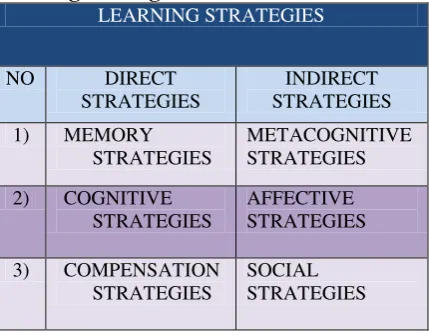
see the categorization of language learning
strategies: direct and indirect strategies
(Oxford, 1990:37) as drawn in Table 1.
Table 1 shows that direct strategies
which concern directly the involvement of
the target language (Oxford, 1990:37) are
divided into memory, cognitive, and
compensation strategies. Indirect strategies,
on the contrary, are metacognitive, affective,
and social strategies which support and
manage language learning without directly
involving the target language (Oxford,
1990:135). Because cognitive and
metacognitive strategies are closely
intertwined and support each other, any
acknowledging the other would not provide
an adequate picture (Livingston, 1997).
Table 1. A Categorization of Language
As a direct strategy, Cognitive refers
to variations of self-consistent modes among
individuals in the preferred way of
perceiving, organizing, or recalling
information and experience in language
learning (Witkin, Stansfield & Hansen in
Ghonsooly, 2006). In addition, Cognitive
strategies cover practicing, receiving and
sending messages, analyzing and reasoning,
and creating structure for input and output
(Oxford, 1990). The activities belonging to
cognitive strategies will work best if they
are supported with indirect strategies such as
metacognitive strategies.
Metacognitive Language Learning
Strategies (MLLSs), on the other hand,
refer to higher order thinking involving
active control over the cognitive processes
engaged in learning (Livingstone, 2007).
Also, MLLSs mean awareness and control
on one’s cognition (Baker & Brown, Flavell, Gourgey in Xiao, 2006) which take place
beyond, beside, or with the cognitive which
include (1) centering learning, (2) arranging
and planning learning, and (3) evaluating
learning which covers self-monitoring and
self-evaluating (Oxford, 1990). Thus
basically MLLSs can be concluded as learner’s awareness and control on one’s cognition by thinking about the learning
process, planning for learning, monitoring
the learning task, and evaluating how well
one has learned. So, Cognitive strategies are
necessary to perform a task, and
Metacognition is necessary to understand
how the task is performed (Schraw, 1988 in
Nuckles et al, 2009).
MLLSs are considered important to
develop student awareness of the importance
of autonomous learning and self-monitoring
or self-reflective thinking during their study
time in the classroom and learning time
outside the classroom. Teachers should
guide them realize the beneficial impacts of
MLLSs. Assisting them to choose and apply
specific strategies, in a long run, will
approach, students are trained to generate
audience, and write multiple drafts in order
to present written products that
communicate their own ideas well.
According to Atay and Kurt (2006:103), the
focus in writing classes is not on the form of
the written product rather on how the learner
should approach the process of writing. In
fact, when students write, they should not
expect to write a perfect composition in a
single draft, but they go through a process of
creating and recreating this piece of writing
until they are able to produce a good
composition (Gebhard, 2000:222). It shows
that process of writing allows students to
develop their ideas gradually in a recursive
process of creating meaning.
Teachers who use this approach give
students a chance to generate ideas and
obtain feedback (teacher feedback, peer
feedback, and self-evaluation) on the
content, organization, and language use.
Accordingly, writing enables students to be
the subjects who experience a process of
discovery since they generate new ideas and
language forms to express their thoughts and
feelings. Thus writing is perceived as a
simultaneous process which encourages
students to experience a developmental
process helping them to write as
professional authors do, choosing and
developing their own ideas in a
comprehensible written product. The writing
process approach also provides students
greater responsibility for their own learning
task, and it also builds sense of ownership
and pride of their own products. The
process of writing, according to Gebhard
(2000: 226), consists of prewriting, drafting,
revising, and writing final product.
Since writing is a complex set of
activities, students need to be aware of the
importance of applying appropriate
strategies and approaches in academic
writing. It is also a demanding task (Ruan,
2005), so helping them to apply MLLSs and
process of writing is extremely important.
Since process of writing is a recursive mode,
MLLSs as a way to monitor how students
evaluate their writing process. Thus
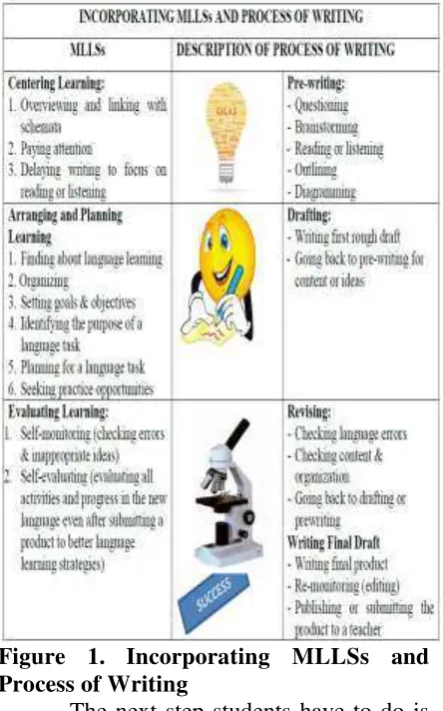
incorporating MLLSs and process of writing is advantageous to cultivate students’
writing ability. Figure 1 elaborates
how to integrate MLLSs and process of
writing in EFL writing classes. The figure
also illustrates the importance of
MLLSs-higher order thinking- in EFL writing
activities.
The first thing students should do is
centering their learning before they start
writing by asking themselves what they
have to do, whether they have adequate
schemata, and or what strategies to employ.
focus on gathering ideas supporting their
topic by asking other people or peers even a
teacher or by reading some sources relevant
to the topic in order to obtain information.
Somehow, there is a debate as to whether all
students require this (Oxford, 2000:138)
depending on cognitive strategies each
student prefers. With regard to the process
of writing, the activities refer to prewriting
step.
Figure 1. Incorporating MLLSs and Process of Writing
The next step students have to do is
called arranging and planning their
composition by elaborating their ideas into a
rough draft, or it is called drafting which
deals with how ideas can be organized and
how to complete a composition
(Chayono,1999). Students start to organize
their ideas into sentences, paragraphs, and a
unit of composition. There must be some
mistakes or inappropriate organization of the
rough draft but then they may revise it in “revising step”. They probably need to think hard how to complete the draft, so they may
need to find more information from some
sources in order to develop the draft much
better or they need additional language
element or functions necessary for the
completion of the task (Oxford, 1990:139).
Last but not least, it is truly
important for students to evaluate their
writing task through self-monitoring and
self-evaluating (Oxford, 1990:140).
Self-monitoring emphasizes on identifying errors
in producing the draft. This activity refers to
revising step in process of writing. They
have to reexamine their draft to find out
linguistic errors and inappropriate content or
organization of their composition. It is
possible for them to be back to pre-writing
step in order to monitor whether they have
written downs ideas they generated in
pre-writing activities. Then they continue
writing final draft and publish or submit
their composition. Somehow, skilled writers
who are aware of metacognitive senses have
a rich understanding of the importance of
applying effective strategies to meet
essential elements and characteristics of
high-quality of composition (Haris et al,
2010:229). That is why, they need to employ
focusing on evaluating overall progress
(Oxford, 1990:140) of their own
composition. They might think again the
overall processes of accomplishing their
writing task which enable them to realize
reflective learners who realize what and how
to do to accomplish their language learning
task.
RESEARCH METHOD
In order to investigate the effects of
Metacognitive Language Learning
Strategies (MLLSs) on students’ writing ability, an experimental design was applied.
The present study took place at Kanjuruhan
University of Malang. The investigation is twofold: First, to see EFL students’ attitudes after being empowered with MLLSs;
second, to measure whether MLLSs has any significant impacts on students’ writing
proficiency. Thirty-two EFL students
joining Writing 3 Class participated in this
research. They were treated using MLLSs
and required to answer questionnaires on
Metacognitive Awareness Inventory (MAI)
to measure the level of their metacognition
during their activities in writing an essay.
Besides, they wrote two different essays (for
pre-test and post-test) to evaluate the
impacts of MLLSs on their writing
proficiency.
The data related to the implementation of
teaching - learning process were measured
through observation list and questionnaire.
Meanwhile, the students’ writing
proficiency was taken from their essays by using a scoring rubric adapted from Cohen’s analytical scoring of writing assessment.
RESULTS AND DISCUSSION
The questionnaire tryout on
Metacognitive Awareness Inventory (MAI)
in which 16 students answered the
questionnaire was measured using
Cronbach’s Alpha with SPSS Version 18. There were 25 items adapted from Schraw
and Dennison using a four-Likert scale
option for each the students had to answer,
as seen in Appendix 1. The results of
computation showed that the reliability
statistics was .734. It indicated that the
instrument was reliable to be applied to measure students’ metacognitive level.
The present study focuses on finding out the impacts of MLLSs on students’ writing proficiency. Thus two major
questions to be answered are:
1. Do Metacognitive Language
Learning Strategies (MLLSs) affect students’ writing proficiency?
2. To what extent MLLSs affect
To answer the above questions, the
students were asked to write an essay in a
pre-test session. Then they were treated
using MLLS before writing another essay as
a post-test activity. In addition, they also
answered the questionnaire on
Metacognitive Awareness Inventory (MAI)
to evaluate their level of metacognition. The
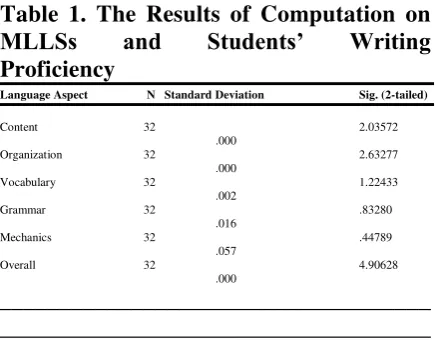
results of computation using Paired sample
T-Test show that MLLSs have a significant effect on students’ writing proficiency (overall) at 0.05 significance level. In
addition, the results also prove that MLLSs have a significant effect on students’ wiring
proficiency in terms of content,
organization, vocabulary, and grammar of
their essay, but the results do not show any
significant interaction between MLLSs and students’ writing proficiency with regards to mechanics (see Table 1).
Table 1. The Results of Computation on
MLLSs and Students’ Writing
Proficiency
Language Aspect N Standard Deviation Sig. (2-tailed)
Content 32 2.03572
.000
Organization 32 2.63277
.000
Vocabulary 32 1.22433
.002
previous studies conducted by different
the relationship between MLLSs and writing
activities in EFL/ESL settings have been
conducted over the last two decades since
John Flavell introduced the term
“metacognition” in 1979. Kasper (1997) found that there is a positive relationship between EFL students’ metacognitive growth and their writing performance, and
strong metacognitive awareness and
strategies are important to empower second
language learners (Wang et al., 2009). In
addition, as MLLLSs reinforce language
learning, they seem important to strengthen
retention as well (Dulger, 2011).
Other studies also show the
importance of MLLSs in EFL academic
writing. Manfred (2007), for instance, found
that MLLSs enable students to build
motivation in language learning. It makes
sense that motivation encourages students to
study harder to accomplish a particular task
and make them participate actively in the
learning process as a whole (Shanon, 2008).
Further, Dulger (2011) concluded that
MLLSs are beneficial to facilitate students
to empower their writing abilities in general,
content, organization, vocabulary, and
mechanics in particular.
Some other studies also proved that MLLSs cultivate students’ self-reflective thinking which guide students to be
autonomous and independent learners
(Yanyan, 2011) in the classroom and outside
discovered that MLLSs develop students’ self-perceptions as student writers and their
metacognitive awareness grow over a
certain period of time, and MLLSs are the
central part of self-regulation (Mahadi and
Subramaniam, 2013) since MLLSs involve
extensive self-regulation and metacognitive control on students’ writing activities (Ruan, 2005). As a result, students who have
metacognitive awareness are more capable
of planning, monitoring and evaluating their
writing activities and thus become efficient
learners or writers (Fengua & Chen, 2010).
Dulger (2011) then added that MLLS can be
used for solving the potential problems of
writing activities as a result of the fact that
writing is a complex skill to master by EFL
learners.
Somehow, the present study does not indicate a significant effect on students’ proficiency in terms of mechanics. One
possible explanation is that students were
still a little bit careless in spelling,
punctuation, and capitalization.
Conclusion and Pedagogical Implications This article attempts to investigate
the impact of Metacognitive Language
Learning
Strategies (MLLSSs) on students’ writing ability. Theoretically, MLLSs are important
strategies learners should apply, and
empirical studies also support that MLLSs are beneficial to improve students’ writing
abilities since metacognitively aware
students are those who realize their
weaknesses and strengths. They are aware of
what they have to overcome their
weaknesses with specific strategies and
maximize their strengths. Students are more
strategic, autonomous, and independent, and
they are able to build their self-reflective
thinking and motivation in language
learning tasks. In short, MLLS are essential
to successful language learning because they
enable individuals to better manage their
cognitive skills and to determine weaknesses
that can be corrected by constructing new
cognitive skills. It should be noticed further
that learners will write better if they apply
MLLSs and process of writing because they
are not only able to practice and complete
their task but they also center, arrange, and
evaluate their writing tasks.
Realizing the importance of
MLLLSs in EFL settings, composition
teachers are strongly advised to use MLLS
to help students learn to analyze and adapt
their thinking, learning, and writing process.
Besides, it is important to facilitate students
to build their metacognitive awareness not
only in academic writing activities but also
for other areas of skills and components of
English in studying settings in the classroom
and learning time outside the classroom.
Last but not least, the students need more
mechanics since it another important
element in writing activities.
Since the present study probably has
many limitations, further studies on the
impacts of Metacognitive Language
Learning Strategies on students’ English skills and elements should provide better
quality in order to reveal the power of
MLLSs on English language learning as a
whole.
References
Atay, Derin and Kurt, Gokce. 2006.
Prospective Teachers and L2 Writing Anxiety. Asian EFL Journal,
Volume 8, Number 4. Pp. 100-118 Brown, H. D. 2007. Teaching by Principles:
An Interactive Approach to Language Pedagogy. White Plains, NY: Pearson Education.
Cahyono, B.Y. 1999. Converging Lines: Towards the Integration of Second Language Research and Teaching. K@ta. Vol. 1 (1)
Dulger, O. 2011. Metacognitive Strategies in Developing EFL Writing Skills. Contemporary Online Language Education Journal. Vol. 1 (2), 2011 Fenghua, LV, and Chen, H. 2010. A Study
of Metacognitive-Strategies-Based
Writing Instruction for Vocational College Students. English Language Teaching Vol. 3, No. 3
Gebhard, J.G. 2000. Teaching English as a Foreign or Second Language. A Teacher Self-Development and Methodology Guide. Ann Arbor. The University of Michigan Press.
Goonsooly, B. and Eghtesadee, A.R. 2006. Role of Cognitive Style of Field-dependence / inField-dependence in Using Metacognitive and Cognitive Reading Strategies by a Group of Skilled and Novice Iranian Students of English
Literature. Asian EFL Journal. Vol 8 (4)
Haris, R.K. 2010. Metacognition and Strategies Instruction in Writing. Metacognition, Strategy Use, and Instruction. New York: The Guilford Press
Kasper, L.F. 1997. Assessing the
Metacognitive Growth of ESL Student writers. Teaching English as a Second or Foreign Language-Electronic Journal. 3
Khaki, N. and Hessamy, G. 2013.
Metacognitive Strategies Employed by EFL Writers in Integrated and
Independent Writing Task. World Applied Sciences Journal 22 (11): 1586-1593
Kusumaningrum, S.R. 2012. Utilizing “Watch-Wrap-Write” Technique to Assist Students in Writing an Argumentative Essay. Proceedings of 59th TEFLIN International Conference.
Livingstone, J.A. 1997. Metacognition: An Overview.
http://gse.bufallo.edu/fas/shuell/cep564/ metacog.htm accessed on February 12, 2014
Mahadi, R. and Subramaniam, G. 2013. The Role of Meta-Cognitive Self-Regulated Learning Strategies in Enhancing Language Performance: A Theoretical And Empirical Review. Journal of Asian Scientific Research. Vol 3(6):570-577
Nuckles et al. 2009. Enhancing Self-Regulated Learning by Writing Learning
Protocols. Learning and Instruction. Vol. 19:259-271
Oxford, R.L. 1990. Language Learning
Strategies. What Every Teacher Should Know. Boston: Heinle & Heinle
Publisher
Ruan, Z. 2005. A Metacognitive Perspective on the Growth of Self-regulated EFL Student Writers. Reading Working Papers in Linguistics 8.
Classroom. College Teaching Methods & Styles Journal. Vol 1. No. 3
Shannon, S.V. 2008. Using Metacognitive Strategies and Learning Styles to Create Self-Directed Learners. Institute for Learning Styles Journal ● Volume 1 Wang, J., Spencer, K., and Xing, M. 2009.
Metacognitive beliefs and strategies in learning Chinese as a foreign language. ScienceDirect Vol. 37. Pp 46-56 Xiao, Y.H. Applying metacognition in EFL
Writing Instruction in China. Reflections on English Language Teaching. Vol. 6 No. 1