Discussion
Reply to comment on ‘‘Evidence for multiphase
deformation in the Archaean basal Warrawoona group in
the Marble Bar area, East Pilbara, Western Australia’’ (van
Haaften, W.M., White, S.H., 1998. Precambrian Research
88, 53 – 66) by M.J., Van Kranendonk, A.H. Hickman,
W.J., Collins
W.M. van Haaften, S.H. White *
Faculty of Earth Sciences,Budapestlaan4,3584CD Utrecht,The Netherlands Accepted 31 May 2000
www.elsevier.com/locate/precamres
Van Kranendonk et al. takes exception to two conclusions that we reached in our structural and kinematic study of the Talga Talga area in the East Pilbara. The first is that our observations are not inconsistent with the diapiric model they have proposed (Hickman, 1984; Collins, 1989; Collins et al., 1998) and, secondly, that the Talga Talga area is not sufficiently disturbed tectonically to impede its use as a type section for the Talga Talga subgroup.
To answer the first concern, it will perhaps help if we outline our philosophy in undertaking the research that led to our paper. This we had done in the original paper but removed it at the request of the editors to bring the article into an accept-able length.
There are two hypotheses to account for the tectonic evolution of the Eastern Pilbara. The first
is based on sub-horizontal tectonism involving thrusting and associated folding and/or extension (Bickle et al., 1980, 1985; Boulter et al., 1987; Krapez, 1993; Zegers et al., 1996) and which may have minor vertical tectonics (diapirism). The sec-ond is diapirism which basically involves vertical tectonics with a minor association of horizontal tectonic processes (Hickman, 1984; Collins, 1989; Collins et al., 1998).
Any hypothesis, to be viable, must be capable of independent verification, which means that it must have a diagnostic characteristic(s) that al-lows it to be discriminated from a rival hypothe-sis. In the case above, because one hypothesis is not totally exclusive of the other, there are few discriminatory characteristics. The main one, from a structural basis, is the direction of tectonic transport at the time of the emplacement of the granitoids. In the diapiric model, it should be radial with movement away from the rising diapir
* Corresponding author.
W.M.6an Haaften,S.H.White/Precambrian Research105 (2001) 79 – 84
80
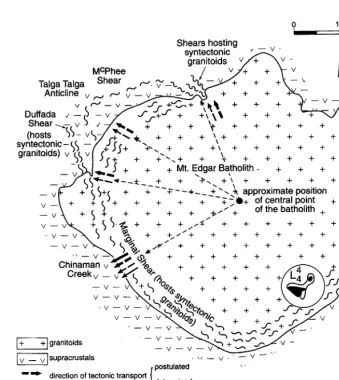
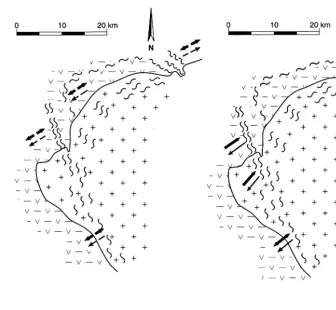
(Fig. 1A). In the horizontal tectonic model, the tectonic transport should have a constant azimuth but can have opposite polarities (see Fig. 1B).
The Mt. Edgar batholith has become the exam-ple par excellence for Archaean diapiric tectonics as a result of the work of Collins (1989), Collins
et al. (1998). Collins (1989) outlined how the Mt. Edgar batholith developed by diapiric processes in a four-stage event at around 3300 Ma. In the southern part of the Mt. Edgar batholith, extend-ing both to the east and west, he shows a mar-ginal shear, his D4shear zone (see Fig. 5, Collins,
Fig. 1. (A) An outline of the marginal shear (D4zone of Collins, 1989) within the Mt. Edgar batholith (after Collins, 1989). The
major shears in the Talga Talga area are included, along with two granitoid-hosting shears on the northern flank of the Talga Talga antiform. The stereographic plot of the stretching and elongate mineral lineations is from the entire D4zone (from Collins, 1989).
The azimuth of the above lineations and associated tectonic transport as found by Collins (1989) for D4 zone adjacent to the
Warrawoona margin are shown. The orientation of stretching and elongate mineral lineations and tectonic transport predicted by a diapiric hypothesis are also indicated. (B) The azimuth of stretching and elongate mineral lineations and tectonic transport as predicted by a horizontal tectonic hypothesis, using the D4 zone adjacent to the Warrawoona margin at Chinaman creek as
Fig. 1. (Continued)
1989). This is reproduced in Fig. 1A of this reply. Collins associated tectonic activity on the mar-ginal shear with the final stage of diapirism and claimed that it displays a radial pattern of stretch-ing and mineral lineations-as if radiatstretch-ing from a single point in the centre of the batholith (see Fig. 1A). He shows that this is correct for the D4
lineations in the SW corner of the Mt. Edgar batholith (Chinaman creek area), and this is de-picted in Fig. 1A. Intriguingly, he shows a stereo-graphic plot of his L4
4
stretching and mineral lineations (reproduced in Fig. 1A) that, in the caption to his figure (Collins, 1989, Fig. 5), is said to refer to the entire D4 zone. Although he states
frequently in the text (Collins, 1989) that the D4
lineations regionally form a radial or sub-radial pattern, the only regional data he presents shows that they are clustered and give a unidirectional trend in NE – SW direction. His statements sup-port diapirism, but these critical data supsup-port
horizontal tectonics. Consequently, we selected the Talga Talga area for our test because any stretching lineation, if associated with a diapiric model, especially in the D4 zone, will have an
approximate NW – SE trend (see Fig. 1A) and if a horizontal tectonic model applies, it will have an approximate NE – SW trend (see Fig. 1B), using the Chinaman creek area as reference. The test formed the basis of an undergraduate research project (WMv.H).
In our study of the Talga Talga area, besides the marginal (D4) shear above, several other
W.M.6an Haaften,S.H.White/Precambrian Research105 (2001) 79 – 84
82
shears are of a brittle – ductile type typical of upper crustal conditions. Because of the compe-tency contrast between the fault rocks within the shears, especially where they consist dominantly of chlorite, carbonate and/or talc, and the country rock, large displacement can occur on even nar-row shears as seen in modem orogens. Both bed-ding parallel and strike-parallel shears exist, but for most, and especially for the McPhee shear and Duffada shear, the dip of the shear is steeper than the dip of So in the footwall sequence. These shears are strike-parallel, as is clearly stated and shown in our paper, and are not bedding-parallel shears. The assertion by Van Kranendonk et al. that we described all shears as being bedding-par-allel is incorrect.
A kinematic analysis of these shears revealed five shearing events which were ordered by stan-dard structural procedures (see our paper). Of these only the third event could be unambiguously related to the emplacement of the granitoids and was found within the marginal (D4) shear and the
Duffada shear and on two small shears on the northern flank of the Talga Talga antiform (see Fig. 1 of our paper). These shears contain evi-dence for syntectonic granitoid intrusions. The stretching and mineral lineations associated with this event had a NE – SW trend (Fig. 1C). Inter-section lineations and the plunge of fold axes had a similar trend. This is not the trend predicted by the diapiric hypothesis but that predicted by the horizontal tectonic hypothesis and is exactly the trend shown by Collins (1989, Fig. 2) for the regional distribution of L44 stretching and mineral
lineations (see Fig. 1A). The transport direction we determined was consistently to the NE. Study within the marginal shear in the Warrawoona area (Van Haaften, 1996) also revealed a NE direction of tectonic transport which dominated over a SW transport direction. Consequently, we conclude that the available kinematic evidence does not support the hypothesis that diapirism, as described by Hickman (1984), Collins (1989), was the important tectonic process during the em-placement of the Mt. Edgar batholith.
The two earlier shear events, which we observed in the Talga Talga area, have also been recognised by Collins (1989) and, speculatively, associated by
him with earlier phases of the emplacement of the Mt. Edgar granitoids. However, the McPhee shear is cut by the Mt. Edgar granitoids. It is also cut by dolerites (see also Collins, 1989) a set of which, in turn, is cut by the granitoids and is not seen in the D4 zone. Consequently, these two
events appear to be earlier than the intrusion of the granitoids. We observed from the literature (see references in our paper) that these two events are not unique to the Talga Talga area but had been recognised by other workers in other areas of the Eastern Pilbara and fitted a regionally recognised scheme. Within this scheme they pre-dated emplacement of the Mt. Edgar granitoids; the first event, namely the extension, predated the Mt. Edgar granitoid emplacement by circa 120 Ma. The same applied to the last two shear events, which we recognised to have occurred after the emplacement of the Mt. Edgar grani-toids. They also fitted a regionally recognised scheme. We did not construct a regional scheme, as claimed by Van Kranendonk et al., from our Talga Talga data, but showed that it fitted one that was regionally recognised (see references given in our paper). Again that scheme is consis-tent with horizontal tectonic processes rather than diapiric processes. Van Kranendonk et al. states that our lineations resulting from the above events are radial about the Talga Talga antiform. That only comes about if all stretching and mineral lineations associated with all of the phases of shearing, which are spread over a possible 700 million year time span (Zegers, 1996), are lumped together. There is no justification for doing this.
In undertaking our kinematic analysis, we are criticised by Van Kranendonk et al. for using drag folds as a criterion. We are aware that they are notoriously unreliable indicators and conse-quently did not use them. We used S – C type fabrics, the geometry of internal shears and ro-tated foliations. Having wrongfully criticised us, they then used drag folds themselves, as can be seen in their comments.
Warrawoona group is tectonically disturbed and forms a lithotectonic complex rather than a true stratigraphic sequence’ and that the ‘true order-ing, …, of the Talga Talga subgroup in its type area needs to be established by careful dating’. We did not conclude that there were stratigraphic repetitions but made the observation that the available dating did not rule out the possibility of a stratigraphic inversion because dates had been interpreted on the premise that the assumption that the Talga Talga section is an ordered strati-graphic sequence was correct. That is, the avail-able dating was sufficiently ambiguous, and the approach to the interpretation of that data was such that stratigraphic inversion could not be precluded. Van Kranendonk et al. repeats and refines the contrary arguments but add no new data, either geochronological or geochemical, that can remove the above ambiguity. That the Talga Talga section is an ordered stratigraphic sequence still remains an assumption. Our recent work indicates that the lower part of the Talga Talga subgroup (North Star basalt) is heavily silled, and the interpretation of any dating without carefully delineating these sills will remain ambiguous. As matters now stand, the lower part of the succes-sion could have an age fitting the lower Warra-woona group as proposed by Van Kranendonk et al., could be younger or, because of the abun-dance of sills, could be older than the inferred ages for the lower Warrawoona group. The same arguments apply to the upper part of the Talga Talga subgroup (Mt. Ada basalts) as Thorpe et al. (1992) interpreted their dates on the assumption that the Talga Talga subgroup was an established ordered stratigraphic succession. Consequently, they considered that any date not fitting this ordering had to be explained by extraordinary phenomena.
Van Kranendonk et al., by recognising that the MePhee formation is sheared, (see also Collins, 1989), admit that the Talga Talga subgroup is a lithotectonic complex. The argument between them and us then becomes one of displacement on the McPhee shear and also the Duffada shear. We state that such displacements may be substantial on flats. Because there are no major changes in metamorphic grade, ramp development cannot be
major. We indicated that displacements on the main shears could be substantial, because of the width of the McPhee and Duffada shears, the competency contrast between their contained fault rocks and the enveloping country rock and the intensity of deformation within them. In the Duf-fada shear, rootless folds plunge parallel to the stretching and mineral lineations and give an in-tersection lineation parallel to these. Such are high strain phenomena. The McPhee shear is marked by a tectonic me´lange as can be seen from our descriptions and those of Hickman (1983). Collins (1989) in his description of the type sec-tion which is based on exposure (Hickman, 1983) recorded that ‘the primary mineralogy of the car-bonate chlorite-quartz rock, which comprises the bulk of the formation, cannot be determined in thin section. Schistosity is a prominent feature. The rock is, as we stated and as also recognised by Van Kranendonk et al., a mylonite. But it is a mylonite that is so reworked mineralogically that its protolith cannot be recognised. This fits the description of an ultramylonite, and this is more likely to be indicative of high, rather than low, shear strains.
Collins (1989) recorded isoclinal recumbent folds within the McPhee shear. Van Kranendonk et al. say that only a moderate displacement across the McPhee shear is supported by data from Collins (1989, Fig. 2) which they claim shows the folds in the McPhee Reward area at a high angle to mineral elongation lineations and, therefore, these folds were not transposed into the shear direction. However, the above Fig. 2, which is of the McPhee Reward area, does not include any lineations. Their above statement is therefore without foundation and, likewise, their argument for ‘a moderate displacement’.
We record normal followed by thrust move-ments (see also Collins, 1989) on the McPhee shear, again there is no direct evidence for the magnitude of their respective displacements. The reactivation of a pre-existing structure negates the pedantic point about the dip of the shears raised by Van Kranendonk et al.
bed-W.M.6an Haaften,S.H.White/Precambrian Research105 (2001) 79 – 84
84
ding in the underlying North Star basalt. If the arguments by Van Kranendonk et al. were cor-rect, namely that the McPhee shear had a negligi-ble net displacement and was parallel to the original bedding in the McPhee formation, which now makes up the tectonic me´lange enveloped by the shear, then it also must follow an unconfor-mity. That is, following Van Kranendonk et al.’s argument, an unconformity must have existed between the McPhee formation and the underly-ing North Star basalt prior to the initiation of shearing. As indicated above, this cannot be ruled out by the currently available geochronological data. The same argument applies to the Duffada shear and its relationship to bedding in the Mt. Ada basalt.
Consequently, the opposing views on the conti-nuity of the stratigraphy at Talga Talga boil down to the following.
Displacements on the major shears are
appre-ciable. Corollary — the Talga Talga section is a lithotectonic complex.
Displacements on the major shears, especially
the McPhee shear, are negligible. Corollary — there is/are angular unconformity(ies) in the Talga Talga section.
In either case, the Talga Talga anticline is prob-lematic as a type section for the lower Warra-woona group.
References
Bickle, M.J., Bettenay, L.F., Boulter, C.A., Groves, D.I., Morant, P., 1980. Horizontal tectonic interaction of an Archean gneiss belt and greenstones, Pilbara block, West-ern Australia. Geology 8, 525 – 529.
Bickle, M.J., Morant, P., Bettenay, L.F., Boulter, C.A., Blake, T.S., Groves, D.I., 1985. Archean tectonics of the Shaw
batholith, Pilbara block, Western Australia: structural and metamorphic trests of the batholith concept. In: Ayres, L.D., Thurston, P.C., Card, K.D., Weber, W. (Eds.), logical Association of Canada Special Paper No. 28. Geo-logical Association of Canada, pp. 325 – 341.
Boulter, C.A., Bickle, M.J., Gibson, B., Wright, R.X., 1987. Horizontal tectonics predating upper Gorge creek sedimen-tation, Pilbara block, Western Australia. Precamb. Res. 36, 241 – 258.
Collins, W.J., 1989. Polydiapirism of the Archean Mt. Edgar batholith, Pilbara block, Western Australia. Precamb. Res. 43, 41 – 62.
Collins, W.J., van Kranendonk, M.J., Teyssier, C., 1998. Partial convective overturn of Archean crust in the east Pilbara craton, Western Australia: driving mechanisms and tectonic implications. J. Struct. Geol. 20, 1405 – 1424. Hickman, A.H., 1983. Geology of the Pilbara Block and its
environs. western Australia Geological Survey. Bulletin 127, 268 pp.
Hickman, A.H., 1984. Archean diapirism in the Pilbara block, Western Australia. In: Kro¨ner, A., Greiling, R. (Eds.), Precambrian Tectonics Illustrated. E. Schweuzerbartsche, Stuttgart, pp. 113 – 127.
Krapez, B., 1993. Sequence stratigraphy of the Archean supracrustal belts of the Pilbara block, Western Australia. Precamb. Res. 60, 1 – 45.
Thorpe, R.A., Hickman, A.H., Davis, D.W., Mortensen, J.K., Trendall, A.F., 1992. U – Pb zircon geochronology of Archean felsic units in the Marble Bar region, Pilbara craton, Western Australia. Precamb. Res. 56, 169 – 189. Van Haaften, W.M., 1996. Geological evolution of the
south-ern margin of the Mt. Edgar batholith. Unpublished M.Sc. thesis. Faculty of Earth Sciences, Utrecht University, p. 67. Van Haaften, W.M., White, S.H., 1998. Evidence for multi-phase deformation in the Archean basal Warrawoona group in the Marble Bar area, East Pilbara, Western Australia. Precamb. Res. 88, 53 – 66.
Zegers, T.E., 1996. Structural, kinematic and metallogenic evolution of selected domains of the Pilbara granitoid – greenstone terrain. Implications for mid Archean tectonic regimes. Geologica Ultraiectina 146, 208.
Zegers, T.E., White, S.H., de Keijzer, M., Dirks, P., 1996. Extensional structures during deposition of the 3460 Ma Warrawoona group in the Eastern Pilbara craton, Western Australia. Precamb. Res. 80, 89 – 105.