ISSN: 2333-5823 (Print), 2333-5831 (Online) Copyright © The Author(s). All Rights Reserved. Published by American Research Institute for Policy Development DOI: 10.15640/ppar.v4n1a5 URL: https://doi.org/10.15640/jmm.v4n1a5
Soccer Fans’ Motivations, Attitudes, and Behavioral Intentions across E thnicity and
Gender Lines: Are Hispanics in the United States More Passionate about Soccer than
Caucasians?
Ricard W. Jensen, Ph.D.1 & Yam B. Limbu, Ph.D.2
Abstract
This study examines the extent to which there are important differences between Hispanics and Caucasians in the United States with regard to soccer fandom. The specific focus of this study is investigate and compare the motivations to attend soccer matches, attachment to soccer, and future attendance intentions of Hispanic and Caucasian males and females. The study also addresses the pressing issues of marketing to multicultural audiences and especially the growing Hispanic-American community that is passionate about soccer. Data were collected using self-administered questionnaire from Hispanic and Caucasian spectators in the United States who attended an international friendly soccer match between two national teams. Results suggest that the Hispanic sample in this study were more significantly more motivated than Caucasians by game quality, the desire to escape, socialization, entertainment, and achievement. Hispanics also exhibited higher attachment to soccer than Caucasians but there was no significant difference in future attendance behavior between the two ethnic groups. Males placed a significantly higher value than females on the importance of game quality and attachment to soccer. This study has important theoretical and practical implications.
Keywords: Soccer, Hispanics, Caucasians, Gender, Motivation, Attachment
I. Introduction
Soccer is the most popular sport in the world (Molinaro, 2014; Foer, 2010; Butler, 2014).Roughly 20 percent of the world’s population (more than 1.4 billion individuals) participated in soccer in 2014 (Smith, 2014). Huge numbers of people follow the FIFA World Cup; more than 950 million individuals tuned in to watch at least one minute of the 2014 final setting a new record for viewership(Ozanian, 2014).
The 2014 FIFA World Cup set new records for the number of people who watched matches on television in several nations, including Brazil, Germany, Argentina and Italy(Campbell, 2014); the tournament also set new benchmarks for social media as the final match as more than 618,000 tweets were sent each minute by fans throughout the world (Sweney, 2014). Globally, the FIFA World Cupis consistently more widely followed and attracts higher television ratings than any other sports event (Harper, 2013; Sandomir, 2010), including the National Football League’s Super Bowl (Mikho, 2013) and the Winter Olympics (Gleeson, 2014).The passion Hispanics exhibit for soccer is one of the major reasons the sport is growing so rapidly in the United States.
1 Associate Professor of Marketing, Department of Marketing, School of Business, Montclair State University, Montclair, NJ
07043, Phone: 973-655-7132, Fax: (973)-655-7673, E mail: jensenr@ mail.montclair.edu
2 Associate Professor of Marketing, Department of Marketing, School of Business, Montclair State University, Montclair, NJ
Hispanic fandom is evident in the fervor shown for recent soccer matches in the USA in which a record crowd of more than 82,000 fans attended the 2016 Chile vs. Argentina Copa America Centenario at MetLife Stadium in New Jersey; the tournament was marked by enthusiastic crowds of Hispanics at venues throughout the United States (E vans, 2016). Final A few academic studies have explored the soccer fandom of Hispanics (Jewell &Molina, 2005; Argeris & Nagle, 2013). In this study, we define Hispanics as Spanish-speaking persons of Latin American descent living in the United States (Taylor & Cohn, 2012) while Caucasians are defined as respondents who self-identified themselves as Caucasian but not Hispanics. A 2014 opinion poll showed that 45 percent of Hispanics in the United States describe themselves as soccer fans who were likely to watch the FIFA World Cup compared to only 28 percent of non-Hispanics (Weiss, 2014).A 2014 sports marketing consulting study suggested 29 percent of millennial-age Hispanics played soccer in the past year, and 20 percent of them watch soccer on television (Jones &Allain, 2014). A 2013 sports media report shows that a greater percentage of Hispanics are fans of Major League Soccer (MLS) than any other spectator sport in the United States; 34 percent of Hispanics said they are MLS fans (Master, 2014). One expert predicted that the MLS fan base may quadruple in the next 50 years, spurred by the passion of Hispanics for soccer (Butler, 2014).
Several studies have investigated the extent to which gender differences influence the attitudes and behaviors of individuals in relation to sports fandom (Clark, Apostolopoulou, & Gladden, 2009; Gantz, Zheng, Paul, & Potter, 2010; Robinson &Trail, 2005; James & Ridinger, 2002; Caucasianside & Hardin, 2011; Ware & Kowalski, 2012; Dietz-Uhler, Harrick, E nd, & Jacquemotte, 2000; Fink, Trail, &Anderson, 2002; Trail, Robinson, &Kim, 2008) although the gender differences in soccer fandom has relatively received little attention. Generally speaking, fans of professional soccer in the United States played by MLS teams are more likely to bemales than females. A 2012 media report suggested that men comprise 65 percent of the MLS fan base (Lipsey, 2013), while a 2013 sports marketing consulting study showed that men make up 68 percent of MLS fans (Master, 2014).The number of female soccer fans in the United States is increasing;; throughout the 2014 World Cup, E SPN saw an increase in the number of female fans watching the tournament on television (Ourand, Botta, and Mickle, 2014). Still, soccer fandom in the United States is believed to be male-dominated.Some researchers have investigated the multitude of factors that motivate people to follow soccer, including the different factors that motivate avid fans (Bodey et al., 2009;Caucasian&Abshir, 2013), and the extent to which people attend matches to seek excitement and be part of a social gathering (Al-Thibiti, 2004; Trail &James, 2001; Bravo, Won, &Lee, 2013). Other studies have examined the extent to which soccer fans might be motivated by pride and patriotism (Jones, Coffee, Sheffield, Yanguez, & Barker, 2012; Trail &James, 2001), and how the attachment of individuals to soccer influences future attendance intentions (Kim &Chalip, 2004; Lee, Shin, & Shinchi, 2010; Bravo et al., 2013).
Despite growing academic interest in soccer fandom in the United States, little empirical research has been conducted to explore factors that motivate Hispanics and females in the United States to follow soccer, their attachments to soccer, and future attendance intentions. Research indicates that the level of attachment to sports may vary between genders (Robinson &Trail, 2005). Intersectional theory is a useful framework to study the extent to which ethnic and gender issues influence sports fandom (Anderson &McCormack, 2010; E schrich, 2010; Moraga, 2015; Bush et al., 2007; Walker, Courneya, & Deng, 2006); the prevailing idea is that one has to consider how these societal conditions may exert some effect on how individuals view sports. Therefore, the main purposes of current study are to explore the differences between a) Hispanics and Caucasians and b) males and females in motivations to attend soccer matches, attachment to soccer, and future attendance intention. The dearth of studies in this area presents a compelling rationale for a study of this sort to investigate how a multicultural audience of Hispanics and Caucasians described their motivations for attending a major soccer match.
In sum, there is a tremendous opportunity to increase soccer fandom in the United States by appealing to the growing Hispanic population (Weiss, 2014).Moreover, understanding the different motivations of Hispanics and Caucasians will help marketers develop the best marketing strategies to help grow soccer fandom.
Literature Review
Several studies have examined the factors that influence people to become soccer fans and attend matches. Bravo et al. (2013) studied the conditions that motivated American college students to watch the FIFA World Cup on television; they found that soccer fandom and patriotism motivated them to watch the tournament. Biscaia, Correia, Rosado, Ross, & Maroco, (2013) studied the extent to which the fans’ perspectives of the brand image of a soccer club in Europe influenced their satisfaction with the team as well as their fandom; they found that the success of the club, the values the club stands for, and the atmosphere in the stadium are important factors. Theodora is, Wann, &Weaver (2012) investigated how team identification, the extent to which a fan feels a psychological connection to a team and/or player, predicts behavioral loyalty (e.g., attendance, word-of-mouth); the results showed that overall team identification fully mediated the relationship between specific dimensions of team identification and behavioral loyalty. Mahony, Nazawaka, Funk, & Gladden (2002) investigated conditions that influence soccer fandom in Japan; they suggest that the attachment to soccer and interest in soccer clubs influence fan behavior. Beccarini & Ferrand (2006) studied soccer fans in Europe and investigated that conditions that motivated them to attend matches; they found that fans considered the stadium atmosphere and experiences at a match as well as the cost to attend and the performance of a club.
To date, only a few empirical studies have investigated the motivations of people to attend international soccer events. Kim & Chalip (2004) examined the motivations and constraints that influenced soccer fans to consider attending the FIFA World Cup in Korea and Japan and found that soccer fandom and interest in learning more about the site of the event were important factors. Florek, Breitbarth, & Conejo (2008) interviewed fans from New Zealand to identify their motivation to attend the 2006 FIFA World Cup; the fans’ primary motivation was to travel, rather than to support the team. Crisp, Heuston, Farr, & Turner, R. (2007) studied how soccer fans in E ngland reacted after their club won or lost and how on-field success motivated fan behavior; they found that avid soccer fans felt sad after a loss but they were still motivated to attend future matches due to the hope of success. A few studies have attempted to develop measures to assess motivation for sports consumption including soccer. Notably, the Motivation Scale for Sports Consumption developed by Trail & James (2001) has received considerable attention and has been updated and used in several studies (Robinson & Trail, 2005; Kim &Trail, 2010; Kim, Trail, & Magnusen, 2013).
Although little research has been done to examine the motivations and attachment of Hispanics to soccer, other studies have investigated Hispanic consumers in context other than sports (Huggins, Holloway, &Caucasian, 2013; Ueltschy & Krampf, 2011; Chattaraman, Lennon, &Rudd, 2010; Stevenson &Plath, 2006). Only a handful of exploratory studies have examined Caucasian soccer fans but the focus was on fan demographics and social issues such as racism (Cleland & Cashmore, 2013). However, little research has been conducted to investigate the psychographics (e.g. motivation, attitudes) that may influence the behaviors of soccer fans of various ethnicities, including Caucasians (Alexandris Tsiotsou, 2012).Hispanic soccer fandom has been the topic of few studies. For instance, Lee, et al. (2010) found that many Hispanics indicated soccer is their favorite sport. Harrolle & Trail (2007) examined the extent to which ethnic identity, acculturation, and identification with sports might motivate Hispanics to become fans of soccer. The study findings suggest that ethnic identity, acculturation, and identification with sport had little or no influence on the motivations of fans. Jewell and Molina (2005) explored soccer fandom and revealed many Hispanics exhibit divided loyalties between the clubs in the home countries and teams in the United States. Argeris &Nagel (2013) found that the success of club is especially important to Hispanic fans. Unlike previous studies, the objective of the present study is to compare the motivations, attachment, and behavioral intentions of Hispanics and Caucasians in the United States.
Research suggests that males and females may differ in attitudes and behaviors related to consumer goods (Li, Tsai, & Soruco, 2013; Chi, Lovett,& Chi, 2012; Seock & Sauls, 2008) but a few studies have explored the role of gender on consumers’ decision-making processes related to sports. For example, Bush et al. (2007) found that females preferred traditional sports and placed a higher value on role models, while research by Hall & O'Mahony (2006) suggest female fans may be more motivated than males to attend sports events because of such factors as such as parking, seating, stadium accessibility, the enjoyment of experiencing sports, and spending time with family and friends. A study by Claussen, Ko & Rinehart (2008) highlights the need of research to examine the role of gender on sport fans’ attitudes and behavior. In addition, empirical studies that compared the soccer fandom of males and females are scarce. Thus, the current study aims to explore and compare the motivations, attachment, and future behavioral intention of male and female soccer spectators in the United States.
Theoretical Foundation and Research Hypotheses
This study investigates several inter-related issues associated with the soccer fandom of Hispanics, including ethnic and gender differences as well as the attachment and motivations of individuals to follow soccer. These issues are discussed in detail in the following section.
E thnic Differences
E thnic identity is a useful framework to understand how the motivations, attachment, and future behavioral intentions of individuals within different ethnic subcultures to become sports fans sports. E thnic identity has been described as “an enduring, fundamental aspect of the self that includes a sense of membership in an ethnic group and the attitudes and feelings associated with that membership” (Phinney, 1996, p. 922). E thnic identity influences interpersonal and intergroup relationships, and is one of several factors that affect a person’s sense of belonging to a group and the values and attitudes an individual has to a group (Phinney & Ong, 2007). E thnic identity theory suggests that individuals within ethnic subcultures might associate themselves with a sport or team that is a source of pride in order to improve their self-esteem or to experience vicarious achievement through the success of others (Ware &Kowalski, 2012). Thus Hispanics might be passionate about soccer because the success of their team reflects positively on the ethnic group as a whole. Pons, Laroche, Nyeck, & Perrault (2001) assessed the extent to which people within different ethnic groups follow sports; results suggest that specific ethnic groups are much more likely to follow sports that are deeply rooted in their culture while ignoring sports they know little about (e.g., Claussen et al., 2008; Bush et al., 2007; Armstrong, 1998).
Hispanic youth might be more likely than non-Hispanics to use their fandom of soccer as a way to express their culture and self-identity (Jones & Allain, 2014). Monistere (2014) suggests Spanish-speaking Hispanics in the United States are more likely to tune into soccer matches featuring prominent teams from Latin America, while E nglish-speaking Hispanics are fans of American sports like the NFL.
The theory of socialization, which is an element of ethnic identity, can be useful to explain how ethnic groups (such as Hispanics, African-American etc.) differ in their attitudes and behavior about sports (Lee et al., 2010; Klein, 2007; Wann et al., 1999). Because ethnic socialization can guide individuals to acquire the perceptions, values, attitudes, and behavior within an ethnic group, it can play an important role in shaping their attitudes and behavior (Coakley &Dunning, 2000). Socialization can play an important role in shaping Hispanic soccer fans’ attitudes and behavioral intention in the United States (Beamon & Messer, 2014; Jensen, 2012). Conversely, Caucasians in the United States have long been ambivalent towards soccer as they have been socialized to place a greater value on traditional American sports (e.g., Baseball, Football) (Foer, 2010). From a theoretical perspective, this intent of this study is to contribute to the literature on ethnic identity and socialization theories by focusing exclusively on the soccer fandom of Hispanics versus Caucasians. The current study posits that Hispanics will exhibit stronger motivation to attend soccer matches, greater attachment to soccer, and higher interest in future attendance than Caucasians.
Motivation to Become Soccer Fans
Previous studies found that several variables including the quality of the game, escape, socialization, entertainment, and achievement motivate individuals to become soccer fans (Trail & James, 2001; Al-Thibiti, 2004; Bravo et al., 2013). The quality of the game motive refers to the extent to which individuals are motivated to follow soccer based on the high level of skills shown by players and the beauty and grace of the game; it is influenced by the extent to which people care about soccer (Al-Thibiti, 2004). This concept proposes that individuals with a deeper knowledge of sports and a passion for soccer are motivated by the talent displayed by athletes and might feel more joy from seeing the game played at its best (Bravo et al., 2013); this may imply that Hispanic fans are more likely to beinfluenced by the quality of the game and team’s success (Argeris & Nagel, 2013).
The escape motive describes the extent to which individuals are motivated to become soccer fans based on the desire to relieve stress and tension, to forget about problems, and torelax (Al-Thibiti, 2004). Lee et al. (2010) indicate that the desire to escape and relieve stress can motivate Hispanics to become fans of soccer. Because soccer is one of the favorite sports of Hispanics, attending a soccer match that includes star players from their country or ethnic group provides an opportunity for escape (Lindner &Hawkins, 2012; Wilson, 2007).Socialization is defined as the extent to which individuals are motivated to become soccer fans based on the desire to interact with others in a group setting and to spend quality time with friends and family (Al-Thibiti, 2004; Kim &Chalip, 2004; Beccarini & Ferrand, 2006). Research indicates that Hispanic females are motivated to become soccer fans because matches provide an opportunity to be with family members and offer opportunity to build network and interact with others (Lee et al., 2010; Harrolle, Trail, Rodriguez, & Jordan, 2010).
E ntertainment describes the extent to which individuals are motivated to become soccer fans based on the need to have a good time and to feel excited and stimulated (Al-Thibiti, 2004; Mahony et al., 2002; Izzo, Munteanu, Langford, Ceobanu, Dumitru, & Nichifor, 2013).Sports teams are entertaining fans by creating a more exciting stadium atmosphere that includes colorful scoreboards, fireworks, marching bands, cheerleaders and promotions (Uhrich & Benkenstein, 2010). Since Hispanics are so passionate about soccer, they are more likely to be more excited and stimulated by soccer games and thus, be more entertained than Caucasians.
H1: Perceptions about a) game quality, b) escape, c) socialization, d) entertainment, and d) achievement will
motivate Hispanics to attend soccer games more than Caucasians.
A ttachmentto Soccer
Attachment has been described as the process through which individuals assign emotional, functional, and symbolic meaning to ideas, thoughts, and images related to sports (Funk &James, 2006). Sports marketing theories describe that individuals can be attached to a specific type of sport, the level of sport (e.g., elite competition or club match), a team, an athlete, being a part of social gathering, and the experience of attending a sports event (Trail, Robinson, Dick, & Gillentine, 2003; Kwon, Trail, and Anderson, 2005; Kim et al., 2013). One of the few studies that investigated the attachment individuals have to soccer by examining psychographics, involvement, and affiliation with a team: Alexandris & Tsiotsou(2012) suggest that individuals who were more involved with soccer and who were more affiliated with a club were most attached to the sport. In this study, we focus on the attachment of individuals to the sport of soccer as well as the level of competition, since the event being studied is a major international soccer match. We define attachment to soccer is defined the extent to which individuals first and foremost consider themselves to be soccer fans, whether soccer is their favorite sport, and if they prefer soccer over all other sports and the extent to which being a soccer fan is an essential part of their self-esteem (Kim & Trail, 2010).Based on the psychological connection some individuals have to sports (Tsiotsou and Alexandris, 2009) and the identification that Hispanics have with soccer (Monistere, 2014; Faflik, 2006), we suggest Hispanics in the United States may have a higher level of attachment to soccer in the United States than Caucasians. The rationale for this proposition is that soccer is the favorite sport of Hispanics in the United States (Lee et al., 2010) and that many Hispanics in the United States are soccer fans (Harrolle & Trail, 2007).Consistent with the literature discussed above and ethnic identity model, we hypothesize the following:
H2: Hispanics will exhibit a higher level of attachment to soccer than Caucasians.
Future A ttendance Behavior
In this study, future attendance behavior is defined as the extent to which individuals would consider attending future soccer matches. A few studies suggest that consumers within different ethnic groups may exhibit different behavioral intentions related to sports events (Claussen et al., 2008). Bush et al. (2007) examined the behavioral intentions of several ethnic groups about sports and their research seems to suggest that Hispanics may be influenced to attend because of marketing promotions, among other factors. Hispanics in the United States could be more likely to attend soccer matches than Caucasians because they have grown up following the sport and often more ardent fans (Jones & Allain, 2014). Bodey et al. (2009) reported that 61 percent of Hispanics in the United States followed the FIFA World Cup, while 58 percent of Hispanics in the United States are fans of the Mexican professional soccer league. Several marketing campaigns targeting Hispanics are now focusing on the passion for soccer to reach this demographic (McCabe, 2013; Huggins et al., 2013). Thus, we hypothesize that:
H3: Hispanics will exhibit greater intentions to attend future soccer games than Caucasians.
Gender Differences
Prior studies in marketing and consumer psychology show that gender can influence several aspects of consumer behavior. For example, women have different perceptions of a brand and its attributes, brand awareness, and brand loyalty than men (Li et al., 2013;Chi et al., 2012; Seock & Sauls, 2008).Similarly, studies have also shown gender differences are present in several areas related to sports e.g., fan motivations to attend a sport event, attachment to a sport, and behavioral intentions. E vidence from these studies can provide insights into how gender influences fan’s motivation and behavior associated with sports.
James & Ridinger (2002) compared the motivations of males and females to attend sports events and consume sports media; they found that males were more likely than females to be avid fans, to watch and follow sports more often, and to be fans of a specific team; they also found that males were motivated by the quality of the game, while females were motivated by the aesthetic appeal of sports. Research shows that women often watch sports as a way as a form of socialization, because they view consuming sports as a way to spend time with family members, rather than being motivated by a passion for the sport (Caucasian side &Hardin, 2011; Ware & Kowalski, 2012; Dietz-Uhler et al., 2000; Fink, Trail, & Anderson, 2002). Trail, Robinson, and Kim (2008) suggest that females are often more casual fans and thus the success of the team factors less into the decision to attend.
Few empirical studies have examined the motivations of men and women to become soccer fans, their level of attachment to soccer, and future behavior intentions. Izzo et al. (2013) found that the men were motivated by the technical aspects of soccer and their passion for the sport, while females were drawn to soccer to socialize and party. Another empirical study found that women are likely to be motivated to become soccer fans to relieve stress, to enjoy the spectacle associated with matches, and to be with family and friends (Lee et al., 2010). In contrast, men are likely to place more importance on highly successful teams, star players, and team performance (Burnett & Wessels, 2012).
From a theoretical perspective, gender socialization theory suggests that males and females learn different gender-appropriate roles through social learning processes; as a result of socialization males and females develop different attitudes and behaviours (Carter, 2014). In applying the theory into the present study, it can be posited that men and women may exhibit different levels of motivation and attachment to soccer as well as behavioral intentions. Based on the above supporting literature and gender socialization theory, we hypothesize the following.
H4: Males and females will exhibit different types of motives (game quality, escape, socialization, entertainment, and achievement) to attend soccer games.
H5: Males and females will exhibit different levels of attachment to soccer.
H6: Males and females will demonstrate different levels of intention to attend future soccer matches.
Methodology
Participants and Data Collection Procedure
The participants of this study were Hispanic and Caucasians individuals who attended an international friendly soccer match between the national teams of two Latin American nations at MetLife stadium in 2013. The data were collected by an intercept method and administering a survey instrument before the game. An E nglish version of the survey questionnaire was translated into Spanish by a bilingual expert and then native Spanish speakers reviewed the survey to assure it was precise and consistent. The questionnaire was back-translated from Spanish to E nglish to ensure accuracy in translation (Brislin, 1986).Field interviewers approached participants and asked if they prefer to complete the survey instrument in E nglish or Spanish. A total of 208 individual participated in the survey. After removing six incomplete cases, the final sample included 202 individuals.
Table 1: Sample Characteristics
Is Spanish the primary language you speak in your home? Yes
No
128 74
63.4 36.6
Are you more likely to watch sports on Spanish-language TV 93 46.0
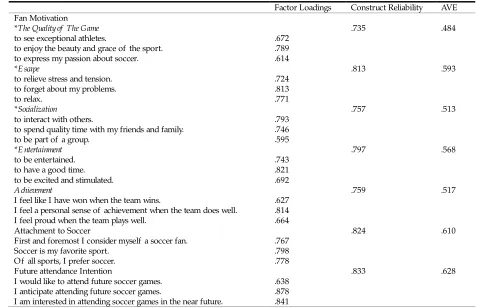
E nglish-language TV 109 54.0 and achievement) were adapted from Al-Thibiti (2004) and (Trail & James, 2001) which measured the motivations that drove participants to attend the game. Attachment to soccer was assessed with three items adapted from (Kim and Trail, 2010).A slightly modified version of Kim & Chalip’s (2004) scale measured fans’ future attendance intentions. The results of the principal components analysis with a varimax rotation are presented in Table 2. The factor loadings for all scales ranged from .59 to .87, above the cut off value of .50 (Hair, Back, Babin, Anderson, & Tatham, 2010). All measures demonstrated adequate reliability above the recommended level of .70 (Bagozzi & Yi, 1988). Average variance extracted (AVE ) estimates range from .48 to .62 which are higher than recommended level of .50 for all constructs with the exception of ‘the quality of the game’ (Fornell & Larcker, 1981).
Table 2: Measurement Items, Factor Loadings, Construct Reliabilities, and Average Variance E xtracted (AVE )
Factor Loadings Construct Reliability AVE
to spend quality time with my friends and family. .746
to be part of a group. .595
I feel a personal sense of achievement when the team does well. .814
I feel proud when the team plays well. .664
Attachment to Soccer .824 .610
First and foremost I consider myself a soccer fan. .767
Soccer is my favorite sport. .798
Of all sports, I prefer soccer. .778
Future attendance Intention .833 .628
I would like to attend future soccer games. .638
I anticipate attending future soccer games. .878
I am interested in attending soccer games in the near future. .841
Results
One-way multivariate analysis of variance (MANOVA) was performed using IBM SPSS Statistics 20 statistical package. Prior to conducting the MANOVA, we assessed basic assumptions of multivariate analysis of variance. The assumption of homogeneity of group variances was not violated (Levene’s test: p> .05). The non-significance of Box’s M tests (p> .005) shows that the assumption of equality of covariance’s among the set of dependent variables is met (Huberty & Petoskey, 2000). Another assumption of MANOVA is that the dependent variables be correlated. As shown in Table 3, the dependent variables are moderately correlated that range from .24 to .72 (Meyers, Gampst, & Guarino, 2006).
Table 3: Correlations among Dependent Variables
1 2 3 4 5 6 7
Game quality (1) 1.00
E scape (2) .441 1.00
Socialization (3) .552 .634 1.00
E ntertainment (4) .654 .452 .726 1.00
Achievement (5) .396 .296 .360 .366 1.00
Attachment to soccer (6) .452 .296 .267 .313 .580 1.00
Attend intention (7) .493 .245 .372 .466 .525 .525 1.00
Note: all correlations are significant at the .01 level.
In Hypothesis 1, we predicted that the factors associated with soccer fan motivations (i.e., the quality of the game, escape, socialization, entertainment, and achievement) would motivate Hispanics to attend soccer games more than Caucasians. A one-way MANOVA using ethnicity as the independent variable and motives, attachment, and
future attendance behavior as dependent variables revealed a significant main effect (Wilks’ λ=.932, F(7, 194)= 2.925,
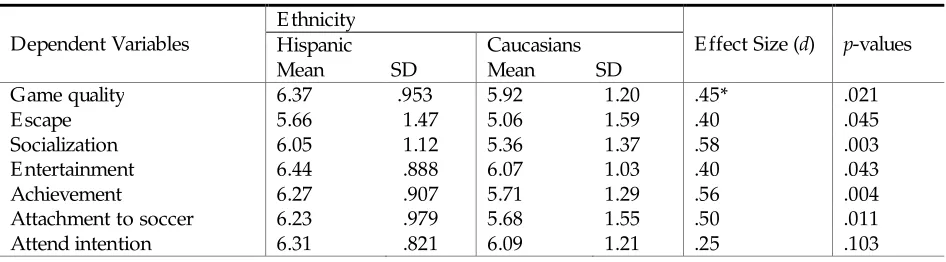
p<.05).. Table 4 presents mean scores of Hispanic and Caucasian spectators, standard deviations, and effect sizes
(Cohen’s d values which represent the magnitude of the relative difference in mean scores between groups, Cohen, 1988). As anticipated Hispanic spectators scored significantly higher than Caucasians on the quality of the soccer game (F(1,200)= 5.421, p=.021, d= .45), escape (F(1,200)= 4.062, p= .045, d= .40), socialization (F(1,200)= 8.849, p= .003, d= .58),
entertainment (F(1,200)= 4.148, p= .043, d= .40), and achievement (F(1,200)= 8.453, p= .004, d= .56). Providing strong
support for Hypothesis 2, Hispanic spectators exhibited significantly higher levels of attachment to soccer than Caucasian spectators (F(1,200)= 6.634, p= .011, d= .50). We hypothesized (H3)that Hispanics would exhibit greater
intentions to attend future soccer games than Caucasians. The data did not support the hypothesis.
Table 4: E ffect Sizes (d), p-values, and Mean Scores of Hispanic versus Caucasians Spectators
Dependent Variables
E thnicity
E ffect Size (d) p-values Hispanic
Mean SD
Caucasians Mean SD
Game quality 6.37 .953 5.92 1.20 .45* .021
E scape 5.66 1.47 5.06 1.59 .40 .045
Socialization 6.05 1.12 5.36 1.37 .58 .003
E ntertainment 6.44 .888 6.07 1.03 .40 .043
Achievement 6.27 .907 5.71 1.29 .56 .004
Attachment to soccer 6.23 .979 5.68 1.55 .50 .011
Attend intention 6.31 .821 6.09 1.21 .25 .103
Note. n = 202
*Cohen’s d is calculated as the difference between two means divided by the pooled standard deviation.
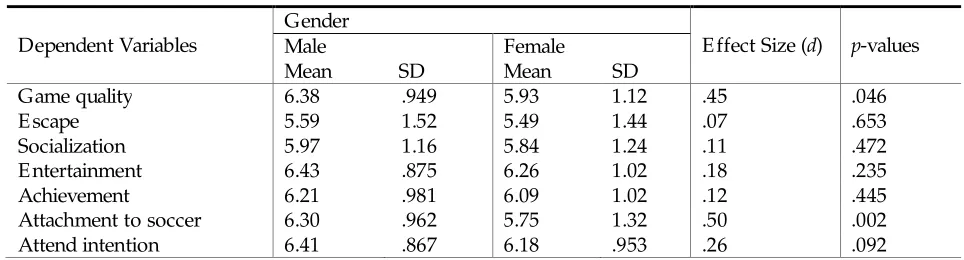
The results are presented in Table 5. As predicted in Hypothesis 4, the quality of the game motivated male spectators to attend a soccer game significantly more than female spectators (F(1,200)= 3.746, p= .046, d= .45). Male
spectators also exhibited significantly higher levels of attachment to soccer than female spectators (F(1,200)= 10.221, p= .002, d= .50). Thus, Hypothesis 5 was supported. However, there were no significant differences in future behavioral intentions between male and female spectators.
Table 5: E ffect Sizes (d), p-values, and Mean Scores of Male versus Female Spectators
Dependent Variables
Gender
E ffect Size (d) p-values Male
Mean SD
Female
Mean SD
Game quality 6.38 .949 5.93 1.12 .45 .046
E scape 5.59 1.52 5.49 1.44 .07 .653
Socialization 5.97 1.16 5.84 1.24 .11 .472
E ntertainment 6.43 .875 6.26 1.02 .18 .235
Achievement 6.21 .981 6.09 1.02 .12 .445
Attachment to soccer 6.30 .962 5.75 1.32 .50 .002
Attend intention 6.41 .867 6.18 .953 .26 .092
Discussion and Implications
Surprisingly, little research has been conducted on Hispanic soccer fans’ motivation and behavior despite the growing Hispanic population. Understanding the factors that motivate Hispanic individuals is one of the keys to making soccer become a major spectator sport in the United States. The number of Hispanics in the United States is expected to grow to 30 percent of the population by the year 2050; the Hispanic population will be younger than most, because of a high birth rate (Taylor & Cohn, 2012). Hispanics in the United States have a demonstrated passion for soccer, since they have grown up in a culture where soccer is the most popular sport (Jones & Allain, 2014). Hispanics are more inclined to follow soccer than any other sport. Many Hispanics believe soccer is not just a sport but instead it is a very important way of expressing pride and patriotism in the successes and achievements of a person’s ethnicity. There is a tremendous opportunity to increase soccer fandom in the United States by appealing to the growing Hispanic population that cares deeply about this sport (Weiss, 2014).Reaching Hispanics in the United States is be a key factor in making soccer more popular (Faflik, 2006; Jensen, 2012).
Our finding sreveal that Hispanics in the United States are more likely than Caucasians to be motivated to attend soccer and be attached to soccer. These findings differ from the work of Harrolle and Trail (2007) who suggested ethnic identity and acculturation do not influence soccer fandom among Hispanics. These findings present several managerial implications which may assist soccer marketers to have a better understanding of the differences between Hispanic and Caucasian spectators in terms of their motivation to attend soccer matches. From this data, one can infer that Hispanic soccer fans have a deeper understanding of the aesthetics of soccer; hence they are more motivated by the quality of the game than Caucasians. Sports marketers need to understand the passion that many Hispanics exhibit for soccer. Similarly, marketers need to understand the passion other ethnic subcultures have for other sports and incorporate that love for sport in marketing campaigns.
It is not surprising that Hispanics rated higher on the extent to which soccer provides an opportunity for socialization. At least some Hispanics who attend soccer match may not necessarily be soccer fans; rather, they come to interact with others, to spend quality time with friends and family, and to socialize with other people. Marketers should incorporate opportunities for socialization as part of soccer events targeted to Hispanics. The finding that Hispanics exhibit higher level of attachment to soccer reflects the importance individuals place on soccer in several Latin American nations; soccer is the national passion and is far and away the most popular sport. Sports marketers should realize that marketing through soccer can be extremely effective if people in a country where soccer dominates.
Marketing campaigns are seeking to reach Hispanics through soccer. Jones & Allain (2014) emphasized the power of soccer to connect with Hispanic Millennials in the United States. Developing Spanish-language websites that focus on soccer is a good strategy to connect with Hispanic fans (Bodey et al., 2009).Corporate sponsors can reach younger Hispanic soccer fans by streaming content onto smart phones and mobile devices (Master, 2014). Results suggest that gender may play a role in influencing the motivations and behaviors of soccer fans. We found that females often are involved in sports for social reasons; often the quality of the game is less important for them (Dietz-Uhler et al., 2000). Sports marketers should promote soccer to women by stressing the opportunity to come out to an event for a safe, welcoming, entertaining, fun, and social experience where they can spend quality time with family and friends.
From a theoretical point of view, this study contributes to the sports marketing literature by extending and applying ethnic identity theory to investigate the soccer fandom of Hispanics versus Caucasians. The current study confirms the central premise of ethnic identity theory (i.e., an enduring, fundamental aspect of the self that includes a sense of membership in an ethnic group and the attitudes and feelings associated with that membership).
In light of the theory, the present study has shown that Hispanics manifest stronger motivation to attend soccer matches and greater levels of attachment to soccer than Caucasians because soccer has been and will continue to be an essential component of Hispanic culture and identity. In regard to gender, the current study expands previous literature by demonstrating differences among males and females related to motivation and attachment associated with soccer; the results show that men are more attached to soccer and more motivated to attend soccer marches than women are.
This study, as others, suffers from a number of limitations and offers opportunities for future research. The cross-sectional study was carried out at one soccer match at one point of time. Future studies should examine multiple matches over time. Another limitation is that this study does not fully represent all the different ethnic subcultures in the United States (e.g., African-Americans, Asian-Americans, etc.) because the almost all the respondents were self-identified as Caucasians and Hispanics; this study could not include other ethnicities than Hispanics and Caucasians in the analysis because African-Americans and Asian-Americans represented an infinitely small portion of the sample participants. Additional research needs to be conducted among other Hispanics and several other non-Hispanic ethnic groups.
References
Al-Thibiti, Y.A. (2004) A Scale Development for Sport Fan Motivation. Doctoral dissertation. Florida State University, Tallahassee, Florida.
Alexandris, K., & Tsiotsou, R.H. (2012). Segmenting soccer spectators by attachment levels: A psychographic profile based on team self-expression and involvement. E uropean Sport Management Quarterly, 12(1): 65-81.
doi: 10.1080/16184742.2011.637174
Anderson, E . and McCormack, M. (2010). Intersectionality, critical race theory and American sporting oppression: E xamining black and gay athletes. Journal of Homosexuality, 57 (8): 949-967.
doi: 10.1080/00918369.2010.503502
Argeris, S. and Nagel, M.S. (2013). An investigation of Major League Soccer attendance. Journal of V enue and
Armstrong, K.L. (1998). Ten strategies to employ when marketing sport to black consumers. Sport Mark eting Quarterly, 7(3): 11-18.
Bagozzi, R.P., &Yi, Y. (1988). On the evaluation of structural equation models. Journal of the A cademy of Marketing
Science, 16 (1), pp. 74-94. doi: 10.1007/bf02723327
Beamon, K., &Messer, C.M. (2014). The E nduring Color L ine in U.S. A thletics. New York: Routledge. doi: 10.4324/9781315879611
Beccarini, C., & Ferrand, A. (2006). Ticket holders’ satisfaction: The influence of club image and fans’ motives.
E uropean Sport Management Quarterly, 6(1):1-22. doi: 10.1080/16184740600799154
Biscaia, R., Correia, A., Rosado, A.F., Ross, S.D, & Maroco, J. (2013). Sport sponsorship: The relationship between team loyalty, sponsorship awareness, attitude toward the sponsor, and purchase intentions. Journal of Sport
Management, 27(4): 288-302.
Bodey, K.J., Judge, L.W., Steward, M. & Gobel, T. (2009). Researching Hispanic fans: Professional sports' use of Spanish language on the Internet. Journal of Research 4(1), 58-63.
Bravo, G.A., Won, D. &Lee, C. (2013). Team USA and the 2010 FIFA World Cup: An examination of TV fans viewing intention. International Journal of Sport Management and Mark eting, 14(1): 169-18.
doi: 10.1504/IJSMM.2013.060636
Brislin, R.W. (1986). The wording and translation of research instruments. In W.J. Lonner & J.W. Berry (E ds.), Field
methods in cross-cultural psychology (pp. 137-164). Thousand Oaks, CA: Sage.
Burnett, C. and Wessels, J.C. (2012). Profiling public viewing and South African viewers during the 2010 FIFA World Cup. A frican Journal for Physical Health E ducation, Recreation and Dance, 18(1): 151-165.
Bush, V.D., Bush, A.J., Shannahan, K.L., & DuPuis, R.J. (2007). Segmenting markets based on sports orientation: An investigation of gender, race, and behavioral intentions. Mark eting Management Journal, 17(1): 39-49.
Butler, D. (2014). A game of two halves: The world’s largest nations will play almost no part in the World Cup. The
E conomist. Retrieved at
http://www.economist.com/news/briefing/21603420-worlds-largest-nations-will-play-almost-no-part-world-cup-there-are-signs
Campbell, T. (2014). World Cup final breaks records worldwide for TV broadcasters. IPTV-News. Retrieved at http://www.iptv-news.com/2014/07/world-cup-final-breaks-records-worldwide-for-tv-broadcasters/ Cartagena, C. (October 14). Hispanics are creating a new baby boom in the United States. CNN. Retrieved at
http://www.cnn.com/2013/10/14/opinion/cartagena-latino-boom/index.html?iref= allsearch
Carter, M.J. (2014). Gender socialization and identity theory. Social Sciences, 3(1): 242-263. doi: 10.3390/socsci3020242 Caucasian, D.W., & Absher, K. (2013). Red Devils, Royals, and the river Thames: The ambassadorial role of sports in
heightening country-of-origin image. Sport, Business and Management: A n International Journal, 3(4): 312-326. doi: 10.1108/SBM-05-2013-0011
Caucasianside, E ., & Hardin, M. (2011) Women (not) watching women: Leisure time, television, and implications for televised coverage of women’s sports. Communication, Culture & Critique, 4(2): 122-143. doi: 10.1111/j.1753-9137.2011.01098.x
Chattaraman, V., Lennon, S.J., &Rudd, N.A. (2010). Social identity salience: E ffects on identity‐based brand choices of Hispanic consumers. Psychology & Mark eting, 27(3): 263-284. doi: 10.1002/mar.20331
Chi, Y.N., Lovett, M.G., &Chi, O. (2012). Gender differences in consumer decision-making styles of Hispanic-American college business students. The International Journal of A rts & Sciences, 5(7): 339–346.
Clark, J.S., Apostolopoulou, A., &Gladden, J.M. (2009). Gender differences in the consumption of the NFL Super Bowl broadcast. Journal of Promotion Management, 15(1): 165-183. doi: 10.1080/10496490902837510
Claussen, C.L., Ko. Y.K., &Rinehart, R.E . (2008). Cultural diversity: An alternative approach to understanding sport participant consumer behavior. The SMA RT Journal, 4(2): 58-71.
Cleland, J., &Cashmore, E . (2013). Football fans’ views of racism in British football. International Review for the Sociology
of Sport, 22(1): 1-17. doi: 10.1177/1012690213506585
Coakley, J., &Dunning, E . (2000). The Handbook of Sports Studies. Los Angeles: Sage. doi: 10.4135/9781848608382 Cohen, J. (1988). Statistical Power Analysis for the Behavioral Sciences. Lawrence E rlbaum Associates, Hillsdale, New Jersey, USA. Crisp, R.J., Heuston, S., Farr, M.J., & Turner, R.N. (2007). Seeing red or feeling blue: Differentiated intergroup
Dietz-Uhler, B., Harrick, E .A., E nd, C. & Jacquemotte, L. (2000). Sex differences in sports fan behavior and reasons for being a sports fan. Journal of Sport Behavior, 23(3): 219-231.
E schrich, J. (2010). They run, they sweat, we write: E SPN’s Bill Simmons, sports journalism, and intersectional identities. UCLA Center for the Study of Women. Retrieved from:
https://escholarship.org/uc/item/1mr6v273
E vans, S. (2016). Mexico is winning Copa America on U.S. turf. Washington Post. Retrieved a
https://www.washingtonpost.com/news/soccer-insider/wp/2016/06/17/mexico-is-winning-copa-america-on-u-s-turf-and-also-at-the-gate-and-on-tv/
Faflik, D. (2006). Fútbol América: Hemispheric sport as border studies. A mericana: The Journal of A merican Popular
Culture. Retrieved at http://www.americanpopularculture.com/journal/articles/spring_2006/faflik.htm
Fink, J.S., Trail, G.T., &Anderson, D.F. (2002). E nvironmental factors associated with spectator attendance and sport consumption behavior: Gender and team differences. Sport Mark eting Quarterly, 11(1): 8-19.
Florek, M., Breitbarth, T., & Conejo, F. (2008). Mega event mega impact? Traveling fans’ experience and perceptions of the 2006 FIFA World Cup host nation. Journal of Sport and Tourism, 13(3): 199-219.
doi: 10.1080/14775080802310231
Foer, F. (2010). How Soccer E xplains the World: A n Unlik ely Theory of Globalization. Harper: New York.
Fornell, C., &Larcker, D.F. (1981). E valuating structural equations models with unobserved variables and measurement error. Journal of Mark eting Research, 18(1): 39-50. doi: 10.2307/3151312
Funk, D.C., &James, J.D. (2006). Consumer loyalty: The meaning of attachment in the development of sport team allegiance. Journal of Sport Management, 20(2): 189-217.
Gantz, W., Zheng, W., Paul, B., & Potter,R.F. (2010). Sports versus all-comers. Journal of Broadcasting and E lectronic
Media, 50(1): 95-118. doi: 10.1207/s15506878jobem5001_6
Gleeson, M. (2014). More than 3.2billion viewers: World Cup 2014 aims for TV victory The Star. Retrieved at http://www.thestar.com.my/Lifestyle/Features/2014/06/12/More-than-3-2-billion-viewers-World-Cup-2014-aiming-for-TV-victory/
Hair, J.F., Back, W.C., Babin, B.J., Anderson, R.E ., & Tatham, R.L. (2010). Multivariate Data A nalysis. Prentice Hall, New Jersey.
Hall, J., &O'Mahony, B. (2006). An empirical analysis of gender differences in sports attendance motives. International
Journal of Sports Mark eting & Sponsorship, 7 (4), pp. 334-346. doi: 10.1108/ijsms-07-04-2006-b008
Harper, C. (2013). Global Sports Media Consumption Report. London: K antar Sports Media.
Harrolle, M.,G., Trail, G.T., Rodriguez, A., &Jordan, J. (2010). Conative loyalty of Latino and non-Latino professional baseball fans. Journal of Sport Management, 24(4): 456-471.
Harrolle, M.G., &Trail, G.T. (2007). E thnic identification, acculturation and sports identification of Latinos in the United States. International Journal of Sports Mark eting & Sponsorship, 8(3): 234-253. doi: /10.1108/ijsms-08-03-2007-b005
Huberty, C.J., &Petoskey, M.D. (2000). Multivariate analysis of variance and covariance. In H. Tinsley and S. Brown (E ds.) Handbook of applied multivariate statistics and mathematical modeling. New York: Academic Press.
Huggins, K.A., Holloway, B. and Caucasian, D.W. (2013). Cross-cultural effects in e-retailing: The moderating role of Mexican from non-Mexican Hispanic consumers. Business Research, 66(3): 321-327.
doi: 10.1016/j.jbusres.2011.08.012
Izzo, G. M., Munteanu, C., Langford, B.E ., Ceobanu, C., Dumitru, I., & Nichifor, F. (2013). Sport fans’ motivations: an investigation of Romanian soccer spectators. Journal of International Business and Cultural Studies, 5(1): 1-28. James, J.D.,& Ridinger, L.L. (2002). Female and male sport fans: A comparison of sport consumption motives. Journal
of Sport Behavior, 25(3): 260-278.
Jensen, R.W. (2012). Why Hispanic fans are the lifeblood of Major League Soccer. In A. E arnhardt, P. Haridakas, & B. Hugenberg, (E ds.), Sports Fans, Identity, and Socialization: E xploring the Fandemonium (pp. 191-200). Lanham, MD: Lexington Books.
Jewell, R.T., & Molina, D.J. (2005). An evaluation of the relationship between Hispanics and Major League Soccer.
Jones, B., &Allain, O. (2014). Dos A Cero: A n E xploratory of the Millennial E ffect on the Future of Soccer in the U.S.Octagon
Sports Mark eting. Retrieved at
http://www.octagon.com/news/press_releases/dos_a_cero_brands_can_reach_hispanic_millennials_throug h_soccer
Jones, M.V., Coffee, P., Sheffield, D., Yanguez, M., &Barker, J.B. (2012). Just agame? Changes in E nglish and Spanish soccer fans’ emotions in the 2010 World Cup. Psychology of Sports and E xercise, 13(2): 162-169.
doi: 10.1016/j.psychsport.2011.10.008
K afkas, M. E ., Çoban, B., and Kafkas, A.S. (2012). Sport fan motivation questionnaire: A study of validity and reliability, Journal of Physical E ducation & Sports Science, 6(1): 34-41.
Kim, N., & Chalip, L. (2004). Why travel to the FIFA World Cup? E ffects of motives, background, interest, and constraints. Tourism Management, 25(6): 695-707. doi: 10.1016/j.tourman.2003.08.011
Kim, Y.K., &Trail, G.T. (2010). Constraints and Motivators: A New Model to E xplain Sport Consumer Behavior.
Journal of Sport Management, 24 (2),pp. 190-210.
Kim, Y.K., Trail, G.T., & Magnusen, M.J. (2013). Transition from motivation to behaviour: examining the moderating role of identification on the relationship between motives and attendance. International Journal of Sports
Mark eting & Sponsorship, 14(3):190-211. doi: http://dx.doi.org/10.1108/IJSMS-14-03-2013-B004
Klein, A. (2007). Latiniziing the national pastime. International Journal of the History of Sport, 24(2): 296-301. doi:10.1080/09523360601046029
Kwon, H. H., Trail, G. T., & Anderson, D. S. (2005). Are multiple points of attachment necessary to predict cognitive, affective, conative, or behavioral loyalty? Sport Management Review, 8(3): 255-270. doi: 10.1016/s1441-3523(05)70041-3
Lee, S., Shin, H., &Shinchi, T. (2010). Identifying sociological motivations of Hispanic/Latino sport consumers attending sporting events. Sport Management International Journal, 6(1): 79-93. doi: 10.4127/ch.2010.0047
Li, W., Tsai, S.W., &Soruco, G. (2013). Perceived ‘Hispanicness’ versus ‘Americanness’: A study of brand ethnicity with Hispanic consumers. International Journal of A dvertising.32(3): 443-465. doi: 10.2501/ija-32-3-443-465
Lindner, A.M., &Hawkins, D.N. (2012). Globalization, culture wars, and attitudes towards soccer in America. The
Sociological Quarterly, 53(1): 68-91. doi: 10.1111/j.1533-8525.2011.01226.x
Lipsey, R. (2013) The United States Sports Fan Consumer A udit. Princeton, New Jersey: Sports Business Research, Inc. Mahony, D.F., Nakazawa, M.,Funk, D.C., & Gladden, J.M. (2002) Motivational factors influencing the behaviour of J.
league spectators. Sport Management Review,5(1): 1–24. doi: 10.1016/S1441-3523(02)70059-4 Master, S. (2014). The Year in Sports Media Report. Nielsen. Retrieved at
http://www.nielsen.com/us/en/insights/reports/2015/the-year-in-sports-media-report-2014.html
McCabe, M.B. (2013). U.S. Hispanics go mobile: Adoption and marketing engagement trends. International Journal of
Mobile Mark eting, 8(2): 67-74.
Meyers, L.S., Gamst, G., and Guarino, A. (2006). A pplied multivariate research: Design and interpretation. Thousand Oaks, CA: Sage Publishers.
Mikho, M. (2013). Brazil’s World Cup is a marketer’s dream. A dvertising Week . Retrieved at
http://www.adweek.com/news/advertising-branding/brazil-s-world-cup-marketers-dream-also-potential-nightmare-152890
Molinaro, J. (2014). Why does the World Cup matter so much? Sports net. Retrieved at http://www.sportsnet.ca/soccer/world-cup-2014/2014-fifa-world-cup-brazil-2/
Monistere, T. (2014) From Fútbol to Football: A Matter of Passion. New York: The Nielsen Company.
Moraga, J.E . (2015). You made el team-o! The transnational browning of the National Basketball Association through the “Noche Latina” marketing campaigns. Social Inclusion, 3(3): 118-128. doi: 10.17645/si.v3i3.134
Ourand, J., Botta, C. &Mickle, T. (2014). The legacy of the cup. Sports Business Journal. Retrieved at http://m.sportsbusinessdaily.com/Journal/Issues/2014/07/14/Events-and-Attractions/World-Cup.aspx?hl= Tripp%20Mickle&sc= 0
Ozanian, M. (2014, June 5). The billion-dollar business of the World Cup. Forbes. Retrieved at
http://www.forbes.com/sites/mikeozanian/2014/06/05/the-billion-dollar-business-of-the-world-cup/ Phinney, J.S. (1996). When we talk about American ethnic groups, what do we mean? A merican Psychologist, 51(9):
Phinney, J.S., & Ong, A.D.(2007). Conceptualization and measurement of ethnic identity: Current status and future directions. Journal of Counseling Psychology, 54(3): 271-281. doi: 10.1037/0022-0167.54.3.271
Pons, F., Laroche, M., Nyeck, S. and Perrault, S. (2001) the role of sporting events as ethno culture’s emblems: Impact of acculturation and ethnic identity on consumers’ orientation toward sporting events. Sport Mark eting
Quarterly, 10(4): 231-240.
Robinson, M.J., &Trail, G.T. (2005). Relationships among spectator gender, motives, points of reference, and sport preference. Journal of Sport Management, 19(1): 58-80.
Sandomir, R. (2010). World Cup ratings certify TV a winner. New York Times. Retrieved at http://www.nytimes.com/2010/06/29/sports/soccer/29sandomir.html
Seock, Y.K., &Sauls, N. (2008). Hispanic consumers' shopping orientation and apparel retail store evaluation criteria: An analysis of age and gender differences. Journal of Fashion Mark eting and Management: A n International Journal, 1(4): 469-486. doi: 10.1108/13612020810906137
Smith, P. (2014). World Football: From Consumption to Sponsorship. New York: Repucom Sports Marketing. Stevenson, T.H. and Plath, D.A. (2006). Marketing financial services to Hispanic American consumers: A
portfolio-centric analysis. Journal of Services Mark eting, 20(1): 37-50. doi: 10.1108/08876040610646563 Sweney, M. (2014). World Cup final breaks Facebook and Twitter records. The Guardian. Retrieved at
http://www.theguardian.com/media/2014/jul/14/world-cup-final-breaks-facebook-and-twitter-records Taylor, P., &Cohn, D. (2012). A milestone en route to a majority minority nation. Pew Research Center. Retrieved at
http://www.pewsocialtrends.org/2012/11/07/a-milestone-en-route-to-a-majority-minority-nation/
Theodorakis, N.D., Wann, D.L., &Weaver, S. (2012). An antecedent model of team identification in the context of professional soccer. Sport Mark eting Quarterly, 21(2): 80-90.
Trail, G.T., Robinson, M.J., Dick, R.J., & Gillentine, A.J. (2003). Motives and points of attachment: Fans versus spectators in intercollegiate athletics. Sport Mark eting Quarterly, 12(4): 217-227.
Trail, G.T., &James, J.D. (2001). The motivation scale for sport consumption: Assessment of the scale’s psychometric properties. Journal of Sports Behavior, 24(1): 108-127.
Trail, G.T., Robinson, M.J., &Kim, Y.K. (2008). Sport consumer behavior: A test for group differences on structural constraints. Sport Mark eting Quarterly, 17(4): 190-200.
Tsiotsou, R.H., & Alexandris, K. (2009). Delineating the outcomes of sponsorship: Sponsor image, word of mouth, and purchase intentions. International Journal of Retail & Distribution Management, 37(4): 358-369. doi: 10.1108/09590550910948583
Ueltschy, L.C., & Krampf, R.F. (2011). The influence of acculturation on advertising effectiveness to the Hispanic market. Journal of A pplied Business Research, 13(2): 87-102. doi: 10.19030/jabr.v13i2.5764
Uhrich, S., & Benkenstein, M. (2010). Sport stadium atmosphere: Formative and reflective indicators for operationalizing the construct. Journal of Sport Management, 24(2): 211-237.
Walker, G. J., Courneya, K. S., & Deng, J. (2006). E thnicity, gender, and the theory of planned behavior: The case of playing the lottery. Journal of L eisure Research, 38(2): 224-253.
Wann, D. L., Bilyeu, J.K., Brennan, K., Osborn, H., & Gambouras, A.F. (1999). An exploratory investigation of the relationship between sport fan motivation and race. Perceptual and Motor Sk ills, 88(3): 1081-1084.
doi: 10.2466/pms.1999.88.3c.1081
Ware, A., &Kowalski, G.S. (2012). Sex identification and the love of sports: BIRGing and CORFing among sports fans. Journal of Sport Behavior, 35(2): 223-236.
Weiss, C. (2014). Will Hispanics give U.S. Soccer a kick? A BC News. Retrieved at
http://abcnews.go.com/blogs/politics/2014/06/will-hispanics-give-u-s-soccer-a-kick/