D
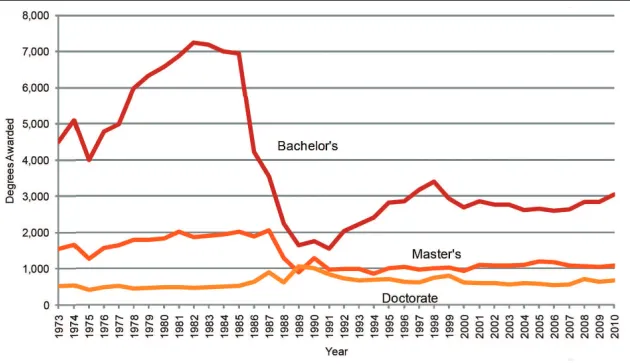
emand for earth scientists is growing—the Bureau of Labor Statistics projects a 21 percent increase in the number of jobs for geologists and geophysicists and an 18 percent increase for hydrologists from 2010 to 2020. However, the number of graduates in earth science ields has not fully recovered from a sharp decline in the early 1980s, which was caused by a loss of U.S. jobs in the petro-leum and mining industries (see Figure 1).Federal agencies offer
earth science education programs for a variety of purposes, including supporting agency missions and helping to build a pool of qualiied recruits. These programs raise awareness of the ield and encourage the retention of students. Although these programs operate independently, they can be thought of as part of a larger system that moves individuals along a path to an earth science career.
This report considers 25 federal earth science education and training programs, lays
out a conceptual framework for thinking about how these programs it together, and suggests ways to leverage federal resources to improve recruitment of a diverse population to careers in earth science.
Program Framework
The 25 federal earth science education and training programs considered in this report (Box 1) provide a range of opportunities and experiences to attract individuals to the ield
A strong earth science workforce is needed to help address issues that are important to the well-being of the nation—from the availability of fossil fuel, mineral, and water resources to a better understanding of geological hazards. Federal agencies play a key role in educating the next generation of earth scientists by offering programs that attract students to the ield, support them through formal education, and provide training for an earth science career. The report examines 25 federal earth science education programs, describes ways to evaluate their success, and identiies opportunities for leveraging federal education resources. It also lays out a framework that shows how the various educational opportunities it together, where stronger program connections are needed to move students along a path toward an earth science career, and where resources could be leveraged.
Preparing the Next Generation of
Earth Scientists
An Examination of Federal Education and Training Programs
Figure 1. Trends in the number of geoscience degrees (deined in this igure as encompassing environmental science, hydrology, oceanography, atmospheric science, geology, geophysics, climate science, geochemistry, paleontology, environmental, exploration, and technical engineering and geoscience management) awarded at U.S. four year colleges from 1973 to 2009.
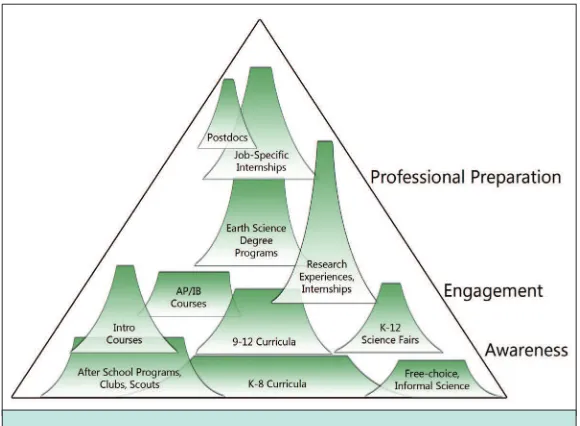
and prepare them for employment. These programs it within a framework that serves individuals at various stages of the earth science career pathway (see Figure 2). The stages of the framework are described as follows:
Awareness — Interest in earth science is sparked through formal education and informal learning in museums, after school programs, and groups. Examples include the USDA’s 4-H Club and the National Park Service’s National Fossil Day.
Engagement — Students actively engage in learning earth science by choosing earth science-related courses, clubs, or community service activities. Examples include the U.S. Geological Survey’s Youth Internship Program, which offers hands-on earth science projects, and the National Science
Foundation’s Opportunities for Enhancing Diversity in the Geosciences program, which supports projects aimed at expanding the involvement of underrepre-sented groups.
Professional Preparation — Individuals acquire earth science-related job skills, knowledge, and abilities. Federally-sponsored research experiences help students build skills and expertise in a specialty area, for example, the National Science Foundation’s
Research Experiences for Undergraduates program. Internships, such as the U.S. Geological Survey’s Hydrologic Technician Internship program, and postdoctoral positions introduce students and early career scientists to job opportunities and employers and provide work-related skills.
The particular pathway individuals take through the framework depends on their speciic interests, the educational and career opportunities available to them, and the needs and expectations of their fami-lies. For example, some people might discover an interest in earth science through a family trip to Yellowstone; others by taking an outstanding intro-ductory course in college. Understanding these pathways could help federal agencies design aware-ness and engagement programs that attract and retain a wide range of individuals.
Developing a System Approach
Federal earth science education and training programs operate largely in isolation from one another. The natural focus of most programs is on agency needs, and not on the larger goal of devel-oping the future workforce. However, connecting federal programs and complementary programs
Box 1. Federal Earth Science Education and Training Programs Considered in This Report
National Science Foundation
•
Earth Science Research Experience for Undergraduates (REU)•
Opportunities for Enhancing Diversity in the Geosciences (OEDG)•
Earth Sciences Postdoctoral Fellowship•
Geoscience Education (GeoEd)•
Global Learning and Observations to Beneit theEnvironment (GLOBE; with NOAA and NASA)
•
Geoscience Teacher Training (GEO-Teach)Department of Energy
•
Ofice of Science Graduate Fellowship Program(SCGF)
•
Summer of Applied Geophysical Experience (SAGE)•
Science Undergraduate Laboratory Internships (SULI)•
Community College Internships (CCI)National Aeronautics and Space Administration
•
Gravity Recovery and Climate Experiment(GRACE)
U.S. Department of Agriculture
•
4-H Environmental Education/Earth Science programs•
Agriculture and Food Research Initiative (AFRI) projects•
AFRI National Institute of Food and Agriculture Fellowships Grant ProgramEnvironmental Protection Agency
•
Greater Research Opportunities (GRO) Undergraduate Fellowships•
Science to Achieve Results (STAR) Graduate Fellowship ProgramNational Oceanic and Atmospheric Administration
•
Educational Partnership Program (EPP) withMinority Serving Institutions
National Park Service
•
Geoscientists-in-the-Parks Program (with the Geological Society of America)•
Geoscience-Teachers-in-Parks Program (with NAGT)•
National Fossil DaySmithsonian Institution
offered by other organizations into a system would help meet both goals.
Stronger and more visible connections between federal, academic, and professional society
programs—for example, through a central listing of available internships—would increase the visibility
of earth science education opportunities and help students ind a path to an earth science career. Currently, the burden of inding opportunities in earth science rests heavily on students, who have only limited knowl-edge and experiences to draw on, and on their advisors, who are most aware of opportunities in their own specialties. As a result, some talented students may not be retained in the ield.
A systems approach would also help federal agencies leverage resources. For example, by mapping their diversity programs onto a conceptual framework, such as the one illustrated in Figure 2a, agencies could identify potential partners and share effective practices for attracting and retaining minority students.
Collaborations with professional societies focused on diversity, such as the National Association of Black Geoscientists, could help connect minority students to education and training opportunities and available positions. Coalitions of partners from federal agencies, private companies, univer-sities, and professional societies would stretch federal dollars and bring a wide range of expertise to bear on the common goal of increasing diversity.
Evaluating Programs
In a time of reduced budgets, it is important for federal agencies to invest in education programs that are effective. Program evalu-ations provide a means and rationale for determining whether a program is
succeeding and why. Such evaluations focus on understanding program goals, estab-lishing criteria for success, and gathering data on program performance. Some programs considered in this report have demonstrated success through formal evaluations. Other programs may also be successful, but have not collected the data necessary to make this determination or to understand how to improve, sustain, or expand the effort. In addition, some stated program goals, such as improving understanding of earth science, are too broad to measure and evaluation criteria do not always match stated goals.
The lack of suitable data for identifying successful programs underscores the importance Figure 2a. Conceptual framework illustrating the types of programs
and experiences that help move individuals along a pathway from awareness of earth science (base of triangle) toward an earth science career (apex of triangle). The framework is portrayed as a triangle because more individuals will develop an interest in earth science than will become engaged in the ield, and more will become engaged in the ield than will prepare for and pursue a career.
Committee on Trends and Opportunities in Federal Earth Science Education and Workforce Development: Arthur Goldstein (Chair), Bridgewater State University, Massachusetts; Pranoti Asher, American Geophysical Union, Washington, D.C.; Susan E. Cozzens, Georgia Institute of Technology, Atlanta; Cathryn A. Manduca, Carleton College, Northield, Minnesota; Eric J. Pyle, James Madison University, Harrisonburg, Virginia; Eric M. Riggs, Texas A&M University, College Station; Karl Turekian, emeritus, Yale University, New Haven, Connecticut (deceased March 2013); Lisa D. White,
University of California Museum of Paleontology, Berkeley; Anne M. Linn (Study Director, Board on Earth Sciences and Resources), Deborah Glickson (Senior Program Oficer, Ocean Studies Board), Eric J. Edkin, (Senior Program Assistant, Board on Earth Sciences and Resources), National Research Council.
The National Academies appointed the above committee of experts to address the speciic task requested by the
U.S. Geological Survey. The members volunteered their time for this activity; their report is peer-reviewed and
the inal product signed off by both the committee members and the National Academies. This report brief was
prepared by the National Research Council based on the committee’s report.
Permission granted to reproduce this brief in its entirety with no additions or alterations. Permission for images/igures must be obtained from their original source.
© 2013 The National Academy of Sciences
of incorporating evaluation into program design. Logic models provide a useful mechanism for helping program managers deine who the program is trying to reach, what it is trying to achieve, what resources it requires, and how to achieve near- and long-term results.
System-Level Evaluation
A system-level evaluation that encompasses all programs and activities within the framework of earth science opportunities could be used to identify imbal-ances in effort and gaps in support—information that could help agencies determine where future education and training efforts may be useful. Broad indicators of program activities could be developed by aggregating relevant information from individual program evaluations, and supplemented by targeted program evaluation aimed at understanding how to create effective programs. Network analysis of the programs in the system could reveal which connec-tions among participating organizaconnec-tions help move individuals through the system, and qualitative studies would help show how individuals ind educa -tion and training opportunities and what they learn from them.
Broadening the Participation of
Underrepresented Groups
A key goal of federal government recruitment policies is to attain a workforce that draws from all segments
of society and leverages diversity to deliver the best public service. However, the federal earth science workforce does not yet mirror the ethnic, racial, and gender diversity of the U.S. population.
Women have made substantial gains in earth science over the past several decades and now obtain 39 percent of bachelor’s degrees in the ield. In comparison, however, available literature shows that, with attention to biases and improved mentoring, it may be possible to narrow or eliminate the degree gap between women and men.
Compared to women, the gains of minorities in earth science education have been modest.
Underrepresented minorities (African American, American Indian, and Hispanic or Latino of any race) comprised 30 percent of the U.S. population according to the 2010 census, but received only 7.2 percent of the earth science bachelor’s degrees awarded in 2009.
Studies suggest that education and training programs that succeed in attracting and retaining minority students have some common elements, including building strong connections with commu-nities and creating linkages with other programs to form clear educational pathways. The latter under-scores the importance of thinking about education and training programs in the context of a system that moves students from awareness to preparation for an earth science career.
For more information, visit http://dels.nas.edu/besror call (202) 334-2744.