http://www.southjournals.com
South Journal of Educational Psychology and Counseling
http://southjournals.com/ojs-2.4.5/index.php/sjepc
Iranian EFL learners' Spoken Performance under the Surveillance
of Teachers and Educational counselors. A Case of Self-repairs
Forud Gholami1*, Rasool Zarhoon2, Homa Derakhshesh3 Halime Khatoon Sadeghi4
1
(Ph.D. Student of Counseling, Hormozgan University,Hormozgan, Iran)
2
(M. A Student of career Counseling, Isfahan University, Isfahan, Iran)
3
(M. A of Counseling, Azad University, KhominiShahr Branch, Khomini Shahr, Iran)
4
(M. A of Counseling, Azad University, KhominiShahr Branch, Khomini Shahr, Iran)
*Corresponding author: Forud Gholami
To cite this paper: gholami, Forud.et.al (2017). Iranian EFL learners' Spoken Performance under the Surveillance of Teachers and Educational counselors. A Case of Self-repairs. South journal of Educational Psychology and Counseling, 4, 1, 70-77.
Abstract:
This study was an attempt to investigate self-repairs in oral performance among Iranian intermediate EFL Learners. To do so a cooperation between EFL teachers and educational counselors was needed. After preparing the preliminaries, 60 male and female EFL learners whose level of proficiency was determined through administering an Oxford Placement Test (OPT) participated in this study. They were divided into 3 groups: 1) group with no pre-task planning time, 2) group with five minute pre-task planning time, and 3) group with ten minute pre-task planning time. The instrument utilized in this study was an oral test through which different types of repairs were identified and further analyzed. A number of chi-square tests were performed to determine whether there were significant differences in three kinds of repairs: error-repair, appropriacy-error-repair, and information- repair in EFL learners’ performance in the three groups. The results revealed that groups with time for pre-task planning have fewer repairs than the group with no time, but there was no significant difference in groups with different pre-task planning time. The outcome of this study can be used by educational counselors and English language teachers to consider the importance of cooperation and thereby transfer transactional knowledge between themselves.
Introduction
Speaking is a skill which was evaluated and considered to be crucial to many EFL learners who are attending in language classes. In addition, fluency in speech production is an automated procedural ability, and fluent speech is natural and effortless necessitating not much concentration and attempt (Schmidt, 1992). Therefore, fluency in speaking was always an important fact which was the focus of many studies in language teaching.
Language teachers in their everyday teaching practice frequently observe self-repair behavior of L2 learners in their L2 speech production. Teachers' frequent observations of students' self-repair have evoked them to investigate the pros and cons of this phenomenon. One way that can lead teachers toward the solution is cooperation and collaboration with educational counselors. Since speaking is a fast as well as a complicated cognitive process, teaching, scoring the learner's speaking ability as well as monitoring and pondering upon the self-repairs are very difficult tasks that a teacher alone can not tackle all these duties. Here the cooperation between teachers and other specialists like educational counselors is in the domain of attention. According to Levelt 1989), speakers can monitor and repair their own speech, and this is a fact that speakers monitor what they are saying and how they are saying it. When they make a mistake or express something inappropriately, they may interrupt themselves and make a repair.Postma 2000 points out that self-repair is a
common event in both conversations and monologues (cited in Yun, 2007). Also, there are so many cases they correct themselves or change the whole idea, this is the subject under the umbrella term self-repair behaviors. According to the definition
which is given for the term “repair” in Longman Dictionary of Language Teaching
and Applied Linguistics, in a conversational analysis, repair is a term for ways errors, unintended forms, or misunderstandings are corrected by speakers or others during conversation (Richard & Schmidt, 2002). Therefore, in the domain of reciprocal comprehension, self-repair is a fact which is important both for the speaker and listener. Self-repair is a cognitive process by which the speaker can frequently correct himself. This correction effect the process of comprehensibility on the part of listener. Comprehensibility alongside the accuracy are cornerstone of the present study which will be considered by the researchers.
Background
During last decades, lots of studies have been conducted to see the effect of different tasks and their roles in language classes. In this regard self-repairs (alterations or
corrections in one’s spontaneous speech) have been the subject of investigation in psycholinguistic and conversational analytic studies. Through the study of self-repairs, in the former discipline, researchers have mainly tried to find out the mechanism of language production (Van Hest, 1996), while in the latter, the concern has generally been with the investigation of the use of language in a social setting
planningis believed to be different from other reflective processes because it happens in a different environment fromthe task itself.
There have been many studies conducted to see the effect of pre-task planning in language learning, but few studies have been focused on EFL learners’ self-repair along with pre-task planning time. Therefore, the present study was an attempt to see how much pre-task planning time could influence the self-repair behaviors of EFL learners. In light of the above theoretical and empirical discussion, the study reported this article aimed to address the following research questions:
1. What is the effect of pre-task planning time on Iranian intermediate EFL
learners’ oral production in terms of error-repair?
2. What is the effect of pre-task planning time on Iranian intermediate EFL
learners’ oral production in terms of appropriacy-repair?
3. What is the effect of pre-task planning time on Iranian intermediate EFL
learners’ oral production in terms of information- repair? Procedure
The first step of the study was to be sure that all participants are at the same level of proficiency. To do so, an OPT were conducted and the participants were assigned into three groups to be interviewed. Since understanding the complexity of cognitive process in producing language needed a more sophisticated and longitudinal study, there was a consensus between the investigators to analyze only the surface structure of this cognitive complexity (we mean analyzing only the spoken language). For this regard different pre-task planning times were allocated to the three different groups, so the aforementioned groups had a different time as pre-task planning time. Three different planning time were considered to answer the tasks and conditions which were prepared for their interview, also each participant in these groups had 10 minutes to answer the questions; these conditions can also be conceptualized in terms of memory demands (Ishikawa, 2007). The Here-and-Now conditions are delineated by distinctive memory demands through the access to or absence of context support. This means that how information is processed in the mind, as in light of the absence of visual support (Here-and-Now), learners have to commit the plotline to memory; subsequently, they have to make an effort to retrieve the needed information from memory, and cohere the information into a unified narrative (Farahani & Meraji, 2011). What the researchers tried to find had been the effect of time on the number of repairs which could consequently be influenced. Three the allocated times for each group to answer the questions were, no time, five minutes, and 10 minutes. The answers were recorded and the number of errors were counted.
Participants
Out of 100 EFL learners studying English at the intermediate level classes of a language institute in Esfahan who were selected through availability sampling, 60 intermediate male and female Iranian EFL learners aged 14-23 were chosen.
In order to make sure in objective terms that the learners were truly at the same level with regard to their English proficiency, an Oxford Placement Test was given to them. After obtaining the proficiency test results, 60 participants who met homogeneity criterion were selected whose grades on the placement test were between 28 and 34 and were assigned to three groups; first one with no time of pre-task planning, second one with five minute pre-task planning, and third group with 10 minute pre-task planning time (20 participants in each).
Instruments
level of proficiency and the interview test was conducted to find the effect of the given pre-task planning time on repairs.
Data Analysis
Since the collected data were non-parametric, the chi-square was used to analyze them. As the chi-square test was used to determine whether there was a significant difference between the observed frequencies in one or more categories, it was the ideal statistical analysis for this study.
Results
Repairs in Different Groups
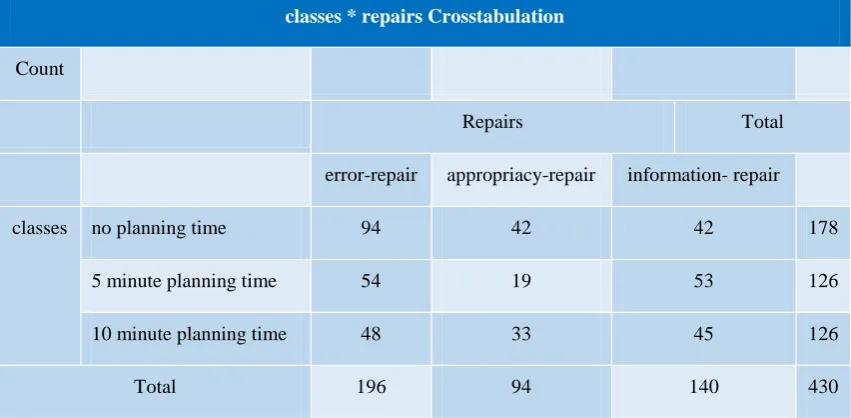
In this part as the first result, a brief report of descriptive statistics (frequency count) can lead us toward more analysis of this study. The following table shows the frequencies of three different repairs in three different groups of the study.
Table 1. Frequencies of Three Different Repairs in Three Different Groups of the Study
classes * repairs Crosstabulation
Count
Repairs Total
error-repair appropriacy-repair information- repair
classes no planning time 94 42 42 178
5 minute planning time 54 19 53 126
10 minute planning time 48 33 45 126
Total 196 94 140 430
As it is shown in the above table, among 430 repairs occurred during EFL learners’
oral production, 196 of them were error-repairs, 94 of them were appropriacy-repairs, and the rest 140 were information-repairs.
The first group of participants considered in this study is a group with no pre-task planning time for the oral production and the final result of the gathered data for this group was 94 error repairs, 42 appropriacy repairs, and 42 information-repairs.
The second group in which repairs were observed in its participants’ language production was the group with five minute pre-task planning time. As the results showed, 54 error-repairs, 19 appropriacy-repairs, and 53 information-repair occurred in this group oral production.
The third and last group of participants were given 10 minutes as the pre-task planning time. The number of repairs are 48 error-repairs, 33 appropriacy-repairs, and 45 information-repairs.
Comparison of Groups
The first comparison was between the group with no pre-task planning time and the group with five-minute pre-task planning time. The results of this comparison through Chi-Square are shown in following Tables.
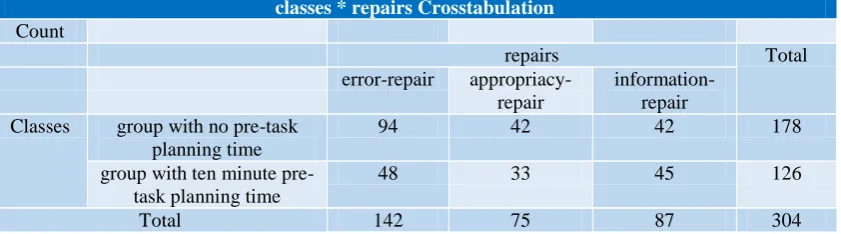
Table 2.Occurred Repairs in Group with No task Planning Time vs. Group with Five Minute
Pre-task Planning Time participants of group with no pre-task planning time and 126 repairs were group with five minute pre-task planning time.
Table 3. Chi-Square Analysis between Groups with No task Planning Time and Five Minute
Pre-task Planning Time Chi-Square Tests
Value df Asymp. Sig. (2-sided) Pearson Chi-Square 12.219a 2 .002
Likelihood Ratio 12.175 2 .002 Linear-by-Linear Association 7.724 1 .005
N of Valid Cases 304
a. 0 cells (.0%) have expected count less than 5. The minimum expected count is 25.28.
With no more explanation, as it can be seen in the above table, the difference between the two groups were significant (p<0.05).
Group with No Pre-Task Planning Time vs. Group with Ten Minute Pre-Task Planning Time
The next comparison was between the group with no pre-task planning time and the group with ten minute pre-task planning time. The result of this comparison through Chi-Square is shown in following tables.
Table 4. Occurred Repairs in Group with No task Planning Time vs. Group with Ten Minute
As it is shown in this Table, out of 304 repairs, 178 ones were in oral performance of participants of group with no pre-task planning time and 126 repairs were group with ten minute pre-task planning time.
Table 5. Chi-Square Analysis between Groups with No task Planning Time and Ten Minute
Pre-task Planning Time Chi-Square Tests
Value df Asymp. Sig. (2-sided) Pearson Chi-Square 7.407a 2 .025
Likelihood Ratio 7.421 2 .024 Linear-by-Linear Association 7.348 1 .007
N of Valid Cases 304
a. 0 cells (.0%) have expected count less than 5. The minimum expected count is 31.09.
As it is shown in this Table, the result of the analysis by Chi-Square shows that these two groups are significantly different (p<0.05).
Group with five minute task Planning Time vs. Group with Ten Minute Pre-task Planning Time
The last comparison was between the group with five minute pre-task planning time and the group with ten minute pre-task planning time. The result of this comparison through Chi-Square is shown in following tables.
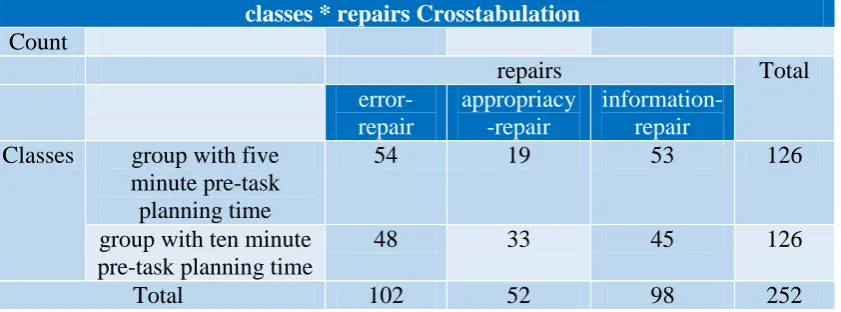
Table 6. Occurred Repairs in Group with Five Minute Pre-task Planning Time vs. Group with Ten
Minute Pre-task Planning Time
classes * repairs Crosstabulation Count
repairs Total
error-repair
appropriacy -repair
information- repair
Classes group with five minute pre-task planning time
54 19 53 126
group with ten minute pre-task planning time
48 33 45 126
Total 102 52 98 252
The above Table shows that, out of 252 repairs, 126 ones were in oral performance of participants of group with five pre-task planning time and 126 repairs were group with ten minute pre-task planning time; the number of occurred repairs are surprisingly the same but the number of them in each repair is different.
Table 7. Chi-Square Analysis between Groups with Five Minute Pre-task Planning Time and Ten
Minute Pre-task Planning Time Chi-Square Tests
Value df Asymp. Sig. (2-sided) Pearson Chi-Square 4.775a 2 .092
Likelihood Ratio 4.823 2 .090
Linear-by-Linear Association .020 1 .888 N of Valid Cases 252
As it is shown in this Table, the result of the analysis by Chi-Square shows that these two groups with time for pre-task planning are not significantly different (p>0.05).
Discussion
The aforementioned design procedure was carried out and certain significant findings were obtained that will be presented in brief: The participants in the group with no pre-task planning time were significantly different in having three different repairs in comparison with that of two other groups; and the participants in five and ten minute pre-task planning time were not significantly different in having repairs in their oral performance. The number of error-repairs was significantly different in the three groups. Pre-task planning time had an effect on Iranian intermediate EFL learners’ oral production in terms of appropriacy-repair, but the length of time had no meaningful effect on this repair occurrence. Pre-task planning time had no effect on Iranian intermediate EFL learners’ oral production in terms of information- repair. The finding of this study was in line with that of Seyyedi, Ismail, and sharafi Nejad (2013) that they found the pre-task planning time has positively influenced complexity, fluency, and accuracy of EFL learners’ narrative writing performance. It has been argued in Yun (2007) that the examination of self-repair and monitoring processes in a comprehensive psycholinguistic framework has special relevance for SLA research, because it can reveal new aspects of automaticity in speech production. Upon discussing the level of automaticity,Levelt 1989 states that monitoring
involves controlled processing, that is, requires attentional control. Performance will
deteriorate if there is not enough attention available for the execution of a task. In less proficient L2 speech processing considerably fewer processes are automatized ,that
is, the linguistic rule or item of vocabulary called for may not be fully acquired yet or it may not be sufficiently automatized and in turn, they require more attention than encoding mechanisms for proficient L2 speakers. Besides, Mojavezi and Ahmadian (2013) who have worked on the same three kind of repair and their relationship with working memory capacity, found out that the number of these repair are quite different. In the present study also information-repairs had no meaningful difference considering the pre-task planning time. This can be in line with Levelt’s statement that speakers are not capable of attending to all aspects of their speech and that they behave selectively when it comes to self-monitoring and effectuating self-repair behavior (1989).
References
Bada, E. (2010). Repetitions as vocalized fillers and self-repairs in English and French interlanguages. J. Pragmatics, 42(6), 1680-1688.
Farahani, A.A. & Meraji, S.R. (2011). The effect of length of pre-task planning time on discourse-analytic measures and analytic ratings in L2 written narratives.
Journal of English Studies, 1(2), 21-37.
Hayes, J. & Gradwohl Nash, J. (1996). On the nature of planning in writing. In C. Levy and S. Ransdell (Eds.).The science of writing. Mahwah NJ: Lawrence Erlbaum.
Jasperson, R (2003). Some linguistic aspects of closure cut-off. In Carlo L. Prevignano and P. J. Thibault (Eds.). Discussing Conversation Analysis: The Work of E.A. Schegloff. Amsterdam: Benjamins, pp.257-286.
Levelt, W. (1989). Speaking From intention to articulation. Cambridge, MA: MIT Press.
Macbeth, D. (2004). The relevance of repair for classroom correction. Lang. Soc., 33, 703-736.
Mojavezi, A. & Ahmadian, M. J. (2013). Working memory capacity and self-repair behavior in first and second language oral production, J Psycholinguist Res, 289-297.
Postma, A. (2000). Detection of errors during speech production: a review of speech monitoring models. Cognition, 77, 97-131.
Richards, J. C., & Schmidt, R. (2002). Dictionary of language and applied linguistics
(3rd ed.). England: A Pearson Education Book.
Rieger, Caroline L (2003). Repetitions as Self-repair Strategies in English and German Conversations. J. Pragmatics, 35(1), 47-69.
Schegloff, E. A. (1979). The relevance of repair to syntax or conversation. In T. Givon (Ed.) Syntax and Semantics, 12: Discourse and Syntax (p. 261-268). New York: Academic Press.
Schegloff, E. A., Jefferson, G. Sacks, H. (1977). The preference for self-correction in the organization of repair in conversation. Language, 53, 361-382.
Schegloff, E. A., Jefferson, G. Sacks, H. (1990). The preference for self-correction in the organization of repair in conversation. In Psathas, G. (Ed.). Interaction
Competence (pp. 31-61) Washington DC: International Institute for
Ethnomethodology and Conversation Analysis and University Press of America, pp. 31-61.
Schmidt, R. (1992). New conceptualizations of practice: Common principles in three paradigms suggest new principles for training. Psychological Science, 3, 207-217. Seyyedi, K., Ismail, S. A. M. M., Orang, M., Sharifi Nejad, M. (2013). The effect of
pre-task planning time on L2 learners’ narrative writing performance, English
Language Teaching, 6(12), 1-10.
Van Hest, E. (1996). Self-repair in L1 and L2 production. Tilburg, Netherlands: Tilburg University Press.