B
udgets are important economic policy instruments and play a key role in promoting public welfare. he quality of budget management determines the extent to which budget policies support achievement of national goals. Accordingly in 2003, as part of its program of reform and as a sign of its intention to restore the original purposes of State budgeting, the Indonesian government passed a new law (No 17/2003) on State Finances. his was the irst time since independence in 1945 that Indonesia had modernized its inance laws: previously, those laws had been based on the Dutch budgetary system called Indische Compatabiliteitswet (better known as ICW).Almost a decade on from the enactment of Law No. 17/2003, it has to be said that Indonesia’s State budgets are not yet fully efective instruments for the distribution of State iscal resources. Various problems adversely afect not only budget formulation and procedures, but also budget implementation. his Budget Brief has grown out of the relections that have informed FITRA’s budget advocacy thus far. It is, therefore, not meant to provide answers to every current budgetary issue; but, rather, it will hopefully act as a catalyst for future budgetary reform both in terms of ideas and as a technical budget guide.
As one of the countries that launched the Open Government Partnership initiative, Indonesia should make budgetary reform a principal component of its national agenda in order to enhance levels of budget transparency, public participation and accountability in Indonesia.1
1 Among the preconditions and purposes of the Open Government Partnership
(OPG) are budget transparency and public participation. For further information on OPG and “Open Government Indonesia”, see http://www.opengovpartnership.
Introduction
TABLE OF CONTENTS
•Introduction
•Constitutional Mandates Not Spelt out in Law on State Finances
•Pro-forma Nature of DPR Enactment of APBNs – Opportunity for Secret Budget Discussions
•Budget “Optimizing” Processes Unregulated – Susceptible to Politicization
•Budget Blocking: Fertile Ground for Rent Seekers
•Rewards & Penalties and Non-transparent APBN Implementation – Causes of Under-expenditure
•Half-hearted Budget Transparency – Enacted APBNs Should be Published in Full
•Disjointed Information Systems for APBN Planning/Funding/Budget Outcomes
•Misconceptions about Budget Savings
•Half-hearted Performance-based Budgeting: Present in Planning, Merely Administrative in End-of-year Fiscal Reports
•References
•Tabulated Summary
•Glossary of Abbreviations
Address: Mampang Prapatan IV, Jl. K no. 37
Jakarta Selatan, 12790 Telefax: (021) 7947608,
e-mail: [email protected]
Website: www.seknasitra.org
Writen by Yuna Farhan Translated into English by Denis Fisher
Budgetary
reform
in indonesia
September 2012
BUDGET BRIEF
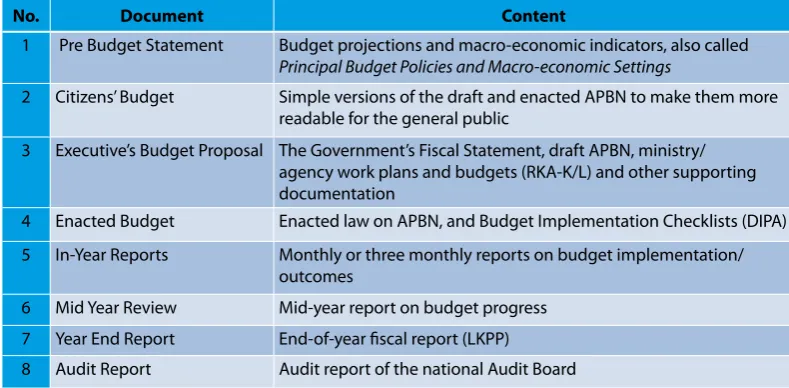
Table 1. Eight Key Documents That Should be Publicly Available
No. Document Content
1 Pre Budget Statement Budget projections and macro-economic indicators, also called
Principal Budget Policies and Macro-economic Settings
2 Citizens’ Budget Simple versions of the draft and enacted APBN to make them more readable for the general public
3 Executive’s Budget Proposal The Government’s Fiscal Statement, draft APBN, ministry/ agency work plans and budgets (RKA-K/L) and other supporting documentation
4 Enacted Budget Enacted law on APBN, and Budget Implementation Checklists (DIPA) 5 In-Year Reports Monthly or three monthly reports on budget implementation/
outcomes
6 Mid Year Review Mid-year report on budget progress 7 Year End Report End-of-year iscal report (LKPP)
8 Audit Report Audit report of the national Audit Board
Recommendations: Revision of the Law on State Finances should contain clear parameters for maximizing public welfare, including a requirement that bureaucratic spending be efective and eicient. Parameters for maximizing public welfare could specify that constitutionally guaranteed citizens’ rights should be leshed out in budgets, leading to expenditure of more substantial iscal resources on promotion of public welfare.
he revised law should also guarantee public access to all budget documents and to information on the entire budgetary process. According to an “Open Budget Index” published by the International Budget Partnership (IBP), there are eight key budget documents that should be made publicly available (see Table 1)2. In
addition, the public should participate
2 For more information on the Open Budget Index, see: http://internationalbudget.org/what-we-do/open-budget-survey/
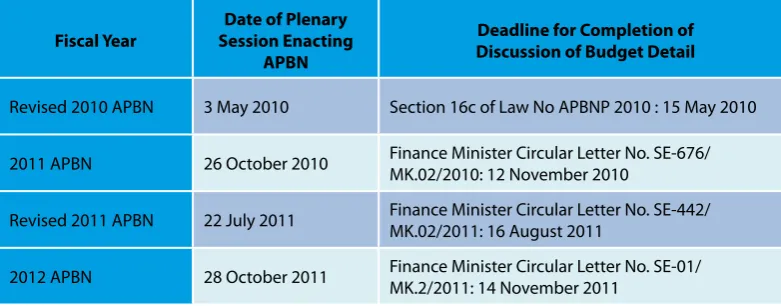
Table 2. Dates of Plenary DPR Sessions and Timing of Completion of Budget Discussions
Fiscal Year
Date of Plenary Session Enacting
APBN
Deadline for Completion of Discussion of Budget Detail
Revised 2010 APBN 3 May 2010 Section 16c of Law No APBNP 2010 : 15 May 2010 2011 APBN 26 October 2010 Finance Minister Circular Letter No. SE-676/
MK.02/2010: 12 November 2010
Revised 2011 APBN 22 July 2011 Finance Minister Circular Letter No. SE-442/ MK.02/2011: 16 August 2011
2012 APBN 28 October 2011 Finance Minister Circular Letter No. SE-01/ MK.2/2011: 14 November 2011
inances should also provide space for public comment on drat APBNs before their enactment. Also, given that APBN laws only remain in force for one budget year, the timeframe for judicial reviews of APBN laws by the Constitutional Court should be before the commencement of the actual budget year in question.
Pro-forma DPR Enactment of APBNs – Opportunity for
Secret Budget Discussions
he situation: Section (5) paragraph 15 of Law No. 17/2003 reads: “APBNs as approved by the DPR shall contain details of organizational units, functions, programs, activities and kinds of
expenditure”. In practice, the DPR does not observe this provision of the law. In fact, its enactment in plenary session of APBN laws continues to be a largely pro-forma exercise, given that discussion of the detail of APBNs continues ater formal enactment (see Table 2 below). A case in point is the lump sum of Rp 1.1 trillion appropriated for budget “optimization” in the revised 2010 budget: those funds were divided up amongst DPR sectoral commissions for discussion with government counterparts
Recommendations: A plenary DPR session held to enact an APBN law should be the DPR’s inal decision taken on that APBN; and APBNs as enacted should contain all the information required in Section 15 of Law No. 17/2003. Discussion of the detail of an APBN should not be permitted ater its formal enactment in plenary session. In addition, all budget-related documentation— government inancial statements, basic budgetary data and full details of budget
allocations (thus far made known by Presidential regulation)—should be attached to the APBN law and form an integral part of it. his should not be impossible to achieve, given that it is already happening at the local government level in Indonesia: full details of budgetary spending—by activity/item of expenditure—are attached to regulations approving local government budgets.
Budget “Optimizing” Process Unregulated –
Susceptible to Politicization
above, in the revised 2010 APBN, the DPR set aside Rp 1.1 trillion for subsequent discussion by its 11 sectoral commissions—Rp 100 billion per commission. A similar situation arises in the case of so called “infrastructure adjustment” funding, also inanced by optimization funds: that money— transferred to regions as part of central iscal balance funding—is fertile ground for budget maia activity. Indeed it has already ensnared several members of the DPR’s Budget Committee.
Recommendations: he MD3 law referred to above or the DPR’s standing orders should lay down unequivocal procedures for allocation of funds identiied in budget “optimization” discussions, given that such funds are susceptible to politicization, are oten misdirected and are liable to misappropriation. It is, therefore, recommended that budget optimization funds be used solely to reduce budget deicits, thereby obviating the need for government to take on new debt. he situation: Section 15, Paragraph (3)
of Law No. 17/2003 on State Finances
Budget Blocking: Fertile Ground for
Rent Seekers
he situation: For as long as a budget item is marked with an asterisk it is blocked and its funding cannot be disbursed by the ministry/agency concerned. An examination by FITRA of the 2011 APBN has revealed that 6 101 items of central government expenditure to the value of Rp 63.4 trillion were blocked in this way. Both the Ministry of Finance and the DPR can block budget items. he former usually blocks an item on the grounds that it lacks full supporting documentation such as terms of reference; that land for construction of a building is not yet available; or that proposed expenditure is at variance with set standards. Budget blocking by the DPR, on the other hand, indicates that the responsible ministry/agency and the DPR—be it a sectoral commission or the DPR’s Budget Committee—have not yet reached agreement and, for that to occur, further discussion and receipt of additional information by the DPR are required. According to records in the Directorate-General of Budgeting, as of 6 January 2012, ministry/agency work plans and budgets to the value of Rp 78.5 billion are still being blocked by DPR sectoral commissions. his blocking process provides further opportunities for budget maias to ply their wares, given that lobbying on blocked items takes place via non-public processes and unblocking them needs only to be agreed by the relevant sectoral commission’s leadership or a sectoral commission’s DPR Budget Committee representative. For example, funding for the “Wisma Atlet” venture
was originally a blocked budget item that was subsequently unblocked by way of undercover agreement. here is no provision whatsoever in the Law on State Finances for the DPR to block budget expenditure. In fact, such action infringes the law’s provision that the DPR should approve the detail of APBNs down to the level of program activities. It follows that once the DPR in plenary session has enacted an APBN, no further discussion of asterisked (blocked) items in that budget should occur.
Rewards & Penalties, and Non-Transparent Budget
Implementation – Causes of Under-Expenditure
Half-Hearted Budget Transparency – Approved Budgets
Should be Published in Full
Recommendations: In an efort to speed up dispersal of budgetary spending the government has this year (2012) formed a Budget Expenditure Oversight and Evaluation Team (known as TEPPA) and has begun to publish quarterly progress reports on budget implementation. But this measure should not be a temporary one: in future, the government should publish quarterly progress reports on the budget spending of all ministries/agencies so that under-performers and bottlenecks can be identiied from the outset. If ater 6 months a ministry/agency has spent less than 50% of its budget allocations, it should be penalized by having its budget for the second half of the year cut to the level of its expenditure for the irst six months. Rewards for good performance in one iscal year should be paid out at the beginning of the next. It is also recommended that rewards and penalties should not be restricted to adjustments of funding levels of ministries/agencies concerned, but should also be applied to remuneration paid to those in control of those budgets. his measure should be implemented as an integral part of bureaucratic reform.
he situation: Claims by government and the DPR that budgetary processes are already open are not entirely accu-rate. he only State budget docu ments available on the Ministry of Finance’s website are government inancial statements, drat laws on APBNs and (ater APBNs are enacted) Presidential
decrees containing APBN details. Other important documents—the very ones that should invite inputs from the general public—are not published: two sets of documents—ministry/agency Work Plans and Budgets (RKA K/L) containing the detail of APBNs and Budget Imple-mentation Checklists (DIPAs)—are he situation: APBN legislation has
introduced a system of rewards and penalties to encourage ministries/agencies to improve their budget expenditure performance: those unable to spend their budgets on time are penalized by having their budget allocations cut, while those with good expenditure levels are rewarded with extra budgetary funding. he problem is that rewards—based on the preceding iscal year’s expenditure performance—are not paid out until the (mid-year) budget revision stage of the next budget year; in practice that leaves less than six months for the rewarded ministry/agency to spend its extra funding. he result is that, instead of encouraging more efective expenditure, rewards for good performance make it more diicult for recipients to sustain good budget realization performance. he truth is that, if ministries/agencies stuck to the cash lows contained in their
through to end-of-year reports on budget outcomes—should be in open/accessible formats and lay-outs (lists or sheets of data) making it easier for researchers or the general public to use them and register inputs on them3. Such practices
would streng then the DPR’s budgetary role and enhance its standing in the eyes of the general public; and would, at the same time, increase its budgetary bargaining power vis-à-vis government. If ministry/agency RKAs were published at the moment of their submission by government to the DPR, cases of misappropriation of funds and corrupt designs on budget allocations could be nipped in the bud.
3A global initiative to present data in an open
and easy to use format is now being acted upon in many countries: see http://www.data. gov/opendatasites/
Disjointed Information Systems for Budget Planning,
Funding Allocation & Budget Outcomes
he situation: Two State institutions are responsible for budget planning: the National Development Planning Agency (Bappenas) and the Ministry of Finance. Bappenas formulates work plans for government and for each ministry/ agency; within the Ministry of Finance, the Directorate-General of Budgeting has oversight of ministry/agency work plans and budgets (RKAs) and budget implementation checklists (DIPAs), while the Directorate-General of Treasury oversees recording of and reporting on budget outcomes. Blondal, Hawkesworth and Coi (2009) point out that Indonesia’s budgetary systems are atypical: in OECD countries planning and budgetary submitted by the executive to the DPR for dis cussion, but are not publicly available. If these documents were published, the community would be able to comment on them and ofer inputs on proposed spending before APBNs are enacted. Also, most budget data published by government is formatted in ways—e.g. in PDF format—that make them diicult to use and analyze; that impedes eforts of researchers and civil society generally to examine the data and register their inputs.
Recommendations: Government and the DPR should be required to publish ministry/agency Work Plans and Budgets (RKA K/L). he DPR should also be obliged to conduct public hearings on drat APBNs with community groups so that the public can register their input on what is proposed. In addition, all budget data—from ministry/agency RKAs right
functions are brought together in one single budget oice and are not separated as they are in Indonesia.4
he problem is that the three authorities referred to above all use diferent reporting systems: Bappenas uses one for its ministry/agency work plans; the Directorate-General of Budgeting uses another for its ministry/agency work plans and budgets (RKA-K/L) and its ministry/agency budget implementation checklists (DIPA); and the Directorate-General of Treasury uses yet another for
4 Jon R. Blondal, Ian Hawkeswoth dan
Hyun-Deok Choi, 2009. Budgeting in Indonesia.
Recommendations: One single integrated budget information and reporting system should apply to all budget documentation from initial government and ministry/ agency work plans, to RKA-K/Ls, DIPAs, quarterly progress reports on budget implementation right through to end-of-year budget outcome reports and central government iscal reports (LKPPs). he system should also contain information on the origin, processing and funding of budget programs and activities during planning, discussion by the DPR, in quarterly implementation reports and in end-of-year performance and budget outcome reports. It should be a transparent system accessible by the general public and containing the information in schema below.
he DPR should produce adequate documentation on the exercise of its mandate to discuss drat APBNs, covering such items as: budget line items subject to revision; the nature of revisions made; the identity of DPR members proposing revisions; and their reasons for doing so. its recording and reporting of budget
outcomes. hese difering reporting systems make for a disjointed budget information system and complicate eforts to track the history of a particular budget item: was funding for it abolished/ reduced/increased at the RKA-K/L stage, during DPR discussions, or maybe even at the DIPA stage? Or was it an item suggested out of the blue during DPR discussion of the APBN? In the case of items whose allocations have been reduced, one aspect to be tracked is consequential efects on its performance indicators. It is very possible that budget allocations are currently being reduced without any adjustment of targeted outcomes. he lack of an integrated budget information system also makes it diicult for policy makers or the general public to assess the efectiveness of spending on a particular program or activity. For now, neither the public nor the DPR can tell whether realized budget expenditure is in accord with original planning and has achieved targets originally set.
Ministry/Agency Work
Plans (Renja K/Ls)
• Information on importance of/need for programs,
performance indicators, locations, funding levels and forward estimates
Ministry/Agency
Work Plans & Budgets
(RKA-K/Ls)-K/Ls)
• Information hitherto included in RKA-KLs;
• Explanation of changes to funding or performance
outomes at time of submission to D-G of Budgeting
Budget Implementation
Checklists (DIPAs)
• Information hitherto included in DIPAs
• Explanation of changes to funding or performance
outcomes during DPR discussion; if asterisked, reason for being blocked
Quarterly Budget
Implementation Progress
Reports
• Quarterly reports on budget implementation and
achievement of desired outcomes
• Explanation of delays in budget implementation
Budget Outcome Reports
(LRAs)
• Information hitherto included in LRAs
• Budget outcomes and reasons for failure to achieve
Misconceptions about Budget Savings
he situation: In 2011 the President issued a decree about budget savings (Inpres No.7/2011 on Budget Savings), as a reaction to wastage of public funds by ministries/agencies on such items as oicial travel and meetings in hotels. Ironically, the decree has turned out to be a contributor to low rates of absorption of budget expenditure, given that it fostered the misconception that budget savings should be sought during periods of budget implementation. he decree directed all ministries/agencies to save 10% of their budget spending ceilings and to re-allocate identiied savings during the mid-year budget revision process. he result of these directives was that, given that budget revision occurs mid-year, ministries/ agencies had to work extra hard at spending re-allocated funds in the limited time remaining—in practice, less than six months.
It has to be acknowledged that during discussions on the drat 2013 APBN the DPR and the government agreed on budget savings, in particular in the area of oicial travel. he problem is, however, that savings identiied were reallocated to capital expenditure line items of ministries and agencies concerned. It is diicult to be conident
that this strategy will be efective: ater all, it is not clear that the ministries/agencies concerned have a genuine need for the reallocated funds. he approach also points to a budgetary mind set still oriented towards “inputs” or, in other words, dependence on levels of funding allocated.
Recommendations: Savings should be identiied at the beginning of the budgetary process: in that way, potentially wasteful expenditure can be identiied at the outset and can be re-allocated to ministries/agencies or programs needing more funding; and expenditure of any extra funding— potentially unable to be spent if re-allocated mid-year—can be planned for when budgets are enacted. his recommendation requires that the Directorate-General of Budgeting should have the power to identify potentially wasteful expenditure items where savings can be made, including those with funding levels in excess of set standards.
Such documentation is the norm for the European Parliament (see http://www. europarl.europa.eu/document/ activities/ cont/201109/20110928ATT27791/201109 28ATT27791EN.pdf). he publication of such documentation in Indonesia would guarantee that budget-related politicking
Performance-based Budgeting is Half-Hearted: Present in Budget
Planning, but Absent in End-of-Year Fiscal Reports
References
he situation: As part of its budget planning every ministry/agency puts together a document containing its
Work Plans and Budgets (RKA-K/L) and performance indicators—targets to be met—for every program or activity. he end result is that every planned budget allocation can be matched with outcomes to be achieved. But it is a very diferent story in ministry/agency end-of-year iscal reports (LK-K/L): they say nothing about the extent to which budget expenditure has contributed to achievement of budget performance indicators. LK-K/Ls are purely administrative documents recording performance in absorption of budget funding by type of expenditure per organizational unit; and thus it cannot be ascertained from them whether actual expenditure succeeded in achieving outcomes originally budgeted for. In short, performance-based budgeting is being practised half-heartedly: it is present at the planning stage, but not when actual budgetary spending is being accounted for. Performance reporting has up to now been included in government institution performance accountability
reports (LAKIP, for short) but these reports deal with issues other than budget realization.
Recommendations: Performance-based budgeting and inclusion of budget performance indicators should apply not only to Ministry/Agency Work plans and Budgets (RKA-K/L) and Budget Implementation Checklists (DIPA), but also to Ministry/Agency end-of-year Fiscal Reports (LK-K/L). LK-KLs should present budget outcomes in the same format as RKA-K/Ls so that a comparison between actual spending and targets achieved would facilitate an assessment of the quality of budget performance. If that were done, ministries/agencies would no longer need to prepare separate performance reports. his recommendation could be implemented by amending Law No. 17/2003 to speciically provide that recording of achievements based on performance should also be included in end-of-year iscal reports of both central government ministries/agencies and regional government work units.
Jon R. Blondal, Ian Hawkeswoth and
Hyun-Deok Choi, 2009. Budgeting
in Indonesia. OECD Journal on Budgeting.
Indonesian Budget Expenditure Oversight and
Evaluation Team (TEPPA). Aktivitas
APBN dan APBD. Status Per Triwulan II-2012. www.ukp.go.id
1945 Constitution of Indonesia Law No 17/2003 on State Finances: www.anggaran.depkeu.go.id
www.data.gov/opendatasites/ www.europarl.europa.eu/committees/
en/budg/publications.
html?id=BUDG00003#menuzone www.internationalbudget.org/what-we-do/
Tabulated Summary
No. Issues and Their Implications Recommendations
1 Constitutional mandates are not yet fully relected in budget law:
• The Law on State Finances does not relect the Constitution’s intent that State budgets be formulated and implemented to maximize public welfare.
• That the intent of the Constitution that budgets be designed and implemented to maximize public welfare be included in the Law on State Finances or in lower-level regulations if revision of the law cannot be carried out immediately;
• That timeframes for judicial reviews of APBNs predate the commencement of the budget year in question.
2 The pro-forma nature of the House of Representatives (DPR)’s enactment of State budgets (APBNs):
• DPR sectoral commissions and their ministry/agency counterparts continue to discuss budget details after enactment of APBNs in plenary session;
• This infringes the Law on State Finances: the DPR should approve APBN details on basis of proposed programs of activities;
• That the DPR’s enactment in plenary of APBNs should be its inal decision on details contained in them
• That all documentation supporting APBNs (basic data, government inancial statement and Presidential decrees on APBN details) be made an integral part of laws enacting APBNs.
3 No rules and regulations govern DPR processes to “optimize” budget allocations:
• Funds subject to DPR budget optimizing processes are liable to misappropriation and are not allocated efectively.
• That funds subject to budget optimizing processes be used only to make good areas of deicit within APBNs.
4 Certain APBN items are blocked (“asterisked”) by the DPR: Such action is not provided for in law;
• It provides scope for secretive budgetary discussions;
• It also retards budget implementation.
• That the DPR not be permitted to “asterisk” certain parts of APBNs;
• That blocking budgetary allocations should be exercised solely by the Minister of Finance and should be no more than an administrative measure;
• That parts of APBNs not yet agreed by the DPR be re-discussed at the time of mid-year budget revision;
• That a parliamentary budget oice be established to support the DPR.
5 The APBN’s system of rewards and penalties is not working well and its implementation is not transparent:
• Rewards are given at budget revision stage;
• This slows down budget implementation.
• That there be transparent quarterly progress reports on budget implementation;
• That rewards be paid out at the beginning of a iscal year;
• That penalties be imposed at the budget revision stage;
• That penalties should also be applied to salaries of those charged with spending budget funds.
6 The half-hearted nature of budget transparency: Details of APBNs are only made public when budget is enacted;
Ministry/agency Work Plans and Budgets as discussed by the DPR are not published;
The DPR does not hold public hearings on draft APBNs.
• That government publish Ministry/ Agency Work Plans and Budgets at the time of their submission to the DPR;
• That all budget documents published on websites be in open, usable format so that they can be handled easily;
• That DPR sectoral commissions hold public hearings as part of discussion of APBNs.
7 Availability of budget planning information is piecemeal:
• Information on budget activities as planned/ formulated/implemented is not made available;
• Ministries/agencies use diferent software programs when compiling their budget information;
• No information is available on adjustments to appropriations or performance indicators.
• That computer software used for presentation of
information on budget planning/allocation/realization be standardized across government;
• That information systems be put in place to make it possible to track any given budget item including adjustments to appropriations and performance indicators;
Glossary of Abbreviations
APBN Anggaran Pendapatan dan Belanja Negara (National) State budget
DAK Dana Alokasi Khusus Special Allocation Fund, a form of central iscal transfers
to regions
DAU Dana Alokasi Umum General Allocation Fund: a form of central iscal transfers
to regions
DBH Dana Bagi Hasil Revenue Sharing Fund: a form of central iscal transfers to
regions
DIPA Daftar Isian Pelaksanaan Anggaran State ministry/agency budget implementation checklist DPR Dewan Perwakilan Rakyat House of Representatives: Indonesia’s national legislature. Renja K/L Rencana Kerja Kementerian/Lembaga Central government ministry/agency work plan(s) RKA -K/L Rencana Kerja dan Anggaran Kementerian/
Lembaga
Central government ministry/agency work plans and budgets
LKPP Laporan Keuangan Pemerintah Pusat Central government end-of-year iscal report LK-K/L Laporan Keuangan Kementerian/Lembaga Ministry/agency end-of-year iscal reports LRA Laporan Realisasi Anggaran Report/s on budget outcomes (realized budget) No. Issues and Their Implications Recommendations
8 Processes around budget savings are misunderstood:
• Wastage of budget funds occurs at time of budget formulation;
• Savings are identiied when budgets are being implemented;
• Savings are reallocated at the budget revision stage;
• This slows the rate of absorption of budget spending.
• That budget savings be identiied at the budget formulation stage;
• That savings be reallocated at the budget formulation stage;
• That the Ministry of Finance have systems in place for identiication and removal of potential waste of budgetary funds.
9 Performance-based budgeting is half-hearted:
• Performance indicators are applied only at the budget formulation stage;
• Actual performance levels cannot be determined on basis of budget allocation information in end-of-year budget realization reports;
• Government Institutional Performance Accountability Reports (LAKIP) do not ill the gap: they are separate documents and do not contain allocation details.
• That the extent to which performance indicators have been achieved be highlighted in budget realization reports;
• That LAKIP reports be integrated into budget realization reports.