M-GOVERNMENT IMPLEMENTATION EVALUATION IN
ENCOURAGING CITIZEN PARTICIPATION IN INDONESIA:
A CASE STUDY OF LAPOR!
A Dissertation Submitted to the University of Manchester for the Degree of Master of Science Faculty of Humanities
2014
DINUR RAHMANI SADAT
Institute for Development Policy and Management
TABLE OF CONTENTS
1.2 Research Objective and Questions ... 15
1.3 Scope of the Study ... 15
1.4 Chapter Outline ... 15
CHAPTER 2 – LITERATURE REVIEW ... 17
2.1 Introduction ... 17
2.2 From E-Government to M-Government ... 17
2.2.1 E-Government ... 17
2.2.2 M-Government ... 20
2.3 Citizen Participation ... 24
2.3.1 Good Governance ... 24
2.3.2 Participation as a Central Foundation of Good Governance ... 25
2.4 M-Government and Participation ... 26
2.5 Evaluating IS Success and Citizens Perceived Benefits ... 30
2.6 Summary ... 33
CHAPTER 3 – RESEARCH METHODOLOGY ... 34
3.1 Introduction ... 34
3.2 Research Purpose and Questions ... 34
3.4 Research Methods ... 36
3.4.1 Data Collection ... 36
3.4.2 Validity and Reliability ... 40
3.5 Data Analysis ... 42
3.6 Summary ... 43
CHAPTER 4 – FINDINGS ... 44
4.1 Introduction ... 44
4.2 M-Government in Indonesia ... 44
4.3 M-Government for Participation: LAPOR! ... 49
4.4 Respondents’ Demographic ... 51
4.5 LAPOR! Success in Encouraging Participation... 53
4.5.1 Descriptive Statistics ... 53
4.5.2 Spearman Correlation ... 59
4.6 Citizens Perceived Benefits ... 60
4.7 Summary ... 63
CHAPTER 5 – DISCUSSION ... 65
5.1 Introduction ... 65
5.2 Current State of M-Government for Participation ... 65
5.3 M-Government Success in Encouraging Participation ... 67
5.3.1 System Quality ... 68
5.3.2 Information Quality ... 69
5.3.3 Service Quality... 70
5.3.4 User Satisfaction ... 70
5.3.5 Use/Intention to Continual Use ... 71
5.4 M-Government Benefits for Citizens ... 71
5.4.1 Convenience ... 72
5.4.2 Cost ... 72
5.4.3 Communication ... 72
5.4.4 Time ... 73
5.4.5 Participation in Decision Making ... 73
5.4.6 Personalisation ... 74
CHAPTER 6 – CONCLUSION... 75
6.1 Introduction ... 75
6.2 Concluding Remarks ... 75
6.3 Recommendations ... 76
6.4 Limitations ... 77
6.5 Future Research Suggestions ... 78
REFERENCES ... 79
APPENDIX A – QUESTIONNAIRE ... 96
APPENDIX B – MAIN INTERVIEW QUESTIONS ... 98
APPENDIX C – LIST OF INTERVIEWEE ... 99
APPENDIX D - LIST OF POLICIES AND REGULATIONS ... 100
Text Word Count : 16,496
LIST OF ILLUSTRATIONS
List of Tables
Table 1 M-Government Benefits ... 23
Table 2 The Ladder of (e-)Participation Maturity Summary ... 27
Table 3 Characterising Participation Level ... 29
Table 4 Data Collection Methods Summary ... 36
Table 5 Measurement Indicators ... 38
Table 6 Perceived Benefits Measures ... 39
Table 7 Reliability Test ... 41
Table 8 Spearman's Correlation Coefficient ... 43
Table 9 Initiatives of mG2C and mG2B in Indonesia ... 48
Table 10 Respondent's Demographic... 52
Table 11 LAPOR! Success Measurement Results ... 53
Table 12 Spearman Correlation Result ... 59
Table 13 Citizens Perceived Benefits Results... 61
Table 14 Benefits Classification ... 63
List of Figure Figure 1 Domains for E-Government Systems ... 18
Figure 2 M-Government Delivery Models ... 21
Figure 3 D&M IS Success Model ... 30
Figure 4 Updated D&M IS Success Model ... 31
Figure 5 M-Government Success and Perceived Benefits Measurement Model ... 32
Figure 6 Guiding Framework... 35
Figure 8 System Quality ... 54
Figure 9 Information Quality ... 55
Figure 10 Service Quality ... 56
Figure 11 User Satisfaction ... 57
LIST OF ABBREVIATIONS
BIDIKMISI Tuition Assistance for Disadvantaged and Excellent Students BTS Base Transceiver Station
D&M DeLone & McLean
E- Electronic-
E-KTP Electronic Identity Card G2B Government-to-Business G2C Government-to-Citizen G2E Government-to-Employee G2G Government-to-Government G2N Government-to-Non-Profits GoI Government of Indonesia
ICT Information and Communication Technology IS Information Systems
KPK Corruption Eradication Commission KRL Electric Train
LAPOR! Online Citizen’s Aspirations and Complaints Services
M- Mobile-
MCIT Ministry of Communication and Information Technology MPLIK Mobile Center for Internet Service District
Musrenbang Multi Stakeholder Consultation Forum for Development Planning NPM New Public Management
PDA Personal Data Assistance
PLIK Center for Internet Service District PLN National Electricity Company RSS Real Simple Syndication RW Rukun Warga (neighborhood)
TKTI Indonesian Telematics Coordinating Team
ABSTRACT
The fast growing of internet technology in public sector has introduced a term of e-government. Many countries have implemented this initiative since it is deemed as a fundamental element in reinventing government, particularly in support of democratisation (Bekkers 2003; Chan et al. 2003; Chan et al. 2008). However, in recent years the penetration of wireless and mobile technologies are increasing even faster than that of landline connection which causes citizens prefer to mobile usage, especially mobile phone, and creates “always-on” society phenomenon. In view of this, governments found a way to encounter new challenges on how improve its functions in more innovative ways and to more involve citizens in government activities by exploiting mobile technology, which is called m-government.
The mobility characteristics of m-governmentare deemed able to offer real-time, personalised, and convenient access to information and services to wider citizens, including those in rural areas. These benefits are therefore expected to advance e-government adoption (Kim et al. 2004), and to improve citizen participation as well as strengthen the government-citizens relationship to support democratic government practice. However, despite of the increasing m-government adoption, mobile extensions to participation focus solutions are still lacking, particularly in developing countries (de Reuver et al. 2010). The potential of m-government in improving citizen participation remains considerably unexploited, including in Indonesia. Thus, this research aims to explore government implementation in Indonesia, specifically focusing on m-government ability to improve citizen participation in governance and its perceived benefits for citizens.
This research was conducted by taking a case study of m-government for participation in Indonesia, called LAPOR! Qualitative and quantitative approaches were applied by performing document investigation, interviews to LAPOR! team, and survey to LAPOR! users. A developed participation level characterization, success measurement model (DeLone & McLean 2003), and net benefits measures (Scott et al. 2011) were used as a guide to conduct this research. The findings in the forms of description, descriptive statistics, and Spearman correlation were then analysed. The findings show that participation level on m-government initiative in Indonesia is at the early consulting/interacting stage. Its implementation has been supported by some policies and regulations, sufficient but impartial ICT deployment across regions, and services that allow input provision related to national development and public service delivery from citizens. Its success evaluation also shows that this initiative has moderate success rate to increase participation with some issues identified. Furthermore, the impact evaluation shows some benefits for citizens in terms of convenience, cost, communication, time, participation in decsision making, and personalisation. Overall, m-government is possible to increase citizens’ participation supported by appropriate policies/regulations, technologies, good quality services and applications.
Key words: citizen participation, e-government, governance, m-government, perceived
ACKNOWLEDGEMENTS
I would like to thank Allah SWT for His grace and blessing in granting me the finest opportunities for pursuing and gaining more knowledge through this whole year. This dissertation is also dedicated to my beloved parents who endlessly support, encourage, and pray for me, my oldest sister Dea and my younger sister Dafi’ who unceasingly encourage and cheer me up, and my grandma who keeps praying for my success. My biggest acknowledgement also goes to Indonesia Endowment Fund for Education (LPDP), Ministry of Finance, The Republic of Indonesia, for giving me the opportunity to achieve Master Degree in University of Manchester.
DECLARATION
INTELLECTUAL PROPERTY STATEMENT
I. The author of this dissertation (including any appendices and/or schedules to this dissertation) owns certain copyright or related rights in it (the “Copyright”) and s/he has given The University of Manchester certain rights to use such Copyright, including for administrative purposes.
II. Copies of this dissertation, either in full or in extracts and whether in hard or electronic copy, may be made only in accordance with the Copyright, Designs and Patents Act 1988 (as amended) and regulations issued under it or, where appropriate, in accordance with licensing agreements which the University has entered into. This page must form part of any such copies made.
III. The ownership of certain Copyright, patents, designs, trademarks and other intellectual property (the “Intellectual Property”) and any reproductions of copyright works in the dissertation, for example graphs and tables (“Reproductions”), which may be described in this dissertation, may not be owned by the author and may be owned by third parties. Such Intellectual Property and Reproductions cannot and must not be made available for use without the prior written permission of the owner(s) of the relevant Intellectual Property and/or Reproductions.
IV. Further information on the conditions under which disclosure, publication and commercialisation of this dissertation, the Copyright and any Intellectual Property and/or Reproductions described in it may take place is available in the
University IP Policy (see
http://documents.manchester.ac.uk/display.aspx?DocID=487), in any relevant Dissertation restriction declarations deposited in the University Library, The
University Library’s regulations (see
CHAPTER 1
–
INTRODUCTION
1.1 Background
The use of information and communication technology (ICT), particularly internet, in government has gained recognition for the past decades and has been regarded as a fundamental component in reinventing government, particularly in support of democratisation (Bekkers 2003; Chan et al. 2003; Chan et al. 2008). Many new terminologies correlated with this phenomenon have been introduced, including the most widely accepted term – e-government (Kumar & Sinha 2007; Chan et al. 2008). Heeks (2013) defines e-government as the use of ICT in the public sector, aimed at improving the access to and delivery of public services by citizens, businesses, and societies.
E-government is argued as an essential component in overall reform agendas since it can be used as a tool to reform and renew interest in public management, and points out the commitment to good governance objectives (OECD 2003). It can improve efficiency; provide greater opportunities for citizens to participate in government activities and decisions democratically; and build trust between government and citizens (Fang 2002; OECD 2003a; Alshehri & Drew 2010). In view of this, it is well-acknowledged fact that many countries, including developing countries, have implemented e-government initiatives to replace the functions performed by traditional government (Alrazooqi & De Silva 2010).
Meanwhile, the mobile-broadband uptake remains the fastest growing market segment in developing countries, while fixed-broadband growth rate is slowing down and expected to decline by half in 2011 to 2014, even though its penetration keeps going up but slowly (ITU 2014). Thus, government is then faced with new challenges and opportunities on how to reshape the government activities in this “always-on” society that the conventional e-government fail to deliver so far, to more closely involve citizens and to improve the fundamental functions of government in more innovative ways, which then opens up a new direction of m-government (Kushchu & Kuscu 2003; Song 2005; Alrazooqi & De Silva 2010).
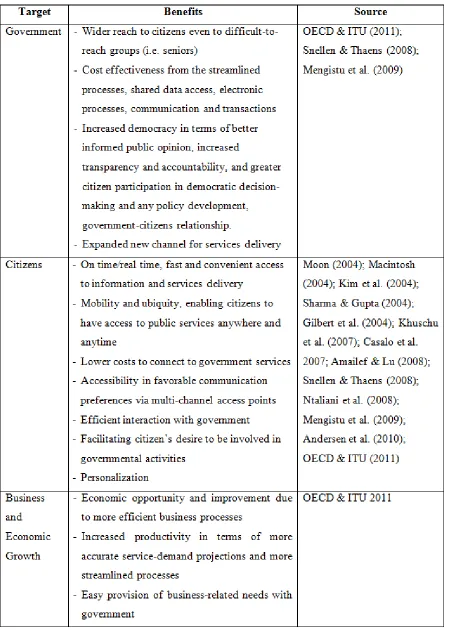
M-government refers to the use of all kinds of wireless and mobile technologies, applications and devices (e.g. internet-enabled mobile phones, PDAs, mobile applications, etc.) in government (Kushchu & Kuscu 2003; El-Kiki et al. 2005; Song 2005). It is designed as innovative ICT applications which allow broader information and services available to a wider audience; assure mobility and flexibility in delivering information and services; and offer more accessible, real-time, and transparent public information and services for citizens, businesses, and government institutions (Moon 2004; Macintosh 2004; Amailef & Lu 2008; Mengistu et al. 2009). M-government may provide convenient and personalised access to information that can help advance e-government adoption (Kim et al. 2004). With these benefits, m-e-government is expected to improve citizen participation in governmental activities and strengthen the government-citizens relationship which, in turn, may support democratic governance practice.
government (Kushchu & Borucki 2004; Islam 2008). There are still limited m-government adoption practices which focus on connecting citizens and m-government with two-way interaction where citizens are not only the ones who ‘get’ something from government but also the ones who ‘provide’ something to government. de Reuver et al. (2010) also argue that mobile extensions to e-participation solutions are still lacking. Thus, the great potential of m-government, particularly in improving citizen participation as part of democratization initiatives, in developing countries remains considerably unexploited in spite of their continuous efforts in developing mobile and network infrastructure (Mengistu et al. 2009), including Indonesia.
The significant changes in Indonesian political system lead to the implementation of e-government and m-e-government in Indonesia. Since the reformation movement to bring down new order regime in 1998, the ideal democracy, referred to people’s power and freedom to take roles in political practices, have begun to be implemented (Rose 2004). Before, democracy was only a tool of rhetorical politics where the real political system was executed with authoritarianism practices by restricting, or even omitting, public information access and citizen participation in governmental activities (Rose 2004). Now, after the wave of democratic reform, the real democracy is recognised where citizens can get balanced and transparent information from and communicate with government, voice their opinions and criticisms, and participate in policy process or other public interest-oriented political decisions (Rose 2004).
to all citizens, by taking advantage of the advancement of internet and mobile technologies.
The percentage of individuals using the internet in Indonesia has almost tripled in five year (ITU 2014b). This massively increasing of internet usage was expected to also increase citizen participation as the potential of e-government adoption which was proven by the increasing e-participation index from 0.0455 in 2008 to 0.1286 in 2010 to 0.2105 in 2012 (UN 2008; UN 2010; UN 2012). However, its growth rate is not quite significant which made Indonesia lack behind, even below world average (0.268) (UN 2014). In other words, along with its increment e-participation index, other countries’ index is also growing even faster. Meanwhile, the number of mobile subscriptions in Indonesia has almost doubled in three year (from 163.7 million in 2009 to 282 million in 2012) (ITU 2014c). Looking at this potential and the continuously growing demand to more involve citizens in governmental activities, there is an opportunity to better engage citizens in more innovative way by adopting m-government, which is expected to provide faster and more reachable services, and increase citizens participation.
The number of m-government initiatives in Indonesia is still limited compare to that of web-based services. Referring to satulayanan.net, portal providing information for all online services administered by government, from 299 online public services, only approximately 5% of them are available on mobile (e.g. online service for train reservation, electricity, electronic identity card, etc.). Moreover, most of them are simply SMS-based services with one-way interaction and e-service focus, which are provided only to deliver information to citizens. The only m-government services which are provided in several channels, two-ways interaction and transactional service-based apparently are just three, mobile-based train reservation, BIDIKMISI scholarship, and Online Citizen’s Aspirations and Complaints Services (LAPOR!).
citizen participation in controlling government performance on national development and public services delivery, and on connecting citizens and government. It covers both e-citizens reform objectives which are ‘talking to citizens’ and ‘listening to citizens’ (Heeks 2013a). Lastly, LAPOR! is also chosen based on consideration of its service type and channel, which is not only provided as an SMS-based service but also in the form of an internet-enabled mobile application.
1.2 Research Objective and Questions
As explained previously, this research aims to explore m-government adoption in Indonesia, specifically focusing on m-government ability to improve citizen participation in governance. In order to realise this research objective, the main research questions are constructed as follows:
1. What is the current state of m-government adoption, particularly for participation, in Indonesia?
2. How successful is m-government in encouraging citizen participation? 3. What are the citizens perceived benefits of using m-government?
1.3 Scope of the Study
This research is conducted within three limited scope of study. First, this research is limited to m-government adoption in Indonesian context, especially the LAPOR! case study where, as a consequence, the result of this study might be restricted for generalisation in other country contexts or even other m-government services. Second, as defined by Kushchu & Kuscu (2003), m-government is differentiated from e-government only in terms of mobile phone usage thus this research is only carried out by analysing SMS-based and mobile application-based LAPOR! services. Third, LAPOR! is seen as a government service which facilitates citizens to actively participate and interact with government in supervising national development and public services.
1.4 Chapter Outline
Chapter one introduces the background of the research including the rationale of selecting this topic, the research questions that is going to be addressed, the objectives of the research, the research scope, and the research structure overview.
Chapter two provides the review of some literatures showing the theoretical
perspectives of m-Government and how it impacts on citizen participation and public services improvement.
Chapter three presents the research methodology that is being used to answer the
research questions. It explains the research approach and methods for gathering and analysing the data.
Chapter four describes the findings from the data that were collected. It consists of the
findings for each research question.
Chapter five attempts to address the research questions by discussing them based on the
findings. It includes discussion on the current state of m-government, its success, and its benefits.
Chapter six restates the research questions and their answers as the final finding
CHAPTER 2
–
LITERATURE REVIEW
2.1 Introduction
This chapter aims to review current literatures about the key issues around m-government and participation areas within the context of developing countries. Firstly, it begins with the concept of e-government and m-government. Secondly, it provides understanding about citizen participation, including the concept of good governance as the background knowledge in understanding citizen participation. Thirdly, it discusses the link between m-government and participation. Fourthly, it describes information systems (IS) success assessment model to analyse the case study. Lastly, it provides the summary of the whole chapter.
2.2 From E-Government to M-Government
As pointed out by many researchers (Cilingir & Kushchu 2004; El-Kiki et al. 2005; Kumar & Sinha 2007; Mengistu et al. 2009), the concept of m-government is highly related to e-government. It is argued to be the subset of e-government efforts. Thus, before explaining about m-government, it is essential to understand e-government as the background of m-government initiatives, especially in a developing country context to make it relevant to the case study.
2.2.1 E-Government
which is now widely known as e-government (Bekkers 2003; Chan et al. 2003; Lee et al. 2005; Trimi & Sheng 2008; Chan et al. 2008).
The World Bank (2011) stresses e-government as the use of ICT which transforms government relationships with citizens, businesses, and/or other government institutions in order to promote citizen empowerment; enhance service delivery; and increase transparency, accountability, and government efficiency. Thus, ultimately there are two main transformation areas or objectives of e-government, internal operations-focused
(i.e. processes in government activities) and external services-focused (e.g. delivering online services, enhancing citizen participation) (Basu 2004; Ndou 2004; Heeks 2013).
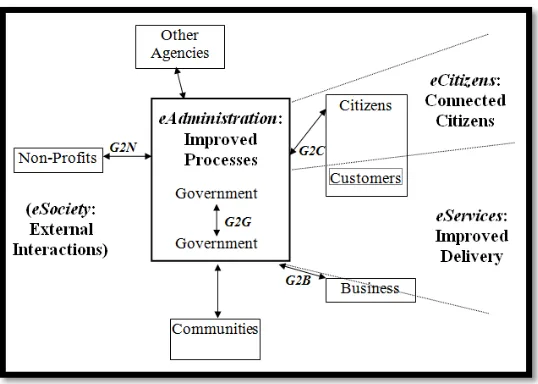
According to Heeks (2013), e-government can be classified based on its segment-served into government (G2G), business (G2B), government-to-citizens (G2C), and government-to-non-profits (G2N) which results four application domains for e-government as seen in Figure 1. In addition to this classification, some researchers also add government-to-employee (G2E) (Kim et al. 2004; Amailef & Lu 2008).
Figure 1 Domains for E-Government Systems (Heeks 2013)
particularly dealing with government relationship with its service consumers (i.e. citizens as customers and businesses). E-citizens focuses on connecting citizens, particularly dealing with the government-citizens relationship where citizens are seen as stakeholders from whom government derives its legitimacy, including talking to citizens and listening to citizens initiatives. E-society addresses building external interactions, particularly dealing with the relationship between government and other institutions (i.e. other government institutions, private sectors, non-profit, and community organisations).
E-Government in Developing Countries
It is a well-acknowledged fact that e-government adoption in developing countries is increasing even though it is still lagging behind that in developed countries. It is still regarded as an answer to the problems faced by the government in serving their constituencies efficiently and effectively (i.e. resource constraint in delivering services to citizens and improving their operations) (Kumar & Best 2006). Furthermore, it is also believed to be a good enabling tool in addressing some key challenges for future growth potential and entering the global economy (Ndou 2004). In developing countries, e-government are seen as a ‘leapfrog’ technology that has potential to reach their national development goals faster and more cheaply compared to previous traditional approaches (Basu 2004).
expectations (Song & Cornford 2006; Al-Thunibat et al. 2010). Since e-government commonly refers to online services through wired network and computer (Kushchu & Kuscu 2003), there is therefore a challenge of fair access for all citizens, particularly for those in financial disadvantaged and/or in rural areas. In view of this, mobile phone, whose penetration is growing faster than that of landline connection, is deemed having opportunity to give wider access to citizens.
2.2.2 M-Government
M-government is widely accepted as a new innovative way of e-government initiative that may offer opportunities to more involve citizens and to improve the fundamental functions of government, particularly in providing good services to its citizens (Kushchu & Kuscu 2003; Song 2005; Alrazooqi & De Silva 2010). The massive adoption of m-government in many countries, particularly developing countries, is commonly driven by major technological changes, including improvement to infrastructure and the range of mobile services available (Kushchu & Kuscu 2003; El-Kiki & Lawrence 2006; OECD & ITU 2011). Those changes include the penetration of wireless and mobile technologies that are larger than the penetration of internet, the convergence of mobile internet/broadband, and mobile-net applications and services, which, in turn, has created a phenomenon of “always-on” society (Kushchu & Kuscu 2003; Abanumy & Mayhew 2005).
e-government services over wired and wireless internet that can be accessed anywhere and anytime.
M-Government Categorisations
Similar to e-government, m-government is classified into four types of services as seen in Figure 2.
Figure 2 M-Government Delivery Models (Oui-Suk 2010 in OECD & ITU 2011)
As illustrated in Figure 2, each domain represents government interaction with different segment served. mG2B services accommodate information provision regarding regulations, policies, applications for procurement, licensing, tax, etc. via mobile technologies. As for mG2G services, government transforms themselves into a connected entity in order to be more effective and efficient in running their operations and providing services to citizens. In mG2E services, government provides training, data access, and tools to the employees, especially for field staff who work in remote locations, in order to assist them in their daily operations, improve governmental efficiencies and accountability, and improve public services quality. Lastly, mG2C enables citizens to interact with government with regards to services provision or citizen involvement in government activities.
information without any interactions, such as reminders/alerts. The second one is characterized as interactive-service which allows two-way communication between
government and citizens, such as provision of suggestions to authority. Furthermore, according to its main purposes in the governmental sector, Zalesak (2003 in Al-Thunibat et al. 2010) also divides m-government into four areas: mCommunication, mServices, mDemocracy, and mAdministration. First, mCommunication focuses on improving communication between citizens and government to promote citizen encouragement, transparency, and accountability. Second, mServices include enabling transactional interactions between government and citizens as part of public services provision. Third, mDemocracy concerns mobile voting and citizen input/comment/aspiration to political decision-making to promote democratic participation. Fourth, mAdministration deals with services to improve internal operations (El-Kiki & Lawrence 2006).
In the case study context, LAPOR! can be included into mG2C which provides interactive services for citizens to give complaints or aspirations related to national development and public services provision. In term of area of services, LAPOR! includes mCommunication which enables two-way communication with government and mDemocracy which enables citizens participation in democratic processes, for example by giving inputs to government related to governmental activities.
Why M-Government?
2.3 Citizen Participation
As argued by Punyaratabandhu (2004) and Rose (2004), the concept of citizen participation in democratisation context cannot be separated from the concept of good governance. Thus, it is essential to get understanding about the broader theoretical perspective by explaining good governance as a background of citizen participation, particularly in developing countries context.
2.3.1 Good Governance
The concept of good governance is increasingly used in many development literatures (Punyaratabandhu 2004; UNESCAP 2009). Governance is defined as ‘a complex system of interactions among structures, traditions, functions (responsibilities) and processes (practices) characterized by three key values of accountabilities, transparency and participation’ (Punyaratabandhu 2004:1) or ‘exercise of authority and control in a society in relation to the management of its resources for social and economic development’ (Schneider 1999:7).
As declared by Kofi Annan, the former Secretary General of the United Nations, good governance is essential for protecting citizens’ rights and advancing both economic and social development (Kim et al. 2005 in Waheduzzaman 2008). Furthermore, good governance assures that minorities’ views are taken into account; the most vulnerable voices to be heard in decision-making, and corruption to be minimised (UNESCAP 2009). In view of this, some scholars define good governance in a simple way as the level of quality of government performance, good public engagement, and good outcomes (Hye 2000 in Waheduzzaman 2008; OPM & CIPFA 2004; Arko-cobbah 2006).
The United Nations Development Program, Overseas Development Administration and Asian Development Bank have all identified four main components of good governance which are considered major principles to ensure good governance: participation,
highlighting the citizen involvement in decision-making; accountability, referring to
making public officials answerable for government behavior and responsive to public’s needs; transparency, suggesting free flow of information; and rule of
legal framework(Turner & Hulme 1997; Waheduzzaman 2007 in Waheduzzaman 2008; Uddin & Joya 2007).
2.3.2 Participation as a Central Foundation of Good Governance
As mentioned in section 2.3.1, there are four major components of good governance which, conceptually, tend to be mutually supportive (Waheduzzaman 2008). However, as argued by Schneider (1999) and Rahman (2005 in Waheduzzaman 2008), citizen participation is the central element government activities among other elements since it can assure more transparent, accountable, and predictable government for the citizens.
Citizen participation, as an essential right, is defined as the capabilities of citizens to help themselves in specifying their needs and discovering solutions, and act as the actors instead of the objects of development (Neras 2001 in Rose 2004; UN 2007). Some scholars define citizen participation by focusing on democratising and increasing the quality and support for policy making by taking into account the potential contribution from citizens (i.e. ideas, comments, solutions) in national development (Arnstein 1969; Lourenço & Costa 2007). It can take forms of public hearings, public survey, citizen review panel, or negotiated rule-making (Arnstein 1969; Fiorino 1990). Meanwhile, other scholars define it in term of citizen’s coproduction by interacting and negotiating with government service providers (Whitaker 1980; Pestoff 2009). In other words, citizen participation is also regarded as involvement in government’s daily processes in providing public services. In this research, a broad view on participation is taken, including both involvements in national development policy-making and in government’s services delivery, in order to make it relevant with the case study context.
orientation in development in terms of efficiency, empowerment, and prevalent benefits (Cleaver 2001), the conviction in the sense of encouraging citizens to provide their opinion or deliberation on policy-making process is argued to be part of solution in improving sustainable development outcome (Gbikpi & Grote 2002).
2.4 M-Government and Participation
As explained in the previous sections, governments keep putting efforts to encourage participation since citizen participation is indeed imperative for the establishment of democratisation and good governance as well as improving legitimacy of political processes and enabling public services improvement (Sanford & Rose 2007). In view of this, governments need to provide communication channel that can be accessed easily, quickly and cheaply by wider citizens. Governments also need to ensure information openness in order to meet public demands. If information is readily accessible and channel is well-established, it is possible for the public to discover more information about policy decisions and governmental processes that interest them, which, in turn, may enable active participation in the processes (UN 2007).
Characterising Participation Level of M-Government
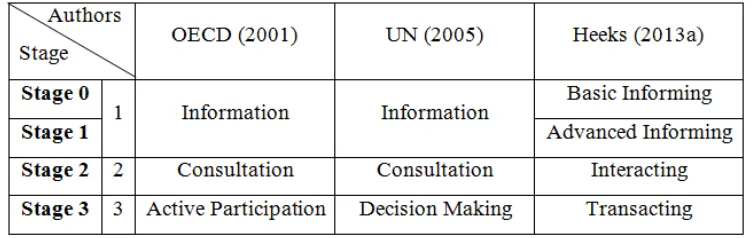
Some (e-)Participation stage models can be used to know participation level of m-government initiative. Generally, those models, as summarised in Table 2, have the same underlying concept but slightly different number of levels.
Table 2 The Ladder of (e-)Participation Maturity Summary (OECD 2001; UN 2005; Heeks 2013a)
1. Stage 0 and Stage 1: Informing
As depicted in Table 2, all models have the same concept which is
information/informing stage. This level refers to one-way relationship between
government and citizens where government plays an active role in producing and disseminating information for use by citizens, such as through static fact websites, mobile application or SMS. In other words, the focus of this level is to enable participation through ICT (Macintosh 2004).
2. Stage 2: Consulting/Interacting
3. Stage 3: Decision Making
In the third stage, each framework has different name but with the same meaning, which is a partnership-based relation between citizens and government where citizens are actively engaged in defining the content and process of policy-making. In other words, citizens are collectively given the right to make decision-making and the government takes citizens’ input into decision-making. Citizens is deemed have equal standing in setting agenda, suggest policy options and shaping the policy dialog. Thus, this level focuses on empowering citizens to actively participate in governmental activities (Macintosh 2004). For example, citizens’ juries, consensus conference, etc.
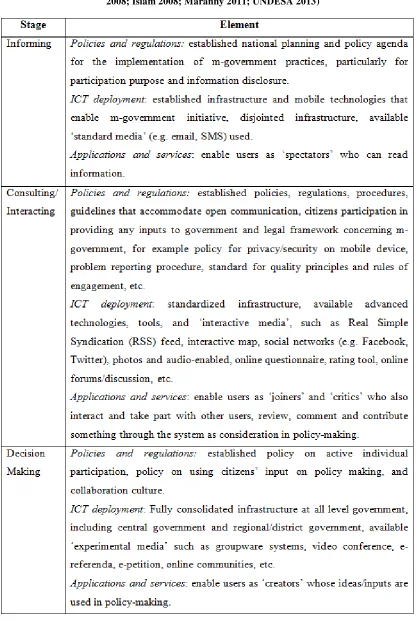
In order to measure the state of participation of m-government, this study focuses on three elements obtained from several literatures which are: policies and regulations to
know how m-government for participation is legally well-supported, ICT deployment to
assess how m-government for participation is technically facilitated, and applications
and services to measure to what extent citizens are being engaged as shown in Table 3.
Table 3 Characterising Participation Level (adapted from Macintosh 2004; Ferguson et al. 2006 in Veenstra et al. 2011; Bannister 2007; Li & Bernoff 2008; Albrecht et al. 2008; Loukis & Xenakis
2.5 Evaluating IS Success and Citizens Perceived Benefits
This research attempts to analyse how the quality/performance of LAPOR! as an IS can facilitate and encourage more participation as intended by evaluating LAPOR! success from citizens’ perspective, by adopting DeLone & McLean (D&M) IS Success Model (2003). Generally, this model is seen as relevant to the purpose of this research because D&M model is a widely used model for measuring system success in IS research area (Kronbichler et al. 2010) and argued to be a useful choice for success assessment. Some researchers have attempted to validate D&M model to e-government context which resulted into some e-government success models (Wang & Liao 2008; Sun 2009; Nayan et al. 2011; Rana et al. 2014). However, those models mostly provide no or slight changes on the D&M model, meaning D&M model is proven suitable for assessing e-government system success. Furthermore, there is currently no particular framework which assesses m-government system success which, consequently, a general IS success model is deemed more suitable for success assessment in this research.
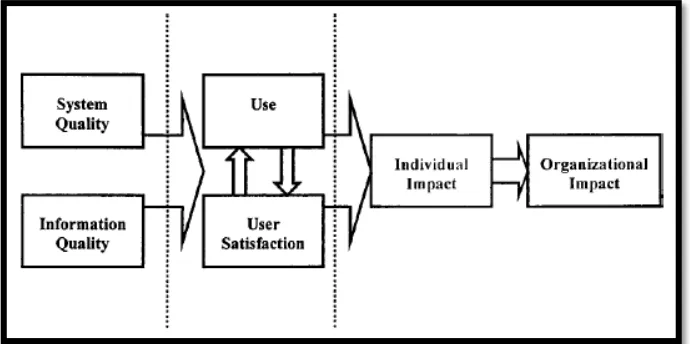
In 1992, DeLone & McLean proposed their first model for conceptualising and operationalising IS success. After doing intensive synthesis towards theoretical and empirical IS researches, they proposed six interdependent dimensions of IS success as seen in Figure 3.
Figure 3 D&M IS Success Model (DeLone & McLean 1992:12)
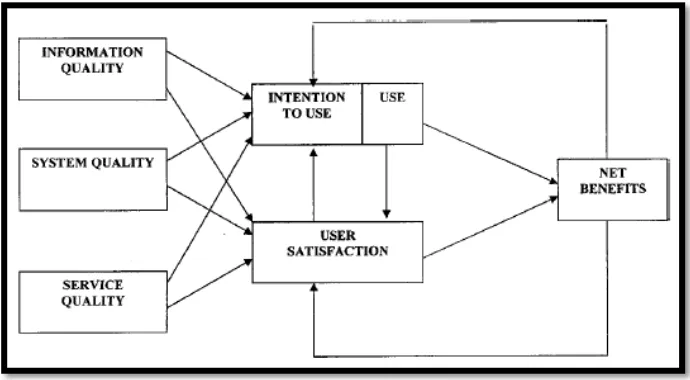
made to evaluate its usefulness considering the dramatic changes in IS practice (Wang & Liao 2008). Firstly, DeLone & McLean (2003) adds ‘service quality’ as a new dimension of IS success measurement. This new dimension is argued essential to measure IS effectiveness since the role and management of IS over the last decade have changed, where IS are not only used as information provider which provides only information product but also as service provider which also provides support to users.
Secondly, there is a debate over the previous dimension ‘use’ which is argued to be confusing whether the system usage is mandatory or voluntary. Thus, they make an alternative dimension ‘intention to use’ or ‘use’ which can be adapted according to the research context. Lastly, they combined the previous dimensions ‘individual impact’ and ‘organisational impact’ into one dimension ‘net benefits’ because they think the impacts of IS are not only perceived by immediate users but also could be by work group impacts, industry impacts, societal impacts, etc. The measurement of the perceived impacts will depend on the type and the purpose of the system to be evaluated. Thus, in order to avoid complicating the model with many impact measures, they group the impact measures into single net benefits dimension.
Figure 4 Updated D&M IS Success Model (DeLone & McLean 2003:24)
As illustrated above, D&M IS Success Model consists of six dimensions:
2) System quality, indicating the desired characteristics of system which are
measured from its performance of information processing and delivery.
3) Service quality, representing the overall support delivered by the government as
service provider of LAPOR!
4) Use satisfaction, referring to the citizens response to the IS output usage
5) Intention to use/use, measuring citizens consumption of the IS output (i.e. information) and their intention to continue consuming the IS output
6) Net benefits, which are the overall impacts resulted from the system to the users.
Measurement Model for Evaluating LAPOR! Success and Perceived Benefits
In this research, D&M IS Success Model (2003) is adopted to assess LAPOR! success in encouraging participation and to analyse citizens perceived benefits. Since the goal/objective of LAPOR! is to improve citizens participation as well as their interaction with government in national development and public services supervision/control, it is assumed that the use/intention to continual use from citizens indicates the success of LAPOR! itself. The success level of m-government initiatives are argued to be determined by citizens’ usage and intention to continue using the system as a form of citizens’ acceptance and engagement towards the initiative and their active contributions to democracy. Thus, in this research, use/intention to continual use serves as an objective measurement as seen in Figure 5.
Figure 5 M-Government Success and Perceived Benefits Measurement Model
As depicted above, there are three qualities that are measured. The quality attributes are
improvement of ICT systems (Ifinendo & Nahar 2006). As argued by Teo et al. (2008), since the quality perceptions are formed from the previous experiences with the system, citizens’ belief whether the system is qualified to facilitate their participation willingness will influence the continuance decision.
Meanwhile, some researches argue about user satisfaction as dimension in IS success model since user satisfaction has been measured indirectly through the other dimensions (Rai et al. 2002; Sedera & Tan 2005; Wang & Liao 2008). However, as pointed out by Wang & Liao (2008), in the e-government success context, which is assumed to be also applicable in m-government context, it is also important to measure the overall level of user satisfaction to see its causal relationship with the indirect measures of user satisfaction in other dimensions. Thus, the user satisfaction dimension is also employed to assess LAPOR! success in encouraging participation.
Further, as stressed by DeLone & McLean (2003), the end result of the overall model will generate certain net benefits which depend on the stakeholders and context in which
benefits are to be measured. This research adopts Net Benefits measures developed by Scott et al. (2011) which focus on public value approach. According to them, in the area of e-government, including m-government, the intention by designers and policy makers is not only for process efficiency but also for greater participation and engagement. Thus, it is important to conform to this environment in order to accurately capture the perceived benefits on the side of citizens. The complete instrument, including the items in each dimension, can be seen in chapter 3.4.1.
2.6 Summary
CHAPTER 3
–
RESEARCH METHODOLOGY
3.1 Introduction
This chapter aims to explain how this research is undertaken. It begins with the explanation of research purpose and questions. The second section presents the research design consisting research approach and strategy. Next, the appropriate research methods, including how to collect data and validate instrument, are discussed. The following section presents how to analyse the data and the last section concludes overall chapter.
3.2 Research Purpose and Questions
According to its purpose, this research is classified as exploratory research. It aims to generate and explore ideas and understanding about m-government adoption in Indonesia, specifically focusing on m-government capability in improving citizen participation in governance, where no or few studies about the issue being investigated are found, particularly in Indonesia context (Collis & Hussey 2014). This research has three research questions: what is the current state of m-government adoption,
particularly for participation, in Indonesia?; how successful is m-government in
encouraging citizen participation?; and what are the perceived benefits of using m-government for citizens?
3.3 Research Design
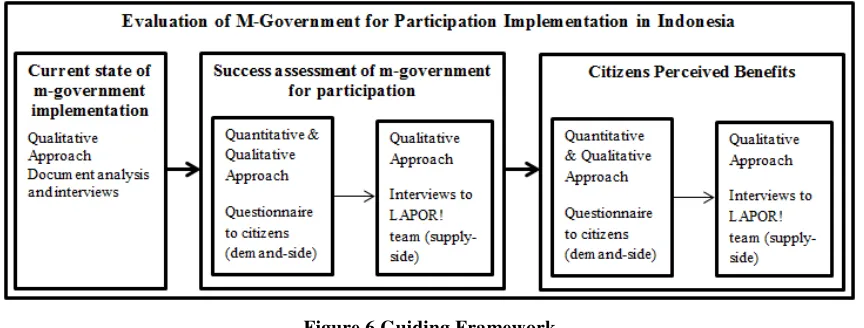
from citizen point of view and the third research question to know citizens perceived benefits of m-government. Quantitative approach turns data collected into numbers (i.e. measurement and quantification) and uses statistical way in interpreting and analysing the data (Creswell 2003; Robson 2011). The summary can be seen in Figure 6.
Figure 6 Guiding Framework
As for research strategy, this research uses case study to explore detailed knowledge about how and why particular contemporary phenomenon happens in one or more real-life contexts by using various tools (Yin 2003; Myers & Avison 2002; Bryman 2012). As argued by Yin (2003) and Benbasat et al. (1987), this strategy is massively used in social science research and suitable for practiced-based issues where the context of the action and the experiences of the actors are critical. With regard to this definition and the research context, a case study is deemed appropriate to conduct this research.
3.4 Research Methods
As mentioned in previous section, this research is based on qualitative and quantitative approaches by mainly doing document analysis, interview, and survey. Document analysis and interview were performed to get data about policy/regulation, ICT deployment, and application and services regarding e-government, m-government and LAPOR! implementation in Indonesia. Survey was performed by distributing questionnaire to LAPOR! users which was constructed from conceptual model.
3.4.1 Data Collection
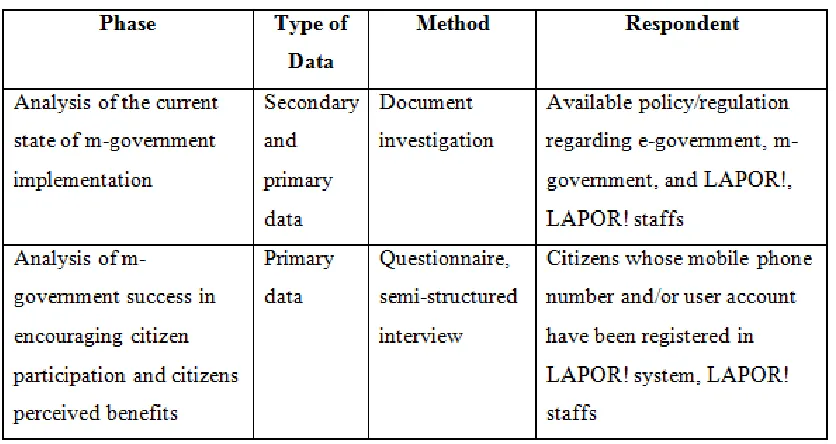
Data collection consists of two parts according to the method used that are summarized in Table 4. This research uses triangulation to ensure data reliability by incorporating different sources and methods. In term of sources, this research consulted some documents and LAPOR! staffs. In terms of methods, this research performed document investigation and questionnaire for main gathering method and semi-structured interview for triangulation.
Table 4 Data Collection Methods Summary
a. Analysis of Current State of M-Government Implementation
investigated were mainly from published and unpublished documents related to e-government, m-e-government, LAPOR! and participation in Indonesia, which were ranging from government policies, regulations, standardisations, guidelines, white paper, and previous researches about m-government. The information being investigated was based on the author’s understanding from literature study about the current practice of m-government in terms of policies/regulations (see Appendix D), technology, and application and services, with emphasis on mobile phone as one of most used channel for m-government and LAPOR! as the only suitable case study for this research’s topic.
b. Analysis of LAPOR! Success and Citizens Perceived Benefits
Measures/Constructs
The questionnaire to evaluate LAPOR! success in encouraging participation was designed based on D&M IS Success Model explained in chapter 2.5 while the indicators of the constructs were mainly adapted from prior studies to assure the content validity (Wang & Liao 2008). On the other hand, the questionnaire to analyse citizen’s perceived benefits adopted Net Benefits measures developed by Scott et al. (2011). The indicators that were operationalised into statements rated by using ‘1-6’ Likert scales, which is a technique to measure respondent’s agreement or disagreement towards each statement in the questionnaire (Noor 2011), where ‘1’ indicates strongly disagree and ‘6’ indicates strongly agree. This even scale was determined with consideration from LAPOR! experts’ suggestion since there is high possibility that the respondents will choose neutral option. Furthermore, there is also one open-ended question for each dimension to ask further comment about the dimensions being assessed.
As for the measures/constructs of citizen’s perceived benefits, this research adopts Net Benefits measures (Scott et al. 2011) which highlight three e-government goals. There are nine measures as recapped in Table 6and 25 items in total1.
Table 6 Perceived Benefits Measures (Scott et al. 2011)
Procedure
LAPOR! success assessment in encouraging citizens’ use of system and citizens perceived benefits were performed by distributing questionnaire with the help from LAPOR! team. Questionnaire is used to elicit reliable responses with regard to what users think and feel about the issue being brought up (Collis & Hussey 2014). This method can provide benefits in terms of minimum cost, shorter data collection period, and access to wider range of audiences (Robson 2011; Collis & Hussey 2014).
The population of the study is LAPOR! users whose mobile phone number and/or user account are currently registered in LAPOR! system while sample was generated differently between prospective respondents with mobile phone number and with user account. The prospective respondents with mobile phone number were selected up to 300 users to be sent a SMS containing link to the online questionnaire with consideration of SMS sending cost by LAPOR! Meanwhile, around 5000 prospective
1
respondents with user account were given the questionnaire’s link by email. The questionnaires were distributed from 16th July-28th July 2014 and 118 responses were collected.
On the other hand, informal semi-structured interview was used to guide data collection for triangulation to ensure information reliability gathered from various perspectives. The interviews consisted of six open-ended questions (see Appendix B) and were performed via e-mail and Skype to save time and resources (Robson 2011; Collis & Hussey 2014). Data were gathered from two key persons in LAPOR! team who know best about LAPOR!
3.4.2 Validity and Reliability
Validity and reliability test is important to ensure the extent to which the questionnaire can measure what it should be and the extent to which the questionnaire gives consistent results on repeated survey (Malhotra & Birks 2007). Validity was assessed by examining content validation while reliability was performed by comparing cronbach’s alpha.
Content validation procedure was performed by two experts in LAPOR! team who are knowledgeable about the constructs to make sure they are appropriate to be used in case study context (Straub 1989). They were asked to review whether there is any inconsistency between items and conceptual definition, and evaluated the representativeness and adequacy of the dimensions (Lynn 1986) and readability of the questionnaire. There were some key points from experts’ review (see Appendix A for full questionnaire):
1. According to them, the information provided by SMS channel just includes simple report and its automatic feedback which is limited only up to 160 characters while the full report and its follow-up are sent in the form of link. Thus, in order to prevent bias perception from respondent, items SQ6 and IQ3 were removed.
3. Items UIU1 and UIU2 were removed since they do not differentiate between
report/critique and aspiration/idea/input on national development/public
services delivery issues. Furthermore, they are similar to UIU3 since it is assumed that user access LAPOR! for the purpose of reporting only, not for reading other people’s reports and doing nothing, especially for SMS-based service.
4. Item UIU3 also needs to be explained clearly especially for SMS-based service case.
The reliability test was conducted by comparing cronbach’s alpha for each component measures. The measure is considered reliable if its cronbach’s alpha is greater than 0.7 (Hair et al. 2006). As summarised in Table 7, the result shows that all measures are reliable.
3.5 Data Analysis
Data analysis was carried out three times based on research questions. All analyses used conceptual frameworks explained in section 2.4 and 2.5 as a guideline. The documents listed in Appendix D and some interviews were analysed to get better understanding about the current condition of m-government implementation for the first analysis. Further, since LAPOR! is a m-government initiative which focus on increasing participation, the evaluation of its participation level is also discussed by matching the gathered information with participation level characterisation explained in chapter 2.4.1. The findings were analysed qualitatively and presented in the form of description.
As for the second analysis, the quantitative data from questionnaire were tabulated and interpreted by using descriptive statistics (i.e. mean and standard deviation) to describe some crucial aspects of a set of data as a group by using SPSS 20.0 (Wiersma & Jurs 2009; Robson 2011). The mean and standard deviation of each indicator, dimension and the overall success were calculated to help interpretation. Mean determines the success range of the indicator, dimension and overall system success while standard deviation shows how the data disperse around mean. The overall evaluation was then performed based on the success category made by the author adapted from Heeks (2002): total success (5-6), moderate success/failure (3-4), and total failure (1-2). This evaluation was enriched by interview findings for triangulation of the questionnaire results.
Table 8 Spearman's Correlation Coefficient (Statstutor 2014)
The third analysis also used descriptive statistics where mean determines the most and least benefits perceived by citizens while standard deviation shows how the data disperse around mean. Moreover, some comments from citizens and interviews from LAPOR! interviewees were also analysed to supplement the questionnaire results.
3.6 Summary
CHAPTER 4
–
FINDINGS
4.1 Introduction
This chapter aims to provide findings of the study. The first two sections provide the overview of m-government implementation and m-government for participation implementation in Indonesia by focusing on the policy and regulation, ICT deployment, and application and services aspects to answer the first research question. The third section presents the findings of. The next three sections provide findings of the second and third research questions, consisting of respondents’ demographic, LAPOR! success in encouraging participation, and citizens perceived benefits. The last section summarises the whole findings.
4.2 M-Government in Indonesia
As mentioned previously in chapter 2.2.2, m-government is part of e-government which focuses on the utilization of particularly mobile phone. The implementation of m-government in Indonesia also cannot be separated from e-m-government and is regulated under the umbrella of e-government implementation.
Policy and Regulation
In 2003, GoI released Presidential Instruction No.3/2003 to further regulate national policy and strategy for e-government development, stating four aims of e-government (GoI 2003):
Providing public services that are in accordance with public interests, interactively reachable anywhere and at any time, and affordable,
Forming relationship with businesses,
Providing communication channel with all government institutions as well as facilitating public dialog for citizens to participate in policy-making,
Supporting transparent and efficient management system and work processes among government institutions.
Thus, all government institutions are instructed to implement e-government initiatives by all means/channels (e.g. computer, mobile phone, etc.) that are considered suitable to the needs, regulations, communication network infrastructure, and government-citizen readiness in their regions (MCIT 2003).
Further, in 2004, Ministry of Communication and Information Technology (MCIT) established an implementation guideline known as E-Government Blueprint. This blueprint aims to equate understanding and implementation of e-government and contains more detailed explanations as referrals for e-government application development in order to ensure integration and interoperability among applications.
implementation of e-government is also supported by some cyber laws for electronic means, such as Law No.11/2008 and Government Regulation No.82/2012 which protect personal data/information via electronic means.
ICT Deployment
In accordance with the aim of e-government, the mobile phone is considered as a new innovative channel which is interactively reachable at any time and affordable for citizens to access e-government initiatives. Besides more extensive mobile network that can reach remote areas because of continuous Base Transceiver Station (BTS) construction, mobile phone also requires cheaper cost than that of computers or other devices.
According to MCIT (2012), as of 2012, the development of optical fiber network has reached 41,151.6 km with capacity of 2,071.18 Gbps. The total of approximately 100,000 BTS 2G and 3G has also been developed from Sumatera to Papua, even though it mostly concentrates in Java and Sumatera due to their population density. Moreover, until now GoI has developed broadband infrastructure which allows always-on-guaranteed internet access for mobile with access speed of 512 kbps and access distribution of 80% to all regions. In order to minimize the ICT gap in rural areas, MCIT also built Center for Internet Service District (PLIK) that provides shared internet access space and productive and useful push content portals. They also provide Mobile PLIK (MPLIK) that was designed to provide easy and cheap internet access to villagers.
Referring to Ministerial Decree No.56/2003, infrastructure components of m-government includes physical channels consisting mobile wireless, broadband wireless, and narrowband mobile; government secured intranet for data communication intra-government; government data management center for managing connectedness and interoperability of government information; basic applications for front- and back-office (i.e. database, search engine); and internet. Some related technologies used for m-government are also available: wireless internet platforms which include integrated wireless internet gateway, e.g. Wireless Access protocol (WAP) proxy and integrated
Application and Services
E-government application systems are designed based on three main government functions: support/service function inter- and intra-government, governance function for
national development, and public information-service delivery function. Considering
those functions, e-government applications are grouped based on segment-served: citizen-, business-, and government-oriented, which also introduces mG2G, mG2B, and mG2C (Depkominfo 2004).
4.3 M-Government for Participation: LAPOR!
LAPOR! is an /m-government initiative that focuses on participation. There is also e-government initiatives with e-participation focus besides LAPOR! called e-Musrenbang (Multi Stakeholder Consultation Forum for Development Planning) where citizens can provide ideas for regional development plan and any input regarding current regional development (LGSP 2007). However, LAPOR! is currently the only e-government with participation focus that can also be accessed via mobile phone. Furthermore, unlike e-Musrenbang that can be accessed only by Rukun Warga (RW) Head in neighborhoods level after discussion with citizens, LAPOR! can be accessed by all citizens as long as they have mobile phone and/or internet connection.
Policy and Regulation
LAPOR! is a m-government initiative with two-way interaction and involves citizen participation to supervise national development and public services delivery. LAPOR! was established by UKP4 under Deputy III mainly in relation to its functions on monitoring national development progress, assisting president in counter-measuring issues related to government’s programs, and accommodating suggestions and complaints as well as conducting the analysis of the slowness of government’s programs as regulated in Government Regulation No.54/2009 and its changes in Government Regulation No.10/2012. Furthermore, LAPOR! was established related to open government and good governance practice, in accordance with Law No.14/2008 on Public Information Disclosure, Information Commission Regulation No.1/2010 on Public Information Service Standard, and policy about citizens participation and transparency in public services delivery (Law No.25/2009). Other policy on National Development Planning System (Law No.25/2004) which emphasises citizen’s involvement in development planning, Long-term National Development Plan (Law No.17/207) which aims to optimalise citizens participation, and some local regulatory for citizens participation in regional development plan (e.g. Government Regulation No.8/2008) also underlying LAPOR! besides policies/regulations mentioned in section
ICT Deployment
LAPOR! is developed by exploiting the existing infrastructure and technology explained previously to provide aspiration channel that is easily and affordably developed and accessed by government and citizens (LAPOR! 2014). SMS-based service is developed in forms of formatted message to short number 1708 and targeted survey about pre-policy ratification. In preparing SMS gateway, LAPOR! collaborates with MCIT and National Crypto Agency to allocate the number and provide the infrastructure needed to give the cheapest price for citizens by not cooperating with content provider. As for mobile application, LAPOR! developed it separately for each mobile platform (i.e. Android and Blackberry). This application is developed with social-media type in the forms of online input form and online survey. It also enables document, photo and video attachments, links to Facebook and Twitter account, RSS feed.
Applications and Services
As the aim of LAPOR! is to connect government and citizens and to increase more citizens participation in governmental activities, it allows citizens to report complaints, aspirations, or any inputs concerning government with direct feedback. LAPOR! can connect citizens with 80 government institutions, including ministries, non-ministerial institutions, and some regional governments which ensure transparency, enable active interaction, and promote supervision consistency from all related stakeholders (LAPOR! 2014).
Another feature that is developed is Policy Opinion. Currently, this feature is available via website and SMS. It aims to collect public opinion about the policies that will be issued by government in the form of survey. The survey is sent to the targeted users based on the topic that is relevant to their interest by using data mining technique. For example, UKP4 set issue regarding the planning to implement new education curriculum to adjust the current education practice. Users who are interested on educational issue, such as those who have sent inputs related to educational topic before, are invited to give their opinion by sending SMS including the issue code.
4.4 Respondents’ Demographic
As seen in Table 10, the questionnaire results show the demographic distribution of the respondents where 85.6% of respondents are male and 14.4% are female. Most of the respondents (about 51.7%) are from 31 to 45 years old and the majority has education of undergraduate (59.3%). The respondents are mostly located in Java with 85.6% followed by Sumatera and Sulawesi with 5.9% each then Kalimantan with 1.7% and Nusa Tenggara-Bali with 0.9%. The respondents work in various occupations: 46.6% work in private sector, 16.1% work as public official, 8.5% are student, and 28.8% work as social or religious activist, entrepreneur, unemployed, etc. Most of them have monthly salary from 1 to 7 million (55.1%).
4.5 LAPOR! Success in Encouraging Participation
4.5.1 Descriptive Statistics
The results of LAPOR! success assessment are shown in the form of mean and standard deviation (see Table 11) and enriched by interview results as triangulation.
As depicted in Table 11, the overall success has score 4.28 and all dimensions have mean scores greater than 4.0 where SQ dimension (4.44) has the greatest score and US dimension (4.16) has the least score. In view of indicators, there are two indicators that has mean scores below 4.0 which are UIU1 (3.68) and SvQ3 (3.83) while SQ1 and SvQ1 have the highest score with 4.73 each. As for the spread of data, all of them are not too disperse from the mean which shows that, on average, the individual responses are just slightly over one point away from mean. Even though all of the scale point can be found in the questionnaire results, the majority answers are still around the mean.
System Quality
The responses distribution from respondents for system quality is shown in Figure 8.
Figure 7 System Quality
As seen above, the majority of respondents state their agreement to all indicators representing System Quality dimension. Looking at the high-agreement-scale (scale ‘5 -6’), it suggests that LAPOR! system is considered good particularly for Ease of Use (86), Friendliness (77), and Functionality (75) indicators. However, according to some users, LAPOR! system still lacks on Feedback Mechanism (28), Response Time (27), and System Reliability (25) shown by the responses from scale ‘1-3’.
3 3 3 4 3 8 4 Strongly Disagree (1) Disagree (2) Quite Disagree (3)
In view of this, some of respondents stressed about the unclear, rigid, and normative feedback mechanism. A respondent also commented about unsynchronised SMS short number for complaint and follow-up. Furthermore, some respondents said that they found access difficulty and system error while accessing the system. There is also security issue where a respondent mentioned that he got problem after he reported wrongdoing happened in his working place.
According to LAPOR! interviewees, access difficulty issues may be caused by abundant users who accessed the system at the same time, poor signal from the mobile phone in particular regions, or poor service from telecommunication provider. As for the security issue, LAPOR! has made mechanism to protect user security/privacy where user identification is not given to the related institution for follow-up. For the comment about feedback mechanism, it is actually the official mechanism where two different number for first complaint and its follow-up.
Information Quality
The responses distribution from respondents for information quality is illustrated in Figure 9.
Figure 8 Information Quality
As depicted above, most of respondents state their agreement to all indicators representing Information Quality dimension. According to respondents, LAPOR! system produces accurate, up-to-date, and sufficient information to users shown by
3 1 3 3