ABSTRACT
Perwirasari, Anthonia Jessy (2016). Equipping the Preservice Teacher with Pedagogical Knowledge through Observations of Teaching in General Listening Class of the English Extension Course. English Education Study Program, Department of Language and Arts Education, Faculty of Teachers Training and Education, Yogyakarta: Sanata Dharma University.
According to Indonesian Law No. 14 Year 2005 about Teachers and Lecturers, four competences to accomplish by teacher candidates are professional, pedagogical, social, and personality competence. However, out of 56 compulsory courses in the English Language Education Study Program (ELESP), there are only two courses which give teaching practice for teacher candidates. Based on a preliminary survey, 87% of 16 respondents have taught English outside campus before they graduate. Unfortunately, many teacher candidates who have taught English have lack of pedagogical skills because they have limited teaching practice. 87% of 16 respondents who have taught English felt that their pedagogical knowledge was limited and 25% of 16 respondents think that two courses for practicing teaching are not enough.
Considering the results of the survey, the researcher had an idea to study about teacher candidates’ learning experiences in doing a classroom observation. There are two questions in this research. The first is how teaching dynamics in the General Listening class IB batch 2015 of the English Extension Course (EEC) are best described. The second question is to what extent observation of teaching dynamics throughout one semester equips teacher candidates with pedagogical knowledge.
A case study had been done to study this research further. The research gathered observational data, inquiry data through FGD, and archival data. The study was conducted for 4 months in a General Listening class IB batch 2015 of the EEC. The data were analyzed using a framework of constructivism, backward design principle, cognitive apprenticeship, preservice teacher learning, content-based instruction, and reflection theory.
The researcher found that the teaching dynamics were best described as a combination of Backward Design Principle and Cognitive Apprenticeship. There were three learning goals designed at the beginning of the semester based on the Backward Design Principle. Then, the assignments, materials, and teaching strategies were conducted based on the Cognitive Apprenticeship, especially the Contents and the Methods aspects. To answer the second questions, the researcher found that the preservice teacher conducting the one-semester observation had gained lot of pedagogical knowledge through the observations. The preservice teacher learned some new teaching skills and also what the attitudes of being a teacher are.
ABSTRAK
Perwirasari, Anthonia Jessy (2016). Equipping the Preservice Teacher with Pedagogical Knowledge through Observations of Teaching in General Listening Class of the English Extension Course. Program Studi Pendidikan Bahasa Inggris, JPBS, FKIP, Yogyakarta: Universitas Sanata Dharma.
Menurut UU di Indonesia No. 14 Tahun 2005 tentang Guru dan Dosen, empat kompetensi yang perlu dicapai oleh calon guru adalah kompetensi profesional, pedagogik, sosial, dan kepribadian. Namun, dari 56 mata kuliah wajib di Pendidikan Bahasa Inggris, hanya ada dua mata kuliah yang memberikan praktek mengajar bagi calon guru. Berdasarkan survei awal, 87% dari 16 responden telah mengajar sebelum mereka lulus. Sayangnya, banyak calon guru yang telah mengajar merasa kurang dalam hal keterampilan pedagogis karena keterbatasan pengalaman praktik mengajar mereka. 87% dari 16 responden merasa bahwa mereka memiliki pengetahuan pedagogis yang terbatas dan 25% dari 16 responden berpikir bahwa dua mata kuliah untuk praktik mengajar tidaklah cukup.
Mempertimbangkan hasil dari penelitian, peneliti memiliki sebuah ide untuk mempelajari pengalaman pembelajaran calon guru dalam melaksanakan observasi kelas. Ada dua pertanyaan dalam penelitian ini. Yang pertama adalah bagaimana dinamika pengajaran di General Listening kelas IB angkatan 2015 English Extension Course (EEC) paling baik digambarkan. Pertanyaan kedua adalah sejauh mana pengamatan dinamika pengajaran selama satu semester membekali calon guru dengan pengetahuan pedagogis.
Sebuah studi kasus telah dilakukan dalam melaksanakan penelitian ini lebih lanjut. Penelitian ini mengumpulkan data pengamatan, data melalui diskusi kelompok, dan data arsip. Penelitian dilakukan selama 4 bulan di mata kuliah General Listening kelas IB angkatan 2015 EEC. Data dianalisis dengan menggunakan kerangka konstruktivisme, prinsip desain mundur, magang kognitif, pembelajaran calon guru, instruksi berbasis konten, dan teori refleksi.
Peneliti menemukan bahwa dinamika pengajaran paling baik digambarkan sebagai kombinasi dari Prinsip Desain Mundur dan Magang Kognitif. Ada tiga tujuan pembelajaran yang dirancang pada awal semester berdasarkan Prinsip Desain Mundur. Kemudian, tugas, bahan, dan strategi pengajaran dilakukan berdasarkan Magang Kognitif, terutama aspek Isi dan Metode. Untuk menjawab pertanyaan kedua, peneliti menemukan bahwa calon guru yang melakukan pengamatan selama satu semester telah memperoleh banyak pengetahuan pedagogis melalui pengamatan. Calon guru belajar beberapa keterampilan mengajar baru dan juga sikap-sikap untuk menjadi seorang guru.
EQUIPPING THE PRESERVICE TEACHER
WITH PEDAGOGICAL KNOWLEDGE
THROUGH OBSERVATIONS OF TEACHING IN GENERAL
LISTENING CLASS OF THE ENGLISH EXTENSION COURSE
A SARJANA PENDIDIKAN THESIS
Presented as Partial Fulfillment of the Requirements to Obtain the Sarjana Pendidikan Degree
in English Language Education
By
Anthonia Jessy Perwirasari Student Number: 121214033
ENGLISH LANGUAGE EDUCATION STUDY PROGRAM DEPARTMENT OF LANGUAGE AND ARTS EDUCATION FACULTY OF TEACHERS TRAINING AND EDUCATION
SANATA DHARMA UNIVERSITY YOGYAKARTA
i
EQUIPPING THE PRESERVICE TEACHER
WITH PEDAGOGICAL KNOWLEDGE
THROUGH OBSERVATIONS OF TEACHING IN GENERAL
LISTENING CLASS OF THE ENGLISH EXTENSION COURSE
A SARJANA PENDIDIKAN THESIS
Presented as Partial Fulfillment of the Requirements to Obtain the Sarjana Pendidikan Degree
in English Language Education
By
Anthonia Jessy Perwirasari Student Number: 121214033
ENGLISH LANGUAGE EDUCATION STUDY PROGRAM DEPARTMENT OF LANGUAGE AND ARTS EDUCATION FACULTY OF TEACHERS TRAINING AND EDUCATION
SANATA DHARMA UNIVERSITY YOGYAKARTA
iv
DEDICATION PAGE
“For the LORD giveth wisdom; out of his mouth
cometh knowledge and understanding”
v
STATEMENTS OF WORK’S ORIGINALITY
I honestly declare that this thesis, which I have written, does not contain the work
or parts of the works of other people, except those cited in the quotations and the
references, as a scientific paper should.
Yogyakarta, 11 April 2016
The Writer
Anthonia Jessy Perwirasari
vi
LEMBAR PERNYATAAN PERSETUJUAN PUBLIKASI KARYA ILMIAH UNTUK KEPENTINGAN AKADEMIS
Yang bertanda tangan di bawah ini, saya Mahasiswa Universtas Sanata Dharma:
Nama : Anthonia Jessy Perwirasari
Nomor Mahasiswa : 121214033
Demi pengembangan ilmu pengetahuan, saya memberikan kepada Perpustakaan Universitas Sanata Dharma karya ilmiah saya yang berjudul:
EQUIPPING THE PRESERVICE TEACHER WITH PEDAGOGICAL KNOWLEDGE
THROUGH OBSERVATIONS OF TEACHING IN GENERAL LISTENING CLASS OF THE ENGLISH EXTENSION COURSE
beserta perangkat yang diperlukan (bila ada). Dengan demikian, saya memberikan kepada Universitas Sanata Dharma hak untuk menyimpan, mengalihkan dalam bentuk media lain, mengelolanya dalam bentuk pangkalan data, mendistribusikan secara terbatas, dan mempublikasikannya di internet atau media lain untuk kepentingan akademis tanpa perlu minta ijin dari saya maupun memberikan royalti kepada saya selama tetap mencantumkan nama saya sebagai penulis.
Demikian pernyataan ini saya buat dengan sebenarnya.
Dibuat di Yogyakarta Pada tanggal: 11 April 2016 Yang menyatakan
vii ABSTRACT
Perwirasari, Anthonia Jessy (2016). Equipping the Preservice Teacher with Pedagogical Knowledge through Observations of Teaching in General Listening Class of the English Extension Course. English Education Study Program, Department of Language and Arts Education, Faculty of Teachers Training and Education, Yogyakarta: Sanata Dharma University.
According to Indonesian Law No. 14 Year 2005 about Teachers and Lecturers, four competences to accomplish by teacher candidates are professional, pedagogical, social, and personality competence. However, out of 56 compulsory courses in the English Language Education Study Program (ELESP), there are only two courses which give teaching practice for teacher candidates. Based on a preliminary survey, 87% of 16 respondents have taught English outside campus before they graduate. Unfortunately, many teacher candidates who have taught English have lack of pedagogical skills because they have limited teaching practice. 87% of 16 respondents who have taught English felt that their pedagogical knowledge was limited and 25% of 16 respondents think that two courses for practicing teaching are not enough.
Considering the results of the survey, the researcher had an idea to study about teacher candidates’ learning experiences in doing a classroom observation. There are two questions in this research. The first is how teaching dynamics in the General Listening class IB batch 2015 of the English Extension Course (EEC) are best described. The second question is to what extent observation of teaching dynamics throughout one semester equips teacher candidates with pedagogical knowledge.
A case study had been done to study this research further. The research gathered observational data, inquiry data through FGD, and archival data. The study was conducted for 4 months in a General Listening class IB batch 2015 of the EEC. The data were analyzed using a framework of constructivism, backward design principle, cognitive apprenticeship, preservice teacher learning, content-based instruction, and reflection theory.
The researcher found that the teaching dynamics were best described as a combination of Backward Design Principle and Cognitive Apprenticeship. There were three learning goals designed at the beginning of the semester based on the Backward Design Principle. Then, the assignments, materials, and teaching strategies were conducted based on the Cognitive Apprenticeship, especially the Contents and the Methods aspects. To answer the second questions, the researcher found that the preservice teacher conducting the one-semester observation had gained lot of pedagogical knowledge through the observations. The preservice teacher learned some new teaching skills and also what the attitudes of being a teacher are.
viii ABSTRAK
Perwirasari, Anthonia Jessy (2016). Equipping the Preservice Teacher with Pedagogical Knowledge through Observations of Teaching in General Listening Class of the English Extension Course. Program Studi Pendidikan Bahasa Inggris, JPBS, FKIP, Yogyakarta: Universitas Sanata Dharma.
Menurut UU di Indonesia No. 14 Tahun 2005 tentang Guru dan Dosen, empat kompetensi yang perlu dicapai oleh calon guru adalah kompetensi profesional, pedagogik, sosial, dan kepribadian. Namun, dari 56 mata kuliah wajib di Pendidikan Bahasa Inggris, hanya ada dua mata kuliah yang memberikan praktek mengajar bagi calon guru. Berdasarkan survei awal, 87% dari 16 responden telah mengajar sebelum mereka lulus. Sayangnya, banyak calon guru yang telah mengajar merasa kurang dalam hal keterampilan pedagogis karena keterbatasan pengalaman praktik mengajar mereka. 87% dari 16 responden merasa bahwa mereka memiliki pengetahuan pedagogis yang terbatas dan 25% dari 16 responden berpikir bahwa dua mata kuliah untuk praktik mengajar tidaklah cukup.
Mempertimbangkan hasil dari penelitian, peneliti memiliki sebuah ide untuk mempelajari pengalaman pembelajaran calon guru dalam melaksanakan observasi kelas. Ada dua pertanyaan dalam penelitian ini. Yang pertama adalah bagaimana dinamika pengajaran di General Listening kelas IB angkatan 2015 English Extension Course (EEC) paling baik digambarkan. Pertanyaan kedua adalah sejauh mana pengamatan dinamika pengajaran selama satu semester membekali calon guru dengan pengetahuan pedagogis.
Sebuah studi kasus telah dilakukan dalam melaksanakan penelitian ini lebih lanjut. Penelitian ini mengumpulkan data pengamatan, data melalui diskusi kelompok, dan data arsip. Penelitian dilakukan selama 4 bulan di mata kuliah General Listening kelas IB angkatan 2015 EEC. Data dianalisis dengan menggunakan kerangka konstruktivisme, prinsip desain mundur, magang kognitif, pembelajaran calon guru, instruksi berbasis konten, dan teori refleksi.
Peneliti menemukan bahwa dinamika pengajaran paling baik digambarkan sebagai kombinasi dari Prinsip Desain Mundur dan Magang Kognitif. Ada tiga tujuan pembelajaran yang dirancang pada awal semester berdasarkan Prinsip Desain Mundur. Kemudian, tugas, bahan, dan strategi pengajaran dilakukan berdasarkan Magang Kognitif, terutama aspek Isi dan Metode. Untuk menjawab pertanyaan kedua, peneliti menemukan bahwa calon guru yang melakukan pengamatan selama satu semester telah memperoleh banyak pengetahuan pedagogis melalui pengamatan. Calon guru belajar beberapa keterampilan mengajar baru dan juga sikap-sikap untuk menjadi seorang guru.
ix
ACKNOWLEDGEMENTS
First of all, I would like to thank My Lord Jesus. There is nothing I can
do without His blessings and grace. All parts of this thesis and all processes are
finally done only because of His blessings.
I would like to thank my parents, Djunaedi Sutianto and Herlin Bekti
Subroto, for all the love, supports, and prayers for me. I thank my parents for
trusting me to pursue my dream through learning in English Learning Education
in Sanata Dharma University. I would also like to thank my sister, Christine
Herdyana Febrianti, for all the love she gives me, through her delicious foods
and our small fights.
I would like to thank my thesis advisor, Markus Budi Raharjo, Ed.D.,
for helping me with my thesis. He has given me lots of opportunities to learn and
to grow through our meetings. He also let me fall, so I could stand higher now.
Then, I would also like to thank my academic advisor, Veronica Triprihatmini,
M.Hum., M.A., for her guidance along these past four years. She has been a good
mother for class 2012 A students. I thank her for always burning our spirit to
finish our study as soon as possible, through her words and help. Then, I would
like to thank all the lecturers in the ELESP who have taught me and who have
given me opportunities to work with. All the time in the the ELESP has made me
a better person.
I would like to thank my best partners. I would like to thank my best
x
silly conversations. I also thank Rosi and Vita for being tough sparring partners in
pursuing our dreams. I also would thank Ryan, for accompanying me, especially
for the past few months, and for having and supporting each other. I would like to
thank them for all the supports they have given to me.
For all my friends in the ELESP, I would like to thank my classmates,
2012 A, especially 2012 A-b, for always supporting each other academically and
emotionally. I would thank Pak Markus’ thesis students for supporting and
helping each other. I also would thank all of my friends from some different
batches for sharing and inspiring each other by spending our precious time in the
very lovable corridor, Lorong Cinta. I really thank them – whom I cannot mention
one by one.
I would like to thank Englicious Jogja, to let me learn and grow through
the community. I also would like to thank UKM PM USD for giving me chances
to learn and to grow by sharing. Then, I would like to thank ViaVia Travel for
giving me chances to be a more open-minded person. I would like to thank Studio
Kopi for being my most favorite workspace to write my thesis.
In the end, I would like to thank everyone for all the supports, prayers, and
even the questions which have burnt my spirit to finish my thesis and my study in
the ELESP. I hope they will also be successful in pursuing their dreams.
xi
TABLE OF CONTENTS
TITLE PAGE………. i
APPROVAL PAGE………... ii
DEDICATION PAGE………... iv
STATEMENTS OF WORK’S ORIGINALITY………. v
PERNYATAAN PERSETUJUAN PUBLIKASI………... vi
ABSTRACT……… vii
ABSTRAK………... viii
ACKNOWLEDGEMENTS……….. ix
TABLE OF CONTENTS……….. xi
LIST OF TABLES ……… xiv
LIST OF FIGURES………... xv
LIST OF APPENDICES………... xvi
CHAPTER I. INTRODUCTION A. Research Background……… 1
B. Research Problems………. 4
C. Problem Limitation……… 4
D. Research Objectives………... 5
E. Research Benefits………... 5
F. Definition of Terms……… 6
CHAPTER II. REVIEW OF RELATED LITERATURE A. Theoretical Description……… 8
1. Constructivism………... 8
2. Backward Design Principle………... 10
3. Research on Teacher Learning……….. 14
xii
5. Content-Based Instruction………. 23
6. Reflection Theory……….. 24
B. Theoretical Framework………. 26
CHAPTER III. RESEARCH METHODOLOGY A. Research Method……….. 28
B. Research Setting………... 29
C. Research Participants……… 30
D. Instruments and Data Gathering Technique………. 31
E. Data Analysis Technique……….. 33
F. Research Procedure………... 35
G. Analysis Triangulation………. 36
CHAPTER IV. RESEARCH RESULTS AND DISCUSSION A. Research Results………... 37
1. Classroom Activities in General Listening class IB batch 2015 of EEC……… 37
a. How the Lecturer Teaches………... 38
b. Students’ Responses……… 44
2. Learning Process Gained by Preservice Teacher during the Observation……….. 49
B. Discussion………. 52
CHAPTER V. CONCLUSIONS AND RECOMMENDATIONS A. Conclusions……….. 64
xiii
1. The ELESP……… 67
2. Teacher Candidates or Preservice Teachers……….. 67
3. The Future Researchers………. 68
REFERENCES……….. 69
xiv
LIST OF TABLES
3.1. Observation Sheet………... 32
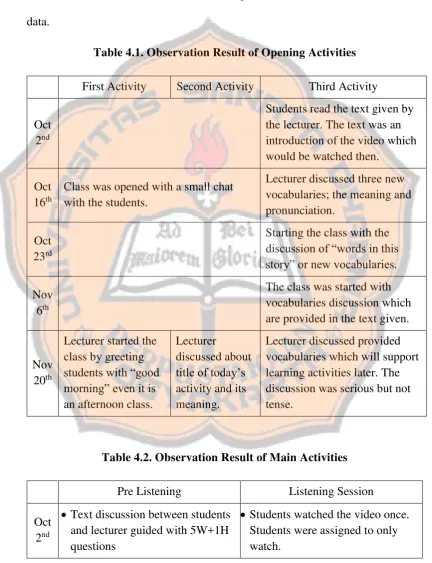
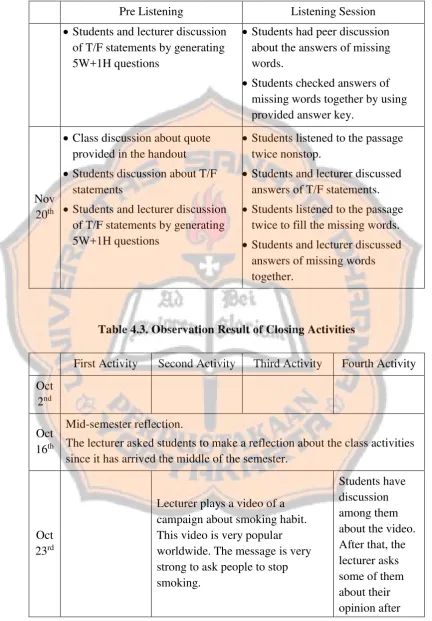
4.1. Observation Result of Opening Activities……….. 42
4.2. Observation Results of Main Activities………. 42
4.3. Observation Result of Closing Activities………... 44
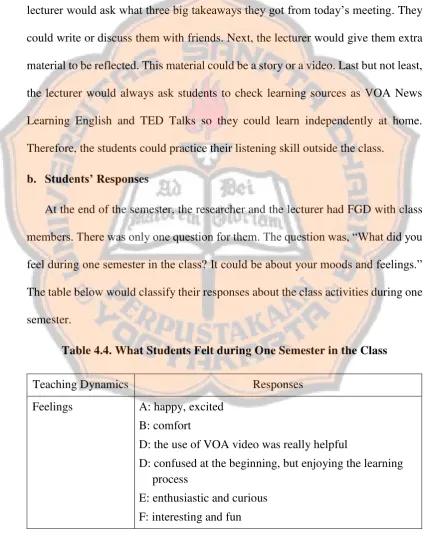
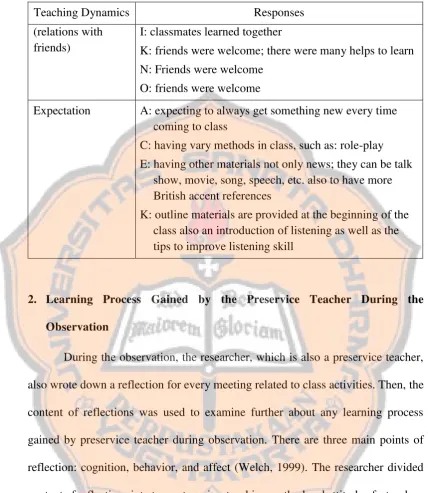
4.4. What Students Felt during One Semester in the Class………... 46
4.5. Preservice Teacher Reflection related to Teaching Method……….. 49
xv
LIST OF FIGURES
2.1. Establishing Curricular Priorities………... 11
xvi
LIST OF APENDICES
Appendix A. Learning Materials of General Listening Class IB
batch 2015 of the EEC………. 73
Appendix B. Observation Results in General Listening Class IB batch 2015 of the EEC………. 89
Appendix C. Reflections of the Preservice Teacher……… 105
Appendix D. Transcription of the Focused-Group Discussion……… 115
1
CHAPTER I
INTRODUCTION
This chapter would discuss the research background, the research problem, the problem limitation, the research objectives, the research benefits, and the definition of terms of the research.
A. RESEARCH BACKGROUND
Students of the English Language Education Study Program (ELESP) of Sanata Dharma University (SDU) are prepared to become teacher candidates of English. According to Indonesian Law No. 14 Year 2005 about Teachers and Lecturers, four competences to become a teacher candidate are professional, pedagogical, social, and personality competence. In order to achieve the four competences, students are equipped with various skills through 56 compulsory courses during the four-year or eight-semester study. Out of the four competencies, however, two competencies are substantially organized in the courses. The two competencies are professional and pedagogical ones. The two competences are directly related to teaching English, therefore, they have the most courses to be learned. The first part is professional competence; it is a competence which becomes a requirement for teacher candidate to master the materials of a specific subject. There are 35 compulsory courses to master all of the English skills – such
understanding. Then, the second part is pedagogical competence. There are 15 compulsory courses to learn pedagogical competence through two different ways: theories and practices. In these subjects, ELESP students are exposed to instructional activities that are geared to prepare them to be professional teachers. The students learn how to teach from the preparatory stages, implemental stages, up to evaluation/assessment stages. However, there are only 2 out of 15 courses which aim to let students practice the teaching.
In contrast to a limited amount of time and opportunity for students to formally practice teaching, however, ELESP students have many job opportunities available in schools or in private courses before they graduate. A case in point, the researcher herself has been teaching English in some places since the third semester. However, as a teacher candidate, the researcher faces the fact that the researcher has lack of knowledge and chances of classroom teaching with a guidance of a proficient teacher or lecturer. As a result, the researcher conducted classroom teaching based on limited teaching practices and experiences. Unfortunately, the researcher finds difficulties in the field because there is no proficient teacher or lecturer who can give example or feedback to the researcher.
To make this statement eligible, the researcher made a small preliminary survey related to students’ teaching experience (see Appendix E). This survey was
he had a problem related to classroom management because real class was different from the micro teaching class. Furthermore, 25% of the respondents said that having two courses for teaching practice were not enough. One of the respondents said that the in the real world, pressure for teacher is more than in the university classroom because teachers are needed to be creative to maintain the class lively. The rest of the respondents said that Micro Teaching and Preservice Teaching Program gave them enough knowledge for teaching professionally later.
Based on the explanation above, the researcher has an idea about apprenticeship in teaching according to Dennen (2004) “At the center of apprenticeship is the concept of more experienced people assisting less experiences ones, providing structure and examples to support attainment of goals” (p. 813). Actually, apprenticeship itself has been applied in Pre-Service Teaching Program (Program Pengalaman Lapangan/PPL), one of the compulsory courses in the ELESP. However, it only gives a small amount of time for students to observe and practice teaching. The Pre-Service Teaching Program gives less than one semester to observe and practice teaching. However, in order to be more proficient as teacher candidates, the researcher assumes that having one full semester of observing and teaching a classroom activity with a guidance of a proficient teacher will prepare students to be fully-equipped teacher candidates.
that, so many things were captured by the researcher for improving teaching capacity, namely from the material preparation, material delivery, student-teacher interaction, student-student interaction, and many more. Furthermore, the researcher also had a discussion with the lecturer to discuss both the researcher’s and the lecturer’s perspectives related to the teaching dynamics in the classroom.
From this experience, the researcher realized that this kind of experience is really needed by ELESP students in order to develop themselves in becoming excellent teacher candidates. Therefore, the researcher would like to study whether a one-semester classroom observation will enrich a teacher candidate with classroom teaching dynamics.
B. RESEARCH PROBLEMS
There are two questions to be answered in this research:
1. How are teaching dynamics in General Listening class IB batch 2015 of the English Extension Course (EEC) best described?
2. To what extent does observation of teaching dynamics throughout one semester equip teacher candidates with pedagogical knowledge?
C. PROBLEM LIMITATION
the discussion of teaching dynamics would be examined by some theories; one of them is the theory of cognitive apprenticeship. However, due to time constraint and capacity of the researcher, the discussion will be limited only to the content and method in cognitive apprenticeship.
D. RESEARCH OBJECTIVES
Objectives of this research can be formulated as follows:
1. To make the best descriptions of the teaching dynamics in General Listening class IB batch 2015 of the EEC.
2. To know whether the observation of teaching dynamics throughout one semester equip a teacher candidate with pedagogical knowledge.
E. RESEARCH BENEFITS
The benefits of this research are:
1. For the proficient lecturer:
2. For the students of English Language Education Study Program:
The students can develop their pedagogical knowledge by learning how to conduct a dynamic teaching-learning situation by observing and learning from a proficient lecturer’s teaching dynamics.
3. For the future researchers:
The researcher expects that this research could help further researchers in the same field. Further researchers can examine about the teaching dynamics of a proficient lecturer using sequencing and sociology in cognitive apprenticeship.
F. DEFINITION OF TERMS
Cognitive apprenticeship is a term used by Collins, Brown, & Newman (1989). Cognitive apprenticeship emphasizes “learning-through-guided-experience on cognitive and metacognitive skills and processes” (Collins, Brown, & Newman,
1989). It lets the learners developing themselves through experiences along with an experienced person to guide them while learning. Apprenticeship is usually used for observable things, such as carving. However, cognitive apprenticeship is used for non-observable thinks like how someone is thinking.
8
CHAPTER II
REVIEW OF RELATED LITERATURE
In this chapter, the researcher would like to discuss some theories and
studies that are going to be used as the theoretical base of the research. This chapter consists of two main parts. They are theoretical description and theoretical framework.
A. THEORETICAL DESCRIPTION
This section presents some meaningful theories that are going to be used as the guidelines and references to conduct the research. Those theories are
Constructivism, Research on Teacher Learning, Cognitive Apprenticeship, Content-Based Instruction, Backward Design Principle, and Reflection Theory.
1. Constructivism
Constructivism is a paradigm in teaching and learning which discusses
about the way learners build their knowledge in order to learn. "Constructivism is the philosophical and scientific position that knowledge arises through a process of active construction." (Mascolo & Fischer, 2005, p. 49). In other words, the
constructivism theory talks about how the learners construct their own understanding towards the learnings they gain. However, constructivism is a wide
a. Cognitive Constructivism
One of the experts who talked about cognitive constructivism was Jean
Piaget. Piaget’s theory talks about the way human’s brain receiving and storing
new information. According on Piaget (1975), human’s brain has their own system in organizing the knowledge related to the learning process. There are three steps in a learning process: assimilation, accommodation, and equilibrium.
The first stage is assimilation. Assimilation is the condition where human’s brain
will integrate the raw information into the existed organization. The information
should fit itself to the organization that has been constructed before by the brain. The second is accommodation. This stage is the opposite of the previous stage. In this stage, the organization in the brain will fit the new information. As a result,
there will be a new or a reconstructed organization in the brain. Lastly, there is a term called equilibrium stage. This is the stage when the information would be
synchronized between assimilation and accommodation stage.
b. Social Constructivism
Vygotsky (1980) had his own theory about constructivism and it is widely known as social constructivism. Cognitive development is affected by the social and cultural context of the subject. His theory was constructed based on his
observation of children’s way of learning. When children have interpersonal contacts, the children will learn something through the interaction, then they will
peers or mentors– will help children gain the most of their knowledge, compare to when children learn alone.
As what has been mentioned before, collaborative learning is a learning
process which is done collaboratively with partners. Furthermore, Dillenbourg (1999) explained that collaborative learning puts more than one person – it can be a pair, a small group, a class, a community, or a society – to have a learning
experience in many ways. The learning itself can be understood as learning both in class, such as learning theories or following courses, and out class, for instance
problem solving or work practice. Also, the collaboration can be in many ways, whether face-to-face through meetings or virtually through computer technology.
In summary, the words 'collaborative learning' describe a situation in which particular forms of interaction among people are expected to occur, which would trigger learning mechanisms, but there is no guarantee that the expected interactions will actually occur. Hence, a general concern is to develop ways to increase the probability that some types of interaction occur (p. 5).
2. Backward Design Principle
Besides teaching, a teacher also has many activities to accomplish. One of the activities is designing curriculum. There are many ways to design curriculum.
According to Wiggins and McTighe (2001), backward design principle is described as the most effective curricular design. Many teachers started with materials and activities rather than goals or standards (p. 8). Therefore, Wiggins
evidences of learning (performances) called for by the standards and the teaching
needed to equip students to perform” (p. 8).
Backward design principle presents an arrangement in designing
curriculum; it consists of three parts: a) identify desired results, b) determine acceptable evidence, and c) plan learning experiences and instructions.
a. Identify Desired Results
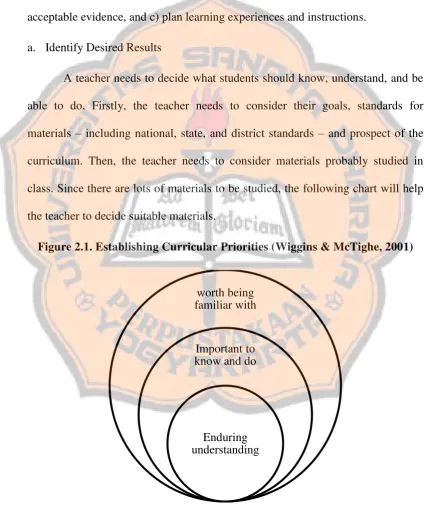
A teacher needs to decide what students should know, understand, and be able to do. Firstly, the teacher needs to consider their goals, standards for
materials – including national, state, and district standards – and prospect of the curriculum. Then, the teacher needs to consider materials probably studied in class. Since there are lots of materials to be studied, the following chart will help
the teacher to decide suitable materials.
Figure 2.1. Establishing Curricular Priorities (Wiggins & McTighe, 2001)
worth being familiar with
Important to know and do
The first is to decide what students are worth being familiar with. The teacher needs to consider what he/she wants students to accomplish. Second, it is
specified becoming important to know and to do. Something important to know means an important knowledge which can be facts, concepts, and principles.
Then, somethings important to do means important skills which included processes, strategies, and methods. Last, the teacher has to make it clearer by enduring understanding. The word ‘enduring’ here means selecting important concepts which students have to internalize and remember.
b. Determine Acceptable Evidence
To check whether students have accomplished the desired results, the
teacher needs to design assessments as evidences of students’ understanding.
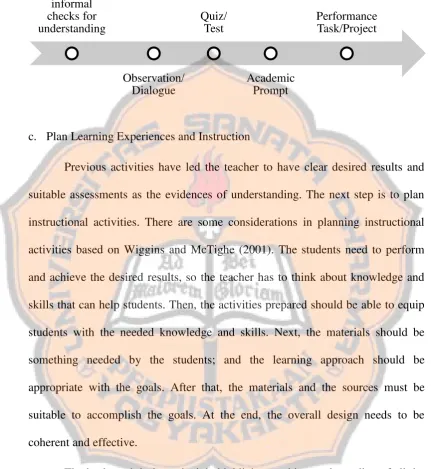
Wiggins and McTighe (2001) has provided a continuum of assessment method
which will help teacher in considering kinds of assessment. As Wiggins and McTighe (2001) stated,
Figure 2.2. Continuum of Assessment Methods (Wiggins & McTighe, 2001)
c. Plan Learning Experiences and Instruction
Previous activities have led the teacher to have clear desired results and
suitable assessments as the evidences of understanding. The next step is to plan instructional activities. There are some considerations in planning instructional activities based on Wiggins and McTighe (2001). The students need to perform
and achieve the desired results, so the teacher has to think about knowledge and skills that can help students. Then, the activities prepared should be able to equip
students with the needed knowledge and skills. Next, the materials should be something needed by the students; and the learning approach should be appropriate with the goals. After that, the materials and the sources must be
suitable to accomplish the goals. At the end, the overall design needs to be coherent and effective.
The backward design principle highlights teaching as the ending of all the
planning. By having clear learning goals, the teacher can focus on planning appropriate assessments and activities to help the students accomplishing the learning goals.
informal checks for understanding
Observation/ Dialogue
Quiz/ Test
Academic Prompt
3. Research on Teacher Learning
Teachers help their students to learn. However, teachers also need to keep learning to improve themselves. Therefore, there are some researchers who did a
research related to teacher learning.
a. Teacher Learning and Situative Perspective
There are many researches discussing about how students learn and
develop their knowledge. However, there are only few researches discussing about how teacher should learn and develop themselves to become a better
teacher. Borko and Putnam (2000) discussed the issue about teacher learning in their journal by the view of situative perspective. “The activity in which knowledge is developed and deployed, it is now argued, is not separable from nor
ancillary to learning and cognition” (Brown, Collins, & Duguid, 1989, p. 32).
According to Borko and Putnam (2000), there are three conceptual themes which
are essential to the situative perspective.
a. Cognition as Situated
Development of one’s cognitive ability affected by the situation around
where they learn. “The physical and social contexts in which an activity takes
place are an integral part of the activity, and that the activity is an integral part of
the learning that takes place within it” (Borko & Putnam, 2000, p. 4). Furthermore, the interaction between an individual to the society in both physical
defined as the ordinary practices of a culture; in other words, they are the activities which are done by the experts (p. 34). “Authentic activities foster the
kinds of thinking and problem-solving skills that are important in out-of-school settings, whether or not the activities themselves mirror what practitioners do”
(Borko & Putnam, 2000, p. 4).
b. Cognition as Social
A person’s cognitive development is not only affected by the individual
him/herself; it is also affected by the relations and connections with the people around him/her. “Interactions with the people in one’s environment are major
determinants of both what is learned and how learning takes place” (Borko & Putnam, 2000, p. 5). This idea drives some experts to look into the existence of school which provided a society that helps students to have social interactions.
“School should be communities where students learn to learn” (Brown, Ash,
Rutherford, Nakagawa, Gordon, & Campione, 1993, p. 190). By this means
communities take an important role in the learning process. Communities can be the cognitive tools as well because there will be some ideas, theories and concepts that can be concluded by the students themselves from their experiences of the
social interactions.
c. Cognition as Distributed
Cognition is not individuality; it can be distributed as individual, other people, and some tools. Furthermore, cognitive capacity and learning process can be shared with other people. However, school, which is believed as a place to
wrote, “as long as school focuses mainly on individual forms of competence, on
tool-free performance, and on decontextualized skills, educating people to be
good learners in school setting alone may not be sufficient to help them become strong out of school learners” (p. 18). School only covers one out of three
distributions of cognition, which is individual. Then, students acquire the other two distributions of cognition outside of school context. Therefore, Borko and Putnam (2000) suggested that school needs to consider distributed cognition
instead of individual capacity only. This consideration will help students having successful participation in the society.
b. Preservice Teacher Learning
In presenting research on teacher learning, Borko and Putnam (2000) have divided the research into two categories: for preservice and in-service teacher.
However, the discussion in this chapter will only cover about the research on preservice learning as written below.
There are many arguments suggesting that a preservice teacher needs to
have experiences in both school and university classroom. So far, there is only school experience provided for the preservice teacher. This issue is closely related
to the development of pedagogical competence. “Unlike experienced teachers,
however, preservice teachers do not have their own classroom in which to situate learning activities and have limited teaching experiences from which to draw in
discussion of pedagogical issues” (Borko & Putnam, 2000, p. 7).
Therefore, Borko and Putnam (2000) further suggested that the preservice
course experienced. This classroom combination puts preservice teacher as an observer. At the same time, the preservice teacher is a student also. Moreover, the
class is taught by an experienced teacher whom the preservice teacher can learn from. As a result, the preservice teacher will develop new ideas and practices
because they put themselves as an observer as well as the students in the class. In addition, the preservice teacher could also make some reflection about teaching as well as the feedbacks of what the preservice teacher has done. “Situating the
preservice teachers’ learning simultaneously in university and field-based
experiences was crucial to the success of the course” (Borko & Putnam, 2000, p.
7).
The preservice teacher who observes a class taught by a more experienced
teacher could gain more than just observation results and reflections. The advantage of having experienced teacher as a learning source is that the preservice
teacher could have a discussion with the experienced teacher. “These people form
a type of “mini discourse community” within which the preservice teacher is
enculturated into the teaching profession” (Borko & Putnam, 2000, p. 10).
4. Cognitive Apprenticeship
a. Definition of Cognitive Apprenticeship
Apprenticeship is one of many popular ways for teaching and learning.
“At the center of apprenticeship is the concept of more experienced people
assisting less experiences ones, providing structure and examples to support
attainment of goals” (Dennen, 2004, p. 813). In apprenticeship, there are at least
apprentice to achieve the objectives. Actually, apprenticeship has been done unconsciously since the beginning of our life. The way we learn how to speak is
by using apprenticeship. Our parents – as experts – will show us how to speak and they will assist us to be able to speak. Therefore, apprenticeship is also known as a
natural way in learning.
There are two kinds of apprenticeship: traditional and cognitive
apprenticeship. Traditional apprenticeship is similar to what we find at school, especially at the vocational school. Students are exposed with the performance of
the teacher to do a certain task, then later they have to perform similarly like the teacher, gradually (Collins, Brown & Holum, 1991). Gradually here means that the students will be responsible from a small part of a job until the entire job. On
the other hand, cognitive apprenticeship uses the idea of traditional apprenticeship as an exemplary method to develop the cognition (Dennen, 2004). Cognitive
apprenticeship is beyond practicing; there is an integration between the skills and the knowledge in order to finish the task.
Cognitive apprenticeship cannot stand by itself without taking some parts from traditional apprenticeship. According to Collins, et al., (1991), some points need to be elaborated in order to develop the cognition, they are explained as follows.
- Teacher needs to make the thinking process visible for both teacher and
teacher needs to find an approach so she/he can observe the thinking process of the students as well, so the teacher can do some corrections on it.
- The teacher needs to bring an abstract concept into an authentic context. When
the concept is contextual, it will be easier for the students to grab the material because it has relevancies in their life.
- The teacher needs to provide a wide range of tasks as well as the level of difficulties. These various tasks will help students to reflect and captivate the
knowledge. If the students can express what they have learned, then the cognitive apprenticeship has been done well.
b. Cognitive Apprenticeship Framework
In order to create an ideal cognitive apprenticeship situation, a framework is designed based on the related pedagogical and theoretical issue. According to
Collins, et al., (1991), there are four dimensions which can create cognitive apprenticeship environment: content, method, sequence, and sociology.
a. Content
Cognitive apprenticeship aims to help students accomplish the most knowledge they are able to gain to develop their cognitive capacity by learning it
from the expert. The expert needs to master appropriate strategies to provide the exact examples. There are several types of knowledge which needed to be
acquired by the expert:
- Heuristic strategies: the effective techniques and approaches for undertaking the particular subject matters; these strategies might not always succeed, but it
would be very helpful if it does.
- Control strategies: these are the boundaries of how students can be working on their tasks. The expert needs to monitor how the students are doing their tasks, analyze the difficulties they experience, and help them to solve problems in
doing tasks.
- Learning strategies: these are the strategies in which will help students gaining their knowledge of particular subject matters. Furthermore, the learning
strategies will help the expert in delivering the other three contents.
b. Method
Some teaching strategies are needed in order to help the students
observing, experiencing, and constructing their own understanding based on the
expert’s performance. There are six teaching methods which are divided into three
groups. The first three methods (modeling, coaching, and scaffolding) are integrated skills which will help students to undergo observation and guided process corresponding with cognitive apprenticeship. The next two methods
(articulation and reflection) will help students to learn problem-solving from the expert and check again whether they have already had accurate understanding.
- Modeling: the expert the needs to perform the task so that the students can observe how the expert works on the task. As a result, the students can
imagine how they should work on the task similarly like the expert.
- Coaching: the expert helps and guides the students on how to work on task as what the expert has done.
- Scaffolding: the expert provides some helps for students if they find some difficulties while they are working on the task. It could be in a form of
suggestions or corrections.
- Articulation: the students are asked to present their task which they have done based on the expert’s model.
- Reflection: the students need to compare what they have done to what their friends have done and to the expert’s model.
- Exploration: the students are insisted to perform their own model of
problem-solving on a certain task. In this stage, the expert is entirely not involved in the
students’ development.
c. Sequence
The content and the method are mainly for constructing students’ knowledge. However, in order to let the knowledge last longer, students need to
find the meaningfulness of what they are doing. These three principles are the bases for sequencing the learning activities to create the meaningfulness of
- Global before local: students need to clearly understand the overall concept of the targeted task even if all they have to do is only a small part of it. Then, if
they have understood, they can continue to the smaller part of the targeted task.
- Increasing complexity: the expert, as a teacher, needs to provide various levels of tasks: easy, medium, high, etc. However, they do not have to be exactly like
the regular order. The expert has to consider about the heuristic strategies and the scaffolding stage.
- Increasing diversity: the expert needs to provide various materials related to
the task. The students need to train themselves for various skills as well in order to develop their cognitive ability.
d. Sociology
One important part which will be really helpful for students while learning is the learning environment. A supportive learning environment will encourage
students to gain the most of their knowledge. There are four characteristics of supportive learning environment in cognitive apprenticeship.
- Situated learning: the learning process should guide the students to be able to answer the real questions in the real world. Therefore, the learning
environment also needs to be situated in order to help the students predicting the real situation in which they will face in the future.
need wide opportunities to have communication and be engaged with the skills directly from the expert.
- Intrinsic motivation: the learning environment should provoke the students
that they have needs to learn this particular subject matters. The students need to realize the goal for their own personal development.
- Exploiting cooperation: related to social interactions, students have to make a cooperation with their classmates. The cooperative and collaborative learning
activities will bring students to have a more powerful and enriched learning process. Additionally, a cooperation in learning is not always about one group
work. This can also be a competition between one group and others.
5. Content-Based Instruction
Learning English is no longer focusing only on grammar and vocabularies.
Nowadays, many language institutions teaching English for general purposes prefer to use content-based instruction as the basic of teaching and learning
approach. As Short (1993) stated in her TESOL journal, “In content-based language instruction, language teachers use content topics, rather than grammar
rules or vocabulary lists, as the scaffolding for the instruction” (p. 629). It does
not mean that the teacher does not pay attention to the grammar and vocabularies. In content-based instruction, grammar and vocabularies is implicitly taught. The
grammar and vocabularies will be taught later after the students have understood and got the meaning in the content or the material itself.
content-based language instruction will make a collaboration with other teachers who are the experts of related content in order to create the most of the contextual
materials. The materials will not only be meaningful –in the relations with the content– but also be synchronized with the English instruction. In addition, the
content-based instruction will elaborate all of the four English skills: listening, speaking, reading, and writing. It is done in such way to keep the learning process become as natural as possible so the students will unconsciously learn English and
not feel burdened.
6. Reflection Theory
According to Welch (1999), there are three components of written reflection which need to be considered.
a. Reflection should be talking about the content from the course. This needs the creativity of an instructor to generate questions that can help students to
transfer their understanding about the course.
b. The instructor needs to be clear about the emotions that students can write in the reflection. There must be no intervention about any kinds of feelings and emotions experienced by the students. Furthermore, the students need to
explain why they feel what they feel.
c. There should be influence(s) to students’ behavior related to cognitive and affective learning process. The students must explain more than what they
In order to produce a good reflection, Welch (1999) presents three components of reflection which is called ABCs reflection.
a. Affect
These components explore individual feelings and/or emotions related to the topic. Students can elaborate their feelings about how far they can enjoy what
they are doing, what they are feeling, and why they are having such kind of feeling.
b. Behavior
This component explores students’ action in three dimension: past, present, and future. The students can report what they have done previously
before they know the subject matter. Then, they can say about what they are doing now. Last, they can elaborate about what they might be doing in the future. These
activities will help students to realize the mistakes in the past and correct them in the future.
c. Cognition or Content
Students can explain about all of the information, concept, skill, or terms that they have learned from the subject matter. It is probably the easiest part
B. THEORETICAL FRAMEWORK
In order to analyze the problems, the researcher considers some important things from all the theories stated before. The theories are formulated into two
parts, as explained below, in order to help the researcher answers the research questions.
The researcher wanted to understand how the proficient lecturer conducted teaching dynamics in the classroom. The researcher expects that the experienced
teacher designs class curriculum using the backward design principle. As a result, the researcher needs to consider three aspects: 1) learning goals, 2) class
assessments, and 3) materials and strategies. Then, the experienced teacher is expected to conduct the learning process by using cognitive apprenticeship approach. Therefore, there are some aspects need to be considered further
according to Collins, et al.,:
a. Contents of the learning process which are divided into four parts: domain knowledge, heuristic strategies, control strategies, and learning strategies.
b. Methods of the experienced teacher in delivering contents which are divided into six parts: modeling, coaching, scaffolding, articulation, reflection, and
exploration.
c. The sequence of how the learning process conducted in three parts: global before local, increasing complexity, and increasing diversity.
d. The sociology of how the learning process conducted which have four categories: situated learning, community of practice, intrinsic motivation, and
However, due to the time constrains, the researcher will only discuss about two aspects: contents and methods.
Furthermore, the researcher – who is a preservice teacher as well – wanted
to learn from the proficient lecturer about the teaching dynamics to give the preservice teacher pedagogical skills learning. Therefore, the researcher conducted a classroom experienced in a university course. The classroom
experienced is completed through one semester. There are some guidelines in conducting classroom experienced based on Borko & Putnam and Welch.
a. Observation: during the classroom experienced, the researcher records all of
the activities happened during the learning process, from the beginning until the end of the learning process in the classroom.
b. Mini discourse community: the researcher should have some discussions with the experienced lecturer related to the observation results.
c. Reflection: the researcher makes reflections of each meeting that are recorded
during the observation. Regarding to the reflections, the researcher will take ABCs reflection from Welch (1999) as the guidance of making reflection. The contents of the reflection will cover emotions of the researcher during
observation (affect), what the researcher have done, are doing, and will do related to the teaching process (behavior), and what lesson the researcher gets
28
CHAPTER III
RESEARCH METHODOLOGY
This chapter would elaborate six major parts of the methodology. They are
research method, research setting, research participants, instruments and data gathering technique, data analysis technique, and research procedure.
A. RESEARCH METHOD
The research method of this study was qualitative research. According to Lichtman (2012) qualitative research is a term which explains about a research to get deep understanding and to make meaning of it. Qualitative research is also
possible to be used in educational research. “The educational experiences of people of all ages (as well as material that expands our knowledge of these experiences); in schools as well as out, can be the subject matter” (Bogdan, 1982).
The focus of qualitative research is the understanding of the researcher him/herself towards the behaviors from the subjects’ perspective (Bogdan, 1982).
Therefore, it is important for the researcher to be able to be the key instrument because the researcher should understand the whole situation by experiencing or
The researcher chose case study as the form of this research. “A case study
is a detailed examination of one setting, or one single subject, or one single depository of documents, or one particular event” (Bogdan, 1982). The researcher
chose case study because this research only focused on one particular class and
one particular course given by one particular lecturer. Case study researcher begins by collecting data, reviewing and exploring it, and making decision about where to go with the study.
Therefore, the researcher decided to conduct the research in two steps. The
first one was class observation. This was the step where the researcher tried to collect all data based on researcher’s own perception. Then, the researcher
conducted review. The review was done in two ways: interview with the lecturer
and focused-group discussion (FGD) with the students. These activities would confirm the researcher’s data from the perspective of the objects themselves. As a
result, the researcher could be resulting data as objective as possible.
B. RESEARCH SETTING
The research was conducted in Sanata Dharma University. Specifically, it
was conducted in General Listening class IB batch 2015 of the EEC. The researcher observed activities in this class every Friday, 4 P.M. at listening
laboratory from August to December, 2015. The researcher joined the class from the very beginning until the end of the class. Then, the researcher made some observation data. However, the researcher only included five meeting observation
research. Furthermore, to confirm the data gathered by the researcher, the researcher held an FGD on December 4, 2015. There were 15 people coming and
sharing their feelings and ideas about the teaching-learning dynamics in their class. The FGD was facilitated by the proficient lecturer who taught them. The
lecturer was then given an initial as Mr. X. The next step was analyzing data. The researcher analyzed the data from December 2015 until January 2016. Then, the last was data confirmation. The researcher confirmed all gathered data to the
lecturer in February 14th, 2016 by doing an interview. At last, the researcher combined all the data gathered to be analyzed and discussed in this research.
C. RESEARCH PARTICIPANTS
The research participants of this research were the lecturer –which is called as Mr. X– and the students of General Listening class IB batch 2015 of the EEC. Actually, there were 30 students in this class. However, there were 15 people who came on December 4, 2015 – the day of the FGD. In order to keep the authenticity, the participants were called as A, B, C, D, E, F, G, H, I, J, K, L, M, N, and O. These people come from various educational background; for example, there were doctors and university students who learn together in this class. The
researcher decided to conduct the FGD because the researcher wanted to know their real perspective about the teaching dynamics in order to verify the data.
using their mother tongue language in order to let them express their real feelings. As a result, the participants could easily and freely express their feelings. During
the FGD, the researcher recorded all the conversation. Also, the researcher wrote down the main points from each participant in the FGD.
D. INSTRUMENTS AND DATA GATHERING TECHNIQUE
The researcher used three data gathering techniques with two kinds of research instruments in this research. The first data gathering was observation.
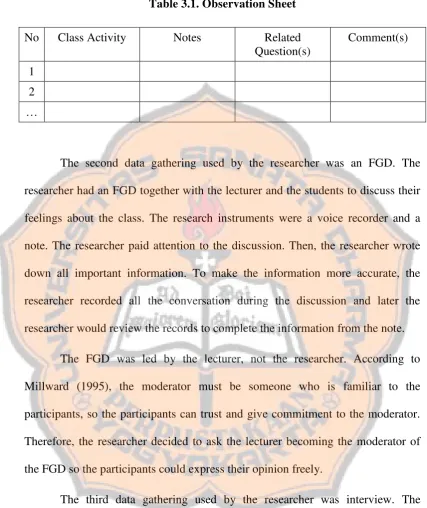
The observation was done to observe all activities happened in General Listening class IB batch 2015 of the EEC. In order to record all the data during observation, the researcher prepared one research instrument to be used. The researcher made
an observation sheet in a form of tables which consisted of four parts: class activity, reflection, question, and comment. Class activity is the column to write
down all the activities happened in the classroom. This column was filled by some series of activities in the classroom from the beginning until the end. Then, the next column is reflection. This column was the researcher’s interpretation about
this class. The researcher was trying to make meaning in this class, so the researcher interpreted what happened in the classroom in this column. The next
one is question. Question column was a column which provided for the researcher if the researcher had questions to the lecturer related to the activities in the
Table 3.1. Observation Sheet
No Class Activity Notes Related
Question(s)
Comment(s)
1 2 …
The second data gathering used by the researcher was an FGD. The researcher had an FGD together with the lecturer and the students to discuss their feelings about the class. The research instruments were a voice recorder and a
note. The researcher paid attention to the discussion. Then, the researcher wrote down all important information. To make the information more accurate, the
researcher recorded all the conversation during the discussion and later the researcher would review the records to complete the information from the note.
The FGD was led by the lecturer, not the researcher. According to Millward (1995), the moderator must be someone who is familiar to the
participants, so the participants can trust and give commitment to the moderator. Therefore, the researcher decided to ask the lecturer becoming the moderator of the FGD so the participants could express their opinion freely.
The third data gathering used by the researcher was interview. The
E. DATA ANALYSIS TECHNIQUE
The researcher used qualitative research as the research method. In qualitative research, there are five steps to analyze the data according to Schutt
(2014); they are: 1) documentation, 2) conceptualization, coding, and categorizing, 3) examining relationship and displaying data, 4) authenticating conclusion, and 5) reflexivity. The researcher had already had data from the
observation and the FGD. Firstly, these data were transformed into written form, so the researcher had observation sheets and a transcript of the FGD. “Documentation is critical to qualitative research for several reasons: It is
essential for keeping track of what will be a rapidly growing volume of notes, tapes, and documents; it provides a way of developing and outlining the analytic
process; and it encourages ongoing conceptualizing and strategizing about the text.” (Schutt, 2014). Therefore, the researcher spent much time in understanding
these data in order to understand and be familiar with these data so the researcher could continue the analysis well. The next step is conceptualization, coding, and
categorization. Conceptualization is needed to deliver comprehensive narrative from the data gathered as well as the understanding of why the data was important. Schutt (2014) suggested to use matrix (a well-designed chart) which
can help the researcher in coding and categorizing data. After that, the step is examining relationship and displaying data. According to Schutt (2014), “Examining relationships is the centerpiece of the analytic process, because it
setting.” Furthermore, Schutt (2014) recommended to use matrix again in
examining relationships. The matrix would help the researcher to find connection
in the research; the researcher could also be helped in developing ideas about the research. Then, the data analysis was continued with authenticating conclusion.
To authenticate the informants, the researcher had done three steps. First, the researcher checked the credibility. The credibility here meant that how far the researcher could trust the informants; whether they were capable to give
information or not. In this research, the researcher tried to make sure that informants who joined FGD, also joined the class from the beginning until the end
so they really knew about the process happened in the classroom. Second, the researcher confirmed whether the statements really responding the questions or just spontaneous. To minimalize the chance of spontaneous responses, the
informants were given time to write down their answers before the FGD was started so they had time to think about their answer. The last is to evaluate
whether the presence of the researcher could make any difference. The researcher had joined the class from one semester. It made the informants familiar with the presence of the researcher. Therefore, it was very unlikely for the informants to be
F. RESEARCH PROCEDURE
This part shows how the researcher conducts the research from the beginning until the researcher write this report. The research procedures are listed
as follows:
1. The researcher proposed a research topic to the academic advisor, then it
was accepted.
2. The researcher and the academic advisor decided to choose one class to be the object of the research.
3. The researcher joined class activities since the first meeting until the end of the meeting.
4. The researcher made observation reports from every meeting experienced
by the researcher. However, the reports for the data of the study were taken from five meetings only.
5. The researcher had discussion with the proficient lecturer at the end of the
meetings to confirm the data gathered.
6. At the end of the semester, the researcher and the class lecturer conducted
an FGD together with the students of the EEC especially General Listening class IB batch 2015.
7. The researcher recorded the FGD and took notes of it.